REVIEW 3 major objections 6 minor 52 references
Gradient-based shape optimization for the reduction of particle erosion in bended pipes
T0 review · 3 major / 6 minor · reviewed 2026-08-14 · deepseek-v4-flash
Pith's one-line read The paper derives a closed-form shape derivative for an Eulerian erosion model and shows that gradient-based reshaping of a pipe bend cuts predicted peak erosion by 76% at the design particle size and at least 20% across a range of sizes.
desk verdict A solid formal contribution to shape optimization for erosion, but the 76% reduction claim rests on the same model that overpredicts at the target Stokes number. read the letter →
The pith
A machine-rendered reading of the paper's core claim, the machinery that carries it, and where it could break.
The reading
What carries the argument
The load-bearing object is the continuous adjoint shape derivative $dJ(\Omega)[V]$ in Eq. (26): a formula for how the reduced cost changes when the bend is deformed by a vector field $V$. It is assembled from the forward solution $(u,p,v,\alpha)$ and adjoint variables $(\lambda_u,\lambda_p,\lambda_v,\lambda_\alpha)$, with volume terms for each PDE constraint and surface terms for erosion and curvature regularization; the derivative is then projected into a smooth mesh deformation via the linear-elasticity saddle-point system (Eqs. (30)–(33)) so each gradient step gives a legitimate geometry change.
What would settle it
Measure or simulate wall erosion on the initial and optimized bends using Lagrangian particle tracking or an experimental aerosol flow with the design particle size (Stk ≈ 0.33). If the optimized geometry does not show substantially lower erosion than the initial bend—or if the gap is much smaller than the model's 76%—then the reported reduction is an artifact of the Eulerian approximation rather than a physical property of the shape.
Extended reading notes
Core claim
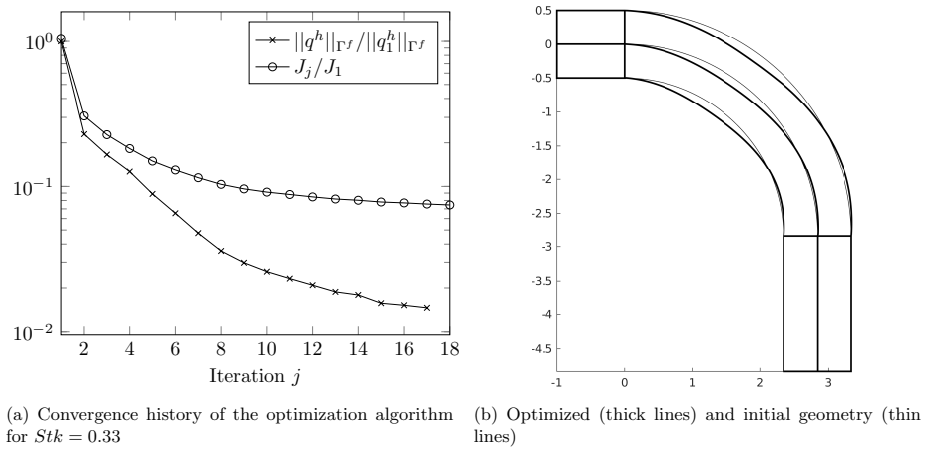
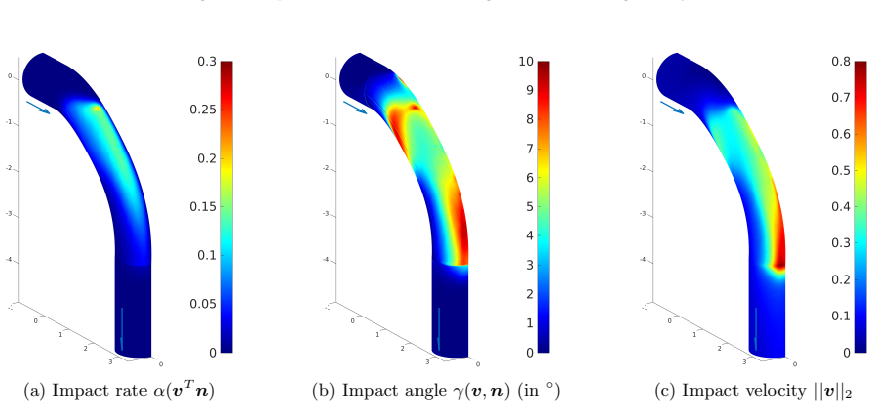
The paper's central claim is that the Eulerian semi-derivative of the reduced erosion cost functional exists in closed form (Theorem 2, Eq. (26)) and can be evaluated from the forward fluid/particle state and a decoupled set of adjoint equations (Eqs. (22)–(25)). The derivative consists of boundary integrals over the deformable wall—capturing the erosion model, the normal convection of impact rate, and the Willmore curvature regularization—plus volume integrals encoding how the Navier-Stokes, particle-velocity, and volume-fraction equations respond to domain changes. Embedded in Algorithm 1, with the derivative projected onto mesh deformations through linear elasticity and a restricted-gradient correction, it drives a gradient descent that stops at a locally optimal shape. For the benchmark 90° bend, the optimized geometry lowers the integrated erosion by at least 20% for all tested Stokes numbers above 0.2 and by 76% for the design species, and the improvement is attributed not to fewer impacts but to more favorable impact angles and lower impact speeds.
Load-bearing premise
The entire 76% reduction is computed with a simplified particle model that, by the authors' own validation, overpredicts impact rates for the very small particles around the design condition; if that error grows after the geometry changes, the optimized bend may not be physically better.
Editorial extensions
If this is right
- If the central claim is right, pipe bends can be erosion-optimized with a gradient method rather than by geometrical intuition or trial-and-error parameter studies.
- The optimized bend's benefit is not limited to the design particle size: predicted erosion falls by at least 20% for every Stokes number above 0.2 in the tested range.
- Because only the partial derivatives of the erosion function enter the adjoint equations, the same derivative machinery applies to other erosion models (e.g., Finnie or E/CRC) with minor substitutions.
- The improvement mechanism is identifiable: high impact rates, steep angles, and high speeds are spatially separated on the optimized wall, so erosion hot spots are dispersed.
- The optimized geometry is locally optimal within the chosen deformation class, as indicated by the decrease of the cost and projected gradient norms over iterations.
Reading between the lines
- A natural testable extension is to build or simulate the optimized bend with Lagrangian particle tracking or experiments, since the 76% figure is a prediction of an Eulerian model that itself overpredicts small-particle impacts at the validation stage.
- The adjoint-derivative structure suggests the same shape optimization could be run for other target Stokes numbers or for a multi-species cost; the reported persistence of improvement across Stokes numbers hints that a single robust shape may serve a whole particle-size distribution.
- Because the cost functional can be modified without re-deriving the full system—only the erosion model's derivatives change—this framework could be coupled with surrogate or space-mapping strategies for turbulent erosion, which the paper names as future work.
- The same shape calculus could be applied to multi-velocity or moment-based particle models once their adjoints are derived, potentially addressing particle trajectory crossing that the single-velocity model cannot represent.
Signed reviews
Editorial analysis
A structured set of objections, weighed in public.
Referee Report
Summary. The manuscript derives a continuous adjoint shape calculus for minimizing particle erosion in a 3D pipe bend using a one-way coupled, single-velocity Eulerian particle model. The main theoretical result is Theorem 2, Eq. (26), which gives the Eulerian semi-derivative of the reduced cost functional, together with the adjoint equations (22)-(25). The authors implement the derivative via a linear-elasticity Riesz projection and a gradient descent method (Algorithm 1), validate the forward model's impact rates against experimental and numerical references for Stokes numbers above 0.43, and optimize a 90-degree bend for Stk = 0.33. They report a 76% reduction in maximal erosion at the target Stokes number and at least a 20% reduction in integrated erosion for every tested Stokes number above 0.2.
Significance. If the central claims hold, this is a useful first demonstration of gradient-based shape optimization for an Eulerian erosion model on a 3D pipe bend, and Eq. (26) is a nontrivial theoretical contribution that can be adapted to other erosion models. The authors deserve credit for deriving the adjoint system explicitly, for validating the forward impact rates against independent experimental and numerical references, and for using externally calibrated erosion constants from the literature. The strength of the quantitative conclusions is, however, limited by the fact that the optimized shape is evaluated only with the same model that overpredicts in the target regime; this is a correctness-risk concern rather than an internal inconsistency.
major comments (3)
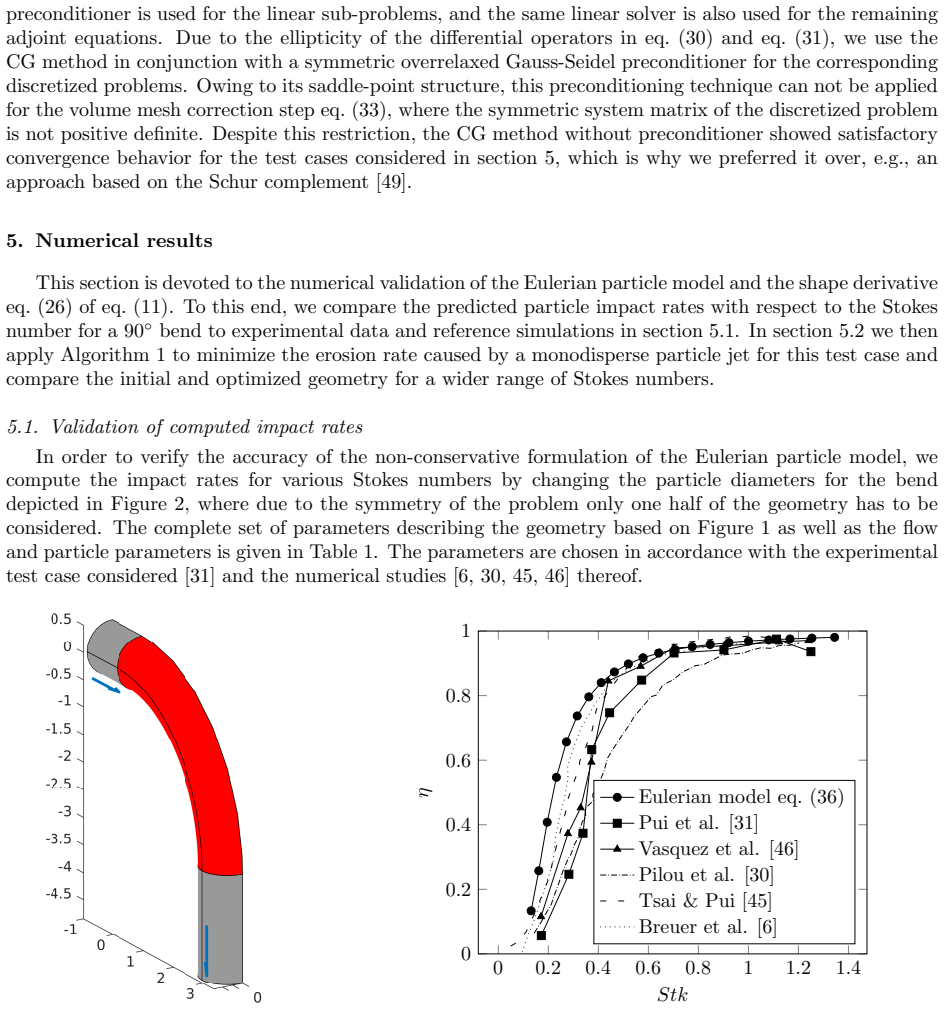
- [Sections 5.1 and 5.2, Figures 3, 5, and 8] The optimization target Stk = 0.33 lies in the range Stk <= 0.43 where the authors state that the Eulerian model overpredicts impact rates, and the optimized geometry is evaluated only with the same Eulerian model. Because a gradient-based method can exploit systematic model bias (for example in impact-rate magnitude, impact-angle distribution, or artificial diffusion) to reduce the predicted objective without improving the physical erosion profile, the reported 76% and greater-than-20% reductions are not established as physical improvements. The authors should validate the optimized geometry with an independent method, such as Lagrangian particle tracking or experiments, or at minimum quantify the sensitivity of the optimized shape to the model discrepancy at Stk = 0.33.
- [Section 2.3 and Theorem 2] The reduced cost functional J(Omega) is defined under an unproved assumption that Eq. (7) has a unique solution, and Eq. (28) additionally requires the forward state to be shape differentiable. The nonlinear Schiller-Naumann drag term and the sign-dependent boundary conditions for the volume fraction alpha make these assumptions nontrivial. Since Theorem 2 and Algorithm 1 rest on this formal calculus, the paper should either prove the needed well-posedness and differentiability in a suitable setting or explicitly mark the derivation as formal and state how this limitation affects the validity of the optimality conditions.
- [Sections 2.1 and 5.2] The authors acknowledge in Section 2.1 that a single particle velocity cannot represent crossing particle trajectories, a limitation known to be relevant in pipe bends. The optimized geometry is a strongly deformed bend, and no evidence is given that this limitation does not become worse on the deformed geometry. This is not a circularity, but it is a concrete correctness risk for the reported reductions; the paper should address it, for example by comparing the optimized geometry against a Lagrangian particle model or by demonstrating that trajectory crossing is negligible in the deformed bend.
minor comments (6)
- [Equations (8)-(10) and Section 2.1] The symbol g is used both for the gravity vector in the momentum equations and for the erosion integrand in the cost functional (10); this notational conflict should be resolved for clarity.
- [Adjoint equations (22)-(24)] The derivation of the adjoint equations omits a detailed discussion of the boundary terms on the sign-dependent set Gamma^-(qv); because the function space Z(Omega) depends on the forward solution, the treatment of these terms should be clarified.
- [Algorithm 1] The stopping criterion 'until converged' is vague; the authors should specify the tolerance or the precise test used on the relative decrease of J and the gradient norm shown in Figure 4a.
- [Throughout] There are several language issues, including 'bended' for 'bent' and 'the later of which' for 'the latter of which'; a careful proofreading pass is recommended.
- [Figure 3 and Section 5.1] The statement that the deviation at low Stokes numbers is 'within the range of deviations among the reference studies' is qualitative; reporting the numerical values of the deviations would make the validation more informative.
- [Section 5.1 and Figure 2] The paper models only half of the bend by symmetry; it should state explicitly whether the deformable boundary Gamma_f and the optimized geometry are constrained to respect that symmetry.
Circularity Check
No circularity: the shape derivative is derived from the state and adjoint equations, the erosion model constants come from external literature, and the forward model is benchmarked against independent experimental and numerical references.
full rationale
The paper's central derivation is self-contained. Theorem 2 computes the Eulerian semi-derivative of the reduced cost functional from the shape Lagrangian, the forward PDE system, and the adjoint equations; the derivative is not fitted to the target reduction and no fitted parameter is renamed as a prediction. The erosion constants (m, Hv, n1, n2) are taken from Oka et al. [27], and the Eulerian particle model is cited from external sources [4,5,25,41]. The only self-citation, reference [24], is not load-bearing for the main claims. The forward model's impact rates are validated against independent experimental and numerical data in Figure 3, with the authors explicitly noting that the model 'seems to slightly over-predict η for Stk≤ 0.43' and that crossing particle trajectories and rebound 'pose severe difficulties' for the single-velocity model. These are acknowledged limitations that create correctness risk for the quantitative 76% reduction at Stk=0.33, but they do not make the derivation circular: the optimized geometry is evaluated with the same Eulerian model used to generate it, which is a standard model-based optimization workflow rather than a reduction of the prediction to the input. No equation is equivalent to another by construction, no parameter is fitted to the quantity it is used to predict, and no uniqueness theorem or ansatz is imported from the authors' prior work to force the result. The reported reduction is a consequence of the gradient-descent minimization, not an independent physical confirmation, but that is a limitation of the validation strategy, not circularity in the derivation.
Assumptions & free parameters
free parameters (4)
- Willmore regularization weight c1 =
c1 = 0.01 * (integral of g on initial Gamma_w) / (integral of 0.5 h^2 on initial Gamma_f)
- Artificial viscosity K =
K = 10^4
- Artificial Peclet number Pe =
Pe = 10^8
- Oka erosion constants m, Hv, n1, n2 =
m = 2.36, Hv = 2, n1 = 0.78, n2 = 1.25
assumptions (6)
- domain assumption The weak forward problem Eq. (7) has a unique solution on every admissible domain.
- domain assumption The particle phase is dilute and one-way coupled, so it does not affect the carrier fluid.
- domain assumption A single locally averaged particle velocity field with artificial diffusion captures erosion-relevant impacts despite known issues with rebound and trajectory crossing.
- domain assumption The flow is stationary, laminar, incompressible, and the Schiller-Naumann drag correlation holds for particle Reynolds numbers below 1000.
- domain assumption The Oka erosion model, Eqs. (8) and (9), describes the erosion rate for the wall material.
- standard math Boundaries and deformations are smooth enough (C^2 and C^{2,1}) for the shape calculus identities in Lemma 1 and the Willmore curvature term.
Cite this review
Pith. "Pith review of Gradient-based shape optimization for the reduction of particle erosion in bended pipes." pith.science (2026). https://pith.science/paper/I2F2RKMA
@misc{pith2026190804712,
  author       = {Pith},
  title        = {Pith review of: Gradient-based shape optimization for the reduction of particle erosion in bended pipes},
  year         = {2026},
  howpublished = {\url{https://pith.science/paper/I2F2RKMA}},
  note         = {Machine review of arXiv:1908.04712}
}
read the original abstract
In this paper we consider a shape optimization problem for the minimization of the erosion, that is caused by the impact of inert particles onto the walls of a bended pipe. Using the continuous adjoint approach, we formally compute the shape derivative of the optimization problem, which is based on a one-way coupled, fully Eulerian description of a monodisperse particle jet, that is transported in a carrier fluid. We validate our approach by numerically optimizing a three-dimensional pipe segment with respect to a single particle species using a gradient descent method, and show, that the erosion rates on the optimized geometry are reduced with respect to the initial bend for a broader range of particle Stokes numbers.
Figures

Figures from the paper (4 more)



Reference graph
Works this paper leans on
-
[1]
An introduction to the space mapping technique
Bakr, M.H., Bandler, J.W., Madsen, K., Søndergaard, J., 2001. An introduction to the space mapping technique. Opti- mization and Engineering 2, 369–384
work page 2001
-
[2]
Space mapping: the state of the art
Bandler, J.W., Cheng, Q.S., Dakroury, S.A., Mohamed, A.S., Bakr, M.H., Madsen, K., Sondergaard, J., 2004. Space mapping: the state of the art. IEEE Transactions on Microwave theory and techniques 52, 337–361
work page 2004
-
[3]
Parametric FEM for geometric biomembranes
Bonito, A., Nochetto, R.H., Pauletti, M.S., 2010. Parametric FEM for geometric biomembranes. Journal of Computational Physics 229, 3171–3188. 16
work page 2010
-
[4]
Bourgault, Y., Boutanios, Z., Habashi, W.G., 2000. Three-dimensional Eulerian approach to droplet impingement simu- lation using fensap-ice, part 1: model, algorithm, and validation. Journal of Aircraft 37, 95–103
work page 2000
-
[5]
A finite element method study of Eulerian droplets impingement models
Bourgault, Y., Habashi, W.G., Dompierre, J., Baruzzi, G.S., 1999. A finite element method study of Eulerian droplets impingement models. International Journal for Numerical Methods in Fluids 29, 429–449
work page 1999
-
[6]
Prediction of aerosol deposition in 90 ◦ bends using LES and an efficient Lagrangian tracking method
Breuer, M., Baytekin, H., Matida, E., 2006. Prediction of aerosol deposition in 90 ◦ bends using LES and an efficient Lagrangian tracking method. Journal of Aerosol Science 37, 1407–1428
work page 2006
-
[7]
Brooks, A.N., Hughes, T.J., 1982. Streamline upwind/Petrov-Galerkin formulations for convection dominated flows with particular emphasis on the incompressible Navier-Stokes equations. Computer Methods in Applied Mechanics and Engi- neering 32, 199–259
work page 1982
-
[8]
COMSOL AB, 2017. COMSOL Multiphysics. Stockholm, Sweden. URL: https://comsol.com
work page 2017
Show all 52 references
-
[9]
Note on the motion of fluid in a curved pipe
Dean, W.R., 1927. Note on the motion of fluid in a curved pipe. The London, Edinburgh, and Dublin Philosophical Magazine and Journal of Science 4, 208–223
1927
-
[10]
Shapes and geometries: metrics, analysis, differential calculus, and optimization
Delfour, M.C., Zol´ esio, J.P., 2011. Shapes and geometries: metrics, analysis, differential calculus, and optimization. volume 22 of Advances in Design and Control . second ed., SIAM, Philadelphia
2011
-
[11]
A quadrature-based moment method for dilute fluid-particle flows
Desjardins, O., Fox, R.O., Villedieu, P., 2008. A quadrature-based moment method for dilute fluid-particle flows. Journal of Computational Physics 227, 2514–2539
2008
-
[12]
Feedback Petrov-Galerkin methods for convection-dominated problems
Do Carmo, E.G.D., Gale˜ ao, A.C., 1991. Feedback Petrov-Galerkin methods for convection-dominated problems. Computer Methods in Applied Mechanics and Engineering 88, 1–16
1991
-
[13]
Innovative pipe wall design to mitigate elbow erosion: A CFD analysis
Duarte, C.A.R., de Souza, F.J., 2017. Innovative pipe wall design to mitigate elbow erosion: A CFD analysis. Wear 380, 176–190
2017
-
[14]
Robust mesh deformation using the linear elasticity equations, in: Proceedings of the Fourth Inter- national Conference on Computational Fluid Dynamics 2006, Springer, Berlin
Dwight, R.P., 2009. Robust mesh deformation using the linear elasticity equations, in: Proceedings of the Fourth Inter- national Conference on Computational Fluid Dynamics 2006, Springer, Berlin. pp. 401–406
2009
-
[15]
A regularized Newton method in electrical impedance tomography using shape Hessian information
Eppler, K., Harbrecht, H., 2005. A regularized Newton method in electrical impedance tomography using shape Hessian information. Control and Cybernetics 34, 203–225
2005
-
[16]
Theory and Practice of Finite Elements
Ern, A., Guermond, J.L., 2004. Theory and Practice of Finite Elements. volume 159 of Applied Mathematical Sciences . Springer, New York
2004
-
[17]
First and second order shape optimization based on restricted mesh deformations
Etling, T., Herzog, R., Loayza, E., Wachsmuth, G., 2018. First and second order shape optimization based on restricted mesh deformations. arXiv:1810.10313
2018 arXiv
-
[18]
Antierosion in a 90 bend by particle impaction
Fan, J., Yao, J., Cen, K., 2002. Antierosion in a 90 bend by particle impaction. AIChE Journal 48, 1401–1412
2002
-
[19]
Some observations on the erosion of ductile metals
Finnie, I., 1972. Some observations on the erosion of ductile metals. Wear 19, 81–90
1972
-
[20]
Higher-order moment models for laminar multiphase flows with accurate particle- stream crossing
Forgues, F., McDonald, J.G., 2019. Higher-order moment models for laminar multiphase flows with accurate particle- stream crossing. International Journal of Multiphase Flow 114, 28–38
2019
-
[21]
Higher-order quadrature-based moment methods for kinetic equations
Fox, R.O., 2009. Higher-order quadrature-based moment methods for kinetic equations. Journal of Computational Physics 228, 7771–7791
2009
-
[22]
Shape optimization of an electric motor subject to nonlinear magnetostatics
Gangl, P., Langer, U., Laurain, A., Meftahi, H., Sturm, K., 2015. Shape optimization of an electric motor subject to nonlinear magnetostatics. SIAM Journal on Scientific Computing 37, B1002–B1025
2015
-
[23]
Optimization with PDE constraints
Hinze, M., Pinnau, R., Ulbrich, M., Ulbrich, S., 2008. Optimization with PDE constraints. volume 23. Springer Science & Business Media
2008
-
[24]
Shape optimization of a polymer distributor using an eulerian residence time model
Hohmann, R., Leith¨ auser, C., 2019. Shape optimization of a polymer distributor using an eulerian residence time model. SIAM Journal on Scientific Computing 41, B625–B648
2019
-
[25]
Eulerian modeling of in-flight icing due to supercooled large droplets
Honsek, R., Habashi, W.G., Aub´ e, M.S., 2008. Eulerian modeling of in-flight icing due to supercooled large droplets. Journal of aircraft 45, 1290–1296
2008
-
[26]
Pneumatic conveying design guide
Mills, D., 2004. Pneumatic conveying design guide. second ed., Elsevier Butterworth-Heinemann
2004
-
[27]
The impact angle dependence of erosion damage caused by solid particle impact
Oka, Y., Ohnogi, H., Hosokawa, T., Matsumura, M., 1997. The impact angle dependence of erosion damage caused by solid particle impact. Wear 203, 573–579
1997
-
[28]
Practical estimation of erosion damage caused by solid particle impact: Part 1: Effects of impact parameters on a predictive equation
Oka, Y.I., Okamura, K., Yoshida, T., 2005. Practical estimation of erosion damage caused by solid particle impact: Part 1: Effects of impact parameters on a predictive equation. Wear 259, 95–101
2005
-
[29]
Overview of the incompressible Navier–Stokes simulation capabilities in the MOOSE framework
Peterson, J.W., Lindsay, A.D., Kong, F., 2018. Overview of the incompressible Navier–Stokes simulation capabilities in the MOOSE framework. Advances in Engineering Software 119, 68–92
2018
-
[30]
Inertial particle deposition in a 90 ◦ laminar flow bend: an Eulerian fluid particle approach
Pilou, M., Tsangaris, S., Neofytou, P., Housiadas, C., Drossinos, Y., 2011. Inertial particle deposition in a 90 ◦ laminar flow bend: an Eulerian fluid particle approach. Aerosol Science and Technology 45, 1376–1387
2011
-
[31]
Experimental study of particle deposition in bends of circular cross section
Pui, D.Y., Romay-Novas, F., Liu, B.Y., 1987. Experimental study of particle deposition in bends of circular cross section. Aerosol Science and Technology 7, 301–315
1987
-
[32]
Numerical solution scheme for inert, disperse, and dilute gas-particle flows
Sachdev, J., Groth, C., Gottlieb, J., 2007. Numerical solution scheme for inert, disperse, and dilute gas-particle flows. International Journal of Multiphase Flow 33, 282–299
2007
-
[33]
Reducing bend erosion with a twisted tape insert
dos Santos, V.F., de Souza, F.J., Duarte, C.A.R., 2016. Reducing bend erosion with a twisted tape insert. Powder Technology 301, 889–910
2016
-
[34]
Two-phase flows - second-order schemes and boundary conditions
Saurel, R., Daniel, E., Loraud, J.C., 1994. Two-phase flows - second-order schemes and boundary conditions. AIAA Journal 32, 1214–1221
1994
-
[35]
A drag coefficient correlation
Schiller, L., N.A., 1935. A drag coefficient correlation. Zeitschrift des Vereins Deutscher Ingenieure 77, 318–320
1935
-
[36]
Impulse response approximations of discrete shape Hessians with application in CFD
Schmidt, S., Schulz, V., 2009. Impulse response approximations of discrete shape Hessians with application in CFD. SIAM Journal on Control and Optimization 48, 2562–2580
2009
-
[37]
Shape derivatives for general objective functions and the incompressible Navier-Stokes equations
Schmidt, S., Schulz, V., 2010. Shape derivatives for general objective functions and the incompressible Navier-Stokes equations. Control and Cybernetics 39, 677–713
2010
-
[38]
Computational comparison of surface metrics for PDE constrained shape optimization
Schulz, V., Siebenborn, M., 2016. Computational comparison of surface metrics for PDE constrained shape optimization. 17 Computational Methods in Applied Mathematics 16, 485–496
2016
-
[39]
Structured inverse modeling in parabolic diffusion problems
Schulz, V.H., Siebenborn, M., Welker, K., 2015. Structured inverse modeling in parabolic diffusion problems. SIAM Journal on Control and Optimization 53, 3319–3338
2015
-
[40]
Differentiation with respect to the domain in boundary value problems
Simon, J., 1980. Differentiation with respect to the domain in boundary value problems. Numerical Functional Analysis and Optimization 2, 649–687
1980
-
[41]
The calculation of inertial particle transport in dilute gas-particle flows
Slater, S.A., Young, J.B., 2001. The calculation of inertial particle transport in dilute gas-particle flows. International Journal of Multiphase Flow 27, 61–87
2001
-
[42]
Introduction to shape optimization: shape sensitivity analysis
Soko lowski, J., Zol´ esio, J.P., 1992. Introduction to shape optimization: shape sensitivity analysis. volume 16 of Springer Series in Computational Mathematics . Springer, Berlin, Heidelberg
1992
-
[43]
Minimax Lagrangian approach to the differentiability of nonlinear PDE constrained shape functions without saddle point assumption
Sturm, K., 2015. Minimax Lagrangian approach to the differentiability of nonlinear PDE constrained shape functions without saddle point assumption. SIAM Journal on Control and Optimization 53, 2017–2039
2015
-
[44]
Optimale Steuerung partieller Differentialgleichungen
Tr¨ oltzsch, F., 2005. Optimale Steuerung partieller Differentialgleichungen. Springer, Wiesbaden
2005
-
[45]
Numerical study of particle deposition in bends of a circular cross-section-laminar flow regime
Tsai, C.J., Pui, D.Y., 1990. Numerical study of particle deposition in bends of a circular cross-section-laminar flow regime. Aerosol Science and Technology 12, 813–831
1990
-
[46]
Analysis of particle transport and deposition of micron-sized particles in a 90 ◦ bend using a two-fluid Eulerian–Eulerian approach
Vasquez, E.S., Walters, K.B., Walters, D.K., 2015. Analysis of particle transport and deposition of micron-sized particles in a 90 ◦ bend using a two-fluid Eulerian–Eulerian approach. Aerosol Science and Technology 49, 692–704
2015
-
[47]
Riemannian geometry
Willmore, T.J., 1996. Riemannian geometry. Oxford University Press
1996
-
[48]
Numerical optimization
Wright, S., Nocedal, J., 1999. Numerical optimization. Springer, New York
1999
-
[49]
The Schur complement and its applications
Zhang, F., 2006. The Schur complement and its applications. volume 4. Springer Science & Business Media
2006
-
[50]
Comparison of computed and measured particle velocities and erosion in water and air flows
Zhang, Y., Reuterfors, E., McLaury, B.S., Shirazi, S., Rybicki, E., 2007. Comparison of computed and measured particle velocities and erosion in water and air flows. Wear 263, 330–338
2007
-
[51]
Numerical analysis of mitigating elbow erosion with a rib
Zhu, H., Li, S., 2018. Numerical analysis of mitigating elbow erosion with a rib. Powder Technology 330, 445–460
2018
-
[52]
Weakly differentiable functions: Sobolev spaces and functions of bounded variation
Ziemer, W.P., 2012. Weakly differentiable functions: Sobolev spaces and functions of bounded variation. volume 120. Springer Science & Business Media. 18
2012
Reviewed August 14, 2026 · model on record in the stance chip above.
Discussion (0). Continue with ORCID to comment.