REVIEW 2 major objections 3 minor 20 references
A symbolic approach to the self-triggered design for networked control systems
T0 review · 2 major / 3 minor · reviewed 2026-08-14 · deepseek-v4-flash
Pith's one-line read Self-triggered control proven via symbolic reachability games
desk verdict A genuinely new abstraction for self-triggered control, but the proof of the main theorem has a real gap; worth refereeing, not ready as is. read the letter →
The pith
A machine-rendered reading of the paper's core claim, the machinery that carries it, and where it could break.
The reading
What carries the argument
The load-bearing object is the symbolic model of Definition 5, parameterized by quantization parameters ηx, ηu, a maximum inter-communication step Mmax, and precision ε≥ηx. Its transitions are defined by over-approximating the reachable tube: an abstract successor x~+ is allowed if it lies in the ball of radius L_x^m ε + ηx around φ(x~, u~, m), the true state reached from the abstract state under constant input. This makes R(ε) = {(x~,x): ‖x~ - x‖ ≤ ε} a strong ε-ASR without requiring stability. On top of the symbolic model, Algorithm 1 iteratively computes the set ~PS of abstract states from which the target is reachable within the safety set; the controller (7) chooses inputs that strictly decrease the layer L(x~), and (8) refines this to concrete states. The mechanism that carries the argument is the combination of the simulation relation, which transfers winning abstract trajectories to concrete ones, and the ε-shrinking of XS and XF, which converts abstract safety into concrete safety.
What would settle it
Simulate the refined controller for any Lipschitz system with verified X0 ⊆ PS; a single trajectory that exits XS before reaching XF would refute Theorem 1.
Extended reading notes
Core claim
The central claim is Theorem 1: given the augmented transition system of a Lipschitz nonlinear plant, its quantized symbolic model, and a strong ε-approximate alternating simulation relation between them, the reachability-game winning set ~PS can be transferred to the plant. Define PS as all concrete states x such that some nearest abstract state is in ~PS. If the initial set X0 lies inside PS, then the controller that picks a winning abstract state nearest to the current concrete state, applies the corresponding constant input for the corresponding waiting time, is valid: every induced trajectory enters the target set in finite time and never leaves the safety set. The proof works by inductively matching each concrete transition to an abstract transition in the winning set, with the simulation relation ensuring the abstract state stays in the shrunk safety set ~XS while the concrete state stays in XS.
Load-bearing premise
The guarantee collapses if X0 ⊈ PS: the paper gives no constructive procedure for choosing the quantization and precision parameters to ensure this inclusion, and for a given plant the winning set can be empty.
Editorial extensions
If this is right
- The synthesis works for non-convex safety sets, so obstacle-filled environments in robot motion planning are directly admissible.
- No Lyapunov or incremental stability assumption is needed; Lipschitz continuity suffices, expanding the class of plants beyond earlier self-triggered designs.
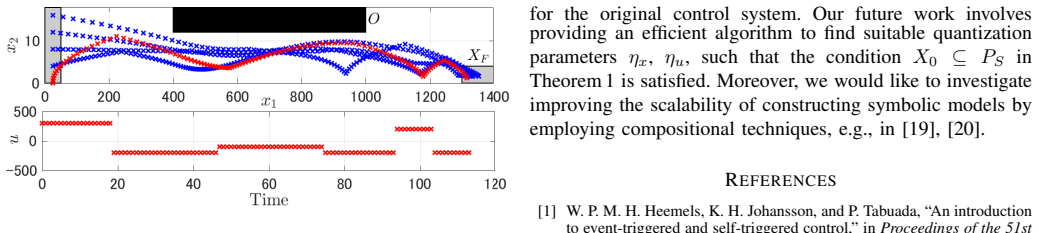
- Communication is aperiodic: the controller outputs both the input and the waiting time, reducing the number of transmissions compared to periodic control (109 to 6 in the example).
- The guarantee is conditional on X0 ⊆ PS; when the condition fails, one can still restrict to X0 ∩ PS and obtain a valid controller for that subset.
- Because the symbolic model is finite, the synthesis terminates, so the same algorithm can be implemented for any discrete-time Lipschitz plant once the parameters are fixed.
Reading between the lines
- The condition X0 ⊆ PS is not only a proof artifact; it suggests a practical design loop where one coarsens ηx, ηu until PS covers X0, at the cost of exponential growth of the abstract state space. A dual strategy—fixing the controller and learning the coarsest admissible quantization—might be derived from the same simulation bounds.
- The layer function L(x~) computed by Algorithm 1 could be reused as a runtime Lyapunov-like certificate for the closed loop, giving a data structure that monitors the remaining time-to-target without additional computation.
- The over-approximation radius ε_m = L_x^m ε + ηx grows exponentially with the waiting time m, so long inter-communication steps are penalized by conservatism. This suggests an inherent trade-off between communication reduction and achievable precision that could be formalized as an optimization over Mmax.
- For systems with large Lipschitz constants, the method may produce an empty ~PS even when a valid controller exists, so a natural testable extension is a parameter-adaptive scheme that locally refines the lattice only near the winning frontier.
Signed reviews
Editorial analysis
A structured set of objections, weighed in public.
Referee Report
Summary. The paper proposes a symbolic-model method for synthesizing self-triggered controllers for nonlinear discrete-time systems subject to reachability and safety specifications. It constructs an augmented transition system for the plant, quantizes it to a finite symbolic model, establishes a strong approximate alternating simulation relation (Lemma 2), solves a reachability game on the abstraction (Algorithm 1) to obtain an abstract winning set and a rank function, and then refines the abstract controller to a memoryless self-triggered controller via Eq. (8). Theorem 1 claims that if all concrete initial states lie within precision ε of the abstract winning set, the refined controller guarantees finite-time reachability of the target set and invariance of the safety set. A numerical vehicle example illustrates the approach and reports aperiodic communication.
Significance. If the central theorem were correct, the paper would contribute a useful abstraction-based synthesis method for self-triggered control with non-convex safety sets, requiring only Lipschitz continuity rather than stability or contractivity assumptions. The construction of the symbolic model and the proof of Lemma 2 are technically sound, and Algorithm 1 is a standard and appropriate fixpoint scheme for the abstract reachability-safety game. The numerical example demonstrates the intended behavior. However, the refinement step in Theorem 1 is not established as written: the memoryless nearest-state selection can break the rank-decrease argument on which the finite-time guarantee rests. The flaw is repairable, but the paper's main guarantee currently lacks a valid proof.
major comments (2)
- [Section IV, Theorem 1 (Eq. (8))] The proof of Theorem 1 has an invalid induction step. In the first step the proof picks ~x_k0 ∈ Nearest_{~P_S}(x_k0) with rank N and uses the strong ε-ASR to obtain an existential abstract successor ~x_k1 ∈ P(N−1) that is related to the concrete successor x_k1. It then says to repeat the procedure from k1. The repeat step, however, must choose Nearest_{~P_S}(x_k1), and nothing in Definition 5, Eq. (7), or Eq. (8) guarantees that this nearest point has rank at most N−1; the rank function L on the finite lattice can vary arbitrarily between nearby abstract states, so the selected point may have rank N or larger. Consequently the sequence of abstract states actually used by the memoryless controller (8) need not be a trajectory of ~ΣA with decreasing L, and Lemma 3 does not apply recursively. A correct refinement would need to choose, for example, an abstract state of minimal rank among those within ε of the concrete state, or to carry the previous abstract state as memory.
- [Section IV, Definition 1 and Eq. (8)] Even if the rank of the nearest abstract state were controlled at the first step, the controller C(x) in Eq. (8) is the union of ~C(~x) over all ~x ∈ Nearest_{~P_S}(x). Since different nearest points can have different ranks, a controlled trajectory in the sense of Definition 1, which quantifies over all possible induced trajectories, could at every communication instant select an action coming from a high-rank nearest point. The proof of Theorem 1 silently fixes one abstract state, but the nondeterminism in (8) is not resolved by the controller definition.
minor comments (3)
- [Remark 2] The sentence 'Even though X0 ⊈PS does not hold' is confusing and should presumably read 'Even if X0⊆PS does not hold, one might still be interested...'.
- [Proof of Lemma 3] The input pair (u′, m′) is introduced in the proof, but the safety condition is later written with (u, m) without primes; this notational slip should be corrected.
- [Section V] The phrase 'with 6 number of communication times' should be reworded, for example as 'with 6 communication events'.
Circularity Check
No significant circularity: the abstraction, reachability game, and controller refinement are derived from stated Lipschitz assumptions and proved locally, not fitted to data or imported from the authors' prior work.
full rationale
The derivation chain is self-contained. Lemma 2 proves that the relation R(ε) = {(˜x, x) : ||˜x − x|| ≤ ε} is a strong ε-ASR from the symbolic model ~Σ^ε_A to Σ_A directly from Assumption 1 (Lipschitz continuity), the quantization structure, and the definition of ~G_A; no constant is fitted to data and no empirical prediction is renamed. Algorithm 1 computes the winning set ~P_S by a standard fixed-point reachability game on the finite abstract state space, and controller (7) is defined purely from the rank L computed by that iteration. Theorem 1 then transfers the abstract reachability/safety guarantee to the concrete system through the ε-ASR, under the explicit hypothesis X0 ⊆ P_S; this hypothesis is an assumption on the initial set, not a hidden restatement of the conclusion. The self-citations [6], [7], and [9] appear only as background comparisons in the introduction and are not load-bearing for the synthesis proof; the central simulation-relation framework is credited to [16] and is re-proved in Lemma 2. The authors' own Remarks 1 and 2, plus the conclusion, acknowledge that no constructive procedure is given for choosing ηx, ηu so that X0 ⊆ P_S holds; this is a limitation of the method, not a circular reduction. Finally, the skeptical concern about the induction step in Theorem 1—that the nearest abstract state at the next communication may not inherit a smaller rank—is a potential proof-soundness gap, not a circularity, because it does not show that the theorem assumes its own conclusion.
Assumptions & free parameters
free parameters (4)
- ηx (state quantization parameter) =
1 (in the example)
- ηu (input quantization parameter) =
50 (in the example)
- ε (precision of the simulation relation) =
1 (in the example, equal to ηx)
- Mmax (maximum inter-communication step) =
30 (in the example)
assumptions (3)
- domain assumption Assumption 1: f is Lipschitz continuous in x with constant Lx.
- domain assumption X0, U, XS, XF are compact sets.
- domain assumption The notion of strong ε-ASR and the refinement property (controller validity transfers from abstraction to concrete system) from [16] and [10].
Cite this review
Pith. "Pith review of A symbolic approach to the self-triggered design for networked control systems." pith.science (2026). https://pith.science/paper/XUFBB5WY
@misc{pith2026190804750,
  author       = {Pith},
  title        = {Pith review of: A symbolic approach to the self-triggered design for networked control systems},
  year         = {2026},
  howpublished = {\url{https://pith.science/paper/XUFBB5WY}},
  note         = {Machine review of arXiv:1908.04750}
}
read the original abstract
In this paper, we investigate novel self-triggered controllers for nonlinear control systems with reachability and safety specifications. To synthesize the self-triggered controller, we leverage the notion of symbolic models, or abstractions, which represent abstracted expressions of control systems. The symbolic models will be constructed through the concepts of approximate alternating simulation relations, based on which, and by employing a reachability game, the self-triggered controller is synthesized. We illustrate the effectiveness of the proposed approach through numerical simulations.
Figures


Reference graph
Works this paper leans on
-
[1]
An introduction to event-triggered and self-triggered control,
W. P. M. H. Heemels, K. H. Johansson, and P. Tabuada, “An introduction to event-triggered and self-triggered control,” in Proceedings of the 51st IEEE Conference on Decision and Control (IEEE CDC) , 2012, pp. 3270–3285
2012
-
[2]
A survey of event-based strate- gies on control and estimation,
Q. Liu, Z. Wang, X. He, and D. Zhou, “A survey of event-based strate- gies on control and estimation,” Systems Science & Control Engineering, vol. 2, no. 1, pp. 90–97, 2014
work page 2014
-
[3]
A survey on recent advances in event-triggered communication and control,
C. Peng and F. Li, “A survey on recent advances in event-triggered communication and control,” Information Sciences , vol. 457, pp. 113– 125, 2018
2018
-
[4]
Self-triggered control for sampled-data systems using reachability analysis,
M. A. Khatib, A. Girard, and T. Ding, “Self-triggered control for sampled-data systems using reachability analysis,” in Proceedings of 20th IFAC World Congress, 2017, pp. 7881–7886
work page 2017
-
[5]
Event-triggered algorithms for continuous- time systems based on reachability analysis,
N. Meslem and C. Prieur, “Event-triggered algorithms for continuous- time systems based on reachability analysis,” in Proceedings of 52nd IEEE Confernece on Decision and Control , 2013
work page 2013
-
[6]
Aperiodic sampled- data control via explicit transmission mapping: a set-invariance ap- proach,
K. Hashimoto, S. Adachi, and D. V . Dimarogonas, “Aperiodic sampled- data control via explicit transmission mapping: a set-invariance ap- proach,” IEEE Transactions on Automatic Control , vol. 63, no. 10, pp. 3523–3530, 2018
work page 2018
-
[7]
Self-triggered control for constrained systems: a contractive set-based approach,
K. Hashimoto, S. Adachi, and D. V . Dimarogonas, “Self-triggered control for constrained systems: a contractive set-based approach,” in Proceedings of 2017 American Control Conference , 2017, pp. 1011– 1016
work page 2017
-
[8]
Event-triggered and self- triggered control for linear systems based on reachable sets,
F. Brunner, W. Heemels, and F. Allgower, “Event-triggered and self- triggered control for linear systems based on reachable sets,”Automatica, vol. 101, pp. 15–26, 2019
work page 2019
Show all 20 references
-
[9]
Synthesizing communication plans for reachability and safety specifications,
K. Hashimoto and D. V . Dimarogonas, “Synthesizing communication plans for reachability and safety specifications,” IEEE Transactions on Automatic Control, (to appear)
-
[10]
Tabuada, Verification and Control of Hybrid Systems – A Symbolic Approach, Springer, 2009
P. Tabuada, Verification and Control of Hybrid Systems – A Symbolic Approach, Springer, 2009
2009
-
[11]
Symbolic models for incrementally stable switched systems with aperiodic time sampling,
Z. Kader, A. Girard, and A. Saoud, “Symbolic models for incrementally stable switched systems with aperiodic time sampling,” in Proceedings of 6th IFAC Conference on Analysis and Design of Hybrid Systems , 2018
2018
-
[12]
A formal traffic characterization of LTI event-triggered control systems,
A. S. Kolarijani and M. Mazo Jr., “A formal traffic characterization of LTI event-triggered control systems,” IEEE Transactions on Control of Network Systems, vol. 5, no. 1, pp. 274–283, 2018
2018
-
[13]
Approximately bisimilar symbolic models for nonlinear control systems,
G. Pola, A. Girard, and P. Tabuada, “Approximately bisimilar symbolic models for nonlinear control systems,” Automatica, vol. 44, no. 10, pp. 2508–2516, 2008
2008
-
[14]
Optimal multirate sampling in symbolic models for incrementally stable switched systems,
A. Saoud and A. Girard, “Optimal multirate sampling in symbolic models for incrementally stable switched systems,” Automatica, vol. 98, pp. 58–65, 2018
2018
-
[15]
Symbolic models for nonlinear control systems without stability assumptions,
M. Zamani, G. Pola, M. Mazo Jr., and P. Tabuada, “Symbolic models for nonlinear control systems without stability assumptions,” IEEE Transactions on Automatic Control, vol. 57, no. 7, pp. 1804–1809, 2012
2012
-
[16]
Design of symbolic con- trollers for networked control systems,
A. Borri, G. Pola, and M. D. D. Benedetto, “Design of symbolic con- trollers for networked control systems,”IEEE Transactions on Automatic Control, 2019 (to appear)
2019
-
[17]
Symbolic approximate time-optimal control,
M. Mazo Jr. and P. Tabuada, “Symbolic approximate time-optimal control,” Systems & Control Letters , vol. 60, no. 4, pp. 256–263, 2011
2011
-
[18]
Symbolic abstrac- tions of networked control systems,
M. Zamani, M. Mazo Jr., M. Khaled, and A. Abate, “Symbolic abstrac- tions of networked control systems,” IEEE Transactions on Control of Network Systems, vol. 5, no. 4, pp. 1622–1634, 2018
2018
-
[19]
Compositional abstraction-based synthesis for cascade discrete-time control systems,
A. Saoud, P. Jagtap, M. Zamani, and A. Girard, “Compositional abstraction-based synthesis for cascade discrete-time control systems,” in Proceedings of 6th IFAC Conference on Analysis and Design of Hybrid Systems, 2018
2018
-
[20]
Compositional abstraction and safety synthesis using overlapping symbolic models,
P. J. Meyer, A. Girard, and E. Witrant, “Compositional abstraction and safety synthesis using overlapping symbolic models,”IEEE Transactions on Automatic Control , vol. 63, no. 6, pp. 1835–1841, 2018
2018
Reviewed August 14, 2026 · model on record in the stance chip above.
Discussion (0). Continue with ORCID to comment.