REVIEW 4 major objections 5 minor 104 references
Conformally symmetric traversable wormholes in $f(R,T)$ gravity
T0 review · 4 major / 5 minor · reviewed 2026-08-14 · deepseek-v4-flash
Pith's one-line read Conformally symmetric traversable wormholes exist in f(R,T)=R+2χT gravity, and the phantom-energy family requires vanishingly small exotic matter as ω approaches -1.
desk verdict Conformally symmetric f(R,T) wormhole solutions with a real pinch-off problem in the ω→−1 limit; referee-worthy despite the flaws. read the letter →
The pith
A machine-rendered reading of the paper's core claim, the machinery that carries it, and where it could break.
The reading
What carries the argument
The central mechanism is the conformal Killing vector (CKV), a vector field $\xi$ satisfying $L_{\xi} g_{ij}=\psi g_{ij}$, under which the metric is mapped to itself up to a conformal factor $\psi$. For the static spherical wormhole metric, this forces the redshift function to be $e^{\nu}=C_2^2 r^2$ and the radial metric component to be $(1-b/r)^{-1}=(C_3/\psi)^2$, reducing the three f(R,T) field equations to a closed system for $\psi$, the energy density, and the pressures. Solving that system with $p_r=\omega\rho$ or $p_t=np_r$ produces the shape functions $b(r)$ that define the two wormhole families. The second essential tool is the volume integral quantifier $I_V$, which integrates $\rho+p_r$ with a cut-off; the paper uses it to argue that the total amount of exotic matter can be made vanishingly small in the $\omega\to -1$ limit.
What would settle it
Compute the generalized thin-shell junction conditions for f(R,T)=R+2χT at r=a: if no surface stress-energy tensor can match the interior to an exterior vacuum spacetime with a>2M, the wormholes cannot be embedded in an asymptotically flat spacetime. A second quantitative check is to evaluate the volume integral quantifier for WH1 at a finite cut-off as ω approaches -1; the claim of vanishing exotic matter requires the boundary term at r0 to vanish and the integral to stay controlled at the junction radius.
Extended reading notes
Core claim
The claimed discovery is that the conformal Killing condition $L_{\xi} g_{ij}=\psi g_{ij}$ fixes the wormhole redshift and radial metric components to $e^{\nu}=C_2^2 r^2$ and $(1-b/r)^{-1}=(C_3/\psi)^2$, turning the f(R,T) field equations into a solvable system for the conformal factor $\psi$ and the matter variables. With isotropic pressure the only solution gives $b'(r_0)=2$, violating the flaring-out condition $b'(r_0)<1$, so that case is discarded. With the phantom equation of state $p_r=\omega\rho$, $\omega<-1$, the resulting shape function satisfies $b(r_0)=r_0$, $b'(r_0)<1$ and $b(r)/r\to 0$ at large $r$, and the stress-energy has $\rho\ge 0$ with $\rho+p_r<0$; with the anisotropy $p_t=np_r$ a second shape function does the same while also satisfying the strong energy condition. Because $e^{\nu}$ does not tend to zero at infinity, neither interior is asymptotically flat, and the paper handles this by declaring a thin-shell matching to an exterior vacuum spacetime, restricting the distribution of exotic matter to the throat neighborhood. The volume integral quantifier is then evaluated for both models and shown to be able to approach zero in the phantom case as $\omega\to -1$.
Load-bearing premise
The entire construction depends on joining the non-asymptotically-flat interior wormhole to an exterior vacuum spacetime through a thin shell, and the paper does not actually compute the f(R,T) junction conditions or the shell's surface stress-energy that would verify this match.
Editorial extensions
If this is right
- Traversable wormhole solutions exist as exact solutions of f(R,T)=R+2χT gravity for both phantom energy with $p_r=\omega\rho$ ($\omega<-1$) and anisotropic matter with $p_t=np_r$, provided one accepts the conformal Killing ansatz.
- In the phantom case, the total amount of exotic matter, as measured by the volume integral quantifier, can be made arbitrarily small as $\omega$ approaches $-1$.
- These wormhole interiors are not asymptotically flat, so they must be embedded via a thin-shell match to an exterior vacuum spacetime; the paper argues this restricts the exotic matter to a neighborhood of the throat.
- The isotropic-pressure conformal solution is ruled out because it gives $b'(r_0)=2$, violating the flaring-out condition, so viable wormholes in this class require phantom energy or anisotropy.
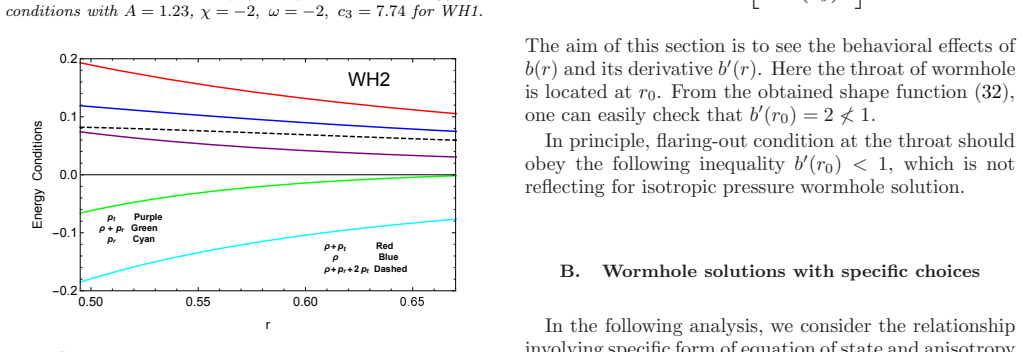
- The anisotropic model WH2 satisfies the strong energy condition while violating the null and weak energy conditions, showing the energy-condition mix is model-dependent in this theory.
Reading between the lines
- A direct next step would be to compute the generalized thin-shell junction conditions for f(R,T)=R+2χT and test whether a surface stress-energy tensor satisfying the usual energy conditions exists at the matching radius; the paper leaves this computation open and the construction depends on it.
- Because the vanishing-volume-integral behavior follows directly from the conformal ansatz $e^{\nu}=C_2^2 r^2$, one can test whether the $\omega\to -1$ suppression survives when that redshift function is perturbed or the junction is smoothed; if it disappears, the result is an artifact of the exact conformal form rather than a property of f(R,T) gravity.
- A natural generalization would be to apply the same conformal-symmetry recipe to charged or rotating wormholes in f(R,T) and other trace-coupled gravity models; the method would then serve as a general solution-generating technique.
- The classical claim of arbitrarily small exotic matter does not by itself guarantee physical viability, because quantum inequality bounds on negative energy would still constrain the throat; whether the vanishing volume integral survives those bounds is untested.
Signed reviews
Editorial analysis
A structured set of objections, weighed in public.
Referee Report
Summary. The paper constructs static, spherically symmetric traversable wormhole solutions in f(R,T)=R+2χT gravity by imposing a conformal Killing vector on the Morris-Thorne metric. Two matter models are solved: a phantom-energy fluid with pr=ωρ and ω<−1 (WH1) and an anisotropic fluid with pt=npr (WH2). The authors report exact shape functions, check the throat and flaring-out conditions, plot energy conditions and embedding diagrams, and compute a volume integral quantifier, claiming that for WH1 the total amount of exotic matter can be made arbitrarily small as ω→−1. Because the conformal ansatz forces a non-asymptotically-flat redshift function, the paper proposes to match the interior to an exterior Schwarzschild vacuum at a thin shell.
Significance. If the claims were fully established, the paper would add two new exact wormhole families to the f(R,T) literature and would strengthen the case that modified gravity can support traversable wormholes with small exotic-matter content. The systematic CKV reduction, the explicit analytic expressions for ψ(r), b(r), and the matter variables, and the checks of throat/flare-out conditions are genuine technical strengths. The paper also honestly acknowledges that the redshift function is not asymptotically flat. However, the two headline physical conclusions—asymptotic flatness of b(r)/r and vanishing exotic matter as ω→−1—are both contradicted by the paper's own equations, and the NEC violation is put in by hand through the chosen phantom/anisotropic equations of state rather than derived.
major comments (4)
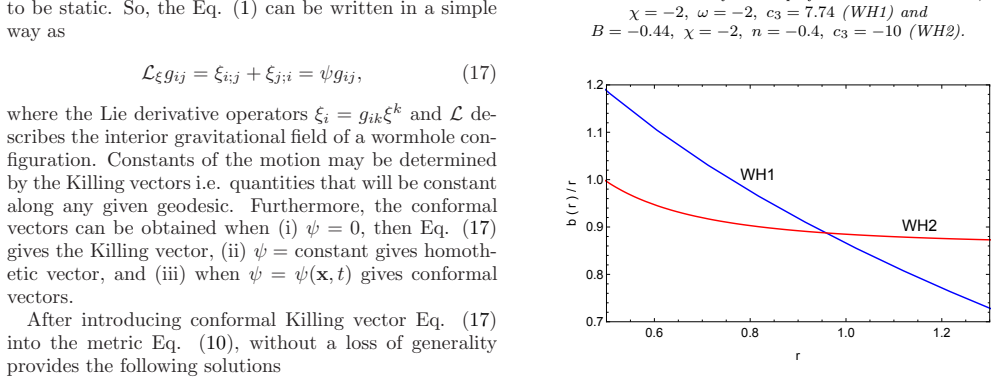
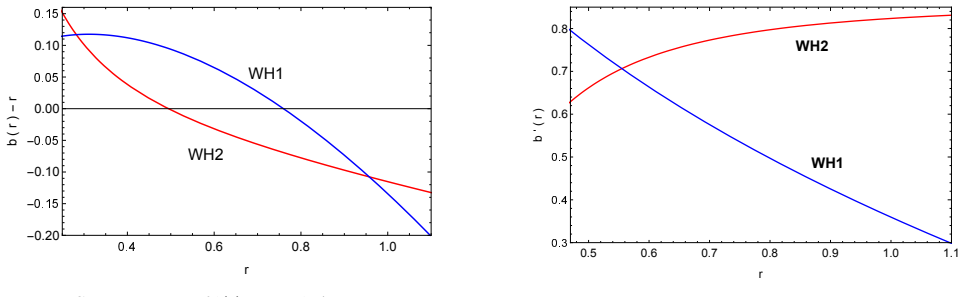
- [VI.B.1, Eq. (37); Fig. 2] The text in Section VI.B.1 states that "we can see directly from Fig. 2 that the asymptotic behavior b(r)/r → 0 as r → ∞," but this is contradicted by Eq. (37). For the stated WH1 parameters (A=1.23, χ=−2, ω=−2, c3=7.74), Eq. (37) gives b(r)/r ≈ 2.88 − 2.01 r^{0.25}, which diverges to −∞ as r→∞, not to zero. The analogous claim in Section VI.B.2 for WH2 is also incorrect: for B=−0.44, χ=−2, n=−0.4, c3=−10, Eq. (46) asymptotes to b/r ≈ 0.86, not zero. The asymptotic-flatness assertions based on Fig. 2 therefore need to be corrected, and the embedding diagrams and the integration limits used in Section VII inherit the same problem.
- [VII, Eq. (53); Section VIII] The claim in Section VIII that as ω→−1 the volume integral quantifier "would by itself become arbitrarily small" is not supported. The throat radius r0 is determined by ψ(r0)=0 in Eq. (36), and for fixed A, C3, and χ the solution behaves as r0→0 when ω→−1, so the lower endpoint of the integral in Eq. (53) collapses. For a fixed matching radius a, the boundary term a(1−b(a)/a) ln(e^ν/(1−b/a)) does not vanish, and the integral tends to a finite value rather than to zero. To claim vanishing exotic matter one would need to rescale A or C3 with ω so that r0 remains fixed and then re-evaluate the limit; the paper does not do this. The conclusion that wormholes can be supported by arbitrarily small amounts of exotic matter is therefore not established.
- [V] Section V announces that the interior wormhole geometries will be matched to an exterior Schwarzschild vacuum at a thin shell, but it never performs the matching. No surface stress-energy tensor, no junction radius a, no Israel junction conditions specialized to f(R,T), and no verification that the required jump conditions can be satisfied are provided. Since the interior has e^ν=C2²r² and the shape function does not approach the Schwarzschild form, the matching is essential for the claim that these are complete traversable wormhole spacetimes with finite dimensions; without the explicit junction calculation, the solutions are only local interior patches.
- [VI.B, Eqs. (38)-(40), (47)-(49)] The NEC/WEC violations reported in Section VI are an input rather than an output of the construction: the phantom-energy condition pr=ωρ with ω<−1 for WH1 and the anisotropic relation pt=npr with n<0 for WH2 are chosen precisely to make ρ+pr negative. This should be acknowledged more prominently so that the physical significance of the solutions is not overstated. The specific exact solutions remain new, but the energy-condition results do not demonstrate that f(R,T) gravity itself provides a new mechanism to avoid exotic matter.
minor comments (5)
- [IV, after Eq. (20)] The sentence beginning "using the above conformal relations relating the form and redshift functions" contains an undefined symbol λ and appears garbled; please rewrite and define all symbols.
- [VI.B.1, after Eq. (37)] The statement "for r ≥ r0 the metric component g^{-1}_{rr} ≥ 0 if ω < −1" is not derived and, given the asymptotic behavior found above, is not evidently correct; it should be checked explicitly with the actual ψ(r) solution.
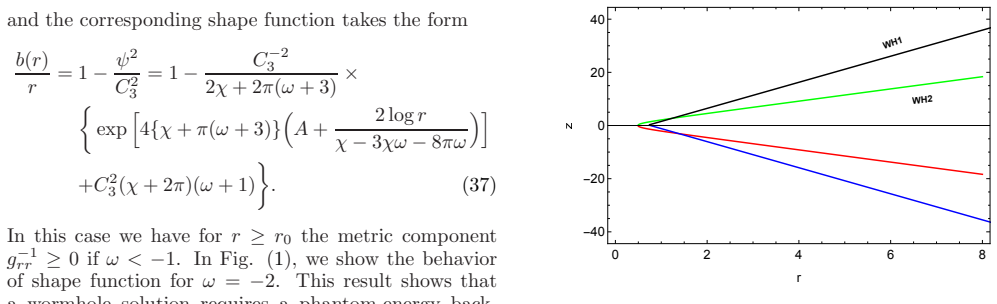
- [Eqs. (43), (50)] The embedding function expressions contain many auxiliary variables (σ, η, p, q, Γ, Θ, Ξ) that are not all defined before use; please define each variable at the point of first appearance.
- [Throughout] There are numerous typographical and grammatical errors (e.g., "the the", "an alignment of systematic approach", "we are successfully able to make the a particular asymptotically flat wormhole geometries"). A careful proofreading pass is needed.
- [VII, Eq. (51)] The sign convention in the volume integral quantifier differs from the standard Visser-Kar-Dadhich expression; please state the convention or add a reference so the sign of IV is unambiguous.
Circularity Check
The vanishing-exotic-matter result for WH1 reduces to the assumed phantom EoS p_r = ωρ; the exact wormhole solutions themselves are derived, not circular.
-
self definitional
[Abstract; Section VI.B.1, Eq. (39); Section VII, after Eq. (53)]
"We constrain the models with phantom energy EoS i.e. ω= p_r/ ρ < −1 ... pr(r) = ωρ(r) ... It is interesting to note that when a → r0 then IV → 0 for both cases. In fact, one can also observe that for WH1 if the parameter ω arbitrary close to −1, the integral may be infinitesimally small."
The volume integral quantifier is defined as IV = ∫(ρ+p_r)dV (Eq. 51). With the assumed phantom EoS p_r=ωρ, the integrand is identically (1+ω)ρ, so IV ∝ (1+ω) for any geometry. Thus the statement that IV becomes arbitrarily small as ω→−1 is a restatement of the input EoS, not an independent result of the field equations. The abstract itself states the EoS as an input ('We constrain the models with phantom energy EoS'), and Section VII then presents the smallness as confirmation. Also, since ψ(r0)=0 fixes the throat, Eq. (36) implies r0 shrinks as ω→−1, so the limiting integral's smallness partly reflects a collapsing integration domain rather than a finite wormhole with tiny exotic-matter content.
full rationale
The central constructions—the CKV ansatz fixing e^ν = C_2^2 r^2 and (1−b/r)^{-1} = (C_3/ψ)^2, the solution of the f(R,T) field equations for p_r=ωρ and p_t=n p_r, and the derived condition ω<−1 for g_rr^{-1}≥0—are genuine algebraic results from the stated assumptions; they are not identities and involve no fitted data. The paper's self-citations (e.g., Refs. [78], [93]) are contextual literature references, not load-bearing justifications. The main circularity is confined to the Section VII/Section VIII claim that WH1 requires 'vanishing amounts of ANEC' as ω→−1: with p_r=ωρ the exotic-matter integrand ρ+p_r is (1+ω)ρ by definition, so the limiting result is built into the chosen EoS rather than discovered. The incomplete thin-shell matching in Section V is a correctness gap, not a circularity. Overall, the exact-solution derivation is self-contained, but one highlighted prediction reduces by construction, giving a partial circularity score of 6.
Assumptions & free parameters
free parameters (6)
- χ (f(R,T) coupling) =
-2 (WH1 and WH2)
- ω (EoS parameter, WH1) =
-2
- n (anisotropy ratio, WH2) =
-0.4
- C3 (integration constant) =
7.74 (WH1), -10 (WH2)
- A (integration constant, WH1) =
1.23
- B (integration constant, WH2) =
-0.44
assumptions (4)
- domain assumption The f(R,T) field equations for f=R+2χT with Lm=-P are taken from Harko et al. (2011) and assumed to govern the wormhole spacetime.
- domain assumption The wormhole metric is the static Morris-Thorne form and admits a conformal Killing vector, leading to e^ν = C₂²r² and (1-b/r)^{-1} = (C₃/ψ)².
- standard math The traversability conditions (flaring-out, finiteness of proper radial length, absence of horizons) are the standard Morris-Thorne criteria.
- domain assumption An exterior Schwarzschild vacuum solution can be matched to the interior at a thin shell, with junction conditions valid in f(R,T) gravity.
Cite this review
Pith. "Pith review of Conformally symmetric traversable wormholes in $f(R,T)$ gravity." pith.science (2026). https://pith.science/paper/N3BUINUF
@misc{pith2026190804754,
  author       = {Pith},
  title        = {Pith review of: Conformally symmetric traversable wormholes in $f(R,T)$ gravity},
  year         = {2026},
  howpublished = {\url{https://pith.science/paper/N3BUINUF}},
  note         = {Machine review of arXiv:1908.04754}
}
abstract
To find more deliberate $f(R, T)$ astrophysical solutions, we proceed by studying wormhole geometries under the assumption of spherical symmetry and the existence of a conformal Killing symmetry to attain the more acceptable astrophysical results. To do this, we consider a more plausible and simple model $f(R,T)=R+2\chi T$, where $R$ is the Ricci scalar and $T= -\rho+p_r+2p_t$ denotes the trace of the energy-momentum tensor of the matter content. We explore and analyze two cases separately. In the first part, wormhole solutions are constructed for the matter sources with isotropic pressure. However, the obtained solution does not satisfy the required wormhole conditions. In the second part, we introduce an EoS relating with pressure (radial and lateral) and density. We constrain the models with phantom energy EoS i.e. $\omega= p_r/ \rho < -1$, consequently violating the null energy condition. Next, we analyze the model via $p_t= n p_r $. Several physical properties and characteristics of these solutions are investigated which are consistent with previous references about wormholes. We mainly focus on energy conditions (NEC, WEC and SEC) and consequently for supporting the respective wormhole geometries in details. In both cases it is found that the energy density is positive as seen by any static observer. To support the theoretical results, we also plotted several figures for different parameter values of the model that helps us to confirm the predictions. Finally, the volume integral quantifier, which provides useful information about the total amount of exotic matter required to maintain a traversable wormhole is discussed briefly.
Figures

Figures from the paper (4 more)

Reference graph
Works this paper leans on
-
[1]
Constants of the motion may be determined by the Killing vectors i.e
can be written in a simple way as Lξgij =ξi;j +ξj;i =ψgij, (17) where the Lie derivative operators ξi = gikξk and L de- scribes the interior gravitational field of a wormhole con- figuration. Constants of the motion may be determined by the Killing vectors i.e. quantities that will be constant along any given geodesic. Furthermore, the conformal vectors can...
-
[2]
8: Embedding surfaces of the two wormholes (WH1 and WH2) after revolution about Z-axis
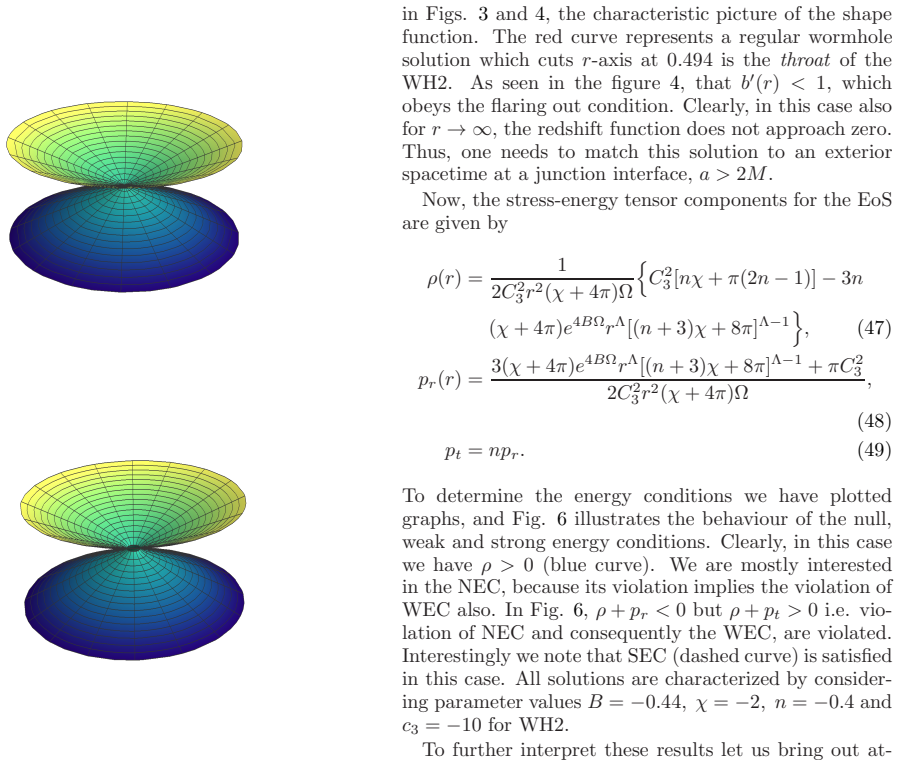
WH2: Model with pt = npr Here, we investigate the wormhole solution for a partic- ularly interesting anisotropy, already explored in [ 51, 94], given by pt =npr, (44) 7 FIG. 8: Embedding surfaces of the two wormholes (WH1 and WH2) after revolution about Z-axis. where the state parameter n is a constant. With this assumption and solving the differential equ...
-
[3]
Anabalon and A
A. Anabalon and A. Cisterna, Phys. Rev. D 85, 084035 (2012)
2012
-
[4]
flaring-out condition
leads to the form (8π + 2χ)∇µTµν = −2χ [ ∇µ (pgµν ) + 1 2gµν ∇µT ] . (9) Regarding the Bianchi identity, obviously in f (R,T ) gravity, the covariant derivative of the energy-momentum tensor is not null in general. But substituting χ = 0 in Eq. ( 9), one can see that the energy-momentum tensor is conserved as in case of general relativity. III. TRA VERSAB...
-
[5]
(35) Let us start for searching an exact wormhole model by considering a linear EoS which is characterized by pr =ωρ
WH1: Model with pr = ωρ With the definitions of ρeff, peff and Peff , one can rewrite the field equations ( 24)-(26) further in the follow- ing form: ρ(r) = 2C2 3 (χ + 2π) −ψ[r(3χ + 8π)ψ′ + 4πψ] 4C2 3r2(χ + 2π)(χ + 4π) , (33) pr(r) = ψ[4(χ + 3π)ψ −rχψ′] − 2C2 3 (χ + 2π) 4C2 3r2(χ + 2π)(χ + 4π) , (34) pt(r) = ψ[r(3χ + 8π)ψ′ + 4πψ] 4C2 3r2(χ + 2π)(χ + 4π). (3...
-
[6]
Cataldo, P
M. Cataldo, P. Salgado and P. Minning, Phys. Rev. D 66, 124008 (2002)
2002
-
[7]
M. H. Dehghani and S. H. Hendi, Gen. Rel. Grav. 41, 1853 (2009)
2009
-
[8]
Morris and K.S
M.S. Morris and K.S. Thorne: Am. J. Phys., 56, 395 (1988)
1988
Show all 104 references
-
[9]
Visser, Lorentzian Wormholes: From Einstein to Hawking (American Institute of Physics, New York, 1995)
M. Visser, Lorentzian Wormholes: From Einstein to Hawking (American Institute of Physics, New York, 1995)
1995
-
[10]
P. F. Gonzalez-Diaz, Phys. Rev. D 68, 084016 (2003)
2003
-
[11]
A. B. Balakin, J. P. S. Lemos and A. E. Zayats, Phys. Rev. D 81, 084015 (2010)
2010
-
[12]
Jamil, P
M. Jamil, P. K. F. Kuhfittig, F. Rahaman and S. A. Rakib, Eur. Phys. J. C 67, 513 (2010)
2010
-
[13]
Visser, S
M. Visser, S. Kar and N. Dadhich, Phys. Rev. Lett. 90, 201102 (2003)
2003
-
[14]
Visser, Phys
M. Visser, Phys. Rev. D 39, 3182 (1989)
1989
-
[15]
Bochicchio and V
I. Bochicchio and V. Faraoni, Phys. Rev. D 82, 044040 (2010)
2010
-
[16]
DeBenedictis, R
A. DeBenedictis, R. Garattini and F. S. N. Lobo, Phys. Rev. D 78, 104003 (2008)
2008
-
[17]
P. K. F. Kuhfittig, Am. J. Phys. 67, 125 (1999)
1999
-
[18]
Cataldo, P
M. Cataldo, P. Meza and P. Minning, Phys. Rev. D 83, 044050 (2011)
2011
-
[19]
Hansen, D
J. Hansen, D. I. Hwang and D. h. Yeom, JHEP 0911, 016 (2009)
2009
-
[20]
Habib Mazharimousavi and M
S. Habib Mazharimousavi and M. Halilsoy, Mod. Phys. Lett. A 31, 1650203 (2016)
2016
-
[21]
Di Criscienzo, R
R. Di Criscienzo, R. Myrzakulov and L. Sebastiani, Class. Quant. Grav. 30, 235013 (2013)
2013
-
[22]
Visser, Nucl
M. Visser, Nucl. Phys. B 328, 203 (1989)
1989
-
[23]
P. K. F. Kuhfittig, Phys. Rev. D 66, 024015 (2002)
2002
-
[24]
Jamil, F
M. Jamil, F. Rahaman, R. Myrzakulov, P. K. F. Kuhfit- tig, N. Ahmed and U. F. Mondal, J. Korean Phys. Soc. 65, 917 (2014)
2014
-
[25]
F. S. N. Lobo and M. A. Oliveira, Phys. Rev. D 80, 104012 (2009)
2009
-
[26]
For obtaining an explicit solution one has to specify or determine the EoS, the shape function b(r) etc
with the following four unknown functions of r, namely, ρ, pr(r), pt(r) and ψ is mathematically well- defined problem. For obtaining an explicit solution one has to specify or determine the EoS, the shape function b(r) etc. by implementing some physical conditions. We employ th...
-
[27]
DeBenedictis and D
A. DeBenedictis and D. Horvat, Gen. Rel. Grav. 44, 2711 (2012)
2012
-
[28]
Rahaman, S
F. Rahaman, S. Islam, P. K. F. Kuhfittig and S. Ray, Phys. Rev. D 86, 106010 (2012)
2012
-
[29]
E. F. Eiroa and G. Figueroa Aguirre, Eur. Phys. J. C 76, 132 (2016)
2016
-
[30]
Pavlovic and M
P. Pavlovic and M. Sossich, Eur. Phys. J. C 75, 117 (2015)
2015
-
[31]
M. H. Dehghani and Z. Dayyani, Phys. Rev. D 79, 064010 (2009)
2009
-
[32]
Sharif and S
M. Sharif and S. Rani, Phys. Rev. D 88, 123501 (2013)
2013
-
[33]
(37) In this case we have for r ≥ r0 the metric component g−1 rr ≥ 0 if ω < −1
and ( 34) then, after integration, we can recover the functional form of ψ(r), which yield ψ(r) = 1 √ 2χ + 2π(ω + 3) { exp [ 4{χ +π(ω + 3)} ( A + 2 logr χ − 3χω − 8πω )] +C2 3 (χ + 2π)(ω + 1) } 1 2 , (36) 6 and the corresponding shape function takes the form b(r) r = 1 − ψ2 C2...
-
[34]
Sharif and S
M. Sharif and S. Rani, Adv. High Energy Phys. 2014, 691497 (2014)
2014
-
[35]
Sharif and S
M. Sharif and S. Rani, Gen. Rel. Grav. 45, 2389 (2013)
2013
-
[36]
Zubair, S
M. Zubair, S. Waheed, G. Mustafa and H. Ur Rehman, Int. J. Mod. Phys. D 28, 1950067 (2019)
2019
-
[37]
Bhar and F
P. Bhar and F. Rahaman, Eur. Phys. J. C 74, 3213 (2014)
2014
-
[38]
Jamil, D
M. Jamil, D. Momeni and M. Ratbay, Chin. Phys. Lett. 29, 109801 (2012)
2012
-
[39]
Matulich and R
J. Matulich and R. Troncoso, JHEP 1110, 118 (2011)
2011
-
[40]
Kord Zangeneh, F
M. Kord Zangeneh, F. S. N. Lobo and M. H. Dehghani, Phys. Rev. D 92, 124049 (2015)
2015
-
[41]
volume integral quan- tifier
and found as z(r) = r √ e4BΩrΛ [(n + 3)χ + 8π]Λ +C2 3n(χ + 2π) C3 √ 2nχ +π(6n − 2)[(5n + 3)χ + 4π(3n + 1)][ −e4BΩrΛ [(n + 3)χ + 8π]Σ + { C2 3 ( −n(χ + 2π) [(n + 3)χ + 8π] + 2[nχ +π(3n − 1)] χ + 2π × [3(n + 1)χ +π(8n + 4)] 2F1(1, Γ; Θ; −Ξ) {e4BΩrΛ C2 3n [(n + 3)χ + 8π]Λ +χ + 2π...
-
[42]
M. R. Mehdizadeh and F. S. N. Lobo, Phys. Rev. D 93, 124014 (2016)
2016
-
[43]
Harko, F
T. Harko, F. S. N. Lobo, S. Nojiri and S. D. Odintsov, Phys. Rev. D 84, 024020 (2011)
2011
-
[44]
M. J. S. Houndjo, F. G. Alvarenga, M. E. Rodrigues and D. F. Jardim, Eur. Phys. J. Plus 129, 171 (2014)
2014
-
[45]
Sharif and M
M. Sharif and M. Zubair, J. Cosmol. Astropart. Phys. 03, 028 (2012)
2012
-
[46]
Alvarenga, M.J.S
F.G. Alvarenga, M.J.S. Houndjo, A.V. Monwanou and J.B. Chabi Orou, J. Mod. Phys. 04, 130 (2013)
2013
-
[47]
Sharif and M
M. Sharif and M. Zubair, J. High Energy Phys. 12, 079 (2013)
2013
-
[48]
Kiani and K
F. Kiani and K. Nozari, Phys. Lett. B 728, 554 (2014)
2014
-
[49]
Shabani and M
H. Shabani and M. Farhoudi, Phys. Rev. D 88, 044048 (2013)
2013
-
[50]
Jamil, D
M. Jamil, D. Momeni, M. Raza and R. Myrzakulov, Eur. Phys. J. C 72, 1999 (2012)
2012
-
[51]
Sharif and M
M. Sharif and M. Zubair, Astrophys. Space Sci. 349, 529 (2014)
2014
-
[52]
Kiran and D
M. Kiran and D. R. K. Reddy, Astrophys. Space Sci. 346, 521 (2013)
2013
-
[53]
Sharif and M
M. Sharif and M. Zubair, Astrophys. Space Sci. 349, 457 (2014)
2014
-
[54]
M. J. S. Houndjo, Int. J. Mod. Phys. D 21, 1250003 (2012)
2012
-
[55]
Alvarenga, A
F.G. Alvarenga, A. Cruz–Dombriz, M. J. S. Houndjo, M. E. Rodrigues and D. S´ aez–G´ omez,Phys. Rev. D 87 (2013), 103526
2013
-
[56]
Calogero and H
S. Calogero and H. Velten, J. Cosmol. Astropart. Phys. 11 025 (2013)
2013
-
[57]
M. J. S. Houndjo and O. F. Piattella, Int. J. Mod. Phys. D 21, 1250024 (2012)
2012
-
[58]
P. H. R. S. Moraes and P. K. Sahoo, Phys. Rev. D 96, 044038 (2017)
2017
-
[59]
P. H. R. S. Moraes, W. de Paula and R. A. C. Correa, Int. J. Mod. Phys. D 28, 1950098 (2019)
2019
- [60]
-
[61]
C. G. Boehmer, T. Harko and F. S. N. Lobo, Phys. Rev. D 76, 084014 (2007)
2007
-
[62]
C. G. Boehmer, T. Harko and F. S. N. Lobo, Class. Quant. Grav. 25, 075016 (2008)
2008
-
[63]
Herrera et al , J
L. Herrera et al , J. Math. Phys. 25, 3274 (1984)
1984
-
[64]
Herrera and J
L. Herrera and J. Ponce de Leon, J. Math. Phys. 26, 2303 (1985)
1985
-
[65]
Maartens and M
R. Maartens and M. S. Maharaj, J. Math. Phys. 31, 151 (1990)
1990
-
[66]
P. K. F. Kuhfittig, Int. J. Mod. Phys. D 26, 1750025 (2016)
2016
-
[67]
P. K. F. Kuhfittig, Annals Phys. 355, 115 (2015)
2015
-
[68]
E. H. Baffou, A. V. Kpadonou, M. E. Rodrigues, M. J. S. Houndjo and J. Tossa, Astrophys. Space Sci. 10 356, 173 (2015)
2015
-
[69]
C. P. Singh and V. Singh, Gen. Rel. Grav. 46, 1696 (2014)
2014
-
[70]
Sharif and M
M. Sharif and M. Zubair, Gen. Rel. Grav. 46, 1723 (2014)
2014
-
[71]
E. H. Baffou, M. J. S. Houndjo, M. Hamani-Daouda and F. G. Alvarenga, Eur. Phys. J. C 77, 708 (2017)
2017
-
[72]
Mishra, S
B. Mishra, S. Tarai and S. K. Tripathy, Mod. Phys. Lett. A 33, 1850170 (2018)
2018
-
[73]
Montelongo Garcia and F
N. Montelongo Garcia and F. S. N. Lobo, Class. Quant. Grav. 28, 085018 (2011)
2011
-
[74]
K. A. Bronnikov and A. M. Galiakhmetov, Grav. Cosmol. 21, 283 (2015)
2015
-
[75]
Musgrave and K
P. Musgrave and K. Lake, Class. Quant. Grav. 13, 1885 (1996)
1996
-
[76]
Sen, Ann
N. Sen, Ann. Phys. (Leipzig) 73, 365 (1924)
1924
-
[77]
Lanczos, Ann
K. Lanczos, Ann. Phys. (Leipzig) 74, 518 (1924)
1924
-
[78]
Israel, Nuovo Cimento 44B, 1 (1966); 48B, 463(E) (1967)
W. Israel, Nuovo Cimento 44B, 1 (1966); 48B, 463(E) (1967)
1966
-
[79]
Poisson and M
E. Poisson and M. Visser, Phys. Rev. D 52, 7318 (1995)
1995
-
[80]
Bejarano, E
C. Bejarano, E. F. Eiroa and C. Simeone, Phys. Rev. D 75, 027501 (2007)
2007
-
[81]
E. F. Eiroa and G. E. Romero, Gen. Rel. Grav. 36, 651 (2004)
2004
-
[82]
J. P. S. Lemos and F. S. N. Lobo, Phys. Rev. D 78, 044030 (2008)
2008
-
[83]
Rahaman, M
F. Rahaman, M. Kalam and K. A. Rahman, Mod. Phys. Lett. A 24, 53 (2009)
2009
-
[84]
S. D. Forghani, S. Habib Mazharimousavi and M. Halil- soy, Eur. Phys. J. C 78, 469 (2018)
2018
-
[85]
Banerjee, K
A. Banerjee, K. Jusufi and S. Bahamonde, Grav. Cosmol. 24, 71 (2018)
2018
-
[86]
Banerjee, F
A. Banerjee, F. Rahaman, S. Chattopadhyay and S. Banerjee, Int. J. Theor. Phys. 52, 3188 (2013)
2013
-
[87]
Deruelle, M
N. Deruelle, M. Sasaki and Y. Sendouda, Prog. Theor. Phys. 119, 237 (2008)
2008
-
[88]
J. M. M. Senovilla, Phys. Rev. D 88, 064015 (2013)
2013
-
[89]
Goswami, A
R. Goswami, A. M. Nzioki, S. D. Maharaj and S. G. Ghosh, Phys. Rev. D 90, 084011 (2014)
2014
-
[90]
Velay-Vitow and A
J. Velay-Vitow and A. DeBenedictis, Phys. Rev. D 96, 024055 (2017)
2017
-
[91]
Poisson, A Relativist’s Toolkit: The Mathematics of Black-Hole Mechanics (Cambridge University Press, New York, 2004)
E. Poisson, A Relativist’s Toolkit: The Mathematics of Black-Hole Mechanics (Cambridge University Press, New York, 2004)
2004
-
[92]
Bejarano, F
C. Bejarano, F. S. N. Lobo, G. J. Olmo and D. Rubiera- Garcia, Eur. Phys. J. C 77, 776 (2017)
2017
-
[93]
Cataldo, L
M. Cataldo, L. Liempi and P. Rodrguez, Phys. Lett. B 757, 130 (2016)
2016
-
[94]
O. B. Zaslavskii, Phys. Rev. D 72, 061303 (2005)
2005
-
[95]
Cataldo, S
M. Cataldo, S. del Campo, P. Minning and P. Salgado, Phys. Rev. D 79, 024005 (2009)
2009
-
[96]
Jamil, U
M. Jamil, U. Farooq and M. A. Rashid, Eur. Phys. J. C 59, 907 (2009)
2009
-
[97]
F. S. N. Lobo, F. Parsaei and N. Riazi, Phys. Rev. D 87, 084030 (2013)
2013
-
[98]
K. K. Nandi, A. A. Potapov, R. N. Izmailov, A. Tamang and J. C. Evans, Phys. Rev. D 93, 104044 (2016)
2016
-
[99]
Rahaman, I
F. Rahaman, I. Karar, S. Karmakar and S. Ray, Phys. Lett. B 746, 73 (2015)
2015
-
[100]
P. Bhar, F. Rahaman, T. Manna and A. Banerjee, Eur. Phys. J. C 76, 708 (2016)
2016
-
[101]
Rahaman, M
F. Rahaman, M. Kalam, M. Sarker, A. Ghosh and B. Raychaudhuri, Gen. Rel. Grav. 39, 145 (2007)
2007
-
[102]
K. K. Nandi, Y. Z. Zhang and K. B. Vijaya Kumar, Phys. Rev. D 70, 127503 (2004)
2004
-
[103]
F. S. N. Lobo, Phys. Rev. D 71, 084011 (2005)
2005
-
[104]
F. S. N. Lobo, Phys. Rev. D 71, 124022 (2005). 11
2005
Reviewed August 14, 2026 · model on record in the stance chip above.
Discussion (0). Continue with ORCID to comment.