REVIEW 3 major objections 4 minor 5 references
DeepAISE -- An End-to-End Development and Deployment of a Recurrent Neural Survival Model for Early Prediction of Sepsis
T0 review · 3 major / 4 minor · reviewed 2026-08-14 · deepseek-v4-flash
Pith's one-line read DeepAISE predicts sepsis onset four hours ahead with AUC 0.90, and its counterfactual analysis suggests that giving antibiotics six hours earlier could improve survival by about 8%.
desk verdict Solid applied sepsis-prediction paper with strong AUCs and a real ATEE contribution, but the MIMIC 'external validation' is a second-site retrain and the label-feature overlap needs a stricter audit before the effect sizes are taken at face value. read the letter →
The pith
A machine-rendered reading of the paper's core claim, the machinery that carries it, and where it could break.
The reading
What carries the argument
The model is a two-layer stacked Gated Recurrent Unit (GRU) followed by a fully connected layer whose output feeds a parametric Weibull-Cox proportional-hazards survival layer; the whole stack is trained end-to-end by minimizing the negative log-likelihood of time-to-sepsis with right-censored events. The Weibull-Cox layer defines the hazard as a baseline hazard times an exponentiated linear combination of learned trajectory features, allowing hourly survival probabilities and hence sepsis risk scores. Interpretability comes from relevance scores computed as the gradient of the risk score with respect to each input multiplied by the input value, then z-scored and thresholded to list the top contributing factors. For the label-selection question, the machinery is a generalized-propensity-score network plus an averaged dose-response network that estimates expected survival under counterfactual antibiotic timing intervals, with isotonic regression for calibration.
What would settle it
Retrain DeepAISE on the same internal cohort after removing the exact variables used in the Sepsis-3 label (PaO2, GCS, MAP, vasopressors, creatinine, bilirubin, platelets, and antibiotic and culture timestamps) and after strictly lagging all inputs so that no future value enters an hourly window. If the four-hour AUC stays near 0.90, the early-prediction claim holds; if it falls substantially, the original score was largely recognizing the Sepsis-3 rule rather than anticipating it.
Extended reading notes
Core claim
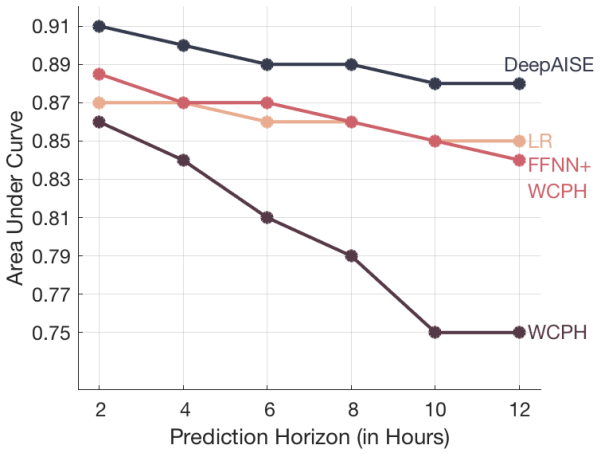
The central claim is that a time-to-event model built on recurrent neural representations can learn the temporal patterns and higher-order interactions among routine ICU measurements that precede sepsis, and that these learned representations outperform logistic regression, a plain Weibull-Cox model, and a feedforward neural network at every prediction horizon tested. The paper further claims that the choice of sepsis label matters: using counterfactual policy evaluation, the Sepsis-3 definition supports a clinically meaningful early-antibiotic policy, with an expected 8.2% improvement in survival when antibiotics are given six hours before onset, while an alternative CDC-style label does not support such a policy. DeepAISE also produces a local explanation for each hourly score by computing input-gradient relevance scores, and the paper argues that these local attributions reflect the actual drivers of individual predictions better than a global list of important features.
Load-bearing premise
The model's reported accuracy rests on the assumption that the SOFA components, antibiotic timestamps, and culture timestamps in its input stream do not already contain the information that defines the sepsis onset label; if future values leak into the prediction window, the AUCs overstate true early prediction.
Editorial extensions
If this is right
- Hourly risk scores can be generated from routine EHR data starting four hours after ICU admission and remain discriminative out to a 12-hour horizon, so the method is deployable without high-resolution bedside monitors.
- If the 8.2% attributable treatment effect estimate holds, a policy of acting on alerts six hours before Sepsis-3 onset could prevent a meaningful fraction of sepsis-related deaths, at the cost of treating patients whose alarms are false.
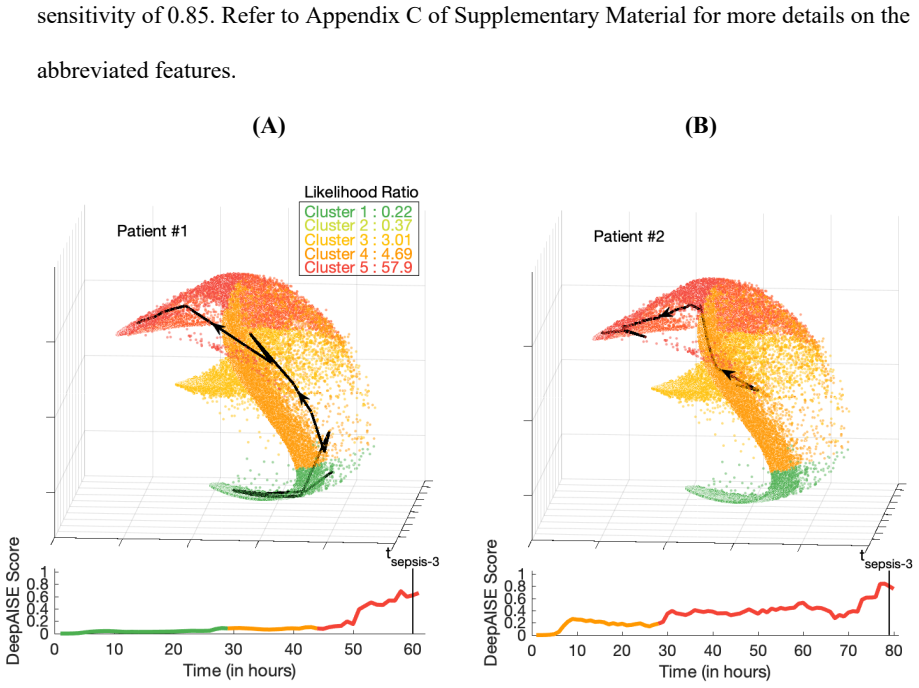
- Because local relevance scores identify the physiology driving each alert, clinicians can use the explanation to decide whether an alert reflects infection, postoperative inflammation, or another deterioration.
- The same GRU-survival architecture and label-selection procedure transfers to the external validation cohort with lower but still strong AUC, suggesting that the learned temporal features are not hospital-specific.
- The separation between global and local feature importance implies that a one-size-fits-all explanation of a sepsis model is inadequate, so deployment tools should surface patient-specific contributors.
Reading between the lines
- A reader may infer that by monitoring which labs and vitals dominate local relevance scores, hospitals could schedule laboratory draws to refresh precisely those measurements, potentially improving model sensitivity without adding all measurements.
- The paper's ATEE estimate assumes that the counterfactual antibiotics policy has no net harm from unnecessary treatment; because the false-alarm rate is around 20 to 26 percent, a reader should weigh possible antibiotic overuse and resistance before translating the 8.2% into expected population benefit.
- The label-leakage concern is not fully settled by the delta-SOFA control: a more decisive test would retrain the model with all SOFA component variables and antibiotic and culture timestamps removed, and compare the AUC.
- The same procedure of choosing a label definition by counterfactual policy value could be applied to other consensus-defined syndromes, such as acute kidney injury or acute respiratory distress syndrome, where onset-time definitions are similarly debated.
Signed reviews
Editorial analysis
A structured set of objections, weighed in public.
Referee Report
Summary. The paper presents DeepAISE, an end-to-end recurrent neural survival model for early prediction of sepsis onset in ICU patients. The model combines a two-layer GRU with a Weibull-Cox proportional hazards layer and is trained on hourly EHR data to predict tsepsis-3 (the Sepsis-3 onset time) at horizons of 2–12 hours. The authors report AUCs of 0.90 (Emory internal test) and 0.87 (MIMIC-III) at a fixed sensitivity of 0.85, with corresponding false-alarm rates of 0.20 and 0.26, outperforming logistic regression, Weibull-Cox, and feedforward baselines. They also introduce an ATEE (attributable treatment effect) framework to compare sepsis labeling criteria and claim that treating patients with antibiotics six hours before tsepsis-3 would yield an 8.2% [7.4, 9.9] improvement in survival. The paper additionally describes an interpretability mechanism (saliency-based relevance scores), a low-dimensional patient trajectory visualization, and a deployed tele-ICU decision-support workflow.
Significance. If the central claims survive scrutiny, this is a substantial contribution to clinical machine learning. Strengths include: (1) evaluation in a sequential-prediction design with real-world prevalence, rather than case-control enrichment, which is methodologically more realistic; (2) comparison against multiple baselines with DeLong significance testing; (3) a concrete deployment narrative including a web-based demo; (4) a concrete attempt at clinically meaningful interpretability via per-prediction feature relevance; and (5) a novel use of counterfactual treatment-effect estimation to compare sepsis labeling criteria. The paper also leverages a large internal cohort (25,820 admissions) and a public external dataset. However, the generalizability claim is weakened because the MIMIC-III model was retrained on MIMIC-III rather than evaluated as a true external transfer, and the headline accuracy depends on the input features having no temporal leakage with respect to the Sepsis-3 label definition. The ATEE-derived clinical recommendation also requires the intervention to be well-defined when the treatment time is itself part of the label definition.
major comments (3)
- [Materials and Methods, 'Study design'; Table 3] The MIMIC-III result is not a true external validation. The manuscript states: 'The DeepAISE model was trained and evaluated on both the Emory cohort and the MIMIC-III external validation cohort separately.' Since the model was retrained on MIMIC, the MIMIC AUC of 0.87 demonstrates reproducibility across institutions, but not external validity in the usual sense of applying a fixed model to a new population. The abstract and Results claim 'external validation' is therefore overstated. Please either report the AUC of the Emory-trained model applied directly to MIMIC without retraining, or rephrase the claim as 'reproduced in a second cohort.'
- [Results, 'DeepAISE prediction performance for sepsis onset'; Appendix C; Table 1] The central early-prediction claim is vulnerable to label-feature overlap. tsepsis-3 is defined by a two-point SOFA increase within a 6-hour window plus tsuspicion, which is derived from antibiotic and blood-culture order timestamps. The model inputs are 65 EHR features whose full list is deferred to Appendix C, and the main text does not demonstrate that every hourly feature vector is strictly left-censored at the time of prediction. If SOFA components (PaO2, GCS, MAP, vasopressors, creatinine, bilirubin, platelets), antibiotic/culture timestamps, or last-observation-carried-forward values after the prediction boundary enter the input, a GRU can learn the Sepsis-3 rule itself. The delta-SOFA FFNN control (AUC 0.54) does not resolve this because it feeds only a summary score, not the full temporal feature sequence the GRU sees. Please provide a feature-by-feature temporal audit, explicitly listing each of the 65 features, how it is computed at prediction time, and how any future values are excluded; and add a control experiment that feeds the actual SOFA components and antibiotic/culture times to the same GRU-FFNN-WCPH architecture to show that the model outperforms this direct label-reconstruction oracle.
- [Methods, 'Attributable treatment effect estimates (ATEE)'; Table 2] The ATEE counterfactual 'antibiotics six hours before tsepsis-3' is not well-defined because tsepsis-3 depends on tsuspicion, which is defined from antibiotic and culture order times. An intervention that administers antibiotics earlier will itself alter tsuspicion and therefore tsepsis-3, changing the label used to anchor the counterfactual. This creates a potential circularity in the causal estimand. The 8.2% [7.4, 9.9] improvement claim therefore requires either a sensitivity analysis under an alternative label definition that fixes the infection-suspicion time independently of treatment timing, or a clear causal model of how the intervention affects the label. At minimum, please discuss this endogeneity and present an analysis with tsepsis-CDC or a SOFA-only onset definition as a robustness check.
minor comments (4)
- [Figure 4B caption] There is a typo: 'negative relavance score' should be 'negative relevance score'.
- [Methods, Eq. (1)] The sentence after Eq. (1) reads 'on the right-hand-side of the question'; this should be 'of the equation'.
- [Table 1] The definition of tsepsis-3 says 'The earlier of the tSOFA or tsuspicion was assigned to tsepsis,' but the proximity condition 'tSOFA + 24 hours > tsuspicion > tSOFA - 12 hours' is asymmetric and does not uniquely determine which is 'earlier' in all cases. Please clarify the exact assignment rule, including whether the earlier time point is used or whether tSOFA is the anchor.
- [Results, 'DeepAISE prediction performance for sepsis onset'] The manuscript reports AUC on the Emory year-based holdout (0.88) but does not state whether this holdout overlaps with the main Emory testing set. Please clarify the relationship between the year-based split and the 70/10/20 split.
Circularity Check
No demonstrated circularity: DeepAISE predicts a future label from earlier hour-binned features, and the ATEE analysis is a separate causal estimate.
full rationale
The paper's central derivation is the survival-model objective: each hourly window uses features x collected at time t and is labeled positive only if the Sepsis-3 event falls in the future horizon (tau is the duration from feature collection to event). The target tsepsis-3 is thus not an input transformed into an output by construction. The fact that some input features (e.g., PaO2, GCS, MAP) are components of the SOFA score used to define the label is a potential feature-label overlap, but the paper's event-window definition implies left-censoring, and no quoted preprocessing step or equation admits post-prediction SOFA components or antibiotic/culture timestamps into x; a leakage audit would be a correctness issue, not a circular reduction. The delta-SOFA FFNN control (AUC 0.54/0.68) is a weak ablation, but weakness of a control is not circularity. The WCPH component is cited to prior work by the same group (ref. 16), but the model is specified in Eq. 2 and evaluated against independent baselines and MIMIC-III external validation, so the self-citation is not load-bearing. The ATEE survival estimates are standard counterfactual predictions from fitted GPS/ADRF models, not predictions of the same fitted quantities. No step in the derivation reduces to its own inputs by definition.
Assumptions & free parameters
free parameters (6)
- GRU hidden state size =
100 per layer (2 layers)
- Learning rate =
1e-2
- L1 regularization weight =
1e-5
- L2 regularization weight =
1e-3
- Mini-batch composition =
1000 patients per batch, 90% controls / 10% septic
- Number of epochs =
200
assumptions (5)
- domain assumption Sepsis-3 criterion defines the ground truth onset time for the prediction label.
- domain assumption SOFA component values are valid input features for predicting the SOFA-based label.
- domain assumption The proportional hazards assumption of the Weibull-Cox model holds for sepsis onset.
- domain assumption Generalized propensity score assumptions: no unmeasured confounding, positivity, and correct model specification.
- ad hoc to paper Exclusion of patients with ICU length of stay greater than 20 days is valid.
Cite this review
Pith. "Pith review of DeepAISE -- An End-to-End Development and Deployment of a Recurrent Neural Survival Model for Early Prediction of Sepsis." pith.science (2026). https://pith.science/paper/X42KCUWU
@misc{pith2026190804759,
  author       = {Pith},
  title        = {Pith review of: DeepAISE -- An End-to-End Development and Deployment of a Recurrent Neural Survival Model for Early Prediction of Sepsis},
  year         = {2026},
  howpublished = {\url{https://pith.science/paper/X42KCUWU}},
  note         = {Machine review of arXiv:1908.04759}
}
read the original abstract
Sepsis, a dysregulated immune system response to infection, is among the leading causes of morbidity, mortality, and cost overruns in the Intensive Care Unit (ICU). Early prediction of sepsis can improve situational awareness amongst clinicians and facilitate timely, protective interventions. While the application of predictive analytics in ICU patients has shown early promising results, much of the work has been encumbered by high false-alarm rates. Efforts to improve specificity have been limited by several factors, most notably the difficulty of labeling sepsis onset time and the low prevalence of septic-events in the ICU. Here, we present DeepAISE (Deep Artificial Intelligence Sepsis Expert), a recurrent neural survival model for the early prediction of sepsis. We show that by coupling a clinical criterion for defining sepsis onset time with a treatment policy (e.g., initiation of antibiotics within one hour of meeting the criterion), one may rank the relative utility of various criteria through offline policy evaluation. Given the optimal criterion, DeepAISE automatically learns predictive features related to higher-order interactions and temporal patterns among clinical risk factors that maximize the data likelihood of observed time to septic events. DeepAISE has been incorporated into a clinical workflow, which provides real-time hourly sepsis risk scores. A comparative study of four baseline models indicates that DeepAISE produces the most accurate predictions (AUC=0.90 and 0.87) and the lowest false alarm rates (FAR=0.20 and 0.26) in two separate cohorts (internal and external, respectively), while simultaneously producing interpretable representations of the clinical time series and risk factors.
Figures

Figures from the paper (3 more)


Reference graph
Works this paper leans on
-
[10]
C. M. DesRoches, E. G. Campbell, S. R. Rao, K. Donelan, T. G. Ferris, A. Jha, R. Kaushal, D. E. Levy, S. Rosenbaum, A. E. Shields, Electronic health records in ambulatory care—a national survey of physicians, New England Journal of Medicine 359, 50–60 (2008). 11. T. Desautels, J. Calvert, J. Hoffman, M. Jay, Y. Kerem, L. Shieh, D. Shimabukuro, U. Chettipa...
work page 2008
-
[17]
K. E. Henry, D. N. Hager, P. J. Pronovost, S. Saria, A targeted real-time early warning score (TREWScore) for septic shock, Science Translational Medicine 7, 299ra122-299ra122 (2015). 18. C. Lin, Y. Zhangy, J. Ivy, M. Capan, R. Arnold, J. M. Huddleston, M. Chi, Early diagnosis and prediction of sepsis shock by combining static and dynamic information usin...
work page 2015
-
[24]
R. C. Bone, R. A. Balk, F. B. Cerra, R. P. Dellinger, A. M. Fein, W. A. Knaus, R. M. Schein, W. J. Sibbald, Definitions for sepsis and organ failure and guidelines for the use of innovative therapies in sepsis. The ACCP/SCCM Consensus Conference Committee. American College of Chest Physicians/Society of Critical Care Medicine, Chest 101, 1644–1655 (1992)....
arXiv 1992
-
[37]
A. H. Carneiro, P. Póvoa, J. A. Gomes, Dear Sepsis-3, we are sorry to say that we don’t like you, Rev Bras Ter Intensiva 29, 4–8 (2017). 38. S. K. Gadre, M. Shah, E. Mireles-Cabodevila, B. Patel, A. Duggal, Epidemiology and predictors of 30-day readmission in patients with sepsis, Chest 155, 483–490 (2019). 39. M. Shankar-Hari, G. D. Rubenfeld, Understand...
arXiv 2017
-
[46]
J. Snoek, H. Larochelle, R. P. Adams, Practical bayesian optimization of machine learning algorithms, Advances in Neural Information Processing Systems , 2951–2959 (2012). 47. T. E. Oliphant, A guide to NumPy (Trelgol Publishing USA, 2006). 48. M. Abadi, P. Barham, J. Chen, Z. Chen, A. Davis, J. Dean, M. Devin, S. Ghemawat, G. Irving, M. Isard, Tensorflow...
work page 2012
Reviewed August 14, 2026 · model on record in the stance chip above.
Discussion (0). Continue with ORCID to comment.