REVIEW 3 major objections 6 minor 1 cited by
Tuning between photon-number and quadrature measurements with weak-field homodyne detection
T0 review · 3 major / 6 minor · reviewed 2026-08-14 · deepseek-v4-flash
Pith's one-line read A weak-field homodyne detector can be tuned continuously between photon-number and quadrature measurements by adjusting the coherent state's amplitude, and the paper demonstrates this experimentally.
desk verdict A solid experimental demonstration that weak-field homodyne detection really can tune between photon-number and quadrature measurements; the central claim holds up, but the mode-overlap parameter in the model is partly tuned to the data, and the secondary linear-scaling claim is heuristic. read the letter →
The pith
A machine-rendered reading of the paper's core claim, the machinery that carries it, and where it could break.
The reading
What carries the argument
The central object is the photon-number difference observable $\Delta\hat{n}=i(\hat{a}^\dagger\hat{b}-\hat{a}\hat{b}^\dagger)$ formed by mixing a signal and a coherent reference on a balanced beam splitter. With ideal number-resolving detection, $\alpha=0$ projects onto photon-number states, while the classical-field limit $\hat{b}\to|\alpha|e^{i\theta}$ turns the same observable into $i|\alpha|\hat{X}(\theta)$, the quadrature operator. The ability to resolve up to about twenty photons with transition edge sensors, superconducting bolometers that measure absorbed light energy, is what makes the intermediate regime experimentally accessible. The comparison models include the effects of detection inefficiency and a heuristic two-effective-mode description of mode mismatch parameterized by a single overlap $M$.
What would settle it
Use the same detector to measure difference statistics for a signal built from two clearly separated temporal modes with a known amplitude ratio, and compare the results to the two-effective-mode prediction computed with the independently measured overlap $M$; a systematic mismatch would show that the single-parameter model is not sufficient to establish the convergence claim.
Extended reading notes
Core claim
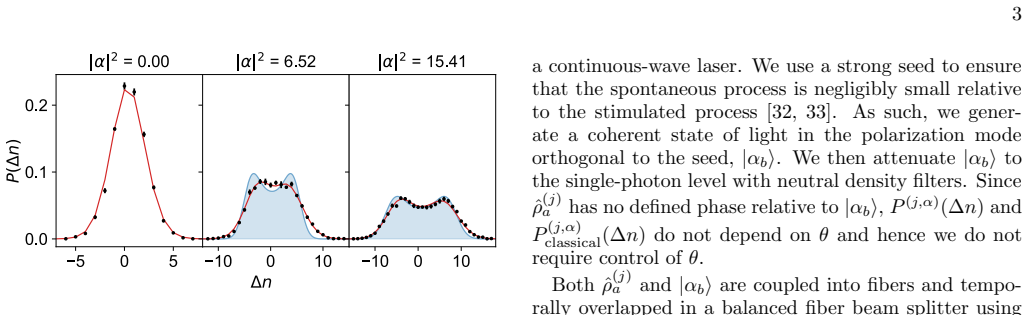
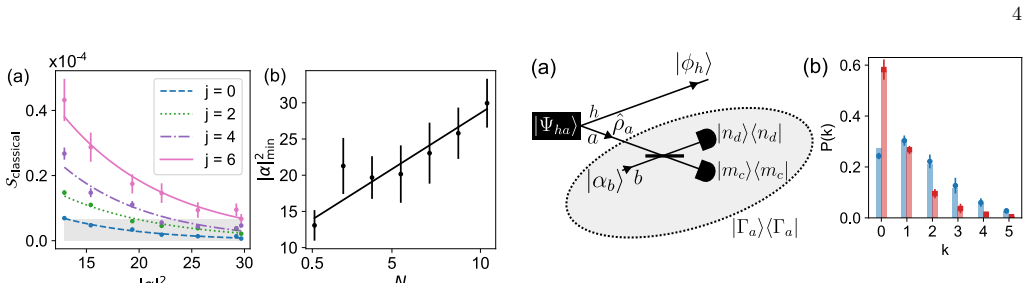
The central discovery is that weak-field homodyne detection continuously interpolates between two complementary measurements. With the signal in a photon-number state and a coherent reference of amplitude $\alpha$, the measured photon-number difference $\Delta\hat{n}=i(\hat{a}^\dagger\hat{b}-\hat{a}\hat{b}^\dagger)$ reduces, under the classical-field approximation $\hat{b}\to|\alpha|e^{i\theta}$, to $i|\alpha|\hat{X}(\theta)$, where $\hat{X}(\theta)$ is the quadrature operator. The measured probability $P^{(j,\alpha)}(\Delta n)$ approaches $P^{(j,\alpha)}_{\mathrm{classical}}(\Delta n)$, the quadrature distribution of a $j$-photon state, as $|\alpha|$ grows. For $j=6$ and $|\alpha|^2=15.41$, the data agree with both the full quantum model and the classical-field model even though $|\alpha|$ is not much larger than the mean photon number $N=10.4$, showing that the measurement is already projecting onto quadrature states. The paper further observes that the minimum coherent strength $|\alpha|^2_{\min}$ required for a quadrature-like measurement scales linearly with $N$, instead of quadratically, and attributes this relaxation to detector inefficiency smoothing the quadrature distribution.
Load-bearing premise
The comparison between data and theory assumes that all imperfect overlap between the signal and the coherent reference can be described by a single number representing how well the two fields occupy the same optical mode; if the fields actually spread over three or more distinct modes, the claimed convergence to quadrature statistics could be an artifact of that assumption.
Editorial extensions
If this is right
- An experimenter can switch a single detector between photon counting and homodyne-like quadrature measurement simply by changing the intensity of the coherent reference field, with no rearrangement of optics.
- In the intermediate regime, the detector performs phase-sensitive non-Gaussian projections, a capability unavailable to either standard photon counters or strong-field homodyne alone.
- The demonstrated state-engineering result implies that one arm of an entangled two-mode squeezed state can be steered into different photon-number distributions by choosing the detection outcome and local-oscillator amplitude.
- Because detector inefficiency lowers the required local-oscillator strength, practical weak-field homodyne can operate with weaker references than the textbook condition $|\alpha|\gg N$.
- The same setup could serve as a loss-tolerant tool for heralding non-Gaussian states such as Schrödinger cat states, since the heralded state's form depends on the continuously tunable measurement basis.
Reading between the lines
- Inference: If the observed linear scaling of $|\alpha|^2_{\min}$ with $N$ holds at other efficiencies, then lossy photon-number-resolving detectors may permit quadrature monitoring of relatively bright signals without bright local oscillators; this is a testable prediction the paper does not make.
- Inference: A direct check of the two-effective-mode overlap assumption would be to deliberately prepare a signal in two distinguishable modes with a known amplitude ratio and compare the model's prediction with the measured difference statistics; a systematic mismatch would indicate that the single overlap parameter $M$ is not sufficient.
- Inference: The same apparatus, used twice, could both herald a non-Gaussian state and verify its nonclassicality in a loss-tolerant way; the paper mentions the prospect but does not implement it.
- Inference: The convergence of discrete difference statistics to a quadrature distribution suggests that weak-field homodyne could serve as a resource for hybrid protocols where the same physical measurement is switched between discrete and continuous variable encodings without changing the optical layout.
Signed reviews
Editorial analysis
A structured set of objections, weighed in public.
Referee Report
Summary. This paper reports an experimental implementation of weak-field homodyne detection using photon-number-resolving transition edge sensors. The authors combine a heralded photon-number state (the signal) with a weak coherent state on a balanced beam splitter and record the photon-number difference at the two outputs. They observe that, as the coherent-state amplitude increases, the measured difference statistics transition from matching a quantum model without the classical-field approximation to also matching a classical-field (quadrature) model. They quantify this transition with a residual metric S_classical and extract a minimum coherent-state amplitude |α|²_min for quadrature behavior, reporting a linear scaling with the signal's mean photon number. They also demonstrate a proof-of-principle state-engineering application in which the weak-field homodyne measurement conditions the photon-number distribution of the heralded mode.
Significance. If the central claims are sustained, this is a valuable experimental advance: it is the first demonstration of continuous tuning between photon-number and quadrature measurements using photon-number-resolving detectors with high efficiency and dynamic range. The paper is generally careful in modeling the experiment, with derivations of the quantum and classical equations in the Supplemental Material and independent calibration of detector efficiencies and the squeezing parameter. The use of TES detectors and the quantitative residual analysis are strengths. However, the mode-overlap parameter M is partly adjusted to fit the very data used for comparison, which tempers the strength of the quadrature-convergence claim.
major comments (3)
- [Supplemental Material, 'Model parameters'; main text 'Results'] The main text states that the parameters of the comparison models are determined from independent measurements, but the mode-overlap parameter M is not independently measured. The supplement reports a measured visibility V=0.800±0.060 and states that 'the models agree best with the data by using M=0.82.' Because both P^(j,α)(Δn) and P^(j,α)_classical(Δn) are evaluated with this same M (Supplemental Eqs. S13 and S19), the agreement between the data and the classical model at |α|²=15.41 in Fig. 3 is in part due to choosing M to fit the data. This weakens the central claim that the detector is already projecting onto quadrature states. I recommend that the authors either determine M from an independent measurement, or provide a quantitative sensitivity analysis of the conclusions with respect to M over its uncertainty range, and explicitly state that M is a fitted parameter rather than an independently measured one.
- [Results, Fig. 4 and Eq. (6)] The extraction of |α|²_min relies on an exponential fit A exp(-B|α|²) to S_classical, but the text only says this is done 'for sufficiently large |α|²' without specifying the number of points, the fitting range, or the criterion used. Because |α|²_min is determined by extrapolating this fit to the threshold S_classical=6.7e-6, the reported linear scaling in Fig. 4(b) could depend on these choices. The authors should state the fitting procedure precisely and show that the conclusions are robust, for instance by fitting over different ranges or reporting systematic uncertainties.
- [Results, Eq. (6)] The threshold S_classical=6.7e-6 is defined as the average squared residual between the data and the quantum model over all j and |α|. Since the quantum model itself depends on the fitted M, the threshold inherits the same model dependence. The authors should quantify how the threshold and hence |α|²_min change when M is varied within its uncertainty, and clarify whether the extracted linear scaling is robust.
minor comments (6)
- [Supplemental Material, Table I] In the 'Model parameters' table, M is listed as 0.800±0.060, but the text states that M=0.82 is used for the model; please ensure that the reported value and the used value are consistent and clearly indicated.
- [Fig. 3 caption and main text] The main text and Fig. 3 use both 'blue curves' and 'blue regions' for the classical model; please use consistent terminology throughout.
- [Results, Fig. 3] The paper would be strengthened by reporting a goodness-of-fit statistic such as reduced chi-square to support the visual claim of agreement between the data and the models.
- [Results, Fig. 4] The exponential fit function is not displayed in the figure or caption; please include it and specify the fitted range.
- [Results, Fig. 4(b)] The claim of a linear scaling between |α|²_min and N would benefit from a citation or a brief derivation, since the linear scaling is presented as a surprising result.
- [Supplemental Material, Fig. S6 caption] There is a typo in the Fig. S6 caption: 'respecitvely' should be 'respectively.'
Circularity Check
The quadrature-convergence comparison is mildly compromised by a mode-overlap parameter M that is chosen to best fit the same data, but the central tunability result remains independently supported.
-
fitted input called prediction
[Supplemental Material, 'Model parameters' (p. 9-10); used in Eqs. (S13), (S16), (S19), (S20); main text Results and Fig. 3.]
"the visibility V of this interference signal provides a lower bound onM. We measuredV = 0.800±0.060, and found that the models agree best with the data by usingM = 0.82."
The red and blue model curves in Fig. 3, including the classical-field quadrature reference P_classical, are evaluated with M=0.82 via Eqs. (S19)-(S20). M is not independently determined; it is chosen because the models 'agree best with the data' being compared. The subsequent claim that at |α|^2=15.41 the data 'are already projecting onto quadrature states' is therefore based partly on a fitted parameter pulling the model toward those same data. The effect is limited because M=0.82 is within the independently measured visibility uncertainty (V=0.800±0.060), and the raw statistics show the trend, so the central claim does not reduce wholly to the fit.
full rationale
The theoretical derivation is self-contained: Eqs. (S7)-(S20) start from the standard beam-splitter transformation and derive the photon-number-difference statistics with and without the classical-field approximation, including Bernoulli-modeled detector losses and an imperfect heralded signal. The efficiencies η_c, η_d, η_h, the squeezing parameter |λ|, and the coherent-state amplitude |α| are obtained from independent Klyshko, photon-counting, and pump-blocking measurements, not from the target difference statistics. No uniqueness theorem is imported, and the self-citations (e.g., Refs. [18-20], [34], [40]) are contextual or methodological rather than load-bearing. The only reduction is the mode-overlap parameter M, which is adjusted to 'agree best with the data' inside the measured visibility uncertainty. Because M is a single constrained parameter and the qualitative tunability between photon-number and quadrature statistics is visible directly in the measured data, the paper's main claim retains independent content. This is a minor circular element, not a self-definitional collapse, so the score is 2.
Assumptions & free parameters
free parameters (3)
- Mode overlap M =
0.82 (within measured visibility 0.800 ± 0.060)
- Threshold S_classical for |α|²_min =
6.7 × 10^-6
- Exponential model parameters A and B for S_classical(|α|²) =
Not reported numerically
assumptions (5)
- standard math Balanced beam splitter unitary transformation (Eq. S8) and the standard commutation relations for annihilation operators.
- domain assumption The coherent state |α_b⟩ can be decomposed into two effective orthogonal modes using Eq. (S12), with a single mode overlap parameter M.
- standard math Detection inefficiency is modeled by fictitious beam splitters with transmissivity η_c and η_d before the detectors (Eq. S11).
- domain assumption The heralded signal ρ̂_a^(j) is a statistical mixture of photon-number states given by Eq. (S14), resulting from a two-mode squeezed vacuum and a heralding measurement with efficiency η_h.
- domain assumption In the large-|α| limit, the classical field approximation b̂ → |α| e^{iθ} is valid (Eq. 2).
Cite this review
Pith. "Pith review of Tuning between photon-number and quadrature measurements with weak-field homodyne detection." pith.science (2026). https://pith.science/paper/7IGWBQ2C
@misc{pith2026190804765,
  author       = {Pith},
  title        = {Pith review of: Tuning between photon-number and quadrature measurements with weak-field homodyne detection},
  year         = {2026},
  howpublished = {\url{https://pith.science/paper/7IGWBQ2C}},
  note         = {Machine review of arXiv:1908.04765}
}
read the original abstract
Variable measurement operators enable the optimization of strategies for testing quantum properties and the preparation of a range of quantum states. Here, we experimentally implement a weak-field homodyne detector that can continuously tune between measuring photon numbers and field quadratures. We combine a quantum signal with a coherent state on a balanced beam splitter and detect light at both output ports using photon-number-resolving transition edge sensors. We observe that the discrete difference statistics converge to the quadrature distribution of the signal as we increase the coherent state amplitude. Moreover, in a proof-of-principle demonstration of state engineering, we show the ability to control the photon-number distribution of a state that is heralded using our weak-field homodyne detector.
Figures

Forward citations
Cited by 1 Pith paper
-
Engineering Schr\"odinger cat states with a photonic even-parity detector
A photonic even-parity detector, built from a beam splitter and photon-number-resolving detectors, can remotely prepare two- and four-component Schrödinger cat states with fidelity approaching unity.
Reference graph
Works this paper leans on
- [1]
- [2]
-
[3]
D. A. Glaser, Phys. Rev. 87, 665 (1952)
work page 1952
-
[4]
R. H. Hadfield, Nat. Photon. 3, 696 (2009)
work page 2009
- [5]
- [6]
-
[7]
S. L. Braunstein, Phys. Rev. A 42, 474 (1990)
work page 1990
- [8]
Show all 50 references
-
[9]
M. G. Raymer, J. Cooper, H. J. Carmichael, M. Beck, and D. T. Smithey, J. Opt. Soc. Am. B 12, 1801 (1995)
1995
-
[10]
Banaszek and K
K. Banaszek and K. W´ odkiewicz, Phys. Rev. A55, 3117 (1997)
1997
-
[11]
Tyc and B
T. Tyc and B. C. Sanders, J. Phys. A 37, 7341 (2004)
2004
-
[12]
Grangier, M
P. Grangier, M. J. Potasek, and B. Yurke, Phys. Rev. A 38, 3132 (1988)
1988
-
[13]
Banaszek and K
K. Banaszek and K. W´ odkiewicz, Phys. Rev. A58, 4345 (1998)
1998
-
[14]
Kuzmich, I
A. Kuzmich, I. A. Walmsley, and L. Mandel, Phys. Rev. Lett. 85, 1349 (2000)
2000
-
[15]
A. I. Lvovsky and M. G. Raymer, Rev. Mod. Phys. 81, 299 (2009)
2009
-
[16]
S. L. Braunstein and P. van Loock, Rev. Mod. Phys. 77, 513 (2005)
2005
-
[17]
N. C. Menicucci, P. van Loock, M. Gu, C. Weedbrook, T. C. Ralph, and M. A. Nielsen, Phys. Rev. Lett. 97, 110501 (2006)
2006
-
[18]
Puentes, J
G. Puentes, J. S. Lundeen, M. P. A. Branderhorst, H. B. Coldenstrodt-Ronge, B. J. Smith, and I. A. Walmsley, Phys. Rev. Lett. 102, 080404 (2009)
2009
-
[19]
Zhang, H
L. Zhang, H. B. Coldenstrodt-Ronge, A. Datta, G. Puentes, J. S. Lundeen, X.-M. Jin, B. J. Smith, M. B. Plenio, and I. A. Walmsley, Nat. Photon. 6, 364 (2012)
2012
-
[20]
Donati, T
G. Donati, T. J. Bartley, X.-M. Jin, M.-D. Vidrighin, A. Datta, M. Barbieri, and I. A. Walmsley, Nat. Com- mun. 5, 5584 (2014)
2014
-
[21]
U. L. Andersen, J. S. Neergaard-Nielsen, P. van Loock, and A. Furusawa, Nat. Phys. 11, 713 (2015)
2015
-
[22]
Allevi, M
A. Allevi, M. Bina, S. Olivares, and M. Bondani, Int. J. Quantum Inf 15, 1740016 (2017)
2017
-
[23]
Olivares, A
S. Olivares, A. Allevi, G. Caiazzo, M. G. Paris, and M. Bondani, New Journal of Physics 21, 103045 (2019)
2019
-
[24]
A. E. Lita, A. J. Miller, and S. W. Nam, Opt. Exp. 16, 3032 (2008)
2008
-
[25]
Leonhardt, Measuring the Quantum State of Light (Cambridge University Press, 1997)
U. Leonhardt, Measuring the Quantum State of Light (Cambridge University Press, 1997)
1997
-
[26]
Skotiniotis, W
M. Skotiniotis, W. D¨ ur, and P. Sekatski, Quantum1, 34 (2017)
2017
-
[27]
See the Supplemental Material for additional details on the theoretical models and the experimental setup
-
[28]
M. J. Fitch, B. C. Jacobs, T. B. Pittman, and J. D. Franson, Phys. Rev. A 68, 043814 (2003)
2003
-
[29]
P. C. Humphreys, B. J. Metcalf, T. Gerrits, T. Hiem- stra, A. E. Lita, J. Nunn, S. W. Nam, A. Datta, W. S. Kolthammer, and I. A. Walmsley, New J. Phys. 17, 103044 (2015)
2015
-
[30]
Eckstein, A
A. Eckstein, A. Christ, P. J. Mosley, and C. Silberhorn, Phys. Rev. Lett. 106, 013603 (2011)
2011
-
[31]
Sperling, W
J. Sperling, W. R. Clements, A. Eckstein, M. Moore, J. J. Renema, W. S. Kolthammer, S. W. Nam, A. Lita, T. Gerrits, W. Vogel, G. S. Agarwal, and I. A. Walmsley, Phys. Rev. Lett. 118, 163602 (2017)
2017
-
[32]
Aichele, A
T. Aichele, A. I. Lvovsky, and S. Schiller, Eur. Phys. J. D 18, 237 (2002)
2002
-
[33]
Liscidini and J
M. Liscidini and J. E. Sipe, Phys. Rev. Lett. 111, 193602 (2013)
2013
-
[34]
Thekkadath, B
G. Thekkadath, B. Bell, I. Walmsley, and A. Lvovsky, Quantum 4, 239 (2020)
2020
-
[35]
Royer, Phys
A. Royer, Phys. Rev. A 15, 449 (1977)
1977
-
[36]
Laiho, K
K. Laiho, K. N. Cassemiro, D. Gross, and C. Silberhorn, Phys. Rev. Lett. 105, 253603 (2010)
2010
-
[37]
Lipfert, J
T. Lipfert, J. Sperling, and W. Vogel, Phys. Rev. A 92, 053835 (2015)
2015
-
[38]
Harder, C
G. Harder, C. Silberhorn, J. Rehacek, Z. Hradil, L. Motka, B. Stoklasa, and L. L. S´ anchez-Soto, Phys. Rev. Lett. 116, 133601 (2016)
2016
-
[39]
Bohmann, J
M. Bohmann, J. Tiedau, T. Bartley, J. Sperling, C. Sil- berhorn, and W. Vogel, Phys. Rev. Lett. 120, 063607 (2018)
2018
-
[40]
Sperling, D
J. Sperling, D. S. Phillips, J. F. F. Bulmer, G. S. Thekka- dath, A. Eckstein, T. A. W. Wolterink, J. Lugani, S. W. Nam, A. Lita, T. Gerrits, W. Vogel, G. S. Agarwal, C. Sil- berhorn, and I. A. Walmsley, Phys. Rev. Lett. 124, 013605 (2020)
2020
-
[41]
S.-W. Ji, J. Kim, H.-W. Lee, M. S. Zubairy, and H. Nha, Phys. Rev. Lett. 105, 170404 (2010). 6
2010
-
[42]
Ourjoumtsev, R
A. Ourjoumtsev, R. Tualle-Brouri, J. Laurat, and P. Grangier, Science 312, 83 (2006)
2006
-
[43]
Tualle-Brouri, A
R. Tualle-Brouri, A. Ourjoumtsev, A. Dantan, P. Grang- ier, M. Wubs, and A. S. Sørensen, Phys. Rev. A 80, 013806 (2009)
2009
-
[44]
M. C. Tichy, J. Phys. B 47, 103001 (2014)
2014
-
[45]
D. N. Klyshko, Quantum Electron. 10, 1112 (1980)
1980
-
[46]
K. D. Irwin, Appl. Phys. Lett 66, 1998 (1995)
1995
-
[47]
R. P. Welty and J. M. Martinis, IEEE Trans. Magn 27, 2924 (1991)
1991
-
[48]
Figueroa-Feliciano, B
E. Figueroa-Feliciano, B. Cabrera, A. Miller, S. Powell, T. Saab, and A. Walker, Nucl. Instrum. Methods Phys. Res 444, 453 (2000)
2000
-
[49]
Z. H. Levine, T. Gerrits, A. L. Migdall, D. V. Samarov, B. Calkins, A. E. Lita, and S. W. Nam, J. Opt. Soc. Am. B 29, 2066 (2012)
2012
-
[50]
Sperling, A
J. Sperling, A. Eckstein, W. R. Clements, M. Moore, J. J. Renema, W. S. Kolthammer, S. W. Nam, A. Lita, T. Gerrits, I. A. Walmsley, G. S. Agarwal, and W. Vogel, Phys. Rev. A 96, 013804 (2017). SUPPLEMENTAL MATERIAL Theory I: Photon-number difference statistics without a classic...
2017
Reviewed August 14, 2026 · model on record in the stance chip above.
Discussion (0). Continue with ORCID to comment.