REVIEW 3 major objections 6 minor 30 references
Adaptive Learning of Aggregate Analytics under Dynamic Workloads
T0 review · 3 major / 6 minor · reviewed 2026-08-14 · deepseek-v4-flash
Pith's one-line read Aggregate-query answers can be predicted locally with under 10% error, and a distance-based drift detector keeps those predictions accurate when analysts' query patterns shift.
desk verdict A plausible query-driven analytics system with a genuinely new drift-detection loop, but the load-bearing distance-to-error proxy is weakly validated and the theoretical bounds do not hold up; worth a serious referee but needs major revision. read the letter →
The pith
A machine-rendered reading of the paper's core claim, the machinery that carries it, and where it could break.
The reading
What carries the argument
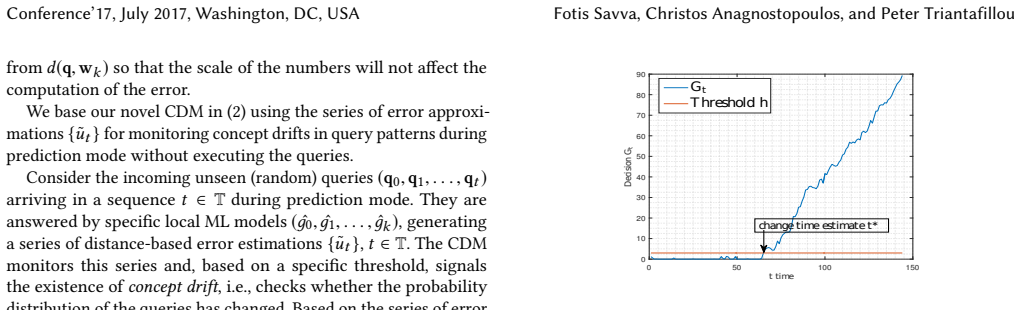
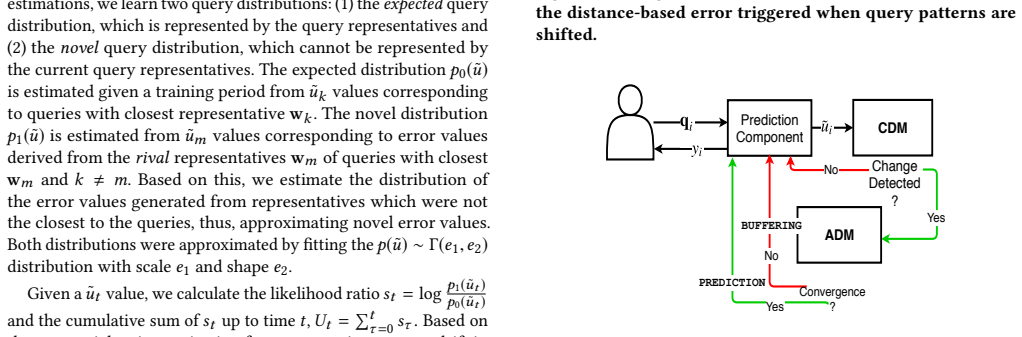
The load-bearing mechanism is the query-vector representation $q=[l_1,u_1,\ldots,l_d,u_d]\in\mathbb{R}^{2d}$, with squared Euclidean distance as the similarity measure, together with a growing set of cluster representatives $w_k$. Each cluster $C_k$ trains a local regression model $\hat{g}_k$, and prediction is $\hat{y}=\sum_{k=1}^K I_k\,\hat{g}_k(q)$, where $I_k$ selects the closest representative. For drift detection, the paper replaces the unavailable true error $(y-\hat{y})^2$ with the distance-based estimate $\tilde{u} = \ln\bigl(1 + d(q,w_k) - \min_{q_\ell\in C_k} d(w_k,q_\ell)\bigr)\cdot u_k$, and feeds the log-likelihood ratios of $\tilde{u}$ into a CUSUM control chart with decision function $G_t=\max(0,G_{t-1}+s_t)$ and threshold $h$. Adaptation is carried by an SGD update that converges a new prototype to the median of the forwarded queries, together with a rival-representative variance rule that decides which queries must go to the central system.
What would settle it
Run the proposed change detector on a labeled stream in which query-region drift is injected at known times, and record both the distance-based error estimate of Equation (2) and the true prediction error. If the two do not rise together, or if the CUSUM alarm fires while the true error remains flat, the proxy at the heart of the drift detector is not doing the work the paper requires.
Extended reading notes
Core claim
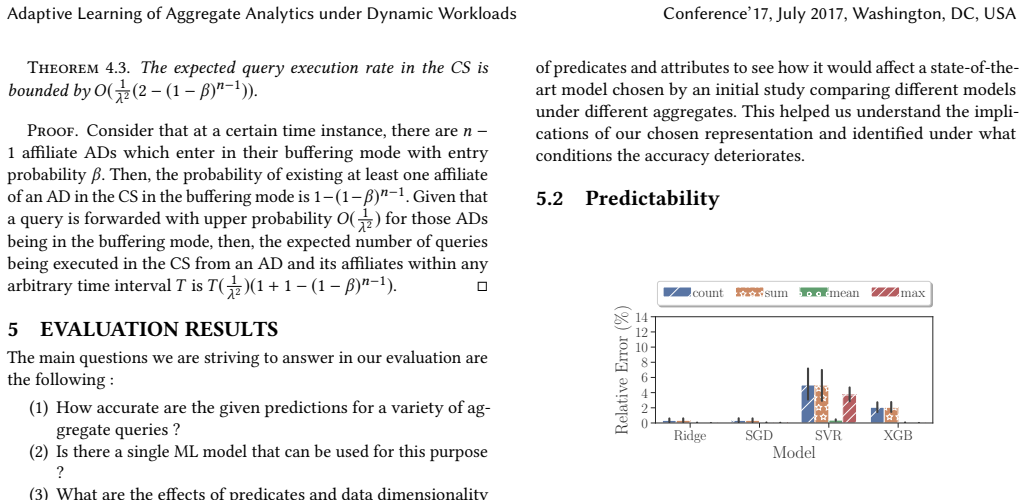
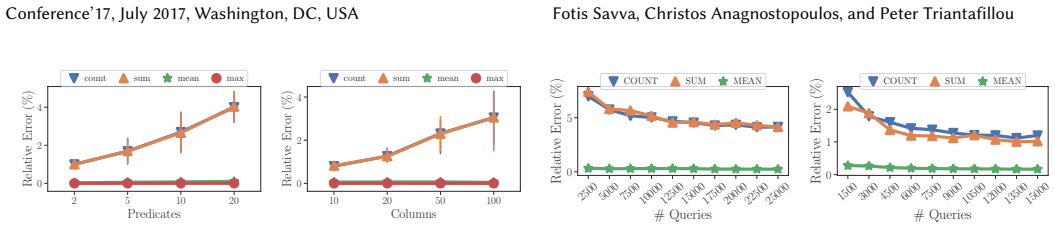
On the paper's own terms, the discovery is that query-driven learning, previously used for cardinality estimation, can be turned into a full aggregate-answer prediction service that is robust to non-stationary workloads. Each query is encoded as a vector of range-predicate bounds, the query space is quantized into clusters, and a local regression model is trained inside every cluster. During prediction mode, only the model of the closest cluster is consulted, giving a predicted answer in well under a millisecond. Because the true answer is not available to the client, the paper replaces the true prediction error by a distance-based estimate and feeds its log-likelihood ratios into a CUSUM control chart; when the cumulative sum crosses a threshold, the device enters buffering mode, where a new cluster representative is adapted toward the median of the queries that had to be executed centrally. Once the new representative converges, the expanded model set is returned to the device, and the paper reports that accuracy stays below 10% relative error across all tested aggregates.
Load-bearing premise
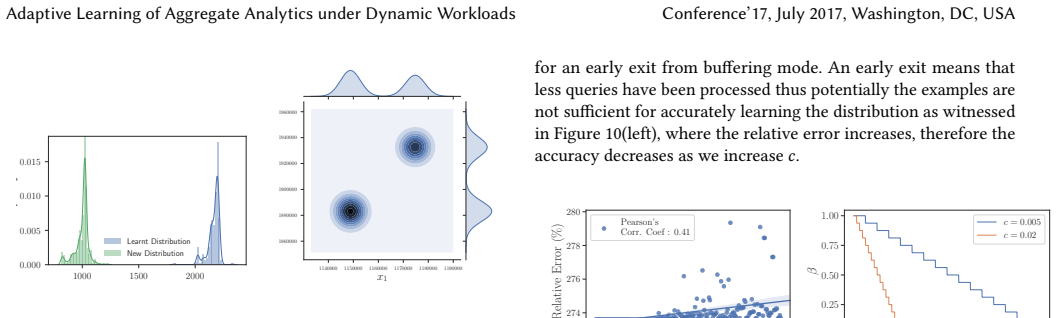
The change detector assumes that a query's distance to its nearest cluster representative tracks how wrong its predicted answer is; the only reported evidence for that link is a single Pearson correlation of 0.3 on one dataset.
Editorial extensions
If this is right
- In prediction mode, each answer is a single forward pass through one small local model, so response time stays in the sub-millisecond range and exploratory interaction remains within the roughly 500 ms interactivity budget even when the backend is remote or federated.
- During buffering, only queries that fall outside the variance radius of their rival cluster representative are sent to the central system, and the Chebyshev bound caps this forwarding probability at a bounded fraction, so most buffering-mode queries are still answered locally.
- Affiliate devices pool their executed queries in the central system, so when many analysts drift at once the new representative converges faster and the expected number of centrally executed queries over any interval is bounded rather than growing linearly with workload.
- If the query space contains finitely many analyst subspaces, repeated drift cycles eventually cover all of them and the probability of entering buffering mode drops to zero, making the system an offline predictor for the learned workload.
- Since one regression algorithm suffices for all tested aggregate operators, the deployed client can store a single model class, keeping the footprint small enough for an analyst's device.
Reading between the lines
- A direct test of the weakest link would be to measure, on several real workloads with injected drift, whether the distance-based error estimate and the true prediction error move together; if not, the CUSUM trigger should be redesigned around a different proxy.
- The query-vector representation is operator-agnostic, so the same machinery could plausibly be applied to join or window aggregates, but each new operator family would need its own validation of the distance-error correlation.
- The affiliate mechanism implies a network effect that the paper does not isolate: devices with overlapping query subspaces should converge faster together, a prediction that a multi-client simulation with correlated drift could test.
- The convergence to an offline mode depends on the set of query subspaces being finite; under open-ended exploration the model ensemble would keep growing, so memory and stale-model management would become the practical bottleneck.
Signed reviews
Editorial analysis
A structured set of objections, weighed in public.
Referee Report
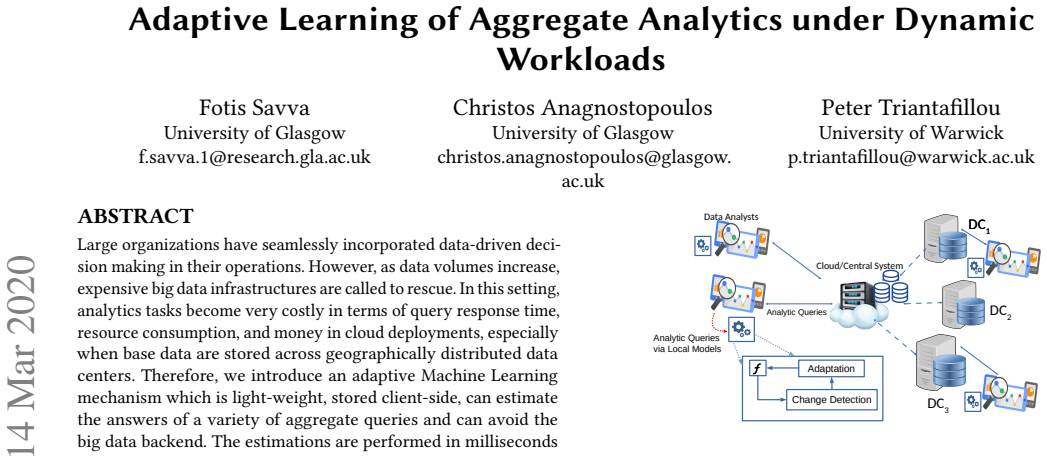
Summary. The paper proposes a client-side, learning-based approximate query processing system for aggregate analytics. Queries are encoded as range vectors, clustered in the query space, and per-cluster regression models are trained to predict aggregate answers without accessing the backend. During prediction mode, a Change Detection Mechanism (CDM) monitors a distance-based proxy of the prediction error to detect concept drift in query workloads, and an Adaptation Mechanism (ADM) selectively forwards queries to the central server, trains new models, and exploits affiliate adaptations from other analysts. The evaluation reports sub-millisecond prediction times and relative errors below 10% on synthetic and real datasets, and claims that the system detects and adapts to dynamic workloads.
Significance. If the drift-detection claim can be substantiated, the work would be a practical contribution: a lightweight alternative to approximate query processing engines for exploratory analytics, with fast local predictions and explicit handling of non-stationary query workloads, an issue often neglected in query-driven learning. The empirical evaluation is broad, covering multiple regression models, aggregate operators, dimensions, predicates, real and synthetic data, and a comparison with VerdictDB. The paper also provides detailed algorithms and data-generation procedures, which support reproducibility. However, the validity of the adaptation mechanism rests on an unvalidated distance-to-error proxy, supported only by a weak 0.3 Pearson correlation reported in a footnote, and the theoretical forwarding bounds contain mathematical errors. The core accuracy and latency claims are credible, but the adaptivity and bound claims require major additional support.
major comments (3)
- [3.1, Eq. (2); footnote 2; 5.4] The drift-detection claim is not established because the proxy in Eq. (2) has not been validated. The only supporting evidence is footnote 2, which reports a 0.3 Pearson correlation on a single real dataset but omits the dataset, aggregate operator, model, and confidence interval; a 0.3 correlation is weak. Section 5.4's adaptivity experiment uses a single synthetic distribution shift, reports no error bars, detection-delay statistics, or false-alarm rates, and never plots the monitored u_t against the true error (y - y_hat)^2. Moreover, Eq. (2) can produce negative values when d(q, w_k) is smaller than the training minimum min_{q_l in C_k} d(w_k, q_l), which is incompatible with the Gamma distributions assumed for p0 and p1 in the likelihood-ratio CUSUM. Without direct validation of the proxy, the CDM cannot be claimed to distinguish genuine query-pattern drift from random distance fluctuations.
- [4, Theorem 4.1] Theorem 4.1 misapplies Chebyshev's inequality. The theorem is stated for a random query q whose distance from its rival representative w_k is greater than lambda*sigma, but that distance condition is exactly the forwarding event; conditioning on the event makes the probability 1. The intended bound is presumably the unconditional probability P(||q - w_k||_2 >= lambda*sigma) <= 1/lambda^2, but this requires q to be drawn from the distribution of cluster C_k with mean w_k and variance sigma^2. In the forwarding scenario, q is drawn from the novel distribution that produced w_{K+1}, so its distance to w_k is not governed by w_k's within-cluster variance. The O(1/lambda^2) forwarding bound is therefore not justified.
- [4.3, Theorem 4.3] The bound in Theorem 4.3 does not follow from the preceding derivation. The proof combines the per-query forwarding probability O(1/lambda^2) with the probability of at least one affiliate being in buffering mode, but the expected number of executions in the CS over an interval T also requires a per-AD query arrival rate and a forwarding probability conditional on the novel-representative event, neither of which is specified. Furthermore, the expression 1 + (1 - (1 - beta)^(n-1)) is not the expected number of affiliates: for independent Bernoulli entries with common probability beta, the expected number of affiliates in buffering mode is (n-1)*beta. As written, the theorem's expression has no clear derivation.
minor comments (6)
- [Abstract] The sentence 'The estimations are performed in milliseconds are inexpensive and accurate' is missing a comma or conjunction; it should read '...performed in milliseconds, are inexpensive, and accurate...'.
- [Definition 2.2] The text calls ||q - q'||_2^2 the Euclidean distance, but the formula is the squared Euclidean distance; this should be clarified to avoid ambiguity.
- [3.1] The symbol EPE is defined as a global expected prediction error but is not used afterward; the per-cluster error u_k is used instead. The relationship between EPE, u_k, and Eq. (2) should be made explicit.
- [4.2, Eq. (4)] The text claims that a higher number of affiliate query representatives leads to faster convergence to the median, but the learning rate gamma = 1/(1 + |Q| + |QA|) decreases as |QA| grows, which typically slows SGD updates; the intended relationship should be clarified.
- [5.4, Figure 9] The relative error for the no-adaptivity baseline reaches values around 1250%; this is far larger than the typical errors reported elsewhere and should be explained, for instance by showing that the drifted distribution is largely disjoint from the training support.
- [5.4, Figure 10(right)] The formula beta = P(G > h) = 1 - l/K is asserted without derivation; it should be justified as an approximation and its relationship to the CUSUM threshold h clarified.
Circularity Check
No significant circularity; the main caveat is an empirically weak but non-circular distance-to-error proxy.
full rationale
The paper's derivation chain is self-contained. Query vectors are clustered from logged queries, local regressors are trained on query-answer pairs, and prediction accuracy is evaluated against held-out actual answers (Sections 2 and 5.2), including an external comparison with VerdictDB. The CDM's distance-based error proxy in Eq. (2) is a modeling assumption supported only by the footnote in Section 3.1 reporting 'A 0.3 Pearson's Correlations was obtained on a real dataset.' This is weak empirical support for the load-bearing link between d(q, w_k) and (y - yhat)^2, but it is not circular: the proxy is not defined in terms of the outcomes it is used to predict, and the drift-detection experiment does not fit any parameter to the target error reduction. The self-citations [5,6] to prior query-driven learning are contextual and not load-bearing; the paper re-derives and evaluates its own query representation, clustering, and local models rather than importing a uniqueness theorem or an ansatz from those citations. Theorems 4.1-4.3 are in-paper bounding and convergence arguments, not imported results. No step reduces by construction to its own inputs, so the correct circularity finding is no significant circularity, with the empirical adequacy of Eq. (2) flagged as a correctness risk rather than a circularity issue.
Assumptions & free parameters
free parameters (4)
- h (change detection threshold) =
3σ to 5σ (heuristic, authors state hyper-tuning is ongoing)
- λ (forwarding selectivity parameter) =
3 to 5 (adopted from h)
- c (convergence threshold for representative update) =
0.008 in the main experiment; varied 0.005-0.02
- Gamma distribution parameters (e1, e2) for p0 and p1 =
not reported
assumptions (4)
- domain assumption Distance-based error approximation is a valid proxy for true prediction error
- ad hoc to paper Forwarded queries satisfy the same distributional assumptions as the cluster around the rival representative
- domain assumption All ADs enter buffering mode independently with equal probability β
- domain assumption The query space is finite and fully learnable
Cite this review
Pith. "Pith review of Adaptive Learning of Aggregate Analytics under Dynamic Workloads." pith.science (2026). https://pith.science/paper/VVXMDTRX
@misc{pith2026190804772,
  author       = {Pith},
  title        = {Pith review of: Adaptive Learning of Aggregate Analytics under Dynamic Workloads},
  year         = {2026},
  howpublished = {\url{https://pith.science/paper/VVXMDTRX}},
  note         = {Machine review of arXiv:1908.04772}
}
read the original abstract
Large organizations have seamlessly incorporated data-driven decision making in their operations. However, as data volumes increase, expensive big data infrastructures are called to rescue. In this setting, analytics tasks become very costly in terms of query response time, resource consumption, and money in cloud deployments, especially when base data are stored across geographically distributed data centers. Therefore, we introduce an adaptive Machine Learning mechanism which is light-weight, stored client-side, can estimate the answers of a variety of aggregate queries and can avoid the big data backend. The estimations are performed in milliseconds are inexpensive and accurate as the mechanism learns from past analytical-query patterns. However, as analytic queries are ad-hoc and analysts' interests change over time we develop solutions that can swiftly and accurately detect such changes and adapt to new query patterns. The capabilities of our approach are demonstrated using extensive evaluation with real and synthetic datasets.
Figures
Figures from the paper (5 more)


Reference graph
Works this paper leans on
-
[1]
URL: https://data.cityofchicago.org/Public- Safety/Crimes-2001-to-present/ijzp-q8t2, 2018
Crimes - 2001 to present. URL: https://data.cityofchicago.org/Public- Safety/Crimes-2001-to-present/ijzp-q8t2, 2018. Accessed: 2018-08-10
work page 2001
-
[2]
URL: https://github.com/Skeftical/GrowingNetworks, 2018
Growing networks. URL: https://github.com/Skeftical/GrowingNetworks, 2018. Accessed: 2018-08-10
work page 2018
-
[3]
URL: http://db.csail.mit.edu/labdata/labdata.html, 2018
Intel lab data. URL: http://db.csail.mit.edu/labdata/labdata.html, 2018. Accessed: 2018-08-10
work page 2018
-
[4]
S. Agarwal, B. Mozafari, A. Panda, H. Milner, S. Madden, and I. Stoica. Blinkdb: queries with bounded errors and bounded response times on very large data. In Proceedings of the 8th ACM European Conference on Computer Systems , pages 29–42. ACM, 2013
work page 2013
-
[5]
C. Anagnostopoulos and P. Triantafillou. Learning set cardinality in distance nearest neighbours. In Data Mining (ICDM), 2015 IEEE International Conference on, pages 691–696. IEEE, 2015
work page 2015
-
[6]
C. Anagnostopoulos and P. Triantafillou. Query-driven learning for predictive analytics of data subspace cardinality. ACM Transactions on Knowledge Discovery from Data (TKDD), 11(4):47, 2017
work page 2017
-
[7]
L. Bottou. Stochastic gradient descent tricks. In Neural networks: Tricks of the trade, pages 421–436. Springer, 2012
work page 2012
-
[8]
Chen and C
T. Chen and C. Guestrin. Xgboost: A scalable tree boosting system. InProceedings of the 22nd acm sigkdd international conference on knowledge discovery and data mining, pages 785–794. ACM, 2016
2016
Show all 30 references
-
[9]
Ditzler, M
G. Ditzler, M. Roveri, C. Alippi, and R. Polikar. Learning in nonstationary en- vironments: A survey. IEEE Computational Intelligence Magazine , 10(4):12–25, 2015
2015
-
[10]
Elwell and R
R. Elwell and R. Polikar. Incremental learning of concept drift in nonstationary environments. IEEE Transactions on Neural Networks , 22(10):1517–1531, 2011
2011
-
[11]
Friedman, T
J. Friedman, T. Hastie, and R. Tibshirani. The elements of statistical learning , volume 1. Springer series in statistics New York, NY, USA:, 2001
2001
-
[12]
Gepperth and B
A. Gepperth and B. Hammer. Incremental learning algorithms and applications. In European Symposium on Artificial Neural Networks (ESANN) , 2016
2016
-
[13]
O. A. Grigg, V. Farewell, and D. Spiegelhalter. Use of risk-adjusted cusum and rsprtcharts for monitoring in medical contexts. Statistical methods in medical research, 12(2):147–170, 2003
2003
-
[14]
J. M. Hellerstein, P. J. Haas, and H. J. Wang. Online aggregation. In Acm Sigmod Record, volume 26, pages 171–182. ACM, 1997
1997
-
[15]
Idreos, O
S. Idreos, O. Papaemmanouil, and S. Chaudhuri. Overview of data exploration techniques. In Proceedings of the 2015 ACM SIGMOD International Conference on Management of Data, pages 277–281. ACM, 2015
2015
-
[16]
Kandula, A
S. Kandula, A. Shanbhag, A. Vitorovic, M. Olma, R. Grandl, S. Chaudhuri, and B. Ding. Quickr: Lazily approximating complex adhoc queries in bigdata clusters. In Proceedings of the 2016 International Conference on Management of Data , pages 631–646. ACM, 2016
2016
-
[17]
Liu and J
Z. Liu and J. Heer. The effects of interactive latency on exploratory visual analysis. IEEE Transactions on Visualization & Computer Graphics , (1):1–1
-
[18]
L. Ma, D. Van Aken, A. Hefny, G. Mezerhane, A. Pavlo, and G. J. Gordon. Query- based workload forecasting for self-driving database management systems. In Proceedings of the 2018 International Conference on Management of Data , pages 631–645. ACM, 2018
2018
-
[19]
Marsland, J
S. Marsland, J. Shapiro, and U. Nehmzow. A self-organising network that grows when required. Neural networks, 15(8-9):1041–1058, 2002
2002
-
[20]
Masoudnia and R
S. Masoudnia and R. Ebrahimpour. Mixture of experts: a literature survey. Artifi- cial Intelligence Review, 42(2):275–293, 2014
2014
-
[21]
Melnik, A
S. Melnik, A. Gubarev, J. J. Long, G. Romer, S. Shivakumar, M. Tolton, and T. Vas- silakis. Dremel: interactive analysis of web-scale datasets. Proceedings of the VLDB Endowment, 3(1-2):330–339, 2010
2010
-
[22]
Y. Park, B. Mozafari, J. Sorenson, and J. Wang. Verdictdb: universalizing approx- imate query processing. In Proceedings of the 2018 International Conference on Management of Data, pages 1461–1476. ACM, 2018
2018
-
[23]
Y. Park, A. S. Tajik, M. Cafarella, and B. Mozafari. Database learning: Toward a database that becomes smarter every time. In Proceedings of the 2017 ACM International Conference on Management of Data , pages 587–602. ACM, 2017
2017
-
[24]
Sattler, I
K.-U. Sattler, I. Geist, and E. Schallehn. Quiet: Continuous query-driven index tuning. In Proceedings of the 29th international conference on Very large data bases-Volume 29, pages 1129–1132. VLDB Endowment, 2003
2003
-
[25]
Sculley, G
D. Sculley, G. Holt, D. Golovin, E. Davydov, T. Phillips, D. Ebner, V. Chaudhary, M. Young, J.-F. Crespo, and D. Dennison. Hidden technical debt in machine learning systems. In Advances in neural information processing systems , pages 2503–2511, 2015
2015
-
[26]
Thusoo, J
A. Thusoo, J. S. Sarma, N. Jain, Z. Shao, P. Chakka, S. Anthony, H. Liu, P. Wyckoff, and R. Murthy. Hive: a warehousing solution over a map-reduce framework. Proceedings of the VLDB Endowment , 2(2):1626–1629, 2009
2009
-
[27]
A. Tsymbal. The problem of concept drift: definitions and related work.Computer Science Department, Trinity College Dublin , 106(2), 2004
2004
-
[28]
Van Aken, A
D. Van Aken, A. Pavlo, G. J. Gordon, and B. Zhang. Automatic database man- agement system tuning through large-scale machine learning. In Proceedings of the 2017 ACM International Conference on Management of Data , pages 1009–1024. ACM, 2017. Adaptive Learning of Aggregate Ana...
2017
-
[29]
Vulimiri, C
A. Vulimiri, C. Curino, P. B. Godfrey, T. Jungblut, K. Karanasos, J. Padhye, and G. Varghese. Wanalytics: Geo-distributed analytics for a data intensive world. In Proceedings of the 2015 ACM SIGMOD international conference on management of data, pages 1087–1092. ACM, 2015
2015
-
[30]
Wasay, X
A. Wasay, X. Wei, N. Dayan, and S. Idreos. Data canopy: Accelerating exploratory statistical analysis. In Proceedings of the 2017 ACM International Conference on Management of Data, pages 557–572. ACM, 2017. Conference’17, July 2017, Washington, DC, USA Fotis Savva, Christos A...
2017
Reviewed August 14, 2026 · model on record in the stance chip above.
Discussion (0). Continue with ORCID to comment.