REVIEW 3 major objections 6 minor 44 references
Properties of Radial Velocities measurement based on LAMOST-II Medium-Resolution Spectroscopic Observations
T0 review · 3 major / 6 minor · reviewed 2026-08-14 · deepseek-v4-flash
Pith's one-line read LAMOST medium-resolution spectra yield radial velocities accurate to ~0.03 km/s across 1.6 million spectra.
desk verdict Useful first RV catalog for LAMOST MRS, but the headline accuracy claim is circular and needs reframing. read the letter →
The pith
A machine-rendered reading of the paper's core claim, the machinery that carries it, and where it could break.
The reading
What carries the argument
The load-bearing mechanism is a two-step cross-correlation search: first match each continuum-normalized spectrum against all 2,194 synthetic templates shifted in coarse 40 km/s steps, then refine in 1 km/s steps and fit a Gaussian to ten points around the correlation peak. The per-band RVs (blue and red) are computed independently, and applying per-exposure, per-spectrograph, per-band zero-point offsets from standard-star observations removes lamp-dependent shifts. Precision is estimated from repeated epochs using the rms scatter of each star's RV measurements about its mean.
What would settle it
Take the paper's repeat-observation sample, discard any star whose RV varies by more than about 3 km/s between epochs or that is flagged as a binary or variable in public catalogs, and recompute the per-S/N rms; if the 1.36/1.08/0.91 km/s values drop noticeably, the quoted precision is contaminated by astrophysical variability.
Extended reading notes
Core claim
The paper's central claim is that a coarse-to-fine template cross-correlation over a grid of 2,194 synthetic spectra, applied independently to the blue (4900–5400 Å) and red (6300–6800 Å) bands, produces radial velocities for LAMOST-II medium-resolution spectra (R≈7500) whose zero point, after per-exposure, per-spectrograph, per-band correction using 983 standard stars, agrees with the HY18 RV-standard catalog to 0.0227 km/s (0.0277 km/s in the detailed residual table). The same measurement, assessed from repeated observations of the same stars, reaches an intrinsic precision of 1.36 km/s at S/N 10, 1.08 km/s at S/N 20, and 0.91 km/s at S/N 50. The paper also establishes that these properties hold across a catalog of 1,594,956 spectra and that blue-band RVs are systematically more precise than red-band RVs.
Load-bearing premise
The precision estimates assume that repeated observations of the same star differ only because of measurement noise, so stars that are actually binaries or pulsators would inflate the quoted scatter.
Editorial extensions
If this is right
- The released 1,594,956-spectrum catalog provides a calibrated RV per spectrum for both blue and red bands, enabling kinematic studies of the Milky Way at R≈7500 resolution.
- Zero-point agreement with RV standards at about 0.03 km/s means time-series users can combine epochs across the lamp change without introducing large velocity jumps, provided they apply the per-spectrograph offsets.
- The S/N-dependent precision curve gives a ready-made error model: 1.36 km/s at S/N 10, 1.08 at 20, and 0.91 at 50, with blue-band measurements more precise than red-band ones.
- The full-grid two-step matching is computationally feasible at survey scale, taking about ten days on a 15-PC Spark cluster for the roughly 3.2 million single-band spectra.
Reading between the lines
- A direct test the paper leaves open: recompute the repeat-observation precision after removing known binaries and variable stars; if the scatter shrinks, the quoted 1.36/1.08/0.91 km/s values are upper limits rather than pure measurement error.
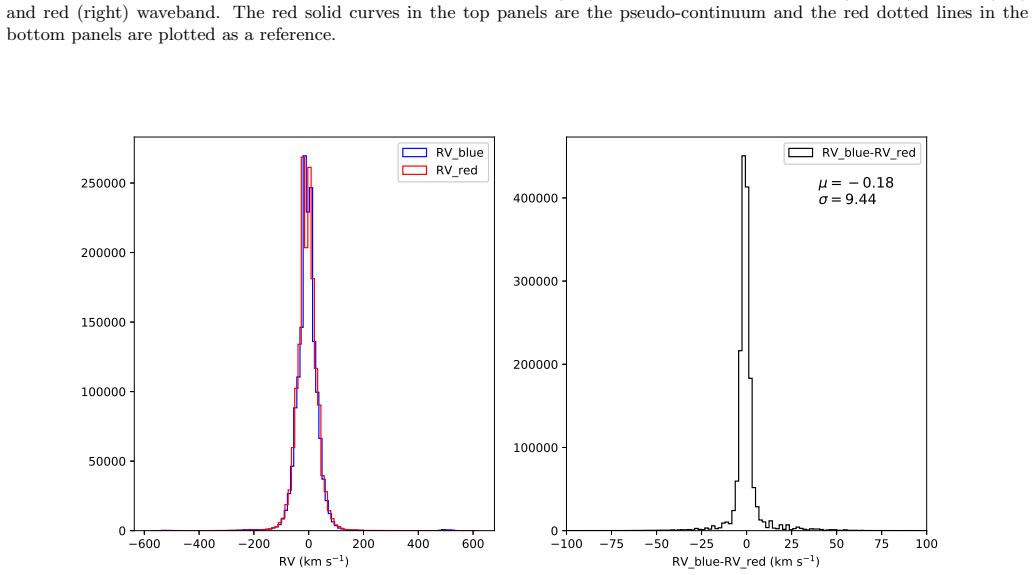
- Because the blue and red bands are measured independently and disagree at the 9.44 km/s level overall, a combined-band RV with flag-aware weighting would likely beat the single-band precision at low S/N; the paper stops at recommending the blue value.
- The per-spectrograph zero points were derived under two arc-lamp regimes; a reader might expect a separate comparison of Sc-lamp-only and Th-Ar-only subsets to reveal whether the lamp transition itself contributes residual offsets, which the paper does not quantify separately.
Signed reviews
Editorial analysis
A structured set of objections, weighed in public.
Referee Report
Summary. This paper describes the measurement of radial velocities for 1,594,956 LAMOST-II medium-resolution (R≈7500) spectra using template matching against Kurucz model spectra. A zero-point calibration is derived per spectrograph, lamp, and waveband from 7,820 spectra of 983 HY18 RV standard stars, and the calibrated RVs are compared with HY18, Gaia RV-STD, APOGEE DR14, RAVE DR5, and Gaia RVS. The authors report an accuracy of 0.0227 km/s (abstract) or 0.0277 km/s (Table 2) with respect to HY18 standards, and an 'intrinsic precision' of 1.36, 1.08, and 0.91 km/s at S/N 10, 20, and 50 based on repeated observations. A public catalog is provided.
Significance. The work is potentially valuable: it delivers a large, homogeneous RV catalog from LAMOST MRS, with per-spectrograph zero-point corrections and validation against several independent surveys. The external comparisons with APOGEE, RAVE, and Gaia RVS are a genuine strength and give a realistic picture of the systematic floor. However, the headline accuracy number in the abstract is computed on the calibration sample itself and is therefore not an independent accuracy measurement; the independent comparisons show offsets of order 0.2-0.4 km/s. With corrected claims, this would be a useful methods-and-catalog paper for the LAMOST community.
major comments (3)
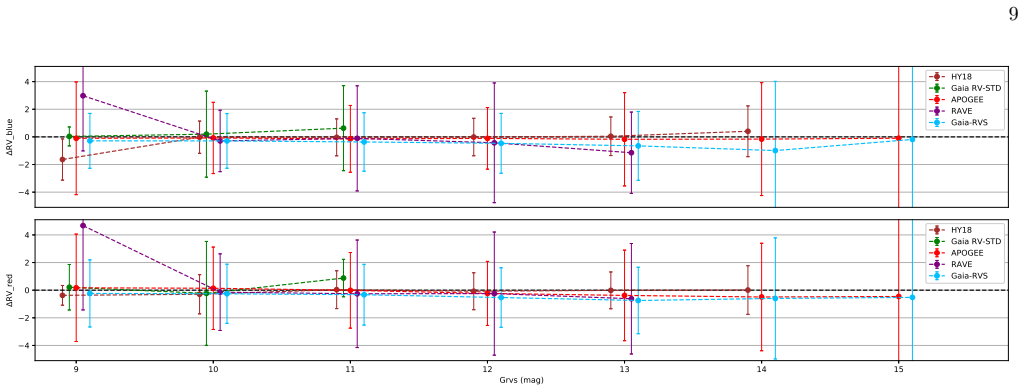
- [§4.1, §4.3, Table 2] The quoted accuracy of 0.0277 km/s (HY18 row of Table 2; abstract 0.0227 km/s) is derived from exactly the same 983 stars and 7,820 spectra used in Section 4.1 to fit the RVZP offsets per spectrograph, lamp, and waveband. After applying the fitted offsets, the mean residual is near zero by construction; this statistic measures internal calibration consistency, not absolute accuracy. The independent comparisons in Table 2 (Gaia RV-STD, APOGEE, RAVE, Gaia RVS) show mean offsets of -0.36 to +0.003 km/s (absolute values 0.22-0.36 km/s except RAVE) with RMS scatters of 1.7-4.1 km/s, which is the more honest statement of external accuracy. The abstract and summary should be revised to state that the zero point is consistent with HY18 at the ~0.03 km/s level on the calibration sample, while independent catalogs indicate systematic offsets at the ~0.2-0.4 km/s level. As written, a reader of the abstract will overestimate the absolute accuracy of the catalog by an order of magnitude.
- [§4.4, Eq. (1), Fig. 13] The precision values (1.36, 1.08, 0.91 km/s at S/N 10, 20, 50) are computed from the sample standard deviation of repeated observations of the same stars without any exclusion of known binaries, pulsating variables, or other RV-variable objects. The text says only that the estimate is 'based on the RV measurements of multiple observations in different epoch for the same stars.' If the repeat-observation sample contains a non-negligible fraction of binaries, the reported scatter is an upper limit on single-epoch measurement precision, not the intrinsic precision claimed. The authors should either remove or flag RV-variable stars (e.g., by iterative sigma clipping or by using a subsample of RV standards) or explicitly re-label the statistic as 'repeatability including astrophysical variability.'
- [Abstract, §4.3, §5, Table 2] The accuracy numbers are internally inconsistent: the abstract gives 0.0227 km/s, Section 4.3 says 0.028 km/s for HY18 and 0.107 km/s for Gaia RV-STD, Table 2 lists 0.0277 and -0.2797 km/s, and the summary states 0.03 and 0.28 km/s. In addition, Section 4.3 reports a HY18 cross-match of 1,106 stars/8,336 spectra and a Gaia RV-STD cross-match of 52 stars/326 spectra, while Table 2 uses 983/7,820 and 46/261; the selection criteria for the table rows are not explained. These discrepancies must be reconciled before the paper can be accepted, because the central claim concerns the accuracy of the measurements.
minor comments (6)
- [Abstract] The abstract has typographical errors: 'km s/1' should be 'km s−1', and there are missing spaces in '1.36 km s−1,1.08 km s−1,0.91 km s−1'.
- [§4.1] 'LAMOSR MRS spectra' should be 'LAMOST MRS spectra'.
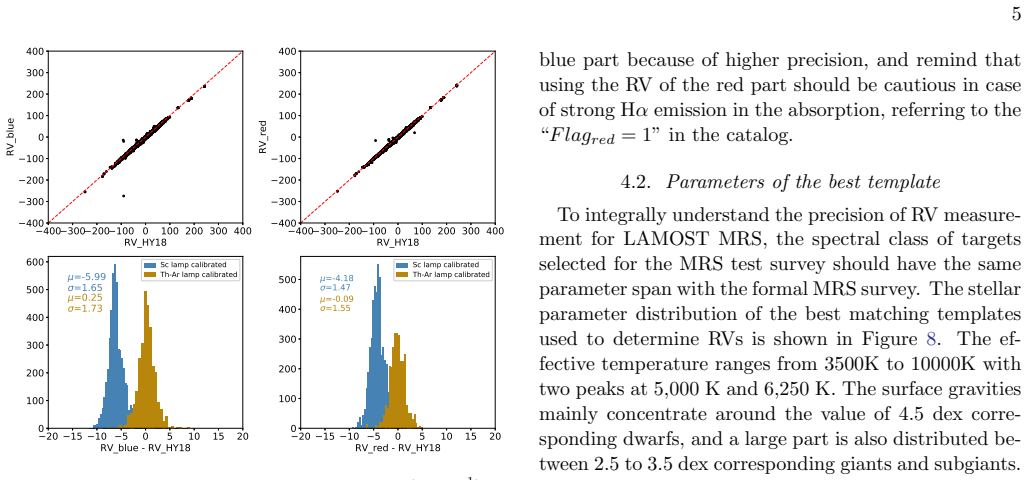
- [Figure 6 and Figure 7 captions] The captions contain 'Sc la p calibrated' and 'Sc lam calibrated'; both should be 'Sc lamp calibrated'.
- [§4.3] 'RVAE RVs are inconsistent' should be 'RAVE RVs are inconsistent'.
- [§5] The summary states the observations were collected 'till 31st Dec 2017', but Section 2.1 states the sample extends to 31st Dec 2018; please correct the date.
- [§4.4, Fig. 13] The provenance of the quoted precision values 1.08 and 0.91 km/s is unclear; please specify whether these are from the blue band, the red band, or the mean of the two, and define the S/N binning used to read the values from Figure 13.
Circularity Check
0.0227/0.0277 km/s accuracy vs HY18 is the residual after zero-point correction fitted to those same HY18 standards, so it is not an independent accuracy; independent catalogs give 0.2–0.5 km/s offsets.
-
fitted input called prediction
[Abstract; Section 4.1 (zero-point calibration); Section 4.3 and Table 2 (accuracy evaluation)]
"Comparing with reference sets, the accuracy of our measurement can get 0.0227 km s −1 with respect to radial velocities standard stars. ... We pick out 983 RV-STDs from Huang et al. (2018) which have 7820 LAMOST MRS spectra covering all spectrographs and exposures. ... Applying the RVZPs obtained from 7820 spectra of 983 RV-STDs to each exposure, spectrograph, and band, the RVs of all 1,594,956 two-band spectra are recalibrated to remove the offsets. ... Table 2: HY18 RV-STD 0.0277 1.4378 983 7,820"
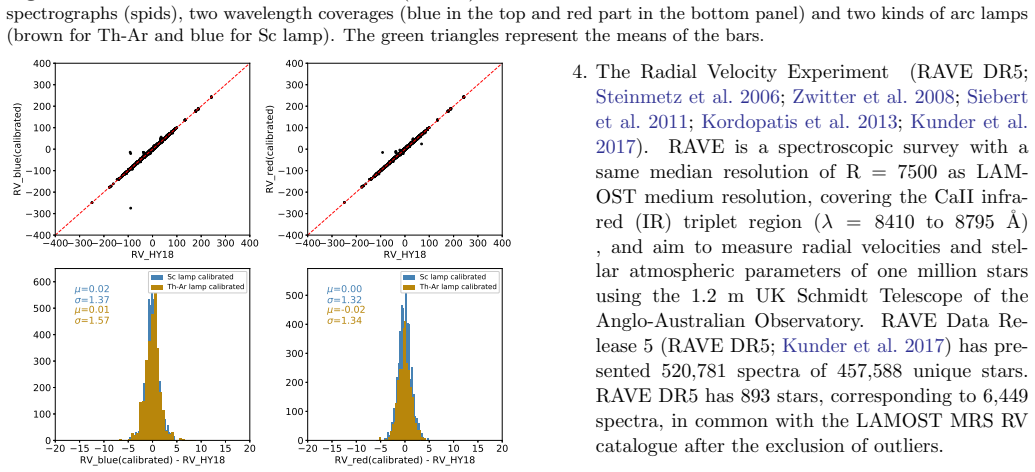
Table 2's HY18 row uses exactly the 983 stars and 7,820 spectra that Section 4.1 used to fit the per-spectrograph/lamp/band zero-point offsets. After subtracting a fitted additive offset, the mean residual on the fitting sample is ~0 by construction (μ=0.02 in Fig. 7; 0.0277 in Table 2). Thus the quoted HY18 'accuracy' measures internal calibration closure, not external accuracy. The paper's own independent comparisons in the same table show offsets of -0.28 (Gaia RV-STD), -0.22 (APOGEE), +0.003 (RAVE), and -0.36 (Gaia-RVS) km/s, roughly an order of magnitude larger than the headline value, so the abstract's 0.0227/0.0277 km/s figure is a fitted input presented as a validation result.
full rationale
The central issue is that the zero-point calibration (§4.1) is fitted to 7,820 spectra of 983 HY18 standards, and Table 2 then reports the mean residual against those same 983 stars/7,820 spectra. By construction, after subtracting per-spectrograph/lamp/band offsets, the mean residual must be near zero (observed as 0.0277 km/s in Table 2 and μ≈0.02 in Fig. 7). The abstract elevates this self-closure to a statement of 'accuracy.' However, the paper includes genuinely independent external checks (Gaia RV-STD, APOGEE DR14, RAVE DR5, Gaia-RVS), which show offsets of about 0.17–0.46 km/s and larger scatters. Therefore the HY18-based 'accuracy' figure is partially circular as a headline claim, but the paper is not wholly circular because the independent comparisons and the multi-epoch precision estimates (1.36/1.08/0.91 km/s) are not fitted to those standards. The overall circularity is partial: the headline accuracy measure reduces to a fitted residual, while other results remain independently grounded.
Assumptions & free parameters
free parameters (2)
- RV zero-point offsets per spectrograph, lamp, and waveband =
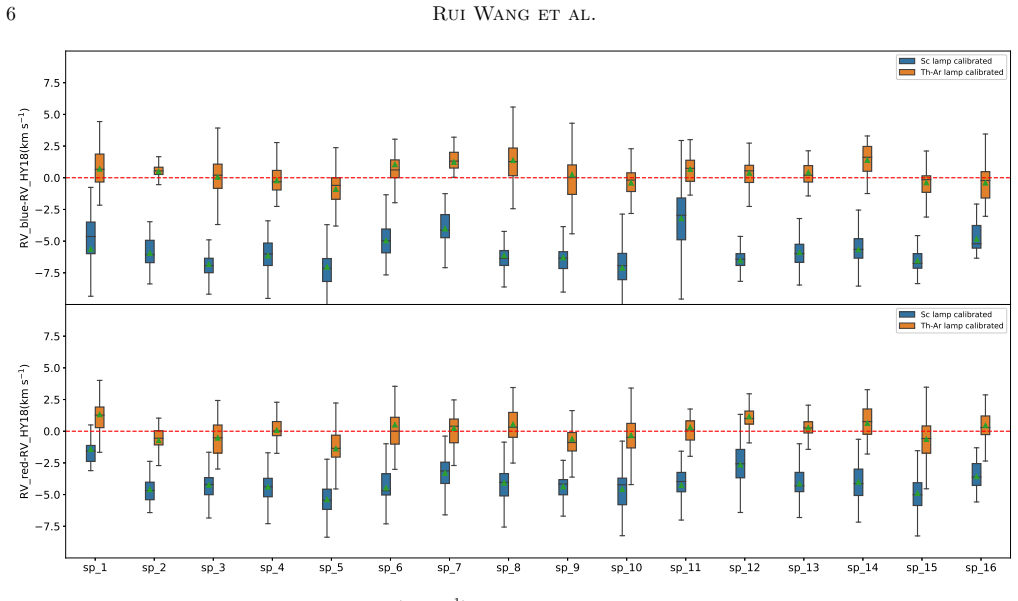
Not tabulated exactly; shown in Figure 6, roughly -6 to +2 km/s
- Outlier cut threshold |RV_blue - RV_red| > 25 km/s =
25 km/s
assumptions (5)
- domain assumption The wavelength calibration of LAMOST MRS spectra is accurate after Th-Ar or Sc lamp calibration.
- domain assumption The Kurucz synthetic template grid covers the stellar parameter space of the observed stars.
- domain assumption The HY18 RV standard stars have stable radial velocities within about 100 m/s.
- domain assumption Scatter among repeated observations of the same star represents measurement precision rather than intrinsic stellar variability.
- domain assumption The reference catalogs (Gaia RV-STD, APOGEE DR14, RAVE DR5, Gaia-RVS DR2) provide accurate radial velocities for validation.
Cite this review
Pith. "Pith review of Properties of Radial Velocities measurement based on LAMOST-II Medium-Resolution Spectroscopic Observations." pith.science (2026). https://pith.science/paper/SVEJOSNU
@misc{pith2026190804773,
  author       = {Pith},
  title        = {Pith review of: Properties of Radial Velocities measurement based on LAMOST-II Medium-Resolution Spectroscopic Observations},
  year         = {2026},
  howpublished = {\url{https://pith.science/paper/SVEJOSNU}},
  note         = {Machine review of arXiv:1908.04773}
}
read the original abstract
The radial velocity (RV) is a basic physical quantity which can be determined through Doppler shift of the spectrum of a star. The precision of RV measurement depends on the resolution of the spectrum we used and the accuracy of wavelength calibration. In this work, radial velocities of LAMOST-II medium resolution (R ~ 7500) spectra are measured for 1,594,956 spectra (each spectrum has two wavebands) through matching with templates. A set of RV standard stars are used to recalibrate the zero point of the measurement, and some reference sets with RVs derived from medium/high-resolution observations are used to evaluate the accuracy of the measurement. Comparing with reference sets, the accuracy of our measurement can get 0.0227 km s/1 with respect to radial velocities standard stars. The intrinsic precision is estimated with the multiple observations of single stars, which can achieve to 1.36 km s/1,1.08 km s/1, 0.91 km s/1 for the spectra at signal-to-noise levels of 10, 20, 50, respectively.
Figures

Figures from the paper (10 more)


Reference graph
Works this paper leans on
-
[1]
, " * write output.state after.block = add.period write newline
ENTRY address archivePrefix author booktitle chapter doi edition editor eprint howpublished institution journal key month number organization pages publisher school series title misctitle type volume year version url label extra.label sort.label short.list INTEGERS output.state before.all mid.sentence after.sentence after.block FUNCTION init.state.consts ...
-
[2]
write newline
" write newline "" before.all 'output.state := FUNCTION format.url url empty "" new.block "" url * "" * if FUNCTION format.eprint eprint empty "" archivePrefix empty "" archivePrefix "arXiv" = new.block " " eprint * " " * new.block " " eprint * " " * if if if FUNCTION format.doi doi empty "" " " doi * " " * if FUNCTION format.pid doi empty eprint empty ""...
-
[3]
thebibliography [1] 20pt to REFERENCES 6pt =0pt 10pt plus 3pt =0pt =0pt =1pt plus 1pt =0pt =0pt -12pt =13pt plus 1pt =20pt =13pt plus 1pt \@M =10000 =-1.0em =0pt =0pt 0pt =0pt =1.0em @enumiv\@empty 10000 10000 `\.\@m \@noitemerr \@latex@warning Empty `thebibliography' environment \@ifnextchar \@reference \@latexerr Missing key on reference command Each re...
-
[4]
Astropy Collaboration , Robitaille , T. P., Tollerud , E. J., et al. 2013, , 558, A33, 10.1051/0004-6361/201322068
-
[5]
2001, , 374, 733, 10.1051/0004-6361:20010730
Bouchy , F., Pepe , F., & Queloz , D. 2001, , 374, 733, 10.1051/0004-6361:20010730
-
[6]
2018, , 474, 3344, 10.1093/mnras/stx2944
Britavskiy , N., Pancino , E., Tsymbal , V., Romano , D., & Fossati , L. 2018, , 474, 3344, 10.1093/mnras/stx2944
-
[7]
Castelli , F., & Kurucz , R. L. 2004, ArXiv Astrophysics e-prints
2004
-
[8]
2010, , 524, A10, 10.1051/0004-6361/201015315
Crifo , F., Jasniewicz , G., Soubiran , C., et al. 2010, , 524, A10, 10.1051/0004-6361/201015315
Show all 44 references
-
[9]
2007, in SF2A-2007: Proceedings of the Annual meeting of the French Society of Astronomy and Astrophysics, ed
Crifo , F., Jasniewicz , G., Soubiran , C., et al. 2007, in SF2A-2007: Proceedings of the Annual meeting of the French Society of Astronomy and Astrophysics, ed. J. Bouvier , A. Chalabaev , & C. Charbonnel , 459
2007
-
[10]
2018, , 616, A5, 10.1051/0004-6361/201832763
Cropper , M., Katz , D., Sartoretti , P., Prusti , T., & others. 2018, , 616, A5, 10.1051/0004-6361/201832763
2018 doi
-
[11]
2012, Research in Astronomy and Astrophysics, 12, 1197, 10.1088/1674-4527/12/9/003
Cui , X.-Q., Zhao , Y.-H., Chu , Y.-Q., Li , G.-P., & others. 2012, Research in Astronomy and Astrophysics, 12, 1197, 10.1088/1674-4527/12/9/003
2012 doi
-
[12]
M., Freeman , K
De Silva , G. M., Freeman , K. C., Bland-Hawthorn , J., & others. 2015, MNRAS, 449, 2604, 10.1093/mnras/stv327
2015 doi
-
[13]
J., Liu , C., et al
Deng , L.-C., Newberg , H. J., Liu , C., et al. 2012, Research in Astronomy and Astrophysics, 12, 735, 10.1088/1674-4527/12/7/003
2012 doi
-
[14]
Gaia Collaboration , Brown , A. G. A., Vallenari , A., et al. 2018, , 616, A1, 10.1051/0004-6361/201833051
2018 doi
-
[15]
M., Latham , D
Geller , A. M., Latham , D. W., & Mathieu , R. D. 2015, , 150, 97, 10.1088/0004-6256/150/3/97
2015 doi
-
[16]
2012, The Messenger, 147, 25
Gilmore , G., Randich , S., Asplund , M., et al. 2012, The Messenger, 147, 25
2012
-
[17]
G., Tokovinin , A., Niemczura , E., et al
He miniak , K. G., Tokovinin , A., Niemczura , E., et al. 2018, arXiv e-prints. 1812.04319
2018 arXiv
-
[18]
A., Shetrone , M., Johnson , J
Holtzman , J. A., Shetrone , M., Johnson , J. A., et al. 2015, AJ, 150, 148, 10.1088/0004-6256/150/5/148
2015 doi
-
[19]
A., Hasselquist , S., Shetrone , M., et al
Holtzman , J. A., Hasselquist , S., Shetrone , M., et al. 2018, AJ, 156, 125, 10.3847/1538-3881/aad4f9
2018 doi
-
[20]
2018, , 156, 90, 10.3847/1538-3881/aacda5
Huang , Y., Liu , X.-W., Chen , B.-Q., et al. 2018, , 156, 90, 10.3847/1538-3881/aacda5
2018 doi
-
[21]
2007, Computing In Science & Engineering, 9, 90, 10.1109/MCSE.2007.55
Hunter, J. 2007, Computing In Science & Engineering, 9, 90, 10.1109/MCSE.2007.55
2007 doi
-
[22]
2001--, SciPy : Open source scientific tools for Python
Jones, E., Oliphant, T., Peterson, P., et al. 2001--, SciPy : Open source scientific tools for Python . http://www.scipy.org/
2001
-
[23]
2004, MNRAS, 354, 1223, 10.1111/j.1365-2966.2004.08282.x
Katz , D., Munari , U., Cropper , M., Zwitter , T., & others. 2004, MNRAS, 354, 1223, 10.1111/j.1365-2966.2004.08282.x
2004
-
[24]
2019, , 622, A205, 10.1051/0004-6361/201833273
Katz , D., Sartoretti , P., Cropper , M., et al. 2019, , 622, A205, 10.1051/0004-6361/201833273
2019 doi
-
[25]
2013, , 146, 134, 10.1088/0004-6256/146/5/134
Kordopatis , G., Gilmore , G., Steinmetz , M., Boeche , C., & others. 2013, , 146, 134, 10.1088/0004-6256/146/5/134
2013 doi
-
[26]
2017, , 153, 75, 10.3847/1538-3881/153/2/75
Kunder , A., Kordopatis , G., Steinmetz , M., Zwitter , T., & others. 2017, , 153, 75, 10.3847/1538-3881/153/2/75
2017 doi
-
[27]
S., Beers , T
Lee , Y. S., Beers , T. C., Sivarani , T., et al. 2008, , 136, 2022, 10.1088/0004-6256/136/5/2022
2008 doi
-
[28]
2019, arXiv e-prints
Liu , N., Fu , J.-N., Zong , W., et al. 2019, arXiv e-prints. 1901.00619
2019 arXiv
-
[29]
2015, Research in Astronomy and Astrophysics, 15, 1095, 10.1088/1674-4527/15/8/002
Luo , A.-L., Zhao , Y.-H., Zhao , G., Deng , L.-C., & others. 2015, Research in Astronomy and Astrophysics, 15, 1095, 10.1088/1674-4527/15/8/002
2015 doi
-
[30]
R., Schiavon , R
Majewski , S. R., Schiavon , R. P., Frinchaboy , P. M., & others. 2017, AJ, 154, 94, 10.3847/1538-3881/aa784d
2017 doi
-
[31]
V., Triaud , A
Martin , D. V., Triaud , A. H. M. J., Udry , S., et al. 2019, arXiv e-prints. 1901.01627
2019 arXiv
-
[32]
2011, pandas : powerful Python data analysis toolkit
McKinney, W. 2011, pandas : powerful Python data analysis toolkit. http://pandas.sourceforge.net/
2011
-
[33]
2006, Guide to NumPy (Trelgol Publishing)
Oliphant, T. 2006, Guide to NumPy (Trelgol Publishing). http://www.tramy.us/numpybook.pdf
2006
-
[34]
R., Winn , J
Ricker , G. R., Winn , J. N., Vanderspek , R., et al. 2014, in , Vol. 9143, Space Telescopes and Instrumentation 2014: Optical, Infrared, and Millimeter Wave, 914320
2014
-
[35]
2018, , 616, A6, 10.1051/0004-6361/201832836
Sartoretti , P., Katz , D., Cropper , M., Panuzzo , P., & others. 2018, , 616, A6, 10.1051/0004-6361/201832836
2018 doi
-
[36]
Siebert , A., Williams , M. E. K., Siviero , A., & others. 2011, , 141, 187, 10.1088/0004-6256/141/6/187
2011 doi
-
[37]
2013, , 552, A64, 10.1051/0004-6361/201220927
Soubiran , C., Jasniewicz , G., Chemin , L., et al. 2013, , 552, A64, 10.1051/0004-6361/201220927
2013 doi
-
[38]
2018, , 616, A7, 10.1051/0004-6361/201832795
Soubiran , C., Jasniewicz , G., Chemin , L., Zurbach , C., et al. 2018, , 616, A7, 10.1051/0004-6361/201832795
2018 doi
-
[39]
G., & others
Steinmetz , M., Zwitter , T., Siebert , A., Watson , F. G., & others. 2006, AJ, 132, 1645, 10.1086/506564
2006 doi
-
[40]
2011, Research in Astronomy and Astrophysics, 11, 924, 10.1088/1674-4527/11/8/006
Wu , Y., Luo , A.-L., Li , H.-N., et al. 2011, Research in Astronomy and Astrophysics, 11, 924, 10.1088/1674-4527/11/8/006
2011 doi
-
[41]
J., Knapp , G
Yanny , B., Rockosi , C., Newberg , H. J., Knapp , G. R., & others. 2009, AJ, 137, 4377, 10.1088/0004-6256/137/5/4377
2009 doi
-
[42]
S., Wendell, P., et al
Zaharia, M., Xin, R. S., Wendell, P., et al. 2016, Commun. ACM, 59, 56, 10.1145/2934664
2016 doi
-
[43]
2012, Research in Astronomy and Astrophysics, 12, 723, 10.1088/1674-4527/12/7/002
Zhao , G., Zhao , Y.-H., Chu , Y.-Q., Jing , Y.-P., & Deng , L.-C. 2012, Research in Astronomy and Astrophysics, 12, 723, 10.1088/1674-4527/12/7/002
2012 doi
-
[44]
C., & others
Zwitter , T., Siebert , A., Munari , U., Freeman , K. C., & others. 2008, , 136, 421, 10.1088/0004-6256/136/1/421
2008 doi
Reviewed August 14, 2026 · model on record in the stance chip above.
Discussion (0). Continue with ORCID to comment.