REVIEW 2 major objections 3 minor 58 references
Entanglement bounds on the performance of quantum computing architectures
T0 review · 2 major / 3 minor · reviewed 2026-08-14 · deepseek-v4-flash
Pith's one-line read The rainbow time of a connectivity graph lower-bounds how fast any quantum architecture can create highly entangled states, and a max-flow protocol nearly reaches it.
desk verdict Rainbow time = reciprocal isoperimetric number gives a clean, nearly tight lower bound on entanglement-generation time; the additivity axiom is misstated but repairable, so the paper deserves review. read the letter →
The pith
A machine-rendered reading of the paper's core claim, the machinery that carries it, and where it could break.
The reading
What carries the argument
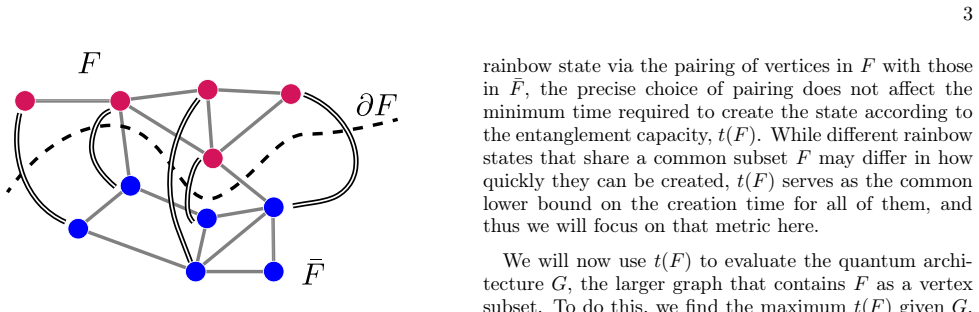
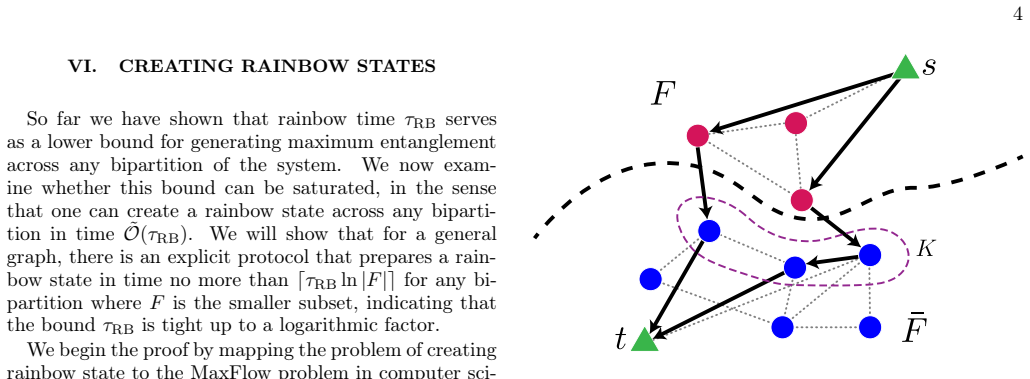
The load-bearing object is the rainbow time $\tau_{\mathrm{RB}}(G)=\max_{|F|\le |V|/2}|F|/|\partial F|$, the reciprocal of the isoperimetric number, with $|\partial F|$ the total weight of edges crossing the bipartition. It is the right quantity because in the Bell-pair model the cut capacity $|\partial F|$ is simultaneously the maximum number of entangled pairs a single round can deliver and the per-round increase allowed by any additive LOCC-monotone entanglement measure. The converse direction rides on MaxFlow-MinCut: representing each desired Bell pair as a unit of flow from the smaller set $F$ to a target set $K$ turns per-round distribution into a max-flow instance whose integer optimum is at least $\lceil |F|/\tau_{\mathrm{RB}}\rceil$ Bell pairs per round; repeating this round makes the bound tight up to $\ln|F|$.
What would settle it
In the model, record the entanglement entropy across the isoperimetric set $F$ after one round: a single round creating more than $|\partial F|$ ebits across that cut would refute the capacity bound. Alternatively, on a small graph with integer weights, run the max-flow protocol and check whether any rainbow state is prepared in fewer than $\lceil \tau_{\mathrm{RB}}\ln|F|\rceil$ rounds; for example, on a 4-node path $\tau_{\mathrm{RB}}=2$, so the lower bound predicts at least 2 rounds to create the rainbow state, and a 1-round preparation would falsify the central claim.
Extended reading notes
Core claim
The central claim is that the rainbow time $\tau_{\mathrm{RB}}(G)=\max_{F\subset V,\,|F|\le |V|/2}|F|/|\partial F|$ is the reciprocal of the graph's isoperimetric number and is the true bottleneck for preparing highly entangled states. Because each round can place at most $|\partial F|$ Bell pairs across the cut $(F,\bar F)$, any entanglement measure obeying additivity and LOCC monotonicity can increase by at most $|\partial F|$ per round, so a state carrying $|F|$ ebits across that cut needs at least $|F|/|\partial F|$ rounds; maximizing over cuts gives $\tau_{\mathrm{RB}}(G)$. The matching construction turns Bell-pair distribution into a network-flow problem: MaxFlow-MinCut guarantees a flow of $\lceil |F|/\tau_{\mathrm{RB}}\rceil$ pairs per round, and iterating removes a $1/\tau_{\mathrm{RB}}$ fraction of the remaining entanglement each round, completing in $\lceil \tau_{\mathrm{RB}}\ln|F|\rceil$ rounds. Thus the lower bound is tight up to a factor logarithmic in the number of qubits.
Load-bearing premise
The bound assumes each edge of weight $w$ generates $w$ Bell pairs per unit time and that local gates, measurements, and classical communication are free; if local latencies are significant or edge weights mean something other than Bell-pair rates, the ordering of architectures under this metric can change.
Editorial extensions
If this is right
- An architecture whose connectivity graph contains a subset with small boundary relative to its size is provably slow at producing global entanglement, regardless of how fast local gates, measurements, or classical communication are.
- Maximizing the isoperimetric number directly improves entanglement-generation speed; the metric can be approximated efficiently and bounded by graph Laplacian eigenvalues, making it usable in design.
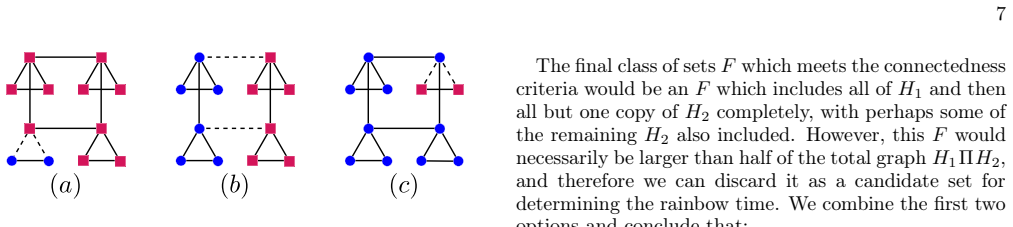
- For the hierarchy family $K_n\Pi_\alpha^k$, rainbow time beats a $d$-dimensional grid whenever $\alpha > n^{(d-1)/d}$, and with $n>\alpha$ it does so without extra total edge weight.
- For every bipartition, some rainbow state is preparable in $\lceil\tau_{\mathrm{RB}}\ln|F|\rceil$ rounds, so the gap between the lower bound and an explicit protocol is only logarithmic.
- Rainbow time gives a benchmark lower bound on circuit depth for algorithms with known entanglement requirements, such as Shor's algorithm and adiabatic protocols.
Reading between the lines
- A testable extension: if the saturation observed in $\lceil\tau_{\mathrm{RB}}\rceil$ rounds on small graphs holds generally, then the logarithmic slack is a proof artifact and the isoperimetric number alone sets the entanglement speed; this could be checked by comparing max-flow rainbow preparation against $\tau_{\mathrm{RB}}$ on random regular and expander graphs.
- The same cut-capacity argument, extended through small-incremental-entangling bounds, suggests the rainbow time also constrains entanglement growth in Hamiltonian models, so the metric may serve as a benchmark for analog quantum simulators and not only circuit models.
- Because exact rainbow time is NP-hard, automated architecture search would rely on the approximation algorithm or Laplacian bounds; testing whether those bounds order real devices the same way as empirically measured rainbow-preparation times is a direct next step.
Signed reviews
Editorial analysis
A structured set of objections, weighed in public.
Referee Report
Summary. This paper proposes a graph-theoretic metric, the "rainbow time" τ_RB(G) = max_{F⊆V, |F|≤|V|/2} |F|/|∂F|, equal to the reciprocal of the edge isoperimetric number, as a performance measure for qubit-connectivity architectures. The physical model of Section II assigns to each edge a Bell-pair generation rate, while measurements, classical communication, and intra-module unitaries are treated as instantaneous. Section III proves a single-round entanglement-capacity bound ΔS ≤ |∂F| for any admissible entanglement measure S, yielding t(F)=|F|/|∂F| as a lower bound on the time needed to create the |F|-ebit rainbow state across a cut F, and hence τ_RB(G) as a lower bound on the slowest rainbow-state creation time. Section VI gives a constructive max-flow/min-cut protocol that prepares a rainbow state across any bipartition in at most ⌈τ_RB ln|F|⌉ rounds, showing the lower bound is tight up to O(log N). Appendix B evaluates τ_RB for complete, star, grid, and hierarchical graphs and identifies a parameter regime, α ∈ [n^{1-1/d}, n), in which a hierarchical architecture has no larger rainbow time but lower total edge weight than a d-dimensional grid.
Significance. The paper is potentially valuable because it introduces a simple, parameter-free architecture metric with a rigorous lower-bound side, and it applies this metric to a concrete architectural comparison. The lower bound is robust to arbitrarily fast local operations and classical feedback, which is a regime often neglected in circuit-depth analyses. The max-flow protocol is explicit and makes the near-saturation claim checkable. The comparison between the hierarchical architecture of Ref. [14] and grids is concrete: for N qubits, the hierarchy achieves τ_RB = Θ(N^{max(0,1-log_n α)}) with total edge weight Θ(N^{max(1,log_n α)}), and the claimed parameter range beats grids on both quantities. The proof techniques are mostly elementary and self-contained, apart from the use of Mohar's connected-isoperimetric-set theorem in Appendix B. With the technical corrections noted below, the paper should be a useful contribution to architecture evaluation.
major comments (2)
- [Section III, Eq. (3)] The axiom S(ρ⊗σ)=S(ρ)+S(σ) is stated to hold for entanglement cost, distillable entanglement, and entanglement of formation. This is not correct: entanglement of formation is not fully additive (additivity of E_F would imply additivity of the minimum output entropy, which is known to fail), and distillable entanglement is superadditive rather than additive. The derivation of ΔS ≤ |∂F| needs only the inequality direction S(ρ⊗Bell^k) ≤ S(ρ)+k, which follows from LOCC monotonicity together with subadditivity; this holds, for example, for entanglement of formation (and for entanglement cost). The proof is therefore repairable, but the stated axiom and the list of admissible entanglement measures should be corrected before the formal lower-bound claim is valid as written.
- [Section VI, opening paragraph] The saturation protocol is proved only for integer edge weights, relying on the integrality of max-flow to decompose the flow into individual Bell-pair paths. The abstract and the opening of Section VI describe the result for "a general graph" without this qualification, and the rainbow-time metric itself is defined for real weights. The authors should either state the integer-weight restriction prominently in the main claims or supply an approximation/rational-rounding argument for real edge weights.
minor comments (3)
- [Section VI, Eqs. (5)-(8)] The sentence "If this is not the case, then a near-identical argument can be made applying this condition to T" omits the details. The argument is correct: applying the isoperimetric bound to T and using |T| ≥ |T∩F| + |F| − |S∩K| gives the same lower bound, but it should be written out for completeness.
- [Section VI, footnote [43]] The parenthetical about the integer ceiling would be clearer if it also addressed why the flow of magnitude ⌈|F|/τ_RB⌉ is achievable when the cut bound only guarantees a real-valued flow of magnitude at least |F|/τ_RB; the proof implicitly relies on the integrality assumption stated earlier.
- [Appendix A, paragraph on Hamiltonians] The sentence extending the bound from von Neumann entropy to other entanglement measures via convex-roof decompositions is hand-wavy; since the main text already establishes the needed bound for entanglement of formation, the auxiliary claim for arbitrary mixed-state measures should either be made precise or softened.
Circularity Check
No load-bearing circularity: the lower bound and max-flow saturation proof are self-contained; score reflects only the minor self-citation of the authors' own hierarchy benchmark.
full rationale
The central derivation is independent: Section III's capacity bound Delta S <= |dF| follows from the physical model (each boundary edge generates w_ij Bell pairs per round) plus LOCC monotonicity and subadditivity of the entanglement measure, so no fitted or calibrated quantity enters as input. Eq. (1) is explicitly identified as the reciprocal of the known isoperimetric number, and the Section VI upper bound is a MaxFlow-MinCut argument using only the defining inequality |S| <= tau_RB |dS|. The only overlap with prior work is that the hierarchy architecture evaluated in Appendix B is taken from the authors' own Ref. [14]; that graph family is an external benchmark, not an input to the lower-bound theorem, so the self-citation is minor and not load-bearing. The skeptical point about Section III is a correctness caveat, not a circularity: full additivity is not satisfied by entanglement of formation or distillable entanglement in the direction used, but the needed upper bound follows from subadditivity, leaving the resource-counting result repairable. No construction-reducing circular step was found.
Assumptions & free parameters
assumptions (5)
- domain assumption The entanglement measure S is zero on product states, additive under tensor product, and non-increasing under LOCC (Section III).
- domain assumption Each edge of weight w generates w Bell pairs per unit time, while local operations and classical communication are free (Section II).
- standard math Max-flow min-cut theorem and integrality of max flow for integer edge weights (Section VI).
- standard math There exists an isoperimetric set whose induced subgraph and complement are both connected (Mohar, Ref [12], invoked in Appendix B).
- standard math Small incremental entangling theorem from Ref [50] bounds entanglement growth under bounded-strength Hamiltonians (Appendix A).
Cite this review
Pith. "Pith review of Entanglement bounds on the performance of quantum computing architectures." pith.science (2026). https://pith.science/paper/EQPFDXZT
@misc{pith2026190804802,
  author       = {Pith},
  title        = {Pith review of: Entanglement bounds on the performance of quantum computing architectures},
  year         = {2026},
  howpublished = {\url{https://pith.science/paper/EQPFDXZT}},
  note         = {Machine review of arXiv:1908.04802}
}
read the original abstract
There are many possible architectures of qubit connectivity that designers of future quantum computers will need to choose between. However, the process of evaluating a particular connectivity graph's performance as a quantum architecture can be difficult. In this paper, we show that a quantity known as the isoperimetric number establishes a lower bound on the time required to create highly entangled states. This metric we propose counts resources based on the use of two-qubit unitary operations, while allowing for arbitrarily fast measurements and classical feedback. We use this metric to evaluate the hierarchical architecture proposed by A. Bapat et al. [Phys. Rev. A 98, 062328 (2018)], and find it to be a promising alternative to the conventional grid architecture. We also show that the lower bound that this metric places on the creation time of highly entangled states can be saturated with a constructive protocol, up to a factor logarithmic in the number of qubits.
Figures

Figures from the paper (2 more)

Reference graph
Works this paper leans on
-
[14]
D. Rosenbaum and M. Perkowski, in2010 40th IEEE In- ternational Symposium on Multiple-Valued Logic (2010) pp. 270–275
work page 2010
-
[1]
Additively distributive over the tensor product, so S(ρ⊗σ) = S(ρ) +S(σ) if ρ and σ are supported on both sides of the bipartition
-
[2]
Zero forstates which are a product of states oneach region, S(ρF⊗ρ ¯F ) = 0
-
[3]
Non-increasing after any operation which is local to each region, even if we permit classical commu- nication. In the main text, we showed how to apply these axioms to the analysis of a case in which computation was performed by the production and consumption of Bell pairs. Here we also look at a gate model of computation and a case in which the graph des...
-
[4]
Alice and Bob start with a data qubit each and two Bell pairs shared between them. They wish to implement an arbitrary two-qubit unitary using only local operations and classical control
-
[5]
Alice uses one Bell pair and classical communica- tion to teleport her qubit to Bob
-
[6]
Bob uses his local operations to perform the desired two-qubit gate
-
[7]
Bob teleports Alice’s qubit back to her. Therefore, the state ρ′ can be obtained from the state ρ by using local operations and classical communication (LOCC) and consuming up to 2|∂F| Bell pairs in the process. Since LOCC cannot increaseS, it follows that: S(ρ′)≤S ( ρ⊗ρ⊗2|∂F| Bell ) (A1) =⇒ ∆S≤ 2|∂F|S(ρBell). (A2) This suggests that the ability to perfor...
Show all 58 references
-
[8]
Monroe and J
C. Monroe and J. Kim, Science339, 1164 (2013)
2013
-
[9]
Ahsan and J
M. Ahsan and J. Kim, in Proceedings of the Design, Automation & Test in Europe Conference & Exhibition (DATE’15)(IEEE Conference Publications, 2015) pp. 1108–1113
2015
-
[10]
Pirker, J
A. Pirker, J. Wallnöfer, and W. Dür, New J. Phys.20, 053054 (2018)
2018
-
[11]
Villalonga, S
B. Villalonga, S. Boixo, B. Nelson, C. Henze, E. Rieffel, R. Biswas, and S. Mandrà, npj Quantum Inf.5 (2019), 10.1038/s41534-019-0196-1
2019 doi
-
[12]
Cheung, D
D. Cheung, D. Maslov, and S. Severini, inProceedings of the Workshop on Quantum Information (2007)
2007
-
[13]
Holmes, S
A. Holmes, S. Johri, G. G. Guerreschi, J. S. Clarke, and A. Y. Matsuura, Quantum Sci. and Technol.5, 025009 (2020)
2020
-
[15]
D. J. Rosenbaum, in 8th Conference on the Theory of Quantum Computation, Communication and Cryptogra- phy (TQC 2013) , Leibniz International Proceedings in Informatics (LIPIcs), Vol. 22, edited by S. Severini and F. Brandao (Schloss Dagstuhl–Leibniz-Zentrum fuer In- formatik, ...
2013
-
[16]
Pedram and A
M. Pedram and A. Shafaei, IEEE Circuits Syst. Mag.16, 62 (2016)
2016
-
[17]
N. M. Linke, D. Maslov, M. Roetteler, S. Debnath, C. Figgatt, K. A. Landsman, K. Wright, and C. Monroe, PNAS 114, 3305 (2017)
2017
-
[18]
Maslov, New J
D. Maslov, New J. Phys.19, 023035 (2017)
2017
-
[19]
Mohar, J
B. Mohar, J. Combin. Theory, Series B47, 274 (1989)
1989
-
[20]
Meignant, D
C. Meignant, D. Markham, and F. Grosshans, Phys. Rev. A 100, 052333 (2019)
2019
-
[21]
Bapat, Z
A. Bapat, Z. Eldredge, J. R. Garrison, A. Deshpande, F. T. Chong, and A. V. Gorshkov, Phys. Rev. A 98, 062328 (2018)
2018
-
[22]
K. S. Chou, J. Z. Blumoff, C. S. Wang, P. C. Reinhold, C. J. Axline, Y. Y. Gao, L. Frunzio, M. H. Devoret, L. Jiang, and R. J. Schoelkopf, Nature561, 368 (2018)
2018
-
[23]
Gottesman and I
D. Gottesman and I. L. Chuang, Nature402, 390 (1999)
1999
-
[24]
Jiang, J
L. Jiang, J. M. Taylor, A. S. Sørensen, and M. D. Lukin, Phys. Rev. A76, 062323 (2007)
2007
-
[25]
K. R. Brown, J. Kim, and C. Monroe, npj Quantum Inf. 2, 16034 (2016)
2016
-
[26]
Nigmatullin, C
R. Nigmatullin, C. J. Ballance, N. de Beaudrap, and S. C. Benjamin, New Journal of Physics 18, 103028 (2016)
2016
-
[27]
Eisert, K
J. Eisert, K. Jacobs, P. Papadopoulos, and M. B. Plenio, Phys. Rev. A62, 052317 (2000)
2000
-
[28]
C. H. Bennett, A. W. Harrow, D. W. Leung, and J. A. Smolin, IEEE Trans. Inf. Theory49, 1895 (2003)
2003
-
[29]
Horodecki, P
R. Horodecki, P. Horodecki, M. Horodecki, and K. Horodecki, Rev. Mod. Phys.81, 865 (2009)
2009
-
[30]
Vidal, Phys
G. Vidal, Phys. Rev. Lett.91, 147902 (2003)
2003
-
[31]
Verstraete, J
F. Verstraete, J. J. García-Ripoll, and J. I. Cirac, Phys. Rev. Lett. 93, 207204 (2004)
2004
-
[32]
This means that any entanglement-based bound on the time- complexity of implementingC would still apply to the ϵ-entangled version
Although universal quantum computation is possible in the limit of vanishing entanglement by implementing any quantum circuitC in a way that’s controlled by a qubit in the state√1−ϵ|0⟩ +√ϵ|1⟩ [51], such computation 9 still requires the ability to implement the circuitC. This m...
-
[33]
J. I. Cirac and P. Zoller, Nat. Phys.8, 264 (2012)
2012
-
[34]
G.Ramírez, J.Rodríguez-Laguna, andG.Sierra,J.Stat. Mech. 2015, P06002 (2015)
2015
-
[35]
R. N. Alexander, A. Ahmadain, Z. Zhang, and I. Klich, Phys. Rev. B100, 214430 (2019)
2019
-
[36]
C. H. Bennett, H. J. Bernstein, S. Popescu, and B. Schu- macher, Phys. Rev. A53, 2046 (1996)
1996
-
[37]
Zhang, A
Z. Zhang, A. Ahmadain, and I. Klich, PNAS114, 5142 (2017)
2017
-
[38]
Mohar, Linear Algebra and its Applications103, 119 (1988)
B. Mohar, Linear Algebra and its Applications103, 119 (1988)
1988
-
[39]
F. R. K. Chung and P. Tetali, Comb. Probab. Comput. 7, 141 (1998)
1998
-
[40]
Chung, Ann
F. Chung, Ann. Comb.9, 1 (2005)
2005
-
[41]
number of rounds required
Note thatτRB(G)can take on any nonnegative real value. Inreality, thecreationofaquantumstatewillalwaystake an integer number of steps greater than or equal to one in our model. Therefore,⌈τRB⌉ can be used as a measure of the “number of rounds required” in cases where this is important
-
[42]
Goldreich, in Studies in Complexity and Cryptogra- phy
O. Goldreich, in Studies in Complexity and Cryptogra- phy. Miscellanea on the Interplay between Randomness and Computation , Lecture Notes in Computer Science (Springer, Berlin, Heidelberg, 2011) pp. 451–464
2011
-
[43]
Ajtai, J
M. Ajtai, J. Komlós, and E. Szemerédi, in Proceed- ings of the Fifteenth Annual ACM Symposium on Theory of Computing , STOC ’83 (ACM, New York, NY, USA,
-
[44]
Reingold, J
O. Reingold, J. ACM55, 17:1 (2008)
2008
-
[45]
Dinur, J
I. Dinur, J. ACM54, 12 (2007)
2007
-
[46]
Arora, S
S. Arora, S. Rao, and U. Vazirani, J. ACM56 (2009), 10.1145/1502793.1502794
2009
-
[47]
Elias, A
P. Elias, A. Feinstein, and C. Shannon, IRE Trans. Inf. Theory 2, 117 (1956)
1956
-
[48]
L. R. Ford and D. R. Fulkerson, Can. J. Math.8, 399 (1956)
1956
-
[49]
D. R. Fulkerson and Rand Corporation.,Notes on Lin- ear Programming. Part XVL, A Network-Flow Feasibility Theorem and Combinatorial Applications , ASTIA Doc- ument ; No. AD 156011 (Rand Corp., Santa Monica, Calif., 1958)
1958
-
[50]
Sinceitisguaranteedtobeinteger-valuedforgraphswith integer-valued edge weights, the flow must in fact be of magnitude⌈|F|/τRB⌉, but this makes no difference to the argument
-
[51]
Schoute, L
E. Schoute, L. Mancinska, T. Islam, I. Kerenidis, and S. Wehner, (2016), arXiv:1610.05238
2016 arXiv
-
[52]
A. M. Childs, E. Schoute, and C. M. Unsal, in 14th Conference on the Theory of Quantum Computation, Communication and Cryptography (TQC 2019) , Leibniz International Proceedings in Informatics (LIPIcs), Vol. 135, edited by W. van Dam and L. Mancinska (Schloss Dagstuhl–Leibniz-...
2019
-
[53]
Orús and J
R. Orús and J. I. Latorre, Phys. Rev. A 69, 052308 (2004)
2004
-
[54]
V. M. Kendon and W. J. Munro, Quantum Info Comput. 6, 630 (2006)
2006
-
[55]
Schuch, M
N. Schuch, M. M. Wolf, K. G. H. Vollbrecht, and J. I. Cirac, New J. Phys.10, 033032 (2008)
2008
-
[56]
Van Acoleyen, M
K. Van Acoleyen, M. Mariën, and F. Verstraete, Phys. Rev. Lett. 111, 170501 (2013)
2013
-
[57]
Z.-X. Gong, M. Foss-Feig, F. G. S. L. Brandão, and A. V. Gorshkov, Phys. Rev. Lett.119, 050501 (2017)
2017
-
[58]
Van den Nest, Phys
M. Van den Nest, Phys. Rev. Lett.110, 060504 (2013)
2013
Reviewed August 14, 2026 · model on record in the stance chip above.
Discussion (0). Continue with ORCID to comment.