REVIEW 3 major objections 4 minor 33 references
Scrambled Mean Field Approach to the Quantum Dynamics of Degenerate Bose Gases
T0 review · 3 major / 4 minor · reviewed 2026-08-14 · deepseek-v4-flash
Pith's one-line read A product of coherent states, applied after a unitary 'scrambling' transformation that diagonalizes the quartic part of the Hamiltonian, suffices to reproduce the quantum collapse of coherence in degenerate Bose gases with equations…
desk verdict A genuinely new scheme with a clean two-mode benchmark, but the only multimode test relies on uncontrolled approximations that are not validated, so the central claim exceeds the evidence. read the letter →
The pith
A machine-rendered reading of the paper's core claim, the machinery that carries it, and where it could break.
The reading
What carries the argument
The central object is the scrambling unitary $\hat U_r(t)=\exp(-i\hat H_0 t/\hbar)$, where $\hat H_0$ is the harmonic part $\hat H_h$ plus the diagonal quartic part $\hat H_{qd}=(\hbar/2)\sum_{j,j'} g_{jj'} \hat b_j^\dagger \hat b_{j'}^\dagger \hat b_{j'} \hat b_j$. Under this unitary each annihilation operator becomes $\hat b_j \to \hat A_j \hat b_j$ with $\hat A_j = \exp(-i\omega_j t - i\sum_{j'} g_{jj'} \hat b_{j'}^\dagger \hat b_{j'} t)$, producing the occupation-dependent phase factors in the coherent-state expectation value. The ansatz is a product of coherent states for the transformed wavefunction $|\tilde\Psi\rangle$, and the expectation in Eq. (7) is closed-form in the amplitudes $\psi_j$ and the coupling matrix $g_{jj'}$. For numerical work the paper restricts to times $g_{jj'}t \lesssim 1$, neglects the non-commutativity of $\hat b_j$ and $\hat A_{j'}$, and replaces the Gaussian dephasing factor by an average over pseudorandom parameters $\sigma$, which reduces the tensor ranks and removes the apparent $O(M^4)$ scaling.
What would settle it
Run the two-mode anharmonic test with quartic coefficients large enough that $g t$ reaches about 1 within the first oscillation period and compare $\mathrm{Var}\{x\}(t)$ from Eq. (6) with exact diagonalization: systematic divergence at those times would show that the neglected commutators and Gaussian factorization set the method's true validity boundary.
Extended reading notes
Core claim
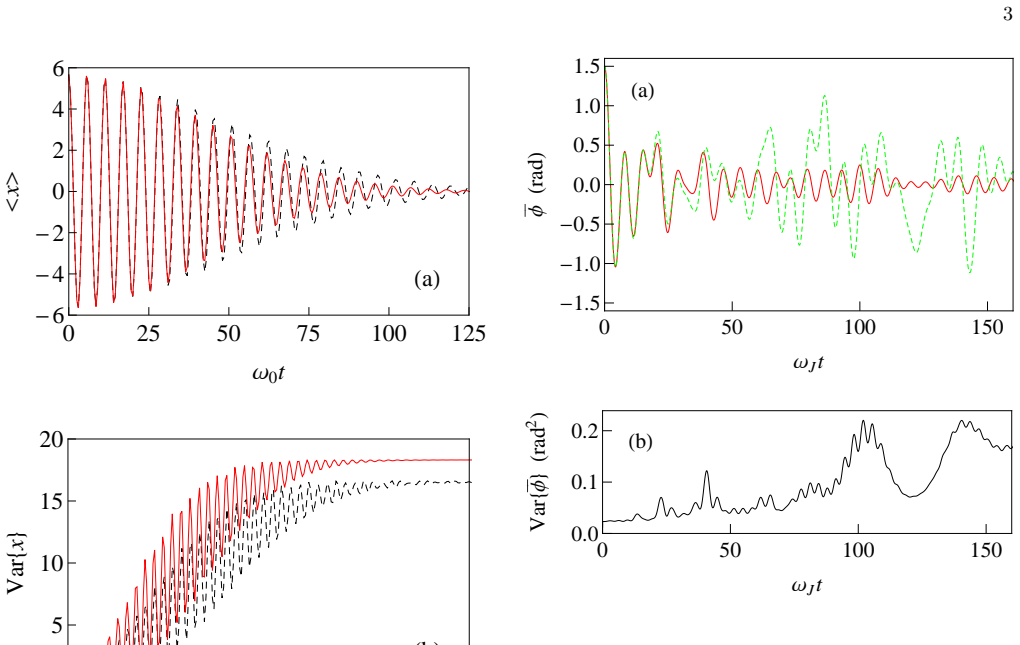
The paper claims that the scrambled mean-field equations, Eq. (6) together with Eq. (7), capture the essential quantum dephasing of degenerate Bose gases while keeping the numerics at the level of coupled Gross-Pitaevskii-like equations for complex amplitudes $\psi_j(t)$. Quantum correlations enter through the factor $\exp[-\sum_j |\psi_j|^2(1 - e^{i G t})]$ in Eq. (7), which appears because the scrambling operator $\hat U_r(t) = \exp(-i\hat H_0 t/\hbar)$ attaches each occupied mode's particle number to every other mode's phase. In the two-mode anharmonic test, the computed expectation values and variances follow the exact diagonalization closely over hundreds of oscillation periods with energy conserved to about 1%; in the multimode Josephson junction, the method yields decaying phase oscillations and growing phase variance rather than the undamped oscillation of the mean-field solution.
Load-bearing premise
Everything rests on the premise that after the scrambling transformation a single product of coherent states still describes the system, with the residual interaction acting only as a mean-field drive; the paper itself notes this leaves out scattering into initially empty modes, and the numerics additionally assume times short compared with the interaction-induced phase shifts.
Editorial extensions
If this is right
- If the method is right, quantum dephasing in a trapped BEC or quasicondensate is computable with Gross-Pitaevskii-like effort: the same complex amplitudes $\psi_j(t)$ that specify the mean field also give the collapsed coherence through occupation-weighted phase spreads.
- For a multimode bosonic Josephson junction, the method predicts that Josephson oscillations damp and phase variance grows while the integrated interference visibility remains high, a testable signature of multimode quantum dephasing.
- The collapse of coherence is governed by the explicit factor $\exp[-\sum_{j'} |\psi_{j'}|^2(1 - e^{i g_{jj'} t})]$, so collapse times can be read off from the occupation-weighted spread of interaction constants $g_{jj'}$, without simulating the many-body Hilbert space.
- Because the construction only assumes well-defined elementary excitations, it transfers to any weakly anharmonic bosonic system, including molecular vibrational dynamics, where the example Hamiltonians can be replaced by an appropriate diagonal quartic part.
- The method reaches time scales on which configuration-based methods become impractically large, since it evolves only $M$ complex functions and conserves energy to roughly 1-2% in the tested cases.
Reading between the lines
- A testable extension would be to replace the fixed orthogonal pseudorandom vectors in the $\sigma$-averaging step with fresh noise at every time step; if the dephasing times shift measurably, the Gaussian factorization itself is biasing the results.
- The author's stated blind spot, scattering into initially empty modes, implies the method is most reliable for observables carried by initially occupied modes; coupling the scrambled equations to a weak reservoir of empty high-energy modes could extend it toward thermalization, but this goes beyond the paper.
- In the Josephson junction example the predicted damping is slower and less complete than the experimental relaxation, which the author attributes to the simplified model; including density-dependent radial widths or coupling to symmetric modes would tell whether the gap is a model limitation or a method limitation.
- Since Eq. (7) evaluates the scrambling factors at coherent amplitudes, the method can likely be recast as a stochastic phase-space evolution in the scrambled variables, connecting it to truncated-Wigner or positive-P techniques, though the paper does not make that connection.
Signed reviews
Editorial analysis
A structured set of objections, weighed in public.
Referee Report
Summary. The manuscript proposes a 'scrambled mean field' method for the quantum dynamics of trapped, weakly interacting Bose gases. The key idea is to transform the many-body Hamiltonian to an interaction representation with respect to the harmonic part plus the diagonal quartic part, and then apply a product-of-coherent-states variational ansatz in that representation. The resulting equations, Eq. (6) with Eq. (7), are claimed to be almost as simple as the Gross-Pitaevskii equation while capturing non-mean-field effects such as the collapse of coherence. The method is benchmarked against exact diagonalization for a two-dimensional anharmonic oscillator (Fig. 1 and Supplemental Material), with reported energy conservation to about 1%. It is then applied to a 21-mode bosonic Josephson junction, where it predicts damping of phase oscillations and growth of phase variance (Fig. 2). The final paragraph states that scattering of quanta into initially empty modes remains beyond the method's scope.
Significance. If the central claim is valid, the method offers a computationally cheap way to describe certain multimode quantum-dephasing phenomena in finite-size bosonic systems, a regime where truncated Wigner methods lose accuracy and MCTDHB may require impractically many configurations. The 2D benchmark is encouraging: the method reproduces expectation values, variances, and covariance for a two-mode anharmonic system over long times, with good energy conservation. The proposed numerical complexity reduction is also attractive for qualitative long-time estimates. However, the multimode demonstration is not yet convincing: the Josephson-junction simulation relies on uncontrolled small-time approximations that are never checked against the unapproximated Eq. (7), and the validity range stated in the Supplemental is violated by the simulation times in Fig. 2. The paper therefore establishes the potential of the idea but not yet its multimode utility.
major comments (3)
- [§Numerical method, Eq. (7), Fig. 2, Supplemental II] The numerical implementation of Eq. (7) uses two uncontrolled simplifications: neglecting the non-commutativity of b_j and A_{j'} (dropping g-dependent terms in the phase ν) and replacing the exponential dephasing factor exp[-|ψ_j|^2(1-e^{iGt})] by a Gaussian small-time expansion. Both are perturbative in g_{jj'}t, but the collapse of coherence that the method is intended to capture occurs at g_{jj'}t ~ 1. The Supplemental states these simplifications are valid for t ≲ ħ/Uc, whereas Fig. 2 runs to ω_J t = 150 with ħω_J = 30Uc, i.e., Uc t/ħ = 5 at the end. Unless all occupied coupling constants are far below Uc/ħ, which is not shown, the run exceeds the stated range. The approximate solver is never compared with the unapproximated Eq. (7), even for a small number of modes, so the reported damping and variance growth may not reflect the actual scrambled mean-field equations. A quantitative comparison, e.g., for M = 3 or 4 modes, is needed to validate the approximation, or the demonstration should be restricted to times within the controlled regime.
- [Fig. 2, mode truncation] No convergence check with respect to the number of modes M is presented. The heuristic thermalization argument in the main text estimates a minimal mode number, but the paper does not show that the Josephson-junction results are stable when M is increased or changed (e.g., M = 14, 21, 34). Without such a test, the observed damping and variance growth could be an artifact of truncation rather than a genuine multimode quantum effect. The claim that the method handles a 'nontrivially large number of modes' requires at least a demonstration that the chosen M is sufficient for the observable of interest.
- [Final paragraph, scope limitation] The closing paragraph acknowledges that 'the description of scattering of quanta into initially empty modes remains beyond its scope.' This is a severe limitation for the central claim, because scattering into initially empty modes is generic in multimode Bose-gas dynamics, and the paper does not identify conditions under which it can be neglected. In the Josephson-junction application, the initial coherent state with ⟨ρ⟩ = 0 may have empty or nearly empty high-frequency modes; if those modes become populated, the method cannot capture the resulting dynamics. The paper should either justify that such scattering is negligible for the chosen initial state and observables over the simulated times, or qualify the central claim accordingly.
minor comments (4)
- [Eq. (8)] The indices κ and λ in g_{κλ} are not explicitly defined in terms of the mode labels in the term V_{j_1...j_l}^{j'_1...j'_{l'}}; please clarify the notation.
- [Supplemental I] The Supplemental states that the 2D benchmark evaluates the r.h.s. of Eq. (6) exactly, but this is not stated clearly in the main text; adding this distinction would help readers understand that Fig. 1 tests the variational ansatz, not the approximate factorizations used in Fig. 2.
- [Supplemental II] The stability test against different random vectors σ_γ shows discrepancies of order 10^{-2} rad, but the effect of these fluctuations on the reported variance, not just the mean phase, should be reported, since the variance is the key demonstration of coherence collapse.
- [Throughout] There are several typographical and formatting issues (e.g., 'Schr¨ odinger', 'we can the find', inconsistent use of hats in Eq. (11)); a careful proofread is recommended.
Circularity Check
No significant circularity found; the derivation is self-contained and benchmarked against external exact diagonalization.
full rationale
Every load-bearing step in the derivation is defined by the paper itself and checked externally. The transformation U_r(t)=exp(-i H_0 t/hbar) with H_0=H_h+H_qd and the mode transformation in Eqs. (3)-(4) follow exactly from the definitions of H_h and H_qd; Eq. (7) is the exact coherent-state expectation value of the transformed interaction operator, and Eq. (6) is the standard variational projection of the Schrodinger equation onto the coherent-state manifold. No parameter is fitted to the quantities that the method is said to predict: the coupling constants g_{jj'} are read off from the model Hamiltonians (the 2D quartic oscillator and the bosonic Josephson junction), and the two-mode benchmark is compared with independent exact diagonalization of Eq. (10). The approximate numerical implementation for the 21-mode Josephson case is a validity concern, not a circularity: the Supplemental states the time scale t <~ hbar/U_c, and the final paragraph explicitly admits that scattering of quanta into initially empty modes remains beyond the method's scope. The collapse of coherence enters by construction through the physical input H_qd, but the observable consequences, such as damped phase oscillations and growth of phase variance, are not assumed in the derivation; they are computed from the equations of motion. No circular step can be exhibited, so the circularity score is 0.
Assumptions & free parameters
free parameters (1)
- number of modes M =
21 (chosen by hand)
assumptions (4)
- domain assumption The anharmonic part of the Hamiltonian is small and can be expanded in a Taylor series in creation and annihilation operators of elementary excitations, beginning with a cubic term.
- ad hoc to paper A product of coherent states in the interaction representation, Eq. (5), remains a valid variational description throughout the evolution.
- ad hoc to paper For times g_{jj'}t less than or similar to 1, noncommutativity of b_j and A_{j'} can be neglected and the exponential dephasing factor can be replaced by a Gaussian form.
- domain assumption The initial state is a product of coherent states for all modes.
Cite this review
Pith. "Pith review of Scrambled Mean Field Approach to the Quantum Dynamics of Degenerate Bose Gases." pith.science (2026). https://pith.science/paper/QMN6P6A5
@misc{pith2026190804831,
  author       = {Pith},
  title        = {Pith review of: Scrambled Mean Field Approach to the Quantum Dynamics of Degenerate Bose Gases},
  year         = {2026},
  howpublished = {\url{https://pith.science/paper/QMN6P6A5}},
  note         = {Machine review of arXiv:1908.04831}
}
read the original abstract
We present a novel approach to modeling dynamics of trapped, degenerate, weakly interacting Bose gases beyond the mean field limit. We transform a many-body problem to the interaction representation with respect to a suitably chosen part of the Hamiltonian and only then apply a multimode coherent-state ansatz. The obtained equations are almost as simple as the Gross--Pitaevskii equation, but our approach captures essential features of the quantum dynamics such as the collapse of coherence.
Figures
Reference graph
Works this paper leans on
-
[1]
Dalfovo, S
F. Dalfovo, S. Giorgini, L. P. Pitaevskii, and S. Stringari, Theory of Bose-Einstein condensation in trapped gases. Rev. Mod. Phys. 71, 463 (1999)
1999
-
[2]
L. P. Pitaevskii, Bose-Einstein condensation in magnetic traps. Introduction to the theory. Physics-Uspekhi 41, 569 (1998)
work page 1998
-
[3]
A. J. Leggett, Bose-Einstein condensation in the alkali gases: Some fundamental concepts. Rev. Mod. Phys. 73, 307 (2001)
work page 2001
-
[4]
M. J. Steel, M. K. Olsen, L. I. Plimak, P. D. Drummond, S. M. Tan, M. J. Collett, D. F. Walls, and R. Graham, Dynamical quantum noise in trapped Bose-Einstein con- densates. Phys. Rev. A 58, 4824 (1998)
work page 1998
-
[5]
A. Sinatra, C. Lobo, and Y. Castin, The truncated Wigner method for Bose-condensed gases: limits of va- lidity and applications . J. Phys. B 35, 3599 (2002)
work page 2002
-
[6]
T. Gasenzer, J. Berges, M. G. Schmidt, and M. Seco, Nonperturbative dynamical many-body theory of a Bose- Einstein condensate. Phys. Rev. A 72, 063604 (2005)
work page 2005
-
[7]
H. Aoki, N. Tsuji, M. Eckstein, M. Kollar, T. Oka, and P. Werner, Nonequilibrium dynamical mean-field theory and its applications. Rev. Mod. Phys. 86, 779 (2014)
work page 2014
-
[8]
I. Chantesana, A. P. Orioli, and T. Gasenzer, Kinetic theory of nonthermal fixed points in a Bose gas. Phys. Rev. A 99, 043620 (2019)
work page 2019
Show all 33 references
-
[9]
Buchhold and S
M. Buchhold and S. Diehl, Kinetic theory for interacting Luttinger liquids. Eur. Phys. J. D 69, 224 (2015)
2015
-
[10]
D. S. Jin, J. R. Ensher, M. R. Matthews, C. E. Wie- man, and E. A. Cornell, Collective Excitations of a Bose- Einstein Condensate in a Dilute Gas. Phys. Rev. Lett.77, 420 (1996)
1996
-
[11]
Mewes, M
M.-O. Mewes, M. R. Andrews, N. J. van Druten, D. M. Kurn, D. S. Durfee, C. G. Townsend, and W. Ketterle, Collective Excitations of a Bose-Einstein Condensate in a Magnetic Trap. Phys. Rev. Lett. 77, 988 (1996)
1996
-
[12]
O. E. Alon, A. I. Streltsov, and L. S. Cederbaum, Multiconfigurational time-dependent Hartree method for bosons: Many-body dynamics of bosonic systems. Phys. Rev. A 77, 033613 (2008)
2008
-
[13]
J. H. V. Nguyen, M. C. Tsatsos, D. Luo, A. U. J. Lode, 5 G. D. Telles, V. S. Bagnato, and R. G. Hulet, Parametric Excitation of a Bose-Einstein Condensate: From Faraday Waves to Granulation. Phys. Rev. X 9, 011052 (2019)
2019
-
[14]
D. X. Horv´ ath and G. Tak´ acs, Overlaps after quantum quenches in the sine-Gordon model. Phys. Lett. B 771, 539 (2017)
2017
-
[15]
Kukuljan, S
I. Kukuljan, S. Sotiriadis, and G. Takacs, Correlation Functions of the Quantum Sine-Gordon Model in and out of Equilibrium. Phys. Rev. Lett. 121, 110402 (2018)
2018
-
[16]
Greiner, O
M. Greiner, O. Mandel, T. W. H¨ ansch, and I. Bloch, Collapse and revival of the matter wave field of a BoseE- instein condensate. Nature 419, 51 (2002)
2002
-
[17]
S. Will, T. Best, U. Schneider, L. Hackerm¨ uller, D.-S. L¨ uhmann, and I. Bloch, Time-resolved observation of coherent multi-body interactions in quantum phase re- vivals. Nature 465, 197 (2010)
2010
-
[18]
T. Zhou, K. Yang, Z. Zhu, X. Yu, S. Yang, W. Xiong, X. Zhou, X. Chen, C. Li, J. Schmiedmayer, X. Yue, and Y. Zhai, Observation of atom-number fluctuations in optical lattices via quantum collapse and revival dynamics. Phys. Rev. A 99, 013602 (2019)
2019
-
[19]
Javanainen and M
J. Javanainen and M. Wilkens, Phase and Phase Dif- fusion of a Split Bose-Einstein Condensate. Phys. Rev. Lett. 78, 4675 (1997)
1997
-
[20]
Imamo¯ glu, M
A. Imamo¯ glu, M. Lewenstein, and L. You, Inhibition of Coherence in Trapped Bose-Einstein Condensates. Phys. Rev. Lett. 78, 2511 (1997)
1997
-
[21]
A. B. Kuklov, N. Chencinski, A. M. Levine, W. M. Schreiber, and J. L. Birman, Quantum dephasing of nor- mal modes of a Bose-Einstein condensate in a magnetic trap. Phys. Rev. A 55, R3307(R) (1997)
1997
-
[22]
F. W. Cummings, Stimulated emission of radiation in a single mode. Phys. Rev. 140, A1051 (1965)
1965
-
[23]
J. H. Eberly, N. B. Narozhny, and J. J. Sanchez- Mondragon, Periodic spontaneous collapse and revival in a simple quantum model. Phys. Rev. Lett. 44, 1323 (1980)
1980
-
[24]
Kucar, H.-D
J. Kucar, H.-D. Meyer, and L. S. Cederbaum, Time- dependent rotated Hartree approach. Chem. Phys. Lett. 140, 525 (1987)
1987
-
[25]
R. J. Glauber, Coherent and Incoherent States of the Radiation Field. Phys. Rev. 131, 2766 (1963)
1963
-
[26]
See Supplemental Material
-
[27]
Salasnich, A
L. Salasnich, A. Parola, and L. Reatto, Effective wave equations for the dynamics of cigar-shaped and disk- shaped Bose condensates. Phys. Rev. A 65, 043614 (2002)
2002
-
[28]
Gritsev, A
V. Gritsev, A. Polkovnikov, and E. Demler, Linear re- sponse theory for a pair of coupled one-dimensional con- densates of interacting atoms. Phys. Rev. B, 75, 174511 (2007)
2007
-
[29]
Pigneur, T
M. Pigneur, T. Berrada, M. Bonneau, T. Schumm, E. Demler, and J. Schmiedmayer, Relaxation to a Phase- Locked Equilibrium State in a One-Dimensional Bosonic Josephson Junction. Phys. Rev. Lett. 120, 173601 (2018)
2018
-
[30]
J. F. Traub and A. G. Werschulz, Complexity and infor- mation (Cambridge University Press, Cambridge, 1998)
1998
-
[31]
H.-D. Meyer. U.Manthe, and L. S. Cederbaum, The multi-configurational time-dependent Hartree approach. Chem. Phys. Lett. 165, 73 (1990)
1990
-
[32]
J. M. Bowman, T. Carrington, and H.-D. Meyer, Vari- ational quantum approaches for computing vibrational energies of polyatomic molecules. Molecular Phys. 106, 2145 (2008). 6 Supplemental Material for Scrambled Mean Field Approach to the Quantum Dynamics of Degenerate Bose Gas...
2008
-
[33]
D. P. Laurie, J. Comput. Appl. Math. 127, 201 (2001)
2001
Reviewed August 14, 2026 · model on record in the stance chip above.
Discussion (0). Continue with ORCID to comment.