REVIEW 4 major objections 5 minor 21 references
SP-NET: One Shot Fingerprint Singular-Point Detector
T0 review · 4 major / 5 minor · reviewed 2026-08-14 · deepseek-v4-flash
Pith's one-line read SP-NET detects fingerprint singular points end-to-end and reports higher true detection rates than four prior methods on three databases.
desk verdict A solid architecture paper whose headline SOTA claim is undercut by a sloppy evaluation protocol; worth sending to peer review but needs major revision. read the letter →
The pith
A machine-rendered reading of the paper's core claim, the machinery that carries it, and where it could break.
The reading
What carries the argument
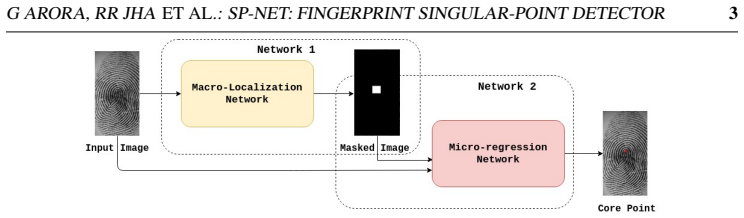
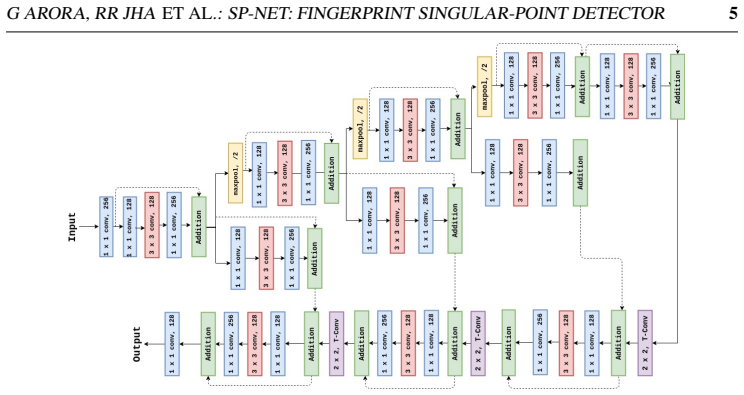
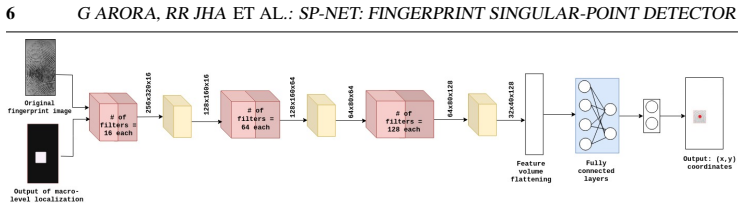
The load-bearing mechanism is the two-stage stack: a Macro-Localization Network, an encoder-decoder with three stacked hourglass bottlenecks that outputs a probability mask, and a Micro-Regression Network, a convolutional block followed by fully connected layers that regresses a single (x,y) coordinate. The hourglass—a multi-scale convolutional module that repeatedly downsamples and upsamples while preserving information through skip connections—lets the network re-assess features across the whole image and across scale, which the paper credits for robustness to noise and blur. The two networks are trained separately and then stacked so a fingerprint image passes through the whole system to produce coordinates in one go.
What would settle it
Re-run the four listed baselines and SP-NET on the same FVC2002 database and identical ground truth under both the 10-pixel and 20-pixel rules; if any baseline's true detection rate at the same tolerance equals or exceeds SP-NET's (98.75% on DB1_A, 96.25% at 10 pixels), the paper's central claim is disproved.
Extended reading notes
Core claim
The discovery the paper argues for is that singular-point detection can be cast as a regression problem solved in one forward pass, with no hand-designed orientation-field or Poincare-index computation. The Macro-Localization Network uses an encoder-decoder with a three-stacked hourglass bottleneck to produce a 43 × 43-pixel mask around the probable singular point; the Micro-Regression Network then concatenates that mask with the original image and regresses the (x,y) coordinates. Trained with binary cross-entropy for the mask and mean squared error for the coordinates, the combined model reaches the reported true detection rates, which the paper compares favorably against four prior methods in its Table 1.
Load-bearing premise
The load-bearing premise is that Table 1's comparison is fair: it lists SP-NET at a 10-pixel tolerance while not stating the tolerance for the four baselines, and its database caption does not match the text, so if the baselines were scored at the looser 20-pixel rule the 'outperforms all' conclusion would not follow.
Editorial extensions
If this is right
- Fingerprint normalization and indexing pipelines can consume singular-point coordinates directly from one forward pass of SP-NET, replacing separate orientation-field and Poincare-index stages.
- The architecture can be trained from scratch on a new sensor population: the 92.72% true detection rate on FPL30K, collected from rural subjects across three sensors, indicates the method transfers beyond the clean FVC setting.
- At the stricter 10-pixel tolerance the model still reports 96.25% on FVC2002 DB1_A, so its localization error is not merely within the 20-pixel acceptance radius.
- Because adding a fourth stacked hourglass gave little improvement, the paper's three-hourglass bottleneck is a deliberate capacity-versus-performance trade-off.
Reading between the lines
- A testable extension the paper does not run is an ablation on the mask size: varying the 43 × 43 ground-truth mask while keeping the regressor fixed would show how much of the accuracy is carried by macro-localization versus micro-regression.
- The same two-stage mask-plus-regression design could be retrained for other high-curvature landmarks, such as iris or palmprint core points, since nothing in the architecture is fingerprint-specific.
- The manual ground-truth labels on FPL30K may set the practical ceiling for reported accuracy; comparing SP-NET's errors against labeler disagreement would separate model error from label noise, a hypothesis the paper leaves implicit.
Signed reviews
Editorial analysis
A structured set of objections, weighed in public.
Referee Report
Summary. The paper proposes SP-NET, a deep CNN for fingerprint singular-point detection. The architecture combines a Macro-Localization Network (an encoder-decoder with three stacked hourglass modules) and a Micro-Regression Network that outputs singular-point coordinates. The model is trained separately on the segmentation and regression stages and then stacked into a single forward-pass detector. The authors report true detection rates (TDR) of 98.75%, 97.5%, and 92.72% on FVC2002 DB1_A, FVC2002 DB2_A, and an in-house FPL30K dataset (30,000 images), respectively, and claim that this outperforms all state-of-the-art techniques. The paper includes a distance-vs-accuracy analysis and a comparison with four prior methods on one database.
Significance. If the reported results hold under a properly controlled protocol, the paper would represent a useful contribution: an end-to-end CNN for singular-point localization that avoids hand-crafted orientation-field features, achieves high TDR on standard benchmarks, and introduces a large manually annotated in-house dataset. The two-stage macro-localization/micro-regression design with stacked hourglass modules is technically reasonable, and the distance-vs-accuracy plots provide more information than a single TDR value. The central claim of state-of-the-art superiority is, however, not currently supported because the comparative evaluation in Table 1 is internally inconsistent and does not establish a common protocol for the baselines. The paper also does not release code or trained models, which limits independent verification.
major comments (4)
- [Section 3.4, Table 1] The dataset label is inconsistent between text and table. Section 3.4 states that the proposed model shows a detection rate of 96.25% on FVC2002 DB1_A at a 10-pixel tolerance, but the caption of Table 1 says the comparison is on FVC2002 DB2_A. Table 2 reports a 20-pixel TDR of 98.75% for DB1_A and 97.50% for DB2_A, which indicates that the 96.25% figure in Table 1 corresponds to DB1_A, not DB2_A. This mismatch must be corrected before the comparison can be interpreted.
- [Table 1, Equation 3] The comparison with baselines in Table 1 is not protocol-equivalent. Equation 3 defines a true detection as a Euclidean distance of at most 20 pixels, and Table 2 uses that threshold. The proposed SP-NET row in Table 1, however, is explicitly reported 'at less than 10 pixels', while the rows for Zhou, Xie, Tiwari, and Liu do not state the tolerance, ground-truth definition, or test split used. If the baselines were evaluated under the more lenient 20-pixel rule, or on a different ground truth, the claimed superiority is not established by the table as presented. The authors should either re-run the baselines under the same protocol or clearly report each method's original tolerance and explain the comparability.
- [Section 3.4, Table 2] The reported TDR values come from a single 80%-20% train-test split with no cross-validation, confidence intervals, or error bars. On FVC2002 DB1_A and DB2_A, the test sets contain only 160 images each, so a change of one or two predictions changes the TDR by roughly 0.6-1.2 percentage points. The difference between the proposed method's 10-pixel TDR (96.25%) and the next-best baseline (96.03%) is within this sampling variability. The authors should report results over multiple splits or provide bootstrap confidence intervals to support the claimed margin of improvement.
- [Section 3.1, Abstract] The abstract claims that SP-NET is 'better than any other state-of-the-art technique' on all three databases, but state-of-the-art comparisons are provided only for one database (and even that comparison is protocol-inconsistent). FPL30K is an in-house dataset with no public release, and the paper gives no baseline results on it. The broad superiority claim is therefore not supported by the evidence presented. The authors should either add controlled comparisons on all databases or substantially soften the claim.
minor comments (5)
- [Title, Abstract] The term 'one-shot' is potentially misleading. The model performs detection in a single forward pass, but it is not one-shot learning in the standard machine-learning sense. Please clarify this terminology.
- [Section 3.1] The ground truth for all databases was 'generated manually', but no details are given about the annotation protocol, the number of annotators, inter-annotator agreement, or quality control. This is important for the credibility of the TDR numbers, especially for the 30,000-image FPL30K dataset.
- [Section 3.2] The 20-pixel tolerance in Equation 3 is introduced without justification. The distance-vs-accuracy curves in Figure 6 partially address this, but the choice of 20 pixels as the headline criterion should be discussed or referenced.
- [Section 2.2] The abstract and introduction describe the model as 'end-to-end', but Section 2.2 says the two subnetworks are trained individually and then stacked. It is unclear whether the stacked network is subsequently fine-tuned as a whole. Please clarify the training procedure.
- [Section 1.2] The contribution list claims robustness to 'scale difference, blurriness etc.' due to repeated scale-up/down operations, but no experiments on scale or blur variations are presented. This claim is not empirically supported.
Circularity Check
No circularity: SP-NET reports trained-model measurements against manually labeled ground truth; reported TDRs are empirical outputs, not fitted inputs.
full rationale
The paper claims an end-to-end CNN that localizes fingerprint singular points and reports TDR on FVC2002 DB1_A, FVC2002 DB2_A, and FPL30K. The derivation chain is architectural and empirical: the macro-localization network is trained with binary cross-entropy on manually generated masks, the micro-regression network is trained with mean squared error on manually marked coordinates, and TDR is defined in Eq. 3 as a Euclidean distance from predicted to ground-truth coordinates. No parameter of the model is fit to the TDR numbers, and no reported quantity is defined in terms of another reported quantity. The ground truth is generated manually (Section 3.1), so the evaluation is not self-referential. Self-citations appear (e.g., [17] in Table 1 and [4] in the introduction), but they are baseline numbers and background references, not load-bearing justifications for the method's correctness; the cited numbers are externally published results. Table 1's mismatched database label and the unstated tolerance for baseline methods are legitimate soundness and protocol concerns, but they are not circularity: they concern comparability, not the reduction of a prediction to its inputs. Therefore no circular step can be quoted, and the circularity score is 0.
Assumptions & free parameters
free parameters (3)
- Tolerance threshold for TDR =
20 pixels (Eq. 3); 10 pixels in Table 1
- Ground truth mask size =
43x43 pixels
- Number of stacked hourglass modules =
3
assumptions (3)
- domain assumption Manually annotated ground truth coordinates are accurate and consistent
- domain assumption The 80-20 train/test split is representative and there is no subject overlap leakage
- standard math Standard deep learning assumptions (i.i.d. data, convergence of Adam optimizer)
Cite this review
Pith. "Pith review of SP-NET: One Shot Fingerprint Singular-Point Detector." pith.science (2026). https://pith.science/paper/VMXNWN4F
@misc{pith2026190804842,
  author       = {Pith},
  title        = {Pith review of: SP-NET: One Shot Fingerprint Singular-Point Detector},
  year         = {2026},
  howpublished = {\url{https://pith.science/paper/VMXNWN4F}},
  note         = {Machine review of arXiv:1908.04842}
}
read the original abstract
Singular points of a fingerprint image are special locations having high curvature properties. They can play a pivotal role in fingerprint normalization and reliable feature extraction. Accurate and efficient extraction of a singular point plays a major role in successful fingerprint recognition and indexing. In this paper, a novel deep learning based architecture is proposed for one shot (end-to-end) singular point detection from an input fingerprint image. The model consists of a Macro-Localization Network and a Micro-Regression Network along with three stacked hourglass as a bottleneck. The proposed model has been tested on three databases viz. FVC2002 DB1_A, FVC2002 DB2_A and FPL30K and has been found to achieve true detection rate of 98.75%, 97.5% and 92.72% respectively, which is better than any other state-of-the-art technique.
Figures


Figures from the paper (3 more)

Reference graph
Works this paper leans on
-
[1]
http://bias.csr.unibo.it/fvc2002/
The FVC2002 database:. http://bias.csr.unibo.it/fvc2002/
-
[2]
Fingerprint singular point detection algorithm by poincaré index
Jin Bo, Tang Hua Ping, and Xu Ming Lan. Fingerprint singular point detection algorithm by poincaré index. WSEAS Transactions on Systems, 7(12):1453–1462, 2008
work page 2008
-
[3]
A fast and accurate method for detecting fingerprint reference point
Xifeng Guo, En Zhu, and Jianping Yin. A fast and accurate method for detecting fingerprint reference point. Neural Computing and Applications, 29(1):21–31, 2018
work page 2018
-
[4]
Fingerprint indexing schemes - a survey
Phalguni Gupta, Kamlesh Tiwari, and Geetika Arora. Fingerprint indexing schemes - a survey. Neurocomputing, 335:352–365, 2019. 10 G ARORA, RR JHA ET AL.: SP-NET: FINGERPRINT SINGULAR-POINT DETECTOR
work page 2019
-
[5]
A robust singular point detection algorithm
Puneet Gupta and Phalguni Gupta. A robust singular point detection algorithm. Applied Soft Computing, 29:411–423, 2015
work page 2015
-
[6]
Fingerprint singular point de- tection based on modified poincare index method
Gabriel Babatunde Iwasokun and Oluwole Charles Akinyokun. Fingerprint singular point de- tection based on modified poincare index method. International Journal of Signal Processing, Image Processing and Pattern Recognition, 7(5):259–272, 2014
work page 2014
-
[7]
Anil K Jain, Patrick Flynn, and Arun A Ross. Handbook of biometrics . Springer Science & Business Media, 2007
work page 2007
-
[8]
L Liang, H Zhao, P He, and H Tian. Algorithm of extracting core point in fingerprint.JOURNAL- HEBEI UNIVERSITY OF TECHNOLOGY, 36(1):46, 2007
work page 2007
Show all 21 references
-
[9]
A method for singular points detection based on faster-rcnn
Yonghong Liu, Baicun Zhou, Congying Han, Tiande Guo, and Jin Qin. A method for singular points detection based on faster-rcnn. Applied Sciences, 8(10):1853, 2018
2018
-
[10]
Handbook of fingerprint recognition
Dario Maio and Anil K Jain. Handbook of fingerprint recognition. springer, 2009
2009
-
[11]
Fingerprint core location algorithm based on sliding window
Xiangshen Min, Xuefeng Zhang, and Fang Ren. Fingerprint core location algorithm based on sliding window. Wuhan University Journal of Natural Sciences, 23(3):195–200, 2018
2018
-
[12]
Stacked hourglass networks for human pose esti- mation
Alejandro Newell, Kaiyu Yang, and Jia Deng. Stacked hourglass networks for human pose esti- mation. In European Conference on Computer Vision, pages 483–499. Springer, 2016
2016
-
[13]
Ipsegnet: Deep convolutional neural network based segmentation framework for iris and pupil
Shreyas Malakarjun Patil, Ranjeet Ranjan Jha, and Aditya Nigam. Ipsegnet: Deep convolutional neural network based segmentation framework for iris and pupil. In International Conference on Signal-Image Technology & Internet-Based Systems (SITIS), pages 184–191. IEEE, 2017
2017
-
[14]
Faster r-cnn: Towards real-time object detection with region proposal networks
Shaoqing Ren, Kaiming He, Ross Girshick, and Jian Sun. Faster r-cnn: Towards real-time object detection with region proposal networks. In Advances in neural information processing systems, pages 91–99, 2015
2015
-
[15]
U-Net: Convolutional networks for biomedical image segmentation
Olaf Ronneberger, Philipp Fischer, and Thomas Brox. U-Net: Convolutional networks for biomedical image segmentation. In International Conference on Medical image computing and computer-assisted intervention, pages 234–241. Springer, 2015
2015
-
[16]
Indexing fingerprint database with minutiae based coaxial gaussian track code and quantized lookup table
Kamlesh Tiwari and Phalguni Gupta. Indexing fingerprint database with minutiae based coaxial gaussian track code and quantized lookup table. In International Conference on Image Process- ing, pages 4773–4777. IEEE, 2015
2015
-
[17]
Meandering energy potential to locate singular point of fingerprint
Kamlesh Tiwari and Phalguni Gupta. Meandering energy potential to locate singular point of fingerprint. In International Conference on Biometrics (ICB), pages 1–6. IEEE, 2016
2016
-
[18]
Fingerprint reference point determination based on a novel ridgeline feature
SJ Xie, HM Yoo, DS Park, and S Yoon. Fingerprint reference point determination based on a novel ridgeline feature. In Intl. Conference on Image Processing, pages 3073–3076. IEEE, 2010
2010
-
[19]
Fingerprint reference point identification based on chain encoded discrete curvature and bending energy
Geevar C Zacharias, Madhu S Nair, and P Sojan Lal. Fingerprint reference point identification based on chain encoded discrete curvature and bending energy. Pattern Analysis and Applica- tions, 20(1):253–267, 2017
2017
-
[20]
A novel algorithm for detecting singular points from fingerprint images
Jie Zhou, Fanglin Chen, and Jinwei Gu. A novel algorithm for detecting singular points from fingerprint images. IEEE Transactions on Pattern Analysis and Machine Intelligence , 31(7): 1239–1250, 2009
2009
-
[21]
Walking to singular points of fingerprints
En Zhu, Xifeng Guo, and Jianping Yin. Walking to singular points of fingerprints. Pattern Recognition, 56:116–128, 2016
2016
Reviewed August 14, 2026 · model on record in the stance chip above.
Discussion (0). Continue with ORCID to comment.