REVIEW 4 major objections 6 minor 56 references
Inelastic scattering of photon pairs in qubit arrays with subradiant states
T0 review · 4 major / 6 minor · reviewed 2026-08-14 · deepseek-v4-flash
Pith's one-line read Subradiant double-excited states create sharp resonances in inelastic photon-pair scattering and can beat single-qubit output by orders of magnitude.
desk verdict A genuine new mechanism in waveguide QED with a clean analytic treatment; the soft spots are scope conditions, not fatal flaws. read the letter →
The pith
A machine-rendered reading of the paper's core claim, the machinery that carries it, and where it could break.
The reading
What carries the argument
The load-bearing object is the non-Hermitian effective qubit Hamiltonian obtained after tracing out the photons, $H^{(1)}_{ij}(\omega_0)=\hbar\omega_0\delta_{ij}-i\hbar\Gamma_0 e^{i\omega_0|z_i-z_j|/c}$, evaluated in the Markovian approximation at the qubit frequency. From it the paper builds the two-particle Hamiltonian $H^{(2)}+U$ and the matrix scattering kernel $Q=-i\chi(1-i\chi\Sigma)^{-1}$, which in the Markovian limit simplifies to $Q=i\chi[(2\varepsilon-H)/(H+U-2\varepsilon)]$ and, near a resonance, to $Q_{ij}\approx 2i\Gamma_0^2 d_i d_j^*/(\varepsilon_\nu-\varepsilon)$. The radiative-transition amplitudes $d_i$ do double duty: they determine the decay rate $\Gamma_1=\Gamma_0\sum_j|d_j|^2$ in the denominator and the oscillator strength in the numerator, which is why states with small but nonvanishing $d_i$ (subradiant) or out-of-phase $d_i$ (twilight) can still dominate the scattering. The classification of double-excited states as superradiant, twilight, or subradiant by the magnitudes of $\sum_j|d_j|^2$ and $|\sum_j d_j|^2$ is the organizational device that makes the resonance structure legible.
What would settle it
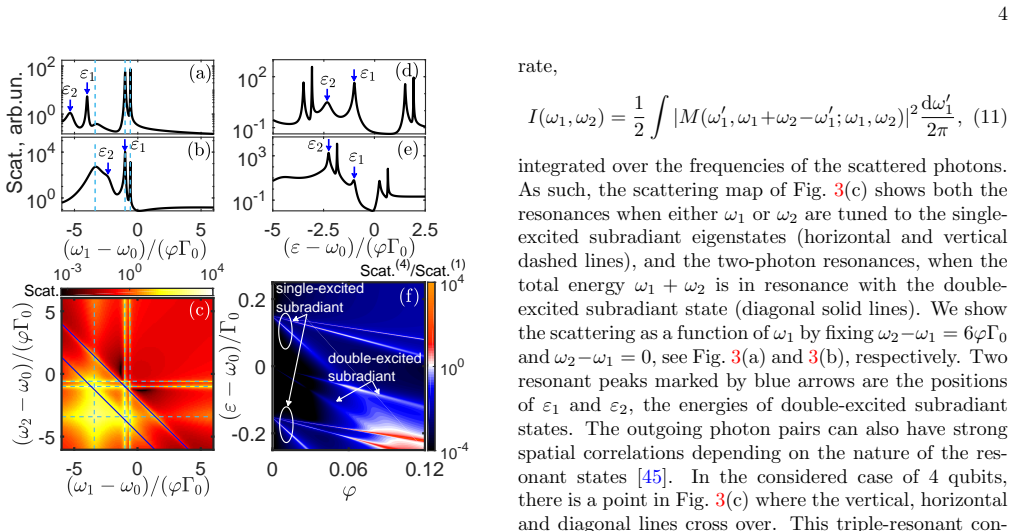
Measure the total forward inelastic scattering of a photon pair in a waveguide coupled to four qubits with spacing $\phi \approx 0.1$: the theory predicts sharp peaks at mean pair energies $2(\omega_0-\phi\Gamma_0)$ and $2(\omega_0-7\phi\Gamma_0/3)$ with widths $\sim\phi^2\Gamma_0$ that exceed the single-qubit scattering maximum; if no such peaks appear, or if the scattering stays at or below the two-qubit value in the suppression dip, the central claim fails.
Extended reading notes
Core claim
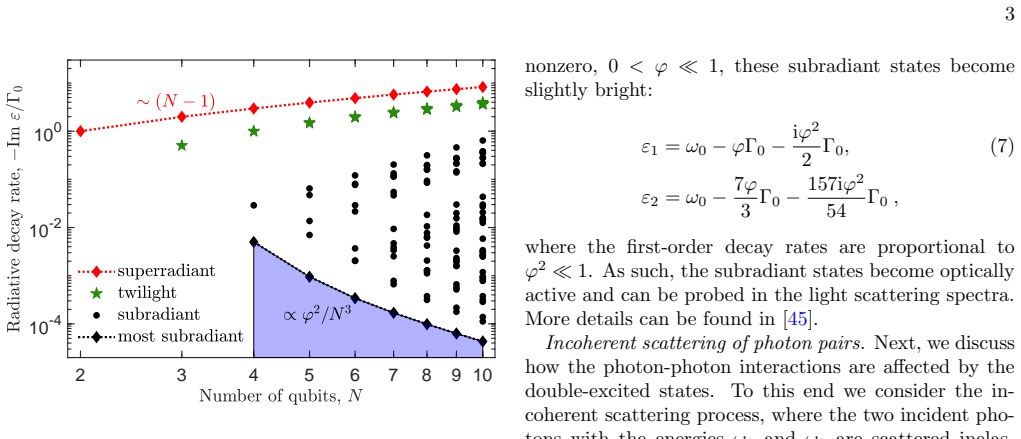
The central discovery is that the two-photon scattering kernel $Q$ is controlled by the eigenstates of the effective two-particle Hamiltonian $H^{(2)}+U$: near a double-excited eigenenergy $\varepsilon_\nu$, $Q_{ij}\approx 2i\Gamma_0^2 d_i d_j^*/(\mathrm{Re}\,\varepsilon_\nu - i\Gamma_0\sum_j |d_j|^2 - \varepsilon)$, where $d_i=\sum_j e^{i\omega_0 z_j/c}\Psi_{ij}$ are the radiative-transition amplitudes. The same amplitudes set both the linewidth and the oscillator strength of the two-photon resonance, and different patterns of $d_i$ separate superradiant ($\sum_j |d_j|^2\sim N$), twilight (finite $\sum_j|d_j|^2$ but $|\sum_j d_j|^2\ll 1$), and subradiant ($\sum_j|d_j|^2\ll 1$) states. For $N=4$ qubits with subwavelength spacing $\phi$, the two subradiant double-excited states have energies $\varepsilon_1=\omega_0-\phi\Gamma_0-i\phi^2\Gamma_0/2$ and $\varepsilon_2=\omega_0-7\phi\Gamma_0/3-157i\phi^2\Gamma_0/54$, and these resonances appear as sharp peaks in the inelastic forward-scattering spectrum, exceeding the single-qubit result by orders of magnitude. The paper further finds that $M$-excitation subradiant states require more than $2M$ qubits, and that twilight states, formed as products of bright and subradiant single-excitation states, emit one photon quickly and the second after $\sim 1/(\phi^2\Gamma_0)$, giving photon-photon correlations far longer-lived than a single qubit's decay time.
Load-bearing premise
Everything hinges on replacing the frequency-dependent photon-mediated coupling by its value at the qubit resonance frequency $\omega_0$, which is valid only for subwavelength spacing; the predicted resonance positions, lifetimes, and scaling are all computed inside that Markovian approximation.
Editorial extensions
If this is right
- For an array of four qubits, the double-excited subradiant resonances appear exactly in the suppression dip where two- and three-qubit arrays show destructive interference, so the enhancement is not washed out by that interference.
- At the triple-resonance point $\omega_1=\omega_2=\omega_0-\phi\Gamma_0$, the single- and double-excited subradiant resonances coincide and further amplify the inelastic forward scattering.
- $M$-excitation subradiant states require more than $2M$ qubits; with $N\ge 4$, the lowest double-excited subradiant decay rate scales as $\Gamma_1\sim \Gamma_0 \phi^2/N^3$, making the states optically accessible while long-lived.
- Twilight states, being products of bright and subradiant single-excitation states, emit one photon quickly and the second only after a time $\sim 1/(\phi^2\Gamma_0)$, producing photon-photon correlations that outlive the single-qubit decay time.
- The subradiant and twilight resonances both appear in inelastic scattering of photon pairs, giving a route to long-lived photon-photon correlations for quantum information storage.
Reading between the lines
- A natural extension the authors do not pursue is applying the same compact matrix method to non-periodic or disordered arrays; if subradiant resonances survive disorder, the enhancement would not require precise periodicity.
- The triple-resonance condition suggests a practical way to create entangled photon pairs with tunable correlation lifetimes by tuning the array period $\phi$; this application is implied but not demonstrated in the paper.
- Since twilight states have linewidth $\sim\Gamma_0$ but lifetime $\sim 1/(\phi^2\Gamma_0)$, they could be easier to address with broad-band pulses than fully subradiant states while still storing correlations; this trade-off is an inference from the paper's spectra.
- For $M>2$ photons, the threshold $N>2M$ implies that a six-qubit array should support three-photon subradiant states; observing them would extend the same resonance mechanism to multiphoton scattering, which the paper leaves beyond its scope.
Signed reviews
Editorial analysis
A structured set of objections, weighed in public.
Referee Report
Summary. This paper develops a Green's-function formalism for inelastic two-photon scattering in a 1D waveguide with an array of two-level (or anharmonic) qubits, and uses it to identify double-excited subradiant states as the origin of sharp resonances. The authors classify double-excited eigenstates into superradiant, twilight, and subradiant states using the single-photon decay amplitudes d_j defined in Eq. (4), and they derive a closed-form expression for the scattering kernel Q in the Markovian approximation, Eqs. (8) and (9). For N=4 qubits they give explicit eigenvalues for the two subradiant states, Eq. (7), and show numerically that the incoherent scattering can exceed the single-qubit value by orders of magnitude (Fig. 3). They also argue, on the basis of a numerical scan in Fig. S10, that M-excitation subradiant states require N ≥ 2M qubits, and they illustrate long-lived photon-photon correlations from twilight and subradiant states in the supplemental figures.
Significance. If the central claims hold, the paper provides a useful conceptual addition to waveguide-QED few-photon scattering: it isolates a mechanism by which collective subradiant two-qubit states produce narrow resonances in the inelastic channel, and it introduces the 'twilight state' classification that connects one-photon and two-photon decay properties. The explicit N=4 analytic eigenvalues, Eqs. (6)–(7), the closed-form scattering kernel, Eq. (9), and the optical-theorem-like identity, Eq. (10), are concrete and checkable results. The paper also ships reproducible numerical spectra and contrasts N=2,3 behavior, which strengthens the presentation. However, the general N ≥ 2M threshold is not proven analytically, and the Markovian approximation—while stated—is not accompanied by a quantitative validity condition, which matters because the predicted linewidths are of order ϕ²Γ0.
major comments (4)
- [Main text, after Eq. (3); Supplemental S4.B] The Markovian replacement of H^(1)(ω) by H^(1)(ω0) is the foundation for the resonance positions and linewidths in Eqs. (7), (8), and (9), yet the paper justifies it only by subwavelength spacing, ϕ << 1. For the N=4 subradiant eigenvalues the relevant detunings from ω0 are of order ϕΓ0, so the neglected frequency dependence of the phase (ω/c)|z_i−z_j| is of order (ϕΓ0)(ϕ/ω0) = ϕ²Γ0/ω0. This correction is comparable to the claimed linewidth itself when Γ0/ω0 is not much smaller than unity. In strongly coupled waveguide-QED implementations Γ0/ω0 can approach 0.1, at which point the predicted linewidths, resonance positions, and the order-of-magnitude enhancements in Fig. 3 are not protected. The authors should state the required weak-coupling condition Γ0/ω0 ≪ 1 (or an equivalent bound) alongside the subwavelength condition, and should specify whether the figures and the N ≥ 2M scan are within such a regime.
- [Main text, 'Multi-excited states' and Fig. S10] The general claim that M-excitation subradiant states exist only for N ≥ 2M is inferred from a numerical scan of minimal decay rates (Fig. S10) and stated as a general fact without an analytic argument. This is load-bearing for the paper's advertised message. The N=4 double-excitation case is supported by the explicit counting argument in the main text (conditions (i)–(iii) with z_j ≡ 0), but that argument does not obviously extend to M>2. The authors should either provide a proof of the N=2M counting result for general M or clearly label it as a conjecture supported by numerics for the studied parameters.
- [Main text, Fig. 3 and Eq. (10)] The central quantitative claim—that the subradiant resonances survive destructive interference and exceed single-qubit scattering by orders of magnitude—is shown in Fig. 3 for a specific set of parameters (χ=10^4Γ0, ϕ=0.1, N=4). Since Eq. (10) is derived in the χ→∞ two-level limit, the authors should state how sensitive the enhancement is to finite χ and to the choice of ϕ. In particular, the figure appears to be taken at χ=10^4Γ0; the text says the two-level limit is χ→∞, but does not quantify how large χ must be for Eq. (10) to be quantitatively reliable. A brief statement of the finite-χ correction would make the comparison to experiment more meaningful.
- [Supplemental S4.C and S6] The long-lived photon-photon correlation claim relies on the kinetic cascade model in S2, which assumes that the single-photon decay channels of the double-excited state are Markovian and independent. The paper notes that the first photon is emitted quickly and the second slowly for twilight states; this is consistent with the kinetic equations, but the equations (S14)–(S20) appear to treat the occupation of the single-excited state as a classical probability without including the interference between multiple decay channels. The authors should state whether the cascade model is exact in the Markovian limit or is a simplifying approximation, since the claim of long-lived correlations is used to motivate quantum-information applications.
minor comments (6)
- [Abstract and Introduction] The abstract states that 'the N-excitation subradiant states can be engineered only if the number of qubits exceeds 2N,' but the paper demonstrates this only for M=2 analytically and for M>2 numerically. Suggest rewording to 'the numerics indicate' or adding a proof.
- [Main text, Eq. (3) and after] The symbol Γ0 is used for the single-qubit decay rate, but in Eq. (5) the decay rate is written as Γ1; the notation Γν21, Γµ10 in the supplement is clearer. Consider defining these once in the main text to avoid confusion.
- [Fig. 3 caption] The caption uses 'Scat.(4)/Scat.(1)' in panel (f) but does not define the normalization of the single-qubit scattering; the text refers to 'Scat.(1)' only after Eq. (11). Please define all abbreviations in the caption.
- [Supplementary Fig. S10] The plot shows decay rates as a function of M and N, but the color scale and the exact definition of the 'most subradiant' state (e.g., which eigenvalue is chosen when several have similar rates) are not specified. This is important for reproducing the N=2M threshold line.
- [Eq. (10) and optical-theorem identity] The identity −2Γ0 Re TrQ = |TrQ|² is stated without derivation in the main text and derived in the supplement; please include the derivation in the main text or point explicitly to Eq. (S47), since this identity is used to argue that the scattering is not suppressed by destructive interference.
- [Language and typos] Minor grammatical issues: 'amplidute' in the text near Eq. (4), 'the photons can be traced out' is vague, and 'the other parameters in the second and fourth panels' in Fig. S9 is unclear. These do not affect the science but should be corrected.
Circularity Check
No significant circularity: resonance positions are derived eigenenergies, and linewidths/enhancements are computed outputs rather than fitted inputs.
full rationale
The paper's derivation chain is self-contained: it starts from the full Hamiltonian (1), obtains the effective non-Hermitian qubit Hamiltonian (2)-(3), diagonalizes the two-particle subspace to get eigenstates and eigenvalues including Eq. (7), and then derives the scattering kernel Q in Eqs. (8)-(9) and expands it near a two-particle eigenstate to obtain the pole formula (10). The resonance positions in Fig. 3 are therefore the same eigenvalues that enter the kernel; this is a mathematical consequence of the pole structure, not a fit. The small decay rates (linewidths) and the oscillator strengths d_j are computed from the eigenstates, and the optical-theorem relation -2Γ0 Re TrQ = |TrQ|² is derived, so the enhancement magnitude is an output. The 'twilight state' classification is based on computed transition amplitudes; its long-lived correlation lifetime is subsequently verified by the kinetic equations and g^(2) calculations in the Supplemental Material, so the classification does not smuggle in the claimed correlation as input. The only significant caveat is the explicitly stated Markovian replacement of H^(1)(ω) by H^(1)(ω0) after Eq. (3), justified by subwavelength spacing; this is an approximation limiting quantitative validity in strongly coupled regimes, but it is not a circularity because the subsequent derivation does not assume the scattering resonances it predicts. Self-citations such as Ref. [44] are used only for the standard large-anharmonicity limit and are not load-bearing. No fitted-parameter or prediction-by-construction steps were found.
Assumptions & free parameters
free parameters (1)
- Qubit anharmonicity chi =
10^4 Gamma0
assumptions (5)
- domain assumption Markovian approximation: inter-qubit phases evaluated at the qubit frequency omega0.
- domain assumption Two-level qubits modeled as bosonic modes with infinite anharmonicity.
- standard math Fermi's Golden Rule for radiative decay rates.
- domain assumption Small-spacing perturbation theory to second order in phi.
- domain assumption Single-mode waveguide with linear dispersion.
Cite this review
Pith. "Pith review of Inelastic scattering of photon pairs in qubit arrays with subradiant states." pith.science (2026). https://pith.science/paper/KSK3YWKX
@misc{pith2026190804844,
  author       = {Pith},
  title        = {Pith review of: Inelastic scattering of photon pairs in qubit arrays with subradiant states},
  year         = {2026},
  howpublished = {\url{https://pith.science/paper/KSK3YWKX}},
  note         = {Machine review of arXiv:1908.04844}
}
read the original abstract
We develop a rigorous theoretical approach for analyzing inelastic scattering of photon pairs in arrays of two-level qubits embedded in a waveguide. Our analysis reveals strong enhancement of the scattering when the energy of incoming photons resonates with the double-excited subradiant states. We identify the role of different double-excited states in the scattering such as superradiant, subradiant, and twilight states, being a product of single-excitation bright and subradiant states. Importantly, the N-excitation subradiant states can be engineered only if the number of qubits exceeds 2N. Both the subradiant and twilight states can generate long-lived photon-photon correlations, paving the way to a storage and processing of quantum information.
Figures

Reference graph
Works this paper leans on
-
[1]
Quantum nonlinear optics — photon by photon,
D. E. Chang, V. Vuleti´ c, and M. D. Lukin, “Quantum nonlinear optics — photon by photon,” Nat. Photonics 8, 685 (2014)
work page 2014
-
[2]
Nonlin- ear optical signals and spectroscopy with quantum light,
K. E. Dorfman, F. Schlawin, and S. Mukamel, “Nonlin- ear optical signals and spectroscopy with quantum light,” Rev. Mod. Phys. 88, 045008 (2016)
work page 2016
-
[3]
Nonlinear light generation in topological nanostructures,
S. Kruk, A. Poddubny, D. Smirnova, L. Wang, A. Slobozhanyuk, A. Shorokhov, I. Kravchenko, B. Luther-Davies, and Y. Kivshar, “Nonlinear light generation in topological nanostructures,” Nat. Nan- otechnology 14, 126–130 (2019)
work page 2019
-
[4]
The quantum internet,
H. J. Kimble, “The quantum internet,” Nature 453, 1023 (2008)
2008
-
[5]
Imaging-based molecular barcoding with pixelated dielectric metasur- faces,
A. Tittl, A. Leitis, M. Liu, F. Yesilkoy, D.-Y. Choi, D. N. Neshev, Y. S. Kivshar, and H. Altug, “Imaging-based molecular barcoding with pixelated dielectric metasur- faces,” Science 360, 1105–1109 (2018)
work page 2018
-
[6]
Coherence in Spontaneous Radiation Pro- cesses,
R. H. Dicke, “Coherence in Spontaneous Radiation Pro- cesses,” Phys. Rev. 93, 99 (1954)
work page 1954
-
[7]
Colloquium: Strongly interacting photons in one-dimensional contin- uum,
D. Roy, C. M. Wilson, and O. Firstenberg, “Colloquium: Strongly interacting photons in one-dimensional contin- uum,” Rev. Mod. Phys. 89, 021001 (2017)
work page 2017
-
[8]
Colloquium: Quantum matter built from nanoscopic lattices of atoms and photons,
D. E. Chang, J. S. Douglas, A. Gonz´ alez-Tudela, C.-L. Hung, and H. J. Kimble, “Colloquium: Quantum matter built from nanoscopic lattices of atoms and photons,” Rev. Mod. Phys. 90, 031002 (2018)
work page 2018
Show all 56 references
-
[9]
Ultrastrong coupling between light and mat- ter,
A. F. Kockum, A. Miranowicz, S. D. Liberato, S. Savasta, and F. Nori, “Ultrastrong coupling between light and mat- ter,” Nature Reviews Physics 1, 19–40 (2019)
2019
-
[10]
Bragg reflection of light from quantum-well structures,
E. L. Ivchenko, A. I. Nesvizhskii, and S. Jorda, “Bragg reflection of light from quantum-well structures,” Phys. Solid State 36, 1156–1161 (1994)
1994
-
[11]
Bragg scattering from atoms in optical lattices,
G. Birkl, M. Gatzke, I. H. Deutsch, S. L. Rolston, and W. D. Phillips, “Bragg scattering from atoms in optical lattices,” Phys. Rev. Lett. 75, 2823–2826 (1995)
1995
-
[12]
Observation of superra- diant and subradiant spontaneous emission of two trapped ions,
R. G. DeVoe and R. G. Brewer, “Observation of superra- diant and subradiant spontaneous emission of two trapped ions,” Phys. Rev. Lett. 76, 2049–2052 (1996)
1996
-
[13]
Nu- clear resonant scattering of synchrotron radiation by mul- tilayer structures,
A. Chumakov, L. Niesen, D. Nagy, and E. Alp, “Nu- clear resonant scattering of synchrotron radiation by mul- tilayer structures,” Hyperfine Interactions 123-124, 427– 454 (1999)
1999
-
[14]
Excitonic polaritons in Fibonacci quasicrystals,
J. Hendrickson, B. C. Richards, J. Sweet, G. Khitrova, A. N. Poddubny, E. L. Ivchenko, M. Wegener, and H. M. Gibbs, “Excitonic polaritons in Fibonacci quasicrystals,” Opt. Express 16, 15382–15387 (2008)
2008
-
[15]
Exciton-lattice polaritons in multiple- quantum-well-based photonic crystals,
D. Goldberg, L. I. Deych, A. A. Lisyansky, Z. Shi, V. M. Menon, V. Tokranov, M. Yakimov, and S. Oktyabrsky, “Exciton-lattice polaritons in multiple- quantum-well-based photonic crystals,” Nat. Photonics 3, 662–666 (2009)
2009
-
[16]
Photon-mediated interactions between distant artificial atoms,
A. F. van Loo, A. Fedorov, K. Lalumiere, B. C. Sanders, A. Blais, and A. Wallraff, “Photon-mediated interactions between distant artificial atoms,” Science 342, 1494–1496 (2013)
2013
-
[17]
Resonant diffraction of electromagnetic waves from solids (a review),
A. Poddubny and E. Ivchenko, “Resonant diffraction of electromagnetic waves from solids (a review),” Phys. Solid State 55, 905–923 (2013)
2013
-
[18]
Observation of Dicke superradiance for two artificial atoms in a cavity with high decay rate,
J. A. Mlynek, A. A. Abdumalikov, C. Eichler, and A. Wallraff, “Observation of Dicke superradiance for two artificial atoms in a cavity with high decay rate,” Nat. Comm. 5, 5186 (2014)
2014
-
[19]
Subradiance in a large cloud of cold atoms,
W. Guerin, M. O. Ara´ ujo, and R. Kaiser, “Subradiance in a large cloud of cold atoms,” Phys. Rev. Lett. 116, 083601 (2016)
2016
-
[20]
Many-body subradiant excitations in metamaterial arrays: Experiment and theory,
S. D. Jenkins, J. Ruostekoski, N. Papasimakis, S. Savo, and N. I. Zheludev, “Many-body subradiant excitations in metamaterial arrays: Experiment and theory,” Phys. Rev. Lett. 119, 053901 (2017)
2017
-
[21]
Fano resonances in photonics,
M. F. Limonov, M. V. Rybin, A. N. Poddubny, and Y. S. Kivshar, “Fano resonances in photonics,” Nat. Photonics 11, 543–554 (2017)
2017
-
[22]
Observation of subradiant atomic mo- mentum states with Bose-Einstein condensates in a recoil resolving optical ring resonator,
P. Wolf, S. C. Schuster, D. Schmidt, S. Slama, and C. Zimmermann, “Observation of subradiant atomic mo- mentum states with Bose-Einstein condensates in a recoil resolving optical ring resonator,” Phys. Rev. Lett. 121, 173602 (2018)
2018
-
[23]
Sub- radiance and radiation trapping in cold atoms,
P. Weiss, M. O. Ara´ ujo, R. Kaiser, and W. Guerin, “Sub- radiance and radiation trapping in cold atoms,” New J. Phys. 20, 063024 (2018)
2018
-
[24]
Generation and controllable switching of superradiant and subradiant states in a 10-qubit supercon- ducting circuit,
Z. Wang, H. Li, W. Feng, X. Song, C. Song, W. Liu, Q. Guo, X. Zhang, H. Dong, D. Zheng, H. Wang, and D.-W. Wang, “Generation and controllable switching of superradiant and subradiant states in a 10-qubit supercon- ducting circuit,” arXiv e-prints , arXiv:1907.13468 (2019), arX...
2019 arXiv
-
[25]
Giant nonlinear response at the nanoscale driven by bound states in the continuum,
L. Carletti, K. Koshelev, C. De Angelis, and Y. Kivshar, “Giant nonlinear response at the nanoscale driven by bound states in the continuum,” Phys. Rev. Lett. 121, 033903 (2018)
2018
-
[26]
Nonlinear genera- tion of quantum-entangled photons from high-Q states in dielectric nanoparticles,
A. N. Poddubny and D. A. Smirnova, “Nonlinear genera- tion of quantum-entangled photons from high-Q states in dielectric nanoparticles,” arXiv:1808.04811 (2018)
2018 arXiv
-
[27]
Observation of extraordinary SHG from all-dielectric nanoantennas governed by bound states in the contin- uum,
K. Koshelev, S. Kruk, J.-H. Choi, E. V. Melik- Gaykazyan, D. Smirnova, H.-G. Park, and Y. Kivshar, 6 “Observation of extraordinary SHG from all-dielectric nanoantennas governed by bound states in the contin- uum,” in Conf. Lasers Electro-Optics (Optical Society of America, 201...
2019
-
[28]
Exact Dicke superradiance theory: Bethe wavefunctions in the discrete atom model,
V. Yudson and V. Rupasov, “Exact Dicke superradiance theory: Bethe wavefunctions in the discrete atom model,” Sov. Phys. JETP 59, 478 (1984)
1984
-
[29]
Strongly correlated multiparticle transport in one dimension through a quantum impurity,
J.-T. Shen and S. Fan, “Strongly correlated multiparticle transport in one dimension through a quantum impurity,” Phys. Rev. A 76, 062709 (2007)
2007
-
[30]
Strongly correlated two-photon transport in a one-dimensional waveguide coupled to a two-level system,
J.-T. Shen and S. Fan, “Strongly correlated two-photon transport in a one-dimensional waveguide coupled to a two-level system,” Phys. Rev. Lett. 98, 153003 (2007)
2007
-
[31]
Waveguide QED: Power spectra and correlations of two photons scattered off multiple distant qubits and a mirror,
Y.-L. L. Fang and H. U. Baranger, “Waveguide QED: Power spectra and correlations of two photons scattered off multiple distant qubits and a mirror,” Phys. Rev. A 91, 053845 (2015)
2015
-
[32]
Subradiant states of quan- tum bits coupled to a one-dimensional waveguide,
A. Albrecht, L. Henriet, A. Asenjo-Garcia, P. B. Dieterle, O. Painter, and D. E. Chang, “Subradiant states of quan- tum bits coupled to a one-dimensional waveguide,” New J. Phys. 21, 025003 (2019)
2019
-
[33]
Exciting a bound state in the continuum through multiphoton scattering plus delayed quantum feedback,
G. Calaj´ o, Y.-L. L. Fang, H. U. Baranger, and F. Cic- carello, “Exciting a bound state in the continuum through multiphoton scattering plus delayed quantum feedback,” Phys. Rev. Lett. 122, 073601 (2019)
2019
-
[35]
Critical open-system dynamics in a one-dimensional optical-lattice clock,
L. Henriet, J. S. Douglas, D. E. Chang, and A. Albrecht, “Critical open-system dynamics in a one-dimensional optical-lattice clock,” Phys. Rev. A 99, 023802 (2019)
2019
-
[37]
Multiphoton scattering in a one-dimensional waveguide with resonant atoms,
V. I. Yudson and P. Reineker, “Multiphoton scattering in a one-dimensional waveguide with resonant atoms,” Phys. Rev. A 78, 052713 (2008)
2008
-
[38]
Attractive pho- tons in a quantum nonlinear medium,
O. Firstenberg, T. Peyronel, Q.-Y. Liang, A. V. Gor- shkov, M. D. Lukin, and V. Vuleti´ c, “Attractive pho- tons in a quantum nonlinear medium,” Nature 502, 71–75 (2013)
2013
-
[39]
Scattering of two pho- tons from two distant qubits: Exact solution,
M. Laakso and M. Pletyukhov, “Scattering of two pho- tons from two distant qubits: Exact solution,” Phys. Rev. Lett. 113, 183601 (2014)
2014
-
[40]
One-dimensional waveguide coupled to multiple qubits: photon-photon correlations,
Y.-L. L. Fang, H. Zheng, and H. U. Baranger, “One-dimensional waveguide coupled to multiple qubits: photon-photon correlations,” EPJ Quantum Technology 1, 3 (2014)
2014
-
[41]
Input-output formalism for few- photon transport: A systematic treatment beyond two photons,
S. Xu and S. Fan, “Input-output formalism for few- photon transport: A systematic treatment beyond two photons,” Phys. Rev. A 91, 043845 (2015)
2015
-
[42]
In- ducing disallowed two-atom transitions with temporally entangled photons,
A. Muthukrishnan, G. S. Agarwal, and M. O. Scully, “In- ducing disallowed two-atom transitions with temporally entangled photons,” Phys. Rev. Lett. 93, 093002 (2004)
2004
-
[43]
Persistent quantum beats and long-distance entanglement from waveguide-mediated interactions,
H. Zheng and H. U. Baranger, “Persistent quantum beats and long-distance entanglement from waveguide-mediated interactions,” Phys. Rev. Lett. 110, 113601 (2013)
2013
-
[44]
Biexciton- mediated superradiant photon blockade,
A. V. Poshakinskiy and A. N. Poddubny, “Biexciton- mediated superradiant photon blockade,” Phys. Rev. A 93, 033856 (2016)
2016
-
[45]
[32], [34], [36], [44], [46] and [47]
See Supplemental Material for details of (S1) Effective model for the excitations; (S2) Decay process; (S3) Subra- diant states; (S4) Two-photon scattering; (S5) Threshold of qubit number for subradiant states; (S6) Subradiant and twilight states in photon-photon correlations, ...
-
[46]
Universal decay cas- cade model for dynamic quantum dot initialization,
V. Kashcheyevs and B. Kaestner, “Universal decay cas- cade model for dynamic quantum dot initialization,” Phys. Rev. Lett. 104, 186805 (2010)
2010
-
[47]
E. L. Ivchenko, Optical Spectroscopy of Semiconduc- tor Nanostructures (Alpha Science International, Harrow, UK, 2005)
2005
-
[48]
Effects of modal dispersion on few- photon–qubit scattering in one-dimensional waveguides,
S ¸. E. Kocaba¸ s, “Effects of modal dispersion on few- photon–qubit scattering in one-dimensional waveguides,” Phys. Rev. A 93, 033829 (2016)
2016
-
[49]
Green’s-function formalism for waveg- uide QED applications,
M. P. Schneider, T. Sproll, C. Stawiarski, P. Schmitteck- ert, and K. Busch, “Green’s-function formalism for waveg- uide QED applications,” Phys. Rev. A 93, 013828 (2016)
2016
-
[50]
Observa- tion of three-photon bound states in a quantum nonlinear medium,
Q.-Y. Liang, A. V. Venkatramani, S. H. Cantu, T. L. Nicholson, M. J. Gullans, A. V. Gorshkov, J. D. Thomp- son, C. Chin, M. D. Lukin, and V. Vuleti´ c, “Observa- tion of three-photon bound states in a quantum nonlinear medium,” Science 359, 783–786 (2018). 7 Supplemental Mater...
2018
-
[51]
We assume that the probability for the decay channel |ν⟩→| µ⟩ is Dν,µ
Because there are N one-excitation state|µ⟩, the first decay process hasN decay channels. We assume that the probability for the decay channel |ν⟩→| µ⟩ is Dν,µ. Before understanding the whole cascade process, we first show how to calculate the decay rate Γ ν 21, Γµ 10 and probab...
-
[52]
! !0)=!0 -0.01 0 0.01 eg(2)(t) ! 1 -0.5 0 0.5 eg(2) ! 1 -4 -2 0 2 4 (
[−iχδij + (−iχ)Σij(−iχ) +... ]s+ j (ω1)s+ j (ω2)2πδ(ω1 +ω2−ω′ 1−ω′ 2) = 2πiMδ (ω1 +ω2−ω′ 1−ω′ 2), M =−2iΓ2 0 N∑ i,j=1 s− i (ω′ 1)s− i (ω′ 2)Qijs+ j (ω1)s+ j (ω2) (c L )2 (S35) 13 + ... FIG. S7. The series corresponding to the calculation of two-photon scattering. Thick lines i...
-
[53]
Universal decay cascade model for dynamic quantum dot initialization,
V. Kashcheyevs and B. Kaestner, “Universal decay cascade model for dynamic quantum dot initialization,” Phys. Rev. Lett. 104, 186805 (2010)
2010
-
[54]
Inducing disallowed two-atom transitions with temporally entangled photons,
A. Muthukrishnan, G. S. Agarwal, and M. O. Scully, “Inducing disallowed two-atom transitions with temporally entangled photons,” Phys. Rev. Lett. 93, 093002 (2004)
2004
-
[55]
Subradiant states of quantum bits coupled to a one-dimensional waveguide,
A. Albrecht, L. Henriet, A. Asenjo-Garcia, P. B. Dieterle, O. Painter, and D. E. Chang, “Subradiant states of quantum bits coupled to a one-dimensional waveguide,” New J. Phys. 21, 025003 (2019)
2019
-
[56]
Theory of subradiant states of a one-dimensional two-level atom chain,
Y.-X. Zhang and K. Mølmer, “Theory of subradiant states of a one-dimensional two-level atom chain,” Phys. Rev. Lett. 122, 203605 (2019)
2019
-
[57]
Subradiant dimer excited states of atom chains coupled to a 1D waveguide,
Y.-X. Zhang, C. Yu, and K. Mølmer, “Subradiant dimer excited states of atom chains coupled to a 1D waveguide,” arXiv:1908.01818 (2019)
2019 arXiv
-
[58]
Biexciton-mediated superradiant photon blockade,
A. V. Poshakinskiy and A. N. Poddubny, “Biexciton-mediated superradiant photon blockade,” Phys. Rev. A 93, 033856 (2016)
2016
Reviewed August 14, 2026 · model on record in the stance chip above.
Discussion (0). Continue with ORCID to comment.