REVIEW 3 major objections 5 minor 31 references
Post-Incident Audits on Cyber Insurance Discounts
T0 review · 3 major / 5 minor · reviewed 2026-08-14 · deepseek-v4-flash
Pith's one-line read A cyber insurer can deter policyholders from falsely claiming security discounts by auditing claims with a probability computed from a game-theoretic equilibrium, and the paper shows this rule outperforms never auditing.
desk verdict The mixed-strategy equilibrium at the paper's core is not sequentially rational, so the headline results don't hold, but the question and data work justify a serious referee's time. read the letter →
The pith
A machine-rendered reading of the paper's core claim, the machinery that carries it, and where it could break.
The reading
What carries the argument
The Cyber Insurance Audit Game (CIAG), a one-shot dynamic Bayesian game with Nature choosing the policyholder's type (secure or not) and the occurrence of a breach, is the object that carries the argument. The load-bearing identity is Theorem 2's mixed-strategy Perfect Bayesian Equilibrium, which uses the indifference principle to derive closed-form probabilities $\delta$ and $\theta$ that make the other player indifferent between their actions. This machinery converts the insurer's uncertainty about whether a discount claim is honest into a computable audit probability that depends only on the audit cost, loss, breach probability after investment, the prior belief, and the policyholder's utility curvature.
What would settle it
An insurer that varies its audit probability around the predicted $\theta$ while recording how often audited discount claims are found to be misrepresented could test the theory: the model predicts fraud rates fall as audits approach $\theta$ and insurer payoff peaks there; if neither happens, the equilibrium's behavioral prediction is wrong.
Extended reading notes
Core claim
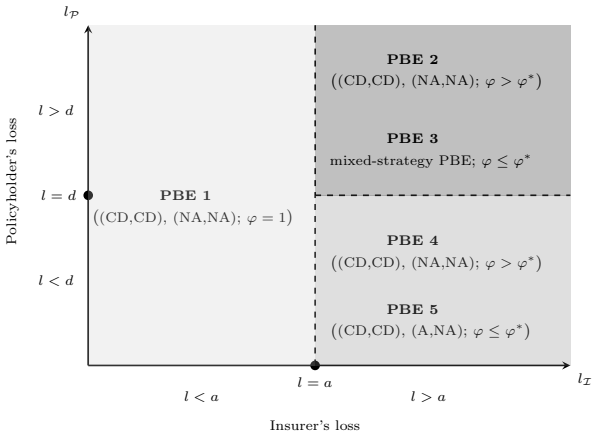
The central claim is that the post-incident auditing problem in cyber insurance admits an exact optimal strategy described by a Perfect Bayesian Equilibrium. For losses larger than both audit cost and premium discount, and when the insurer's prior belief that the policyholder is secure is at or below the threshold $\phi^* = (l-a)/l$, the unique equilibrium is mixed: the non-secure policyholder claims the discount with probability $\delta = a/((1-\phi)l)$, and the insurer audits discount claims with probability $\theta = (U(W-p+d)-U(W-p)) / (\beta(U(W-p+d)-U(W-p+d-l)))$, while never auditing claims that do not ask for a discount. Above the threshold, the insurer never audits and all types claim the discount. The paper further claims that in numerical simulations using real pricing-scheme data, this equilibrium strategy yields higher expected insurer payoff than several naive audit policies, with the advantage growing as premium discounts and audit costs rise.
Load-bearing premise
The load-bearing premise is that the policyholder's security investment is already fixed before the game begins and is drawn by Nature with a known prior, so the discount and audit policy do not influence the investment decision.
Editorial extensions
If this is right
- An insurer can compute a single audit probability from the model's parameters and apply it when a discount claim arrives after a breach, without needing to distinguish secure from non-secure policyholders directly.
- When the prior belief $\phi$ exceeds $(l-a)/l$ and losses exceed both audit cost and discount, the equilibrium says never audit is optimal, so the model explains when the common industry practice of not auditing is rational.
- The model's mixed equilibrium shows that a cyber-insurance market can remain viable even when policyholders can fraudulently report their security level, in contrast to earlier models without claims auditing.
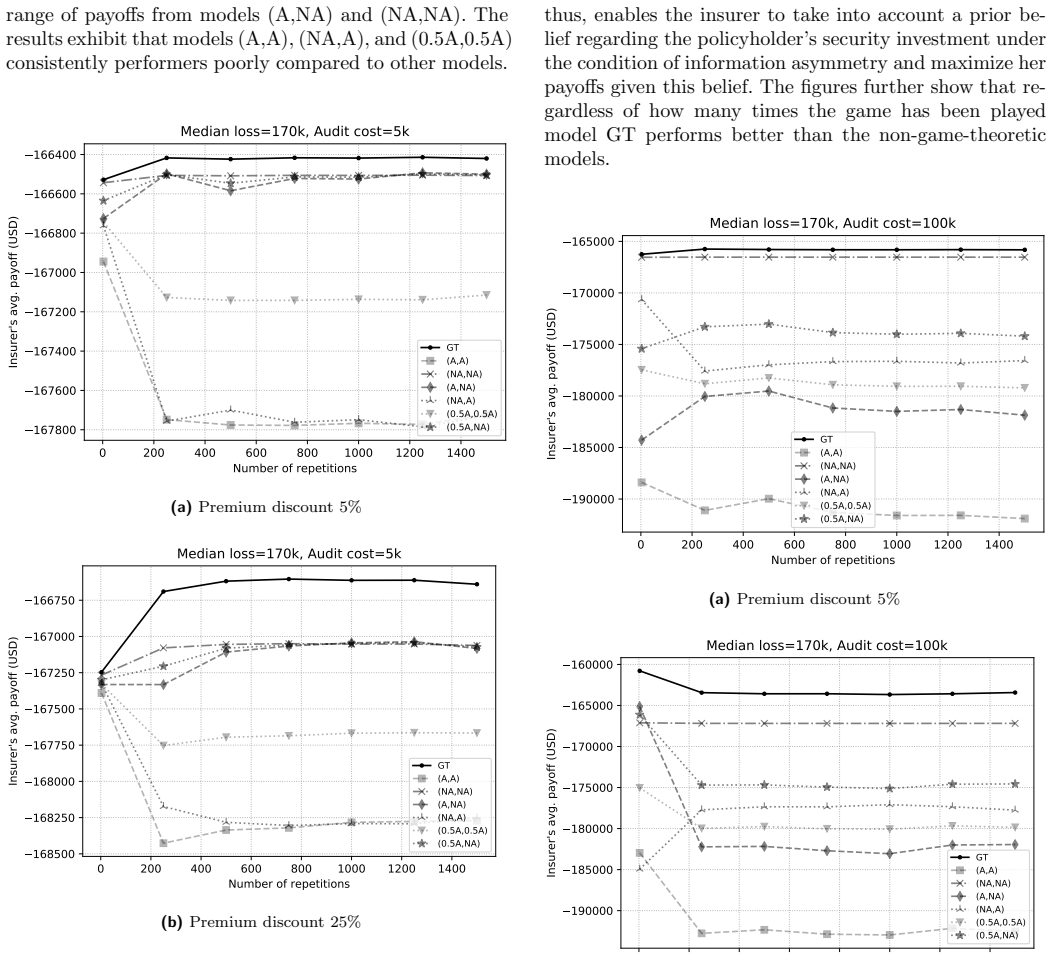
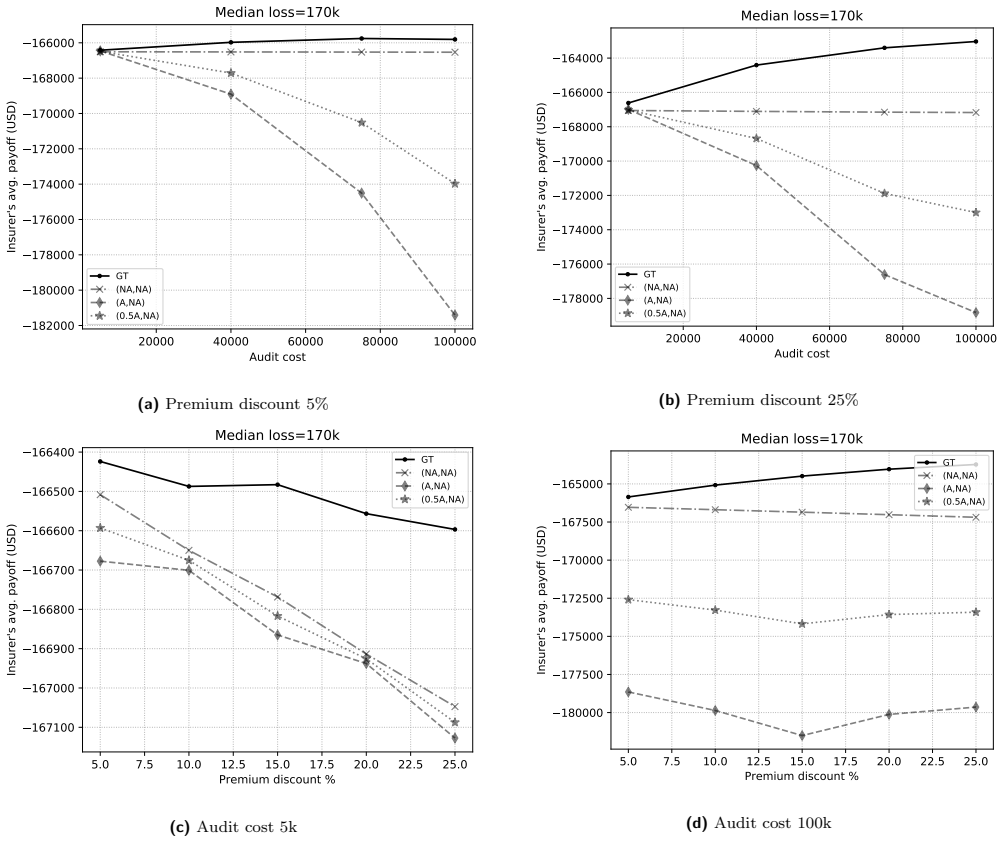
- Simulation results indicate the game-theoretic strategy yields higher insurer payoff than always-audit, never-audit, audit-only-if-claimed, and random-audit baselines, with the gap widening as premium discounts and audit costs increase.
Reading between the lines
- Beyond the paper, the same indifference-principle construction should transfer to other insurance lines where policyholders self-report loss-prevention measures such as fire alarms or flood defenses, making the audit probability formula a general template for claims verification.
- The authors list investment-as-strategic-choice as future work; making that change would likely replace the fixed prior $\phi$ with an equilibrium condition, so the numerical values of $\delta$ and $\theta$ would shift even if the structure of the audit rule remains.
- A natural empirical test is to compare misrepresentation rates across insurers who audit near $\theta$ versus those using fixed policies; the model predicts lower fraud among the former.
- Because the model assumes full coverage, extending to deductibles or co-insurance would alter the utility differences in $\theta$, but the logic that random auditing deters false discount claims should persist.
Signed reviews
Editorial analysis
A structured set of objections, weighed in public.
Referee Report
Summary. This manuscript develops a Bayesian game, the Cyber Insurance Audit Game (CIAG), to model whether a cyber insurer should audit policyholders who claim a premium discount after a reported security investment. Nature draws the policyholder type (secure PS or non-secure PN), the policyholder chooses whether to claim the discount, and the insurer, after observing a breach, decides whether to audit. The authors derive pure and mixed Perfect Bayesian Equilibria under parameter restrictions, obtaining closed-form equilibrium audit and claim probabilities. They then parameterize simulations using California insurance filings and empirical breach data, and compare the game-theoretic (GT) audit rule with several common-sense auditing policies, concluding that GT dominates. The central theoretical vehicle is Theorem 2, which supplies the mixed-strategy PBE used in the simulations.
Significance. The motivating question — how often cyber insurers should audit self-reported security claims — is timely and practically grounded. The paper's strengths include its use of underwriter interviews, regulatory pricing filings, and empirical breach statistics to instantiate the model, and its explicit formulation of a finite Bayesian game with well-defined information sets. Theorem 1, for the pure-strategy region, appears internally consistent. If Theorem 2 were correct, the resulting closed-form audit probability would be a genuinely useful, falsifiable prescription. However, the derivation of the mixed-strategy equilibrium contains a sequential-rationality error, and the simulation comparison is partly circular. These issues are load-bearing, so the paper's main claims are not currently supported.
major comments (3)
- [Section 4, Theorem 2 proof, Eqs. (25)-(26)] The derivation of δ is not sequentially rational. The expected payoffs UA and UNA in Eqs. (25)-(26) include the terms (1−δ)(p−l−a) and (1−δ)(p−l), which correspond to histories in which the PN policyholder chose NC. Those histories lie in the NC information set, where the insurer's strategy is NA; the action chosen at the CD information set cannot affect them. The indifference condition that pins down δ must be evaluated at the CD information set conditional on the belief μ = φ/(φ+(1−φ)δ). That condition, EU_A = μ(p−d−l−a)+(1−μ)(p−d−a) and EU_NA = p−d−l, gives μ = (l−a)/l and hence δ = φa/((1−φ)(l−a)), not a/((1−φ)l). With the paper's δ, for φ < (l−a)/l the insurer strictly prefers A at the CD information set, contradicting the claimed mixing. Since Theorem 2 supplies the 'GT' strategy used in Section 5, this error is load-bearing.
- [Section 5.2, simulation methodology] The performance comparison is partly circular. The simulations compute the insurer's average payoff for each strategic model against a policyholder who plays the PBE strategy obtained from the paper's analysis. By construction, the game-theoretic strategy is the best response to that policyholder, so any fixed non-equilibrium strategy should be weakly worse; the comparison does not provide independent evidence that GT outperforms common-sense rules against other plausible policyholder behaviors. The authors should either analyze performance against a range of policyholder strategies, report the value of the game and regret bounds, or clearly frame the result as 'the equilibrium strategy is optimal against an equilibrium-optimal policyholder' rather than as a general empirical dominance result.
- [Section 4, Theorem 2, existence of mixed strategies] The theorem asserts a mixed-strategy PBE for all φ ≤ (l−a)/l, l > a, l > d, but it does not verify that the probability θ in Eq. (22) lies in [0,1]. Since u is increasing and concave, the ratio [u(W−p+d)−u(W−p)]/[u(W−p+d)−u(W−p+d−l)] is strictly positive and less than 1; if β is smaller than this ratio, then θ > 1, and the prescribed randomization is impossible. In that case the equilibrium would be a pure strategy (or may fail to exist in the claimed form). The theorem should either state a sufficient condition such as θ ≤ 1 or analyze the pure PBE that arises in that parameter region. This directly affects the closed-form audit policy the paper recommends.
minor comments (5)
- [Section 4, Theorem 2 proof, part (a)] The sentence 'we obtain µ = µ and λ = λ in Equation (2)' is a typo: it should refer to the computed expressions in terms of φ, δ, and the Bayes-rule equations (13)-(14).
- [Figure 5 caption] The caption lists panel (d) as 'Audit cost 25k', but the text and the panel title refer to an audit cost of $100k; the caption should be corrected.
- [Section 5.2, paragraph after Figure 4] The text mentions '1500 independent repetitions', but Figures 3 and 4 plot up to only 1400 repetitions; the numbers should be made consistent.
- [Introduction and Section 2] The claim of being 'the first theoretical consideration of post-incident claims management in cyber security' is strong given the existing insurance-fraud and costly-state-verification literature cited in Section 2; the authors should either soften the claim or explain more precisely what is new beyond that literature.
- [Section 3, model assumptions] The security investment decision is explicitly exogenous, as the authors acknowledge. The abstract and conclusion should be careful not to imply that the model explains how audits deter security investment; the model only addresses the claims-stage choice of the non-secure type. The discussion in Section 6 already flags this, but the framing elsewhere should match that limitation.
Circularity Check
The PBE derivation is not circular, but the simulation claim that GT outperforms naive strategies is forced by construction because the simulated policyholder plays the PBE strategy and GT is the equilibrium best response.
-
self definitional
[Section 5.2 (Numerical Analysis), simulation setup paragraph]
"In the following simulation figures, the insurer's average payoffs with each strategic model are calculated against a policyholder who plays the PBE strategy obtained through our analysis. This policyholder is also the most challenging one for the insurer as it claims for a discount even in the case of non investment."
The evaluation compares GT with fixed naive audit strategies against a policyholder who, by construction, plays the PBE strategy. GT is exactly the equilibrium best response to that PBE policyholder, so by the definition of a best response GT must weakly outperform every fixed alternative strategy in expectation. The paper presents this as an empirical demonstration that the game-theoretic approach is more efficient, but the superiority is a logical consequence of the equilibrium construction, not an independent test. The claim would be circular only for Section 5; the analytical derivation of Theorem 2 itself does not assume the simulation conclusion.
full rationale
The analytical game-theoretic derivation is self-contained: Theorem 2 is obtained by applying Bayes' rule and indifference conditions to the stated payoff structure, with no parameter fitted to the later simulation results. The comparative evaluation in Section 5.2, however, is circular in a narrower sense. The payoff comparison fixes the policyholder at the PBE strategy and then measures how GT and naive strategies perform against that fixed opponent. Since GT is the equilibrium best response to that same PBE policyholder, its dominance over fixed naive strategies is guaranteed by the definition of a best response, regardless of parameter values. The paper even acknowledges the opponent is the PBE policyholder, making the construction explicit. This does not undermine the model's theoretical content or the existence/uniqueness claims, but it does mean the 'common sense techniques are not as efficient' finding is not an empirical discovery. No self-citation chain or fitted-parameter renaming is load-bearing elsewhere, so the circularity is localized to the simulation validation and warrants a partial rather than total score.
Assumptions & free parameters
free parameters (8)
- phi (prior probability of secure type) =
not stated in paper
- U (policyholder utility function) =
not specified
- l (breach loss) =
$170,000 (median from [2])
- beta (breach probability, non-secure type) =
0.015 (from [2])
- a (audit cost) =
range $5,000 to $100,000
- d (premium discount) =
5% to 25% of $3,630 premium
- p (premium) =
$3,630
- c (security investment cost) =
from industry reports via [31]
assumptions (6)
- domain assumption Common prior: Nature draws policyholder type PS with probability phi and PN with 1-phi; the insurer knows only this distribution.
- domain assumption Security investment decision is exogenous: the policyholder has already chosen to invest or not before the game; no endogenous investment choice.
- domain assumption Audit, when performed, perfectly reveals whether the policyholder misrepresented security level; no false positives or false negatives.
- domain assumption Full coverage: if the insurer does not refuse the claim, indemnity equals the full loss l.
- domain assumption The insurer offers the premium discount without ex-ante audit because auditing applicants who never file claims is uneconomical.
- standard math Players are expected-utility maximizers; the insurer is risk-neutral (linear in money), the policyholder has a concave utility U.
Cite this review
Pith. "Pith review of Post-Incident Audits on Cyber Insurance Discounts." pith.science (2026). https://pith.science/paper/TNMWBII5
@misc{pith2026190804867,
  author       = {Pith},
  title        = {Pith review of: Post-Incident Audits on Cyber Insurance Discounts},
  year         = {2026},
  howpublished = {\url{https://pith.science/paper/TNMWBII5}},
  note         = {Machine review of arXiv:1908.04867}
}
read the original abstract
We introduce a game-theoretic model to investigate the strategic interaction between a cyber insurance policyholder whose premium depends on her self-reported security level and an insurer with the power to audit the security level upon receiving an indemnity claim. Audits can reveal fraudulent (or simply careless) policyholders not following reported security procedures, in which case the insurer can refuse to indemnify the policyholder. However, the insurer has to bear an audit cost even when the policyholders have followed the prescribed security procedures. As audits can be expensive, a key problem insurers face is to devise an auditing strategy to deter policyholders from misrepresenting their security levels to gain a premium discount. This decision-making problem was motivated by conducting interviews with underwriters and reviewing regulatory filings in the U.S.; we discovered that premiums are determined by security posture, yet this is often self-reported and insurers are concerned by whether security procedures are practised as reported by the policyholders. To address this problem, we model this interaction as a Bayesian game of incomplete information and devise optimal auditing strategies for the insurers considering the possibility that the policyholder may misrepresent her security level. To the best of our knowledge, this work is the first theoretical consideration of post-incident claims management in cyber security. Our model captures the trade-off between the incentive to exaggerate security posture during the application process and the possibility of punishment for non-compliance with reported security policies. Simulations demonstrate that common sense techniques are not as efficient at providing effective cyber insurance audit decisions as the ones computed using game theory.
Figures


Figures from the paper (3 more)

Reference graph
Works this paper leans on
-
[1]
R. J. Anderson, Security engineering: a guide to building de- pendable distributed systems, John Wiley & Sons, 2010
work page 2010
-
[2]
S. Romanosky, Examining the costs and causes of cyber inci- dents, Journal of Cybersecurity 2 (2) (2016) 121–135
work page 2016
-
[3]
A. Beautement, M. A. Sasse, M. Wonham, The compliance budget: managing security behaviour in organisations, in: Pro- ceedings of the 2008 New Security Paradigms Workshop, ACM, 2009, pp. 47–58
work page 2008
-
[4]
T. Moore, On the harms arising from the equifax data breach of 2017, International Journal of Critical Infrastructure Protection 19 (C) (2017) 47–48
work page 2017
-
[5]
D. W. Woods, I. Agrafiotis, J. R. Nurse, S. Creese, Mapping the coverage of security controls in cyber insurance proposal forms, Journal of Internet Services and Applications 8 (1) (2017) 8
work page 2017
-
[6]
S. Romanosky, L. Ablon, A. Kuehn, T. Jones, Content analysis of cyber insurance policies: How do carriers write policies and price cyber risk?, in: Proceedings of The 16th Workshop on the Economics of Information Security (WEIS 2017), 2017
work page 2017
-
[7]
Franke, The cyber insurance market in Sweden, Computers & Security 68 (2017) 130–144
U. Franke, The cyber insurance market in Sweden, Computers & Security 68 (2017) 130–144
work page 2017
- [8]
Show all 31 references
-
[9]
Thoyts, Insurance theory and practice, Routledge, 2010
R. Thoyts, Insurance theory and practice, Routledge, 2010
2010
-
[10]
Complaint in columbia cas. co. v. cottage health sys., no. 2:16-cv-03759 (c.d. cal.), https://www.insideprivacy.com/wp- content/uploads/sites/6/2016/06/CNA-v-Cottage-Health- 2016-complaint.pdf (2016)
2016
-
[11]
D. W. Woods, A. C. Simpson, Policy measures and cyber in- surance: A framework, Journal of Cyber Policy 2 (2) (2017) 209–226
2017
-
[12]
B¨ ohme, G
R. B¨ ohme, G. Schwartz, et al., Modeling cyber-insurance: To- wards a unifying framework., in: WEIS, 2010
2010
-
[13]
Kunreuther, G
H. Kunreuther, G. Heal, Interdependent security, Journal of risk and uncertainty 26 (2-3) (2003) 231–249
2003
-
[14]
Laszka, M
A. Laszka, M. Felegyhazi, L. Buttyan, A survey of interde- pendent information security games, ACM Computing Surveys 47 (2) (2015) 23:1–23:38
2015
-
[15]
H. Ogut, N. Menon, S. Raghunathan, Cyber insurance and IT security investment: Impact of interdependence risk., in: Pro- ceedings of The 4th Workshop on the Economics of Information Security (WEIS 2005), 2005
2005
-
[16]
Bolot, M
J.-C. Bolot, M. Lelarge, A new perspective on internet security using insurance, in: INFOCOM 2008. The 27th Conference on Computer Communications. IEEE, IEEE, 2008, pp. 1948–1956
2008
-
[17]
B¨ ohme, G
R. B¨ ohme, G. Kataria, Models and measures for correlation in cyber-insurance., in: Proceedings of The 5th Workshop on the Economics of Information Security (WEIS 2006), 2006
2006
-
[18]
W. S. Baer, A. Parkinson, Cyberinsurance in it security man- agement, IEEE Security & Privacy 5 (3)
-
[19]
Laszka, B
A. Laszka, B. Johnson, J. Grossklags, M. Felegyhazi, Estimating systematic risk in real-world networks, in: Proceedings of the 18th International Conference on Financial Cryptography and Data Security (FC), 2014, pp. 417–435
2014
-
[20]
D. W. Woods, A. C. Simpson, Monte carlo methods to inves- tigate how aggregated cyber insurance claims data impacts se- curity investments, Workshop on the Economics of Information Security, 2018
2018
-
[21]
M. M. Khalili, M. Liu, S. Romanosky, Embracing and control- ling risk dependency in cyber-insurance policy underwriting, in: Proceedings of The 17th Workshop on the Economics of Infor- mation Security (WEIS 2018), 2018
2018
-
[22]
Laszka, J
A. Laszka, J. Grossklags, Should cyber-insurance providers in- vest in software security?, in: European Symposium on Research in Computer Security, Springer, 2015, pp. 483–502
2015
-
[23]
Shetty, G
N. Shetty, G. Schwartz, M. Felegyhazi, J. Walrand, Competitive cyber-insurance and internet security, in: Economics of informa- tion security and privacy, Springer, 2010, pp. 229–247
2010
-
[24]
R. P. Majuca, W. Yurcik, J. P. Kesan, The evolution of cyberin- surance, arXiv preprint cs/0601020
-
[25]
Laszka, E
A. Laszka, E. Panaousis, J. Grossklags, Cyber-insurance as a signaling game: Self-reporting and external security audits, in: Proceedings of the 9th Conference on Decision and Game The- ory for Security (GameSec 2018), Springer, 2018
2018
-
[26]
Schwartz, N
G. Schwartz, N. Shetty, J. Walrand, Why cyber-insurance con- tracts fail to reflect cyber-risks, in: 2013 51st Annual Allerton Conference on Communication, Control, and Computing (Aller- ton), IEEE, 2013, pp. 781–787
2013
-
[27]
Bandyopadhyay, V
T. Bandyopadhyay, V. S. Mookerjee, R. C. Rao, Why it man- agers don’t go for cyber-insurance products, Communications of the ACM 52 (11) (2009) 68–73
2009
-
[28]
Picard, Economic analysis of insurance fraud, in: Handbook of Insurance, Springer, 2013, pp
P. Picard, Economic analysis of insurance fraud, in: Handbook of Insurance, Springer, 2013, pp. 349–395
2013
-
[29]
Picard, Auditing claims in the insurance market with fraud: The credibility issue, Journal of Public Economics 63 (1) (1996) 27–56
P. Picard, Auditing claims in the insurance market with fraud: The credibility issue, Journal of Public Economics 63 (1) (1996) 27–56
1996
-
[30]
Gibbons, A primer in game theory, Harvester Wheatsheaf, 1992
R. Gibbons, A primer in game theory, Harvester Wheatsheaf, 1992
1992
-
[31]
C. D. Heitzenrater, A. C. Simpson, Policy, statistics and ques- tions: Reflections on uk cyber security disclosures, Journal of Cybersecurity 2 (1) (2016) 43–56. 12
2016
Reviewed August 14, 2026 · model on record in the stance chip above.
Discussion (0). Continue with ORCID to comment.