REVIEW 3 major objections 4 minor 49 references
Evolution of structure and magnetism across the metal-insulator transition in the pyrochlore iridate $($Nd$_{1-x}$Ca$_x)_2$Ir$_2$O$_7$
T0 review · 3 major / 4 minor · reviewed 2026-08-14 · deepseek-v4-flash
Pith's one-line read This paper claims that substituting calcium for neodymium in the pyrochlore iridate $(Nd_{1-x}Ca_x)_2Ir_2O_7$ drives the metal-insulator transition by hole doping, not lattice distortion, with a metallic ground state appearing for $x >…
desk verdict A clean, complementary-probe study of Ca-doped Nd2Ir2O7 that maps a filling-controlled MIT, but the abstract overstates the Ir-order coincidence and the doped-series magnetic order is inferred, not directly measured. read the letter →
The pith
A machine-rendered reading of the paper's core claim, the machinery that carries it, and where it could break.
The reading
What carries the argument
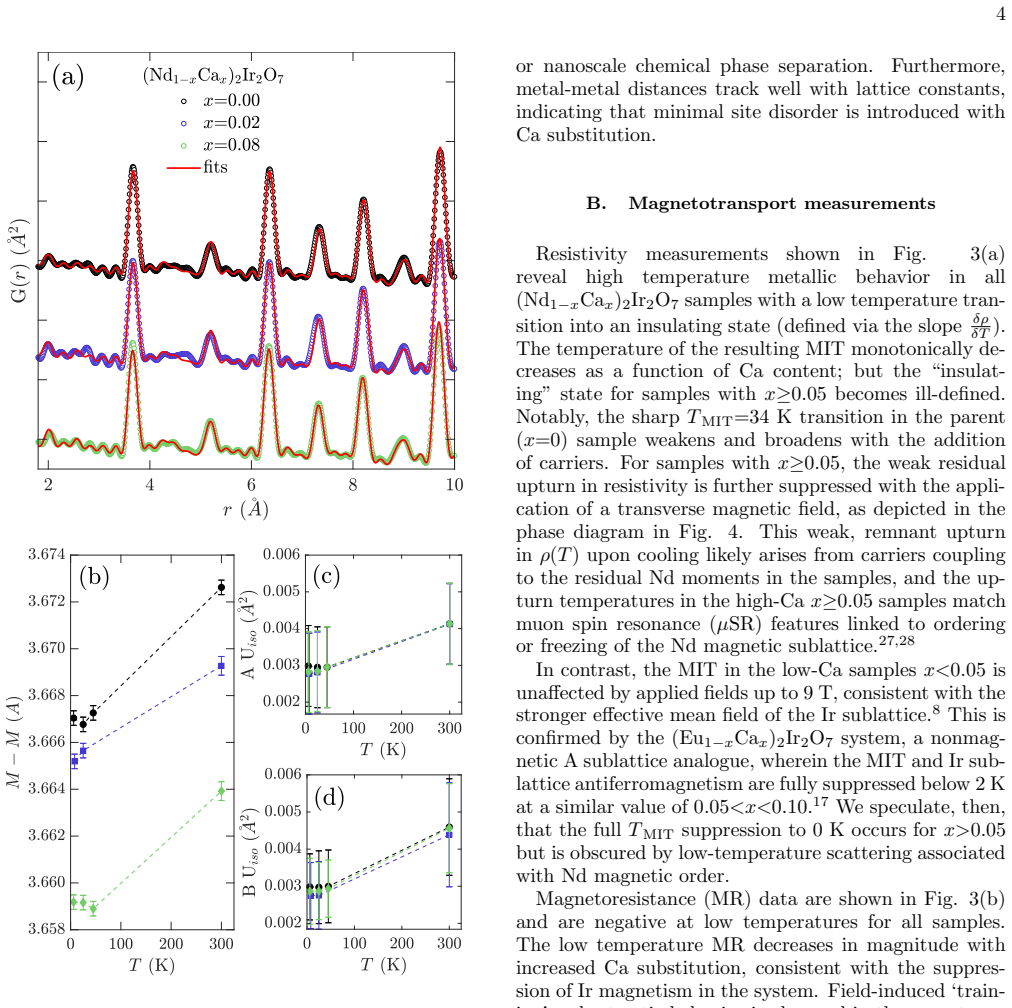
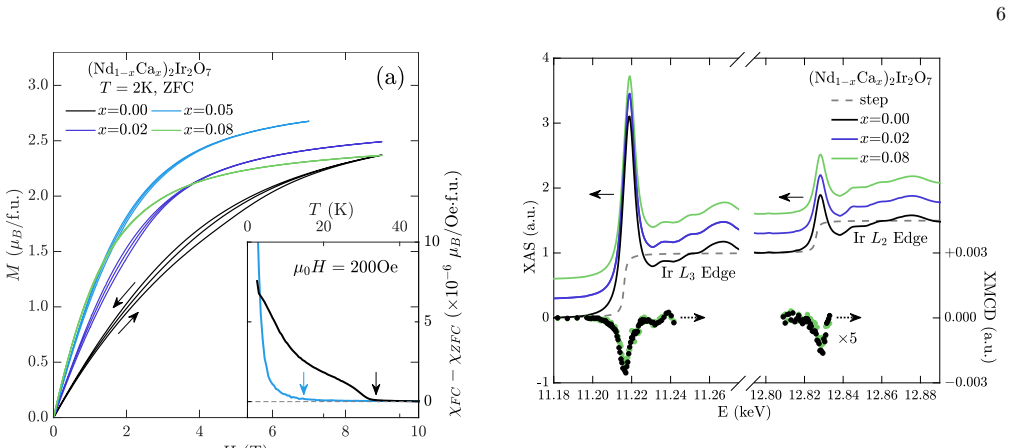
The load-bearing object is the pyrochlore lattice, two interpenetrating networks of corner-sharing tetrahedra with $J_{eff}=1/2$ iridium moments on one network and neodymium/calcium ions on the other. The argument is carried by a set of matched probes: synchrotron diffraction and pair-distribution analysis to show the lattice and local structure barely change with calcium content; resistivity and magnetization to track the metal-insulator transition and magnetic order; and iridium L-edge X-ray absorption with magnetic circular dichroism to show that the spin-orbit-entangled iridium configuration survives doping. Together these let the authors attribute the transition's suppression to hole concentration rather than to lattice distortion.
What would settle it
Cool a polycrystalline $x=0.08$ sample to 2 K and probe its magnetic structure with neutron diffraction or muon spin rotation; if no all-in-all-out iridium order appears while the resistivity upturn remains, the claimed coincidence of the metal-insulator transition with iridium antiferromagnetism in the metallic regime fails.
Extended reading notes
Core claim
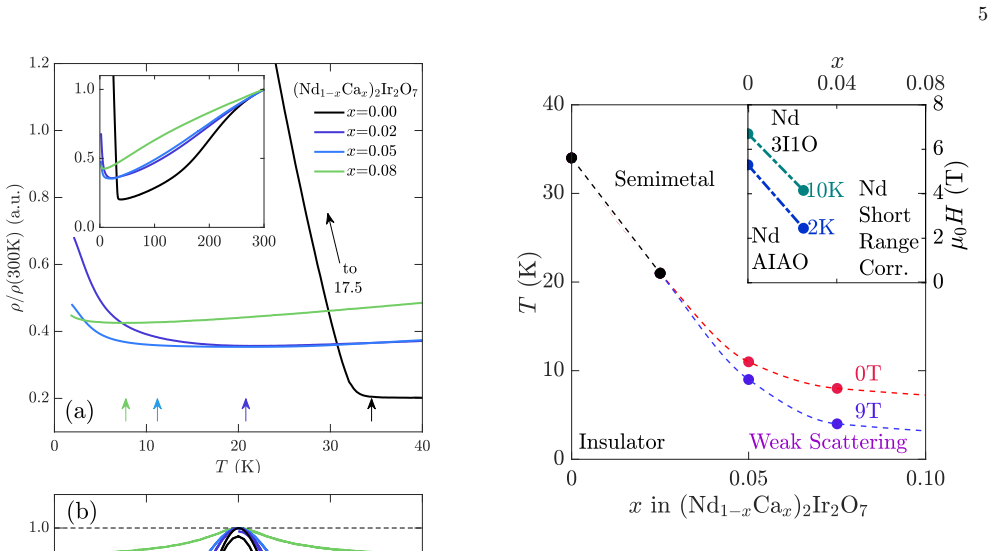
The paper's central claim is that substituting $Ca^{2+}$ for $Nd^{3+}$ in $(Nd_{1-x}Ca_x)_2Ir_2O_7$ produces a filling-controlled Mott-like transition: the metal-insulator transition temperature falls monotonically with $x$, the long-range all-in-all-out iridium antiferromagnetic order stays coincident with the transition in every measured sample, and by $x>0.05$ the ground state is metallic with only a weak low-temperature resistivity upturn that tracks neodymium magnetism. The structural response is minimal, with the lattice constant following Vegard's law, bond angles shifting by less than a degree, and local pair-distribution data showing no clustering or phase separation. X-ray absorption indicates the iridium ions retain a $J_{eff}=1/2$ spin-orbit-entangled configuration with a branching ratio near 6 in both insulating and metallic samples. The authors conclude that hole concentration, rather than bandwidth change from lattice distortion, is the dominant control parameter, and that suppression of the charge gap and suppression of iridium magnetic order proceed together.
Load-bearing premise
The load-bearing assumption is that the resistivity slope change and the field-cooled/zero-field-cooled magnetization split in the doped samples signal the same long-range iridium magnetic order known from the parent compound, since that order was not directly measured in the doped series.
Editorial extensions
If this is right
- $T_{MIT}$ and the iridium ordering temperature fall together with calcium content, so any theory of the transition in this material must tie the charge gap to the all-in-all-out magnetic order.
- The metallic state for $x>0.05$ still shows a weak resistivity upturn and magnetization irreversibility, implying neodymium moments keep coupling to charge carriers even after long-range iridium order is gone.
- The persistence of a $J_{eff}=1/2$ spin-orbit-entangled iridium configuration across the transition suggests the Mott physics is destroyed by filling, not by quenching of spin-orbit coupling.
- The similar suppression seen in the nonmagnetic europium analogue and in rhodium-substituted iridium sites supports a common hole-doping mechanism across pyrochlore iridates.
Reading between the lines
- Editorial inference: the same Ca-doping series measured under hydrostatic pressure would test the steric contribution directly; if the transition temperature barely moves under pressure at fixed $x$, the filling-control interpretation is strongly confirmed.
- Editorial inference: the nearly identical weak iridium XMCD signal in the parent and $x=0.08$ samples could be read as remnant all-in-all-out domains surviving into the metallic regime; a hysteresis-loop measurement of remnant magnetization on the metallic sample would separate true ferromagnetism from a reversible field response.
- Editorial inference: if the residual low-temperature upturn is a generic effect of a magnetic rare-earth sublattice, the same calcium doping in a praseodymium-based pyrochlore iridate should reproduce it, which would show the phenomenon is not specific to neodymium.
Signed reviews
Editorial analysis
A structured set of objections, weighed in public.
Referee Report
Summary. This paper reports a combined structural, transport, magnetic, and spectroscopic study of polycrystalline (Nd1−xCax)2Ir2O7 across 0≤x≤0.08. Synchrotron XRD and PDF show that Ca incorporation preserves the pyrochlore structure with only small lattice-constant and bond-angle changes and no resolvable clustering. Resistivity shows a metal-insulator transition (MIT) that weakens and broadens with x and gives way to a metallic ground state for x≥0.05, while magnetization shows FC-ZFC irreversibility and field hysteresis that evolve with doping. XAS/XMCD indicate that the Ir 5d states remain near a Jeff=1/2 configuration with a small field-induced Ir moment. The authors conclude that Ca substitution drives a filling-controlled Mott-like transition in which hole doping, rather than lattice distortion, suppresses the MIT, and they associate the MIT with Ir-sublattice antiferromagnetic ordering whose onset temperature decreases with x.
Significance. If the central conclusion is correct, the paper provides an important experimental data point in the pyrochlore iridate phase diagram: it separates filling control from bandwidth control and shows that the suppression of the charge gap and of all-in-all-out magnetic order remain coupled under hole doping, in contrast to some reports on (Y,Ca) and (Eu,Sr) systems. The study is strong in its use of complementary probes (average and local structure, transport, magnetization, XAS/XMCD) with no ad hoc fitting of free parameters to the target result, and the XAS/XMCD analysis follows standard sum-rule practice with a clearly stated ⟨Tz⟩ assumption. The main limitation is that no direct zero-field magnetic order-parameter measurement is reported for any doped sample, leaving the magnetic-coincidence claim more provisional than the abstract suggests.
major comments (3)
- [Abstract and Section IV] The Abstract states that 'the metal-insulator transition coincides with antiferromagnetic ordering on the Ir sublattice for all measured samples,' but Section IV (first paragraph) states that 'Once a doping level of x=0.08 is reached, signatures of Ir magnetic order vanish,' and later attributes the high-x signal to 'short-range freezing of Nd/Ir moments.' The x=0.08 sample is explicitly included in the measured series, so these statements are in direct tension. Please either qualify the abstract to exclude x=0.08 from the coincidence claim or provide direct evidence of Ir-sublattice order in that sample.
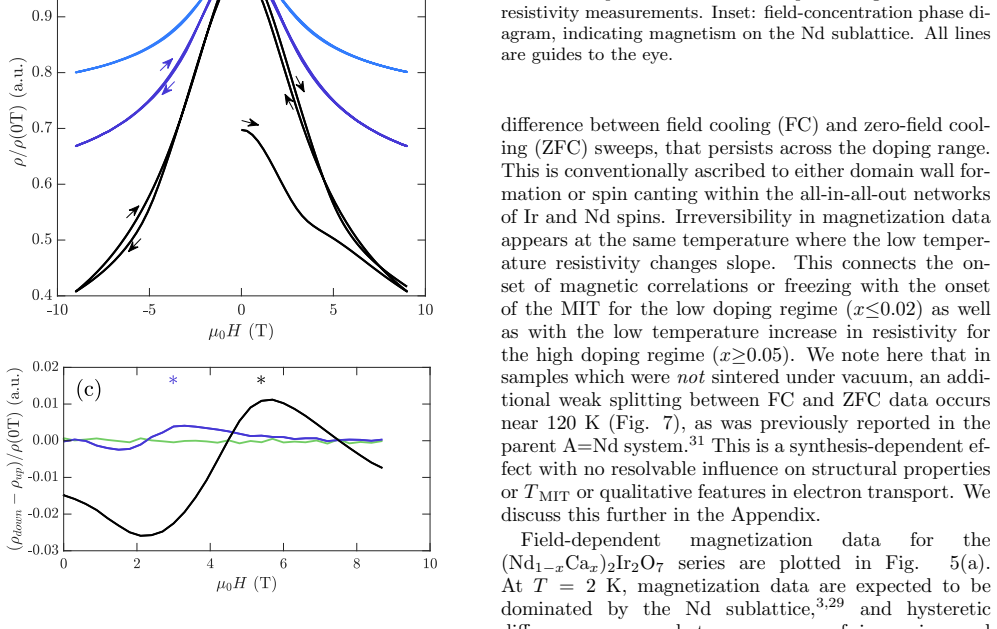
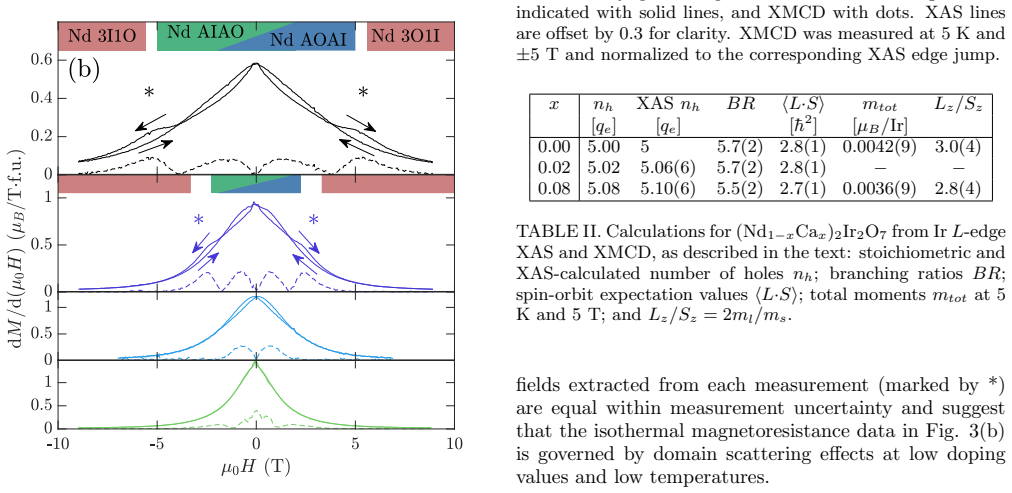
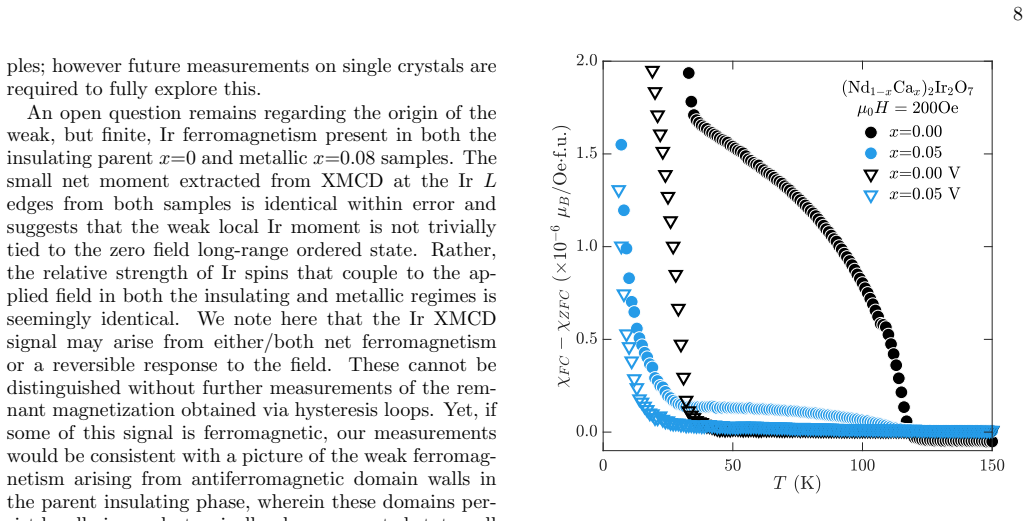
- [Section III C and Figure 5] The assignment of a long-range all-in-all-out Ir antiferromagnetic transition in doped samples is inferred from FC-ZFC magnetization irreversibility and from the resistivity slope change, with no direct order-parameter probe (neutron diffraction or muSR) on any Ca-doped sample. In polycrystalline, chemically substituted materials, FC-ZFC irreversibility can arise from spin-glass freezing, short-range correlations, or Nd-moment dynamics, and the paper itself acknowledges this ambiguity for x≥0.05. Consequently, the coincidence of T_MIT and the proposed T_N for x=0.02 and x=0.05 in Figure 4 is not established to the same standard as in the parent compound. Please provide a direct magnetic-order measurement for at least one doped sample, or explicitly reframe the magnetic-coincidence claim as provisional.
- [Section III A, Table I] The conclusion that the MIT is 'filling-controlled' rather than bandwidth-driven relies on the assertion that structural changes are minimal, yet Table I shows a monotonic Ir-O-Ir bond-angle increase from 130.6(2)° at x=0 to 131.1(2)° at x=0.08, moving toward the ≈132° value associated with metallicity in the A=Pr system. The text argues that this change 'alone may not account for metallicity' but provides no quantitative estimate of the associated bandwidth change. Please add a quantitative comparison of the structurally induced bandwidth change against the measured hole-doping effect, or soften the filling-controlled claim accordingly.
minor comments (4)
- [Table I] No crystallographic data are listed for x=0.05, the composition that anchors the metallic boundary in the transport phase diagram; please clarify whether structural and PDF data were collected for this sample and, if so, include them or state that they are omitted.
- [Figure 4] The phase boundary in the high-x region is drawn through a weak, broad resistivity upturn; please specify the criterion used to define the upturn temperature (for example, the temperature of the resistivity minimum or of a change in derivative).
- [Section III D, Table II] The absolute XMCD moments are sensitive to the assumed ⟨Tz⟩≈0.2⟨Sz⟩ value and to the fact that the XMCD signal is reported as being just above the detection limit; please propagate the uncertainty in ⟨Tz⟩ into the quoted mtot values or explicitly state the sensitivity of the result to this assumption.
- [Section III B] The statement that the high-x resistivity upturn temperatures 'match' muSR features (Refs. 27,28) refers to measurements on the undoped parent compound; please clarify that no muSR data were taken on the Ca-doped samples in this study, so the correspondence is inferred, not directly demonstrated.
Circularity Check
No circularity: the phase diagram is measured, not derived from its inputs; the Ir-order claim is under-supported rather than circular.
full rationale
The paper's derivation chain is experimental rather than formal. Ca concentrations are fixed by WDXRF and used as refinements inputs, not fitted from the target physics. The MIT is defined from the resistivity slope, while magnetic features come from magnetization irreversibility; the stated coincidence of the two transitions is an empirical comparison of separate measurements, not a construction where one defines the other. The XAS hole counting, branching ratios, and XMCD sum rules use standard external calibrations, including an assumed <Tz> taken from prior IrO6 studies, which is an assumption but not a reduction of the conclusion to its inputs. The only load-bearing weakness is evidentiary, not circular: the abstract claims Ir-sublattice antiferromagnetic order coincides with the MIT 'for all measured samples,' yet no direct Ir order parameter is measured for doped samples, and Section IV states that at x=0.08 'signatures of Ir magnetic order vanish' and attributes the high-x signal to 'short-range freezing of Nd/Ir moments.' This internal tension affects support for the magnetic half of the central claim, but it does not mean the paper derives a prediction from its own fitted parameters. Two cited works involve a co-author (Disseler et al., Refs. 27 and 31), but they provide external muSR/neutron and magnetization data on the parent compound and are not used as the sole justification for the new doping dependence. No equation in the paper equals an input by construction, and no fitted parameter is renamed as a prediction. The paper is self-contained against external benchmarks and should receive a non-circularity finding.
Assumptions & free parameters
assumptions (4)
- domain assumption XMCD sum rules apply with an assumed magnetic dipole term Tz ≈ 0.2 Sz taken from other iridates.
- domain assumption Changes in Ir L-edge white-line intensity relative to the parent compound measure the number of doped holes nh.
- domain assumption Magnetization irreversibility (FC minus ZFC splitting) marks the onset of magnetic order or freezing associated with the Ir and Nd sublattices.
- domain assumption Calcium occupies only the A site in the pyrochlore structure.
Cite this review
Pith. "Pith review of Evolution of structure and magnetism across the metal-insulator transition in the pyrochlore iridate $($Nd$_{1-x}$Ca$_x)_2$Ir$_2$O$_7$." pith.science (2026). https://pith.science/paper/4ZMNI3PV
@misc{pith2026190804874,
  author       = {Pith},
  title        = {Pith review of: Evolution of structure and magnetism across the metal-insulator transition in the pyrochlore iridate $($Nd$_1-x$Ca$_x)_2$Ir$_2$O$_7$},
  year         = {2026},
  howpublished = {\url{https://pith.science/paper/4ZMNI3PV}},
  note         = {Machine review of arXiv:1908.04874}
}
abstract
We report on the evolution of the thermal metal-insulator transition in polycrystalline samples of Nd$_2$Ir$_2$O$_7$ upon hole-doping via substitution of Ca$^{2+}$ for Nd$^{3+}$. Ca substitution mediates a filling-controlled Mott-like transition with minimal resolvable structural changes and without altering site symmetry. Local structure confirms that Ca substitution does not result in local chemical phase separation, and absorption spectroscopy establishes that Ir cations maintain a spin-orbit entangled electronic configuration. The metal-insulator transition coincides with antiferromagnetic ordering on the Ir sublattice for all measured samples, and both decrease in onset temperature with Ca content. Weak low-temperature upturns in susceptibility and resistivity for samples with high Ca content suggest that Nd sublattice antiferromagnetism continues to couple to carriers in the metallic regime.
Figures

Figures from the paper (4 more)
Reference graph
Works this paper leans on
-
[1]
author author J. S. \ Gardner , author M. J. \ Gingras , \ and\ author J. E. \ Greedan ,\ 10.1103/RevModPhys.82.53 journal journal Reviews of Modern Physics \ volume 82 ,\ pages 53 ( year 2010 ) NoStop
-
[2]
author author K. Matsuhira , author M. Wakeshima , author R. Nakanishi , author T. Yamada , author A. Nakamura , author W. Kawano , author S. Takagi , \ and\ author Y. Hinatsu ,\ 10.1143/JPSJ.76.043706 journal journal Journal of the Physical Society of Japan \ volume 76 ,\ pages 43706 ( year 2007 ) NoStop
-
[3]
author author K. Matsuhira , author M. Wakeshima , author Y. Hinatsu , \ and\ author S. Takagi ,\ 10.1143/JPSJ.80.094701 journal journal Journal of the Physical Society of Japan \ volume 80 ,\ pages 094701 ( year 2011 ) NoStop
-
[5]
author author X. Wan , author A. M. \ Turner , author A. Vishwanath , \ and\ author S. Y. \ Savrasov ,\ 10.1103/PhysRevB.83.205101 journal journal Physical Review B \ volume 83 ,\ pages 205101 ( year 2011 ) NoStop
-
[6]
author author L. Savary \ and\ author L. Balents ,\ 10.1103/PhysRevLett.108.037202 journal journal Physical Review Letters \ volume 108 ,\ pages 037202 ( year 2012 ) NoStop
-
[7]
Witczak-Krempa \ and\ author Y
author author W. Witczak-Krempa \ and\ author Y. B. \ Kim ,\ 10.1103/PhysRevB.85.045124 journal journal Physical Review B \ volume 85 ,\ pages 45124 ( year 2012 ) NoStop
-
[8]
author author L. Savary , author E. G. \ Moon , \ and\ author L. Balents ,\ 10.1103/PhysRevX.4.041027 journal journal Physical Review X \ volume 4 ,\ pages 041027 ( year 2014 ) NoStop
-
[9]
author author I. Kimchi \ and\ author A. Vishwanath ,\ 10.1103/PhysRevB.89.014414 journal journal Physical Review B \ volume 89 ,\ pages 14414 ( year 2014 ) NoStop
Show all 49 references
-
[10]
Ueda , author R
author author K. Ueda , author R. Kaneko , author H. Ishizuka , author J. Fujioka , author N. Nagaosa , \ and\ author Y. Tokura ,\ 10.1038/s41467-018-05530-9 journal journal Nature Communications \ volume 9 ,\ pages 3032 ( year 2018 ) NoStop
-
[11]
author author A. B. \ Sushkov , author J. B. \ Hofmann , author G. S. \ Jenkins , author J. Ishikawa , author S. Nakatsuji , author S. Das Sarma , \ and\ author H. D. \ Drew ,\ 10.1103/PhysRevB.92.241108 journal journal Physical Review B \ volume 92 ,\ pages 241108 ( year 2015...
-
[12]
Fujita , author Y
author author T. Fujita , author Y. Kozuka , author M. Uchida , author A. Tsukazaki , author T.-h. \ Arima , \ and\ author M. Kawasaki ,\ 10.1038/srep09711 journal journal Scientific Reports \ volume 5 ,\ pages 9711 ( year 2015 ) NoStop
-
[13]
Ueda , author J
author author K. Ueda , author J. Fujioka , \ and\ author Y. Tokura ,\ 10.1103/PhysRevB.93.245120 journal journal Physical Review B \ volume 93 ,\ pages 245120 ( year 2016 ) NoStop
2016 doi
-
[14]
Machida , author S
author author Y. Machida , author S. Nakatsuji , author S. Onoda , author T. Tayama , \ and\ author T. Sakakibara ,\ 10.1038/nature08680 journal journal Nature \ volume 463 ,\ pages 210 ( year 2010 ) NoStop
2010 doi
-
[15]
Witczak-Krempa , author G
author author W. Witczak-Krempa , author G. Chen , author Y. B. \ Kim , \ and\ author L. Balents ,\ 10.1146/annurev-conmatphys-020911-125138 journal journal Annual Review of Condensed Matter Physics \ volume 5 ,\ pages 57 ( year 2013 ) NoStop
-
[16]
Nakayama , author T
author author M. Nakayama , author T. Kondo , author Z. Tian , author J. J. \ Ishikawa , author M. Halim , author C. Bareille , author W. Malaeb , author K. Kuroda , author T. Tomita , author S. Ideta , author K. Tanaka , author M. Matsunami , author S. Kimura , author N. Inam...
-
[17]
Kaneko , author M.-T
author author R. Kaneko , author M.-T. \ Huebsch , author S. Sakai , author R. Arita , author H. Shinaoka , author K. Ueda , author Y. Tokura , \ and\ author J. Fujioka ,\ 10.1103/PhysRevB.99.161104 journal journal Physical Review B \ volume 99 ,\ pages 161104 ( year 2019 ) NoStop
-
[18]
Zhu , author M
author author W. Zhu , author M. Wang , author B. Seradjeh , author F. Yang , \ and\ author S. Zhang ,\ 10.1103/PhysRevB.90.054419 journal journal Physical Review B \ volume 90 ,\ pages 054419 ( year 2014 ) NoStop
2014 doi
-
[19]
Banerjee , author J
author author A. Banerjee , author J. Sannigrahi , author S. Giri , \ and\ author S. Majumdar ,\ 10.1103/PhysRevB.96.224426 journal journal Physical Review B \ volume 96 ,\ pages 224426 ( year 2017 ) NoStop
2017 doi
-
[20]
Hammersley , author S
author author A. Hammersley , author S. Svensson , author M. Hanfland , author A. Fitch , \ and\ author D. Hausermann ,\ 10.1080/08957959608201408 journal journal International Journal of High Pressure Research \ volume 14 ,\ pages 235 ( year 1996 ) NoStop
-
[21]
Qiu , author J
author author X. Qiu , author J. W. \ Thompson , \ and\ author S. J. \ Billinge ,\ 10.1107/S0021889804011744 journal journal Journal of Applied Crystallography \ volume 37 ,\ pages 678 ( year 2004 ) NoStop
2004 doi
-
[22]
Farrow , author P
author author C. Farrow , author P. Juhas , author J. Liu , author D. Bryndin , author E. Bo z in , author J. Bloch , author T. Proffen , \ and\ author S. Billinge ,\ 10.1088/0953-8984/19/33/335219 journal journal Journal of Physics: Condensed Matter \ volume 19 ,\ pages 33521...
-
[23]
Haskel , author Y
author author D. Haskel , author Y. Tseng , author J. Lang , \ and\ author S. Sinogeikin ,\ 10.1063/1.2773800 journal journal Review of Scientific Instruments \ volume 78 ,\ pages 083904 ( year 2007 ) NoStop
2007 doi
-
[24]
Telang , author K
author author P. Telang , author K. Mishra , author A. K. \ Sood , \ and\ author S. Singh ,\ 10.1103/PhysRevB.97.235118 journal journal Physical Review B \ volume 97 ,\ pages 235118 ( year 2018 ) NoStop
2018 doi
-
[25]
author author J. N. \ Millican , author R. T. \ Macaluso , author S. Nakatsuji , author Y. Machida , author Y. Maeno , \ and\ author J. Y. \ Chan ,\ 10.1016/j.materresbull.2006.08.011 journal journal Materials Research Bulletin \ volume 42 ,\ pages 928 ( year 2007 ) NoStop
2006 doi
-
[26]
Takatsu , author K
author author H. Takatsu , author K. Watanabe , author K. Goto , \ and\ author H. Kadowaki ,\ 10.1103/PhysRevB.90.235110 journal journal Physical Review B \ volume 90 ,\ pages 235110 ( year 2014 ) NoStop
2014 doi
-
[27]
author author S. M. \ Disseler , author C. Dhital , author T. C. \ Hogan , author A. Amato , author S. R. \ Giblin , author C. De La Cruz , author A. Daoud-Aladine , author S. D. \ Wilson , \ and\ author M. J. \ Graf ,\ 10.1103/PhysRevB.85.174441 journal journal Physical Revie...
-
[28]
Guo , author K
author author H. Guo , author K. Matsuhira , author I. Kawasaki , author M. Wakeshima , author Y. Hinatsu , author I. Watanabe , \ and\ author Z.-A. \ Xu ,\ 10.1103/PhysRevB.88.060411 journal journal Physical Review B \ volume 88 ,\ pages 060411 ( year 2013 ) NoStop
-
[29]
Tian , author Y
author author Z. Tian , author Y. Kohama , author T. Tomita , author H. Ishizuka , author T. H. \ Hsieh , author J. J. \ Ishikawa , author K. Kindo , author L. Balents , \ and\ author S. Nakatsuji ,\ 10.1038/nphys3567 journal journal Nature Physics \ volume 12 ,\ pages 134 ( y...
-
[30]
author author E. Y. \ Ma , author Y.-T. \ Cui , author K. Ueda , author S. Tang , author K. Chen , author N. Tamura , author P. M. \ Wu , author J. Fujioka , author Y. Tokura , \ and\ author Z.-X. \ Shen ,\ 10.1126/science.aac8289 journal journal Science \ volume 350 ,\ pages ...
-
[31]
author author S. M. \ Disseler , author S. R. \ Giblin , author C. Dhital , author K. C. \ Lukas , author S. D. \ Wilson , \ and\ author M. J. \ Graf ,\ 10.1103/PhysRevB.87.060403 journal journal Physical Review B \ volume 87 ,\ pages 060403(R) ( year 2013 ) NoStop
-
[32]
Ueda , author J
author author K. Ueda , author J. Fujioka , author B. J. \ Yang , author J. Shiogai , author A. Tsukazaki , author S. Nakamura , author S. Awaji , author N. Nagaosa , \ and\ author Y. Tokura ,\ 10.1103/PhysRevLett.115.056402 journal journal Physical Review Letters \ volume 115...
-
[33]
Thole , author P
author author B. Thole , author P. Carra , author F. Sette , \ and\ author G. van der Laan ,\ 10.1103/PhysRevLett.68.1943 journal journal Physical Review Letters \ volume 68 ,\ pages 1943 ( year 1992 ) NoStop
1943 doi
-
[34]
426830A T_z
note This "426830A T_z "526930B value differs from studies of nearly-isolated [IrCl _6 ] ^ 2- systems in the next reference (Pedersen et al. 2016), where "426830A T_z "526930B 0.5 "426830A S_z "526930B , but note that the ligand and the bonding environment are different. Stop
2016
-
[35]
author author K. S. \ Pedersen , author J. Bendix , author A. Tressaud , author E. Durand , author H. Weihe , author Z. Salman , author T. J. \ Morsing , author D. N. \ Woodruff , author Y. Lan , author W. Wernsdorfer , author C. Mathoni \`e re , author S. Piligkos , author S....
-
[36]
author author M. A. \ Laguna-Marco , author D. Haskel , author N. Souza-Neto , author J. Lang , author V. Krishnamurthy , author S. Chikara , author G. Cao , \ and\ author M. van Veenendaal ,\ 10.1103/PhysRevLett.105.216407 journal journal Physical Review Letters \ volume 105 ...
-
[37]
Haskel , author G
author author D. Haskel , author G. Fabbris , author M. Zhernenkov , author P. Kong , author C. Jin , author G. Cao , \ and\ author M. van Veenendaal ,\ 10.1103/PhysRevLett.109.027204 journal journal Physical Review Letters \ volume 109 ,\ pages 027204 ( year 2012 ) NoStop
-
[38]
author author W. C. \ Yang , author W. K. \ Zhu , author H. D. \ Zhou , author L. Ling , author E. S. \ Choi , author M. Lee , author Y. Losovyj , author C.-K. \ Lu , \ and\ author S. X. \ Zhang ,\ 10.1103/PhysRevB.96.094437 journal journal Physical Review B \ volume 96 ,\ pag...
-
[39]
Clancy , author N
author author J. Clancy , author N. Chen , author C. Kim , author W. Chen , author K. Plumb , author B. Jeon , author T. Noh , \ and\ author Y.-J. \ Kim ,\ 10.1103/PhysRevB.86.195131 journal journal Physical Review B \ volume 86 ,\ pages 195131 ( year 2012 ) NoStop
-
[40]
Kim , author H
author author B. Kim , author H. Jin , author S. Moon , author J.-Y. \ Kim , author B.-G. \ Park , author C. Leem , author J. Yu , author T. Noh , author C. Kim , author S.-J. \ Oh , author J.-H. \ Park , author V. Durairaj , author G. Cao , \ and\ author E. Rotenberg ,\ 10.11...
-
[41]
Hozoi , author H
author author L. Hozoi , author H. Gretarsson , author J. Clancy , author B.-G. \ Jeon , author B. Lee , author K. Kim , author V. Yushankhai , author P. Fulde , author D. Casa , author T. Gog , et al. ,\ 10.1103/PhysRevB.89.115111 journal journal Physical Review B \ volume 89...
-
[42]
Shinaoka , author S
author author H. Shinaoka , author S. Hoshino , author M. Troyer , \ and\ author P. Werner ,\ 10.1103/PhysRevLett.115.156401 journal journal Physical Review Letters \ volume 115 ,\ pages 156401 ( year 2015 ) NoStop
2015 doi
-
[43]
Ueda , author J
author author K. Ueda , author J. Fujioka , author Y. Takahashi , author T. Suzuki , author S. Ishiwata , author Y. Taguchi , \ and\ author Y. Tokura ,\ 10.1103/PhysRevLett.109.136402 journal journal Physical Review Letters \ volume 109 ,\ pages 136402 ( year 2012 ) NoStop
-
[44]
Ueda , author J
author author K. Ueda , author J. Fujioka , author Y. Takahashi , author T. Suzuki , author S. Ishiwata , author Y. Taguchi , author M. Kawasaki , \ and\ author Y. Tokura ,\ 10.1103/PhysRevB.89.075127 journal journal Physical Review B \ volume 89 ,\ pages 75127 ( year 2014 ) NoStop
-
[45]
Clancy , author A
author author J. Clancy , author A. Lupascu , author H. Gretarsson , author Z. Islam , author Y. Hu , author D. Casa , author C. Nelson , author S. LaMarra , author G. Cao , \ and\ author Y.-J. \ Kim ,\ 10.1103/PhysRevB.89.054409 journal journal Physical Review B \ volume 89 ,...
-
[46]
Ueda , author J
author author K. Ueda , author J. Fujioka , author C. Terakura , \ and\ author Y. Tokura ,\ 10.1103/PhysRevB.92.121110 journal journal Physical Review B \ volume 92 ,\ pages 121110 ( year 2015 c ) NoStop
2015 doi
-
[47]
Nakatsuji , author Y
author author S. Nakatsuji , author Y. Machida , author Y. Maeno , author T. Tayama , author T. Sakakibara , author J. van Duijn , author L. Balicas , author J. Millican , author R. Macaluso , \ and\ author J. Y. \ Chan ,\ 10.1103/PhysRevLett.96.087204 journal journal Physical...
-
[48]
\ Koo , author M.-H
author author H.-J. \ Koo , author M.-H. \ Whangbo , \ and\ author B. J. \ Kennedy ,\ 10.1006/jssc.1997.7705 journal journal Journal of Solid State Chemistry \ volume 136 ,\ pages 269 ( year 1998 ) NoStop
1997
-
[49]
Giampaoli , author J
author author G. Giampaoli , author J. Li , author A. P. \ Ramirez , author A. W. \ Sleight , \ and\ author M. Subramanian ,\ 10.1021/acs.inorgchem.7b00345 journal journal Inorganic Chemistry \ volume 56 ,\ pages 4706 ( year 2017 ) NoStop
-
[50]
278 ** "278
\@bibitem \@bibitem#1 @filesw \@auxout #1 @enumi \@gobble \@lbibitem[#1]#2 [\@biblabel #1 ] @filesw ##1 ##1 \@auxout #2 #1 #1#2 \@namedef b@#1 #2 \@SetMaxRefLabel #1 = @ \@SetMaxRefLabel#1 \@ExpandsToRefNumber #1 @h \@normalsize [ b@#1 ] @h \@normalsize @th\@stripdollars b@#1 ...
2000
Reviewed August 14, 2026 · model on record in the stance chip above.
Discussion (0). Continue with ORCID to comment.