REVIEW 3 major objections 5 minor 98 references
Multilevel and multifidelity uncertainty quantification for cardiovascular hemodynamics
T0 review · 3 major / 5 minor · reviewed 2026-08-14 · deepseek-v4-flash
Pith's one-line read Cheap 0D/1D blood-flow models cut uncertainty-quantification cost by up to 1000x
desk verdict Solid application of MLMF to cardiovascular UQ with real cost gains, but the headline savings are extrapolated from small pilots and need uncertainty bounds before I'd trust the factor-of-10-100 numbers. read the letter →
The pith
A machine-rendered reading of the paper's core claim, the machinery that carries it, and where it could break.
The reading
What carries the argument
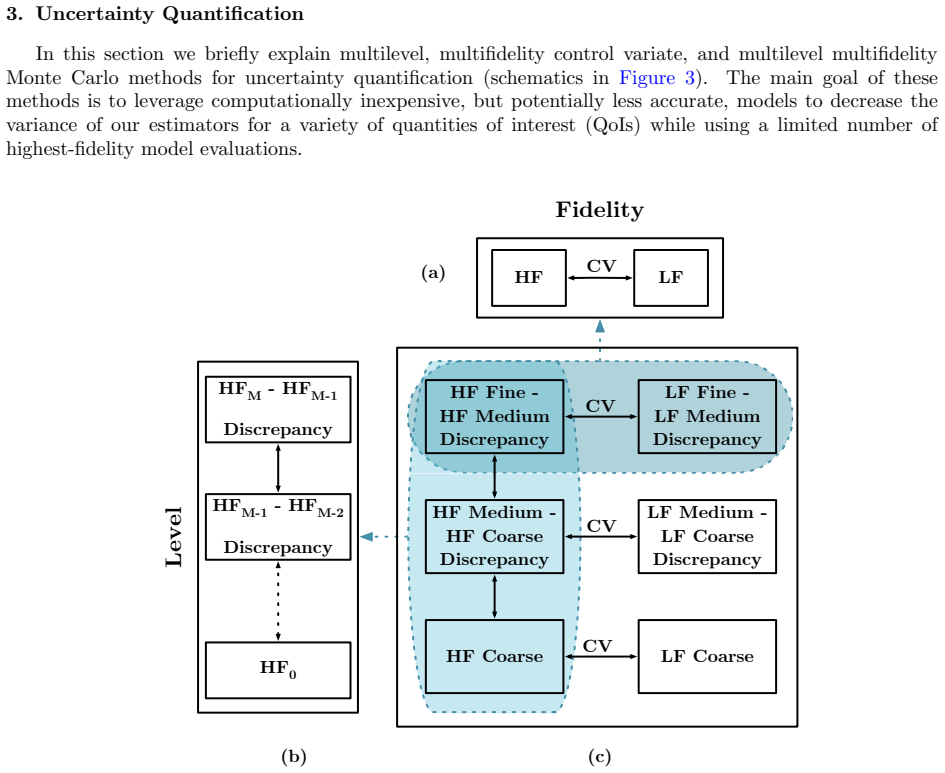
The load-bearing object is the multilevel multifidelity (MLMF) estimator, which writes the target expectation as a sum over levels $\ell$ of discrepancies $Y_\ell$ between successive 3D mesh resolutions and, at each level, augments the high-fidelity discrepancy estimator with a control variate $\alpha_\ell(\hat{Y}^{\mathrm{LF}}_\ell-\mathbb{E}[Y^{\mathrm{LF}}_\ell])$ built from a low-fidelity model. The variance reduction is governed by the per-level Pearson correlation $\rho_\ell$ between high- and low-fidelity discrepancies and the cost ratio $w_\ell$; these determine the optimal sample allocation $N_\ell^{\mathrm{HF}}$ and the low-fidelity oversampling factor $r^\star_\ell$. The paper documents high correlations (mostly above 0.99 for global quantities, and above 0.6 for wall shear stress), which is what lets the cheap models carry most of the sampling burden.
What would settle it
Run the 3D-1D-0D workflow to an actual normalized confidence interval of 0.01 for all quantities of interest on a new anatomy, with independent pilot and convergence phases, and compare realized cost with the extrapolated cost; if realized costs systematically exceed the extrapolated costs beyond the spread seen in the paper's single validation case, the central efficiency claim fails in that setting. A cheaper check is to resample the pilot many times with different 25-sample seeds and see whether the extrapolated cost varies by more than an order of magnitude.
Extended reading notes
Core claim
The central discovery is that the variance-reduction machinery of multilevel Monte Carlo—a telescoping sum of discrepancies between successive mesh resolutions—can be fused with a control-variate correction from cheap low-fidelity models at every level, and for cardiovascular hemodynamics this fusion yields estimators whose normalized confidence interval ($\mathrm{nCI}=6\sigma/\mu$) reaches 0.01 at a fraction of the cost of single-fidelity estimators. With two low-fidelity families (1D and 0D, the latter in full and resistor-only forms) plus three 3D mesh levels, the paper reports extrapolated costs as low as tens of equivalent 3D-fine runs for global quantities, versus thousands for Monte Carlo and hundreds for multilevel Monte Carlo, with local wall-shear-stress quantities showing smaller but still substantial gains. The low-fidelity models need not be unbiased: because each level is corrected by a control variate, bias in the 0D or 1D model is automatically compensated as long as the correlation with the high-fidelity quantity stays high.
Load-bearing premise
The reported cost reductions are extrapolated from variances and correlations estimated in a single pilot run of 25 samples per level, so the savings assume those pilot estimates represent the true sampling behavior of the quantities of interest.
Editorial extensions
If this is right
- Global quantities of interest (outlet flow, outlet pressure, model-averaged pressure) can be converged to a normalized confidence interval of 0.01 with tens of equivalent 3D-fine runs in the best cases, making routine uncertainty quantification feasible within typical clinical compute budgets.
- Local quantities such as spatially averaged wall shear stress remain the hard case: even the best MLMF costs are hundreds to thousands of equivalent 3D-fine runs, and diseased geometries widen the gap relative to healthy ones.
- Adding very cheap 0D models as an extra coarse level improves the 3D-1D-0D scheme over the 3D-1D scheme, with better post-pilot confidence intervals and lower extrapolated costs, most visibly for local quantities.
- Under a fixed high-fidelity budget equal to 50 fine 3D runs, the MLMF schemes deliver smaller (better) confidence intervals for healthy than for diseased anatomies, and for global than for local quantities.
Reading between the lines
- If the pilot-based variance and correlation estimates generalize across patient cohorts, the workflow could be wrapped in an adaptive pilot that spends fewer 3D runs per level (e.g., 5-10 instead of 25) and still reaches the target confidence interval, trading expensive high-fidelity samples for many more cheap low-fidelity samples.
- The method's reliance on correlation suggests a cheap screening test for a new anatomy: measure the per-level correlation between 3D and 1D/0D discrepancies for the target quantity before launching a full campaign; if correlations fall well below the values reported here, the MLMF advantage over multilevel Monte Carlo will shrink accordingly.
- Time-resolved estimators (full pressure and flow waveforms) would likely preserve the same ordering of gains because the per-time-step variance reduction depends on the same correlations, although the pilot cost would increase by the number of time points reported.
Signed reviews
Editorial analysis
A structured set of objections, weighed in public.
Referee Report
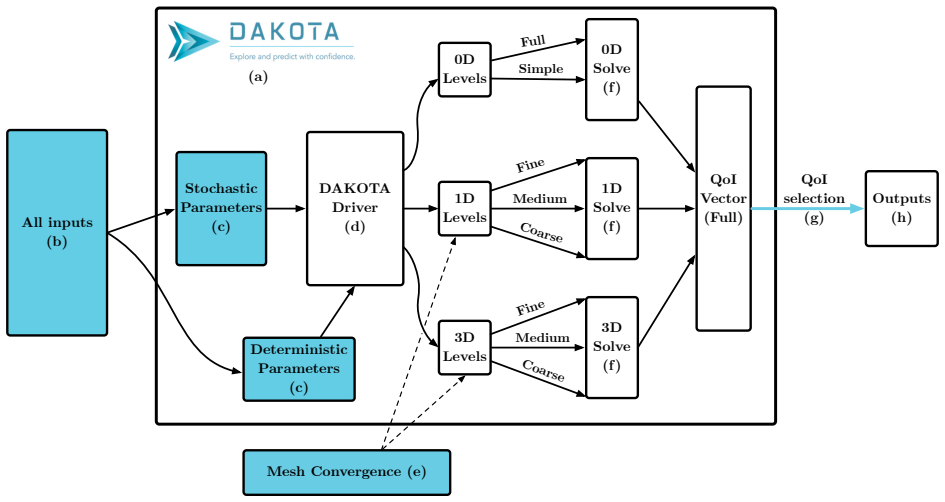
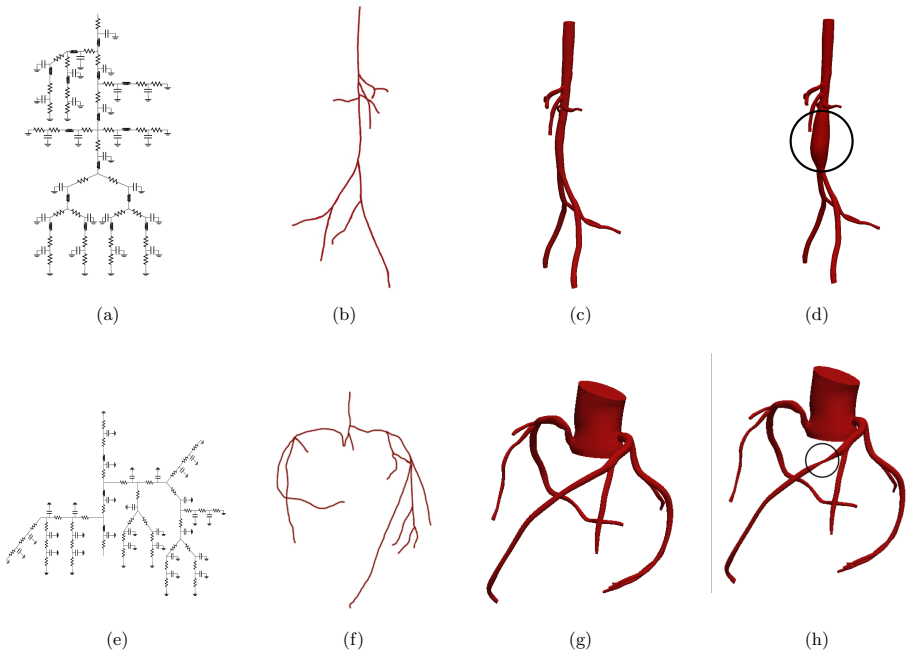
Summary. The paper integrates Sandia Dakota's multilevel multifidelity Monte Carlo (MLMF) estimators with the SimVascular modeling pipeline to perform uncertainty quantification for cardiovascular hemodynamics. Three fidelities are used (3D, 1D, and 0D) with multiple spatial resolution levels, and the framework is demonstrated on healthy and diseased aorto-femoral and coronary anatomies with eight stochastic inputs and 132 or 148 quantities of interest. The central claim is that MLMF estimators achieve one to two orders of magnitude cost reduction over multilevel Monte Carlo and one to three orders over Monte Carlo when extrapolating to a normalized confidence interval of nCI=0.01, with extrapolated costs reported in Tables 5a and 5b. The paper also compares 3D-1D and 3D-1D-0D schemes, healthy versus diseased models, and global versus local QoIs, and it validates the extrapolation procedure for one representative pressure QoI per healthy model in Section 5.2.
Significance. If the reported cost reductions hold, the paper is a valuable demonstration that multilevel multifidelity estimators can make UQ feasible for expensive patient-specific hemodynamic simulations. The work is strengthened by a public workflow repository with a DOI, careful construction and validation of 0D/1D models against 3D results, a wide range of QoIs, and consistent comparisons across methods and anatomies. The main weakness is that the headline cost numbers are extrapolated from small pilot samples, and the validation covers only one pressure QoI per healthy model at variance reductions far smaller than those claimed for the nCI=0.01 target. The manuscript therefore presents a sound methodological application whose quantitative headline needs additional support before the order-of-magnitude claims can be considered robust.
major comments (3)
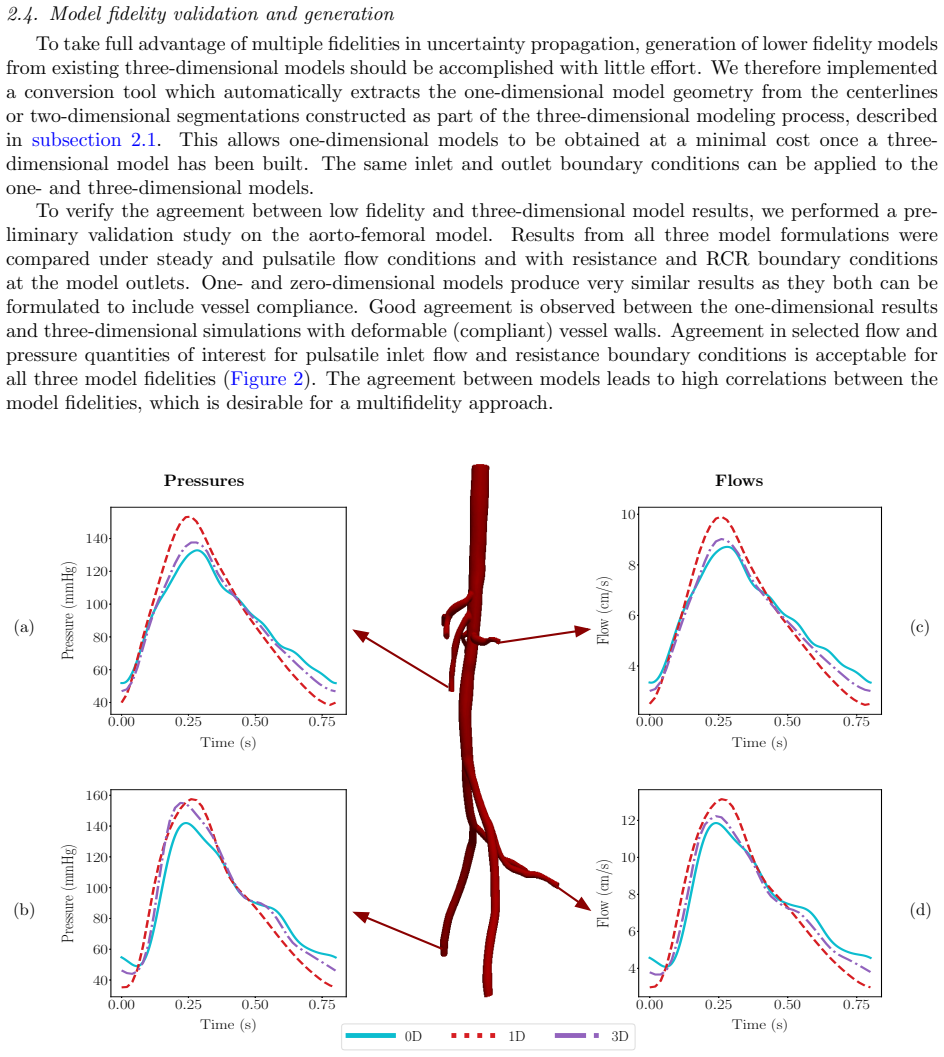
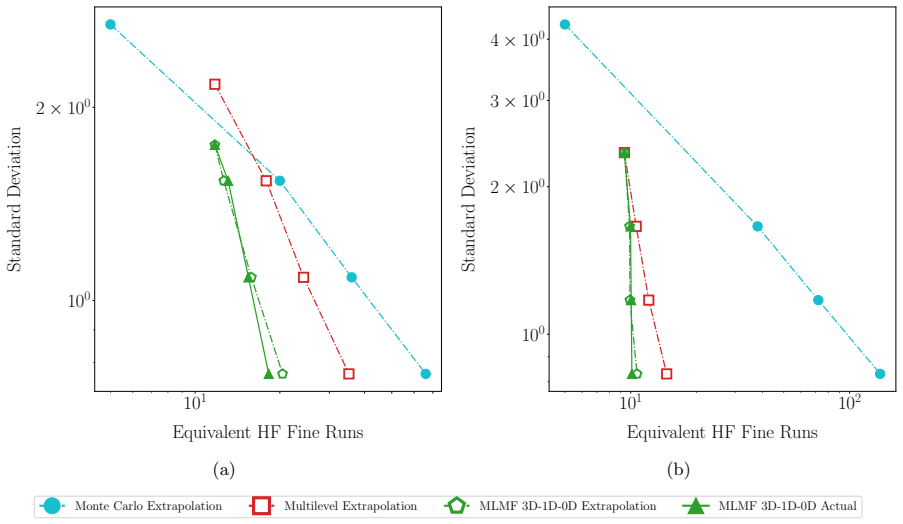
- [§5.1.2, Tables 5a/5b, Eqs. (16), (21), (23)] The extrapolated cost comparisons in Tables 5a and 5b are computed from pilot estimates of level variances, correlations, and cost ratios using only 25 paired samples per level. With n=25, a sample variance has a relative standard error of roughly 28%, and a correlation estimate near 0.8 has a 95% confidence interval of approximately 0.59–0.91; since the control-variate variance reduction factor 1−Λ(r*) depends nonlinearly on ρ² and the cost ratio w, these sampling errors can plausibly change the extrapolated cost ratios by factors of 2–4. No uncertainty or sensitivity analysis is reported for any entry in Tables 5a and 5b. The direct validation in Section 5.2 uses a smaller pilot and targets only variance improvements of ε=0.5, 0.25, and 0.125, which correspond to at most an 8× variance reduction, and it covers one pressure QoI per healthy model rather than the local TAWSS QoIs where the paper still claims 10–100× gains. I request either bootstrap confidence intervals on the extrapolated costs or an independent validation at a variance reduction much closer to the nCI=0.01 target, for several representative QoIs including local WSS.
- [§5.2, Eq. (28)] Equation (28) defines the validation target as Vtarget[Q̂_MLMF] = ε Vpilot[Q̂_ML], where Q̂_ML is stated to be the MLMC estimator. If the pilot variance on the right-hand side is not the variance of the MLMF estimator being validated, then the extrapolation exercise does not directly test the MLMF cost curves shown in Figure 10 and Tables 5a/5b. The text should clarify why the MLMC pilot variance is the reference, and if the equation is correct, it should be shown that this target corresponds to the same nCI improvement used in Section 5.1.2. As written, the validation protocol appears to test a different variance-reduction path than the one used for the central cost claims.
- [§3.1 and §6 (Discussion)] The manuscript explicitly targets only the variance contribution to the mean squared error and assumes that the 3D model's discretization bias is already satisfactory, with the underlying convergence studies stated to be 'not reported here for brevity'. This is an acceptable choice for a relative cost comparison of estimators, but it means the reported nCI values quantify uncertainty around the 3D model prediction, not around the true clinical quantity. Because the abstract and introduction describe improved accuracy of hemodynamic quantities of interest, the manuscript should state this limitation more prominently and either provide the mesh-convergence data in supplementary material or give a reference where it can be found.
minor comments (5)
- [Table 5a] In the Aorto-Femoral Healthy Model TAWSS row, the Monte Carlo effective cost is printed as '23 94.0', which appears to be a typo for '23 940.0'; please correct this.
- [Figure 10 caption] The caption says the values shown in green pentagons and triangles are the projected and actual extrapolated costs, respectively, but the legend text is not fully explicit about which symbol corresponds to which quantity; please clarify the symbol mapping.
- [§5.2] The validation section uses a pilot with 15, 10, and 5 samples on the three discrepancy levels, whereas the main pilot uses 25 samples per level; the text should state explicitly why this smaller pilot was chosen and how it affects the comparison with the main extrapolation.
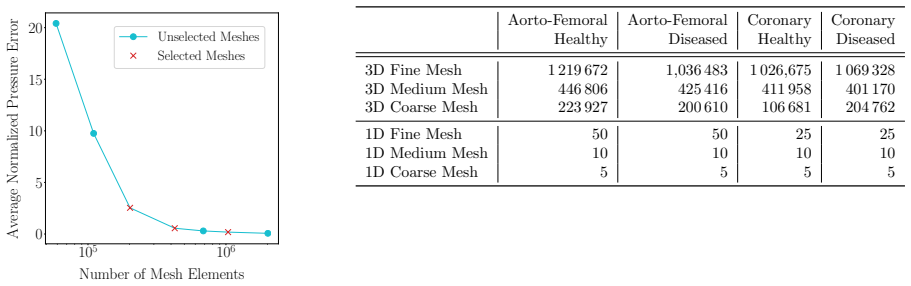
- [Table 2] Some numbers in Table 2 use inconsistent digit-grouping separators (e.g., '1 219 672', '1 036 483', '1 026,675'); please standardize the formatting.
- [§4.2] The phrase 'a simplified LPN was constructed from only resistor elements to serve the purpose of a coarse model representation' is clear, but the later statement that the zero-dimensional models count as 'resolution levels' could be made more explicit about how a lack of spatial resolution is handled in the MLMF hierarchy.
Circularity Check
No circularity found: the MLMF estimator is an existing method applied to new cardiovascular UQ problems, and the claimed cost reductions are extrapolated from pilot estimates and partially validated by actual runs, not derived from the target results.
full rationale
The paper's central claim is that MLMF estimators reduce computational cost relative to MC/MLMC for cardiovascular hemodynamics UQ. The method itself is taken from prior work, including self-citations, but the estimator equations are restated in the paper (Eqs. 22-25) and the application is new. The cost reduction figures in Tables 5a/5b are explicitly extrapolated from a 25-sample-per-level pilot run that estimates V[Y_l], rho_l, and per-level costs; this is a standard pilot-extrapolation procedure, not a fit of a parameter that is then renamed a prediction. The paper validates the extrapolation in Section 5.2 with actual simulations for representative QoIs (Figure 10), so the claimed cost curve is checked against measured performance rather than being forced by construction. The self-citations to [46,47,73,74] provide background and the specific MLMF algorithm version, but the load-bearing comparisons are computed from the cardiovascular pilot data and solver costs reported in Tables 2-4, and the QoI values are obtained from direct simulations of the three model fidelities. No uniqueness theorem or ansatz is imported from the authors' prior work to forbid alternatives. The main weakness is statistical: pilot-based estimates of variances and correlations carry sampling error, and the validation covers only one QoI per model at variance reductions up to 8x, but this is an uncertainty/robustness limitation, not circularity.
Assumptions & free parameters
assumptions (4)
- domain assumption The high-fidelity (3D) model has negligible discretization bias for the quantities of interest.
- domain assumption The pilot run of 25 samples per level provides reliable estimates of variances, correlations, and costs for extrapolation.
- domain assumption The low-fidelity models are sufficiently correlated with the high-fidelity model at each level for control variates to reduce variance.
- domain assumption The measured mean computational cost per model level is representative of the cost distribution across the stochastic parameter space.
Cite this review
Pith. "Pith review of Multilevel and multifidelity uncertainty quantification for cardiovascular hemodynamics." pith.science (2026). https://pith.science/paper/2K2SILQJ
@misc{pith2026190804875,
  author       = {Pith},
  title        = {Pith review of: Multilevel and multifidelity uncertainty quantification for cardiovascular hemodynamics},
  year         = {2026},
  howpublished = {\url{https://pith.science/paper/2K2SILQJ}},
  note         = {Machine review of arXiv:1908.04875}
}
read the original abstract
Standard approaches for uncertainty quantification in cardiovascular modeling pose challenges due to the large number of uncertain inputs and the significant computational cost of realistic three-dimensional simulations. We propose an efficient uncertainty quantification framework utilizing a multilevel multifidelity Monte Carlo estimator to improve the accuracy of hemodynamic quantities of interest while maintaining reasonable computational cost. This is achieved by leveraging three cardiovascular model fidelities, each with varying spatial resolution to rigorously quantify the variability in hemodynamic outputs. We employ two low-fidelity models to construct several different estimators. Our goal is to investigate and compare the efficiency of estimators built from combinations of these low-fidelity and high-fidelity models. We demonstrate this framework on healthy and diseased models of aortic and coronary anatomy, including uncertainties in material property and boundary condition parameters. We seek to demonstrate that for this application it is possible to accelerate the convergence of the estimators by utilizing a MLMF paradigm. Therefore, we compare our approach to Monte Carlo and multilevel Monte Carlo estimators based only on three-dimensional simulations. We demonstrate significant reduction in total computational cost with the MLMF estimators. We also examine the differing properties of the MLMF estimators in healthy versus diseased models, as well as global versus local quantities of interest. As expected, global quantities and healthy models show larger reductions than local quantities and diseased model, as the latter rely more heavily on the highest fidelity model evaluations. In all cases, our workflow coupling Dakota's MLMF estimators with the SimVascular cardiovascular modeling framework makes uncertainty quantification feasible for constrained computational budgets.
Figures

Figures from the paper (12 more)



Reference graph
Works this paper leans on
-
[1]
GBD 2017 Causes of Death Collaborators, Global, regional, and national age-sex-specific mortality for 282 causes of death in 195 countries and territories, 1980-2017: a systematic analysis for the global burden of disease study 2017, Lancet 392 (2018) 1736–1788
2018
-
[2]
Heron, Deaths: Leading causes for 2016, Natl Vital Stat Rep 67 (2018)
M. Heron, Deaths: Leading causes for 2016, Natl Vital Stat Rep 67 (2018)
2018
-
[3]
C. A. Taylor, T. J. Hughes, C. K. Zarins, Finite element modeling of blood flow in arteries, Comput Methods Appl Mech Eng 158 (1998) 155–196
1998
-
[4]
E. J. Benjamin, S. S. Virani, C. W. Callaway, A. M. Chamberlain, A. R. Chang, et al., Heart disease and stroke statistics—2018 update: A report from the american heart association, Circulation 137 (2018) e67–e492
2018
-
[5]
C. A. Taylor, T. A. Fonte, J. K. Min, Computational fluid dynamics applied to cardiac computed tomography for noninvasive quantification of fractional flow reserve: Scientific basis, J Am Coll Cardiol 61 (2013) 2233–2241
2013
-
[6]
A. B. Ramachandra, A. M. Kahn, A. L. Marsden, Patient-specific simulations reveal significant differences in mechanical stimuli in venous and arterial coronary grafts, J Cardiovasc Transl Res 9 (2016) 279–290
2016
-
[7]
E. Kung, A. Baretta, C. Baker, G. Arbia, G. Biglino, et al., Predictive modeling of the virtual hemi-fontan operation for second stage single ventricle palliation: Two patient-specific cases, J Biomech 46 (2013) 423–429
2013
-
[8]
Schiavazzi, E
D. Schiavazzi, E. Kung, A. Marsden, C. Baker, G. Pennati, et al., Hemodynamic effects of left pulmonary artery stenosis after superior cavopulmonary connection: A patient-specific multiscale modeling study, J Thorac Cardiovasc Surg 149 (2015) 689–696.e3
2015
Show all 98 references
-
[9]
Verma, M
A. Verma, M. Esmaily, J. Shang, R. Figliola, J. A. Feinstein, T.-Y. Hsia, A. L. Marsden, Optimization of the assisted bidirectional glenn procedure for first stage single ventricle repair, World J Pediatr Congenit Heart Surg 9 (2018) 157–170
2018
-
[10]
Sengupta, A
D. Sengupta, A. M. Kahn, J. C. Burns, S. Sankaran, S. C. Shadden, A. L. Marsden, Image-based modeling of hemodynamics in coronary artery aneurysms caused by kawasaki disease, Biomech Model Mechanobiol 11 (2012) 915–932
2012
-
[11]
N. G. Gutierrez, O. Shirinsky, N. Gagarina, G. Lyskina, R. Fukazawa, et al., Assessment of coronary artery aneurysms caused by kawasaki disease using transluminal attenuation gradient analysis of computerized tomography angiograms, Am J Cardiol 120 (2017) 556–562
2017
-
[12]
Grande Gutierrez, M
N. Grande Gutierrez, M. Mathew, B. W. McCrindle, J. Tran, A. M. Kahn, et al., Hemodynamic variables in aneurysms are associated with thrombotic risk in children with kawasaki disease, Int J Cardiol 281 (2019)
2019
-
[13]
W. Yang, A. L. Marsden, M. T. Ogawa, C. Sakarovitch, K. K. Hall, et al., Right ventricular stroke work correlates with outcomes in pediatric pulmonary arterial hypertension, Pulmonary Circulation 8 (2018)
2018
-
[14]
W. Yang, M. Dong, M. Rabinovitch, F. P. Chan, A. L. Marsden, J. A. Feinstein, Evolution of hemodynamic forces in the pulmonary tree with progressively worsening pulmonary arterial hypertension in pediatric patients, Biomech Model Mechanobiol 18 (2019) 779–796
2019
-
[15]
G.-Y. Suh, A. S. Les, A. S. Tenforde, S. C. Shadden, R. L. Spilker, et al., Quantification of particle residence time in abdominal aortic aneurysms using magnetic resonance imaging and computational fluid dynamics, Ann Biomed Eng 39 (2011) 864–883
2011
-
[16]
Arzani, S
A. Arzani, S. Shadden, Characterization of the transport topology in patient-specific abdominal aortic aneurysm models, Phys Fluids 24 (2012) 81901
2012
-
[17]
Piccinelli, A
M. Piccinelli, A. Veneziani, D. A. Steinman, A. Remuzzi, L. Antiga, A framework for geometric analysis of vascular structures: Application to cerebral aneurysms, IEEE Trans Med Imaging 28 (2009) 1141–1155
2009
-
[18]
Cebral, F
J. Cebral, F. Mut, J. Weir, C. Putman, Association of hemodynamic characteristics and cerebral aneurysm rupture, AJNR Am J Neuroradiol 32 (2011) 264–270
2011
-
[19]
J. R. Cebral, M. A. Castro, J. E. Burgess, R. S. Pergolizzi, M. J. Sheridan, C. M. Putman, Characterization of cerebral aneurysms for assessing risk of rupture by using patient-specific computational hemodynamics models, AJNR Am J Neuroradiol 26 (2005) 2550–2559
2005
-
[20]
T. J. Hughes, J. Lubliner, On the one-dimensional theory of blood flow in the larger vessels, Math Biosci 18 (1973) 161–170
1973
-
[21]
Mirramezani, S
M. Mirramezani, S. Diamond, H. Litt, S. Shadden, Reduced order models for transstenotic pressure drop in the coronary arteries, J Biomech Eng 141 (2019) 031005–031011
2019
-
[22]
Quarteroni, A
A. Quarteroni, A. Veneziani, C. Vergara, Geometric multiscale modeling of the cardiovascular system, between theory and practice, Comput Methods Appl Mech Eng 302 (2016) 193–252. 34
2016
-
[23]
M. E. Moghadam, I. E. Vignon-Clementel, R. Figliola, A. L. Marsden, A modular numerical method for implicit 0d/3d coupling in cardiovascular finite element simulations, J Comput Phys 244 (2013) 63–79
2013
-
[24]
Quarteroni, S
A. Quarteroni, S. Ragni, A. Veneziani, Coupling between lumped and distributed models for blood flow problems, Comput Vis Sci 4 (2001) 111–124
2001
-
[25]
Migliavacca, G
F. Migliavacca, G. Pennati, G. Dubini, R. Fumero, R. Pietrabissa, et al., Modeling of the norwood circulation: effects of shunt size, vascular resistances, and heart rate, Am J Physiol Heart Circ Physiol 280 (2001) H2076–H2086
2001
-
[26]
M. M. Esmaily, F. Migliavacca, I. Vignon-Clementel, T. Hsia, A. Marsden, Optimization of shunt placement for the norwood surgery using multi-domain modeling, J Biomech Eng 134 (2012) 051002–0510013
2012
-
[27]
Schiavazzi, G
D. Schiavazzi, G. Arbia, C. Baker, A. Hlavacek, T. Y Hsia, A. Marsden, I. Vignon-Clementel, T. Modeling Of Congenital Hearts Alliance Mocha Investigators, Uncertainty quantification in virtual surgery hemodynamics predictions for single ventricle palliation, Int J Numer Method ...
2015
-
[28]
Sankaran, H
S. Sankaran, H. J. Kim, G. Choi, C. A. Taylor, Uncertainty quantification in coronary blood flow simulations: Impact of geometry, boundary conditions and blood viscosity, J Biomech 49 (2016) 2540–2547
2016
-
[29]
Schiavazzi, A
D. Schiavazzi, A. Doostan, G. Iaccarino, A. Marsden, A generalized multi-resolution expansion for uncertainty propagation with application to cardiovascular modeling, Comput Methods Appl Mech Eng 314 (2017) 196–221
2017
-
[30]
J. S. Tran, D. E. Schiavazzi, A. M. Kahn, A. L. Marsden, Uncertainty quantification of simulated biomechanical stimuli in coronary artery bypass grafts, Comput Methods Appl Mech Eng 345 (2019) 402–428
2019
-
[31]
P. Chen, A. Quarteroni, G. Rozza, Simulation-based uncertainty quantification of human arterial network hemodynamics, Int J Numer Method Biomed Eng 29 (2013) 698–721
2013
-
[32]
Sankaran, A
S. Sankaran, A. L. Marsden, The impact of uncertainty on shape optimization of idealized bypass graft models in unsteady flow, Phys Fluids 22 (2010) 121902
2010
-
[33]
V. Eck, J. Sturdy, L. Hellevik, Effects of arterial wall models and measurement uncertainties on cardiovascular model predictions, J Biomech 50 (2017) 188–194
2017
-
[34]
J. S. Tran, D. E. Schiavazzi, A. B. Ramachandra, A. M. Kahn, A. L. Marsden, Automated tuning for parameter identifi- cation and uncertainty quantification in multi-scale coronary simulations, Comput Fluids 142 (2017) 128–138
2017
-
[35]
D. E. Schiavazzi, A. Baretta, G. Pennati, T.-Y. Hsia, A. L. Marsden, Patient-specific parameter estimation in single- ventricle lumped circulation models under uncertainty, Int J Numer Method Biomed Eng 33 (2017) e02799
2017
-
[36]
Biehler, W
J. Biehler, W. A. Wall, The impact of personalized probabilistic wall thickness models on peak wall stress in abdominal aortic aneurysms, Int J Numer Method Biomed Eng 34 (2017) e2922
2017
-
[37]
A. D. Marquis, A. Arnold, C. Dean-Bernhoft, B. E. Carlson, M. S. Olufsen, Practical identifiability and uncertainty quantification of a pulsatile cardiovascular model, Math Biosci 304 (2018) 9–24
2018
-
[38]
Brault, L
A. Brault, L. Dumas, D. Lucor, Uncertainty quantification of inflow boundary condition and proximal arterial stiffness- coupled effect on pulse wave propagation in a vascular network, Int J Numer Method Biomed Eng 33 (2017) e2859
2017
-
[39]
Boccadifuoco, A
A. Boccadifuoco, A. Mariotti, S. Celi, N. Martini, M. Salvetti, Impact of uncertainties in outflow boundary conditions on the predictions of hemodynamic simulations of ascending thoracic aortic aneurysms, Comput Fluids 165 (2018) 96–115
2018
-
[40]
D. Xiu, G. Karniadakis, The wiener–askey polynomial chaos for stochastic differential equations, SIAM J Sci Comput 24 (2002) 619–644
2002
-
[41]
Babuˇ ska, F
I. Babuˇ ska, F. Nobile, R. Tempone, A stochastic collocation method for elliptic partial differential equations with random input data, SIAM J Numer Anal 45 (2007) 1005–1034
2007
-
[42]
Metropolis, S
N. Metropolis, S. Ulam, The Monte Carlo method, J Am Stat Assoc 44 (1949) 335–341
1949
-
[43]
Giles, Multilevel Monte Carlo methods., Acta Numer 24 (2015) 259–328
M. Giles, Multilevel Monte Carlo methods., Acta Numer 24 (2015) 259–328
2015
-
[44]
Peherstorfer, K
B. Peherstorfer, K. Willcox, M. Gunzburger, Optimal model management for multifidelity Monte Carlo estimation., SIAM J Sci Comput 38 (2016) A3163–A3194
2016
-
[45]
Nobile, F
F. Nobile, F. Tesei, A multi level monte carlo method with control variate for elliptic pdes with log-normal coefficients, Stochastic Partial Differential Equations: Analysis and Computations 3 (2015) 398–444
2015
-
[46]
Geraci, M
G. Geraci, M. Eldred, G. Iaccarino, A multifidelity control variate approach for the multilevel Monte Carlo technique, Center for Turbulence Research, Stanford University, 2015, pp. 169–181
2015
-
[47]
Geraci, M
G. Geraci, M. S. Eldred, G. Iaccarino, A multifidelity multilevel Monte Carlo method for uncertainty propagation in aerospace applications, in: 19th AIAA Non-Deterministic Approaches Conference, American Institute of Aeronautics and Astronautics, Grapvine, Texas, 2017
2017
-
[48]
H. R. Fairbanks, A. Doostan, C. Ketelsen, G. Iaccarino, A low-rank control variate for multilevel monte carlo simulation of high-dimensional uncertain systems, Journal of Comput Phys 341 (2016)
2016
-
[49]
Updegrove, N
A. Updegrove, N. Wilson, J. Merkow, H. Lan, A. Marsden, S. Shadden, SimVascular: An open source pipeline for cardiovascular simulation, Ann Biomed Eng 45 (2016) 525–541
2016
-
[50]
Adams, M
B. Adams, M. Ebeida, M. Eldred, G. Geraci, J. Jakeman, et al., Dakota, a multilevel parallel object-oriented framework for design optimization, parameter estimation, uncertainty quantification, and sensitivity analysis: Version 6.6 user’s manual, Sandia Technical Report SAND201...
2014
-
[51]
Formaggia, F
L. Formaggia, F. Nobile, A. Quarteroni, A. Veneziani, Multiscale modelling of the circulatory system: a preliminary analysis, Comput Vis Sci 2 (1999) 75–83
1999
-
[52]
I. E. Vignon-Clementel, C. A. Figueroa, K. E. Jansen, C. A. Taylor, Outflow boundary conditions for three-dimensional finite element modeling of blood flow and pressure in arteries, Comput Methods Appl Mech Eng 195 (2006) 3776–3796
2006
-
[53]
Esmaily Moghadam, Y
M. Esmaily Moghadam, Y. Bazilevs, T.-Y. Hsia, I. E. Vignon-Clementel, A. L. Marsden, Modeling of Congenital Hearts Alliance (MOCHA), A comparison of outlet boundary treatments for prevention of backflow divergence with relevance to blood flow simulations, Comput Mech 48 (2011) 277–291
2011
-
[54]
Esmaily-Moghadam, Y
M. Esmaily-Moghadam, Y. Bazilevs, A. L. Marsden, A bi-partitioned iterative algorithm for solving linear systems arising 35 from incompressible flow problems, Comput Methods Appl Mech Eng 286 (2015) 40–62
2015
-
[55]
K. E. Jansen, C. H. Whiting, G. M. Hulbert, A generalized- α method for integrating the filtered navierstokes equations with a stabilized finite element method, Comput Methods Appl Mech Eng 190 (2000) 305–319
2000
-
[56]
Esmaily-Moghadam, Y
M. Esmaily-Moghadam, Y. Bazilevs, A. L. Marsden, A new preconditioning technique for implicitly coupled multidomain simulations with applications to hemodynamics, Comput Mech 52 (2013) 1141–1152
2013
-
[57]
J. Seo, D. E. Schiavazzi, A. L. Marsden, Performance of preconditioned iterative linear solvers for cardiovascular simulations in rigid and deformable vessels, Comput Mech (2019)
2019
-
[58]
Chatzizisis, A
Y. Chatzizisis, A. Coskun, M. Jonas, E. Edelman, C. Feldman, P. Stone, Role of endothelial shear stress in the natural history of coronary atherosclerosis and vascular remodeling: molecular, cellular, and vascular behavior, J Am Coll Cardiol 49 (2007) 2379–2393
2007
-
[59]
Figueroa, I
A. Figueroa, I. Vignon-Clementel, K. Jansen, T. Hughes, C. Taylor, A coupled momentum method for modeling blood flow in three-dimensional deformable arteries, Comput Methods Appl Mech Eng 195 (2006) 5685–5706
2006
-
[60]
Euler, Principia pro motu sanguinis per arterias determinando, Opera posthuma mathematica et physica anno 1844 detecta 2 (1775) 814–823
L. Euler, Principia pro motu sanguinis per arterias determinando, Opera posthuma mathematica et physica anno 1844 detecta 2 (1775) 814–823. Ediderunt PH Fuss et N Fuss Petropoli; Apund Eggers et Socios
-
[61]
Vignon, C
I. Vignon, C. Taylor, Outflow boundary conditions for one-dimensional finite element modeling of blood flow and pressure waves in arteries, Wave Motion 39 (2004) 361–374
2004
-
[62]
Vignon, A Coupled Multidomain Method for Computational Modeling of Blood Flow, Ph.D
I. Vignon, A Coupled Multidomain Method for Computational Modeling of Blood Flow, Ph.D. thesis, Stanford University, 2006
2006
-
[63]
J. Wan, B. Steele, S. A. Spicer, S. Strohband, G. R. Feijo, T. J. Hughes, C. A. Taylor, A one-dimensional finite element method for simulation-based medical planning for cardiovascular disease, Comput Methods Biomech Biomed Engin 5 (2002) 195–206
2002
-
[64]
Steele, C
B. Steele, C. Taylor, J. Wan, J. Ku, T. Hughes, In vivo validation of a one-dimensional finite element method for simulation-based medical planning for cardiovascular bypass surgery, volume 1, 2001, pp. 120–123
2001
-
[65]
Miliˇ si´ c, A
V. Miliˇ si´ c, A. Quarteroni, Analysis of lumped parameter models for blood flow simulations and their relation with 1D models, ESAIM Math Model Numer Anal 38 (2004) 613–632
2004
-
[66]
Migliavacca, R
F. Migliavacca, R. Balossino, G. Pennati, G. Dubini, T.-Y. Hsia, et al., Multiscale modelling in biofluidynamics: Appli- cation to reconstructive paediatric cardiac surgery, J Biomech 39 (2006) 1010–1020
2006
-
[67]
Corsini, D
C. Corsini, D. Cosentino, G. Pennati, G. Dubini, T.-Y. Hsia, F. Migliavacca, Multiscale models of the hybrid palliation for hypoplastic left heart syndrome, J Biomech 44 (2011) 767–770
2011
-
[68]
Pasupathy, B
R. Pasupathy, B. W. Schmeiser, M. R. Taaffe, J. Wang, Control-variate estimation using estimated control means., IIE Trans 44 (2012) 381–385
2012
-
[69]
L. Ng, K. Willcox, Multifidelity approaches for optimization under uncertainty., Int J Numer Methods Eng 100 (2014) 746–772
2014
-
[70]
R. Y. Rubinstein, R. Marcus, Efficiency of multivariate control variates in monte carlo simulation, Operations Research 33 (1985) 661–677
1985
-
[71]
A. A. Gorodetsky, G. Geraci, M. Eldred, J. D. Jakeman, A Generalized Approximate Control Variate Framework for Multifidelity Uncertainty Quantification, J Comput Phys (2020) 109257
2020
-
[72]
D. C. Maniaci, A. L. Frankel, G. Geraci, M. L. Blaylock, M. S. Eldred, Multilevel uncertainty quantification of a wind turbine large eddy simulation model, in: 6th European Conference on Computational Mechanics—7th European Conference on Computational Fluid Dynamics, Internatio...
2018
-
[73]
C. M. Fleeter, G. Geraci, D. E. Schiavazzi, A. M. Kahn, M. S. Eldred, A. L. Marsden, Multilevel multifidelity approaches for cardiovascular flow under uncertainty, in: Sandia Center for Computing Research Summer Proceedings 2017, A.D. Baczewski and M.L. Parks, eds., volume Techn...
2017
-
[74]
Schiavazzi, C
D. Schiavazzi, C. M. Fleeter, G. Geraci, A. L. Marsden, Multifidelity approaches for cardiovascular hemodynamics, in: 6th European Conference on Computational Mechanics—7th European Conference on Computational Fluid Dynamics, International Centre for Numerical Methods in Engine...
2018
-
[75]
Fleeter, Dakota-Simvascular Cardiovascular UQ Interface, 2019
C. Fleeter, Dakota-Simvascular Cardiovascular UQ Interface, 2019. doi: 10.5281/zenodo.3352431
2019 doi
-
[76]
K. C. Kent, Abdominal aortic aneurysms, N Engl J Med 371 (2014) 2101–2108
2014
-
[77]
G. D. Giannoglou, A. P. Antoniadis, Y. S. Chatzizisis, G. E. Louridas, Difference in the topography of atherosclerosis in the left versus right coronary artery in patients referred for coronary angiography, BMC Cardiovasc Disord 10 (2010) 26
2010
-
[78]
Peir´ o, A
J. Peir´ o, A. Veneziani, Reduced models of the cardiovascular system, Springer Milan, Milano, 2009, pp. 347–394
2009
-
[79]
Y. Zhou, G. Kassab, S. Molloi, On the design of the coronary arterial tree: a generalization of Murray’s law, Phys Med Biol 44 (1999) 2929–2945
1999
-
[80]
A. S. Les, S. C. Shadden, C. A. Figueroa, J. M. Park, M. M. Tedesco, et al., Quantification of hemodynamics in abdominal aortic aneurysms during rest and exercise using magnetic resonance imaging and computational fluid dynamics, Ann Biomed Eng 38 (2010) 1288–1313
2010
-
[81]
Coogan, J
J. Coogan, J. Humphrey, C. Figueroa, Computational simulations of hemodynamic changes within thoracic, coronary, and cerebral arteries following early wall remodeling in response to distal aortic coarctation, Biomech Model Mechanobiol 12 (2013) 79–93
2013
-
[82]
Roccabianca, C
S. Roccabianca, C. Figueroa, G. Tellides, J. Humphrey, Quantification of regional differences in aortic stiffness in the aging human, J Mech Behav Biomed Mater 29 (2014) 618–634
2014
-
[83]
B. A. Zambrano, H. Gharahi, C. Lim, F. A. Jaberi, J. Choi, W. Lee, S. Baek, Association of intraluminal thrombus, hemodynamic forces, and abdominal aortic aneurysm expansion using longitudinal ct images., Ann Biomed Eng 44 (2015) 36 1502–1514
2015
-
[84]
Geraci, M
G. Geraci, M. S. Eldred, A. A. Gorodetsky, J. D. Jakeman, Leveraging active directions for efficient multifidelity uq, in: 6th European Conference on Computational Mechanics—7th European Conference on Computational Fluid Dynamics, International Centre for Numerical Methods in Eng...
2018
-
[85]
P. J. Blonigan, G. Geraci, F. Rizzi, M. S. Eldred, K. Carlberg, On-line generation and error handling for surrogate models within multifidelity uncertainty quantification., Sandia Technical Report SAND2019-11427R (2019)
2019
-
[86]
P. J. Blonigan, G. Geraci, F. Rizzi, M. S. Eldred, Towards an integrated and efficient framework for leveraging reduced order models for multifidelity uncertainty quantification, 2020
2020
-
[87]
Perotto, A
S. Perotto, A. Ern, A. Veneziani, Hierarchical local model reduction for elliptic problems: A domain decomposition approach, Multiscale Model Simul 8 (2010)
2010
-
[88]
Perotto, A
S. Perotto, A. Veneziani, Coupled model and grid adaptivity in hierarchical reduction of elliptic problems, J Sci Comput 60 (2013) 505–536
2013
-
[89]
M. C. Aletti, S. Perotto, A. Veneziani, Himod reduction of advection—diffusion—reaction problems with general boundary conditions, J Sci Comput 76 (2018) 89–119
2018
-
[90]
MansillaAlvarez, P
L. MansillaAlvarez, P. Blanco, C. Bulant, E. Dari, A. Veneziani, R. Feij´ oo, Transversally enriched pipe element method (tepem): An effective numerical approach for blood flow modeling, Int J Numer Method Biomed Eng 33 (2017) e2808. E2808 cnm.2808
2017
-
[91]
Blanco, L
P. Blanco, L. M. Alvarez, R. Feij´ oo, Hybrid element-based approximation for the navierstokes equations in pipe-like domains, Comput Methods Appl Mech Eng 283 (2015) 971–993
2015
-
[92]
Alvarez, P
A. Alvarez, P. Blanco, R. Feij´ oo, An efficient method for the numerical solution of blood flow in 3d bifurcated regions, in: Proceeding Series of the Brazilian Society of Applied and Computational Mathematics, volume 6, 2018
2018
-
[93]
Guzzetti, L
S. Guzzetti, L. M. Alvarez, P. Blanco, K. Carlberg, A. Veneziani, Propagating uncertainties in large-scale hemodynamics models via network uncertainty quantification and reduced-order modeling, Comput Methods Appl Mech Eng 358 (2020) 112626
2020
-
[94]
Dal Santo, S
N. Dal Santo, S. Deparis, L. Pegolotti, Data driven approximation of parametrized pdes by reduced basis and neural networks, arXiv preprint arXiv:1908.04875 (2019)
2019 arXiv
-
[95]
Geraci, M
G. Geraci, M. S. Eldred, A. Gorodetsky, J. Jakeman, Recent advancements in multilevel-multifidelity techniques for forward uq in the darpa sequoia project, in: AIAA Scitech 2019 Forum, San Diego, CA, 2019
2019
-
[96]
A. A. Gorodetsky, G. Geraci, M. S. Eldred, J. D. Jakeman, Latent variable networks for multifidelity uncertainty quan- tification and data fusion, in: 6th European Conference on Computational Mechanics—7th European Conference on Computational Fluid Dynamics, International Centre...
2018
-
[97]
Towns, T
J. Towns, T. Cockerill, M. Dahan, I. Foster, K. Gaither, et al., Xsede: Accelerating scientific discovery, Comput Sci Eng 16 (2014) 62–74
2014
-
[98]
Wilkins-Diehr, S
N. Wilkins-Diehr, S. Sanielevici, J. Alameda, J. Cazes, L. Crosby, M. Pierce, R. Roskies, An overview of the xsede extended collaborative support program, in: High Performance Computer Applications - 6th International Conference, ISUM 2015, Revised Selected Papers, volume 595 ...
2015
Reviewed August 14, 2026 · model on record in the stance chip above.
Discussion (0). Continue with ORCID to comment.