REVIEW 4 major objections 4 minor 45 references
Orbital transmutation and the electronic spectrum of FeSe in the nematic phase
T0 review · 4 major / 4 minor · reviewed 2026-08-14 · deepseek-v4-flash
Pith's one-line read Spin-orbit coupling or surface hybridization can change an excitation's dominant orbital character in FeSe between the tetragonal and nematic phases, explaining why the xz and yz modes at the M point do not merge at T_nem.
desk verdict Orbital transmutation is a genuinely new mechanism for the FeSe M-point puzzle, but the resolution is conditional on unmeasured couplings and fitted level crossings; still worth a serious referee. read the letter →
The pith
A machine-rendered reading of the paper's core claim, the machinery that carries it, and where it could break.
The reading
What carries the argument
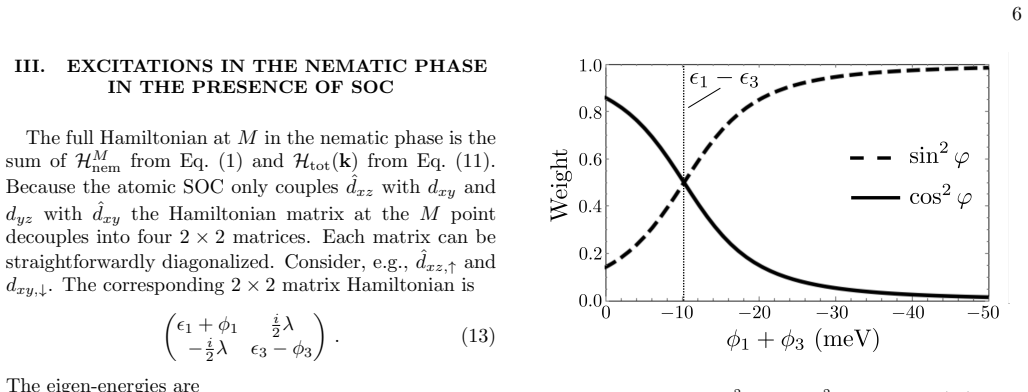
The load-bearing object is the effective $2\times2$ Hamiltonian at the $M$ point in the $xz$--$xy$ and $yz$--$xy$ orbital sectors, built from a $k\cdot p$ expansion that respects the glide-plane symmetry of FeSe. The central identity is the mixing angle $\tan 2\phi = -\lambda/(\epsilon_1-\epsilon_3+\phi_1+\phi_3)$; when the nematic combination $\phi_1+\phi_3$ grows large enough to overcome the small orbital splitting $\epsilon_1-\epsilon_3$, the angle moves from near zero to near $-\pi/2$ and the dominant orbital weight of the two eigenstates is exchanged. That sign change, named orbital transmutation, is what lets one excitation from each doublet swap its orbital identity between high and low temperature. In the surface scenario the same work is done by the hybridization $\eta\,\hat d^\dagger_{xz,\sigma} d_{yz,\sigma}+\mathrm{H.c.}$, which is forbidden in the bulk by glide-plane symmetry but allowed at the surface probed by ARPES and STM.
What would settle it
A decisive test is polarization-resolved ARPES at the $M$ point just above $T_{\rm nem}$ with resolution better than the expected splittings: the spin-orbit scenario predicts one doubly degenerate $xz/yz$ doublet and one doubly degenerate $xy$ doublet, whereas the surface-hybridization scenario predicts two split $xz/yz$ modes with equal $xz$ and $yz$ orbital weight. Observing neither the predicted doublet structure nor the two split singlets would falsify the orbital-transmutation mechanism; seeing the two modes actually merge above $T_{\rm nem}$ would indicate the puzzle was a thermal-broadening artifact.
Extended reading notes
Core claim
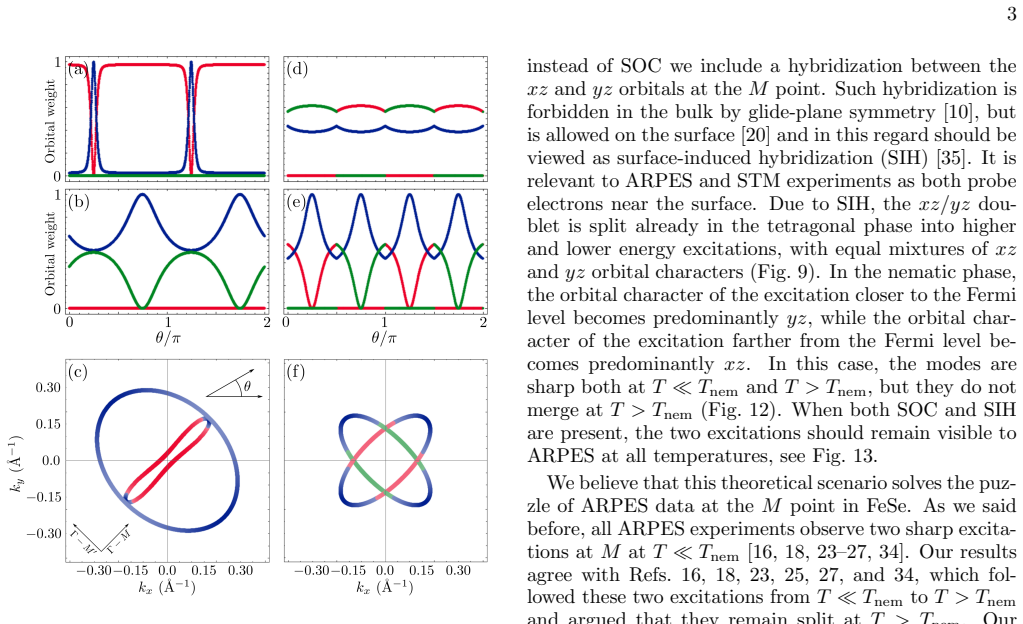
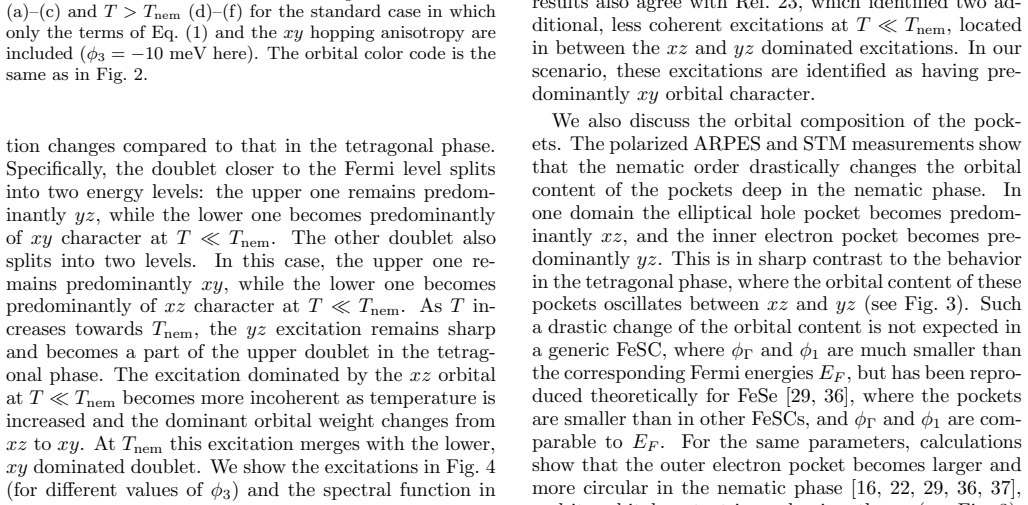
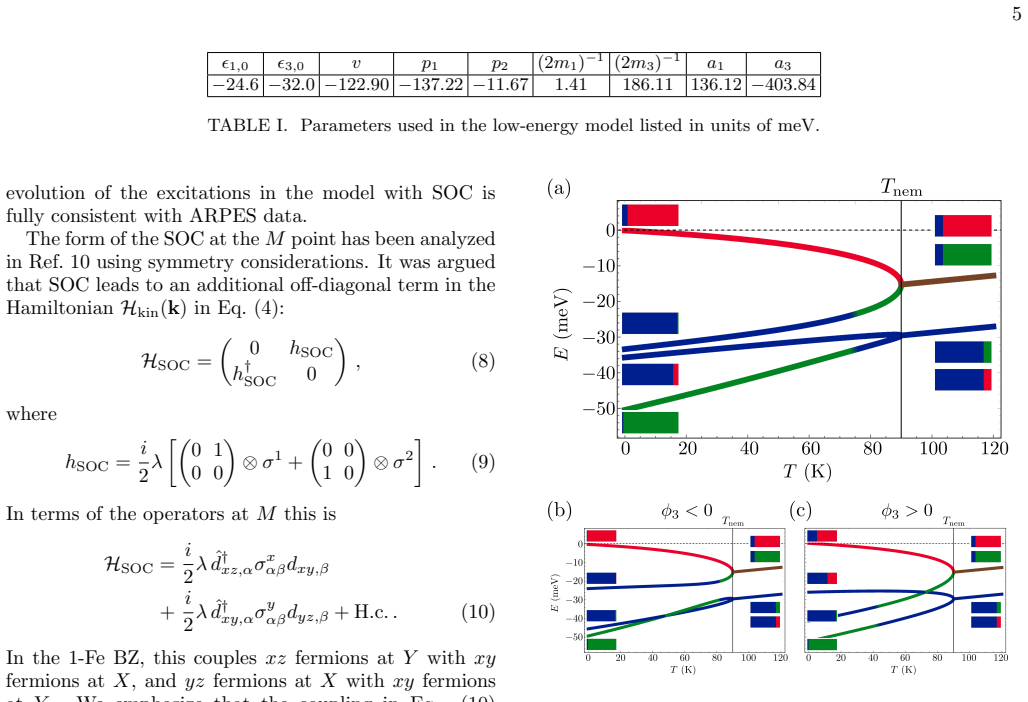
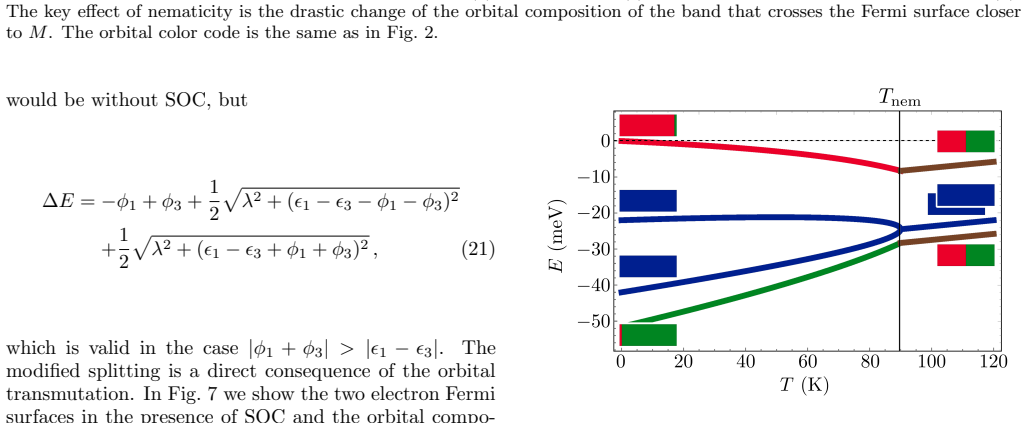
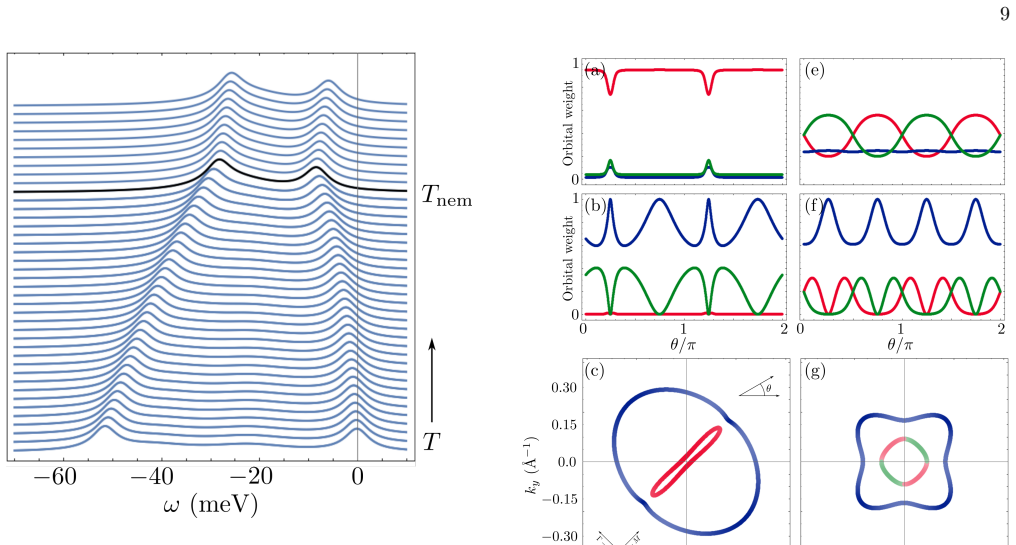
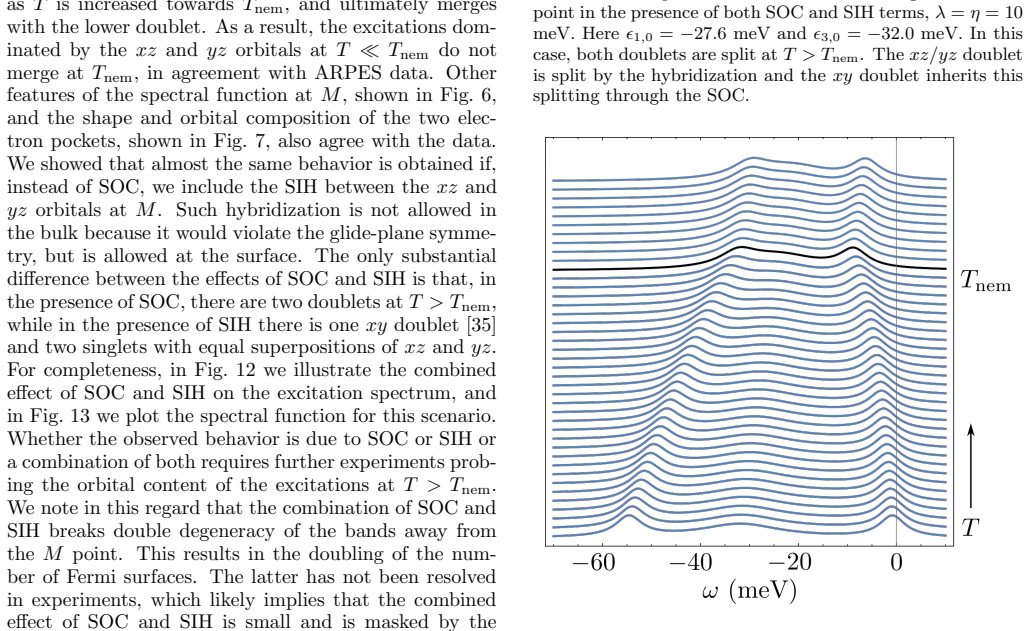
The central claim is that an excitation from each doublet at the $M$ point undergoes an orbital transmutation below $T_{\rm nem}$: its dominant orbital contribution changes relative to the tetragonal phase. In the spin-orbit-coupling scenario, the doublet closer to the Fermi level splits into a state that remains predominantly $yz$ and a state that becomes predominantly $xy$ at $T\ll T_{\rm nem}$; the other doublet splits into a state that remains predominantly $xy$ and a state that becomes predominantly $xz$. Because the $xz$-dominated low-temperature mode has become $xy$ as $T$ approaches $T_{\rm nem}$, it does not merge with the $yz$ mode; instead it joins the lower $xy$ doublet. The paper argues this reproduces the ARPES spectra, including the two sharp peaks at low temperature, the two weaker intermediate peaks identified with $xy$ orbitals, and the missing outer electron pocket if $xy$ fermions are incoherent. In the complementary surface-hybridization scenario, the same non-merging follows from a tetragonal-phase splitting of the $xz/yz$ doublet into equal $xz\pm yz$ mixtures, with the low-temperature eigenstates becoming almost pure $yz$ and $xz$.
Load-bearing premise
The argument needs the spin-orbit coupling $\lambda$ (or the surface hybridization $\eta$) to be large enough—the paper uses 10 meV for each—and the orbital splitting $\epsilon_1-\epsilon_3$ to be small enough that the nematic combination $\phi_1+\phi_3$ overturns the sign of the mixing-angle denominator; neither $\lambda$ nor $\eta$ has been measured directly on the electron pockets.
Editorial extensions
If this is right
- The measured splitting between the $xz$ and $yz$ modes deep in the nematic phase is not simply $2|\phi_1|$; it is the modified expression in Eq. (21) that involves $\lambda$, $\phi_1+\phi_3$, and the orbital splitting, so extracting the nematic order parameter from ARPES requires accounting for spin-orbit coupling.
- The absence of the outer electron pocket in ARPES finds a natural explanation: when $xy$ fermions are incoherent, a pocket that is predominantly $xy$ contributes only weak, broad spectral weight.
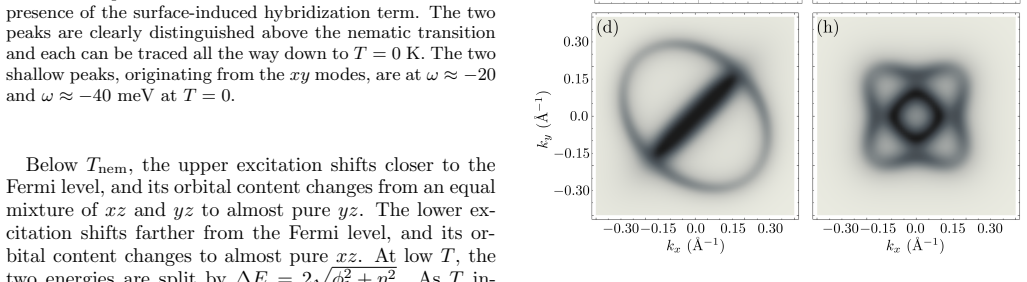
- The $xz$ spectral weight measured along the diagonal of the peanut-shaped inner electron pocket is a direct fingerprint of spin-orbit coupling, and its magnitude is sensitive to the values of $\lambda$ and the nematic order parameters.
- The two scenarios can be separated by measurements in the tetragonal phase: SOC gives two doubly degenerate bands, while surface-induced hybridization splits the $xz/yz$ doublet into distinct singlet excitations even above $T_{\rm nem}$.
Reading between the lines
- If the mechanism is generic, orbital transmutation should be strongest in materials where the relevant orbital splitting is comparable to the nematic order parameter, as in FeSe; in materials with larger orbital splittings the same hybridization would produce only small weight transfers rather than an identity swap.
- A testable extension would be to look for the predicted temperature dependence of spectral weight in detwinned crystals: the low-temperature $xz$-dominated peak should continuously lose $xz$ weight and gain $xy$ weight as $T$ approaches $T_{\rm nem}$, which could be seen by tracking peak intensities under two polarizations.
- The same level-crossing logic may apply to other multiorbital systems with a nematic-like order parameter that can flip the sign of a mixing-angle denominator, suggesting orbital transmutation as a general spectroscopic signature of orbital order.
Editorial analysis
A structured set of objections, weighed in public.
Referee Report
Summary. This manuscript proposes an explanation for the persistent splitting of the xz/yz-derived excitations at the M point in FeSe above the nematic transition. Working in the 2-Fe Brillouin zone, the authors add to the standard nematic k·p model either the spin-orbit coupling allowed at M or a surface-induced xz/yz hybridization. They show that in both cases the dominant orbital character of one low-energy branch changes between the tetragonal and deeply nematic regimes ('orbital transmutation'), so the state identified as xz at low T does not return to the upper xz/yz doublet as T approaches T_nem, but instead connects to the lower xy-dominated doublet. The model is used to compute M-point energies, spectral functions, Fermi-surface shapes, and orbital weights, and is compared with ARPES and STM data. The two scenarios are distinguished by predictions for polarized ARPES above T_nem.
Significance. If established, the orbital-transmutation mechanism would resolve a long-standing ARPES puzzle in FeSe and would be a useful concept for other small-Fermi-energy iron-based materials. The paper's strengths are its analytical transparency (the 2x2 diagonalizations leading to Eqs. (14)-(19) are clean), its symmetry-based derivation of the allowed SOC and surface terms, and the fact that it makes concrete falsifiable predictions: two degenerate doublets above T_nem in the SOC scenario versus split singlets in the SIH scenario, with distinct orbital contents measurable by polarized ARPES. The main limitation is that the effect is demonstrated in a parameter regime whose key inputs are not independently measured; the paper therefore establishes an internally consistent scenario rather than a closed explanation.
major comments (4)
- [Sec. III, Eqs. (13)-(19); Sec. V] The central claim that the low-temperature xz branch does not merge at T_nem depends on the sign change of D(T) = eps1 - eps3 + phi1(T) + phi3(T) (Eq. (16)): only if |phi1+phi3| exceeds |eps1-eps3| does the mixing angle phi reach the transmuted branch. In the manuscript this inequality is guaranteed by choices that are fitted to the very data under study: phi1,0 = -24 meV, eps1,0 - eps3,0 is set to 7.4 meV in Sec. II and to 10.2 meV in the SOC scenario (Fig. 4), and phi3,0 is varied as 0 or +/-10 meV although its sign is stated to be experimentally unverified (Sec. I). Moreover, Sec. V explicitly states that neither lambda nor eta has been measured directly; the value 10 meV is assumed. If the actual lambda were much smaller, or if eps1 - eps3 were larger, the sign change would not occur and the standard-model contradiction would remain. Please provide an independent constraint on this parameter regime, for example a full fit to the M-point dispersions and orbital weights with lambda and eta as free parameters, or a threshold analysis showing how large lambda and eta must be for the transmutation to survive.
- [Sec. III, Eq. (21); Sec. II] The quantitative comparison with ARPES is partly constructed. Eq. (21) shows that the low-temperature splitting Delta E is a combination of phi1, phi3, lambda, and eps1 - eps3, and the text (Sec. II) states that eps1,0 and eps3,0 are adjusted in each scenario to maintain the peanut-shaped pocket; the values differ between the SOC scenario (-24.8, -35.0 meV) and the SIH scenario (-26.3, -32.0 meV). Thus the measured M-point splitting constrains phi1 only through an assumed lambda (or eta), while the onsite energies are themselves re-fit to reproduce the pocket shapes. The agreement therefore demonstrates consistency, not prediction. I recommend an explicit statement of this circularity and, if possible, a two-parameter scan of (lambda, eta) showing the range over which the data are reproduced.
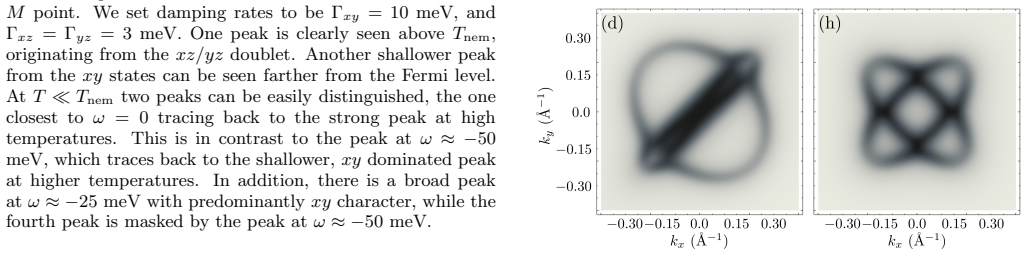
- [Sec. III, Eq. (20) and Fig. 6] The observability of the non-merging in the SOC scenario relies on the ad hoc assumption that Gamma_xy = 10 meV is much larger than Gamma_xz = Gamma_yz = 3 meV. If the xy orbital were coherent, the transmuted lower branch would remain a sharp peak and the spectral function would show four peaks; if Gamma_xy is made very large, the apparent merging is produced by broadening rather than by the physics of transmutation. The paper motivates this input by orbital-selective physics (Refs. [38,39]) but does not calibrate or test it. This premise should be stated as a separate assumption and its consequences checked by varying Gamma_xy over a wide range.
- [Sec. IV, Eq. (12); Sec. V] The SIH scenario has the same status as a consistency check rather than an explanation, because the splitting above T_nem is exactly the assumed surface hybridization 2 eta and eta is not measured. The scenario is only distinguished from SOC by the orbital content above T_nem (Sec. V), which is not currently available. The authors should either soften the wording that these scenarios 'describe the data' to 'are consistent with the data' or provide additional evidence, for example a surface-sensitive measurement or a comparison between ARPES and bulk probes, that an xz/yz hybridization of order 10 meV exists.
minor comments (4)
- [Eq. (16) and surrounding text] The mixing angle phi in Eq. (16) is defined through tan 2phi, which is invariant under 2phi -> 2phi + pi; the text's statement that phi varies from approximately 0 to approximately -pi/2 is only correct for one branch of the inverse tangent. Please state the chosen branch or define phi directly from the eigenvector components to avoid ambiguity.
- [Throughout] There are several typographical errors: 'ro' should be 'to' in Sec. IV, 'intentisty' should be 'intensity' and 'variation with' should probably be 'contrast with' in Sec. V, and 'fartherst' should be 'farthest' in the Fig. 9 caption.
- [Sec. II, Table I] The temperature-dependent onsite energies eps1(T) = eps1,0 + 0.083T and eps3(T) = eps3,0 + 0.083T are given without stating the units of the slope; please specify meV/K and note that this slope is also an input fitted to the ARPES data.
- [Fig. 7 and Fig. 11] The caption color code references the same orbital colors as Fig. 2, but the printed figures use overlapping blue and green shades; for accessibility, consider using distinct line styles or explicitly labeling the pockets in the lower panels.
Circularity Check
No significant circularity: the non-merging follows from an exact diagonalization and band-identity swap, not from a fitted parameter renamed as a prediction.
full rationale
The central mechanism, orbital transmutation, is a direct algebraic consequence of diagonalizing the 2x2 Hamiltonians in Eqs. (13)-(19): when |phi1 + phi3| exceeds epsilon1 - epsilon3, the mixing angle phi in Eq. (16) varies from 0 to -pi/2 and the dominant orbital character of the two coupled branches is exchanged. The paper then shows that the low-temperature xz-dominated excitation connects to the lower xy doublet above Tnem, rather than to the upper xz/yz doublet, so the two low-temperature xz/yz peaks do not merge; this is a derived consequence, not an imposed output. Parameters such as epsilon1,0, epsilon3,0, and phi1,0 are indeed fitted to ARPES/STM pocket shapes, tetragonal dispersions, and the low-temperature splitting, and the level-crossing condition is already visible in the standard-model fit of Fig. 2. However, the non-merging above Tnem is not one of the fitting targets; it emerges from the identity swap induced by SOC or SIH. The form of the SOC is taken from the external symmetry analysis of Ref. [10], and the SIH term is justified both by a symmetry argument in this paper and by a self-citation [20]; that self-citation is not load-bearing because the SOC scenario independently explains the non-merging. The paper explicitly states that lambda and eta have not been measured directly, making the scenarios conditional on the chosen parameter regime, but conditionality is a limitation, not circularity. No step in the derivation reduces by construction to its own input, so no circularity is found.
Assumptions & free parameters
free parameters (9)
- epsilon1,0 (xz/yz onsite energy at M) =
-24.6 meV (SOC: -24.8; SIH: -26.3)
- epsilon3,0 (xy onsite energy at M) =
-32.0 meV (SOC: -35.0)
- Temperature slope of onsite energies =
0.083 meV/K
- Dispersion parameters v, p1, p2, (2m1)^-1, (2m3)^-1, a1, a3 =
See Table I: -122.90, -137.22, -11.67, 1.41, 186.11, 136.12, -403.84 (meV)
- phi1,0 (nematic order for xz/yz at M) =
-24 meV
- phi3,0 (nematic order for xy at M) =
0, +/-10 meV
- lambda (electron-pocket spin-orbit coupling) =
10 meV
- eta (surface-induced xz/yz hybridization) =
10 meV
- Damping rates Gamma_xy and Gamma_xz/yz =
Gamma_xy = 10 meV; Gamma_xz = Gamma_yz = 3 meV
assumptions (5)
- domain assumption The space group of FeSe is P4/nmm, whose glide-plane symmetry restricts the allowed hybridizations and SOC at the M point.
- domain assumption Nematic order parameters follow the mean-field form phi_i(T) = phi_i,0 sqrt(1 - T/T_nem).
- domain assumption xy orbital fermions are largely incoherent (Z_xy << 1), represented by Gamma_xy > Gamma_xz,yz.
- standard math The k.p expansion around the M point from Ref. 10 captures the low-energy electronic structure.
- domain assumption The orbital energy difference epsilon1 - epsilon3 is small (about 7 meV) so that |phi1 + phi3| can exceed it.
Cite this review
Pith. "Pith review of Orbital transmutation and the electronic spectrum of FeSe in the nematic phase." pith.science (2026). https://pith.science/paper/PQV4C4JP
@misc{pith2026190804889,
  author       = {Pith},
  title        = {Pith review of: Orbital transmutation and the electronic spectrum of FeSe in the nematic phase},
  year         = {2026},
  howpublished = {\url{https://pith.science/paper/PQV4C4JP}},
  note         = {Machine review of arXiv:1908.04889}
}
abstract
We consider the electronic spectrum near $M=(\pi,\pi)$ in the nematic phase of FeSe ($T<T_{{\rm nem}}$) and make a detailed comparison with recent ARPES and STM experiments. Our main focus is the unexpected temperature dependence of the excitations at the $M$ point. These have been identified as having $xz$ and $yz$ orbital character well below $T_{{\rm nem}}$, but remain split at $T>T_{{\rm nem}}$, in apparent contradiction to the fact that in the tetragonal phase the $xz$ and $yz$ orbitals are degenerate. Here we present two scenarios which can describe the data. In both scenarios, hybridization terms present in the tetragonal phase leads to an orbital transmutation, a change in the dominant orbital character of some of the bands, between $T > T_{\rm nem}$ and $T \ll T_{\rm nem}$. The first scenario relies on the spin-orbit coupling at the $M$ point. We show that a finite spin-orbit coupling gives rise to orbital transmutation, in which one of the modes, identified as $xz$ ($yz)$ at $T \ll T_{{\rm nem}}$, becomes predominantly $xy$ at $T > T_{{\rm nem}}$ and hence does not merge with the predominantly $yz$ ($xz$) mode. The second scenario, complementary to the first, takes into consideration the fact that both ARPES and STM are surface probes. In the bulk, a direct hybridization between the $xz$ and $yz$ orbitals is not allowed at the $M$ point, however, it is permitted on the surface. In the presence of a direct $xz/yz$ hybridization, the orbital character of the $xz/yz$ modes changes from pure $xz$ and pure $yz$ at $T \ll T_{{\rm nem}}$ to $xz \pm yz$ at $T > T_{{\rm nem}}$, i.e., the two modes again have mono-orbital character at low $T$, but do not merge at $T_{{\rm nem}}$. We discuss how these scenarios can be distinguished in polarized ARPES experiments.
Figures

Figures from the paper (10 more)



Reference graph
Works this paper leans on
-
[1]
A. E. B¨ ohmer and A. Kreisel. Nematicity, magnetism and superconductivity in FeSe. J. Phys. Cond. Mat. 30, 023001 (2017)
work page 2017
-
[2]
P. O. Sprau, A. Kostin, A. Kreisel, A. E. B¨ ohmer, V. Taufour, P. C. Canfield, S. Mukherjee, P. J. Hirschfeld, B. M. Andersen, and J. C. S´ eamus Davis. Discovery of orbital-selective Cooper pairing in FeSe. Science 357, 75 (2017)
work page 2017
-
[3]
A. I. Coldea and M. D. Watson. The Key Ingredients of the Electronic Structure of FeSe. Ann. Rev. Cond. Mat. Phys. 9, 125 (2018)
work page 2018
-
[4]
J. P. Sun, et al. Dome-shaped magnetic order competing with high-temperature superconductivity at high pres- sures in FeSe. Nat. Commun. 7, 12146 (2016)
work page 2016
-
[5]
A. E. B¨ ohmer, et al. Distinct pressure evolution of coupled nematic and magnetic order in FeSe. arXiv:1803.09449, (2018)
work page Pith review arXiv 2018
-
[6]
T. M. McQueen, A. J. Williams, P. W. Stephens, J. Tao, Y. Zhu, V. Ksenofontov, F. Casper, C. Felser, and R. J. Cava. Tetragonal-to-Orthorhombic Structural Phase Transition at 90 K in the Superconductor Fe1.01Se. Phys. Rev. Lett. 103, 057002 (2009)
work page 2009
- [7]
-
[8]
To simplify the presentation we will use this notation without specifying the value of kz
Strictly speaking, the notations Γ, X and Y hold only for kz = 0. To simplify the presentation we will use this notation without specifying the value of kz
Show all 45 references
-
[9]
C.-H. Lin, T. Berlijn, L. Wang, C.-C. Lee, W.-G. Yin, and W. Ku. One-Fe versus Two-Fe Brillouin Zone of Fe- Based Superconductors: Creation of the Electron Pock- ets by Translational Symmetry Breaking. Phys. Rev. Lett. 107, 257001 (2011)
2011
-
[10]
Cvetkovic and O
V. Cvetkovic and O. Vafek. Space group symmetry, spin- orbit coupling, and the low-energy effective Hamiltonian for iron-based superconductors. Phys. Rev. B 88, 134510 (2013)
2013
-
[11]
M. H. Christensen, J. Kang, B. M. Andersen, I. Eremin, and R. M. Fernandes. Spin reorientation driven by the in- terplay between spin-orbit coupling and Hund’s coupling in iron pnictides. Phys. Rev. B 92, 214509 (2015)
2015
-
[12]
S. V. Borisenko, D. V. Evtushinsky, Z.-H. Liu, I. Moro- zov, R. Kappenberger, S. Wurmehl, B. B¨ uchner, A. N. Yaresko, T. K. Kim, M. Hoesch, T. Wolf, and N. D. Zhi- 12 gadlo. Direct observation of spin-orbit coupling in iron- based superconductors. Nat. Phys. 12, 311 (2016)
2016
-
[13]
Terashima, et al
T. Terashima, et al. Anomalous Fermi surface in FeSe seen by Shubnikov-de Haas oscillation measurements. Phys. Rev. B 90, 144517 (2014)
2014
-
[14]
Audouard, F
A. Audouard, F. Duc, L. Drigo, P. Toulemonde, S. Karls- son, P. Strobel, and A. Sulpice. Quantum oscillations and upper critical magnetic field of the iron-based supercon- ductor FeSe. Europhys. Lett. 109, 27003 (2015)
2015
-
[15]
Maletz, et al
J. Maletz, et al. Unusual band renormalization in the simplest iron-based superconductor FeSe1−x. Phys. Rev. B 89, 220506(R) (2014)
2014
-
[16]
L. C. Rhodes, M. D. Watson, A. A. Haghighirad, M. Eschrig, and T. K. Kim. Strongly enhanced temperature dependence of the chemical potential in FeSe. Phys. Rev. B 95, 195111 (2017)
2017
-
[17]
Y. S. Kushnirenko, A. A. Kordyuk, A. V. Fedorov, E. Haubold, T. Wolf, B. B¨ uchner, and S. V. Borisenko. Anomalous temperature evolution of the electronic struc- ture of FeSe. Phys. Rev. B 96, 100504(R) (2017)
2017
-
[18]
M. D. Watson, T. K. Kim, A. A. Haghighirad, N. R. Davies, A. McCollam, A. Narayanan, S. F. Blake, Y. L. Chen, S. Ghannadzadeh, A. J. Schofield, M. Hoesch, C. Meingast, T. Wolf, and A. I. Coldea. Emergence of the nematic electronic state in FeSe. Phys. Rev. B91, 155106 (2015)
2015
-
[19]
Shimojima, et al
T. Shimojima, et al. Lifting of xz/yz orbital degeneracy at the structural transition in detwinned FeSe. Phys. Rev. B 90, 121111(R) (2014)
2014
-
[20]
M. H. Christensen, J. Kang, and R. M. Fernandes. In- tertwined spin-orbital coupled orders in the iron-based superconductors. Phys. Rev. B 100, 014512 (2019)
2019
-
[21]
Suzuki, et al
Y. Suzuki, et al. Momentum-dependent sign inversion of orbital order in superconducting FeSe. Phys. Rev. B 92, 205117 (2015)
2015
-
[22]
Fanfarillo, J
L. Fanfarillo, J. Mansart, P. Toulemonde, H. Cercellier, P. Le F` evre, F. Bertran, B. Valenzuela, L. Benfatto, and V. Brouet. Orbital-dependent Fermi surface shrinking as a fingerprint of nematicity in FeSe. Phys. Rev. B 94, 155138 (2016)
2016
-
[23]
Fedorov, A
A. Fedorov, A. Yareshko, T. K. Kim, Y. Kushnirenko, E. Haubold, T. Wolf, M. Hoesch, A. Gr¨ uneis, B. B¨ uchner, and S. V. Borisenko. Effect of nematic ordering on elec- tronic structure of FeSe. Sci. Rep. 6, 36834 (2016)
2016
-
[24]
M. D. Watson, A. A. Haghighirad, L. C. Rhodes, M. Hoesch, and T. K. Kim. Electronic anisotropies revealed by detwinned angle-resolved photo-emission spectroscopy measurements of FeSe. New J. Phys. 19, 103021 (2017)
2017
-
[25]
M. D. Watson, T. K. Kim, L. C. Rhodes, M. Eschrig, M. Hoesch, A. A. Haghighirad, and A. I. Coldea. Evidence for unidirectional nematic bond ordering in FeSe. Phys. Rev. B 94, 201107(R) (2016)
2016
-
[26]
Yi, et al
M. Yi, et al. The Nematic Energy Scale and the Missing Electron Pocket in FeSe. arXiv:1903.04557 (2019)
2019 arXiv
-
[27]
S. Huh, J. Seo, B. Kim, S. Cho, J. Jung, S. Kim, Y. Koh, C. Kwon, J. Kim, W. Kyung, J. D. Denlinger, Y. Kim, B. Chae, N. Kim, Y. Kim, C. Kim. Lifted electron pocket and reversed orbital occupancy imbalance in FeSe. arXiv:1903.08360 (2019)
2019 arXiv
-
[28]
Vafek and R
O. Vafek and R. M. Fernandes. Distinguishing spin-orbit coupling and nematic order in the electronic spectrum of iron-based superconductors. Phys. Rev. B 90, 214514 (2014)
2014
-
[29]
J. Kang, R. M. Fernandes, and A. V. Chubukov. Super- conductivity in FeSe: The Role of Nematic Order. Phys. Rev. Lett. 120, 267001 (2018)
2018
-
[30]
Onari, Y
S. Onari, Y. Yamakawa, and H. Kontani. Sign-Reversing Orbital Polarization in the Nematic Phase of FeSe due to the C 2 Symmetry Breaking in the Self-Energy. Phys. Rev. Lett. 116, 227001 (2016)
2016
-
[31]
H. Pfau, S. D. Chen, M. Yi, M. Hashimoto, C. R. Ro- tundu, J. C. Palmstrom, T. Chen, P.-C. Dai, J. Straqua- dine, A. Hristov, R. J. Birgeneau, I. R. Fisher, D. Lu, and Z.-X. Shen. Momentum Dependence of the Nematic Order Parameter in Iron-Based Superconductors. Phys. Rev. Lett...
2019
-
[32]
A. V. Chubukov, M. Khodas, and R. M. Fernandes. Mag- netism, Superconductivity, and Spontaneous Orbital Or- der in Iron-Based Superconductors: Which Comes First and Why? Phys. Rev. X 6, 041045 (2016)
2016
-
[33]
R.-Q. Xing, L. Classen, M. Khodas, and A. V. Chubukov. Competing instabilities, orbital ordering, and splitting of band degeneracies from a parquet renormalization group analysis of a four-pocket model for iron-based supercon- ductors: Application to FeSe. Phys. Rev. 95, 085108 (2017)
2017
-
[34]
L. C. Rhodes, M. D. Watson, A. A. Haghighirad, D. V. Evtushinsky, M. Eschrig, and T. K. Kim. Scaling of the superconducting gap with orbital character in FeSe. Phys. Rev. B 98, 180503(R) (2018)
2018
-
[35]
For simplicity we ignore this effect here
The SIH term also splits the two xy modes above the ne- matic transition [20]. For simplicity we ignore this effect here
-
[36]
Kreisel, B
A. Kreisel, B. M. Andersen, P. O. Sprau, A. Kostin, J. C. S´ eamus Davis, and P. J. Hirschfeld. Orbital selective pairing and gap structures of iron-based superconductors. Phys. Rev. B 95, 174504 (2017)
2017
-
[37]
Benfatto, B
L. Benfatto, B. Valenzuela, and L. Fanfarillo. Nematic pairing from orbital-selective spin fluctuations in FeSe. npj Quant. Mat. 3, 56 (2018)
2018
-
[38]
Lanat` a, H
N. Lanat` a, H. U. R. Strand, G. Giovannetti, B. Hells- ing, L de’ Medici, and M. Capone. Orbital selectivity in Hund’s metals: The iron chalcogenides. Phys. Rev. B 87, 045122 (2013)
2013
-
[39]
de’ Medici, G
L. de’ Medici, G. Giovannetti, and M. Capone. Selective Mott Physics as a Key to Iron Superconductors. Phys. Rev. Lett. 112, 177001 (2014)
2014
-
[40]
Yu and Q
R. Yu and Q. Si. Orbital-selective Mott phase in multior- bital models for iron pnictides and chalcogenides. Phys. Rev. B 96, 125110 (2017)
2017
-
[41]
Y. S. Kushnirenko, A. V. Fedorov, E. Haubold, S. Thiru- pathaiah, T. Wolf, S. Aswartham, I. Morozov, T. K. Kim, B. B¨ uchner, and S. V. Borisenko. Three-dimensional superconducting gap in FeSe from angle-resolved pho- toemission spectroscopy. Phys. Rev. B 97, 180501(R) (2018)
2018
-
[42]
P. M. Eugenio and O. Vafek. Classification of symmetry derived pairing at theM point in FeSe. Phys. Rev. B 98, 014503 (2018)
2018
-
[43]
Kang and R
J. Kang and R. M. Fernandes. Superconductivity in FeSe Thin Films Driven by the Interplay between Nematic Fluctuations and Spin-Orbit Coupling. Phys. Rev. Lett 117, 217003 (2016)
2016
-
[44]
O’Halloran, D
J. O’Halloran, D. F. Agterberg, M. X. Chen, and M. Weinert. Stabilizing the spin vortex crystal phase in two- dimensional iron-based superconductors. Phys. Rev. B 95, 075104 (2017)
2017
-
[45]
In this case, the yz dominated excitation undergoes an orbital transmutation
In the other domain, the situation is reversed, as φΓ < 0 13 and φ1 > 0. In this case, the yz dominated excitation undergoes an orbital transmutation
Reviewed August 14, 2026 · model on record in the stance chip above.
Discussion (0). Continue with ORCID to comment.