REVIEW 3 major objections 4 minor 65 references
Photochemical Upconversion Theory: Importance of Triplet Energy Levels and Triplet Quenching
T0 review · 3 major / 4 minor · reviewed 2026-08-14 · deepseek-v4-flash
Pith's one-line read Photochemical upconversion performance is set by triplet energy-level alignment and sensitizer quenching, not just triplet transfer speed.
desk verdict Useful integration of Boltzmann triplet statistics and sensitizer quenching into a device simulator, but the headline ZnOEP/DPA explanation and optimal-concentration prediction rest on a degenerate Delta E/kq fit to one small dataset. read the letter →
The pith
A machine-rendered reading of the paper's core claim, the machinery that carries it, and where it could break.
The reading
What carries the argument
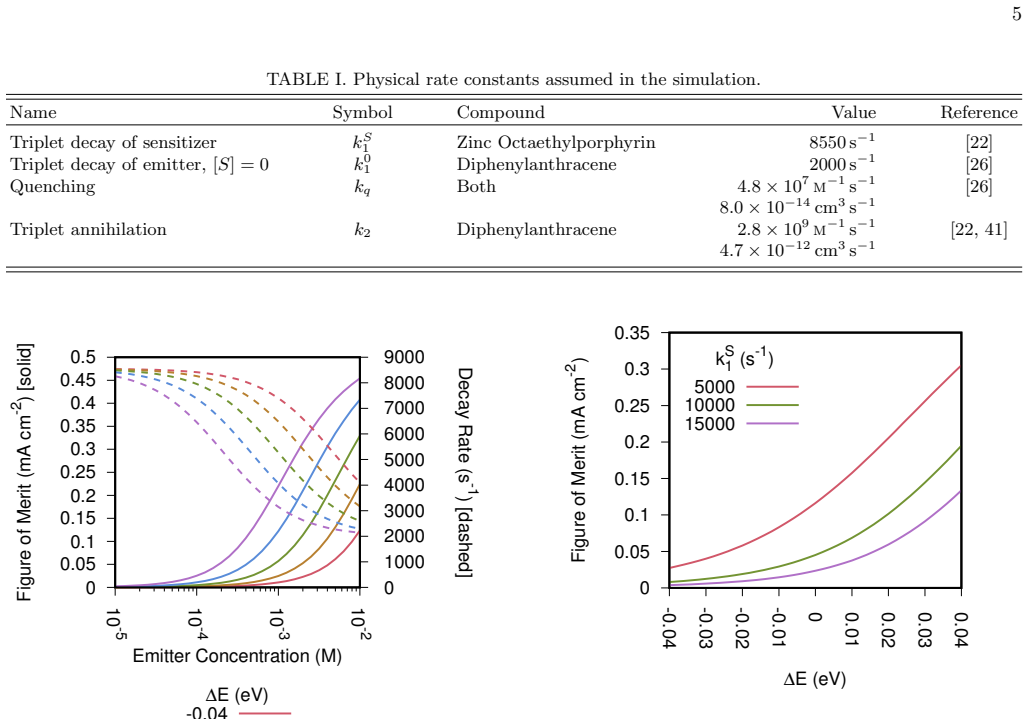
The load-bearing identity is the effective triplet decay constant $$k_1 = \frac{[S]k_1^S e^{-\$\Delta$ E/k_B T} + [E]k_1^E}{[S]e^{-\$\Delta$ E/k_B T} + [E]},$$ combined with the concentration-dependent emitter decay $k_1^E = k_1^0 + k_q[S]$. These define the pool of emitter-localized triplets available for annihilation, $[{}^3E^*] = [T][E]/([S]e^{-\Delta E/k_B T}+[E])$, which enters the quantum yield $\Phi_{\mathrm{UC}} = k_2[{}^3E^*]/(2(k_1 + k_2[{}^3E^*]))$. The triplet energy gap $\Delta E$ controls where triplets sit, the quenching constant $k_q$ controls how fast they die, and the competition between light absorption and quenching sets the optimal concentration.
What would settle it
Measure the upconversion photocurrent and the emitter triplet decay rate as functions of sensitizer concentration across the solubility range in a strongly exothermic pair: if the maximum appears at the highest concentration, or if $k_1$ rises faster than linearly with $[S]$, the model's central design prediction is wrong.
Extended reading notes
Core claim
The central claim is that the figure of merit of a photochemical upconversion device is controlled by the equilibrium distribution of triplet excitons between the sensitizer and emitter, and by the sensitizer's concentration-dependent quenching of emitter triplets. Because triplet transfer is fast compared with decay, the two triplet populations equilibrate, so the effective triplet decay rate is a Boltzmann-weighted average of the sensitizer and emitter decay rates; and because sensitizer molecules also quench emitter triplets with rate constant $k_q$, the emitter decay rate grows linearly with sensitizer concentration. Including both effects, the upconversion quantum yield $\Phi_{\mathrm{UC}}$ peaks at a finite sensitizer concentration, often below the solubility limit, instead of rising monotonically. Applied to zinc octaethylporphyrin and diphenylanthracene, the model reproduces the measured concentration dependence of the triplet decay and explains the system's poor upconversion with a near-zero or slightly negative $\Delta E$ and a substantial $k_q$.
Load-bearing premise
The design prediction assumes that the only significant concentration-dependent loss is quenching of emitter triplets by the sensitizer; the authors explicitly omit concentration quenching of triplets within the sensitizer, which can be about $10^7$ m$^{-1}$ s$^{-1}$ and may be important.
Editorial extensions
If this is right
- Devices should be optimized with sensitizer concentration as a free variable; the maximum photocurrent can occur below the solubility limit.
- For a given emitter, increasing the triplet energy gap $\Delta E$ improves yield up to the point where the upconverted photon loses too much energy or the sensitizer stops absorbing useful sunlight.
- A fast triplet energy transfer rate by itself does not guarantee good upconversion; equilibrium partitioning and quenching must be measured.
- The figure of merit is sensitive to temperature: for exothermic pairs, heating raises the effective decay rate and lowers yield.
- The simulation provides a screening method that uses measured spectra and rate constants to compare sensitizer/emitter pairs before making devices.
Reading between the lines
- Because the model omits sensitizer self-quenching, the predicted optimal concentrations are upper bounds; if self-quenching is comparable to the emitter-quenching constant, the true optimum would be even lower, though very strong self-quenching could remove the optimum entirely.
- The same equilibrium-plus-quenching logic should apply to solid-state upconversion films, where concentration is fixed by the film; there, the design lesson becomes choosing a matrix that suppresses sensitizer-emitter contact rather than tuning concentration.
- A decisive test of the Boltzmann interpretation would be to measure the emitter triplet decay rate as a function of both sensitizer and emitter concentration; the two-parameter model predicts a specific curvature that the pure-quenching model cannot reproduce.
Signed reviews
Editorial analysis
A structured set of objections, weighed in public.
Referee Report
Summary. The manuscript presents a kinetic and Monte Carlo model of photochemical upconversion devices. It introduces a Boltzmann equilibrium distribution of triplet excitons between the sensitizer and the emitter (Eqs. 2-4) and couples this to the measured sensitizer-induced quenching of emitter triplet excitons (Eq. 5). On this basis it predicts that the optimal sensitizer concentration can lie below the solubility limit, and it proposes that the experimental inefficiency of zinc octaethylporphyrin with diphenylanthracene, compared with platinum octaethylporphyrin, can be explained by near-zero or endothermic triplet-energy alignment (ΔE ≈ -0.02 eV) combined with the quenching rate kq, without invoking heavy-atom or phenyl-rotation mechanisms. The paper includes an open-source simulator and gives detailed Monte Carlo procedures using AM1.5G spectra, a Tauc-model solar cell, experimental absorption and emission spectra, and photon recycling.
Significance. If the quantitative claims survive scrutiny, the work provides a useful design framework: it separates sensitizer-emitter triplet energy alignment from concentration-dependent quenching as distinct loss channels, and it makes the model testable through an open-source simulator. The Monte Carlo treatment of light absorption, re-emission, and photon recycling is detailed, and the authors are transparent about assumptions such as the omission of sensitizer self-quenching and disequilibrium at low emitter concentration. The central predictive claim, that the optimal sensitizer concentration can be below the solubility limit, is physically plausible and follows from Eq. (5) given a measured kq. However, the explanatory claim about zinc octaethylporphyrin/diphenylanthracene is currently underdetermined by the same fitted dataset, so the significance is conditional on an identifiability analysis or on an independent measurement of ΔE.
major comments (3)
- [Section IV.C, Fig. 10, Eqs. (2) and (5)] The value ΔE = -0.02(1) eV is obtained by fitting the same Ref. [26] data that the model is then used to explain, and Section IV.C explicitly states that "neither model can be rejected." The parameters ΔE and kq enter both equations and are largely degenerate: a positive ΔE with a different kq is also consistent with the measured decay rates. Because the zinc octaethylporphyrin/diphenylanthracene explanation depends on the sign of ΔE, the manuscript's claim to explain the experimental failure is not uniquely supported. Please provide a joint confidence region for (ΔE, kq), use an independent determination of ΔE such as phosphorescence measurements, and ideally test the model at multiple emitter concentrations as suggested in Section IV.C.
- [Table II and Fig. 11] The quantitative design conclusions inherit the same degeneracy. Table I lists kq = 4.8×10^7 M^-1 s^-1 from Ref. [26] based on a linear quenching model; if ΔE is in fact negative, Eq. (2) implies that the fitted kq is overestimated. Fig. 11 and Table II optimize sensitizer concentration and device thickness with this single kq value, so the reported numerical optima, for example 23.5 µA/cm^2 at ΔE = -0.02 eV, are conditional on one point in a degenerate parameter space. A sensitivity analysis over the identified (ΔE, kq) uncertainty is needed before the quantitative design recommendation can be considered established.
- [Section IV.B, Eq. (5), Figs. 8-9] The authors acknowledge omitting concentration quenching of triplet excitons within the sensitizer, noting that its rate can be ~10^7 M^-1 s^-1 and "may be important." This rate is comparable to kq, and adding a concentration-dependent loss to kS1 in Eq. (2) would change the quantitative values of the optimal sensitizer concentration and the optimized figure of merit in Figs. 8-11 and Table II. The directional conclusion that the optimum can lie below the solubility limit is likely robust, but the quantitative predictions are not. Please include an estimate or bound for this self-quenching rate, or state explicitly the range of rates over which the reported optima remain valid.
minor comments (4)
- [Section V.D, Eq. (7)] The displayed equation for the figure of merit is incomplete in the manuscript; it should read J = e n / t for the current density.
- [Section IV.C, Eq. (2)] The sign convention for ΔE is used implicitly; please state explicitly that ΔE is the sensitizer triplet energy minus the emitter triplet energy, so that positive ΔE corresponds to exothermic transfer into the emitter.
- [Fig. 11 caption] The vertical axis of Fig. 11(a) is labeled "mA cm^-1" while the text and Eq. (7) describe a current density in mA cm^-2; please reconcile this unit inconsistency.
- [Section IV.B] The statement that "the solubility limit on [S] is above 1 mM" should cite the solvent and measurement or clarify that it is an assumed value for the simulated device.
Circularity Check
The ZnOEP/DPA explanation reuses a ΔE value fitted to the very data it explains; the forward device-optimization predictions are independent.
-
fitted input called prediction
[Section IV.C (Interplay of sensitizer quenching and Boltzmann statistics), Eqs. (2) and (5), Fig. 10; invoked again in the Conclusions.]
"In Fig. 10, we reanalyze zinc octaethylporphyrin and diphenylanthracene data from Ref. [26]. We compare the prediction of Equation 5 with the combined prediction of Equations 2 and 5. Equation 2 increases the number of free parameters, so its inclusion must improve the accuracy of the model. While the experimental uncertainty is large enough that neither model can be rejected, it does seem that ΔE is not large enough to keep all the triplet excitons in the emitter. We suggest that ΔE = −0.02(1) eV. The triplet energy transfer may be endothermic."
The parameter ΔE = −0.02(1) eV is chosen by fitting Eqs. (2)+(5) to the Ref. [26] k1([S]) data reproduced as Fig. 10. The paper then presents this same fitted value as the physical explanation for why zinc octaethylporphyrin fails to sensitize diphenylanthracene: the Conclusions state that the poor performance 'can be explained by ... the alignment of triplet energy levels.' This is fitting a parameter to the explanandum and then using that parameter as the explanation; the explanatory claim reduces to the fitted input. The paper itself concedes the degeneracy: 'Both parameters can explain the experimental increase in the emitter triplet exciton decay' and 'neither model can be rejected.' By contrast, the optimal-concentration and figure-of-merit predictions in Figs.
full rationale
The central forward simulations are not circular: Eq. (2) is the Boltzmann-weighted combination of measured sensitizer and emitter decay rates, Eq. (5) is the linear quenching law with kq taken from prior experimental work [26], and the figure of merit is computed by Monte Carlo propagation using experimental spectra and independently tabulated rate constants. These calculations would stand even if the ZnOEP/DPA ΔE discussion were removed. The one genuinely circular element is the explanatory claim about ZnOEP/DPA. The paper fits ΔE = −0.02(1) eV to the Ref. [26] data shown in Fig. 10, acknowledges that neither the quenching-only model nor the combined Boltzmann model can be rejected, and then uses the fitted ΔE to explain that same experimental failure. The text also explicitly notes the degeneracy of ΔE and kq ('Both parameters can explain the experimental increase in the emitter triplet exciton decay') and proposes future concentration-dependent measurements to remove the ambiguity. Because the fitted parameter is used as the explanation for the data it was fit to, this sub-claim is partially circular. However, the paper's headline device-design prediction (optimal sensitizer concentration below the solubility limit) is obtained with kq as an input parameter and with ΔE set independently (e.g., ΔE = 0 in Fig. 11), so that prediction does not reduce to the fit. The acknowledged omission of sensitizer self-quenching and the admitted large experimental uncertainty are correctness risks, not additional circularity. Overall, the score is 4 rather than 6 because the main optimization results retain independent evidential content; only the ZnOEP/DPA explanation is weakened by fitting the explanatory parameter to the data it explains.
Assumptions & free parameters
free parameters (2)
- Delta E (sensitizer-emitter triplet energy difference) =
-0.02(1) eV (suggested for ZnOEP/DPA)
- kq (sensitizer-emitter triplet quenching rate constant) =
4.8 x 10^7 M^-1 s^-1
assumptions (5)
- domain assumption Sensitizer and emitter triplet populations are in thermal equilibrium described by a Boltzmann factor.
- domain assumption Sensitizer triplet excitons do not contribute to upconversion because known sensitizers lack a suitable first excited singlet spin state.
- domain assumption Sensitizer intersystem crossing, triplet energy transfer, and fluorescence are perfectly efficient in well-constructed systems.
- domain assumption The emitter triplet decay rate depends linearly on sensitizer concentration: k1^E = k1^0 + kq[S].
- domain assumption The figure of merit assumes a solar cell with perfect quantum efficiency and an AM1.5G spectrum.
Cite this review
Pith. "Pith review of Photochemical Upconversion Theory: Importance of Triplet Energy Levels and Triplet Quenching." pith.science (2026). https://pith.science/paper/H7VFSK6P
@misc{pith2026190804927,
  author       = {Pith},
  title        = {Pith review of: Photochemical Upconversion Theory: Importance of Triplet Energy Levels and Triplet Quenching},
  year         = {2026},
  howpublished = {\url{https://pith.science/paper/H7VFSK6P}},
  note         = {Machine review of arXiv:1908.04927}
}
read the original abstract
Photochemical upconversion is a promising way to boost the efficiency of solar cells using triplet exciton annihilation. Currently, predicting the performance of photochemical upconversion devices is challenging. We present an open source software package which takes experimental parameters as inputs and gives the figure of merit of an upconversion system, enabling theory-driven design of better solar energy devices. We incorporate the statistical distribution of triplet excitons between the sensitizer and the emitter. Using the dynamic quenching effect of the sensitizer on emitter triplet excitons, we show that the optimal sensitizer concentration can be below the sensitizer solubility limit in liquid devices. These theoretical contributions can explain, without use of heavy atom-induced triplet exciton formation or phenyl group rotation, the experimental failure of zinc octaethylporphyrin to effectively sensitize diphenylanthracene, where platinum octaethylporphyrin succeeds. Our predictions indicate a change in direction for device design that will reduce triplet exciton losses.
Figures


Figures from the paper (6 more)



Reference graph
Works this paper leans on
-
[26]
T. W. Schmidt and F. N. Castellano, Photochemical up- conversion: the primacy of kinetics, The Journal of Phys- ical Chemistry Letters 5, 4062 (2014)
work page 2014
-
[1]
(4) In many cases, ∆ E much is larger than the thermal energy
The quantum yield is more precisely written as ΦUC = k2[3E∗] 2 (k1 + k2[3E∗]) . (4) In many cases, ∆ E much is larger than the thermal energy. Then it is not necessary to consider kS 1 . An excessively large ∆ E is detrimental to energy efficiency because it reduces the upward shift in the energy of the upconverted photons. If ∆ E is enhanced by shifting th...
work page 2000
-
[2]
L. C. Hirst and N. J. Ekins-Daukes, Fundamental losses in solar cells, Progress in Photovoltaics: Research and Applications 19, 286 (2011)
2011
-
[3]
W. Shockley and H. J. Queisser, Detailed balance limit of efficiency of p-n junction solar cells, Journal of Applied Physics 32, 510 (1961)
work page 1961
-
[4]
Details of the algorithm are in Section V
For the solar cell, we use the Tauc model of direct bandgap absorption so that the bandgap of the solar cell is a free variable [45, 46]. Details of the algorithm are in Section V. III. TRIPLET KINETICS OWING TO TRIPLET ENERGY LEVELS The rate of energy transfer from the sensitizer to the emitter is much faster than the triplet decay rate of the sensitizer...
work page 2000
-
[5]
J. Pedrini and A. Monguzzi, Recent advances in the application triplet–triplet annihilation-based photon up- conversion systems to solar technologies, Journal of Pho- tonics for Energy 8, 022005 (2017)
work page 2017
- [6]
-
[7]
Y. Zeng, J. Chen, T. Yu, G. Yang, and Y. Li, Molecular– supramolecular light harvesting for photochemical energy conversion: Making every photon count, ACS Energy Letters 2, 357 (2017)
work page 2017
Show all 65 references
-
[8]
T. F. Schulze and T. W. Schmidt, Photochemical upcon- version: present status and prospects for its application to solar energy conversion, Energy & Environmental Sci- ence 8, 103 (2015)
2015
-
[9]
C. E. McCusker and F. N. Castellano, Materials inte- grating photochemical upconversion, Topics in Current Chemistry 374, 19 (2016)
2016
-
[10]
V. Gray, K. Moth-Poulsen, B. Albinsson, and M. Abra- hamsson, Towards efficient solid-state triplet–triplet an- nihilation based photon upconversion: Supramolecular, macromolecular and self-assembled systems, Coordina- tion Chemistry Reviews 362, 54 (2018)
2018
-
[11]
E. Y. Chen, C. Milleville, J. M. Zide, M. F. Doty, and J. Zhang, Upconversion of low-energy photons in semi- conductor nanostructures for solar energy harvesting, MRS Energy & Sustainability 5, e16 (2018)
2018
-
[12]
M. Wu, D. N. Congreve, M. W. Wilson, J. Jean, N. Geva, M. Welborn, T. Van Voorhis, V. Bulovi´ c, M. G. Bawendi, and M. A. Baldo, Solid-state infrared-to-visible upcon- version sensitized by colloidal nanocrystals, Nature Pho- tonics 10, 31 (2016)
2016
-
[13]
C. E. McCusker and F. N. Castellano, Materials inte- grating photochemical upconversion, in Photolumines- cent Materials and Electroluminescent Devices (Springer,
-
[14]
Frazer, Photochemical upconversion light emitting diode (LED): Theory of triplet annihilation enhanced by a cavity, Advanced Theory and Simulations 2, 1800099 (2019)
L. Frazer, Photochemical upconversion light emitting diode (LED): Theory of triplet annihilation enhanced by a cavity, Advanced Theory and Simulations 2, 1800099 (2019)
2019
-
[15]
M. A. Baldo, C. Adachi, and S. R. Forrest, Transient analysis of organic electrophosphorescence. II. Transient analysis of triplet-triplet annihilation, Physical Review B 62, 10967 (2000)
2000
-
[16]
T. C. Wu, D. N. Congreve, and M. A. Baldo, Solid state photon upconversion utilizing thermally activated 10 delayed fluorescence molecules as triplet sensitizer, Ap- plied Physics Letters 107, 031103 (2015)
2015
-
[17]
Okumura, K
K. Okumura, K. Mase, N. Yanai, and N. Kimizuka, Employing core-shell quantum dots as triplet sensitizers for photon upconversion, Chemistry-A European Journal 22, 7721 (2016)
2016
-
[18]
Amemori, N
S. Amemori, N. Yanai, and N. Kimizuka, Metallonaph- thalocyanines as triplet sensitizers for near-infrared pho- ton upconversion beyond 850 nm, Physical Chemistry Chemical Physics 17, 22557 (2015)
2015
-
[19]
Baluschev, V
S. Baluschev, V. Yakutkin, G. Wegner, T. Miteva, G. Nelles, A. Yasuda, S. Chernov, S. Aleshchenkov, and A. Cheprakov, Upconversion with ultrabroad excita- tion band: Simultaneous use of two sensitizers, Applied Physics Letters 90, 181103 (2007)
2007
-
[20]
Huang, X
Z. Huang, X. Li, M. Mahboub, K. M. Hanson, V. M. Nichols, H. Le, M. L. Tang, and C. J. Bardeen, Hy- brid molecule–nanocrystal photon upconversion across the visible and near-infrared, Nano Letters 15, 5552 (2015)
2015
-
[21]
Turshatov, D
A. Turshatov, D. Busko, Y. Avlasevich, T. Miteva, K. Landfester, and S. Baluschev, Synergetic effect in triplet–triplet annihilation upconversion: Highly efficient multi-chromophore emitter, ChemPhysChem 13, 3112 (2012)
2012
-
[22]
X. Yu, X. Cao, X. Chen, N. Ayres, and P. Zhang, Triplet–triplet annihilation upconversion from ratio- nally designed polymeric emitters with tunable inter- chromophore distances, Chemical Communications 51, 588 (2015)
2015
-
[23]
J. K. H. Pun, J. K. Gallaher, L. Frazer, S. K. Prasad, C. B. Dover, R. W. MacQueen, and T. W. Schmidt, TIPS-anthracene: a singlet fission or triplet fusion mate- rial?, Journal of Photonics for Energy 8, 022006 (2018)
2018
-
[24]
V. Gray, A. Dreos, P. Erhart, B. Albinsson, K. Moth- Poulsen, and M. Abrahamsson, Loss channels in triplet– triplet annihilation photon upconversion: importance of annihilator singlet and triplet surface shapes, Physical Chemistry Chemical Physics 19, 10931 (2017)
2017
-
[25]
C. Gao, J. Y. Seow, B. Zhang, C. Hall, A. Tilley, J. White, T. Smith, and W. W. H. Wong, Tetraphenylethene 9, 10-diphenylanthracene derivatives– synthesis and photophysical properties, ChemPlusChem 84, 746 (2019)
2019
-
[27]
Y. Y. Cheng, A. Nattestad, T. F. Schulze, R. W. Mac- Queen, B. F¨ uckel, K. Lips, G. G. Wallace, T. Khoury, M. J. Crossley, and T. W. Schmidt, Increased upconver- sion performance for thin film solar cells: a trimolecular composition, Chemical Science 7, 559 (2016)
2016
-
[28]
E. M. Gholizadeh, L. Frazer, R. W. MacQueen, J. K. Gal- laher, and T. W. Schmidt, Photochemical upconversion is suppressed by high concentrations of molecular sensi- tizers, Physical Chemistry Chemical Physics 20, 19500 (2018)
2018
-
[29]
Y. Y. Cheng, B. F¨ uckel, T. Khoury, R. G. Clady, M. J. Tayebjee, N. Ekins-Daukes, M. J. Crossley, and T. W. Schmidt, Kinetic analysis of photochemical upconversion by triplet-triplet annihilation: Beyond any spin statisti- cal limit, The Journal of Physical Chemistry Letters ...
2010
-
[30]
M. J. Tayebjee, D. R. McCamey, and T. W. Schmidt, Be- yond Shockley–Queisser: molecular approaches to high- efficiency photovoltaics, The Journal of Physical Chem- istry Letters 6, 2367 (2015)
2015
-
[31]
T. W. Schmidt and R. W. MacQueen, Photochemical upconversion of light for renewable energy and more, in Proceedings of SPIE, Vol. 9562 (2015) p. 956202
2015
-
[32]
Y. Y. Cheng, B. F¨ uckel, R. W. MacQueen, T. Khoury, R. G. Clady, T. F. Schulze, N. Ekins-Daukes, M. J. Cross- ley, B. Stannowski, K. Lips, et al. , Improving the light- harvesting of amorphous silicon solar cells with photo- chemical upconversion, Energy & Environmental Scien...
2012
-
[33]
Monguzzi, R
A. Monguzzi, R. Tubino, and F. Meinardi, Upconversion- induced delayed fluorescence in multicomponent organic systems: Role of dexter energy transfer, Physical Review B 77, 155122 (2008)
2008
-
[34]
Huang, Z
Z. Huang, Z. Xu, M. Mahboub, X. Li, J. W. Taylor, W. H. Harman, T. Lian, and M. L. Tang, PbS/CdS core– shell quantum dots suppress charge transfer and enhance triplet transfer, Angewandte Chemie International Edi- tion 56, 16583 (2017)
2017
-
[35]
Younts, H.-S
R. Younts, H.-S. Duan, B. Gautam, B. Saparov, J. Liu, C. Mongin, F. N. Castellano, D. B. Mitzi, and K. Gun- dogdu, Efficient generation of long-lived triplet excitons in 2D hybrid perovskite, Advanced Materials29, 1604278 (2017)
2017
-
[36]
Nienhaus, M
L. Nienhaus, M. Wu, N. Geva, J. J. Shepherd, M. W. Wilson, V. Bulovi´ c, T. Van Voorhis, M. A. Baldo, and M. G. Bawendi, Speed limit for triplet-exciton transfer in solid-state PbS nanocrystal-sensitized photon upcon- version, ACS Nano 11, 7848 (2017)
2017
-
[37]
T. N. Singh-Rachford and F. N. Castellano, Triplet sen- sitized red-to-blue photon upconversion, The Journal of Physical Chemistry Letters 1, 195 (2009)
2009
-
[38]
L. M. Pazos-Out´ on, M. Szumilo, R. Lamboll, J. M. Richter, M. Crespo-Quesada, M. Abdi-Jalebi, H. J. Bee- son, M. Vru´ cini´ c, M. Alsari, H. J. Snaith, et al. , Pho- ton recycling in lead iodide perovskite solar cells, Science 351, 1430 (2016)
2016
-
[39]
Y. V. Aulin, M. van Sebille, M. Moes, and F. C. Grozema, Photochemical upconversion in metal-based octaethyl porphyrin–diphenylanthracene systems, RSC Advances 5, 107896 (2015)
2015
-
[40]
F. Deng, A. Francis, W. Weare, and F. Castellano, Photo- chemical upconversion and triplet annihilation limit from a boron dipyrromethene emitter, Photochemical & Pho- tobiological Sciences 14, 1265 (2015)
2015
-
[41]
B. Wang, B. Sun, X. Wang, C. Ye, P. Ding, Z. Liang, Z. Chen, X. Tao, and L. Wu, Efficient triplet sensitizers of palladium (II) tetraphenylporphyrins for upconversion- powered photoelectrochemistry, The Journal of Physical Chemistry C 118, 1417 (2014)
2014
-
[42]
Z. Xun, Y. Zeng, J. Chen, T. Yu, X. Zhang, G. Yang, and Y. Li, Pd–porphyrin oligomers sensitized for green- to-blue photon upconversion: The more the better?, Chemistry–A European Journal 22, 8654 (2016)
2016
-
[43]
V. Gray, D. Dzebo, A. Lundin, J. Alborzpour, M. Abra- hamsson, B. Albinsson, and K. Moth-Poulsen, Photo- physical characterization of the 9,10-disubstituted an- thracene chromophore and its applications in triplet– triplet annihilation photon upconversion, Journal of Ma- teria...
2015
-
[44]
V. Gray, K. B¨ orjesson, D. Dzebo, M. Abrahams- son, B. Albinsson, and K. Moth-Poulsen, Porphyrin– 11 anthracene complexes: Potential in triplet–triplet annihi- lation upconversion, The Journal of Physical Chemistry C 120, 19018 (2016)
2016
-
[45]
Baluschev, V
S. Baluschev, V. Yakutkin, T. Miteva, G. Weg- ner, T. Roberts, G. Nelles, A. Yasuda, S. Chernov, S. Aleshchenkov, and A. Cheprakov, A general approach for non-coherently excited annihilation up-conversion: transforming the solar-spectrum, New Journal of Physics 10, 013007 (2008)
2008
-
[46]
M. B. Smith and J. Michl, Singlet fission, Chemical Re- views 110, 6891 (2010)
2010
-
[47]
B. D. Viezbicke, S. Patel, B. E. Davis, and D. P. Birnie III, Evaluation of the Tauc method for optical ab- sorption edge determination: ZnO thin films as a model system, physica status solidi (b) 252, 1700 (2015)
2015
-
[48]
Tauc, Optical properties and electronic structure of amorphous Ge and Si, Materials Research Bulletin 3, 37 (1968)
J. Tauc, Optical properties and electronic structure of amorphous Ge and Si, Materials Research Bulletin 3, 37 (1968)
1968
-
[49]
A. D. McNaught, Compendium of Chemical Terminology, 2nd ed. (IUPAC, Research Triangle Park, USA, 2014)
2014
-
[50]
Y. Y. Cheng, B. F¨ uckel, T. Khoury, R. G. Clady, N. Ekins-Daukes, M. J. Crossley, and T. W. Schmidt, En- tropically driven photochemical upconversion, The Jour- nal of Physical Chemistry A 115, 1047 (2011)
2011
-
[51]
Skoplaki and J
E. Skoplaki and J. A. Palyvos, On the temperature de- pendence of photovoltaic module electrical performance: A review of efficiency/power correlations, Solar Energy 83, 614 (2009)
2009
-
[52]
Perun, J
S. Perun, J. Tatchen, and C. M. Marian, Singlet and Triplet Excited States and Intersystem Crossing in Free-Base Porphyrin: TDDFT and DFT/MRCI Study, ChemPhysChem 9, 282 (2008)
2008
-
[53]
Mongin, S
C. Mongin, S. Garakyaraghi, N. Razgoniaeva, M. Zamkov, and F. N. Castellano, Direct observa- tion of triplet energy transfer from semiconductor nanocrystals, Science 351, 369 (2016)
2016
-
[54]
Kasha, Characterization of electronic transitions in complex molecules, Discussions of the Faraday Society 9, 14 (1950)
M. Kasha, Characterization of electronic transitions in complex molecules, Discussions of the Faraday Society 9, 14 (1950)
1950
-
[55]
Goudarzi, S
H. Goudarzi, S. Limbu, J. Cabanillas-Gonzalez, V. M. Zenonos, J.-S. Kim, and P. E. Keivanidis, Impact of molecular conformation on triplet-fusion induced photon energy up-conversion in the absence of exothermic triplet energy transfer, Journal of Materials Chemistry C7, 3634 (2019)
2019
-
[56]
X. Cao, B. Hu, and P. Zhang, High upconversion effi- ciency from hetero triplet–triplet annihilation in multiac- ceptor systems, The Journal of Physical Chemistry Let- ters 4, 2334 (2013)
2013
-
[57]
Swinehart, The Beer-Lambert Law, Journal of Chem- ical Education 39, 333 (1962)
D. Swinehart, The Beer-Lambert Law, Journal of Chem- ical Education 39, 333 (1962)
1962
-
[58]
J. B. Callis, J. M. Knowles, and M. Gouterman, Por- phyrins. XXVI. Triplet excimer quenching of free base, zinc, palladium, and platinum complexes, The Journal of Physical Chemistry 77, 154 (1973)
1973
-
[59]
Dexter and J
D. Dexter and J. H. Schulman, Theory of concentration quenching in inorganic phosphors, The Journal of Chem- ical Physics 22, 1063 (1954)
1954
-
[60]
O. Ohno, Y. Kaizu, and H. Kobayashi, Luminescence of some metalloporphins including the complexes of the IIIb metal group, The Journal of Chemical Physics 82, 1779 (1985)
1985
-
[61]
Wu, W.-X
G.-Z. Wu, W.-X. Gan, and H.-K. Leung, Photophysical properties of meso-substituted octaethylporphines and their zinc complexes, Journal of the Chemical Society, Faraday Transactions 87, 2933 (1991)
1991
-
[62]
X. Liu, E. K. Yeow, S. Velate, and R. P. Steer, Photo- physics and spectroscopy of the higher electronic states of zinc metalloporphyrins: a theoretical and experimen- tal study, Physical Chemistry Chemical Physics 8, 1298 (2006)
2006
-
[63]
Brinen and J
J. Brinen and J. Koren, The lowest triplet state of 9, 10 diphenylanthracene, Chemical Physics Letters 2, 671 (1968)
1968
-
[64]
Hoseinkhani, R
S. Hoseinkhani, R. Tubino, F. Meinardi, and A. Monguzzi, Achieving the photon up-conversion thermodynamic yield upper limit by sensitized triplet– triplet annihilation, Physical Chemistry Chemical Physics 17, 4020 (2015)
2015
-
[65]
See Supplemental Material at [URL will be inserted by publisher] for the manual for the upconversion solar cell simulator
Reviewed August 14, 2026 · model on record in the stance chip above.
Discussion (0). Continue with ORCID to comment.