REVIEW 4 major objections 5 minor 21 references
Towards Simultaneous Observation of Path and Interference of Single Photon in a Modified Mach-Zehnder Interferometer
T0 review · 4 major / 5 minor · reviewed 2026-08-14 · deepseek-v4-flash
Pith's one-line read A modified Mach-Zehnder interferometer with a milk-coated, weakly scattering prism reports single-photon interference visibility of 0.97 and path distinguishability of 0.83, giving V²+D²≈1.63, beyond the orthodox wave–particle duality…
desk verdict Claimed violation of wave-particle duality is an artifact of comparing visibility on scattered photons with reflectivity inferred from reflected photons; the experiment is real but the conclusion is not. read the letter →
The pith
A machine-rendered reading of the paper's core claim, the machinery that carries it, and where it could break.
The reading
What carries the argument
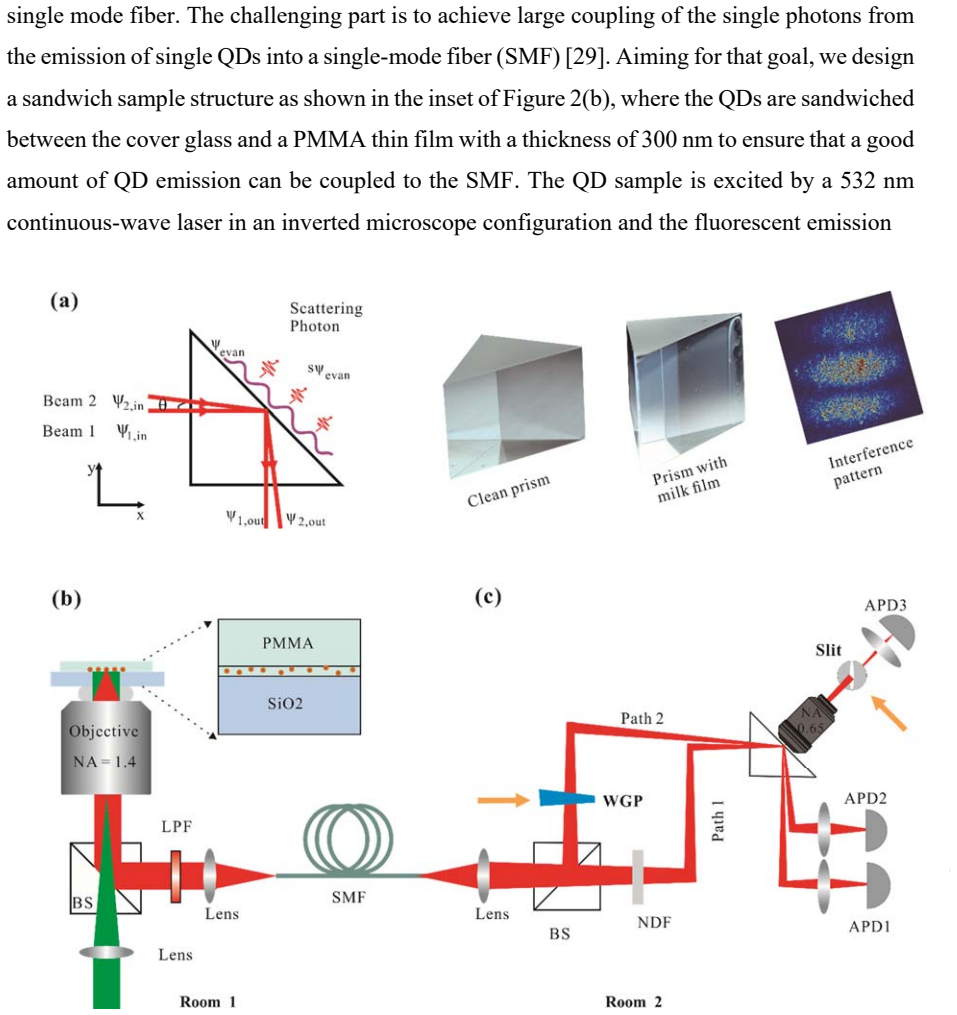
The key element is the milk-coated prism surface, which acts as a weakly scattering interference screen. Two single-photon beams arrive at the prism hypotenuse with a small angle difference, interfere there, and mostly reflect into two path detectors, while a small scattered fraction is collected by a microscope objective and sent to a movable slit detector. The theoretical description uses the scattered-field intensity expression, proportional to 8SAP₀[1+cos(...)], to predict the interference pattern, and equates the path distinguishability with the measured reflectivity R≈0.83. This combination of high reflectivity and weak scattering is what lets the same surface provide both path information and interference fringes.
What would settle it
A coincidence-resolved version of the experiment would settle the claim: for each detected photon, record which reflected output (APD1 or APD2) it comes from and whether it also contributes to the scattered fringe signal at APD3. If D and V are computed from the same photon stream, the inequality V²+D²≤1 should be restored, whereas the paper's claim predicts it stays near 1.6.
Extended reading notes
Core claim
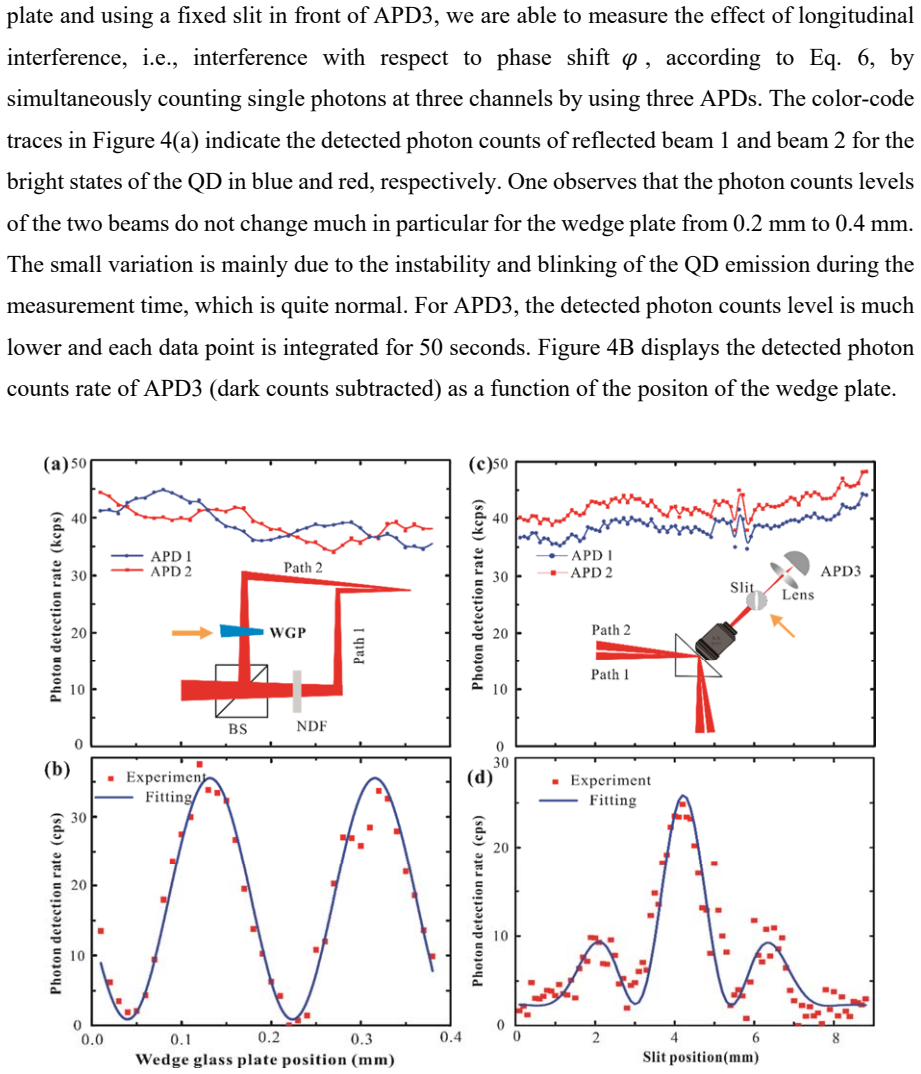
The central claim is that a weakly scattering total-internal-reflection prism surface can serve as an interference screen inside a Mach-Zehnder interferometer, allowing a single photon to show both wave and particle properties at once. The measured longitudinal fringe visibility is V=0.97, the reflectivity-based path distinguishability is D=0.83, and their squares sum to 1.63, which exceeds the orthodox bound of V²+D²≤1. The lateral interference pattern gives V=0.84 and V²+D²≈1.39. The authors state that these observations are consistent with standard quantum mechanical calculations for this weak-measurement setup, yet they go beyond the familiar principle of wave–particle duality as usually formulated.
Load-bearing premise
The result depends on identifying path distinguishability D with the measured reflectivity R=0.83 of the milk-coated prism and on evaluating V from a scattered subensemble that may differ from the reflected subensemble used for D; if D and V do not describe the same photons, the claimed violation does not follow.
Editorial extensions
If this is right
- Single-photon interference and which-path information can be extracted from the same interferometer without inserting or removing the second beam splitter.
- Values of V²+D² greater than 1 become experimentally accessible, so the orthodox limit is not a universal constraint on every interferometric arrangement.
- The measured longitudinal visibility of 0.97 and reflectivity-based distinguishability of 0.83 imply V²+D²≈1.63, while the lateral fringes still give 1.39.
- Improving the single-photon source, the scattering film, and the collection efficiency should push the combination toward the predicted V=1 and D→1 regime, i.e. V²+D²→2.
Reading between the lines
- A stricter test would measure D with a genuine which-path observable, such as a weak path marker in each arm, applied to the same photons whose scattering contributes to V; until then, equating D with the reflectivity R remains an assumption.
- The scattered subensemble used for V may be a biased sample: photons that scatter are not necessarily representative of the reflected ensemble used for D, so comparing V from APD3 with D from APD1/APD2 might involve different populations.
- If the result survives a same-ensemble test, it would not invalidate quantum mechanics but would show that the standard V²+D²≤1 inequality encodes a tradeoff between strong, mutually exclusive measurements rather than a fundamental limit for weak measurements.
Signed reviews
Editorial analysis
A structured set of objections, weighed in public.
Referee Report
Summary. The paper reports a single-photon experiment in a modified Mach-Zehnder interferometer in which a prism surface coated with a weakly scattering milk film acts as an 'interference screen.' The authors measure an interference visibility of V=0.97 (longitudinal) or 0.84 (lateral) on the weakly scattered channel (APD3) and infer a path distinguishability D=0.83 from the measured reflectivity R of the prism surface. They combine these into V²+D²≈1.63 and claim this violates the orthodox wave-particle duality bound V²+D²≤1. The theoretical analysis in Section 3 derives the scattered-light interference pattern from the evanescent field, and Section 4 presents the phase-dependent and position-dependent APD3 count rates together with flat response of the reflected channels APD1 and APD2.
Significance. If the claim were correct, it would constitute a major empirical challenge to the Englert–Jaeger–Shimony–Vaidman complementarity bound and to standard quantum theory. The experimental implementation of a weak-scattering interferometer using single photons from a quantum dot source is in principle interesting, and the paper includes useful single-photon characterization (g(2) anti-bunching, dark-count subtraction, bright-state selection). However, the central quantitative claim is not supported because the quantities V and D are not defined for the same ensemble of photons, and the identification of path distinguishability with the reflectivity R is not grounded in a quantum measurement model. The reported violation is therefore an artifact of the analysis rather than a property of the measured photons.
major comments (4)
- [Section 3] The definition 'the path distinguishability is taken simply as D≈R' is not a legitimate operational definition of which-path distinguishability. In the Englert inequality, D is the maximum probability with which an observer can correctly guess which path a photon took based on the outcome of a path-detection measurement performed on that same photon. Here R is the average probability that a photon is reflected rather than scattered; it is a partition probability over the two subensembles, not a per-outcome distinguishability for the scattered photons whose interference is being observed. A photon that reaches APD3 has not been reflected and carries no which-arm information from the reflected detectors; a photon that reaches APD1 or APD2 is essentially perfectly tagged but does not contribute to the APD3 interference pattern.
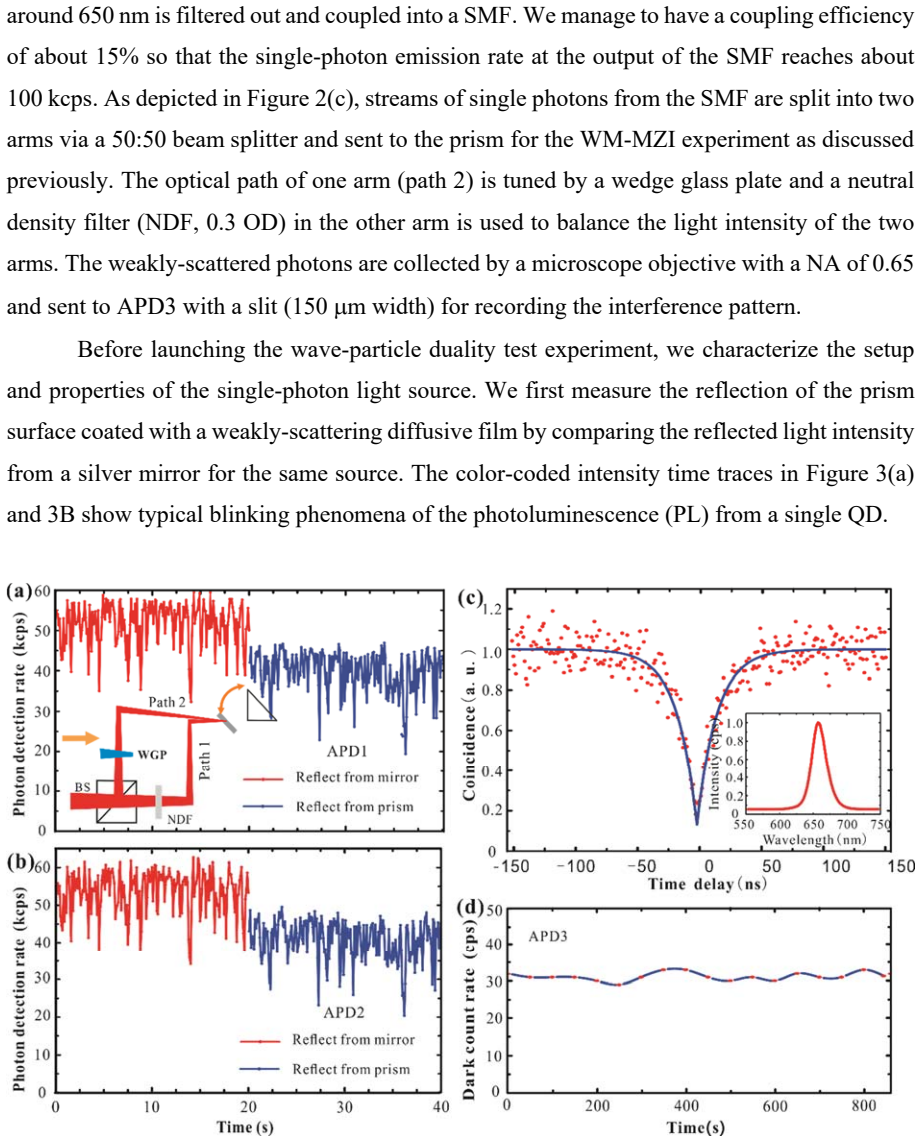
- [Section 4 / Figure 4] The values V=0.97 and D=0.83 are not measured on the same subensemble. The visibility is extracted from the scattered channel APD3, while D is inferred from the time-averaged reflectivity calibration of Figure 3(a) using the reflected signals that appear phase-flat in Figures 4(a) and 4(c). For a valid complementarity test, V and D must correspond to the same ensemble of photons under the same measurement record. Had the authors evaluated a global visibility over all three outputs, the phase-flat reflected channels would dilute the contrast: in an ideal equal-efficiency model with reflection probability R=0.83, the global visibility would be at most S·V_APD3 ≈ 0.17·0.97, giving V²+D² ≈ 0.72 ≤ 1. The conditional APD3 visibility cannot be paired with a path-distinguishability derived from the complementary reflected subensemble.
- [Equations (1)–(6)] The theoretical derivation supports only the conditional intensity of the scattered subensemble. Equation (6) gives the intensity distribution at APD3 after scattering, proportional to S·A, and its contrast is unity only within that scattered subensemble. The calculation does not address the full positive-operator-valued measure (POVM) that includes the reflected outputs, and it provides no justification for combining the conditional APD3 visibility with a global reflectivity-based D. The complementarity inequality is a statement about a single interferometer output distribution, not about separately conditioned subsets; the paper does not supply the full multi-channel quantum description needed for such a claim.
- [Section 4, 'The above experimental data clearly indicates'] The claim that the experiment 'agrees well with theoretical prediction as made in Eq. 6 and in Ref. [25]' is weakened by the fact that Ref. [25] is by the same research group and was developed for this specific design. More importantly, the agreement is with Eq. (6), which only predicts the scattered-subensemble fringe contrast, not with a derivation of V²+D²>1. No independent quantum-mechanical calculation of the combined inequality is provided; the result V²+D²≈1.63 is forced by the identification D≡R rather than by a measurement of the complementarity quantity.
minor comments (5)
- [Figure 3] The caption of Figure 3(a) repeats 'reflection from a silver mirror' for both traces; one of the two should refer to the milk-coated prism surface.
- [Abstract / Introduction] The phrase 'convincingly show the possibility of breaking the limit' overstates the evidence, given the conditional-visibility issue described above; a more cautious wording would be appropriate.
- [Section 2] There are several typographical errors, e.g., 're fection' in the text before Figure 3 and inconsistent use of 'positon' in Section 4; a careful proofread is needed.
- [Figure 4] The visibility of the lateral interference pattern is extracted from a Gaussian-overlap fit that includes additional free parameters (beam waist, overlap, inclination); the uncertainty on the reported V=0.84 is not quoted, and the fit model is not described in a reproducibility level of detail.
- [Section 4] The reflectivity calibration accounts for the silver mirror reflectivity and prism surface transmission, but the paper does not state the uncertainty on the 83.3% value or propagate it into the final V²+D² estimate; a quantitative uncertainty budget is needed.
Circularity Check
The claimed violation reduces to defining D as the reflectivity R; no independent distinguishability test is performed.
-
self definitional
[Section 3, 'Theoretical Analysis of the WM-MZI', paragraph after Eq. (6)]
"Now since scattering does occur, the extent of deviation of each photon from its original path is measured by the practical reflectivity R, thus the path distinguishability is taken simply as D≈R."
The quantity D in a wave-particle duality inequality is a which-path distinguishability, not a reflectivity. By setting D≡R, the paper converts a calibrated optical loss into the duality variable. Section 4 then inserts R=83% into V²+D², so the 'violation' is a restatement of the calibration rather than a test of the inequality. No independent measurement of D on the same photon ensemble is made: APD1/APD2 counts calibrate the reflectivity, while APD3 fringes provide V, so the combined quantity does not correspond to a single subensemble that would possess both V=0.97 and D=0.83.
-
fitted input called prediction
[Section 4, 'Observations of the wave-particle test experiment in WM-MZI', duality estimate after reflectivity calibration]
"This allows us to estimate the path distinguishability D≈R=83%. As a result, we can make a good estimate to evaluate the wave-particle duality. For the longitudinal interference case we obtain V²+D²≈0.97²+0.83²=1.63≫1"
The 'estimate' of D is the fitted and calibrated reflectivity R, and the 'predicted' value 1.63 is just the sum of two measured numbers, one of which was defined as R. The paper presents this sum as a test of a quantum bound, but the bound is never evaluated from the interferometer state. The numerical output is forced by the input definition, not derived from a first-principles calculation.
1 more flagged steps
-
self citation load bearing
[Section 1, Introduction, second paragraph]
"a modified MZI working in the weak-measurement regime, hereafter called WM-MZI, can largely get around the difficult mutual exclusion problem by using an interference screen to replace BS2 in the standard MZI [25]. ... Quantum mechanical analyses show that compared to standard MZI the proposed WM-MZI has the potential to make simultaneous observation of interference and which-path information of microscopic particles."
Ref. [25] (Z.Y. Li, EPL 117, 50005, 2017) is by the corresponding author and supplies the central premise that a weakly scattering screen can make V and D simultaneously large. The current paper's own Eqs. (1)-(6) derive the fringe visibility but never derive D; the D input is the assumed D≈R. Thus the theoretical justification for the possibility of breaking the bound is imported from the authors' own prior work, and the experimental agreement is asserted with the same self-citation.
full rationale
Section 3 states the central identification: 'the path distinguishability is taken simply as D≈R.' Section 4 then calibrates R=83% from a silver-mirror comparison and uses the APD3 fringe visibility V=97% to compute V²+D²≈1.63. Because D is never obtained from a which-path measurement, and because V and R are extracted from different subensembles (scattered APD3 photons versus reflected APD1/APD2 photons), the quoted combination is not the Englert V²+D² for one ensemble. The 'violation' is therefore true by construction: it restates the reflectivity calibration rather than supplying a quantum test of wave-particle duality. The paper is partly self-contained on the interference side, since Eqs. (1)-(6) do derive the fringe visibility, but the bound-breaking number is forced by the D=R identification. The theoretical expectation that WM-MZI can reach V²+D²→2 is additionally carried by a self-citation, Ref. [25] by coauthor Z.Y. Li. The central claim therefore reduces, by definition, to the input assumption D=R, yielding a circularity score of 8.
Assumptions & free parameters
free parameters (3)
- Interference visibility V =
0.97 (longitudinal), 0.84 (lateral)
- Path distinguishability D =
0.83
- Gaussian beam overlap parameters =
not specified
assumptions (4)
- domain assumption Incident fields are plane waves (Eq. 1).
- ad hoc to paper Weak scattering field is proportional to the evanescent field amplitude (Eq. 4).
- ad hoc to paper D is identified with R.
- ad hoc to paper The complementarity inequality applies to the combined subensemble quantities.
Cite this review
Pith. "Pith review of Towards Simultaneous Observation of Path and Interference of Single Photon in a Modified Mach-Zehnder Interferometer." pith.science (2026). https://pith.science/paper/JBSQHH7G
@misc{pith2026190804982,
  author       = {Pith},
  title        = {Pith review of: Towards Simultaneous Observation of Path and Interference of Single Photon in a Modified Mach-Zehnder Interferometer},
  year         = {2026},
  howpublished = {\url{https://pith.science/paper/JBSQHH7G}},
  note         = {Machine review of arXiv:1908.04982}
}
read the original abstract
Classical wisdom of wave-particle duality says that it is impossible to observe simultaneously the wave and particle nature of microscopic object. Mathematically the principle requests that the interference visibility V and which-path distinguishability D satisfy an orthodox limit of square(V)+square(D)<=1. This work presents a new wave-particle duality test experiment with single photon in a modified Mach-Zehnder interferometer and convincingly show the possibility of breaking the limit. The key element of the interferometer is a weakly-scattering total-internal reflection prism surface, which exhibits pronounced single-photon interference with a visibility up to 0.97 and simultaneously provides path distinguishability of 0.83. Apparently square(V)+square(D)=1.63 far exceeds the orthodox limit set by the principle of wave-particle duality for single photon. It is expected that more delicate experiments in future should be able to demonstrate the ultimate regime of square(V)+square(D) approaching 2 and shed new light on the foundations of contemporary quantum mechanics.
Figures

Figures from the paper (1 more)
Reference graph
Works this paper leans on
-
[1]
[1]. N. Bohr, in Albert Einstein: Philosopher Scientist (ed. P. A. Schilpp) 200-241 (Library of Living Philosophers, Evanston, 1949); reprinted in Quantum Theory and Measurement (eds. J. A. Wheeler and W. H. Zurek) 9-49 , Princeton Univ. Press, Princeton,
work page 1949
-
[20]
[30]. G. Nair, J. Zhao, and M. G. Bawendi, Nano Lett. 2011, 11,
work page 2011
-
[33]
[9]. P. Bertet, S. Osnaghi, A. Rauschenbeutel, G. Nogues, A. Auffeves, M. Brune, J. M. Raimond, and S. Haroche, Nature 2001, 411,
work page 2001
-
[111]
[8]. S. Dürr, T. Nonn, and G. Rempe, Nature 1998, 395,
work page 1998
-
[166]
[10]. V. Jacques, E. Wu, F. Grosshans, F. Treussart, P. Grangier, A. Aspect, and J. F. Roch, Science 2007, 315,
work page 2007
-
[179]
[29]. K. G. Lee, X. W. Chen, H. Eghlidi, P. Kukura, R. Lettow, A. Renn, V. Sandoghdar, and S. Götzinger, Nature Photonics 2011, 5,
work page 2011
-
[295]
[17]. O. Steuernagel, Found. Phys. 2007, 37,
work page 2007
-
[473]
[4]. M. Schlosshauer, Rev. Mod. Phys. 2004, 76,
work page 2004
Show all 21 references
-
[600]
[14]. F. Kaiser, T. Coudreau, P. Milman, D. B. Ostrowsky, and S. Tanzilli, Science 2012, 338,
2012
-
[634]
[16]. S. S. Afshar, E. Flores, K. F. McDonald, and E. Knoesel, Found. Phys. 2007, 37,
2007
-
[637]
[15]. A. Peruzzo, P. Shadbolt, N. Brunner, S. Popescu, and J. L. O’Brien, Science 2012, 338,
2012
-
[966]
[11]. V. Jacques, E. Wu, F. Grosshans, F. Treussart, P. Grangier, A. Aspect, and J. F. Roch, Phys. Rev. Lett. 2008, 110, 220402. [12]. R. Ionicioiu and D. R. Terno, Phys. Rev. Lett. 2011, 107, 230406. [13]. J. S. Tang, Y. L. Li, X. Y. Xu, G. Y. Xiang, C. F. Li, and G. C. Guo, ...
2008
-
[1051]
[6]. J. A. Wheeler, in Mathematical Foundations of Quantum Theory,(Eds: E. R. Marlow ) Academic Press, New York, 1978, p. 9-48; J. A. Wheeler, in Problems in the Formulations of Physics, (Eds: G. T. di Francia), North-Holland, Amsterdam,
1978
-
[1136]
[31]. W. Xu, X. Hou, Y. Meng, R. Meng, Z. Wang, H. Qin, X. Peng, X. W. Chen, Nano Letters 2017, 17,
2017
-
[1170]
[20]. A. Danan, D. Farfurnik, S. Bar-Ad, and L. Vaidman, Phys. Rev. Lett. 111, 240402 (2013). [21]. H. Yan, K. Liao, Z. Deng, J. He, Z. Y. Xue, Z. M. Zhang, and S. L. Zhu, Phys. Rev. A 2015, 91, 042132 [22]. B. G. Englert, Phys. Rev. Lett. 1996, 77,
2013
-
[1267]
[5]. A. D. Cronin, J. Schmiedmayer, and D. E. Pritchard, Rev. Mod. Phys. 2009, 81,
2009
-
[1370]
14 [18]. V. Jacques, N. D. Lai, A. Dreau, D. Zheng, D. Chauvat, F. Treussart, P. Grangier, and J. F. Roch , New J. Phys. 2008, 10, 123009. [19]. S. Kocsis, B. Braverman, S. Ravets, M. J. Stevens, R. P. Mirin, L. K. Shalm, A. M. Steinberg, Science 2011, 332,
2008
-
[1979]
[7]. M. O. Scully, B. G. Englert, and H. Walther, Nature 1991, 351,
1991
-
[1983]
13 [2]. R. Feynman, R. Leighton, and M. Sands, The Feynman Lectures on Physics, (Addison Wesley, Reading, 1965, Vol. III, Ch. I. [3]. W. K. Wootters and W. H. Zurek, Phys. Rev. D 1979, 19,
1965
-
[2154]
[23]. Z. Y. Li, Chin. Phys. B 2014, 23, 110309. [24]. Z. Y. Li, Chin. Phys. Lett. 2016, 33, 080302. [25]. Z. Y. Li, Eur. Phys. Lett. 2017, 117, 50005. [26]. Z. Y. Li, Chin. Phys. B 2019, 28, 060301. [27]. P. Michler, A. Kiraz, C. Becher, W. V. Schoenfeld, P. M. Petroff, L. Zha...
2014
-
[2282]
[28]. H. Qin, Y. Niu, R. Meng, X. Lin, R. Lai, W. Fang, and X. Peng, J. Am. Chem. Soc. 2014, 136,
2014
Reviewed August 14, 2026 · model on record in the stance chip above.
Discussion (0). Continue with ORCID to comment.