REVIEW 2 major objections 5 minor 33 references
The role of coherence on two-particle quantum walks
T0 review · 2 major / 5 minor · reviewed 2026-08-14 · deepseek-v4-flash
Pith's one-line read This paper derives a general density-matrix formula for the two-particle correlation function of a quantum walk and shows that, for a concrete two-photon scheme, the degree of coherence and the relative phase of the initial state…
desk verdict A useful but incremental density-matrix extension of two-boson quantum walks; the central formula is sound for constant tunneling but the derivation has a sign slip that undermines the advertised generality for site-dependent potentials. read the letter →
The pith
A machine-rendered reading of the paper's core claim, the machinery that carries it, and where it could break.
The reading
What carries the argument
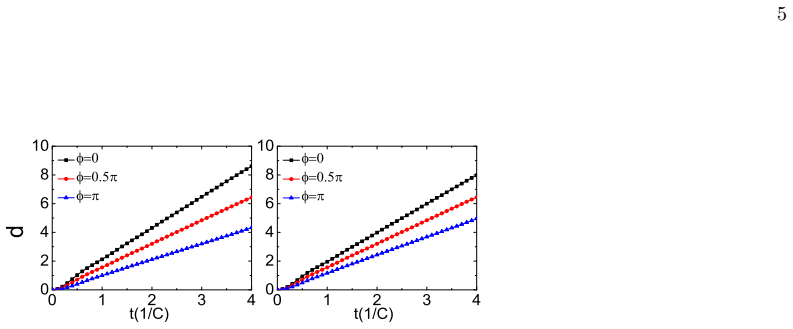
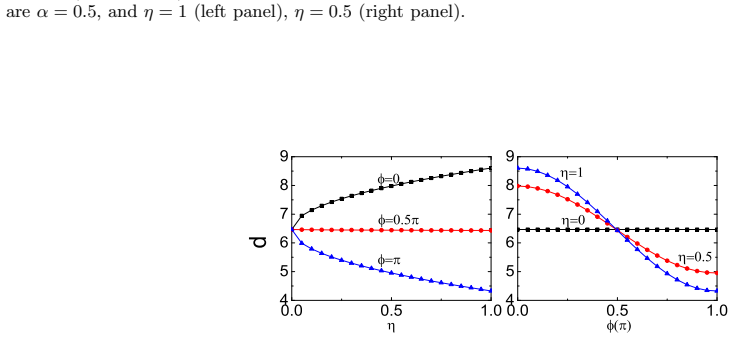
The load-bearing object is the input density matrix $\rho_{qr,q'r'}$ on the two-particle occupation basis together with the single-particle propagator $U_{q,r}(t)$ obtained from the equation of motion $\mathrm{i}\partial_t\hat a_q^\dagger=\beta_q\hat a_q^\dagger+T_{q,q+1}\hat a_{q+1}^\dagger+T_{q,q-1}\hat a_{q-1}^\dagger$. Eq. (8) combines them into the exact two-particle correlation function, separating the cases where the two particles start on the same site from distinct sites. In the concrete scheme, all coherence effects are concentrated in one term, $2\gamma\,\mathrm{Re}(e^{i\varphi}U_{q0}U_{r0}U_{r1}^*U_{q1}^*)$, with $\gamma=\sqrt{\eta-1+4\alpha(1-\alpha)}$; this is the term that produces two-photon interference, that grows as $\eta$ increases, and that flips sign when $\varphi$ changes from $0$ to $\pi$. Its sign, through $\cos\varphi$, decides whether the two photons are pushed apart or pulled together in the numerical correlation maps and in the average-distance expression (13).
What would settle it
Perform the proposed two-photon walk in a uniform waveguide array with $\alpha=0.5$ and a fixed partial coherence (for instance $\eta=0.5$), and measure the average distance $d$ between the two photons at time $t=4/C$ while the relative phase $\varphi$ is scanned from $0$ to $\pi$. Equation (13) predicts that $d$ varies sinusoidally with $\varphi$ with amplitude proportional to $\sqrt{\eta}$, and that at $\eta=0$ the curve is exactly flat. Observing no phase dependence at $\eta=0.5$, or observing a phase dependence at $\eta=0$, would falsify the paper's central claim.
Extended reading notes
Core claim
On its own terms, the paper establishes that the two-particle correlation function $\Gamma_{k,l}(t)=\langle\hat a_k^\dagger(t)\hat a_l^\dagger(t)\hat a_l(t)\hat a_k(t)\rangle$ for a two-boson quantum walk is determined by the input density matrix through Eq. (8), with no assumption that the input is pure. For the proposed mixed two-photon state, $\rho=\cos^2\delta|\psi_1\rangle\langle\psi_1|+\sin^2\delta|\psi_2\rangle\langle\psi_2|$ with $\psi_1=\cos(\theta/2)|2\rangle_1+\sin(\theta/2)e^{i\varphi}|2\rangle_0$ and $\psi_2=|2\rangle_1$, the correlation becomes $\Gamma_{q,r}=2\gamma\,\mathrm{Re}(e^{i\varphi}U_{q0}U_{r0}U_{r1}^*U_{q1}^*)+2\alpha|U_{r0}U_{q0}|^2+2(1-\alpha)|U_{r1}U_{q1}|^2$. In a uniform periodic lattice this is (12), $\Gamma_{q,r}(\tau)=-2\gamma\cos\varphi\, J_q(\tau)J_r(\tau)J_{r-1}(\tau)J_{q-1}(\tau)+2\alpha[J_q(\tau)J_r(\tau)]^2+2(1-\alpha)[J_{r-1}(\tau)J_{q-1}(\tau)]^2$. The coherence of the input enters through $\eta=2\,\mathrm{Tr}(\rho^2)-1$ inside $\gamma$; when $\eta=0$ the interference term vanishes, when $\eta=1$ the pure-state two-photon interference is recovered. The average distance between the two photons inherits the same $\gamma\cos\varphi$ factor, which is why the distance grows with $\eta$ for $\varphi=0$, shrinks with $\eta$ for $\varphi=\pi$, and is insensitive to $\eta$ at $\varphi=\pi/2$.
Load-bearing premise
The quantitative predictions of the proposed scheme rest on the assumption that the two mutually incoherent beams, after passing through gratings and entering the waveguide array, really produce the density matrix in Eq. (9) with exactly the stated $\psi_1$ and $\psi_2$, so that the off-diagonal element is $\rho_{00,11}=\frac12 e^{i\varphi}\sqrt{\eta-1+4\alpha(1-\alpha)}$; any residual coherence, spectral distinguishability, or multi-pair emission that changed this element would alter the interference term in Eq. (11) and invalidate the predicted photon separation.
Editorial extensions
If this is right
- Experimentalists can compute the full two-photon coincidence map for any pure or mixed input by substituting the initial density matrix into Eq. (8), without re-solving the two-particle problem.
- The degree of coherence $\eta$ becomes a tunable control: at $\varphi=0$ raising $\eta$ increases the average photon distance, at $\varphi=\pi$ it decreases it, and at $\varphi=\pi/2$ it leaves the distance unchanged.
- The relative phase $\varphi$ acts as a switch between bunching and antibunching, so the sign of two-photon interference can be chosen in advance by setting the initial phase.
- In the fully incoherent limit $\eta=0$, the correlation is a simple incoherent sum of single-particle probability products, and the nonclassical two-photon interference signature disappears entirely.
- Because the general formula depends on the lattice only through the single-particle amplitude $U_{q,r}(t)$, it also applies to lattices with defects, non-uniform tunnel couplings, or other single-particle geometries.
Reading between the lines
- The same coherence-parameter route could be applied to fermionic or interacting walkers: the sign and magnitude of the interference term would then encode exchange statistics or interaction phases, making a partially coherent two-particle walk a possible probe of statistical effects.
- Because the amplitude of the phase-dependent part of the average distance $d$ is proportional to $\sqrt{\eta}$ at fixed $\alpha$, a measurement of $d(\varphi)$ in this setup would give a direct experimental estimate of the degree of coherence $\eta$; the framework thereby doubles as a coherence metrology tool.
- The simple formula $\gamma=\sqrt{\eta-1+4\alpha(1-\alpha)}$ works because the mixed state has only one off-diagonal pair; for inputs with several mutually coherent sectors, a single scalar $\eta$ would no longer suffice and the full off-diagonal density matrix would be needed.
Signed reviews
Editorial analysis
A structured set of objections, weighed in public.
Referee Report
Summary. This paper studies a continuous-time quantum walk of two noninteracting bosons on a one-dimensional lattice, described by the tight-binding Hamiltonian (1). The authors develop a density-matrix formalism that allows the initial two-particle state to be pure or mixed, and they derive a general expression, Eq. (8), for the two-boson correlation function Γ_{k,l}(t) in terms of single-particle propagators U_{q,r}(t) and the initial density-matrix elements. For a concrete mixed initial state parameterized by an occupation probability α, a coherence parameter η = 2Tr(ρ^2) − 1, and a relative phase φ, they obtain the closed form Eq. (11) and its Bessel-function version Eq. (12) for a uniform lattice. They also compute the average inter-photon distance, Eq. (13), and present numerical plots showing that the correlation function and the distance depend on α, η, and φ, with the coherent first term in Eq. (11) responsible for Hanbury Brown–Twiss-type interference. The pure-state limit is shown to reproduce a known result from Ref. [16].
Significance. If correct, the paper provides a useful analytic tool for two-particle bosonic quantum walks with partially coherent initial states. The general formula (8) goes beyond earlier pure-state treatments and could serve as a reference for experiments in waveguide lattices. The derivation is standard second-quantization, and the pure-state limit matches the known result of Bromberg et al. The concrete prediction that the coherence parameter η and the relative phase φ control the interference contribution to the two-photon correlation and to the average distance is the main value of the work. The paper does not present machine-checked proofs or reproducible code; the numerical results are evaluations of the analytic formulas. Overall, this is a reasonable contribution to the quantum-walk literature, though not a conceptual breakthrough.
major comments (2)
- [§II, Eq. (6)] Equation (6) has a sign error in the β term. For the Hamiltonian in Eq. (1), the Heisenberg equation of motion is i∂_t a†_q = −β_q a†_q + T_{q,q+1} a†_{q+1} + T_{q,q−1} a†_{q−1}, because [a†_q, a†_j a_j] = −a†_j δ_{q,j}. The published Eq. (6) has +β_q, which corresponds to a Hamiltonian with −β_q in the potential term, not the one written in Eq. (1). For the constant-β case used in Sec. III, this only changes a global phase in U_{q,r}(t) and that phase cancels in Γ, so Eqs. (11)–(13) and Figs. 1–3 remain valid. However, Sec. II explicitly allows site-dependent β_q, including the boundary-defect case, and for such β_q the U obtained from Eq. (6) is not the propagator of Eq. (1). Since Eq. (8) is advertised as a general result for arbitrary initial states, this sign inconsistency must be corrected and the derivation re-examined.
- [§II, Eq. (8)] The derivation of Eq. (8) from Eqs. (6)–(7) is omitted. The formula contains four sums with explicit factors of √2 in the double-occupancy contributions, and without an explicit derivation or a precise reference the reader cannot verify that all combinatoric factors are correct. Because Eq. (8) is the central analytical claim of the paper, the authors should include the derivation (for example in an appendix) or give a reference that contains the general two-boson correlation formula for arbitrary density matrices.
minor comments (5)
- [§III, Eq. (9)] The text states the intensity relation as "cos 2δ : sin2δ", which appears to mean cos^2 δ : sin^2 δ; please write this unambiguously to match Eq. (9).
- [§III, after Eq. (10)] The reparameterization ρ00,00 = α and ρ11,11 = 1−α should be stated explicitly in terms of the original parameters δ and θ, i.e., α = cos^2δ sin^2(θ/2) and 1−α = cos^2δ cos^2(θ/2)+sin^2δ, so that the range constraints and the expression for γ are transparent.
- [§III, Eq. (11)] The expression for ρ00,11 contains "η − 1 − 4α^2 + 4α"; writing it as η − 1 + 4α(1 − α) would make the nonnegativity of the radicand clearer.
- [Figures 2 and 4] The captions should specify the number of lattice sites L for all figures; currently only Fig. 4 states L = 15, while Figs. 2 and 3 do not, which makes the numerical plots hard to reproduce.
- [§III, proposed scheme] The preparation scheme leading to Eq. (9) assumes that two mutually incoherent beams, after grating splitting, produce exactly the mixture cos^2δ|ψ1⟩⟨ψ1| + sin^2δ|ψ2⟩⟨ψ2|. The paper should state this as an idealization and briefly comment on how residual coherence between the beams, spectral distinguishability, or multi-pair emission would affect the off-diagonal element ρ00,11 and hence the interference term in Eq. (11).
Circularity Check
No significant circularity: the correlation formulas are derived from the stated density matrix and propagator, with no fitted target or self-citation chain.
full rationale
The derivation chain is self-contained. The input is the two-boson density matrix (10); the coherence parameter eta is explicitly defined in the text as eta = 2Tr(rho^2) - 1, and the off-diagonal element rho_{00,11} is parameterized through it. Equation (11) follows from the general trace formula (8) by direct evaluation with this density matrix, and Eq. (12) substitutes the known Bessel-function propagator U_{q,r}(t) = e^{2iCt} i^{q-r} J_{q-r}(2Ct). No parameter is fitted to the correlation or distance data; the numerical figures merely evaluate the derived analytical expressions. The pure-state limit reproduces the cited result of Bromberg et al. (Ref. [16]). The only self-citation, Ref. [29], supplies a standard definition of the coherence measure that is restated explicitly in the present paper, so it is not load-bearing. The sign discrepancy between Eq. (6) and the Hamiltonian in Eq. (1) is a correctness concern about the claimed generality of the derivation, not a circularity: Eq. (8) is not assumed as an input but is presented as a derived consequence. Therefore no step reduces the paper's predictions to its inputs by construction.
Assumptions & free parameters
free parameters (3)
- alpha
- eta
- phi
assumptions (3)
- domain assumption The two photons are non-interacting bosons evolving under the tight-binding Hamiltonian (1).
- standard math The single-particle propagator on a uniform lattice is U_{q,r}(tau)=e^{i2Ct} i^{q-r}J_{q-r}(2Ct).
- ad hoc to paper The two incoherent beams produce the density matrix rho = cos^2(delta)|psi_1><psi_1| + sin^2(delta)|psi_2><psi_2| with psi_1 and psi_2 as in Eq. (9).
Cite this review
Pith. "Pith review of The role of coherence on two-particle quantum walks." pith.science (2026). https://pith.science/paper/CFVXGVU6
@misc{pith2026190804987,
  author       = {Pith},
  title        = {Pith review of: The role of coherence on two-particle quantum walks},
  year         = {2026},
  howpublished = {\url{https://pith.science/paper/CFVXGVU6}},
  note         = {Machine review of arXiv:1908.04987}
}
read the original abstract
We investigate the dynamical properties of the two-bosons quantum walk in system with different degrees of coherence, where the effect of the coherence on the two-bosons quantum walk can be naturally introduced. A general analytical expression of the two-bosons correlation function for both pure states and mixed states is given. We propose a possible two-photon quantum-walk scheme with a mixed initial state and find that the two-photon correlation function and the average distance between two photons can be influenced by either the initial photon distribution, or the relative phase, or the degree of coherence. The propagation features of our numerical results can be explained by our analytical two-photon correlation function.
Figures

Figures from the paper (1 more)
Reference graph
Works this paper leans on
- [16]
-
[1]
Zhejiang Institute of Modern Physics and Department of Phy sics, Zhejiang University, Hangzhou 310027, P. R. China
-
[2]
Collaborative Innovation Center of Advanced Microstruc tures, Nanjing, P. R. China (Received August 15, 2019) We investigate the dynamical properties of the two-bosons q uantum walk in system with different degrees of coherence, where the effect of the coherence on the two-bosons quantum walk can be naturally introduced. A general analytical expression of t...
work page 2019
-
[3]
Y. Aharonov, L. Davidovich, and N. Zagury: ”Quantum rand om walks” Phys. Rev. A, Vol. 48, (1993), PP. 1687
work page 1993
-
[4]
M. Mohseni, P. Rebentrost, S. Lloyd, and A. Aspuru-Guzik : ”Environment-assisted quantum walks in photosynthetic energy transfer”, J. Chem. Phys., Vol. 129, (2008), PP. 1741 06
work page 2008
- [5]
-
[6]
S. E. Venegas-Andraca: ”Quantum walks: a comprehensive review ”, Quantum Information Processing, Vol. 11, (2012), PP. 1015
work page 2012
-
[7]
M. S. Underwood and D.L. Feder: ”Universal quantum compu tation by discontinuous quantum walk”, Phys. Rev. A, Vol. 82, (2010), PP. 042304
work page 2010
Show all 33 references
-
[8]
Lovett, S
N.B. Lovett, S. Cooper, M. Everitt, M. Trevers, and V. Ken don: ”Universal quantum computation using the discrete-ti me quantum walk”, Phys. Rev. A, Vol. 81, (2010), PP. 042330
2010
-
[9]
Childs: ”Universal Computation by Quantum Walk”, P hys
A.M. Childs: ”Universal Computation by Quantum Walk”, P hys. Rev. Lett., Vol. 102, (2009), PP. 180501
2009
-
[10]
A. M. Childs, D. Gosset, Z. Webb: ”Universal Computation by Multiparticle Quantum Walk ”, Science, Vol. 339, (2013), PP. 791
2013
-
[11]
Watrous: ”Quantum simulations of classical random wa lks and undirected graph connectivity”, Journal of compute r and system sciences, Vol
J. Watrous: ”Quantum simulations of classical random wa lks and undirected graph connectivity”, Journal of compute r and system sciences, Vol. 62, (2001), PP. 376
2001
-
[12]
Farhi and S
E. Farhi and S. Gutmann: ”Quantum computation and decis ion trees”, Phys. Rev. A, Vol. 58, (1998), PP. 915
1998
-
[13]
H. B. Perets, Y. Lahini, F. Pozzi, M. Sorel, R. Morandott i, and Y. Silberberg: ”Realization of Quantum Walks with Negligible Decoherence in Waveguide Lattices”, Phys. Rev. Lett., Vol. 100, (2008), PP. 170506
2008
-
[14]
Schreiber, K
A. Schreiber, K. N. Cassemiro, V. Potoˇ cek, A. G´ abris, P. J. Mosley, E. Andersson, I. Jex, and Ch. Silberhorn: ”Phot ons Walking the Line: A Quantum Walk with Adjustable Coin Operat ions”, Phys. Rev. Lett., Vol. 104, (2010), PP. 050502. 7
2010
-
[15]
M. A. Broome, A. Fedrizzi, B. P. Lanyon, I. Kassal, A. Asp uru-Guzik, and A. G. White: ”Discrete Single-Photon Quantu m Walks with Tunable Decoherence”, Phys. Rev. Lett., Vol. 104 , (2010), PP. 153602
2010
-
[17]
Weitenberg, M
C. Weitenberg, M. Endres, J. F. Sherson, M. Cheneau, P. S chauss, T. Fukuhara, I. Bloch, S. Kuhr: ” Single-spin addres sing in an atomic Mott insulator ”, Nature, Vol. 471, (2011), PP. 3 19
2011
-
[18]
Bromberg, Y
Y. Bromberg, Y. Lahini, R. Morandotti, and Y. Silberber g: ”Quantum and Classical Correlations in Waveguide Lattic es”, Phys. Rev. Lett., Vol. 102, (2009), PP. 253904
2009
-
[19]
Peruzzo, M
A. Peruzzo, M. Lobino, J. C. F. Matthews, N. Matsuda, A. P oliti, K. Poulios, X. Q. Zhou, Y. Lahini, N. Ismail, K. W¨ orhoff, Y. Bromberg, Y. Silberberg, M. G. Thompson, J. L. Ob rien: ”Quantum Walks of Correlated Photons ”, Science, Vol. 329,(2010), PP. 1500
2010
-
[20]
P. L. Knight, E. Roldan, J. E. Sipe: ”Quantum walk on the l ine as an interference phenomenon”, Phys. Rev. A, Vol. 68, (2003), PP. 020301
2003
-
[21]
Y. Omar, N. Paunkovic, L. Sheridan, S. Bose: ”Quantum wa lk on a line with two entangled particles”, Phys. Rev. A, Vol. 74, (2006), PP. 042304
2006
-
[22]
Lahini, M
Y. Lahini, M. Verbin, S. D. Huber, Y. Bromberg, R. Pugatc h, and Y. Silberberg: ”Quantum walk of two interacting bosons”, Phys. Rev. A, Vol. 86, (2012), PP. 011603
2012
-
[23]
X. Z. Qin, Y. G. Ke, X. W. Guan, Z. B. Li, N. Andrei, and C. H. Lee: ”Quantum Walks of Two Interacting Particles in One Dimension”, Phys. Rev. A, Vol. 90, (2014), PP. 062301
2014
-
[24]
Kendon:”Decoherence in quantum walks - A review”, Ma thematical structures in computer science, Vol
V. Kendon:”Decoherence in quantum walks - A review”, Ma thematical structures in computer science, Vol. 17, (2007) , PP. 1169
2007
-
[25]
Farhi, and S
E. Farhi, and S. Gutmann:”Quantum computation and deci sion trees”, Phys. Rev. A, Vol. 58, (1997), PP. 915
1997
-
[26]
Z. J. Li, J. A. Izaac, and J. B. Wang: ”Position-defect-i nduced reflection, trapping, transmission, and resonance i n quantum walks”, Phys. Rev. A, Vol. 87, (2013), PP. 012314
2013
-
[27]
Mattle, M
K. Mattle, M. Michler, H. Weinfurter, A. Zeilinger, M. Z ukowski: ”Noncalssical statistics at multiport beam-spli tters”, Appl. Phys. B, Vol. 60, (1995), PP. S111
1995
-
[28]
Lederer, G
F. Lederer, G. I. Stegeman, D. N. Christodoulides, G. As santo, M. Segev, and Y. Silberberg: ”Discrete solitons in op tics”, Phys. Rep., Vol. 463, (2008), PP. 1
2008
-
[29]
Yariv: Quantum Electronics, Wiley, New York, (1989)
A. Yariv: Quantum Electronics, Wiley, New York, (1989)
1989
-
[30]
Szameit, F
A. Szameit, F. Dreisow, H. Hartung, S. Nolte, A. Tunnerm ann, and F. Lederer: ”Quasi-incoherent propagation in wave guide arrays”, Appl. Phys. Lett., Vol. 90, (2007), PP. 241113
2007
-
[31]
L. H. Lu and Y. Q. Li: ”Dynamics for partially coherent Bo se-Einstein condensates in double wells”, Phys. Rev. A, Vol . 80, (2009), PP. 033619
2009
-
[32]
Hanbury Brown and R
R. Hanbury Brown and R. Q. Twiss,”Correlation between p hotons in 2 coherent beams of light” Nature, Vol. 177, (1956) , PP. 27
1956
-
[33]
Schachenmayer, B
J. Schachenmayer, B. P. Lanyon, C. F. Roos, and A. J. Dale y, ”Entanglement growth in quench dynamics with variable range interactions” Phys. Rev. X, Vol. 3, (2013), PP. 031015
2013
Reviewed August 14, 2026 · model on record in the stance chip above.
Discussion (0). Continue with ORCID to comment.