REVIEW 5 minor 178 references
Recent progress towards chemically-specific coarse-grained simulation models with consistent dynamical properties
T0 review · 0 major / 5 minor · reviewed 2026-08-14 · deepseek-v4-flash
Pith's one-line read Chemically specific coarse-grained models now have three complementary routes to recover consistent dynamics—Mori–Zwanzig friction corrections, empirical time rescaling, and barrier-targeted potential refinement—but none is universally…
desk verdict A solid, well-hedged review that organizes the CG-dynamics literature into three useful routes; no new results, but no load-bearing flaws—worth sending to a serious referee. read the letter →
The pith
A machine-rendered reading of the paper's core claim, the machinery that carries it, and where it could break.
The reading
What carries the argument
The central object is the generalized Langevin equation (GLE) obtained from the Mori–Zwanzig projection-operator formalism: dP/dt = −dU0/dR − ∫ Γ(R,P,t−t′)V(t′) dt′ + δF^Q(t). The paper uses the GLE as a conceptual and practical scaffold: the conservative term is the many-body potential of mean force, the memory-kernel term encodes friction that depends on coordinates, momenta, and time, and the random force is connected to the kernel by a fluctuation–dissipation relation. The three reviewed strategies correspond to simplifying this equation in different ways—retaining a structured friction kernel (MZ approach), collapsing the kernel to a scalar and absorbing it into a time-rescaling factor (time-rescaling approach), or neglecting explicit friction and instead shaping the conservative potential to capture the free-energy barriers that dominate barrier-crossing kinetics (free-energy-landscape approach). The review's conceptual move is to treat these three simplifications as complementary perspectives on the same GLE.
What would settle it
The claim would be falsified by a chemically specific CG model that, with only a uniform Langevin thermostat and a structure-based potential, reproduces the reference model's velocity autocorrelation functions, diffusion constants, and ratios of mean first-passage times between metastable states; or, in a controlled two-basin system, by showing that changing barrier heights without changing intrabasin friction leaves the relative transition rates unchanged.
Extended reading notes
Core claim
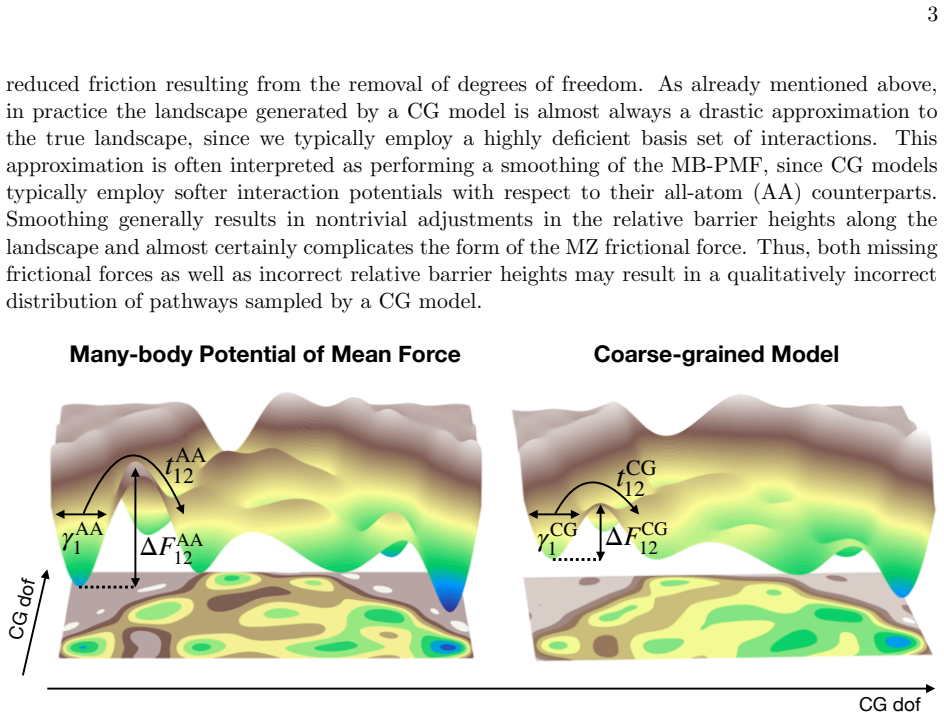
The paper's central claim is that the two known sources of dynamical error in bottom-up coarse-grained models—the loss of friction from eliminated degrees of freedom and the smoothing of the many-body potential of mean force by approximate interaction potentials—distort not just absolute time scales but the ratios of time scales between distinct processes, which can change the qualitative pathways a model samples. It organizes recent progress into three approaches: (i) bottom-up parametrization of the generalized Langevin equation, from dissipative particle dynamics friction kernels to memory kernels and variational methods; (ii) empirical time-rescaling relations, including scalar rescalings for polymer melts and entropy-based rescalings for liquids; and (iii) free-energy-landscape-informed refinement, where structural–kinetic relationships and Markov state models are used to reparametrize conservative forces so that dominant barriers and the hierarchy of long-time processes are reproduced. The review does not claim any single method is universally successful; it claims that the field now has a structured view of the problem and a set of methods that work in identifiable regimes, with clear markers of when they fail.
Load-bearing premise
The synthesis assumes the Mori–Zwanzig diagnosis—that missing friction and smoothed free-energy barriers are the two dominant sources of dynamical error—is correct for chemically specific CG models, and that the cited studies fairly represent the field.
Editorial extensions
If this is right
- MZ-based methods with memory or momentum-dependent friction are now practical for high-resolution CG models, though they demand a clear time-scale separation to reproduce both short-time correlation functions and long-time diffusion.
- Scalar time rescaling works when a single, state-point-dependent factor reconnects CG and reference dynamics; this holds for homopolymer melts and some simple liquids but fails when distinct species or processes demand different rescalings, as in ionic liquids or azobenzene liquid crystals.
- Refining conservative potentials to reproduce free-energy barriers—guided by Markov state models or structural–kinetic relationships—can restore the hierarchy of long-time processes without adding dissipative forces, at the cost of accepting errors in basin-resolved thermodynamics.
- Variational and path-space methods (relative entropy rate, trajectory matching, spectral matching) are emerging as systematic routes to target dynamics directly, but have not yet been widely tested on molecular systems.
- A consistent theme: the CG mapping, the conservative potential, and the dissipative forces are coupled; optimizing one without the others limits achievable dynamical accuracy.
Reading between the lines
- A testable extension: combining a barrier-targeted potential with a modest memory-friction correction should outperform either alone for systems like ionic liquids, where both barrier heterogeneity and missing friction are severe; this is implicit in the review's outlook but not yet demonstrated.
- The review's emphasis on relative time scales suggests a useful quality metric for CG models: not the absolute speed-up factor but the ratio of mean first-passage times between pairs of metastable states compared with the reference model; this metric would be transferable across systems where a uniform rescaling is inapplicable.
- The structural–kinetic results for helix–coil systems hint that steric excluded volume alone constrains the attainable free-energy landscape, implying that CG representations that preserve accurate excluded volume may inherit more kinetic fidelity than those that soften it—a connection left implicit in the paper.
- For machine-learned CG potentials, the review implies that training losses should be augmented with dynamical observables or constraints on relative barriers, not just structural correlation functions, to avoid reproducing structures while losing dynamics.
Signed reviews
Editorial analysis
A structured set of objections, weighed in public.
Referee Report
Summary. This review surveys recent methodological advances toward chemically specific coarse-grained (CG) models that reproduce dynamical properties of higher-resolution references. The author organizes the field into three perspectives: (i) explicit correction of dynamics via the Mori-Zwanzig (MZ) formalism, including DPD, momentum-dependent friction, memory kernels, and variational approaches; (ii) empirical or semi-empirical time-rescaling relationships for polymers and liquids; and (iii) free-energy-landscape-informed refinement, including structural-kinetic relationships and Markov-state-model-based reparametrization. The review is explicitly self-limited, acknowledging that no single method currently provides general dynamical consistency and that several variational frameworks remain without molecular applications.
Significance. The paper is a useful and well-structured synthesis of a rapidly growing literature. Its main contribution is organizational: it connects approaches that are usually presented in separate communities (MZ-based bottom-up dynamics, time-rescaling, and MSM-based kinetics) and identifies the plateau problem, the breakdown of uniform rescaling, and the coupling between conservative and dissipative forces as recurring cross-cutting issues. The review is carefully hedged, uses representative counterexamples (e.g., azobenzene liquid crystals, ionic liquids) to illustrate limitations, and explicitly lists open challenges. It does not overclaim, and it gives credit to recent theoretical advances. As a review, its value lies in the accuracy and comprehensiveness of its literature synthesis rather than in new results.
minor comments (5)
- [Section II.A, Eq. (5)] The definition of the Liouville operator as L = Σ_i (∂/∂r_i + ∂/∂p_i) is dimensionally inconsistent and incomplete. It should read iL = Σ_i [(p_i/m_i)·∂/∂r_i + F_i·∂/∂p_i] (up to the usual sign convention). Please correct or replace with a proper reference.
- [Section III.A, text near ref. [101]] The citation 'Salerno and Grest [101]' should be 'Salerno et al. [101]' since the cited article has four authors; likewise, 'Armstrong and Ballone [117]' should be 'Armstrong et al. [117]'.
- [Reference list] References [31] and [11] are duplicates, as are references [50] and [26]; please consolidate or remove the redundant entries.
- [Figure 3 caption] The caption contains a typo: 'long time sale' should read 'long time scale'.
- [Section II.B, Eqs. (8)-(10)] The symbol t is reused as an integration cutoff and as an evaluation time; the text should explicitly state that t is chosen as a plateau time and that the three expressions are approximations that coincide only under time-scale separation.
Circularity Check
No significant circularity: the review's organizational claims are supported by independent literature, and self-citations are illustrative rather than load-bearing.
full rationale
This is a review article, not a derivation paper, so there is no equation-level chain that reduces a claimed new result to its own inputs. The central claim is an explicitly hedged organizational statement: recent work has improved CG dynamical consistency along three routes (Mori-Zwanzig parametrization, time rescaling, free-energy-landscape refinement), while no single method yet provides general dynamical consistency. That claim is supported by a broad literature that is largely independent of the author. The only self-referenced items are Rudzinski & Bereau 2016/2018 and Bereau & Rudzinski 2018, described in Section IV as specific published studies of MSM-based refinement, structural-kinetic relationships, and cross-correlation effects; they appear as examples within the review's taxonomy, not as premises that make the taxonomy true. No uniqueness theorem is invoked, no fitted parameter is relabeled as a prediction, and no ansatz is smuggled in through a self-citation. Moreover, the review explicitly names open challenges and missing applications, e.g., 'there seems to be a lack of applications to molecular systems' for variational frameworks and 'shockingly few investigations' into optimizing the CG mapping, which shows the claims are self-limited rather than forced. Because the paper makes no overreaching universal claim and the organizational thesis does not depend on any single self-cited result, there is no circular step to exhibit by quotation and reduction.
Assumptions & free parameters
Cite this review
Pith. "Pith review of Recent progress towards chemically-specific coarse-grained simulation models with consistent dynamical properties." pith.science (2026). https://pith.science/paper/455D7IUX
@misc{pith2026190805001,
  author       = {Pith},
  title        = {Pith review of: Recent progress towards chemically-specific coarse-grained simulation models with consistent dynamical properties},
  year         = {2026},
  howpublished = {\url{https://pith.science/paper/455D7IUX}},
  note         = {Machine review of arXiv:1908.05001}
}
read the original abstract
Coarse-grained (CG) models can provide computationally efficient and conceptually simple characterizations of soft matter systems. While generic models probe the underlying physics governing an entire family of free-energy landscapes, bottom-up CG models are systematically constructed from a higher-resolution model to retain a high level of chemical specificity. The removal of degrees of freedom from the system modifies the relationship between the relative time scales of distinct dynamical processes through both a loss of friction and a "smoothing" of the free-energy landscape. While these effects typically result in faster dynamics, decreasing the computational expense of the model, they also obscure the connection to the true dynamics of the system. The lack of consistent dynamics is a serious limitation for CG models, which not only prevents quantitatively accurate predictions of dynamical observables but can also lead to qualitatively incorrect descriptions of the characteristic dynamical processes. With many methods available for optimizing the structural and thermodynamic properties of chemically-specific CG models, recent years have seen a stark increase in investigations addressing the accurate description of dynamical properties generated from CG simulations. In this review, we present an overview of these efforts, ranging from bottom-up parametrizations of generalized Langevin equations to refinements of the CG force field based on a Markov state modeling framework. We aim to make connections between seemingly disparate approaches, while laying out some of the major challenges as well as potential directions for future efforts.
Figures


Reference graph
Works this paper leans on
-
[1]
F., The Theory of Polymer Dynamics (Claredon Press, Oxford, England, 1986)
Doi, M., Edwards, S. F., The Theory of Polymer Dynamics (Claredon Press, Oxford, England, 1986)
1986
-
[2]
Taketomi, Y
H. Taketomi, Y. Ueda, and N. G¯ o, Int. J. Pept. Protein Res. 7, 445 (1975)
1975
-
[3]
Clementi, Curr
C. Clementi, Curr. Opin. Struc. Biol. 18, 10 (2008)
2008
-
[4]
Onsager, Chem
L. Onsager, Chem. Rev. 13, 73 (1933)
1933
-
[5]
J. G. Kirkwood, J. Chem. Phys. 3, 300 (1935). 23
1935
-
[6]
W. G. Noid, J. Chem. Phys. 139, 090901 (2013)
2013
-
[7]
Peter and K
C. Peter and K. Kremer, Soft Matter 5, 4357 (2009)
2009
-
[8]
Riniker, J
S. Riniker, J. R. Allison, and W. F. van Gunsteren, Phys. Chem. Chem. Phys. 14, 12423 (2012)
2012
Show all 178 references
-
[9]
Mori, Prog
H. Mori, Prog. Theor. Phys. 34, 399 (1965)
1965
-
[10]
Zwanzig, Phys
R. Zwanzig, Phys. Rev. 124, 983 (1961)
1961
-
[11]
Hij´ on, P
C. Hij´ on, P. Espa˜ nol, E. Vanden-Eijnden, and R. Delgado-Buscalioni, Faraday Disc.144, 301 (2010)
2010
-
[12]
Rosenfeld, J
Y. Rosenfeld, J. Phys.: Condens. Matter 11, 5415 (1999)
1999
-
[13]
J. T. Padding and W. J. Briels, J. Phys.: Condens. Matter 23, 233101 (2011)
2011
-
[14]
Zwanzig, Physica 30, 1109 (1964)
R. Zwanzig, Physica 30, 1109 (1964)
1964
-
[15]
Robertson, Phys
B. Robertson, Phys. Rev. 144, 151 (1966)
1966
-
[16]
Kawasaki and J
K. Kawasaki and J. Gunton, Phys. Rev. A 8, 2048 (1973)
1973
-
[17]
Koide and T
T. Koide and T. Kodama, Phys. Rev. E 78, 051107 (2008)
2008
-
[18]
P. Li, Y. Dong, N. Zhao, and Z. Hou, J. Chem. Phys. 140, 154109 (2014)
2014
-
[19]
W. G. Noid, J.-W. Chu, G. S. Ayton, V. Krishna, S. Izvekov, G. A. Voth, A. Das, and H. C. Andersen, J. Chem. Phys. 128, 244114 (2008)
2008
-
[20]
Kinjo and S
T. Kinjo and S. Hyodo, Phys. Rev. E 75, 051109 (2007)
2007
-
[21]
Izvekov and B
S. Izvekov and B. M. Rice, J. Chem. Phys. 140, 104104 (2014)
2014
-
[22]
Deichmann and N
G. Deichmann and N. F. A. van der Vegt, J. Chem. Phys. 149, 244114 (2018)
2018
-
[23]
Izvekov, J
S. Izvekov, J. Chem. Phys. 138, 134106 (2013)
2013
-
[24]
Duenweg, U
B. Duenweg, U. D. Schiller, and A. J. C. Ladd, Phys. Rev. E 76, 036704 (2007)
2007
-
[25]
Espa˜ nol and P
P. Espa˜ nol and P. B. Warren, J. Chem. Phys.146, 150901 (2017)
2017
-
[27]
Di Pasquale, T
N. Di Pasquale, T. Hudson, and M. Icardi, Phys. Rev. E 99, 013303 (2019)
2019
-
[28]
Kauzlari´ c, P
D. Kauzlari´ c, P. Espa˜ nol, A. Greiner, and S. Succi, Macromol. Theory Sim.20, 526 (2011)
2011
-
[29]
Izvekov and G
S. Izvekov and G. A. Voth, J. Chem. Phys. 125, 151101 (2006)
2006
-
[30]
Markutsya and M
S. Markutsya and M. H. Lamm, J. Chem. Phys. 141, 174107 (2014)
2014
-
[31]
Hijon, P
C. Hijon, P. Espanol, E. Vanden-Eijnden, and R. Delgado-Buscalioni, Faraday Disc. 144, 301 (2010)
2010
-
[32]
Davtyan, J
A. Davtyan, J. F. Dama, G. A. Voth, and H. C. Andersen, J. Chem. Phys. 142, 154104 (2015)
2015
-
[33]
Izvekov, Phys
S. Izvekov, Phys. Rev. E 95, 013303 (2017)
2017
-
[34]
Izvekov, J
S. Izvekov, J. Chem. Phys. 146, 124109 (2017)
2017
-
[35]
Espa˜ nol, J
P. Espa˜ nol, J. A. de la Torre, and D. Duque-Zumajo, Phys. Rev. E 99, 022126 (2019)
2019
-
[36]
H. Lei, B. Caswell, and G. E. Karniadakis, Phys. Rev. E 81, 026704 (2010)
2010
-
[37]
Yoshimoto, I
Y. Yoshimoto, I. Kinefuchi, T. Mima, A. Fukushima, T. Tokumasu, and S. Takagi, Phys. Rev. E 88, 043305 (2013)
2013
-
[38]
Z. Li, X. Bian, B. Caswell, and G. E. Karniadakis, Soft Matter 10, 8659 (2014)
2014
-
[39]
Z. Li, X. Bian, X. Li, and G. E. Karniadakis, J. Chem. Phys. 143, 243128 (2015)
2015
-
[40]
Z. Li, H. S. Lee, E. Darve, and G. E. Karniadakis, J. Chem. Phys. 146, 014104 (2017)
2017
-
[41]
Espa˜ nol, M
P. Espa˜ nol, M. Serrano, and I. Z´ u˜ niga, Int. J. Mod. Phys. C8, 899 (1997)
1997
-
[42]
Flekkøy and P
E. Flekkøy and P. Coveney, Phys. Rev. Lett. 83, 1775 (1999)
1999
-
[43]
Flekkøy, P
E. Flekkøy, P. Coveney, and G. De Fabritiis, Phys. Rev. E 62, 2140 (2000)
2000
-
[44]
Ayton, H
G. Ayton, H. Tepper, D. Mirijanian, and G. Voth, J. Chem. Phys. 120, 4074 (2004)
2004
-
[45]
Eriksson, M
A. Eriksson, M. N. Jacobi, J. Nystr¨ om, and K. Tunstrøm, Phys. Rev. E 77, 016707 (2008)
2008
-
[46]
Eriksson, M
A. Eriksson, M. N. Jacobi, J. Nystr¨ om, and K. Tunstrøm, Europhys. Lett. 86, 44001 (2009)
2009
-
[47]
K. R. Hadley and C. McCabe, J. Phys. Chem. B 114, 4590 (2010)
2010
-
[48]
Y. Han, J. F. Dama, and G. A. Voth, J. Chem. Phys. 149 (2018), 10.1063/1.5039738
2018 doi
-
[49]
H. Bock, K. E. Gubbins, and S. H. L. Klapp, Phys. Rev. Lett. 98, 267801 (2007)
2007
-
[50]
Junghans, M
C. Junghans, M. Praprotnik, and K. Kremer, Soft Matter 4, 156 (2008)
2008
-
[51]
Izvekov and B
S. Izvekov and B. M. Rice, Phys. Chem. Chem. Phys. 17, 10795 (2015)
2015
-
[52]
Tr´ ement, B
S. Tr´ ement, B. Schnell, L. Petitjean, M. Couty, and B. Rousseau, J. Chem. Phys.140, 134113 (2014)
2014
-
[53]
C. A. Lemarchand, M. Couty, and B. Rousseau, J. Chem. Phys. 146, 074904 (2017)
2017
-
[54]
Deichmann, V
G. Deichmann, V. Marcon, and N. F. A. van der Vegt, J. Chem. Phys. 141, 224109 (2014)
2014
-
[55]
Brini, V
E. Brini, V. Marcon, and N. F. A. van der Vegt, Phys. Chem. Chem. Phys. 13, 10468 (2011)
2011
-
[56]
Espa˜ nol, M
P. Espa˜ nol, M. Serrano, I. Pagonabarraga, and I. Z´ u˜ niga, Soft Matter12, 4821 (2016)
2016
-
[57]
Faure, R
G. Faure, R. Delgado-Buscalioni, and P. Espa˜ nol, J. Chem. Phys. 146, 224106 (2017)
2017
-
[58]
Espa˜ nol, Europhys
P. Espa˜ nol, Europhys. Lett.40, 631 (1997). 24
1997
-
[59]
Soheilifard, D
R. Soheilifard, D. E. Makarov, and G. J. Rodin, J. Chem. Phys. 135, 54107 (2011)
2011
-
[60]
Zgorski and E
A. Zgorski and E. Lyman, Biophys. J. 111, 2689 (2016)
2016
-
[61]
Malevanets and R
A. Malevanets and R. Kapral, J. Chem. Phys. 110, 8605 (1999)
1999
-
[62]
Multi-particle collision dynamics: A particle- based mesoscale simulation approach to the hydrodynamics of complex fluids,
G. Gompper, T. Ihle, D. M. Kroll, and R. G. Winkler, “Multi-particle collision dynamics: A particle- based mesoscale simulation approach to the hydrodynamics of complex fluids,” in Advanced Computer Simulation Approaches for Soft Matter Sciences III , edited by C. Holm and K. K...
2009
-
[63]
Sterpone, P
F. Sterpone, P. Derreumaux, and S. Melchionna, J. Chem. Theor. Comp. 11, 1843 (2015)
2015
-
[64]
Gnutt, S
D. Gnutt, S. Timr, J. Ahlers, B. Ko, E. Manderfeld, M. Heyden, F. Sterpone, and S. Ebbinghaus, J. Am. Chem. Soc. 141, 4660 (2019)
2019
-
[65]
J. Hu, I. A. Korotkin, and S. A. Karabasov, J. Chem. Phys. 149, 084108 (2018)
2018
-
[66]
Y. Wang, Z. Li, J. Xu, C. Yang, and G. E. Karniadakis, Soft Matter 15, 1747 (2018)
2018
-
[67]
Z. Cao, J. F. Dama, L. Lu, and G. A. Voth, J. Chem. Theor. Comp. 9, 172 (2013)
2013
-
[68]
G. Jung, M. Hanke, and F. Schmid, J. Chem. Theor. Comp. 13, 2481 (2017)
2017
-
[69]
G. Jung, M. Hanke, and F. Schmid, Soft Matter 14, 9368 (2018)
2018
-
[70]
Davtyan, G
A. Davtyan, G. A. Voth, and H. C. Andersen, J. Chem. Phys. 145, 224107 (2016)
2016
-
[71]
H. Lei, N. A. Bakera, and X. Li, Proc. Natl. Acad. Sci. USA 113, 14183 (2016)
2016
-
[72]
Yoshimoto, Z
Y. Yoshimoto, Z. Li, I. Kinefuchi, and G. E. Karniadakis, J. Chem. Phys. 147, 244110 (2017)
2017
-
[73]
Lyubimov and M
I. Lyubimov and M. G. Guenza, Phys. Rev. E 84, 031801 (2011)
2011
-
[74]
C.-C. Fu, P. M. Kulkarni, M. S. Shell, and L. G. Leal, J. Chem. Phys. 139, 094107 (2013)
2013
-
[75]
M. S. Shell, J. Chem. Phys. 129, 144108 (2008)
2008
-
[76]
Espa˜ nol and I
P. Espa˜ nol and I. Z´ u˜ niga, Phys. Chem. Chem. Phys.13, 10538 (2011)
2011
-
[77]
Dequidt and J
A. Dequidt and J. G. S. Canchaya, J. Chem. Phys. 143, 084122 (2015)
2015
-
[78]
J. G. S. Canchaya, A. Dequidt, F. Goujon, and P. Malfreyt, J. Chem. Phys. 145, 054107 (2016)
2016
-
[79]
Kempfer, J
K. Kempfer, J. Devemy, A. Dequidt, M. Couty, and P. Malfreyt, ACS Omega 4, 5955 (2019)
2019
-
[80]
Kalligiannaki, V
E. Kalligiannaki, V. Harmandaris, M. A. Katsoulakis, and P. Plech´ aˇ c, J. Chem. Phys. 143, 084105 (2015)
2015
-
[81]
Harmandaris, E
V. Harmandaris, E. Kalligiannaki, M. Katsoulakis, and P. Plech´ aˇ c, J. Comp. Phys.314, 355 (2016)
2016
-
[82]
M. A. Katsoulakis and P. Plechac, J. Chem. Phys. 139, 074115 (2013)
2013
-
[83]
Copperman and M
J. Copperman and M. G. Guenza, J. Phys. Chem. B 119, 9195 (2015)
2015
-
[84]
Caballero-Manrique, J
E. Caballero-Manrique, J. K. Bray, W. A. Deutschman, F. W. Dahlquist, and M. G. Guenza, Biophys. J. 93, 4128 (2007)
2007
-
[85]
Copperman and M
J. Copperman and M. Guenza, J. Chem. Phys. 143, 243131 (2015)
2015
-
[86]
Copperman, M
J. Copperman, M. Dinpajooh, E. R. Beyerle, and M. G. Guenza, Phys. Rev. Lett. 119, 158101 (2017)
2017
-
[87]
Guenza, Phys
M. Guenza, Phys. Rev. Lett. 88, 025901 (2002)
2002
-
[88]
M. G. Guenza, J. Phys.: Condens. Matter 20, 033101 (2008)
2008
-
[89]
K. Z. Takahashi, R. Nishimura, N. Yamato, K. Yasuoka, and Y. Masubuchi, Sci. Rep. 7, 12379 (2017)
2017
-
[90]
Kremer and G
K. Kremer and G. Grest, J. Chem. Phys. 92, 5057 (1990)
1990
-
[91]
V. A. Harmandaris, N. P. Adhikari, N. F. A. van der Vegt, and K. Kremer, Macromolecules 39, 6708 (2006)
2006
-
[92]
V. A. Harmandaris, N. P. Adhikari, N. F. A. van der Vegt, K. Kremer, B. A. Mann, R. Voelkel, H. Weiss, and C. C. Liew, Macromolecules 40, 7026 (2007)
2007
-
[93]
V. A. Harmandaris, D. Reith, N. F. A. Van der Vegt, and K. Kremer, Macromol. Chem. Phys. 208, 2109 (2007)
2007
-
[94]
V. A. Harmandaris and K. Kremer, Soft Matter 5, 3920 (2009)
2009
-
[95]
Fritz, V
D. Fritz, V. A. Harmandaris, K. Kremer, and N. F. A. van der Vegt, Macromolecules 42, 7579 (2009)
2009
-
[96]
V. A. Harmandaris and K. Kremer, Macromolecules 42, 791 (2009)
2009
-
[97]
Fritz, K
D. Fritz, K. Koschke, V. A. Harmandaris, N. F. A. van der Vegt, and K. Kremer, Phys. Chem. Chem. Phys. 13, 10412 (2011)
2011
-
[98]
V. A. Harmandaris, G. Floudas, and K. Kremer, Macromolecules 44, 393
-
[99]
V. A. Harmandaris, Korea-Australia Rheology Journal 26, 15 (2014)
2014
-
[100]
V. A. Harmandaris, K. Kremer, and G. Floudas, Phys. Rev. Lett. 110, 165701 (2013)
2013
-
[101]
Salerno, A
K. Salerno, A. Agrawal, D. Perahia, and G. Grest, Phys. Rev. Lett. 116, 058302 (2016)
2016
-
[102]
Ohkuma and K
T. Ohkuma and K. Kremer, Polymer 130, 88 (2017)
2017
-
[103]
I. V. Volgin, S. V. Larin, A. V. Lyulin, and S. V. Lyulin, Polymer 145, 80 (2018). 25
2018
-
[104]
Agrawal, K
V. Agrawal, K. Holzworth, W. Nantasetphong, A. V. Amirkhizi, J. Oswald, and S. Nemat-Nasser, J. Polym. Sci. B 54, 797 (2016)
2016
-
[105]
J. Song, D. D. Hsu, K. R. Shull, F. R. Phelan, J. F. Douglas, W. Xia, and S. Keten, Macromolecules 51, 3818 (2018)
2018
-
[106]
I. Y. Lyubimov and M. G. Guenza, J. Chem. Phys. 138, 12A546 (2013)
2013
-
[107]
Cohen and D
M. Cohen and D. Turnbull, J. Chem. Phys. 31, 1164 (1959)
1959
-
[108]
Adam and J
G. Adam and J. Gibbs, J. Chem. Phys. 43, 139 (1965)
1965
-
[109]
Rosenfeld, Phys
Y. Rosenfeld, Phys. Rev. A 15, 2545 (1977)
1977
-
[110]
Starr, S
F. Starr, S. Sastry, J. Douglas, and S. Glotzer, Phys. Rev. Lett. 89, 125501 (2002)
2002
-
[111]
Mittal, J
J. Mittal, J. R. Errington, and T. M. Truskett, J. Phys. Chem. B 111, 10054 (2007)
2007
-
[112]
Saika-Voivod, P
I. Saika-Voivod, P. Poole, and F. Sciortino, Nature 412, 514 (2001)
2001
-
[113]
Sastry, Nature 409, 164 (2001)
S. Sastry, Nature 409, 164 (2001)
2001
-
[114]
G. Goel, W. P. Krekelberg, M. J. Pond, J. Mittal, V. K. Shen, J. R. Errington, and T. M. Truskett, J. Stat. Mech. , P04006 (2009)
2009
-
[115]
W. P. Krekelberg, M. J. Pond, G. Goel, V. K. Shen, J. R. Errington, and T. M. Truskett, Phys. Rev. E 80, 061205 (2009)
2009
-
[116]
J. C. Dyre, J. Chem. Phys. 149, 210901 (2018)
2018
-
[117]
J. A. Armstrong, C. Chakravarty, and P. Ballone, J. Chem. Phys. 136, 124503 (2012)
2012
-
[118]
Likos, Phys
C. Likos, Phys. Rep. 348, 267 (2001)
2001
-
[119]
M. S. Shell, J. Chem. Phys. 137, 084503 (2012)
2012
-
[120]
Accary and V
J. Accary and V. Teboul, J. Chem. Phys. 136, 094502 (2012)
2012
-
[121]
A. A. Veldhorst, J. C. Dyre, and T. B. Schrøder, J. Chem. Phys. 141, 054904 (2014)
2014
-
[122]
W. Xia, J. Song, N. K. Hansoge, F. R. Phelan, S. Keten, and J. F. Douglas, J. Phys. Chem. B 122, 2040 (2018)
2018
-
[123]
W. Xia, N. K. Hansoge, W.-S. Xu, F. R. Phelan, Jr., S. Keten, and J. F. Douglas, Sci. Adv. 5, eaav4683 (2019)
2019
-
[124]
Stillinger and T
F. Stillinger and T. Weber, Phys. Rev. A 25, 978 (1982)
1982
-
[125]
Stillinger, Science 267, 1935 (1995)
F. Stillinger, Science 267, 1935 (1995)
1995
-
[126]
Onuchic, Z
J. Onuchic, Z. LutheySchulten, and P. Wolynes, Annu. Rev. Phys. Chem. 48, 545 (1997)
1997
-
[127]
K. A. Dill and H. S. Chan, Nat. Struct. Biol. 4, 10 (1997)
1997
-
[128]
P. E. Leopold, M. Montal, and J. N. Onuchic, Proc. Natl. Acad. Sci. USA 89, 8721 (1992)
1992
-
[129]
Bereau, D
T. Bereau, D. Andrienko, and K. Kremer, APL Mater. 4, 053101 (2016)
2016
-
[130]
E. V. Schneider, J. B¨ ottcher, R. Huber, K. Maskos, and L. Neumann, Proc. Natl. Acad. Sci. USA 110, 8081 (2013)
2013
-
[131]
Winquist, S
J. Winquist, S. Geschwindner, Y. Xue, L. Gustavsson, D. Musil, J. Deinum, and U. H. Danielson, Biochemistry 52, 613 (2013)
2013
-
[132]
C. J. Dickson, V. Hornak, R. A. Pearlstein, and J. S. Duca, J. Am. Chem. Soc. 139, 442 (2017)
2017
-
[133]
Menichetti, K
R. Menichetti, K. H. Kanekal, K. Kremer, and T. Bereau, J. Chem. Phys. 147, 125101 (2017)
2017
-
[134]
J. F. Rudzinski and T. Bereau, Computation 6, 21 (2018)
2018
-
[135]
J. F. Rudzinski and T. Bereau, J. Chem. Phys. 148, 204111 (2018)
2018
-
[136]
S. J. Klippenstein, V. S. Pande, and D. G. Truhlar, J. Am. Chem. Soc. 136, 528 (2014)
2014
-
[137]
and Pande, Vijay S
Bowman, Gregory R. and Pande, Vijay S. and No´ e, Frank, An Introduction to Markov State Models and Their Application to Long Timescale Molecular Simulation (Springer Science and Business Media, Dordrecht, Netherlands, 2014)
2014
-
[138]
S. Klus, F. Nuske, P. Koltai, H. Wu, I. Kevrekidis, C. Schuette, and F. Noe, J. Nonlinear Sci. 28, 985 (2018)
2018
-
[139]
Y. Mu, P. Nguyen, and G. Stock, Prot. Struct. Func. Bioinfo. 58, 45 (2005)
2005
-
[140]
Naritomi and S
Y. Naritomi and S. Fuchigami, J. Chem. Phys. 134, 065101 (2011)
2011
-
[141]
C. R. Schwantes and V. S. Pande, J. Chem. Theor. Comp. 9, 2000 (2013)
2013
-
[142]
Perez-Hernandez, F
G. Perez-Hernandez, F. Paul, T. Giorgino, G. De Fabritiis, and F. No´ e, J. Chem. Phys. 139, 015102 (2013)
2013
-
[143]
C. R. Schwantes and V. S. Pande, J. Chem. Theor. Comp. 11, 600 (2015)
2015
-
[144]
Chen and A
W. Chen and A. L. Ferguson, J. Comp. Chem. 39, 2079 (2018)
2018
-
[145]
Wehmeyer and F
C. Wehmeyer and F. Noe, J. Chem. Phys. 148, 241703 (2018)
2018
-
[146]
Sittel and G
F. Sittel and G. Stock, J. Chem. Theor. Comp. 12, 2426 (2016). 26
2016
-
[147]
Lemke and B
O. Lemke and B. G. Keller, J. Chem. Phys. 145, 164104 (2016)
2016
-
[148]
B. E. Husic, K. A. McKiernan, H. K. Wayment-Steele, M. M. Sultan, and V. S. Pande, J. Chem. Theor. Comp. 14, 1071 (2018)
2018
-
[149]
No´ e, J
F. No´ e, J. Chem. Phys.28, 244103 (2008)
2008
-
[150]
J. H. Prinz, H. Wu, M. Sarich, B. Keller, M. Senne, M. Held, J. D. Chodera, C. Sch¨ utte, and F. No´ e, J. Chem. Phys. 134, 174105 (2011)
2011
-
[151]
Trendelkamp-Schroer and F
B. Trendelkamp-Schroer and F. No´ e, J. Chem. Phys. 138, 164113 (2013)
2013
-
[152]
Noe and F
F. Noe and F. Nueske, Multiscale Model. Simul. 11, 635 (2013)
2013
-
[153]
N¨ uske, B
F. N¨ uske, B. Keller, G. P´ erez-Hern´ andez, M. A., and F. No´ e, J. Chem. Theor. Comp.10, 1739 (2014)
2014
-
[154]
R. T. McGibbon and V. S. Pande, J. Chem. Phys. 142, 124105 (2015)
2015
-
[155]
Mardt, L
A. Mardt, L. Pasquali, H. Wu, and F. Noe, Nat. Commun. 9, 5 (2018)
2018
-
[156]
B. E. Husic and V. S. Pande, J. Am. Chem. Soc. 140, 2386 (2018)
2018
-
[157]
J. F. Rudzinski and T. Bereau, Eur. Phys. J. Special Topics 225, 1373 (2016)
2016
-
[158]
J. F. Rudzinski, K. Kremer, and T. Bereau, J. Chem. Phys. 144, 051102 (2016)
2016
-
[159]
Bereau and J
T. Bereau and J. F. Rudzinski, Phys. Rev. Lett. 121, 256002 (2018)
2018
-
[160]
J. Chen, J. Chen, G. Pinamonti, and C. Clementi, J. Chem. Theor. Comp. 14, 3849 (2018)
2018
-
[161]
N¨ uske, L
F. N¨ uske, L. Boninsegna, and C. Clementi, J. Chem. Phys. 151, 044116 (2019)
2019
-
[162]
Crommelin and E
D. Crommelin and E. Vanden-Eijnden, Multiscale Model Simul. 9, 1588 (2011)
2011
-
[163]
Jeong, D
D. Jeong, D. Kim, M. Y. Choi, H. J. Kim, and Y. Jung, in Ionic Liquids: Theory, Properties, New Approaches, edited by Kokorin, A (Intech Europe, Rijeka, Croatia, 2011) pp. 167–182
2011
-
[164]
H. A. Karimi-Varzaneh, F. Mueller-Plathe, S. Balasubramanian, and P. Carbone, Phys. Chem. Chem. Phys. 12, 4714 (2010)
2010
-
[165]
Pal and M
T. Pal and M. Vogel, ChemPhysChem 18, 2233 (2017)
2017
-
[166]
Moradzadeh, M
A. Moradzadeh, M. H. Motevaselian, S. Y. Mashayak, and N. R. Aluru, J. Chem. Theor. Comp. 14, 3252 (2018)
2018
-
[167]
Mukherjee, C
B. Mukherjee, C. Peter, and K. Kremer, J. Chem. Phys. 147, 114501 (2017)
2017
-
[168]
Mukherjee, C
B. Mukherjee, C. Peter, and K. Kremer, Phys. Rev. E 88, 010502(R) (2013)
2013
-
[169]
Q. H. Zeng, A. B. Yu, and G. Q. Lu, Prog. Polym. Sci. 33, 191 (2008)
2008
-
[170]
L. Sun, C. Zheng, and T. J. Webster, Int. J. Nanomedicine 12, 73 (2017)
2017
-
[171]
ˇSulc, F
P. ˇSulc, F. Romano, T. E. Ouldridge, L. Rovigatti, J. P. K. Doye, and A. A. Louis, J. Chem. Phys. 137, 135101 (2012)
2012
-
[172]
T. E. Ouldridge, P. ˇSulc, F. Romano, J. P. K. Doye, and A. A. Louis, Nucleic Acids Res. 41, 8886 (2013)
2013
-
[173]
J. S. Schreck, T. E. Ouldridge, F. Romano, P. ˇSulc, L. P. Shaw, A. A. Louis, and J. P. K. Doye, Nucleic Acids Res. 43, 6181 (2015)
2015
-
[174]
Srinivas, T
N. Srinivas, T. E. Ouldridge, P. ˇSulc, J. M. Schaeffer, B. Yurke, A. A. Louis, J. P. K. Doye, and E. Winfree, Nucleic Acids Res. 41, 10641 (2013)
2013
-
[175]
Mosayebi, F
M. Mosayebi, F. Romano, T. E. Ouldridge, A. A. Louis, and J. P. K. Doye, J. Phys. Chem. B 118, 14326 (2014)
2014
-
[176]
Habibi, J
M. Habibi, J. Rottler, and S. S. Plotkin, PLoS Comput. Biol. 12, e1005211 (2016)
2016
-
[177]
P. C. Whitford, J. K. Noel, S. Gosavi, A. Schug, K. Y. Sanbonmatsu, and J. N. Onuchic, Prot. Struct. Func. Bioinfo. 75, 430 (2009)
2009
-
[178]
Davtyan, N
A. Davtyan, N. P. Schafer, W. Zheng, C. Clementi, P. G. Wolynes, and G. A. Papoian, J. Phys. Chem. B 116, 8494 (2012)
2012
-
[179]
Guttenberg, J
N. Guttenberg, J. F. Dama, M. G. Saunders, G. A. Voth, J. Weare, and A. R. Dinner, J. Chem. Phys. 138, 094111 (2013)
2013
Reviewed August 14, 2026 · model on record in the stance chip above.
Discussion (0). Continue with ORCID to comment.