REVIEW 4 major objections 4 minor 76 references
Evolution of nuclear structure in and around Z=50 closed shell: Generalized Seniority in Cd, Sn and Te isotopes
T0 review · 4 major / 4 minor · reviewed 2026-08-14 · deepseek-v4-flash
Pith's one-line read A neutron-only generalized seniority scheme reproduces measured energies, quadrupole moments, B(E2) values and g-factor trends across Cd, Sn and Te isotopes.
desk verdict A straightforward extension of the authors' generalized seniority scheme to Cd and Te, with a real trend description but an overclaimed no-shell-quenching conclusion. read the letter →
The pith
A machine-rendered reading of the paper's core claim, the machinery that carries it, and where it could break.
The reading
What carries the argument
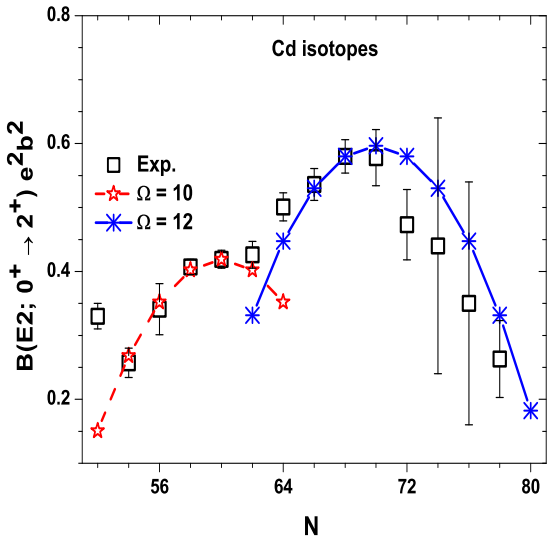
The load-bearing object is the generalized seniority quasi-spin algebra for multi-j identical nucleons, built from $S^+=\sum_j (-1)^{l_j}S^+_j$ with pair degeneracy $\Omega=\sum_j(2j+1)/2$. Two reduction formulas carry the argument. Equation (3), $\langle \tilde j^n v l J || \sum_i r_i^2 Y^2 || \tilde j^n v l J \rangle = [(\Omega-n)/(\Omega-v)]\langle \tilde j^v \ldots \rangle$, makes quadrupole moments linear in nucleon number and zero at midshell; Eq. (4) makes $\sqrt{B(E2)}$ for $\Delta v=2$ transitions flat in the interior while the change of effective configuration across $N=64$ produces the asymmetric double-hump. Constancy of excitation energies follows from Eq. (2), $E(\tilde j^n,v=2,J)-E(\tilde j^n,v=0,0)=\langle\tilde j^2J|V_{ik}|\tilde j^2J\rangle-V_0$, which is independent of $n$. The multi-j configurations $\Omega=9$, $10$, $12$ and the freeze-out of $g_{7/2}$ and $d_{5/2}$ at $N=64$ map these formulas onto the Cd, Sn and Te chains.
What would settle it
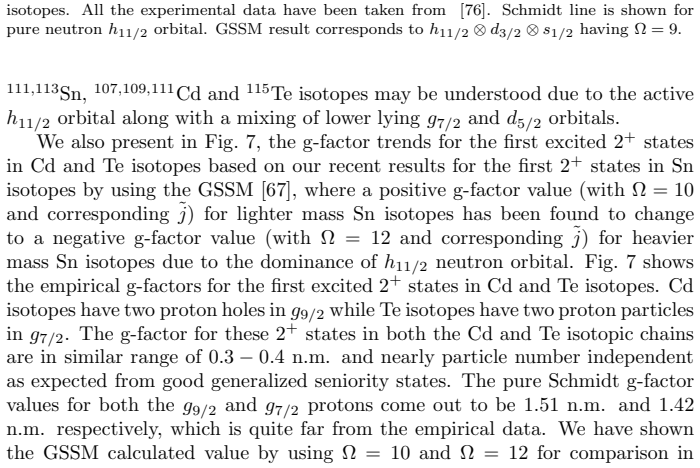
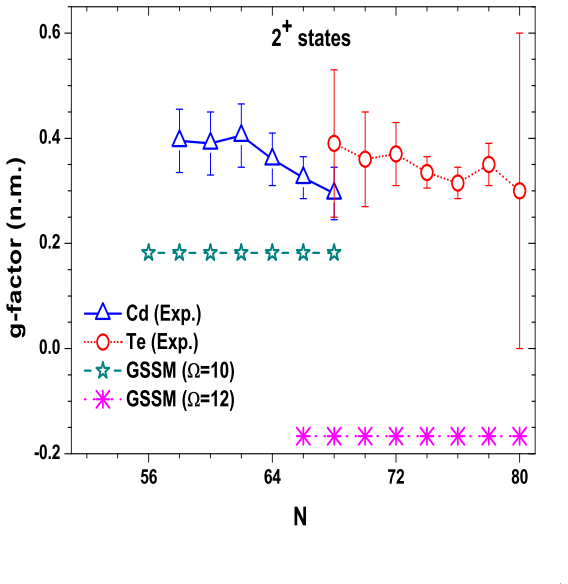
A measurement of the $11/2^-$ quadrupole moment in a neutron-rich Te isotope near $N=81$ that breaks the predicted linear trend and zero crossing at $N=73$, or a $B(E2;0^+\to2^+)$ value in exotic Cd near $N=80$ that does not follow the descending parabola, would falsify the neutron-only generalized seniority picture. A more direct test is the $2^+$ g-factor: the paper itself reports systematic deviations in Cd and Te, and precise g-factors that move with neutron number would show the constant proton-shift assumption fails.
Extended reading notes
Core claim
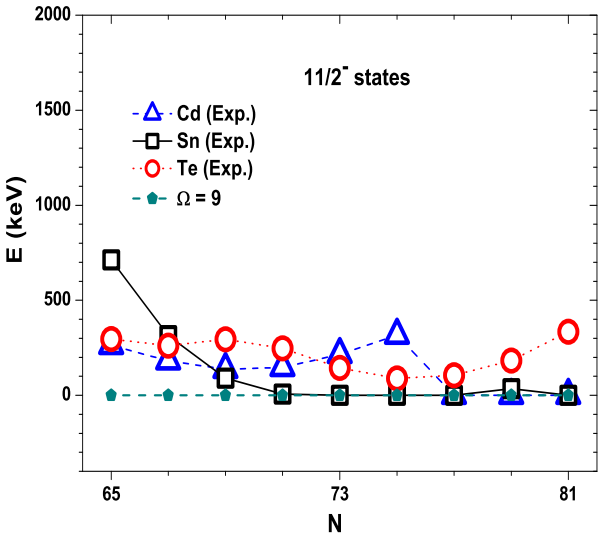
The central claim is that generalized seniority, defined through the quasi-spin pair operator $S^+=\sum_j (-1)^{l_j} S^+_j$, remains a good quantum number for the low-lying $2^+$ and $11/2^-$ states not only in the semi-magic Sn isotopes but also in Cd and Te isotopes, where proton holes or particles are present. With the neutron $N=50$–$82$ valence space split at $N=64$ into two effective multi-j configurations—$\Omega=10$ ($g_{7/2}\otimes d_{5/2}\otimes d_{3/2}\otimes s_{1/2}$) before the middle and $\Omega=12$ ($d_{5/2}\otimes h_{11/2}\otimes d_{3/2}\otimes s_{1/2}$) after—the scheme reproduces the asymmetric double-hump $B(E2;0^+\to2^+)$ pattern in Cd and Te just as it did in Sn. The $11/2^-$ quadrupole moments, treated as generalized seniority $v=1$ states in $\Omega=9$ ($h_{11/2}\otimes d_{3/2}\otimes s_{1/2}$), increase linearly with neutron number and cross zero at $N=73$ in all three chains. Proton holes and particles enter only as a neutron-number-independent constant; the paper states that the g-factor lines lie systematically below the measured Cd and Te values, so proton contributions are small but not zero. No shell quenching is found, meaning N=50 and N=82 stay closed.
Load-bearing premise
The load-bearing premise is that the proton holes in Cd and the proton particles in Te act only through a constant energy and moment contribution that does not change as the neutron number varies; if proton-neutron interactions depend on neutron number, the neutron-only model loses its explanatory power.
Editorial extensions
If this is right
- The same generalized seniority quantum number governs the first $2^+$ and $11/2^-$ states across three isotopic chains despite the proton-hole/particle difference, so the gross structure around Z=50 is controlled by neutron filling.
- The asymmetric double-hump in $B(E2)$ is a signature of changing neutron orbitals at $N=64$, not of deformation or of a weakened shell, and models that predict shell quenching are inconsistent with this data.
- Linear quadrupole-moment trends with a zero at $N=73$ should hold for the $11/2^-$ states in all three chains, giving a specific experimental prediction for unmeasured Te isotopes.
- Magic numbers N=50 and N=82 remain unchanged, so shell-model spaces built on these closures remain valid for describing the low-lying states.
Reading between the lines
- The neutron-only success suggests a broader empirical rule: in near-closed-shell nuclei with a few proton holes or particles, proton-neutron correlations may largely average into a state-independent shift, so seniority-like descriptions could extend to other chains such as those around Z=82 or N=126.
- A natural extension is to treat the proton contribution not as a constant but as a slowly varying function of neutron number; the g-factor deviations the paper reports give a quantitative target for fitting that function.
- The different radial integrals extracted from fitting Cd, Sn and Te ($45.78$, $42.04$, $60.05$ fm$^2$) suggest that the effective charge of the neutron quasi-particle changes across the proton-shell closure, a trend that could be compared with large-scale shell-model effective charges.
Signed reviews
Editorial analysis
A structured set of objections, weighed in public.
Referee Report
Summary. The manuscript applies the multi-j generalized seniority scheme to describe the first 2+ states and the 11/2- states in the Cd, Sn, and Te isotopic chains around Z=50. Using neutron valence space alone, with the proton holes in Cd and proton particles in Te absorbed into a constant shift, the authors claim to explain the nearly constant 2+ excitation energies, the asymmetric double-hump B(E2) systematics, the linearly increasing quadrupole moments of the 11/2- states, and the g-factor trends. The paper further concludes that no shell quenching is supported and that the N=50 and N=82 magic numbers remain robust in these chains. The analysis fits one or two experimental points per curve and uses the freeze-out of the g7/2 and d5/2 orbitals at N=64 to switch between two configurations (Omega=10 before and Omega=12 after the middle of the shell).
Significance. If the neutron-only description were quantitatively robust, the paper would provide a notable extension of generalized seniority to non-semi-magic nuclei and a simple organizing scheme for the Z=50 region. The systematic comparison across three isotopic chains is useful and the paper makes an honest attempt to confront a broad set of electromagnetic observables. However, the quantitative support is weaker than the presentation suggests: each calculated curve is normalized to one or two experimental points, the N=64 boundary between configurations is externally chosen, the zero crossing of the quadrupole moment at N=73 follows directly from the chosen Omega=9 active space, and the shell-quenching conclusion is built into the model's fixed valence space rather than derived from data. The paper would be substantially strengthened by a residual analysis, a sensitivity study of the N=64 switch, and a more careful reframing of the shell-quenching claim.
major comments (4)
- [Sec. 3.1 and Sec. 3.4] No further text.
- [Sec. 3.3, Eq. (3)] No further text.
- [Sec. 3.1 and Sec. 3.2] No further text.
- [Abstract; Sec. 3.2 and Sec. 4] No further text.
minor comments (4)
- [Table 1 and Sec. 3.3] No further text.
- [Sec. 3.2] No further text.
- [Sec. 3.3] No further text.
- [Eqs. (6)-(7)] No further text.
Circularity Check
The paper's headline claims reduce to its input choices: no shell quenching is inherited from the fixed valence-space assumption, the N=73 quadrupole zero follows from Omega=9 and the N=64 cutoff, and the B(E2) double hump is built from the Omega=10/12 split with one fitted point per side.
-
self definitional
[Section 3.2, B(E2) discussion (paragraph beginning 'One may note...')]
"One may note that the calculations only consider the active orbitals of N = 50 − 82 valence space. No signs of shell quenching have, therefore, been witnessed for these first excited 2 + states in all the three Cd, Sn and Te isotopes."
The calculation is restricted from the outset to the N=50-82 valence space, so the absence of shell quenching is an input of the model, not an output. The sentence 'No signs of shell quenching have, therefore, been witnessed' explicitly derives the conclusion from the active-space restriction. Any model that fixes these orbitals as the full valence space cannot detect quenching, so the abstract's claim that N=50 and N=82 'remain robust' is equivalent to the assumption made before the calculation.
-
self definitional
[Section 3.3, Quadrupole moments of the 11/2- states]
"The calculations have been done by assuming these 11 / 2− states as the generalized seniority v = 1 states arising from the multi-j configuration corresponding to the pair degeneracy Ω = 9 ... The g7/ 2 and d5/ 2 orbitals are assumed to be fully occupied till N = 64 ... Hence, we obtain a linear trend as per the Ω −n/Ω −v coefficient for the full chains after N = 64 ... The calculated trends also support the zero Q value at N = 73."
With v=1 and Omega=9, Eq. (3) gives Q proportional to (Omega-n)/(Omega-v) = (9-n)/8. Counting n = N-64 after the assumed N=64 freeze-out, the zero occurs at n=9, i.e. N=73. Thus the celebrated zero crossing at N=73 is arithmetic from the chosen Omega and the chosen starting point, not an independent prediction. The radial integral is also fixed by fitting one experimental Q value per chain, so the magnitude scale is fitted as well.
2 more flagged steps
-
ansatz smuggled in via citation
[Section 3.2, B(E2) double-hump paragraph]
"The generalized seniority calculations for the even-even Cd and Te isotopes use the multi-j configuration corresponding to Ω = 10 (before the middle) and Ω = 12 (after the middle), respectively, as assumed in the case of Sn isotopes in our earlier paper [63] ... To take care of the other structural effects, we fit one of the experimental data and restrict the values of radial integrals and involved 3j− and 6j− coefficients as a constant."
The two asymmetric parabolas are generated by switching from Omega=10 before N=64 to Omega=12 after N=64, a split taken from the authors' prior Sn study and motivated by the same data feature (the kink/dip near mid-shell). With one experimental point fitted in each region and all radial/angular factors held constant, each hump is a one-parameter curve through the data; the 'asymmetric double-hump behavior' is therefore imposed by the choice of active space and normalization rather than derived from the generalized seniority algebra alone.
-
fitted input called prediction
[Section 3.1, particle-number-independent energy variation]
"However, a constant proton contribution can take care of this nearly particle number independent energy variation in Cd and Te isotopes also ... This constant and additional proton contribution have been obtained by fitting E(˜jn, v = 2, J ) − E(˜jn, v = 0, J = 0) from one of the experimental data of Cd isotopes for both Ω = 10 and 12 multi-j configurations."
The abstract's claim that a neutron-only model explains Cd and Te rests on absorbing the proton hole/particle effects into a constant fitted from one experimental energy per configuration. Since the fitted constant is exactly the proton contribution whose neutron-number independence is the premise, the calculation does not test that premise; Section 3.4 later concedes 'contributions from proton orbitals cannot be ignored completely' for g-factors. The energy trends for Cd/Te are therefore reproduced by construction after a per-chain fit, not predicted from neutron valence space alone.
full rationale
The generalized seniority reduction formulas (Eqs. 3-7) are legitimate algebraic results, and using them to represent data is not circular by itself; likewise, citing prior work on seniority is normal scientific practice. The circularity enters at the level of the paper's advertised conclusions. The no-shell-quenching statement is a restatement of the fixed N=50-82 valence-space input. The quadrupole zero at N=73 follows identically from Omega=9 and the assumed N=64 freeze-out of g7/2 and d5/2, with the one-point fit setting the scale. The B(E2) double hump is produced by imposing Omega=10 before mid-shell and Omega=12 after mid-shell, with one fitted point per side, so the asymmetric shape is an input ansatz (inherited from the authors' earlier Sn paper) rather than an independent outcome. Finally, the 'neutron valence space alone' explanation for Cd and Te energies depends on a fitted constant proton shift, and the paper itself admits that proton contributions cannot be ignored completely in the g-factor analysis. These are not fatal flaws in the algebraic framework, but they mean the paper's strongest claims are partially circular: several 'predictions' reduce by construction to the chosen Omega values, the fitted normalization, and the shell-quenching-free active space. Since no external large-scale shell-model comparison or out-of-sample test is provided, the circularity score is 6.
Assumptions & free parameters
free parameters (8)
- Radial integral for 11/2^- Q-moment in Sn =
42.04 fm^2
- Radial integral for 11/2^- Q-moment in Cd =
45.78 fm^2
- Radial integral for 11/2^- Q-moment in Te =
60.05 fm^2
- B(E2) normalization for the lower parabola (N<64) =
Not stated
- B(E2) normalization for the upper parabola (N>64) =
Not stated
- 2+ excitation energy constants for Sn =
Fitted to one experimental level each for N<64 and N>64
- 2+ excitation energy constant for Cd and Te =
Fitted to one experimental Cd level
- N=64 sub-shell closure switch point =
64
assumptions (5)
- domain assumption Validity of generalized seniority reduction formulas (Eqs. 3 and 4) for the chosen multi-j configurations.
- domain assumption The N=50-82 valence space is spanned by configurations giving Omega=9, 10, and 12, with g7/2 and d5/2 frozen at N=64.
- ad hoc to paper The two proton holes/particles in Cd and Te contribute a constant, neutron-number-independent shift.
- domain assumption The effective neutron charge equals the free neutron charge when deducing the radial integral <r^2>^{1/2}.
- domain assumption The quasi-spin algebra with alpha_j=(-1)^{l_j} provides good generalized seniority quantum numbers.
Cite this review
Pith. "Pith review of Evolution of nuclear structure in and around Z=50 closed shell: Generalized Seniority in Cd, Sn and Te isotopes." pith.science (2026). https://pith.science/paper/CKY3SAU3
@misc{pith2026190805028,
  author       = {Pith},
  title        = {Pith review of: Evolution of nuclear structure in and around Z=50 closed shell: Generalized Seniority in Cd, Sn and Te isotopes},
  year         = {2026},
  howpublished = {\url{https://pith.science/paper/CKY3SAU3}},
  note         = {Machine review of arXiv:1908.05028}
}
abstract
We study the quadrupole moments and the B(E2; $2^+ \rightarrow 0^+$) values for the ${11/2}^-$ states and the first $2^+$ states, respectively, by using a multi-j generalized seniority approach in the Cd (Z = 48), Sn (Z = 50) and Te (Z = 52) isotopic chains. The g-factor trends have also been discussed. Although, Cd and Te isotopes represent two-proton hole and two-proton particle systems, thus involving both kind of particles (protons and neutrons) in contrast to Sn (Z = 50) where only neutrons play a role, we find that a similar model based on neutron valence space alone is able to explain nearly all the gross features and trends. This paper represents the first attempt to test the validity of the generalized seniority scheme away from the semi-magic region and appears to be surprisingly successful. The linearly varying quadrupole moments in Cd, Sn and Te isotopes, are described by using a consistent multi-j configuration. The asymmetric double-hump behavior of B(E2) values in Cd and Te isotopes are understood in a manner identical to that of Sn isotopes by using the generalized seniority scheme for the first time. No shell quenching is supported in the calculations; hence, the neutron magic numbers, N = 50 and N = 82, remain robust in these isotopic chains.
Figures


Figures from the paper (6 more)


Reference graph
Works this paper leans on
-
[1]
A. Bohr and B. R. Mottelson, Nuclear Structure, W. A. Benjamin Inc., New York, Volume I: Single Particle Motion, 1969 and Volume II: Nuclea r Deformations, 1975
work page 1969
-
[2]
M. G. Mayer and J. H. D. Jensen, Elementary Theory of Nuclear S hell Structure, John Wiley and Sons Inc., New York, 1955
work page 1955
-
[3]
G. Racah, Phys. Rev 63, 367 (1943); Research Council of Israel, Jerusalem, L. F arkas Memorial V olume, 294 (1952)
work page 1943
-
[4]
A. de Shalit and I. Talmi, Nuclear Shell Theory, Academic Press, Ne w York and London, 1963
work page 1963
-
[5]
R. F. Casten, Nuclear Structure from a Simple Perspective, Oxf ord Uni- versity Press, 1990
work page 1990
-
[6]
Heyde, The Nuclear Shell model, Springer-Verlag Belrin Heidelbe rg, 1990
K. Heyde, The Nuclear Shell model, Springer-Verlag Belrin Heidelbe rg, 1990
work page 1990
-
[7]
Talmi, Simple Models of Complex Nuclei, Harwood, 1993
I. Talmi, Simple Models of Complex Nuclei, Harwood, 1993
work page 1993
-
[8]
P. V. Isacker, Nucl. Phys. News 24, 23 (2014)
work page 2014
Show all 76 references
-
[9]
D. T. Yordanov et al. , Phys. Rev. Lett. 110, 192501 (2013)
2013
-
[10]
Wood, Physics 6, 52 (2013)
J. Wood, Physics 6, 52 (2013)
2013
-
[11]
Vancraeyenest et al
A. Vancraeyenest et al. , EPJ Web Conf. 62, 01004 (2013)
2013
-
[12]
P. W. Zhao, S. Q. Zhang and J. Meng, Phys. Rev. C 89, 011301(R) (2014)
2014
-
[13]
N. B. de Takacsy, Phys. Rev. C 89, 034301 (2014)
2014
-
[14]
Ilieva et al
S. Ilieva et al. , Phys. Rev. C 89, 014313 (2014). 17
2014
-
[15]
Ramayya et al
A.V. Ramayya et al. , AIP Conf. Proc. 1609, 113 (2014)
2014
-
[16]
Y. Lei, H. Jiang and S. Pittel, Phys. Rev. C 92, 024321 (2015)
2015
-
[17]
Mishev and V
S. Mishev and V. V. Voronov, Phys. Rev. C 92, 044329 (2015)
2015
-
[18]
Wood, EPJ Web Conf
J.L. Wood, EPJ Web Conf. 93, 01006 (2015)
2015
-
[19]
Banerjee et al
P. Banerjee et al. , Phys. Rev. C 92, 024318 (2015)
2015
-
[20]
Lei et al
Y. Lei et al. , J. Phys.:Conf. Ser. 730, 012015 (2016)
2016
-
[21]
Benczer-Koller et al
N. Benczer-Koller et al. , Phys. Rev. C 94, 034303 (2016)
2016
-
[22]
Lascar et al
D. Lascar et al. , Phys. Rev. C 96, 044323 (2017)
2017
-
[23]
Schmidt, K
T. Schmidt, K. L. G. Heyde, A. Blazhev and J. Jolie, Phys. Rev. C 96, 014302 (2017)
2017
-
[24]
Z. Z. Qin and Y. Lei, Nucl. Sci. Tech. 29, 163 (2018)
2018
-
[25]
D. T. Yordanov et al. , Phys. Rev. C 98, 011303(R) (2018)
2018
-
[26]
Chaudhary et al
R. Chaudhary et al. , Nucl. Phys. A 970, 44 (2018)
2018
-
[27]
Rosner, Phys
B. Rosner, Phys. Rev. 136, B644 (1964)
1964
-
[28]
Silva and G.E
R.J. Silva and G.E. Gordon, Phys. Rev. 136, B618 (1964)
1964
-
[29]
Kawase et al
Y. Kawase et al. , Nucl. Phys. A 241, 237 (1975)
1975
-
[30]
Fogelberg et al
B. Fogelberg et al. , Nucl. Phys. A 267, 317 (1976)
1976
-
[31]
Pandoh, Rani Devi and S.K
A. Pandoh, Rani Devi and S.K. Khosa, Phys. Rev. C 60, 047302 (1992)
1992
-
[32]
Zamfir, R.L
N.V. Zamfir, R.L. Gill, D.S. Brenner, R.F. Casten and A. Wolf, Phys. Rev. C 51, 98 (1995)
1995
-
[33]
Long, S.J
G.L. Long, S.J. Zhut and H.Z. Sun, J. Phys. G, Nucl. Part. Phys. 21, 331 (1995)
1995
-
[34]
Juutinen et al
S. Juutinen et al. , Phys. Lett. B 386, 80 (1996)
1996
-
[35]
Buforn et al
N. Buforn et al. , Eur. Phys. J. A 7, 347 (2000)
2000
-
[36]
Corminboeuf et al
F. Corminboeuf et al. , Phys. Rev. Lett. 84, 4060 (2000)
2000
-
[37]
Fotiades et al
N. Fotiades et al. , Phys. Rev. C 61, 064326 (2000)
2000
-
[38]
Fotiades et al
N. Fotiades et al. , Phys. Scr. T 88, 127 (2000)
2000
-
[39]
Kautzsch et al
T. Kautzsch et al. , Eur. Phys. J. A 9, 201 (2000)
2000
-
[40]
Dillmann et al
I. Dillmann et al. , Phys. Rev. Lett. 91, 162503 (2003)
2003
-
[41]
Bandyopadhyay et al
D. Bandyopadhyay et al. , Phys. Rev. C 68, 014324 (2003)
2003
-
[42]
Kadi et al
M. Kadi et al. , Phys. Rev. C 68, 031306 (2003)
2003
-
[43]
Wang et al
Y. Wang et al. , Phys. Rev. C 67, 064303 (2003). 18
2003
-
[44]
Batchelder et al
J.C. Batchelder et al. , Phys. Rev. C 72, 044306 (2005)
2005
-
[45]
Kautzsch et al
T. Kautzsch et al. , Eur. Phys. J. A 25, 117 (2005)
2005
-
[46]
Jungclaus and J
A. Jungclaus and J. L. Egido, Phys. Scr. T125, 53 (2006)
2006
-
[47]
Jungclaus et al
A. Jungclaus et al. , Phys. Rev. Lett. 99, 132501 (2007)
2007
-
[48]
Garrett et al
P.E. Garrett et al. , Phys. Rev. C 75, 054310 (2007)
2007
-
[49]
Stoyer et al
M.A. Stoyer et al. , Nucl. Phys. A 787, 455 (2007)
2007
-
[50]
Hoteling et al
N. Hoteling et al. , Phys. Rev. C 76, 044324 (2007)
2007
-
[51]
Dworschak et al
M. Dworschak et al. , Phys. Rev. Lett. 100, 072501 (2008)
2008
-
[52]
T. R. Rodriguez, J. L. Egido and A. Jungclaus, Phys. Lett. B 668, 410 (2008)
2008
-
[53]
Batchelder et al
J.C. Batchelder et al. , Phys. Rev. C 80, 054318 (2009)
2009
-
[54]
Caceres et al
L. Caceres et al. , Phys. Rev. C 79, 011301(R) (2009)
2009
-
[55]
Garrett and J.L
P.E. Garrett and J.L. Wood, J. Phys. G 37, 064028 (2010)
2010
-
[56]
Chamoli et al
S.K. Chamoli et al. , Phys. Rev. C 83, 054318 (2011)
2011
-
[57]
Frauendorf, Y
S. Frauendorf, Y. Gu and J. Sun, Int. J. Mod. Phys. E 20, 465 (2011)
2011
-
[58]
Luo et al
Y.X. Luo et al. , Nucl. Phys. A 874, 32 (2012)
2012
-
[59]
Hossain et al
I. Hossain et al. , Int. J. Mod. Phys. E 21, 1250072 (2012)
2012
-
[60]
A. K. Kerman, Ann. Phys. (NY) 12 300 (1961)
1961
-
[61]
Helmers, Nucl
K. Helmers, Nucl. Phys. 23, 594 (1961)
1961
-
[62]
Maheshwari and A
B. Maheshwari and A. K. Jain, Phys. Lett. B 753, 122 (2016)
2016
-
[63]
Maheshwari, A
B. Maheshwari, A. K. Jain and B. Singh, Nucl. Phys. A 952, 62 (2016)
2016
-
[64]
A. K. Jain and B. Maheshwari, Nuclear Phys. Review 34, 73 (2017)
2017
-
[65]
A. K. Jain and B. Maheshwari, Physica Scripta 92, 074004 (2017)
2017
-
[66]
Maheshwari, S
B. Maheshwari, S. Garg and A. K. Jain, Pramana-Journal of Ph ysics (Rapid Comm.) 89, 75 (2017)
2017
-
[67]
Maheshwari and A
B. Maheshwari and A. K. Jain, Nuclear Physics A 986, 232 (2019)
2019
-
[68]
B. H. Flowers, Proc. Roy. Soc. (London) A, 212, 248 (1952)
1952
-
[69]
Arima and M
A. Arima and M. Ichimura, Prog. of Theo. Phys. 36, 296 (1966)
1966
-
[70]
Talmi, Nucl
I. Talmi, Nucl. Phys. A 172, 1 (1971)
1971
-
[71]
Shlomo and I
S. Shlomo and I. Talmi, Nucl. Phys. A 198, 82 (1972)
1972
-
[72]
Arvieu and S
R. Arvieu and S. A. Moszokowski, Phys. Rev. 145, 830 (1966). 19
1966
-
[73]
V. K. B. Kota, Bulgarian Journal of Physics 44, 454 (2017); arXiv: 1707.03552v1
2017 arXiv
-
[74]
National Nuclear Data Center; www.nndc.bnl.gov/
-
[75]
Pritychenko, M
B. Pritychenko, M. Birch, B. Singh and M. Horoi, Atomic Data Nuc lear Data Tables 107, 1 (2016)
2016
-
[76]
N. J. Stone, www-nds.iaea.org/publications, INDC(NDS)-0658 , Feb. (2014). 20
2014
Reviewed August 14, 2026 · model on record in the stance chip above.
Discussion (0). Continue with ORCID to comment.