REVIEW 3 major objections 3 minor 30 references
Computing and Communicating Functions in Disorganized Wireless Networks
T0 review · 3 major / 3 minor · reviewed 2026-08-14 · deepseek-v4-flash
Pith's one-line read This paper shows that a disorganized wireless network can be reorganized into layers so that the fusion center's function-computation rate is the minimum of simple per-hop CoMAC rates, generalizing over-the-air computation and orthogonal…
desk verdict A promising hierarchical CoMAC framework undermined by a load-bearing entropy normalization error and an invalid Jensen step; the special cases are right but the general rate formula does not hold as stated. read the letter →
The pith
A machine-rendered reading of the paper's core claim, the machinery that carries it, and where it could break.
The reading
What carries the argument
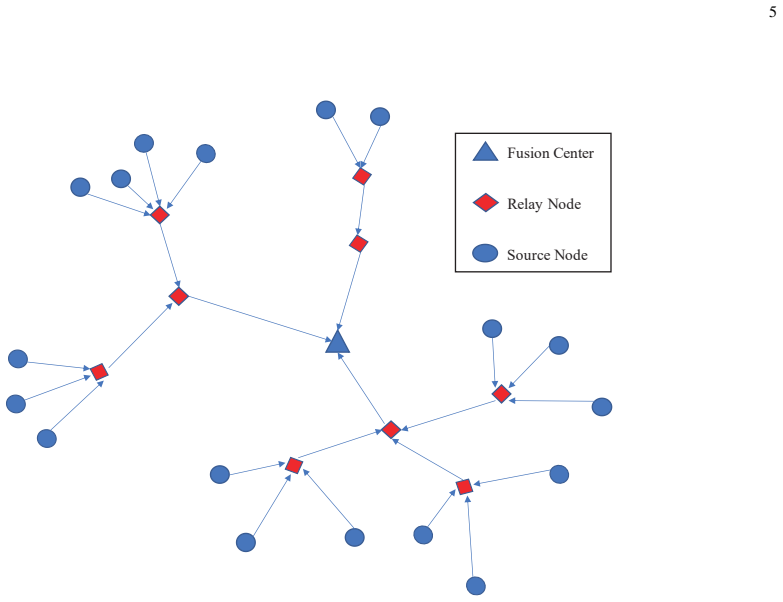
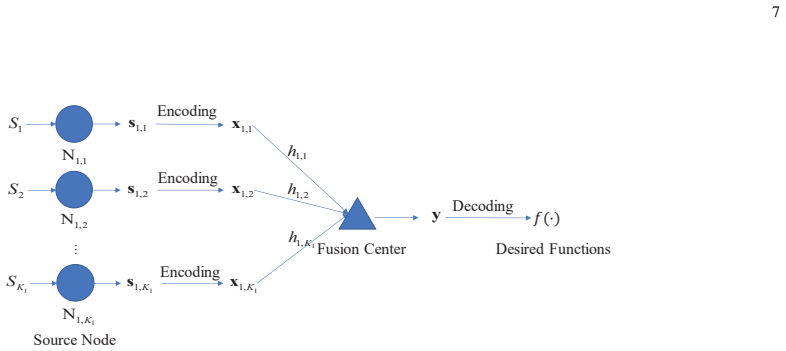
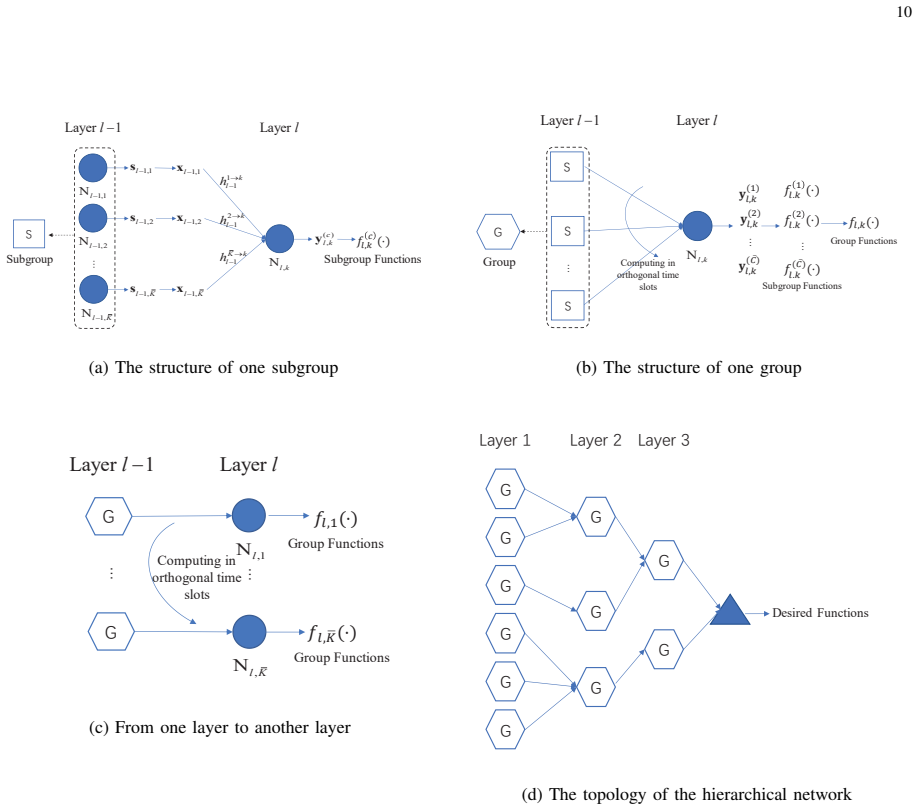
The central object is the layered hierarchical reorganization: every layer's nodes are partitioned into groups, each group into subgroups; within a subgroup all nodes transmit simultaneously so CoMAC computes a subgroup function, and within a group the subgroup functions are forwarded over orthogonal time slots so the node reconstructs the group function. The load-bearing recurrence is Eq. (18), which states that the number of function values available at a node is the minimum of what its parents supply and what its own subgroups compute; Theorem 2 is the repeated minimum of these per-hop rates. The physical-layer engine that makes each per-subgroup rate achievable is a sequence of nested lattice codes.
What would settle it
Simulate or build a three-layer network with four source nodes, two second-layer relays, and one fusion center under i.i.d. Rayleigh fading, and measure the maximum number of desired-function values per channel use with optimal time allocation; if the measured rate disagrees with Eq. (29), the paper's central claim is wrong.
Extended reading notes
Core claim
The paper establishes that any disorganized network whose nodes each have a single transmission destination can be reorganized into an $L$-layer hierarchy, and that in this hierarchy the fusion center can compute the desired function at rate $$R=\min_{l\in[2:L]}\min_{k\in\mathcal{K}_l}\alpha_{l,k}\min_{c\in\mathcal{C}_{\mathcal{N}_{l,k}}}\$beta^{{(c)}}$_{l,k}\mathbb{E}\left[C_+\left(\frac{1}{$K^{{(c)}}$_{\mathcal{N}_{l,k}}}+\min_{i\in\mathcal{K}^{(c)}_{\mathcal{N}_{l,k}}}|$h^{{i\to k}}$_{l-1}|^$2P^{{i\to k}}$_{l-1}\right)\right],$$ where $C_+(x)=\max\{\frac{1}{2}\log x,0\}$, $\alpha_{l,k}$ is the fraction of channel uses given to node $N_{l,k}$, and $\beta^{(c)}_{l,k}$ is the fraction given to subgroup $c$. The proof is a recurrence: the number of desired-function values that survive to a node is the minimum of the numbers its parent groups supply and the numbers its own subgroups compute, so the overall rate is the worst per-hop subgroup rate. The paper then derives closed-form solutions for time allocation with fixed power and with adaptive power, and notes that with one subgroup per layer the rate reduces to CoMAC while with one node per subgroup it reduces to orthogonal time-sharing.
Load-bearing premise
The formula assumes that every disorganized network can be reorganized into a layered hierarchy in which each node has exactly one transmission destination and every intermediate subgroup and group function carries the same entropy as the desired function; if either condition fails, the overall rate is not simply the minimum over per-hop rates.
Editorial extensions
If this is right
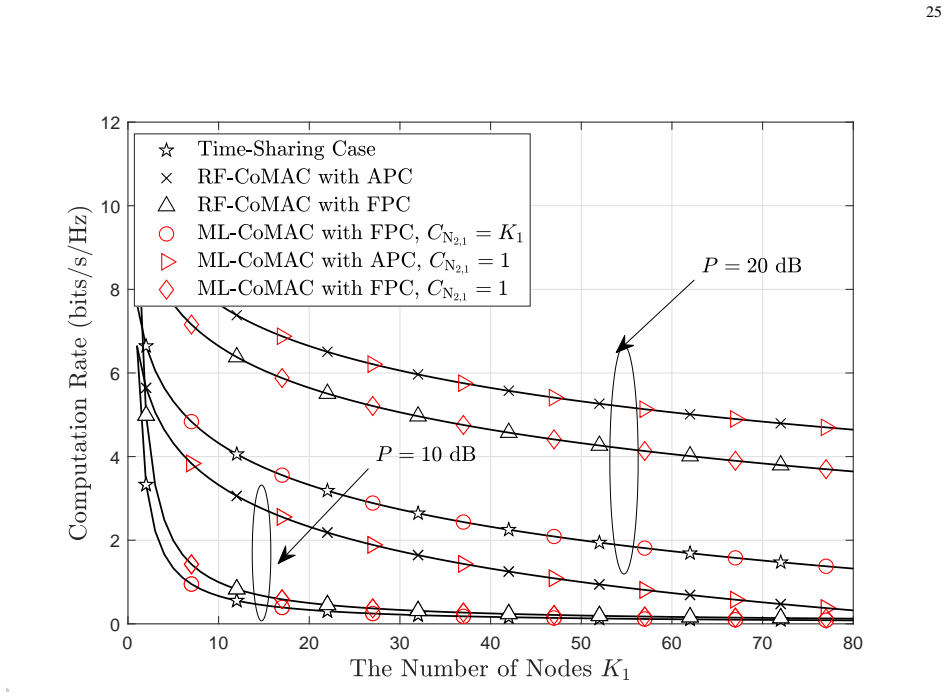
- In a two-layer network, setting the number of subgroups per group to one recovers the classical CoMAC rate, and setting it to the number of source nodes recovers the orthogonal time-sharing rate.
- Because the overall rate is the minimum across subgroups and layers, the optimal time allocation equalizes the products $\alpha_{l,k}\beta^{(c)}_{l,k}$ for all subgroups, with the closed-form optimum given by the reciprocal-sum expression in Eq. (29).
- Adaptive power control improves the achievable rate over fixed power control, and its optimal allocation is expressed through the Lambert W function.
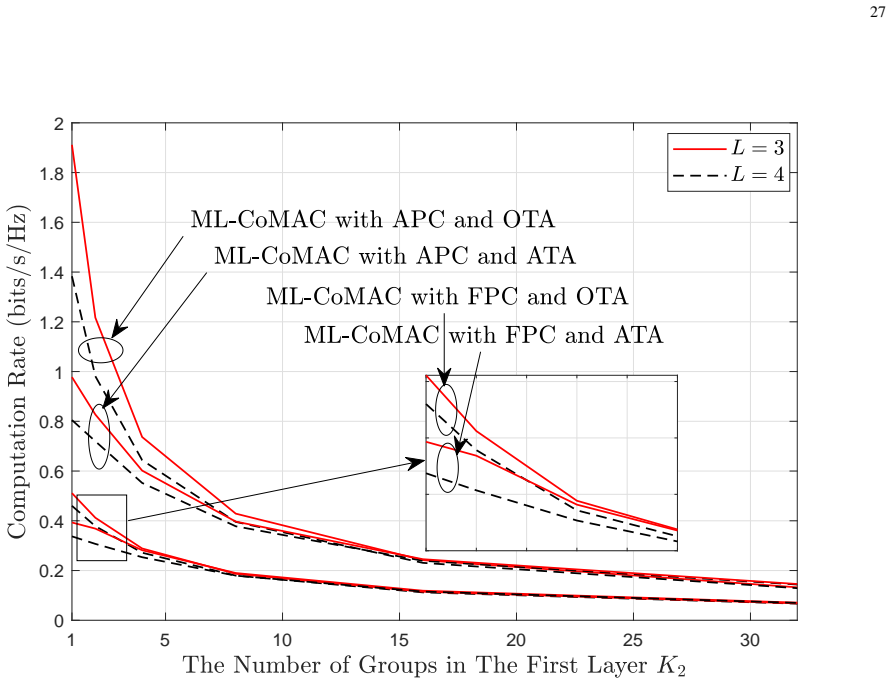
- Adding layers lowers the computation rate because each layer consumes channel uses, while increasing the number of groups can support a larger number of source nodes with a slower rate decline.
Reading between the lines
- The paper does not spell out that its min-of-rates formula turns function computation into a tree resource-allocation problem, so standard scheduling and network-utility methods could be adapted to choose group sizes and routes that maximize the bottleneck rate.
- If a subgroup function has a different entropy from the desired function, the rate normalization by $H(f(\mathbf{b}_v))$ in Definition 2 would need to be layer-specific; testing this with non-symmetric functions would show where the formula needs correction.
- The reorganization requires each node to have exactly one destination; extending the result to broadcasting or multi-destination nodes would likely require a min-cut-like bound over several per-node rates rather than a single minimum.
- The simulations suggest that adding groups slows the rate loss as the number of sources grows; a natural next step is to prove a scaling law as both the number of sources and the number of groups grow.
Signed reviews
Editorial analysis
A structured set of objections, weighed in public.
Referee Report
Summary. The paper considers computation of a desired function of distributed sources in a wireless network whose topology may be disorganized. The authors propose reorganizing such a network into a layered hierarchy of groups and subgroups, and then introduce multi-layer function computation (ML-FC) in which each subgroup function is computed by CoMAC and each group function is reconstructed by orthogonal communication over the subgroup outputs. The main theoretical claim is a closed-form computation rate for the desired function, expressed as a minimum over layers, groups, and subgroups of time-sharing factors times per-subgroup CoMAC rates (Theorems 1 and 2). The paper then formulates time-allocation and power-control problems and derives closed-form solutions, with simulation results comparing fixed and adaptive power control and optimal versus equal time allocation. The central claim is that this framework generalizes both classical CoMAC and orthogonal communication schemes to multi-hop settings.
Significance. If the rate formula and optimization results were correct, the paper would provide a useful design rule for multi-hop over-the-air computation and would extend CoMAC beyond single-hop relay-free networks. The problem is timely, and the hierarchical decomposition of the network into subgroups and groups is a natural and appealing conceptual step. The manuscript also gives closed-form resource-allocation expressions and simulations over Rayleigh fading channels, which would be of practical interest. However, the derivation of the main rate formula contains a load-bearing error in the conversion from computation rates to numbers of computed values, and the optimization section applies Jensen's inequality to a function that is not concave. These issues invalidate the central claims as stated, so the current contribution is not established.
major comments (3)
- [Section IV-B, Eq. (16)] The proof of Theorem 1 mishandles the relation between computation rate and the number of computed function values. Definition 2 states R = lim T_d/(n H(f)), so the number of values obtained in |T| channel uses is T_d = R |T| H(f), not R |T| / H(f) as written for U^(c)_l,k. The displayed equation for U^(c)_l,k is therefore dimensionally inconsistent, and the cancellation leading to the final expression in Eq. (16) is invalid. Independently, the normalization should use the entropy H(f^(c)_l,k) of the subgroup function, not H(f(bv)) of the desired function; these entropies differ in general, since a subgroup function typically depends on only a subset of sources. For example, with two one-source subgroups computing f=(S1,S2), H(S1)=1 bit, H(S2)=10 bits, equal per-subgroup rates R0 and beta=0.5, the paper's Eq. (14) gives 0.5 R0, while the entropy-corrected computation gives a rate bottlenecked by the first subgroup and equal to R0/22. The error changes which subgroup is the bottleneck, so it is not a constant-factor issue. Since Theorem 2 and all of Section V are built on Eq. (16), the claimed general rate and closed-form allocations are unsupported.
- [Section V-A, Eq. (21)] The Jensen step in Eq. (21) is invalid because C+(x) = max{0, 0.5 log x} is not concave on the positive reals. A concrete counterexample is X=0.5 with probability 0.5 and X=1.5 with probability 0.5: E[X]=1, so C+(E[X])=0, while E[C+(X)] = 0.25 log(1.5) > 0. Thus the asserted inequality E[C+(1/K + min |h|^2 P)] <= C+(1/K + E[min |h|^2] P) is false. Consequently Problem 1 and Problem 2 do not optimize the actual computation rate, but rather a rate expression obtained through an invalid upper bound. The subsequent closed-form solutions and the simulation comparisons based on those solutions therefore do not establish the claimed performance of the proposed time allocation. The same non-concavity also casts doubt on the convexity argument for Problem 4.
- [Section III-A, Remark 3] Remark 3 asserts without proof that every disorganized network can be equivalently represented as a layered hierarchy in which each node has exactly one transmission destination. In a general wireless network a node's transmission may be received by multiple relays, and a node may have multiple intended destinations, but the reorganization in Fig. 3 does not preserve such connectivity. As stated, the result applies only to networks with a single-destination routing structure. The authors should either prove the equivalence under explicit conditions or restrict the claims about 'disorganized networks' accordingly. This is a scope issue for the paper's main title and motivation, and it is not addressed in the system model.
minor comments (3)
- [Section IV-A, Algorithm 1] The step in Algorithm 1 that says 'The given channel uses for the group {N1,1,...,N1,5} belongs a set T2,1' should say 'belong to a set T2,1' and should specify whether the group includes all five nodes or only those in the depicted subgroup.
- [Eq. (14) and Eq. (17)] The equality between the sample average (1/|T^(c)|) sum over m in T^(c) and an expectation E[.] is only justified as an ergodic limit as the block length grows. It would be clearer to state this limit explicitly rather than writing the equality for a finite set of channel uses.
- [Section V-B, Eq. (34)] The denominator E[ min_i |h|^2 / |h|^2 ] uses h as a representative coefficient without defining its distribution or its relation to the channels in the subgroup. The expression would be clearer if written with explicit indices, for example E[ |h_i->k|^2 / |h_j->k|^2 ] under the stated symmetry assumption.
Circularity Check
No circularity found: the rate derivation composes an external CoMAC theorem with min-rate chaining; special-case reductions are consistency checks, not assumed inputs.
full rationale
The central claim is not assumed as an input anywhere in the derivation. Lemma 1 obtains the per-subgroup computation rate directly from the external CoMAC result [21, Theorem 3 and Section IV-A], whose authors do not overlap with the present paper. Theorem 1 then composes these external rates by taking minima over subgroup time fractions, and Theorem 2 chains the group rates across layers by repeated minima; this is a rate-composition argument, not a self-referential one. The optimization sections maximize that composed rate, so they are not renaming a fitted parameter as a prediction. The special-case reductions in Remarks 5 and 6, and the simulation checks in Section VI, instantiate the general formula with L=2 and particular subgroup counts and then recover [21] and time-sharing; recovering a known benchmark from a more general formula is a consistency check rather than circularity. Remark 3's equivalence between disorganized and hierarchical networks is a modeling assumption about topology, not a conclusion derived from the rate formula. The cited [22] includes some of the same authors, but it is not load-bearing: the proof of Lemma 1 and the CoMAC-rate steps cite [21], not [22]. One potential mathematical gap is that Eq. (16) normalizes every subgroup-function count by H(f(bv)) instead of the subgroup function's own entropy; this is a correctness or modeling concern, not circularity, because the rate expression is not assumed as an input. Thus the paper shows no significant circularity.
Assumptions & free parameters
assumptions (5)
- domain assumption Relay-free CoMAC achievable rate formula (Eq. 3) from [21, Theorem 3] holds for each subgroup.
- ad hoc to paper Any disorganized network can be reorganized into a hierarchical network with groups and subgroups, preserving routing paths (Remark 3).
- ad hoc to paper The desired function can be divided into subgroup functions and reconstructed by a function g_l,k (Eqs. 6 and 7).
- ad hoc to paper The entropy of each subgroup function equals H(f(bv)), the entropy of the desired function.
- ad hoc to paper C+(x)=max(0,0.5 log x) is concave so Jensen's inequality can be applied in Eq. (21).
invented entities (2)
-
Hierarchical network reorganization
-
Multi-layer function computation (ML-FC)
Cite this review
Pith. "Pith review of Computing and Communicating Functions in Disorganized Wireless Networks." pith.science (2026). https://pith.science/paper/YCP6UZPB
@misc{pith2026190805030,
  author       = {Pith},
  title        = {Pith review of: Computing and Communicating Functions in Disorganized Wireless Networks},
  year         = {2026},
  howpublished = {\url{https://pith.science/paper/YCP6UZPB}},
  note         = {Machine review of arXiv:1908.05030}
}
read the original abstract
For future wireless networks, enormous numbers of interconnections are required, creating a disorganized topology and leading to a great challenge in data aggregation. Instead of collecting data individually, a more efficient technique, computation over multi-access channels (CoMAC), has emerged to compute functions by exploiting the signal-superposition property of wireless channels. However, the implementation of CoMAC in disorganized networks with multiple relays (hops) is still an open problem. In this paper, we combine CoMAC and orthogonal communication in the disorganized network to attain the computation of functions at the fusion center. First, to make the disorganized network more tractable, we reorganize the disorganized network into a hierarchical network with multiple layers that consists of subgroups and groups. In the hierarchical network, we propose multi-layer function computation where CoMAC is applied to each subgroup and orthogonal communication is adopted within each group. By computing and communicating subgroup and group functions over layers, the desired functions are reconstructed at the fusion center. The general computation rate is derived and the performance is further improved through time allocation and power control. The closed-form solutions to optimization are obtained, which suggest that existing CoMAC and orthogonal communication schemes can be generalized.
Figures
Figures from the paper (5 more)



Reference graph
Works this paper leans on
-
[21]
Computation over Gaussian networks with orthogonal components,
S.-W. Jeon, C.-Y . Wang, and M. Gastpar, “Computation over Gaussian networks with orthogonal components,”IEEE Trans. Inf. Theory , vol. 60, no. 12, pp. 7841–7861, 2014
work page 2014
-
[1]
5G: Personal mobile internet beyond what cellular did to telephony,
G. Fettweis and S. Alamouti, “5G: Personal mobile internet beyond what cellular did to telephony,” IEEE Commun. Mag. , vol. 52, no. 2, pp. 140–145, 2014
work page 2014
-
[2]
Internet of things: A survey on enabling technologies, protocols, and applications,
A. Al-Fuqaha, M. Guizani, M. Mohammadi, M. Aledhari, and M. Ayyash, “Internet of things: A survey on enabling technologies, protocols, and applications,” IEEE Commun. Surv. Tutorials , vol. 17, no. 4, pp. 2347–2376, 2015
work page 2015
-
[3]
A. Orlitsky and J. R. Roche, “Coding for computing,” in Proceedings of IEEE 36th Annual F oundations of Computer Science. IEEE, 1995, pp. 502–511
work page 1995
-
[4]
A network information theory for wireless communication: Scaling laws and optimal operation,
L.-L. Xie and P. R. Kumar, “A network information theory for wireless communication: Scaling laws and optimal operation,” IEEE Trans. Inf. Theory , vol. 50, no. 5, pp. 748–767, 2004
work page 2004
-
[5]
Computing and communicating functions over sensor networks,
A. Giridhar and P. R. Kumar, “Computing and communicating functions over sensor networks,” IEEE J. Sel. Areas Commun., vol. 23, no. 4, pp. 755–764, 2005
work page 2005
-
[6]
Multisource, multidestination, multirelay wireless networks,
L.-L. Xie and P. R. Kumar, “Multisource, multidestination, multirelay wireless networks,” IEEE Trans. Inf. Theory , vol. 53, no. 10, pp. 3586–3595, 2007
work page 2007
-
[7]
The worst-case capacity of wireless sensor networks,
T. Moscibroda, “The worst-case capacity of wireless sensor networks,” in 2007 6th International Symposium on Information Processing in Sensor Networks . IEEE, 2007, pp. 1–10
work page 2007
Show all 30 references
-
[8]
Upper bound on function computation in directed acyclic networks,
C. Huang, Z. Tan, and S. Yang, “Upper bound on function computation in directed acyclic networks,” in 2015 IEEE Information Theory Workshop (ITW) . IEEE, 2015, pp. 1–5
2015
-
[9]
Joint sink mobility and routing to maximize the lifetime of wireless sensor networks: the case of constrained mobility,
J. Luo and J.-P. Hubaux, “Joint sink mobility and routing to maximize the lifetime of wireless sensor networks: the case of constrained mobility,” IEEE/ACM Trans. Networking , vol. 18, no. 3, pp. 871–884, 2010
2010
-
[10]
Minimum-energy connected coverage in wireless sensor networks with omni- directional and directional features,
K. Han, L. Xiang, J. Luo, and Y . Liu, “Minimum-energy connected coverage in wireless sensor networks with omni- directional and directional features,” in Proceedings of the thirteenth ACM international symposium on Mobile Ad Hoc Networking and Computing . ACM, 2012, pp. 85–94. 30
2012
-
[11]
Duty-cycle-aware minimum-energy multicasting in wireless sensor networks,
K. Han, Y . Liu, and J. Luo, “Duty-cycle-aware minimum-energy multicasting in wireless sensor networks,” IEEE/ACM Trans. Networking, vol. 21, no. 3, pp. 910–923, 2013
2013
-
[12]
Spatio-temporal compressive sensing and internet traffic matrices,
M. Roughan, Y . Zhang, W. Willinger, and L. Qiu, “Spatio-temporal compressive sensing and internet traffic matrices,” IEEE/ACM Trans. Networking , vol. 20, no. 3, pp. 662–676, 2012
2012
-
[13]
Data loss and reconstruction in sensor networks,
L. Kong, M. Xia, X.-Y . Liu, M.-Y . Wu, and X. Liu, “Data loss and reconstruction in sensor networks,” in 2013 Proceedings IEEE INFOCOM . IEEE, 2013, pp. 1654–1662
2013
-
[14]
Hierarchical data aggregation using compressive sensing (hdacs) in wsns,
X. Xu, R. Ansari, A. Khokhar, and A. V . Vasilakos, “Hierarchical data aggregation using compressive sensing (hdacs) in wsns,” ACM Trans. Sens. Netw. , vol. 11, no. 3, p. 45, 2015
2015
-
[15]
Nomographic functions: Efficient computation in clustered Gaussian sensor networks,
M. Goldenbaum, H. Boche, and S. Sta ´nczak, “Nomographic functions: Efficient computation in clustered Gaussian sensor networks,” IEEE Trans. Wireless Commun. , vol. 14, no. 4, pp. 2093–2105, 2015
2015
-
[16]
Over-the-air function computation in sensor networks,
O. Abari, H. Rahul, and D. Katabi, “Over-the-air function computation in sensor networks,” arXiv preprint arXiv:1612.02307, 2016
2016 arXiv
-
[17]
On the channel estimation effort for analog computation over wireless multiple-access channels,
M. Goldenbaum and S. Stanczak, “On the channel estimation effort for analog computation over wireless multiple-access channels,” IEEE Wireless Commun. Lett. , vol. 3, no. 3, pp. 261–264, 2014
2014
-
[18]
Computation over multiple-access channels,
B. Nazer and M. Gastpar, “Computation over multiple-access channels,” IEEE Trans. Inf. Theory , vol. 53, no. 10, pp. 3498–3516, 2007
2007
-
[19]
Computing linear functions by linear coding over networks,
R. Appuswamy and M. Franceschetti, “Computing linear functions by linear coding over networks,” IEEE Trans. Inf. Theory, vol. 60, no. 1, pp. 422–431, 2014
2014
-
[20]
Compute-and-forward: Harnessing interference through structured codes,
B. Nazer and M. Gastpar, “Compute-and-forward: Harnessing interference through structured codes,” IEEE Trans. Inf. Theory, vol. 57, no. 10, pp. 6463–6486, 2011
2011
-
[22]
Computation over wide-band multi-access channels: Achievable rates through sub-function allocation,
F. Wu, L. Chen, N. Zhao, Y . Chen, F. R. Yu, and G. Wei, “Computation over wide-band multi-access channels: Achievable rates through sub-function allocation,” IEEE Trans. Wireless Commun. , vol. 18, no. 7, pp. 3713–3725, 2019
2019
-
[23]
Analog computation over the wireless channel: A proof of concept,
A. Kortke, M. Goldenbaum, and S. Sta ´nczak, “Analog computation over the wireless channel: A proof of concept,” in SENSORS, 2014 IEEE . IEEE, 2014, pp. 1224–1227
2014
-
[24]
Over-the-air computation for cooperative wideband spectrum sensing and performance analysis,
L. Chen, N. Zhao, Y . Chen, F. R. Yu, and G. Wei, “Over-the-air computation for cooperative wideband spectrum sensing and performance analysis,” IEEE Trans. V eh. Technol., vol. 67, no. 11, pp. 10 603–10 614, 2018
2018
-
[25]
Lattices which are good for (almost) everything,
U. Erez, S. Litsyn, and R. Zamir, “Lattices which are good for (almost) everything,” IEEE Trans. Inf. Theory , vol. 51, no. 10, pp. 3401–3416, 2005
2005
-
[26]
Airshare: Distributed coherent transmission made seamless,
O. Abari, H. Rahul, D. Katabi, and M. Pant, “Airshare: Distributed coherent transmission made seamless,” in 2015 IEEE Conference on Computer Communications (INFOCOM) . IEEE, 2015, pp. 1742–1750
2015
-
[27]
Opportunistic function computation for wireless sensor networks,
S.-W. Jeon and B. C. Jung, “Opportunistic function computation for wireless sensor networks,” IEEE Trans. Wireless Commun., vol. 15, no. 6, pp. 4045–4059, 2016
2016
-
[28]
Computation of real-valued functions over the channel in wireless sensor networks,
M. Goldenbaum, “Computation of real-valued functions over the channel in wireless sensor networks,” Ph.D. dissertation, Technische Universit¨at M ¨unchen, 2014
2014
-
[29]
Mccormick-based relaxations of algorithms,
A. Mitsos, B. Chachuat, and P. I. Barton, “Mccormick-based relaxations of algorithms,” SIAM J. Optim. , vol. 20, no. 2, pp. 573–601, 2009
2009
-
[30]
Boyd and L
S. Boyd and L. Vandenberghe, Convex optimization. Cambridge university press, 2004
2004
Reviewed August 14, 2026 · model on record in the stance chip above.
Discussion (0). Continue with ORCID to comment.