REVIEW 4 major objections 5 minor 103 references
Exploring the mass surface near the rare-earth abundance peak via precision mass measurements at JYFLTRAP
T0 review · 4 major / 5 minor · reviewed 2026-08-14 · deepseek-v4-flash
Pith's one-line read New masses of 13 rare-earth isotopes improve r-process abundance agreement near A=165.
desk verdict Solid mass measurements with a genuinely useful contamination correction; the r-process claim is the weakest part, but the paper deserves a serious referee. read the letter →
The pith
A machine-rendered reading of the paper's core claim, the machinery that carries it, and where it could break.
The reading
What carries the argument
The central object is the atomic mass surface of the Z≈60–65 isotopic chains, expressed through finite-difference derivatives that turn mass values into structural observables: one-neutron separation energy, two-neutron separation energy, neutron pairing gap, two-neutron shell gap, and the proton-neutron interaction metric. For the abundance calculation, the load-bearing machinery is a reaction network with a statistical reaction code computing neutron-capture rates, a representative dynamical ejecta trajectory, and a simple asymmetric fission split, with a baseline theoretical mass model supplying masses beyond the measured region. The Penning-trap frequency-ratio measurements feed these derivatives, using two reference ion species and both time-of-flight and phase-imaging resonance techniques.
What would settle it
Recalculate the r-process abundances with the identical new masses but with several alternative ejecta trajectories (for instance higher Ye or entropy) or a different fission-product split; if the χ² improvement near A≈165 disappears or reverses for most alternatives, the paper's r-process claim would be falsified, as would a measurement of 168Dy or 169Tb that shows a sharp rise in two-neutron shell-gap energies at N=100.
Extended reading notes
Core claim
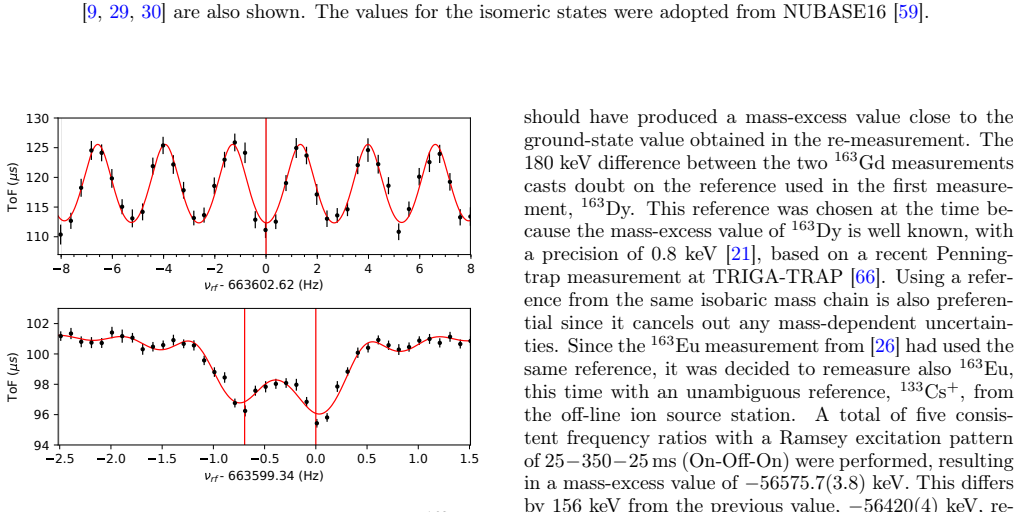
The central claim is that the measured masses, most of them new, alter the experimental mass surface of the neutron-rich rare-earth region in three connected ways. First, derivatives of the mass surface show no signature of the proposed N=100 subshell closure: two-neutron shell-gap energies do not rise at N=100, despite a peak in 2+ excitation energies. Second, the same derivatives show unusually large two-neutron shell-gap and proton-neutron interaction values at N=93 for 154Pm and at N=97 for 162Tb, evidence of enhanced proton-neutron interactions in odd-odd nuclei whose valence proton and neutron numbers are equal. Third, when the new masses replace extrapolated or older values in an r-process simulation using a representative low-electron-fraction merger ejecta trajectory, the abundance distribution near the top of the rare-earth peak at A≈165 becomes smoother and matches the solar r-process pattern more closely, as measured by a reduction of χ² from 10.7 to 9.6. The paper also reports that a reference ion used in the first JYFLTRAP campaign was most likely misidentified, and that re-analysis with the corrected calibrant makes the earlier 163Eu and 163Gd results consistent with the new measurements and with independent Penning-trap results.
Load-bearing premise
The r-process conclusion assumes that a single representative neutron-star merger ejecta trajectory with Ye=0.016 and s/kB=8, together with a simple asymmetric fission split and the adopted reaction rates, captures the conditions that form the rare-earth abundance peak; if those choices are unrepresentative, the reported improvement from χ²=10.7 to 9.6 would not necessarily follow from the new masses.
Editorial extensions
If this is right
- The experimental mass surface in the rare-earth region now extends beyond the limit of known nuclei in the 2016 mass evaluation, so future r-process simulations will use measured rather than extrapolated masses for 161Pm, 163Sm, 164,165Eu, 167Gd, and 165,167,168Tb.
- The absence of a two-neutron shell-gap increase at N=100 weakens the case for a subshell closure there, shifting attention to the observed structural change in 2+ excitation energies as a dynamical, rather than binding-energy, effect.
- The enhanced shell-gap and proton-neutron interaction values at N=93 and N=97 for 154Pm and 162Tb imply that valence proton-neutron interactions can produce local irregularities in the mass surface that global mass models do not reproduce.
- Pairing gaps derived from the new masses are systematically smaller than the baseline mass model predicts, so neutron capture and photodissociation rates used in r-process models may need adjustment toward weaker pairing in this mass region.
- With the corrected reference-ion assignment, the JYFLTRAP results for 162Eu, 163Eu, and 163Gd now agree with independent Penning-trap mass measurements, establishing a consistent local mass anchor near A=163.
Reading between the lines
- A direct testable extension would apply the same mass-surface derivative analysis to the neighboring even-Z chains such as Dy, Ho, and Er; if the N=97 enhancement persists across odd-odd isotones, the proton-neutron interaction interpretation would be strengthened.
- The abundance improvement should be re-tested with the same masses under a range of ejecta trajectories and fission yields; the paper uses one representative trajectory, and a multi-trajectory ensemble would reveal whether the reduced χ² near A≈165 is robust or trajectory-specific.
- The mass-surface trend implies that global mass models underestimating pairing for N≥94 will also mispredict photodissociation rates for nuclei on the r-process path, so future measurements could be prioritized where model disagreement is largest.
- A similar δVpn analysis applied to future measurements of odd-odd nuclides with equal valence proton and neutron numbers at larger N would show whether the enhancement repeats near the midshell or fades with increasing neutron number.
Signed reviews
Editorial analysis
A structured set of objections, weighed in public.
Referee Report
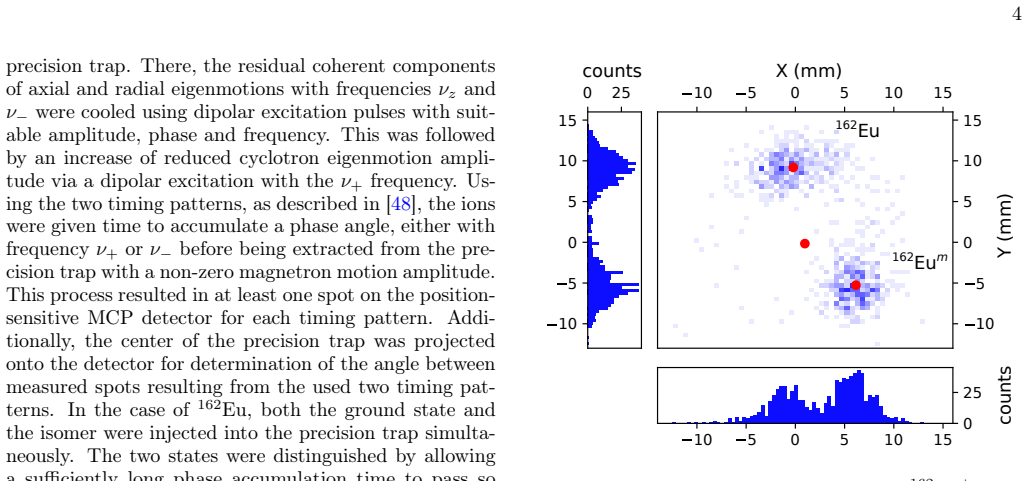
Summary. The paper reports precision atomic mass measurements of 13 neutron-rich rare-earth nuclides with the JYFLTRAP double Penning trap, including first-time measurements of 161Pm, 163Sm, 164Eu, 165Eu, 167Gd, 165Tb, 167Tb, and 168Tb. In addition, the paper remeasures 154Nd, 162Eu and its isomer, 163Eu, and 163Gd and its isomer, using both TOF-ICR and PI-ICR techniques. A central data-handling result is the identification of a likely contamination of the 163Dy reference ion used in the earlier JYFLTRAP campaign by 146La16O1H+, which leads to revised values for 163Eu and 163Gd. The mass surface is analyzed through one- and two-neutron separation energies, neutron pairing-gap energies, two-neutron shell-gap energies, and the δVpn metric. The authors conclude that the mass data do not support a subshell closure at N=100, that there are enhanced proton-neutron interactions at N=93 and N=97, and that the new masses improve the agreement of calculated r-process abundances with solar r-process abundances near A≈165, as quantified by a reduction of χ2 from 10.7 to 9.6.
Significance. The Penning-trap measurements themselves are a solid and valuable experimental contribution. The paper provides first-time masses for eight nuclides, a careful treatment of systematic uncertainties including Birge-ratio inflation, ion-ion interaction effects, and field-fluctuation uncertainties, and a convincing diagnostic of the earlier reference-ion misidentification. The complete frequency-ratio and mass-excess tables will be useful for future mass evaluations and astrophysical network calculations. The structural and r-process interpretations are interesting but less firmly established: the r-process comparison rests on a single representative trajectory and on a small χ2 change, and some of the structural enhancement claims are attributed to nuclei that were not measured in this paper. If the mass data are taken as the primary result, the paper merits publication after the interpretive claims are clarified or suitably softened.
major comments (4)
- [Section VI, Fig. 17] The r-process improvement claim is not robust as presented. The calculation uses a single representative dynamical-ejecta trajectory with Ye=0.016 and s/kB=8, and a fixed simple asymmetric fission split, with no sensitivity scan or trajectory ensemble. The statement that up to 90% of prompt ejecta produce very similar abundances is an assertion without a quantitative demonstration. In addition, the comparison labeled 'this work' includes not only the eight first-time masses but also the corrected 163Eu and 163Gd values, so the reported change from χ2=10.7 to 9.6 does not isolate the effect of the new nuclides. Since the χ2 metric uses only solar abundance uncertainties in the denominator and no propagated uncertainty in the calculated abundances, the improvement should be supported either by a trajectory/fission-split variation study, by an explicit separation of corrected versus new masses, or by a more cautious statement in the abstract and conclusions.
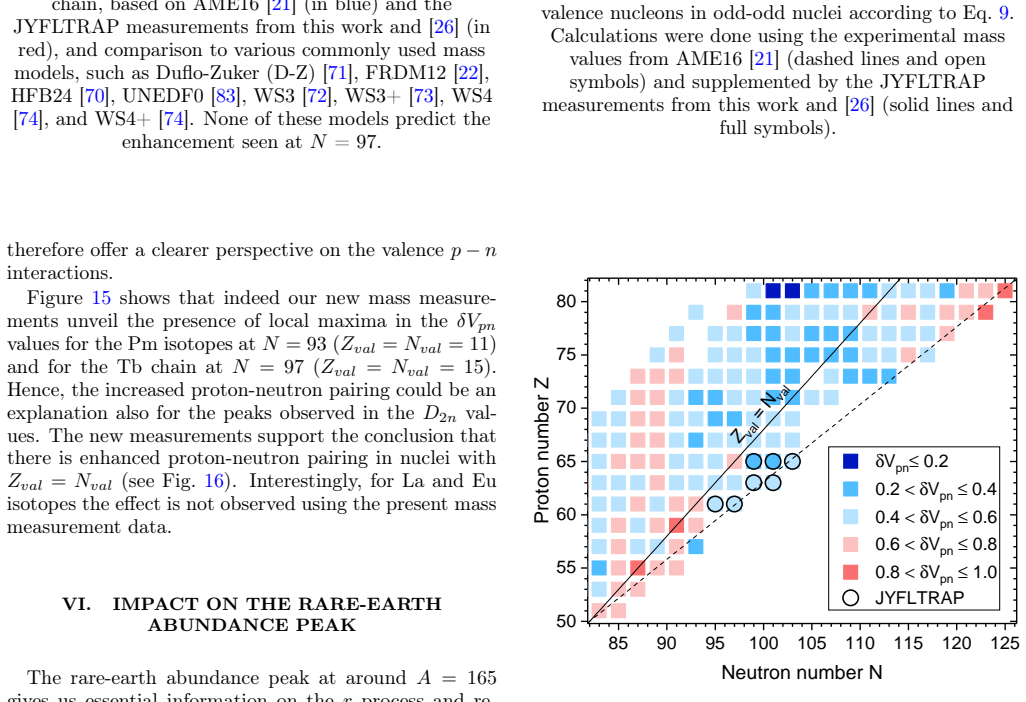
- [Section V.E, Eq. (9), and Section V.D, Eq. (8)] The text states that 'our new mass measurements unveil the presence of local maxima' in δVpn at N=93 for Pm and at N=97 for Tb, and the conclusions state that 'the new mass values reveal an unusual enhancement' in D2n for 154Pm and 162Tb. However, 154Pm and 162Tb were not measured in this work, and none of the newly measured nuclides enters the Sn or S2n differences that define the D2n and δVpn values at those specific points. For example, δVpn(154Pm)=Sn(Pm,93)-Sn(Nd,93) involves masses of 152,153,154Pm and 152,153Nd, and D2n(162Tb)=S2n(162Tb)-S2n(164Tb) involves masses of 160,162,164Tb; the new Tb masses (165,167,168Tb) and the new 161Pm mass are not part of these values. The paper should identify which measurements, from this work or from Ref. [26], actually produce the enhancements, or should rephrase the claims so that they are attributed correctly.
- [Section IV.A, Table I, 163Gd discussion] The new ground-state mass for 163Gd, -61382.4(10.2) keV, is in tension with the CPT value -61316.0(15.0) keV at the 3.7σ level, and the measured isomeric excitation energy of 161(17) keV does not agree with the previously reported 137.8 keV from Ref. [50]. The paper argues that the CPT and earlier JYFLTRAP values resulted from unresolved isomeric mixtures and that the earlier reference ion was misidentified, but it does not explain the isomer-energy discrepancy or provide a spectrum demonstrating that the 'ground-state' resonance is free of contamination. Because the revised 163Gd mass enters both the structural systematics and the r-process comparison, this discrepancy should be discussed explicitly and the 163Gd result should be presented with appropriate caution until the inconsistency with Ref. [50] is resolved.
- [Section V.B, Section V.D, Figs. 10 and 13] The conclusion that the data 'negat[e] the presence of a sub-shell closure or onset of deformation' at N=100 is stated more strongly in Section V.B than the evidence supports. The paper itself notes in Section V.D that deformation can affect S2n and therefore D2n, and the isotopes reaching beyond N=100 are limited to just a few chains in this region. The Section V.B sentence should be rephrased as, for example, 'no evidence for a subshell closure at N=100 is seen in the present binding-energy indicators,' and the deformation caveat should be restated in the same context as the definitive conclusion.
minor comments (5)
- [Section VII and Section IV.A, 166Tb] The precision improvement factor for 166Tb is stated as 'almost 20' in Section IV.A but as '54 times more precise' in the Conclusions; Table I gives 70 keV versus 3.7 keV, which is a factor of about 19. The two statements should be made consistent.
- [Table I caption] The caption says that 'the isomeric-state mass values were adopted from NUBASE16,' but the table reports JYFLTRAP values and uncertainties for 162Eum and 163Gdm and the text describes these as measured in this work. Please clarify which isomeric values are measured and which are adopted.
- [Section V.A, Table III] The RMS-error and δDn calculations combine data from this work and Ref. [26], but the set of experimental Sn values entering Ntot is not specified. Stating which chains and which N ranges define the sample would make the model comparison reproducible.
- [Section VI, Fig. 17 caption] The bottom panel's comparison of the full JYFLTRAP dataset (purple to red) makes it difficult to see the marginal effect of the present campaign alone. The 'green to red' change shown in the middle panel is the relevant comparison for the new masses and should be emphasized in the text.
- [Introduction] There are several typographical errors in the Introduction, for example 'ther process' and 'The r processtakesplaceatleastin'; a copy-editing pass is needed before publication.
Circularity Check
No significant circularity: the mass measurements are direct experimental results, and the structural and r-process claims are model-output comparisons against external benchmarks rather than reductions to fitted inputs.
full rationale
The central data are Penning-trap frequency-ratio measurements calibrated against AME16 reference masses (136Xe, 133Cs) and cross-checked against independent CPT values; no quantity is fitted to the conclusions the paper draws. The structural observables (Sn, S2n, Dn, D2n, deltaVpn) are standard derivatives of the measured masses and are compared with external mass models and literature data, so they are not defined in terms of the N=100 or N=93/97 conclusions. The N=100 statement is an empirical negative observation with an explicit deformation caveat in Sec. V.D, not a fitted prediction. The r-process comparison uses an external solar abundance pattern, a published trajectory from Mendoza-Temis et al., TALYS rates, and a disclosed asymmetric fission-split assumption from prior work; the chi-square change from 10.7 to 9.6 is a genuine model-output comparison with solar data. Self-citations to the first JYFLTRAP campaign and earlier Mumpower/Surman work provide methodology and baseline choices, but those cited items are either externally benchmarked, code-based, or explicitly disclosed assumptions; they do not by themselves force the paper's conclusions. The inclusion of remeasured 163Eu and 163Gd alongside first-time masses in Fig. 17 is a comparison-design caveat rather than a circular step. No equation defines the measured masses in terms of solar abundances or vice versa, so no prediction reduces to its input by construction.
Assumptions & free parameters
assumptions (5)
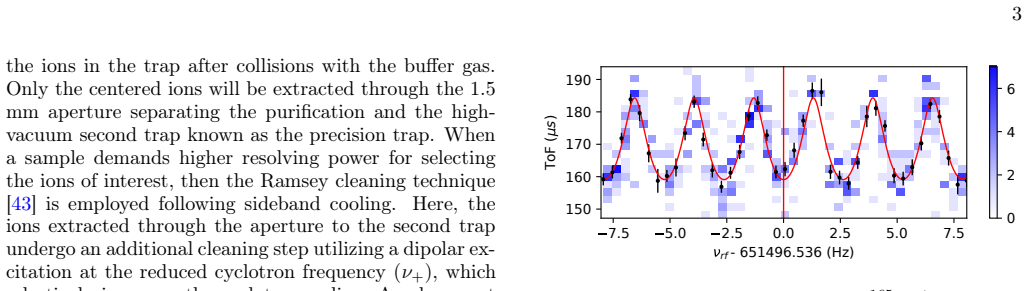
- domain assumption The cyclotron frequency relation nu_c = qB/(2*pi*M) and the mass equation m = r*(m_ref - m_e) + m_e correctly determine atomic masses.
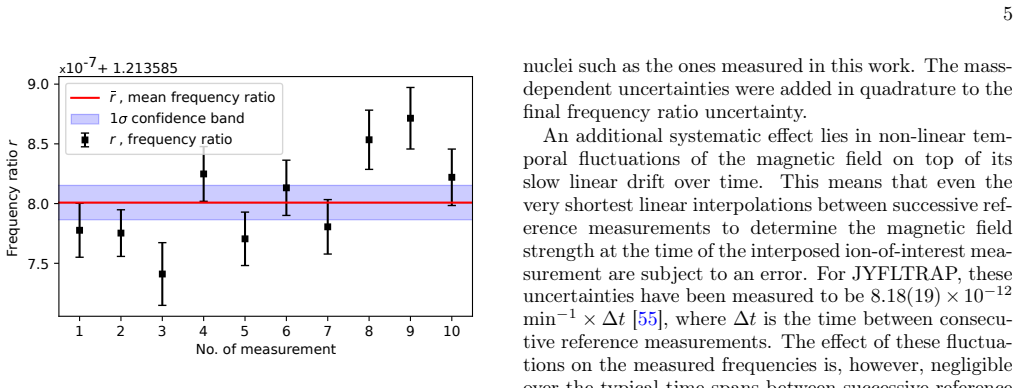
- domain assumption Reference masses for 136Xe and 133Cs from AME16, and the previously measured systematic coefficients (mass-dependent error 2.2e-10/u and field drift 8.18e-12 per minute), are correct.
- domain assumption The ion-ion interaction correction determined from the 165Tb dataset is representative for all TOF-ICR measurements.
- domain assumption A single neutron star merger trajectory with Ye=0.016 and s/kB=8, plus a simple asymmetric fission split and TALYS reaction rates, adequately represents r-process conditions for the rare-earth peak.
- domain assumption AME16 and NUBASE16 masses for anchor nuclei not measured in this work are reliable enough for the D2n and deltaVpn conclusions.
Cite this review
Pith. "Pith review of Exploring the mass surface near the rare-earth abundance peak via precision mass measurements at JYFLTRAP." pith.science (2026). https://pith.science/paper/Z6W6NP56
@misc{pith2026190805043,
  author       = {Pith},
  title        = {Pith review of: Exploring the mass surface near the rare-earth abundance peak via precision mass measurements at JYFLTRAP},
  year         = {2026},
  howpublished = {\url{https://pith.science/paper/Z6W6NP56}},
  note         = {Machine review of arXiv:1908.05043}
}
abstract
The JYFLTRAP double Penning trap at the Ion Guide Isotope Separator On-Line (IGISOL) facility has been used to measure the atomic masses of 13 neutron-rich rare-earth isotopes. Eight of the nuclides, $^{161}$Pm, $^{163}$Sm, $^{164,165}$Eu, $^{167}$Gd, and $^{165,167,168}$Tb, were measured for the first time. The systematics of the mass surface has been studied via one- and two-neutron separation energies as well as neutron pairing-gap and shell-gap energies. The proton-neutron pairing strength has also been investigated. The impact of the new mass values on the astrophysical rapid neutron capture process has been studied. The calculated abundance distribution results in a better agreement with the solar abundance pattern near the top of the rare-earth abundance peak at around $A\approx165$.
Figures


Figures from the paper (11 more)




Reference graph
Works this paper leans on
-
[26]
N.R.Tanvir, A.J.Levan, C.González-Fernández, O.Ko- robkin, I. Mandel, S. Rosswog, J. Hjorth, P. D’Avanzo, A. S. Fruchter, C. L. Fryer, T. Kangas, B. Milvang- Jensen, S. Rosetti, D. Steeghs, R. T. Wollaeger, Z. Cano, C. M. Copperwheat, S. Covino, V. D’Elia, A. de Ugarte Postigo, P. A. Evans, W. P. Even, S. Fairhurst, R. F. Jaimes, C. J. Fontes, Y. I. Fujii...
work page 2017
-
[50]
H. Hayashi, M. Shibata, M. Asai, A. Osa, T. Sato, M. Koizumi, A. Kimura, and M. Oshima, Nucl. Instr. Methods Phys. Res. Sect. A747, 41 (2014)
work page 2014
-
[1]
The first trap, known as the purification trap, is gas-filled and used to remove isobaric contaminants via the sideband cooling technique [42]
JYFLTRAP double Penning trap mass spectrometer The JYFLTRAP double Penning trap is comprised of two orthogonalized [40] cylindrical Penning traps located in the common bore of a 7 T superconducting solenoid [32, 41]. The first trap, known as the purification trap, is gas-filled and used to remove isobaric contaminants via the sideband cooling technique [42]....
-
[2]
quadrupolar
TOF-ICR measurements In the TOF-ICR technique [44, 45], the ion’s initial magnetron motion is converted into cyclotron motion by applying a quadrupole excitation pulse with a fixed du- ration and amplitude at a frequency around the expected cyclotron frequency. This results in a more-or-less com- plete conversion of the slow magnetron motion into the fast ...
-
[3]
phase spot
PI-ICR measurements In the PI-ICR method, determination of the cyclotron frequency relies on detecting the projections of the ion’s radial motions in a trap onto a position-sensitive MCP detector with a delay-line anode. Measurements were performed using the second measurement scheme pre- sented in [48]. In this scheme the cyclotron frequency is determine...
-
[4]
S. K. Ghorui, B. B. Sahu, C. R. Praharaj, and S. K. Patra, Phys. Rev. C85, 064327 (2012)
2012
-
[5]
J. Wu, S. Nishimura, G. Lorusso, P. Möller, E. Ideguchi, P.-H. Regan, G. S. Simpson, P.-A. Söderström, P. M. Walker, H. Watanabe, Z. Y. Xu, H. Baba, F. Browne, R. Daido, P. Doornenbal, Y. F. Fang, G. Gey, T. Isobe, P. S. Lee, J. J. Liu, Z. Li, Z. Korkulu, Z. Patel, V. Phong, S. Rice, H. Sakurai, L. Sinclair, T. Sumikama, M.Tanaka, A.Yagi, Y.L.Ye, R.Yokoya...
2017
-
[6]
These can be due to e.g
Uncertainties due to geometry andB field fluctuations Multiple systematic effects can be present in Penning- trap measurements. These can be due to e.g. misalign- ment of the trap with respect to the magnetic field, inho- mogeneous magnetic field, harmonic and non-harmonic distortion of the trapping potential, and other unavoid- able geometric irregularities [...
Show all 103 references
-
[7]
One of the main effects that has to be considered in the data analysis is the ion-ion interactions when multiple ions are simulta- neously trapped [56]
Uncertainties due to ion-ion interactions The ions are injected into the precision Penning trap as bunches containing typically a few ions. One of the main effects that has to be considered in the data analysis is the ion-ion interactions when multiple ions are simulta- neously...
-
[8]
Thus, the results are largely independent of the specific astrophysical condi- tions
Most of the prompt ejected mass (up to 90%) is as- sumed to originate from these types of reheated, fission- recycling trajectories which all yield very similar abun- dances with the mass model used. Thus, the results are largely independent of the specific astrophysical condi- ...
-
[9]
D. J. Hartley, F. G. Kondev, R. Orford, J. A. Clark, G. Savard, A. D. Ayangeakaa, S. Bottoni, F. Buchinger, M. T. Burkey, M. P. Carpenter, P. Copp, D. A. Gorelov, K. Hicks, C. R. Hoffman, C. Hu, R. V. F. Janssens, J.W.Klimes, T.Lauritsen, J.Sethi, D.Seweryniak, K.S. Sharma, H. ...
2018
-
[10]
E. M. Burbidge, G. R. Burbidge, W. A. Fowler, and F. Hoyle, Rev. Mod. Phys.29, 547 (1957)
1957
-
[11]
P. Brix, Z. Phys.132, 579 (1952)
1952
-
[12]
B. R. Mottelson and S. G. Nilsson, Phys. Rev.99, 1615 (1955)
1955
-
[13]
E. F. Jones, J. H. Hamilton, P. M. Gore, A. V. Ramayya, J. K. Hwang, and A. P. de Lima, Eur. Phys. J. A25, 467 (2005)
2005
-
[14]
B. P. Abbott (LIGO Scientific Collaboration and Virgo Collaboration), Phys. Rev. Lett.119, 161101 (2017)
2017
-
[15]
B. P. Abbottet al., Astrophys. J. Lett.848, L12 (2017)
2017
-
[16]
Patel, P.-A
Z. Patel, P.-A. Söderström, Z. Podolyák, P. H. Re- gan, P. M. Walker, H. Watanabe, E. Ideguchi, G. S. Simpson, H. L. Liu, S. Nishimura, Q. Wu, F. R. Xu, F. Browne, P. Doornenbal, G. Lorusso, S. Rice, L. Sin- clair, T. Sumikama, J. Wu, Z. Y. Xu, N. Aoi, H. Baba, F. L. Bello Gar...
2014
-
[17]
Yokoyama, S
R. Yokoyama, S. Go, D. Kameda, T. Kubo, N. In- abe, N. Fukuda, H. Takeda, H. Suzuki, K. Yoshida, K. Kusaka, K. Tanaka, Y. Yanagisawa, M. Ohtake, H. Sato, Y. Shimizu, H. Baba, M. Kurokawa, D. Nishimura, T. Ohnishi, N. Iwasa, A. Chiba, T. Ya- mada, E. Ideguchi, T. Fujii, H. Nish...
2017
-
[18]
J. B. Gupta, Phys. Rev. C92, 044316 (2015). 16
2015
-
[19]
M. R. Mumpower, G. C. McLaughlin, and R. Surman, Phys. Rev. C85, 045801 (2012)
2012
-
[20]
Goriely, J.-L
S. Goriely, J.-L. Sida, J.-F. Lemaître, S. Panebianco, N. Dubray, S. Hilaire, A. Bauswein, and H.-T. Janka, Phys. Rev. Lett.111, 242502 (2013)
2013
-
[21]
JYFLTRAP measurements extend the AME16 trend in showing that FRDM12 consistently over-estimates the effect of pairing for neutron-rich nuclei
(dashed lines, open symbols) and the JYFLTRAP measurements from this work and [26] (thick solid lines, full symbols), and the FRDM12 mass model [81] (baseline). JYFLTRAP measurements extend the AME16 trend in showing that FRDM12 consistently over-estimates the effect of pairing...
-
[22]
Stellar evolution, nuclear astrophysics, and nucleogenesis,
A. Cameron, “Stellar evolution, nuclear astrophysics, and nucleogenesis,” (1957), Chalk River Report CLR-41. Publisher: Atomic Energy of Canada Limited
1957
-
[23]
Arnould, S
M. Arnould, S. Goriely, and K. Takahashi, Phys. Rep. 450, 97 (2007)
2007
-
[24]
C. J. Horowitz, A. Arcones, B. Côté, I. Dillmann, W. Nazarewicz, I. U. Roederer, H. Schatz, A. Apra- hamian, D. Atanasov, A. Bauswein, T. C. Beers, J. Bliss, M. Brodeur, J. A. Clark, A. Frebel, F. Foucart, C. J. Hansen, O. Just, A. Kankainen, G. C. McLaughlin, J. M. Kelly, S. ...
2019
-
[25]
https://www.nndc.bnl.gov/ensdf/
-
[27]
Kasen, B
D. Kasen, B. Metzger, J. Barnes, E. Quataert, and E. Ramirez-Ruiz, Nature551, 80 (2017)
2017
-
[28]
Surman, J
R. Surman, J. Engel, J. R. Bennett, and B. S. Meyer, Phys. Rev. Lett.79, 1809 (1997)
1997
-
[29]
Orford, N
R. Orford, N. Vassh, J. A. Clark, G. C. McLaughlin, M. R. Mumpower, G. Savard, R. Surman, A. Apra- hamian, F. Buchinger, M. T. Burkey, D. A. Gorelov, T. Y. Hirsh, J. W. Klimes, G. E. Morgan, A. Nystrom, and K. S. Sharma, Phys. Rev. Lett.120, 262702 (2018)
2018
-
[30]
Van Schelt, D
J. Van Schelt, D. Lascar, G. Savard, J. A. Clark, S. Cald- well, A. Chaudhuri, J. Fallis, J. P. Greene, A. F. Levand, G. Li, K. S. Sharma, M. G. Sternberg, T. Sun, and B. J. Zabransky, Phys. Rev. C85, 045805 (2012)
2012
-
[31]
1: Experimental excitation energies of the first2+ states (solid lines) together with the ratio of the first4+ and 2+ states (dashed lines)
that uses the observed shape of the rare-earth abun- arXiv:1908.05043v2 [nucl-ex] 22 Nov 2019 2 8 89 09 29 49 69 81 001 021 001 502 002 503 003 502 .22.42.62.83.03.23.49 49 69 81 001 02607 08 09 0N eutron number NE (2+ ) (keV)E (4+ )/E(2+ ) Dy Gd Sm NdE (2+ ) (keV)N eutron num...
1908 arXiv
-
[32]
M. Wang, G. Audi, F. Kondev, W. Huang, S. Naimi, and X. Xu, Chin. Phys. C41, 030003 (2017)
2017
-
[33]
Möller, A
P. Möller, A. Sierk, T. Ichikawa, and H. Sagawa, At. Data Nucl. Data Tables109–110, 1 (2016)
2016
-
[34]
M. R. Mumpower, R. Surman, D.-L. Fang, M. Beard, P. Möller, T. Kawano, and A. Aprahamian, Phys. Rev. C 92, 035807 (2015)
2015
-
[35]
Mumpower, R
M. Mumpower, R. Surman, G. McLaughlin, and A. Aprahamian, Progr. Part. Nucl. Phys.86, 86 (2016)
2016
-
[36]
Vilen, J
M. Vilen, J. M. Kelly, A. Kankainen, M. Brodeur, A. Aprahamian, L. Canete, T. Eronen, A. Jokinen, T. Kuta, I. D. Moore, M. R. Mumpower, D. A. Nesterenko, H. Penttilä, I. Pohjalainen, W. S. Porter, S. Rinta-Antila, R. Surman, A. Voss, and J. Äystö, Phys. Rev. Lett.120, 262701 (2018)
2018
-
[37]
Savard, S
G. Savard, S. Baker, C. Davids, A. Levand, E. Moore, R. Pardo, R. Vondrasek, B. Zabransky, and G. Zinkann, Nucl. Instr. Meth. Phys. Res. Sect. B266, 4086 (2008), proceedings of the XVth International Conference on Electromagnetic Isotope Separators and Techniques Re- lated to ...
2008
-
[38]
Moore, T
I. Moore, T. Eronen, D. Gorelov, J. Hakala, A. Joki- nen, A. Kankainen, V. Kolhinen, J. Koponen, H. Pent- tilä, I. Pohjalainen, M. Reponen, J. Rissanen, A. Saasta- moinen, S. Rinta-Antila, V. Sonnenschein, and J. Äystö, Nucl. Instr. Meth. Phys. Res. Sect. B317, 208 (2013), xVI...
2013
-
[39]
Nieminen, J
A. Nieminen, J. Huikari, A. Jokinen, J. Äystö, P. Camp- bell, and E. Cochrane, Nucl. Instr. Methods Phys. Res. Sect. A469, 244 (2001)
2001
-
[40]
Gabrielse and F
G. Gabrielse and F. Mackintosh, Int. J. Mass Spectrom. Ion Proc.57, 1 (1984)
1984
-
[41]
M. R. Mumpower, G. C. McLaughlin, R. Surman, and A. W. Steiner, J. Phys. G: Nucl. Part. Phys.44, 034003 (2017)
2017
-
[42]
Eronen, V
T. Eronen, V. S. Kolhinen, V. V. Elomaa, D. Gorelov, U. Hager, J. Hakala, A. Jokinen, A. Kankainen, P. Kar- vonen, S.Kopecky, I.D.Moore, H.Penttilä, S.Rahaman, S. Rinta-Antila, J. Rissanen, A. Saastamoinen, J. Sz- erypo, C. Weber, and J. Äystö, Eur. Phys. J. A 48, 46 (2012)
2012
-
[43]
is employed following sideband cooling. Here, the ions extracted through the aperture to the second trap undergoanadditionalcleaningsteputilizingadipolarex- citation at the reduced cyclotron frequency (ν+), which selectively increases the cyclotron radius. A subsequent transfe...
2018
-
[44]
Satpathy and S
L. Satpathy and S. Patra, Nucl. Phys. A 722, C24 (2003)
2003
-
[45]
Satpathy and S
L. Satpathy and S. K. Patra, J. Phys. G: Nucl. Part. Phys. 30, 771 (2004)
2004
-
[46]
Äystö, Nucl
J. Äystö, Nucl. Phys. A693, 477 (2001)
2001
-
[47]
Penttilä, V
H. Penttilä, V. V. Elomaa, T. Eronen, J. Hakala, A. Joki- nen, A. Kankainen, I. D. Moore, S. Rahaman, S. Rinta- Antila, J. Rissanen, V. Rubchenya, A. Saastamoinen, C. Weber, and J. Äystö, Eur. Phys. J. A48, 43 (2012)
2012
-
[48]
V., Rakopoulos, V., Penttilä, H., Tarrío, D., Wiberg, S., Österlund, M., and Pomp, S., Eur
Al-Adili, A., Jansson, K., Lantz, M., Solders, A., Gorelov, D., Gustavsson, C., Mattera, A., Moore, I., Prokofiev, A. V., Rakopoulos, V., Penttilä, H., Tarrío, D., Wiberg, S., Österlund, M., and Pomp, S., Eur. Phys. J. A51, 59 (2015)
2015
-
[49]
Karvonen, I
P. Karvonen, I. Moore, T. Sonoda, T. Kessler, H. Pent- tilä, K. Peräjärvi, P. Ronkanen, and J. Äystö, Nucl. Instr. Methods Phys. Res. Sect. B266, 4794 (2008)
2008
-
[51]
Kolhinen, S
V. Kolhinen, S. Kopecky, T. Eronen, U. Hager, J. Hakala, J. Huikari, A. Jokinen, A. Nieminen, S. Rinta-Antila, J. Szerypo, and J. Äystö, Nucl. Instr. Meth. Phys. Res. Sect. A528, 776 (2004)
2004
-
[52]
Savard, S
G. Savard, S. Becker, G. Bollen, H. J. Kluge, R. B. Moore, T. Otto, L. Schweikhard, H. Stolzenberg, and 17 U. Wiess, Phys. Lett. A158, 247 (1991)
1991
-
[53]
Eronen, V.-V
T. Eronen, V.-V. Elomaa, U. Hager, J. Hakala, A. Joki- nen, A. Kankainen, S. Rahaman, J. Rissanen, C. Weber, and J. Äystö, Nucl. Instr. Methods Phys. Res. Sect. B 266, 4527 (2008)
2008
-
[54]
G. Gräff, H. Kalinowsky, and J. Traut, Z. Phys. A297, 35 (1980)
1980
-
[55]
König, G
M. König, G. Bollen, H. J. Kluge, T. Otto, and J. Sz- erypo, Int. J. Mass Spectrom. Ion Proc.142, 95 (1995)
1995
-
[56]
George, K
S. George, K. Blaum, F. Herfurth, A. Herlert, M. Kret- zschmar, S. Nagy, S. Schwarz, L. Schweikhard, and C. Yazidjian, Int. J. Mass Spectrom.264, 110 (2007)
2007
-
[57]
Kretzschmar, Int
M. Kretzschmar, Int. J. Mass Spectrom.264, 122 (2007)
2007
-
[58]
Eliseev, K
S. Eliseev, K. Blaum, M. Block, A. Dörr, C. Droese, T. Eronen, M. Goncharov, M. Höcker, J. Ketter, E. M. Ramirez, D. A. Nesterenko, Y. N. Novikov, and L. Schweikhard, Appl. Phys. B114, 107 (2014)
2014
-
[59]
D. A. Nesterenko, T. Eronen, A. Kankainen, L. Canete, A. Jokinen, I. D. Moore, H. Penttilä, S. Rinta-Antila, A. de Roubin, and M. Vilen, Eur. Phys. J. A54, 154 (2018)
2018
-
[60]
Greenwood and M
R. Greenwood and M. Putnam, Nucl. Instr. Meth. Phys. Res. Sect. A337, 106 (1993)
1993
-
[61]
Vilén, L
M. Vilén, L. Canete, B. Cheal, A. Giatzoglou, R. de Groote, A. de Roubin, T. Eronen, S. Geldhof, A. Jokinen, A. Kankainen, I. Moore, D. Nesterenko, H. Penttiä, I. Pohjalainen, M. Reponen, and S. Rinta- Antila, Nucl. Instr. Meth. Phys. Res Sect. B (2019), https://doi.org/10.101...
2019 doi
-
[62]
Beringer et al
J. Beringer et al. (Particle Data Group), Phys. Rev. D 86, 010001 (2012)
2012
-
[63]
L. S. Brown and G. Gabrielse, Rev. Mod. Phys.58, 233 (1986)
1986
-
[64]
Brodeur, T
M. Brodeur, T. Brunner, C. Champagne, S. Ettenauer, M. Smith, A. Lapierre, R. Ringle, V. L. Ryjkov, G. Audi, P. Delheij, D. Lunney, and J. Dilling, Phys. Rev. C80, 044318 (2009)
2009
-
[65]
Canete, A
L. Canete, A. Kankainen, T. Eronen, D. Gorelov, J. Hakala, A. Jokinen, V. S. Kolhinen, J. Koponen, I. D. Moore, J. Reinikainen, and S. Rinta-Antila, Eur. Phys. J. A52, 124 (2016)
2016
-
[66]
Bollen, H.-J
G. Bollen, H.-J. Kluge, M. König, T. Otto, G. Savard, H. Stolzenberg, R. B. Moore, G. Rouleau, G. Audi, and ISOLDE Collaboration, Phys. Rev. C46, R2140 (1992)
1992
-
[67]
Kellerbauer, K
A. Kellerbauer, K. Blaum, G. Bollen, F. Herfurth, H.-J. Kluge, M. Kuckein, E. Sauvan, C. Scheidenberger, and L. Schweikhard, Eur. Phys. J. D22, 53 (2003)
2003
-
[68]
Vilén, D
M. Vilén, D. A. Nesterenko, T. Eronen, and A. Kankainen, To be submitted (2019)
2019
-
[69]
G. Audi, F. Kondev, M. Wang, W. Huang, and S. Naimi, Chin. Phys. C41, 030001 (2017)
2017
-
[70]
Goriely, N
S. Goriely, N. Chamel, and J. M. Pearson, Phys. Rev. C 88, 024308 (2013)
2013
-
[71]
D’auria, D
J. D’auria, D. Ostrom, and S. Gujrathi, Nucl. Phys. A 178, 172 (1971)
1971
-
[72]
Tannila and J
O. Tannila and J. Kantele, Z. Phys. A251, 87 (1972)
1972
-
[73]
Yamamoto, K
H. Yamamoto, K. Kawade, H. Fukaya, and T. Katoh, J. Phys. Soc. Japan 37, 10 (1974), https://doi.org/10.1143/JPSJ.37.10
1974 doi
-
[74]
D. C. Kayser and W. H. Johnson, Phys. Rev. C12, 1054 (1975)
1975
-
[75]
Hardy, L
J. Hardy, L. Carraz, B. Jonson, and P. Hansen, Phys. Lett. B71, 307 (1977)
1977
-
[76]
Schneider, T
F. Schneider, T. Beyer, K. Blaum, M. Block, S. Chen- marev, H. Dorrer, C. E. Düllmann, K. Eberhardt, M. Eibach, S. Eliseev, J. Grund, U. Köster, S. Nagy, Y. N. Novikov, D. Renisch, A. Türler, and K. Wendt, Eur. Phys. J. A51, 89 (2015)
2015
-
[77]
Ringle, High-Precision Mass Measurement of 38Ca and Development of the LEBIT 9.4-T Penning Trap Sys- tem, Ph.D
R. Ringle, High-Precision Mass Measurement of 38Ca and Development of the LEBIT 9.4-T Penning Trap Sys- tem, Ph.D. thesis, Michigan State University (2006)
2006
-
[78]
Savard, J
G. Savard, J. Wang, K. Sharma, H. Sharma, J. Clark, C. Boudreau, F. Buchinger, J. Crawford, J. Greene, S. Gulick, A. Hecht, J. Lee, A. Levand, N. Scielzo, W. Trimble, J. Vaz, and B. Zabransky, Int. J. Mass Spectrom. 251, 252 (2006)
2006
-
[79]
Hayashi, Y
H. Hayashi, Y. Kojima, M. Shibata, and K. Kawade, Nucl. Instr. Meth. Phys. Res. Sect. A613, 79 (2010)
2010
-
[80]
Y. A. Litvinov, T. J. Bürvenich, H. Geissel, Y. N. Novikov, Z. Patyk, C. Scheidenberger, F. Attallah, G. Audi, K. Beckert, F. Bosch, M. Falch, B. Franzke, M. Hausmann, T. Kerscher, O. Klepper, H.-J. Kluge, C. Kozhuharov, K. E. G. Löbner, D. G. Madland, J. A. Maruhn, G.Münzenbe...
2005
-
[81]
The second calculation included the JYFLTRAP mass values from the first measurement campaign [26]
mass model values where no experimental data ex- isted. The second calculation included the JYFLTRAP mass values from the first measurement campaign [26]. Finally, the third set included all JYFLTRAP measure- ments performed in this region ([26] and this work). To be consistent...
-
[82]
Duflo and A
J. Duflo and A. Zuker, Phys. Rev. C52, R23 (1995)
1995
-
[83]
Wang and M
N. Wang and M. Liu, Journal of Physics: Conference Series 420, 012057 (2013)
2013
-
[84]
Wang and M
N. Wang and M. Liu, Phys. Rev. C84, 051303 (2011)
2011
-
[85]
N. Wang, M. Liu, X. Wu, and J. Meng, Phys. Lett. B 734, 215 (2014)
2014
-
[86]
B. A. Brown, Phys. Rev. Lett.111, 162502 (2013)
2013
-
[87]
Hakala, J
J. Hakala, J. Dobaczewski, D. Gorelov, T. Eronen, A. Jokinen, A. Kankainen, V. S. Kolhinen, M. Korte- lainen, I. D. Moore, H. Penttilä, S. Rinta-Antila, J. Ris- sanen, A. Saastamoinen, V. Sonnenschein, and J. Äystö, Phys. Rev. Lett.109, 032501 (2012)
2012
-
[88]
Satuła, J
W. Satuła, J. Dobaczewski, and W. Nazarewicz, Phys. Rev. Lett.81, 3599 (1998)
1998
-
[89]
T.Duguet, P.Bonche, P.-H.Heenen, andJ.Meyer,Phys. Rev. C65, 014311 (2001)
2001
-
[90]
Bohr and B
A. Bohr and B. Mottelson, Nuclear Structure, Vol. 1 (World Scientific, Singapore, 1998)
1998
-
[91]
Möller, W
P. Möller, W. D. Myers, H. Sagawa, and S. Yoshida, Phys. Rev. Lett.108, 052501 (2012)
2012
-
[92]
Lunney, J
D. Lunney, J. M. Pearson, and C. Thibault, Rev. Mod. Phys. 75, 1021 (2003)
2003
-
[93]
Kortelainen, T
M. Kortelainen, T. Lesinski, J. Moré, W. Nazarewicz, J. Sarich, N. Schunck, M. V. Stoitsov, and S. Wild, Phys. Rev. C82, 024313 (2010)
2010
-
[94]
Bonatsos, S
D. Bonatsos, S. Karampagia, R. B. Cakirli, R. F. Casten, K. Blaum, and L. A. Susam, Phys. Rev. C88, 054309 (2013)
2013
-
[95]
Talmi, Rev
I. Talmi, Rev. Mod. Phys.34, 704 (1962)
1962
-
[96]
Van Isacker, D
P. Van Isacker, D. D. Warner, and D. S. Brenner, Phys. Rev. Lett.74, 4607 (1995)
1995
-
[97]
S. J. Smarttet al., Nature551, 75 (2017)
2017
-
[98]
4.4 Abundances of the elements in the Solar System: Datasheet from Landolt-Börnstein - Group VI Astronomy and Astro- physics · Volume 4B: “Solar System
K. Lodders, H. Palme, and H.-P. Gail, “4.4 Abundances of the elements in the Solar System: Datasheet from Landolt-Börnstein - Group VI Astronomy and Astro- physics · Volume 4B: “Solar System” in SpringerMateri- als (http://dx.doi.org/10.1007/978-3-540-88055-4_34),” (2009), acc...
2009 doi
-
[99]
C., Barklem, P
Christlieb, N., Beers, T. C., Barklem, P. S., Bessell, 18 M., Hill, V., Holmberg, J., Korn, A. J., Marsteller, B., Mashonkina, L., Qian, Y.-Z., Rossi, S., Wasserburg, G. J., Zickgraf, F.-J., Kratz, K.-L., Nordström, B., Pfeiffer, B., Rhee, J., and Ryan, S. G., A&A428, 1027 (2004)
2004
-
[100]
Frebel and T
A. Frebel and T. Beers, Phys. Today71, 30 (2018)
2018
-
[101]
J. d. J. Mendoza-Temis, M.-R. Wu, K. Langanke, G. Martínez-Pinedo, A. Bauswein, and H.-T. Janka, Phys. Rev. C92, 055805 (2015)
2015
-
[102]
Koning and D
A. Koning and D. Rochman, Nucl. Data Sheets113, 2841 (2012), special Issue on Nuclear Reaction Data
2012
-
[103]
Möller, B
P. Möller, B. Pfeiffer, and K.-L. Kratz, Phys. Rev. C67, 055802 (2003)
2003
Reviewed August 14, 2026 · model on record in the stance chip above.
Discussion (0). Continue with ORCID to comment.