REVIEW 4 major objections 5 minor 34 references
Role of higher-order phonon scattering in the zone-center optical phonon linewidth and the Lorenz oscillator model
T0 review · 4 major / 5 minor · reviewed 2026-08-14 · deepseek-v4-flash
Pith's one-line read Four-phonon scattering, not three-phonon scattering, sets the zone-center optical phonon linewidth in diamond, Si, Ge, BAs, 3C-SiC, and α-quartz, and including it fixes predicted infrared spectra.
desk verdict This paper makes a credible, parameter-free case that four-phonon scattering dominates zone-center optical phonon linewidths in common materials, fixing a long-standing underestimation of IR linewidths; the main caveat is the harmonic-spectrum approximation that the authors themselves flag. read the letter →
The pith
A machine-rendered reading of the paper's core claim, the machinery that carries it, and where it could break.
The reading
What carries the argument
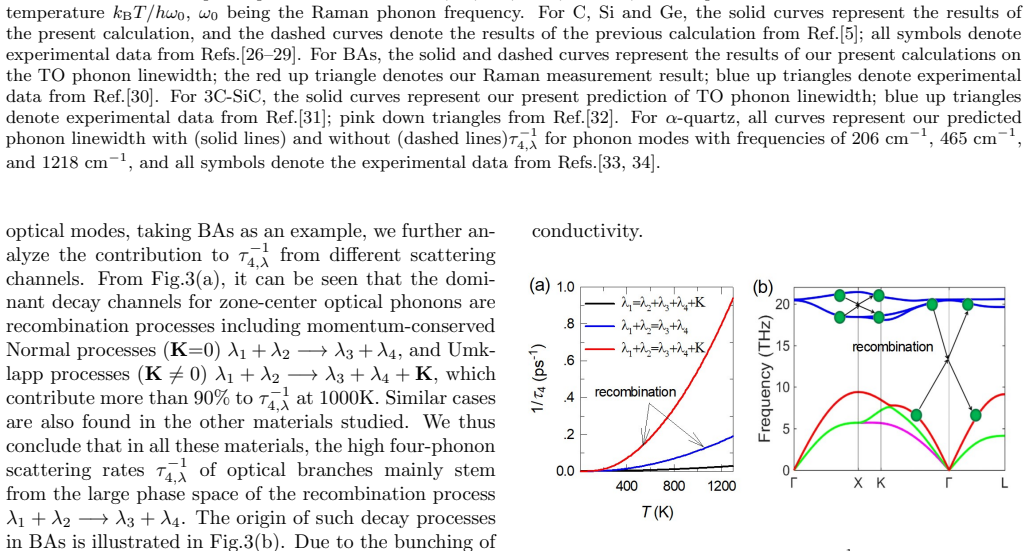
The load-bearing object is the zone-center optical phonon linewidth $2\Gamma$, the full width at half maximum of a TO or LO mode, computed from the quartic term $\hat{H}_4$ of the Taylor-expanded vibrational Hamiltonian as a four-phonon scattering rate $\tau_{4,\lambda}^{-1}$. This rate is obtained by Fermi's golden rule from fourth-order interatomic force constants and added to the isotope and three-phonon rates in a Matthiessen sum, Eq. (2). The paper identifies the dominant microscopic channel as four-phonon recombination, $\lambda_1+\lambda_2 \to \lambda_3+\lambda_4$ with or without a reciprocal lattice vector $\mathbf{K}$, which has a large phase space because the zone-center optical branches are bunched in energy, so energy and momentum conservation are easily satisfied. That large phase space is why four-phonon scattering can dominate optical linewidths even in crystals where it remains a minor correction to thermal conductivity.
What would settle it
A decisive test would be to measure the intrinsic zone-center TO linewidth of isotopically pure silicon or GaAs from room temperature to well above the Debye temperature and compare with the paper's three-plus-four-phonon prediction, since an intrinsic prediction should be a lower bound for any real crystal; a measured linewidth clearly below the sum would falsify the rate calculation. A complementary calculation would recompute the linewidths with temperature-renormalized phonon frequencies and check whether four-phonon scattering remains dominant when the frequencies shift.
Extended reading notes
Core claim
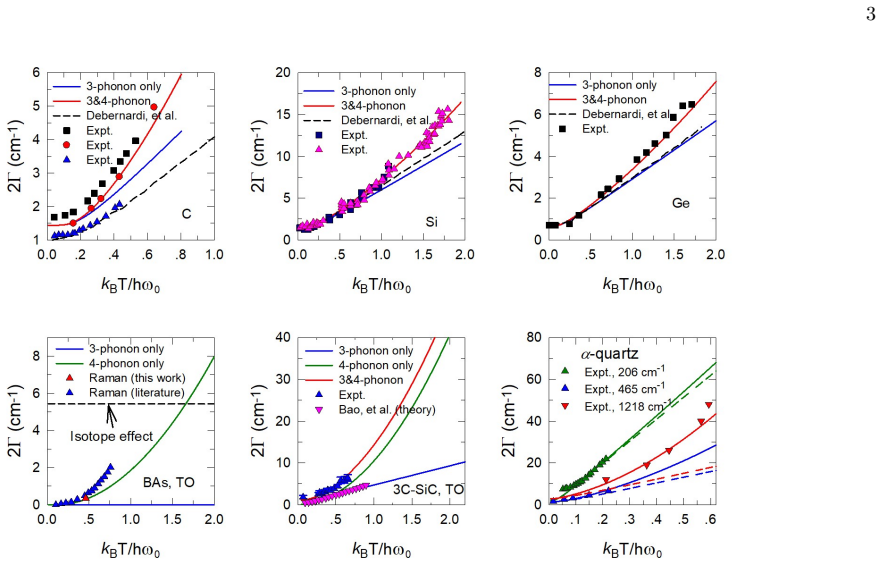
The paper's central claim is that the intrinsic width of zone-center optical phonon modes is governed by four-phonon scattering at room temperature and increasingly by even higher orders as temperature rises, for diamond, Si, Ge, BAs, 3C-SiC, and α-quartz. The evidence comes from first-principles linewidth calculations written as a Matthiessen sum, $2\Gamma = \tau_{\mathrm{iso}}^{-1} + \tau_{3,\lambda}^{-1} + \tau_{4,\lambda}^{-1} + \cdots$, where only the four-phonon term repairs the systematic underestimate against measured Raman and infrared linewidths. For BAs the three-phonon channel is nearly forbidden, so four-phonon and isotope scattering dominate across the whole temperature range, and the residual gap at high temperature suggests five-phonon scattering is also needed. Inserting the four-phonon-corrected linewidths into the Lorentz oscillator model reduces predicted dielectric peaks by tens of percent and brings the reflectance of α-quartz, 3C-SiC, and BAs into much closer agreement with experiment.
Load-bearing premise
The load-bearing premise is that the linewidth is a simple sum of independent inverse lifetimes computed from harmonic phonon frequencies and static interatomic force constants, with no temperature-dependent phonon renormalization; the paper itself says renormalization is not dealt with and can be non-negligible above the Debye temperature.
Editorial extensions
If this is right
- Infrared dielectric functions and reflectance peaks calculated from three-phonon scattering alone are too narrow and too high; including four-phonon scattering lowers the imaginary dielectric peak by about 70% for 3C-SiC at 1000 K and by 20–50% for α-quartz modes at 785 K, matching measurements.
- Four-phonon scattering must be included in optical linewidth predictions even for materials where it is negligible for thermal conductivity, because the phase-space conditions for optical and acoustic modes differ.
- For BAs, the near-absence of three-phonon decay makes four-phonon and isotope scattering the whole story at room temperature, and five-phonon scattering appears necessary to close the gap at high temperatures.
- Zone-center optical modes with very short mean free paths still behave as well-defined phonons rather than a hopping channel, suggesting that two-channel thermal transport models that convert these modes into a hopping contribution need adjustment.
Reading between the lines
- If bunched optical branches are the cause, the same four-phonon dominance should show up in other polar semiconductors and oxides with flat optical dispersion, so existing three-phonon-only linewidth tables for such materials are probably underestimates.
- Isotopically pure crystals would expose the intrinsic four-phonon linewidth most cleanly; in BAs the isotope background masks much of the effect at room temperature.
- The quadratic rise of the four-phonon rate with temperature implies that the perturbative scattering expansion may converge poorly above the Debye temperature, where temperature-renormalized phonon frequencies could change the high-temperature numbers.
- Because the Lorentz model's peak heights depend on linewidth, spectral emissivity and radiative-cooling design calculations that stop at three-phonon anharmonicity inherit a systematic high-temperature error.
Signed reviews
Editorial analysis
A structured set of objections, weighed in public.
Referee Report
Summary. The manuscript presents first-principles calculations of the zone-center optical phonon linewidth for GaAs, diamond, Si, Ge, BAs, 3C-SiC, and α-quartz, including isotope scattering, three-phonon scattering, and four-phonon scattering. The central claim is that four-phonon scattering is often comparable to or larger than three-phonon scattering for these zone-center optical modes, in contrast to the usual assumption and in contrast to thermal conductivity, where four-phonon processes are generally secondary at room temperature. The authors use the calculated linewidths in the Lorentz oscillator model to predict infrared dielectric functions and reflectance, reporting much better agreement with experiment when four-phonon scattering is included. They also propose that five-phonon scattering may be important in BAs and comment on implications for the two-channel thermal transport model.
Significance. If the central claim is correct, the paper is significant: it identifies a general mechanism, the recombination phase space of zone-center optical phonons, that is not captured by standard three-phonon calculations, and it connects this to measurable infrared and Raman properties. The paper's strengths are that the linewidths are parameter-free first-principles predictions, the comparison spans several structurally different materials, the phonon dispersions are validated against experiment, and the BAs comparison includes the authors' own Raman measurements. The qualitative picture, that four-phonon scattering matters for optical phonon linewidths at elevated temperatures, is plausible and useful. However, the quantitative support is limited by the acknowledged neglect of temperature-dependent phonon renormalization, by the absence of convergence tests and error bars, and by the lack of released data or code. These issues constrain the strength of the paper's quantitative claims.
major comments (4)
- [BAs discussion, paragraph after Fig. 2; Eq. (2)] The quantitative argument for four-phonon dominance rests on rates computed from fixed harmonic phonon frequencies and interatomic force constants. The authors explicitly state that temperature-induced phonon renormalization is 'not dealt with in the present work, but non-negligible especially above Debye temperature (kBT/hω0 > 1)'. Since both τ_3^-1 and τ_4^-1 depend on the energy- and momentum-conserving phase space constructed from these frequencies, renormalization can open or close decay channels and change the relative weights. This is not purely a high-temperature caveat: for Ge at 300 K the ratio kBT/hω0 is already near 0.8, and the α-quartz comparison at 785 K involves modes whose Debye temperatures are comparable to or below the measurement temperature. I request a quantitative sensitivity check, for example using temperature-dependent spectra from self-consistent phonon calculations, or a clearly stated restriction of the claims to the harmonic-spectrum approximation.
- [Figs. 1 and 2 and the text around them] The manuscript reports no convergence tests or uncertainty estimates for the computed linewidths. There is no information on q-grid convergence, smearing parameters, LDA versus other exchange-correlation functionals, or sensitivity to the truncation and fitting of interatomic force constants. Given that the central claim is quantitative ('matches with experiment surprisingly well', 'peak value decreases by 70%'), the absence of such tests makes it difficult to assess whether the remaining discrepancies are systematic or due to numerical choices. Please add convergence studies and representative error bars for the quoted linewidths and dielectric-function changes.
- [BAs paragraph after Fig. 2 and Fig. 2 caption] The inference that five-phonon scattering is significant in BAs is based on the difference between the calculated four-phonon linewidth and the experimental Raman data after subtracting an isotope/defect background. The background subtraction is described only by reference to the Supplementary Material, and no experimental uncertainty is given for the subtracted data. The remaining discrepancy could also reflect the neglected phonon renormalization acknowledged in the same paragraph, or uncertainties in the subtraction procedure. The claim about five-phonon scattering is therefore not yet robust. Please either quantify the subtraction and experimental uncertainty or soften the inference to a suggestion.
- [Eq. (2) and the discussion of the Lorentz oscillator model] The manuscript uses a Matthiessen sum of independent inverse lifetimes, Eq. (2), and then inserts the total linewidth into the Lorentz oscillator model with harmonic zone-center frequencies ω_LO and ω_TO. This assumes that scattering channels add independently and that frequency shifts do not play a role in the line shape. These are standard assumptions, but they become more consequential at the high temperatures where the paper claims the largest four-phonon effects. I ask the authors to state explicitly the limits of this treatment and, if possible, to estimate whether temperature-dependent frequency shifts would change the reported reflectance and dielectric-function results.
minor comments (5)
- [Title and Eq. (1)] The model is usually called the Lorentz oscillator model; the manuscript consistently uses 'Lorenz' in the title and Eq. (1). Please correct the spelling or justify the usage.
- [Abstract and Introduction] The abstract lists diamond, Si, Ge, BAs, 3C-SiC, and α-quartz but omits GaAs, which is the first example discussed in the paper. Please make the material list consistent.
- [Introduction, first paragraph] There are typographical errors, including 'descrepancy' and later 'particlar'. A careful proofread is needed.
- [Fig. 2 caption] The caption lists several experimental references collectively for different materials. It would improve readability to state explicitly which symbol corresponds to which reference for each panel.
- [Data and code availability] No statement is provided about availability of the computed data or the four-phonon scattering code. Given the journal context, please add a data availability statement or provide the numerical linewidths in the Supplementary Material.
Circularity Check
No significant circularity: linewidths are first-principles predictions with no fitted target parameters; self-cited four-phonon method is independently validated.
full rationale
The derivation is self-contained: the zone-center phonon linewidths are computed from Eq. (2) as a Matthiessen sum of isotope, three-phonon, and four-phonon scattering rates, all evaluated from DFT-computed second-, third-, and fourth-order interatomic force constants with no parameter fitted to the experimental linewidths or IR spectra. The central claim that four-phonon scattering is significant or dominant follows from the computed tau_4^{-1} values, which are then compared with external linewidth and reflectance measurements; the Lorentz oscillator model of Eq. (1) consumes the computed gamma_m rather than fitting it. The four-phonon formalism is self-cited (Refs. 10-12), but this citation is not load-bearing in a circular way: the method is independently supported by BAs thermal-conductivity experiments (Refs. 13-15), as the paper explicitly notes, and the same formalism is here re-applied to a new observable (zone-center optical linewidth) rather than being imported as an unverified premise. The five-phonon suggestion for BAs is a residual-mismatch inference after including tau_4^{-1}, not a fitted input used to define the prediction. The acknowledged neglect of temperature-dependent phonon renormalization (BAs discussion: 'not dealt with in the present work, but non-negligible especially above Debye temperature') is a correctness/robustness limitation for the quantitative high-temperature agreement, not a circular step: it does not make Eq. (2) equivalent to its inputs, and the harmonic frequencies are independently checked against measured dispersions. Therefore no circularity is present; score 0.
Assumptions & free parameters
assumptions (5)
- domain assumption The vibrational Hamiltonian is Taylor-expanded and truncated at the quartic term; five-phonon and higher interactions are neglected in the main linewidth calculation.
- domain assumption The total linewidth is a Matthiessen sum of independent inverse lifetimes, Eq. (2): tau_iso^{-1} + tau_3^{-1} + tau_4^{-1}.
- domain assumption DFT within the LDA gives accurate second, third, and fourth order interatomic force constants for all studied materials.
- domain assumption Temperature-induced phonon renormalization is neglected; harmonic phonon frequencies are used throughout.
- domain assumption The isotope scattering model of Ref. [21] quantitatively captures the isotope contribution to each material's linewidth.
Cite this review
Pith. "Pith review of Role of higher-order phonon scattering in the zone-center optical phonon linewidth and the Lorenz oscillator model." pith.science (2026). https://pith.science/paper/UCIXS2N7
@misc{pith2026190805121,
  author       = {Pith},
  title        = {Pith review of: Role of higher-order phonon scattering in the zone-center optical phonon linewidth and the Lorenz oscillator model},
  year         = {2026},
  howpublished = {\url{https://pith.science/paper/UCIXS2N7}},
  note         = {Machine review of arXiv:1908.05121}
}
abstract
Zone-center optical phonon linewidth is a key parameter for infrared and Raman spectra as well as the Lorenz oscillator model. While three-phonon scattering was often assumed to be the leading contribution, in this work we find, surprisingly, that higher-order phonon scattering universally plays a significant or even dominant role over three-phonon scattering at room temperature, and more so at elevated temperatures, for a wide range of materials including diamond, Si, Ge, boron arsenide (BAs), cubic silicon carbide (3C-SiC), and $\alpha$-quartz. This is enabled by the large fourphonon scattering phase space of zone-center optical phonons, and distinct from heat conduction where at room temperature four-phonon scattering is still secondary to three-phonon scattering. Moreover, our results imply that five-phonon and even higher-order scattering may be significant for some large band-gap materials, e.g., BAs. Our predicted infrared optical properties through the Lorenz oscillator model, after including four-phonon scattering, show much better agreement with experimental measurements than those three-phonon based predictions. This work will raise broad interest of studying high-order scattering in various areas beyond heat conduction.
Figures

Figures from the paper (1 more)

Reference graph
Works this paper leans on
-
[1]
Zhang, Nano/microscale heat transfer
Z. Zhang, Nano/microscale heat transfer. (New York: McGraw-Hill, 2007)
work page 2007
-
[2]
Ellipsometry of anisotropic materials (2007), URL https://doi.org/10.1002/9780470060193.ch6
-
[3]
A. Debernardi, S. Baroni, and E. Molinari, Phys. Rev. Lett. 75, 1819 (1995), URL https://link.aps.org/ doi/10.1103/PhysRevLett.75.1819
-
[4]
G. Lang, K. Karch, M. Schmitt, P. Pavone, A. P. Mayer, R. K. Wehner, and D. Strauch, Phys. Rev. B 59, 6182 (1999), URL https://link.aps.org/doi/10. 1103/PhysRevB.59.6182
work page 1999
-
[6]
A. Debernardi, C. Ulrich, K. Syassen, and M. Cardona, Phys. Rev. B 59, 6774 (1999), URL https://link.aps. org/doi/10.1103/PhysRevB.59.6774
-
[7]
F. Bechstedt, P. K?ckell, A. Zywietz, K. Karch, B. Adolph, K. Tenelsen, and J. Furthmller, phys. stat. sol. (b) 202, 35 (1997), ISSN 0370-1972, URL https://doi.org/10.1002/1521-3951(199707)202: 1<35::AID-PSSB35>3.0.CO;2-8
-
[9]
H. Bao, B. Qiu, Y. Zhang, and X. Ruan, Jour- nal of Quantitative Spectroscopy and Radiative Transfer 113, 1683 (2012), ISSN 0022-4073, URL http://www.sciencedirect.com/science/article/ pii/S0022407312002336
work page 2012
-
[11]
T. Feng, L. Lindsay, and X. Ruan, Phys. Rev. B 96, 161201 (2017), URL https://link.aps.org/doi/ 10.1103/PhysRevB.96.161201
Show all 34 references
-
[13]
J. S. Kang, M. Li, H. Wu, H. Nguyen, and Y. Hu, Science 361, 575 (2018), ISSN 0036-8075, http://science.sciencemag.org/content/early/2018/07/03/science.aat5522.full.pdf, URL http://science.sciencemag.org/content/ early/2018/07/03/science.aat5522
2018
-
[14]
F. Tian, B. Song, X. Chen, N. K. Ravichandran, Y. Lv, K. Chen, S. Sullivan, J. Kim, Y. Zhou, T.-H. Liu, et al., Science 361, 582 (2018), ISSN 0036-8075, http://science.sciencemag.org/content/early/2018/07/03/science.aat7932.full.pdf, URL http://science.sciencemag.org/content/ ...
2018
-
[15]
S. Li, Q. Zheng, Y. Lv, X. Liu, X. Wang, P. Y. Huang, D. G. Cahill, and B. Lv, Science 361, 579 (2018), ISSN 0036-8075, http://science.sciencemag.org/content/361/6402/579.full.pdf, URL http://science.sciencemag.org/content/361/ 6402/579
2018
-
[16]
Fugallo, B
G. Fugallo, B. Rousseau, and M. Lazzeri, Phys. Rev. B 98, 184307 (2018), URL https://link.aps.org/doi/ 10.1103/PhysRevB.98.184307
2018 doi
-
[17]
D. A. Broido, M. Malorny, G. Birner, N. Mingo, and D. A. Stewart, Applied Physics Letters 91, 231922 (2007), https://doi.org/10.1063/1.2822891, URL https: //doi.org/10.1063/1.2822891
2007 doi
-
[18]
Lindsay, D
L. Lindsay, D. A. Broido, and N. Mingo, Phys. Rev. B 82, 115427 (2010), URL https://link.aps.org/doi/ 10.1103/PhysRevB.82.115427
2010 doi
-
[19]
Lindsay, D
L. Lindsay, D. A. Broido, and T. L. Reinecke, Phys. Rev. Lett. 109, 095901 (2012), URL https://link.aps.org/ doi/10.1103/PhysRevLett.109.095901
2012 doi
-
[20]
Esfarjani, G
K. Esfarjani, G. Chen, and H. T. Stokes, Phys. Rev. B 84, 085204 (2011), URL https://link.aps.org/doi/ 10.1103/PhysRevB.84.085204
2011 doi
-
[21]
Kundu, N
A. Kundu, N. Mingo, D. A. Broido, and D. A. Stewart, Phys. Rev. B 84, 125426 (2011), URL https://link. aps.org/doi/10.1103/PhysRevB.84.125426
2011 doi
-
[22]
Kresse and J
G. Kresse and J. Furthmller, Computational Ma- terials Science 6, 15 (1996), ISSN 0927-0256, URL http://www.sciencedirect.com/science/article/ pii/0927025696000080
1996
-
[23]
See supplemental material for the computational details, phonon dispersions for all of materials examined in this work, and raman spectroscopy characterization
-
[24]
With τ−1 4,λ included, the prediction matches with experiment surprisingly well
even at Troom. With τ−1 4,λ included, the prediction matches with experiment surprisingly well. Note that four-phonon scattering is negligible for thermal conduc- tivity of GaAs at Troom. Also, as T increases, our pre- diction of 2 Γ including τ−1 4,λ deviates significantly fro...
-
[25]
Irmer, M
G. Irmer, M. Wenzel, and J. Monecke, phys. stat. sol. (b) 195, 85 (1996), ISSN 0370-1972, URL https://doi. org/10.1002/pssb.2221950110
1996 doi
-
[26]
Y. P. Joshi, M. D. Tiwari, and G. S. Verma, Phys. Rev. B 1, 642 (1970), URL https://link.aps.org/doi/10. 1103/PhysRevB.1.642
1970
-
[27]
Borer, S
W. Borer, S. Mitra, and K. Namjoshi, Solid State Communications 9, 1377 (1971), ISSN 0038- 1098, URL http://www.sciencedirect.com/science/ article/pii/0038109871903991
1971
-
[28]
Herchen and M
H. Herchen and M. A. Cappelli, Phys. Rev. B 43, 11740 (1991), URL https://link.aps.org/doi/10. 1103/PhysRevB.43.11740
1991
-
[29]
Balkanski, R
M. Balkanski, R. F. Wallis, and E. Haro, Phys. Rev. B 28, 1928 (1983), URL https://link.aps.org/doi/10. 1103/PhysRevB.28.1928
1983
-
[30]
Menendez and M
J. Menendez and M. Cardona, Phys. Rev. B 29, 2051 (1984), URL https://link.aps.org/doi/10. 1103/PhysRevB.29.2051
1984
-
[31]
V. G. Hadjiev, M. N. Iliev, B. Lv, Z. F. Ren, and C. W. Chu, Phys. Rev. B 89, 024308 (2014), URL https:// link.aps.org/doi/10.1103/PhysRevB.89.024308
2014 doi
-
[32]
Ulrich, A
C. Ulrich, A. Debernardi, E. Anastassakis, K. Syassen, and M. Cardona, phys. stat. sol. (b) 211, 293 (1999), ISSN 0370-1972, URL https: //doi.org/10.1002/(SICI)1521-3951(199901)211: 1<293::AID-PSSB293>3.0.CO;2-O . 6
1999 doi
-
[33]
Z. Tong, L. Liu, L. Li, and H. Bao, Physica B: Condensed Matter 537, 194 (2018), ISSN 0921- 4526, URL http://www.sciencedirect.com/science/ article/pii/S092145261830142X
2018
-
[34]
K. J. Dean, W. F. Sherman, and G. R. Wilkin- son, Spectrochimica Acta Part A: Molecular Spec- troscopy 38, 1105 (1982), ISSN 0584-8539, URL http://www.sciencedirect.com/science/article/ pii/0584853982800445
1982
-
[35]
Gervais and B
F. Gervais and B. Piriou, Phys. Rev. B 11, 3944 (1975), URL https://link.aps.org/doi/10.1103/PhysRevB. 11.3944
1975 doi
-
[36]
Hellman, P
O. Hellman, P. Steneteg, I. A. Abrikosov, and S. I. Simak, Physical Review B 87, 1162 (2013)
2013
-
[37]
K. M. Pitman, A. M. Hofmeister, A. B. Corman, and A. K. Speck, A&A 483, 661 (2008), URL https://doi. org/10.1051/0004-6361:20078468
2008 doi
-
[38]
Mukhopadhyay, D
S. Mukhopadhyay, D. S. Parker, B. C. Sales, A. A. Puretzky, M. A. McGuire, and L. Lindsay, Science 360, 1455 (2018), URL http://science.sciencemag. org/content/360/6396/1455.abstract
2018
Reviewed August 14, 2026 · model on record in the stance chip above.
Discussion (0). Continue with ORCID to comment.