REVIEW 4 major objections 4 minor 1 cited by
Lumley Decomposition of the Turbulent Round Jet Far-field. Part 1 -- Kinematics
T0 review · 4 major / 4 minor · reviewed 2026-08-14 · deepseek-v4-flash
Pith's one-line read This paper claims that the streamwise optimal Lumley-decomposition eigenfunctions of the self-similar round-jet far field are stretched amplitude-decaying Fourier modes, with wavelength growing linearly downstream and amplitude decaying…
desk verdict The SADFM result is a genuine, clearly-derived idea, but its central premise—homogeneity of the scaled two-point correlation—is not tested with data that could directly check it. read the letter →
The pith
A machine-rendered reading of the paper's core claim, the machinery that carries it, and where it could break.
The reading
What carries the argument
The central object is the weighted Lumley-decomposition integral in tensor form, $\mathcal{R}\Phi = \langle v(\Phi,v)_w\rangle = \lambda\Phi$, restricted to the weighted space $L^2_w$ with weight $w=e^{-\xi}$ in stretched spherical coordinates. The weight is chosen to cancel exactly the geometric factors $e^{3\xi}$ (volume element) and $e^{2\xi}$ (metric) introduced by the stretched coordinates, making the scaled two-point correlation invariant under streamwise separation and allowing a Fourier ansatz along $\xi$. The transformation $\chi = e^{-\xi/2}\Phi$ then restores orthogonality in the unweighted $L^2$ space and fixes the $-3/2$ amplitude decay, producing the stretched amplitude-decaying Fourier modes that carry the argument.
What would settle it
Measure the two-point correlation tensor of the scaled contravariant velocity in stretched spherical coordinates over an extended streamwise range and check whether the correlation depends only on the separation $\zeta$ and not on absolute $\xi$; if it does depend on absolute $\xi$, the derived SADFM are not eigenfunctions of the actual Lumley operator.
Extended reading notes
Core claim
After transforming the round jet far field to stretched spherical coordinates $\xi=\ln(r/C)$, and using a weighted inner product with $w=e^{-\xi}$, the Lumley decomposition integral becomes translationally invariant in $\xi$. The paper deduces that the physical streamwise eigenfunctions take the stretched amplitude-decaying Fourier form $\chi^\xi_\alpha = \psi^\xi_\alpha(\theta) e^{i(\omega t + \kappa\xi + m\phi)} / ((C e^{\xi})^{3/2} \sqrt{A} \sin\theta)$, so in terms of distance from the virtual origin, $\tilde{x}=(x-x_0)/C$, the streamwise evolution is $\tilde{x}^{i\kappa - 3/2}$. Thus the wavelength increases linearly with downstream distance while the amplitude decays as the $-3/2$ power of distance, which the authors describe as reversed wave shoaling. Energy spectra computed by projecting experimental PIV fields onto these modes show a $-5/3$ range and a $-7/3$ cross-spectrum slope, the same scaling laws normally associated with homogeneous and constant-shear turbulence.
Load-bearing premise
The derivation assumes the two-point correlation of the centerline-scaled contravariant velocity is independent of absolute position in the stretched streamwise coordinate $\xi$, so the correlation depends only on the separation $\zeta=\xi'-\xi$ and the Fourier ansatz applies.
Editorial extensions
If this is right
- The streamwise part of the optimal basis for the self-similar jet far field is known analytically, so modal analysis along the jet does not require numerically computed streamwise eigenfunctions.
- Energy spectra projected onto SADFM exhibit $-5/3$ and $-7/3$ power-law regions, indicating that these classic scaling exponents are not tied to strict homogeneity or to ordinary trigonometric Fourier modes.
- The eigenvalue problem is solved analytically in the streamwise and azimuthal directions, leaving only the transverse direction to numerical diagonalization; the first mode holds 38.3% of the energy and the first seven modes hold 80%.
- The tensor formulation and the weight-function construction apply to any flow admitting equilibrium similarity, enabling Fourier-based decomposition along inhomogeneous flow directions in such flows.
Reading between the lines
- If the same weighted-LD construction works in planar wakes, mixing layers, or boundary layers with equilibrium similarity, the SADFM form would be a generic consequence of similarity scaling rather than of spherical geometry; this is directly testable by repeating the derivation in those coordinates.
- The paper's Appendix E shows that the weight $e^{-\xi}$ removes roughly half the resolved turbulent kinetic energy in the chosen window; a per-mode correction would allow eigenvalue spectra from weighted and unweighted decompositions to be compared quantitatively.
- Because the $-5/3$ and $-7/3$ slopes survive in the SADFM basis, one could test whether these slopes are more robust under SADFM projection than under ordinary Fourier projection when the streamwise window is shortened, a question the current dataset could in principle settle.
Signed reviews
Editorial analysis
A structured set of objections, weighed in public.
Referee Report
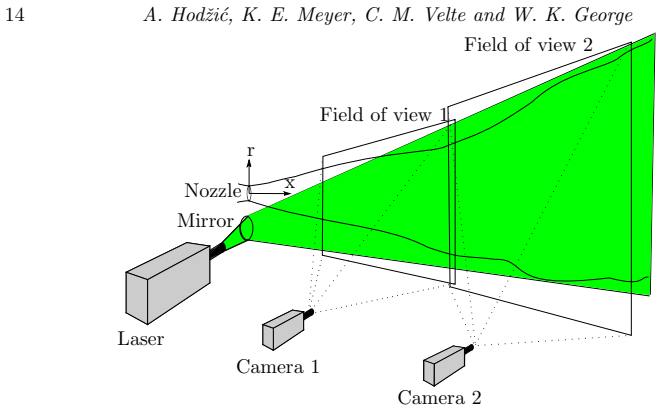
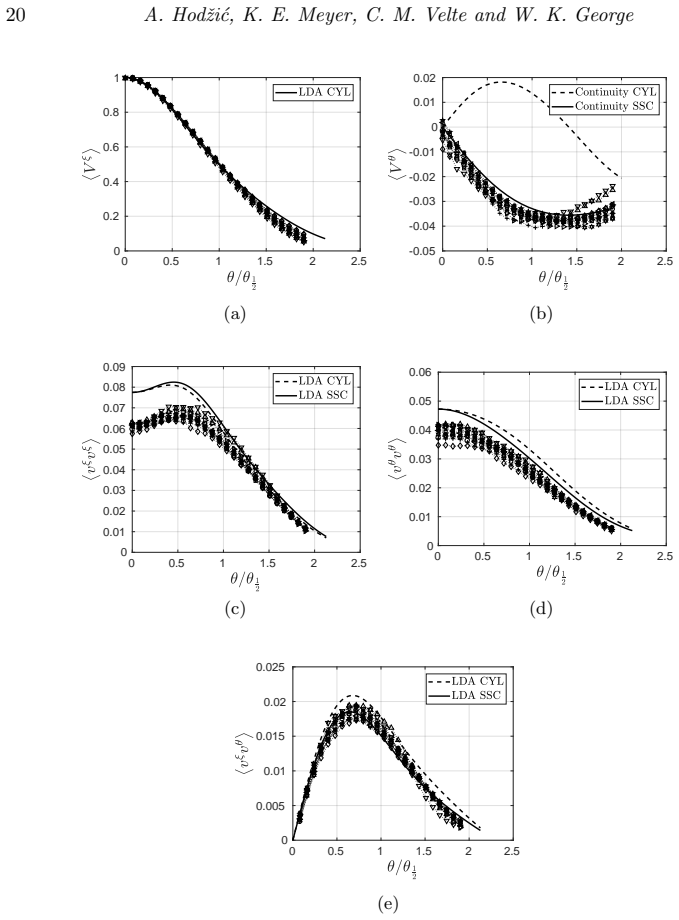
Summary. The paper develops a tensor-calculus formulation of the Lumley decomposition (LD) in curvilinear coordinates and applies it to the self-similar far field of an axisymmetric round jet expressed in stretched spherical coordinates (SSC). The central analytical claim is that, after introducing a positive inner-product weight w = e^{-ξ}, the streamwise optimal eigenfunctions are stretched amplitude-decaying Fourier modes (SADFM) whose physical form is e^{iκξ-3ξ/2}, corresponding to an amplitude decay as (x-x0)^{-3/2} and linearly growing wavelength. The derivation is carried out in Section 3 and Appendices B-D, the transverse modes are solved numerically in the θ-direction, and the bases are used to produce spatial spectra from two independent PIV datasets, E1 and E2. The measured single-point profiles collapse reasonably, the spectra exhibit reported -5/3 and -7/3 regions, and the first LD modes contain a large fraction of the energy.
Significance. If the central premise is validated, the paper is a useful and original contribution: it extends Fourier-type POD bases to a flow direction that is not statistically homogeneous, for a class of flows admitting equilibrium similarity. The tensor formulation is clearly laid out, the algebraic derivations in Appendices B-C are transparent, and the two independent datasets provide a welcome cross-check of single-point statistics. The prediction of the -3/2 amplitude decay and the linear wavelength growth is explicit and falsifiable. However, the main analytical result is conditional on a homogeneity-after-scaling assumption that is not directly tested in the present manuscript, and the relation between weighted-space optimality and physical-space L2 orthogonality needs sharper statement. The significance is therefore real but prospective until the key premise is checked.
major comments (4)
- [Section 3.3, Eq. (3.41) and the sentence preceding Eq. (3.45)] The deduction of the SADFM rests on the statement that the correlation tensor rR^j_·ĵ in Eq. (3.41) is invariant with respect to ζ = ξ'-ξ, which licenses the Fourier ansatz (3.45). This premise is imported from Ewing et al. (2007) and is not directly verified with the present two-point data. Projecting the measured fields onto the SADFM in Section 6 measures only the energy captured by the basis, not whether the basis diagonalizes the measured two-point correlation tensor. Because both datasets cover the full ξ-range, the authors can test the premise directly by computing the scaled two-point correlation as a function of ζ for several anchor positions ξ; if it does not collapse, the SADFM are not eigenfunctions of the actual LD operator. This is the load-bearing assumption of the paper and should be addressed before the central claim is accepted.
- [Section 4, Ωξ=[0,1.21], and Appendix C] Even if exact ξ-homogeneity of Eq. (3.41) holds, the measured domain Ωξ=[0,1.21] is finite, so the integral operator with a homogeneous kernel is Toeplitz rather than circulant in ξ. Strict Fourier eigenfunctions are therefore an infinite-domain or periodic-domain idealization. Appendix C establishes orthogonality of the SADFM on the finite interval, but orthogonality alone does not make them eigenfunctions of the finite-interval LD integral. The paper should quantify the finite-domain error, for example by comparing the Fourier projection with numerical eigenfunctions of the truncated Toeplitz operator in ξ in the same way that the θ-direction is treated numerically, or by showing that boundary terms are negligible over Ωξ. Without this, the -3/2 amplitude prediction is not tied to the actual finite measurement domain.
- [Section 3.3, Eqs. (3.36), (3.52), and Section 6.3, Eqs. (6.6)-(6.7)] The paper should distinguish more sharply between optimality in the weighted space L2_w and in the physical space L2. The SADFM are eigenfunctions of the weighted LD integral (3.40) after choosing w=e^{-ξ}; the transformation χ=e^{-ξ/2}Φ in Eq. (3.52) is a unitary equivalence that makes the modes orthonormal in L2, but it does not by itself show that the χ-modes are eigenfunctions of the unweighted LD operator. The projection coefficients in Eqs. (6.6)-(6.7) are nevertheless presented as expansions of the physical field. The authors should state explicitly that the optimality claim applies to the weighted inner product, or supply the additional argument showing optimality in L2. This distinction matters because the abstract and conclusions present the SADFM as 'the optimal eigenfunctions' without specifying the space.
- [Section 6.3, Fig. 9] The -5/3 and -7/3 spectral ranges are central to the claim that the SADFM reproduce homogeneous-turbulence scaling, but the figure displays no fitted reference lines or uncertainty estimates, and the stated ranges (κ∈[20:300] for -5/3 and κ∈[20:250] for -7/3) are not supported by a quantitative fitting procedure. The authors should provide the fit details and show compensated spectra, particularly for the cross-spectrum away from the centerline where the -7/3 range is reported to disappear. This is needed for the reader to judge whether the observed ranges are significant beyond visual inspection.
minor comments (4)
- [Section 5.1] The sentence reporting the conservative window sizes is incomplete: '≈ 1.25 and Lξ« 1.1 and' appears to contain a typo, and the stated values should be reconciled with Lξ=1.21 given in Section 4.
- [Section 3.3, Eq. (3.33) and Appendix B] The notation rUc for the contravariant centerline velocity should be defined more carefully, since it has different dimensions from the physical centerline velocity Uc; currently the reader has to infer the scaling from the reconstruction argument in Eq. (B.5).
- [Figures 6-9] Several captions do not identify the subpanels, and the text refers to panels (a)-(h) without a consistent labeling in the figure files; for example, Fig. 9 has no subpanel labels in the caption.
- [Section 4 and Eq. (6.6)] The symbol θ1/2 is used in figures and text but is never formally defined; please add its definition, e.g., the location where the mean streamwise velocity falls to half its centerline value.
Circularity Check
SADFM amplitude decay is fixed by the chosen weight w=e^{-\xi}; Fourier premise rests on an unverified same-group citation.
-
self definitional
[Sec. 3.3 (Eqs. 3.36, 3.52, 3.53a-c) and Appendix B]
"pw“e´ˆξ. ... Note that this was achieved by introducing a specific inner product weight in the inner product definition in SSC (Appendix B). ... The´3{2-power appears due to the orthogonality criterion imposed on the functions in three spatial dimensions (see Appendix D for the basis in one-dimensional space). Orthogonality is therefore only satisfied if the power´3{2 appears in the eigenfunction definition."
The e^{-3\xi/2} amplitude in (3.53a-c) is not an empirical deduction from the measured two-point statistics; it is the product of the physical-component conversion factor e^{-\xi} and the square root of the chosen weight e^{-\xi/2} from the transformation \chi=e^{-\xi/2}\Phi in (3.52). Once w=e^{-\xi} is inserted into the inner product, the streamwise decay is fixed by algebra, independent of the velocity correlation. The paper itself says the -3/2 power 'appears due to the orthogonality criterion,' i.e. it is imposed to make the weighted and unweighted orthonormality conditions consistent, so the central 'deduction' of the SADFM amplitude reduces by construction to the chosen weight and coordinate metric.
-
self citation load bearing
[Sec. 3.3 (after Eq. 3.44) and Introduction]
"Since the correlation tensor in (3.41) is invariant with respect to the separation in (3.37) the eigenfunctions ˜ϕjα can be decomposed with respect to Fourier modes ... The work of Ewing et al. (2007) showed using experiments in the same jet described below that the single and two-point similarity results were valid descriptions of the flow."
The Fourier ansatz (3.45), and hence the whole SADFM construction, is licensed by the \zeta-invariance of the scaled two-point correlation (3.41). That invariance is imported from Ewing et al. (2007), a paper co-authored by W. K. George, an author of the present paper, and it is not tested against the present PIV datasets. Section 6 only projects the data onto the pre-assumed SADFM basis, which measures energy in that basis but does not verify that the basis diagonalizes the measured two-point correlation. Thus the central prediction rests on a load-bearing same-group prior result rather than on independent evidence presented here.
full rationale
The paper's central claim—that the streamwise optimal modes are SADFM with a -3/2 amplitude decay—is not an independent deduction from the measured velocity statistics. The amplitude factor e^{-3\xi/2} in (3.53a-c) is the product of the physical-component conversion e^{-\xi} and the square root of the chosen weight e^{-\xi/2} (3.52); once w=e^{-\xi} is inserted, the decay is fixed by algebra, independent of the correlation data. The Fourier ansatz itself is licensed by the \zeta-invariance of the scaled two-point correlation (3.41), which the paper imports from Ewing et al. (2007), a paper sharing author W. K. George, and does not verify with the present PIV data. Projecting data onto the pre-assumed SADFM (Sec. 6.3) measures energy in that basis but does not establish diagonalization of the actual correlation. The measured -5/3 and -7/3 spectral slopes (Sec. 6.3) are empirical results and are not circular per se. The paper is transparent that the weight is an introduced device and that eigenvalues are correspondingly weighted (Appendix E), so this is a partial self-definition of the 'optimal' basis plus a load-bearing self-citation rather than a wholly hidden tautology. Score 6 reflects that the central analytical prediction reduces by construction to the chosen weight and to an unverified same-group prior result, while the single-point statistics and transverse LD modes retain independent content.
Assumptions & free parameters
free parameters (3)
- Inner-product weight w = e^{-xi} =
exponent -1
- Virtual origin x0 =
E1: 3.1D, E2: 2.4D
- Centerline velocity decay rate Bu =
E1: 5.76, E2: 5.72
assumptions (4)
- domain assumption The far-field round jet is in equilibrium similarity so that single- and two-point statistics, when scaled by the local centerline velocity and the stretched coordinate, are self-similar (George 1989, Ewing et al. 2007).
- domain assumption The two-point correlation tensor of the scaled contravariant velocity field depends only on the separation zeta = xi' - xi and not on absolute streamwise position.
- ad hoc to paper The inner product weight w can be chosen freely as long as it is positive definite, and the resulting L2_w space is accepted as the space in which the eigenfunctions are optimal.
- domain assumption Statistical stationarity and axisymmetry of the far-field jet allow Fourier modes in time and azimuthal angle.
invented entities (1)
-
SADFM (stretched amplitude-decaying Fourier modes)
Cite this review
Pith. "Pith review of Lumley Decomposition of the Turbulent Round Jet Far-field. Part 1 -- Kinematics." pith.science (2026). https://pith.science/paper/DCZWYZDD
@misc{pith2026190805134,
  author       = {Pith},
  title        = {Pith review of: Lumley Decomposition of the Turbulent Round Jet Far-field. Part 1 -- Kinematics},
  year         = {2026},
  howpublished = {\url{https://pith.science/paper/DCZWYZDD}},
  note         = {Machine review of arXiv:1908.05134}
}
read the original abstract
The current work presents a tensor formulation of the Lumley Decomposition (LD), introduced in its original form by Lumley (1967b), allowing decompositions of turbulent flow fields in curvilinear coordinates. The LD in his form is shown to enable semi-analytical decompositions of self-similar turbulent flows in general coordinate systems. The decomposition is applied to the far-field region of the fully developed turbulent axi-symmetric jet, which is expressed in stretched spherical coordinates in order to exploit the self-similar nature of the flow while ensuring the self-adjointness of the LD integral. From the LD integral it is deduced that the optimal eigenfunctions in the streamwise direction are stretched amplitude-decaying Fourier modes (SADFM). The SADFM are obtained from the LD integral upon the introduction of a streamwise-decaying weight function in the vector space definition. The wavelength of the Fourier modes is linearly increasing in the streamwise direction with an amplitude which decays with the -3/2 power of distance from the virtual origin. The streamwise evolution of the SADFM re-sembles reversed wave shoaling known from surface waves. The energy- and cross-spectra obtained from these SADFM exhibit a -5/3- and a -7/3-slope region, respectively, as would be expected for regular Fourier modes in homogeneous and constant shear flows. The approach introduced in this work can be extended to other flows which admit to equilibrium similarity, such that a Fourier-based decomposition along inhomogeneous flow directions can be performed.
Figures


Figures from the paper (17 more)






Forward citations
Cited by 1 Pith paper
-
Lumley Decomposition of the Turbulent Round Jet Far-field. Part 2 -- Dynamics
A modal decomposition of the round jet far field shows that the first Lumley mode dominates shear-stress production and that many modes draw energy directly from the mean flow, including in the -5/3 spectral range.
Reference graph
Works this paper leans on
-
[1]
, " * write output.state after.block = add.period write newline
ENTRY address author booktitle chapter edition editor howpublished institution journal key month note number organization pages publisher school series title type volume year label extra.label sort.label short.list INTEGERS output.state before.all mid.sentence after.sentence after.block FUNCTION init.state.consts #0 'before.all := #1 'mid.sentence := #2 '...
-
[2]
write newline
" write newline "" before.all 'output.state := FUNCTION n.dashify 't := "" t empty not t #1 #1 substring "-" = t #1 #2 substring "--" = not "--" * t #2 global.max substring 't := t #1 #1 substring "-" = "-" * t #2 global.max substring 't := while if t #1 #1 substring * t #2 global.max substring 't := if while FUNCTION word.in bbl.in capitalize " " * FUNCT...
-
[3]
Champagne, F. H. 1978 The fine-scale structure of the turbulent velocity field . Journal of Fluid Mechanics\/ 86 (1), 67--108
work page 1978
-
[4]
K., Pedersen, J
Ewing, D., Frohnapfel, B., George, W. K., Pedersen, J. M. & Westerweel, J. 2007 Two-point similarity in the round jet . Journal of Fluid Mechanics\/ 577 , 309--330
2007
-
[5]
& George, W
Gamard, S., Jung, D. & George, W. K. 2004 Downstream evolution of the most energetic modes in a turbulent axisymmetric jet at high Reynolds number. Part 2. The far-field region . Journal of Fluid Mechanics\/ 514 , 205--230
2004
-
[6]
George, W. K. 1989 The self-preservation of turbulent flows and its relation to initial conditions and coherent structures . In Advances in Turbulence, 3973\/
work page 1989
-
[7]
George, W. K. 2014 Reconsidering the ‘ Local Equilibrium ' hypothesis for small scale turbulence . In Turbulence Colloquium Marseille 2011: Fundamental Problems of Turbulence, 50 Years After the Marseille 1961 Conference. Les Ulis, Fr.: EDP Sci.\/
work page 2014
-
[8]
George, W. K. 2017 A 50-Year Retrospective and the Future . In Whither Turbulence and Big Data in the 21st Century?\/ , pp. 13--43. Springer
2017
Show all 21 references
-
[9]
2013 Introduction to Tensor Analysis and the Calculus of Moving Surfaces \/
Grinfeld, P. 2013 Introduction to Tensor Analysis and the Calculus of Moving Surfaces \/
2013
-
[10]
1975 Turbulence \/
Hinze, J.O. 1975 Turbulence \/ . McGraw-Hill
1975
-
[11]
2019 A Tensor Calculus Formulation of the Lumley Decomposition applied to the Turbulent Axi-symmetric Jet Far-field
Hod z i \' c , A. 2019 A Tensor Calculus Formulation of the Lumley Decomposition applied to the Turbulent Axi-symmetric Jet Far-field . Ph.d. thesis, Technical University of Denmark
2019
-
[12]
E., George, W
Hod z i \' c , A., Meyer, K. E., George, W. K. & Velte, C. M. 2019 Lumley Decomposition of the Turbulent Round Jet Far-field. Part 2 -- Dynamics . ArXiv\/ (1909.01307)
2019 arXiv
-
[13]
Holmes, P., Lumley, J. L. & Berkooz, G. 2012 Turbulence, Coherent Structures, Dynamical Systems and Symmetry \/ , second edi edn. Cambridge University Press
2012
-
[14]
J., Capp, S
Hussein, H. J., Capp, S. P. & George, W. K. 1994 Velocity measurements in a high-Reynolds-number, momentum-conserving, axisymmetric, turbulent jet . Journal of Fluid Mechanics\/ 258 (1), 31--75
1994
-
[15]
Lumley, J. L. 1967 a\/ Similarity and the turbulent energy spectrum . Physics of Fluids\/ 10 (4), 855--858
1967
-
[16]
Lumley, J. L. 1967 b\/ The structure of inhomogeneous turbulent flows . In Atmospheric turbulence and radio wave propagation\/ , pp. 166--178. Nauka, Moscow
1967
-
[17]
1953 The Physical components of vectors and Tensors
Truesdell, C. 1953 The Physical components of vectors and Tensors . ZAMM‐Journal of Applied Mathematics and Mechanics/Zeitschrift f \" u r Angewandte Mathematik und Mechanik\/ 33.10 (11), 345--356
1953
-
[18]
a nstr \
W \" a nstr \" o m, M. 2009 Spatial decompositions of a fully-developed turbulent round jet sampled with particle image velocimetry . Ph.d. thesis, Chalmers University of Technology
2009
-
[19]
@esa (Ref
\@ifclassloaded aguplus natbib The aguplus class already includes natbib coding, so you should not add it explicitly Type <Return> for now, but then later remove the command natbib from the document \@ifclassloaded nlinproc natbib The nlinproc class already includes natbib cod...
-
[20]
@stdbsttrue NAT@ctr \@lbibitem[ NAT@ctr ] \@lbibitem[#1]#2 \@extra@b@citeb \@ifundefined br@#2\@extra@b@citeb \@namedef br@#2 \@nameuse br@#2\@extra@b@citeb \@ifundefined b@#2\@extra@b@citeb @num @parse #2 [ @natanchorstart #2\@extra@b@citeb \@biblabel @num @natanchorend] @ifc...
-
[21]
**jfm.tex ! Emergency stop
@open @close @open @close and [1] URL: #1 \@ifundefined chapter * \@mkboth \@ifundefined NAT@sectionbib * \@mkboth * \@mkboth\@gobbletwo \@ifclassloaded amsart * \@ifclassloaded amsbook * \@ifundefined bib@heading @heading NAT@ctr thebibliography [1] @ \@biblabel NAT@ctr \@bib...
2013
Reviewed August 14, 2026 · model on record in the stance chip above.
Discussion (0). Continue with ORCID to comment.