REVIEW 3 major objections 4 minor 1 cited by
Lumley Decomposition of the Turbulent Round Jet Far-field. Part 2 -- Dynamics
T0 review · 3 major / 4 minor · reviewed 2026-08-14 · deepseek-v4-flash
Pith's one-line read The far-field round jet's Lumley modes draw a substantial share of their energy directly from the mean flow, including in the wavenumber band where the spectrum shows a -5/3 slope.
desk verdict A genuine modal production budget for the jet far field, worth referee time, but the SADFM basis—especially the unexplained ω in Eq. (3.15)—needs validation before the central claim is fully consequential. read the letter →
The pith
A machine-rendered reading of the paper's core claim, the machinery that carries it, and where it could break.
The reading
What carries the argument
The argument is carried by the modal production term (3.21b), $\lambda\phi^i_\alpha\phi^{j*}_\alpha\nabla_j\langle V^i\rangle$, which measures how much turbulence kinetic energy a given Lumley mode draws per unit time from the mean-velocity gradients. Dividing by the modal energy $\lambda$ gives the energy-normalized production (3.25), whose near-constancy across mode number and wavenumber is the quantitative evidence for direct mean-flow feeding. These objects are computed on the stretched amplitude decaying Fourier modes (SADFM) of Part 1, a basis in stretched spherical coordinates whose streamwise part is a decaying Fourier wave, combined with a Galerkin projection of the energy equation in curvilinear coordinates.
What would settle it
Recompute the energy-normalized production on a time-resolved far-field jet dataset or a large-eddy simulation and check whether the production-to-energy ratio for modes at wavenumbers $\kappa \in [20,300]$ stays near its high-shear plateau; if the plateau disappears away from the half-width region, the claim that a wide range of modes are directly fed by the mean flow would fail.
Extended reading notes
Core claim
The central discovery is a modal energy budget for the far-field round jet in which scale-by-scale feeding from the mean flow is the norm. When the production term of the turbulence kinetic energy equation is expanded in the Lumley eigenfunctions, the energy-normalized production $P_{\rho\lambda}$ remains at significant and nearly constant levels over a wide range of mode numbers and wavenumbers, including the $\kappa$-range $20 < \kappa < 300$ where the averaged one-dimensional spectra follow a $-5/3$ power law. The same modal budget shows that the first mode alone reconstructs the $-7/3$ range of the cross-spectrum near the half-width, where mean shear is high, and the first two modes almost completely reconstruct the Reynolds shear-stress profile. These observations are presented as support for the hypothesis that multiple modes extract energy directly from the mean flow, contradicting the idea that the $-5/3$ range is exclusively an inertial range fed only by a Richardson-style cascade.
Load-bearing premise
The argument rests on the assumption that the stretched amplitude decaying Fourier modes from the earlier paper really are the eigenfunctions of the measured correlation tensor, and that the temporal frequency written into those modes is available from PIV data, although the paper does not explain how.
Editorial extensions
If this is right
- A two-mode truncation of the Lumley decomposition should be enough to reproduce the Reynolds shear-stress profile in the jet far field, since modes 1 and 2 nearly reconstruct it.
- The $-7/3$ cross-spectrum range in high-shear regions is a property of the first mode by itself, so low-order models that keep the first mode can capture the shear-stress spectrum without higher modes.
- Energy production in the $-5/3$ range implies that cascade-only closures miss a real source term; models must account for mode-specific mean-flow production.
- Modal self-similarity across wavenumbers, manifested as a collapse of the modal spectral building blocks, offers a possible scaling law for transferring modes between wavenumber bands.
Reading between the lines
- The paper does not examine other inhomogeneous shear flows, but if the near-constant energy-normalized production is robust, the same direct mean-flow feeding should also show up in boundary layers and wakes, where spectral modes in the inertial range are often assumed to be cascade-dominated.
- The paper does not specify how the temporal frequency $\omega$ in the mode definition is obtained from PIV data; if it is inferred indirectly, the production plateau could be partly sensitive to that choice, so a time-resolved dataset would be the cleanest test.
- A practical modeling direction left implicit in the paper is to assign each mode its measured production-to-energy ratio from mean-flow gradients rather than treating the inertial range as a passive drain, which could be formulated as a testable subgrid closure.
Signed reviews
Editorial analysis
A structured set of objections, weighed in public.
Referee Report
Summary. This paper, the second part of a two-part study, uses a semi-analytical Lumley Decomposition (LD) based on stretched amplitude decaying Fourier modes (SADFM) to analyze the dynamics of the turbulent round jet far field from PIV data. The authors derive a Galerkin projection of the turbulent kinetic energy transport equation in curvilinear coordinates, identify the modal production term, and use it to compute energy-normalized production (ENP) spectra. They report three central results: (i) a wide range of LD modes receive significant energy directly from the mean flow, even at wavenumbers where the averaged spectra exhibit the -5/3 slope; (ii) the -7/3 range of the cross-spectrum is reconstructed by the first mode alone in regions of high mean shear; and (iii) the first two modes almost fully reconstruct the shear-stress profile. The paper interprets these results as supporting the hypothesis of Wänström (2009) that multiple modes tap directly into mean-flow energy, in contrast to a purely Richardson-like cascade.
Significance. If the central claims are correct, the paper provides a substantive challenge to the usual interpretation of the -5/3 spectral range as a conservative cascade range in a inhomogeneous shear flow, and it supplies a tensor-calculus framework for modal TKE budgets that could be reused in other flows. The reconstruction of the -7/3 cross-spectrum by a single mode and the rapid convergence of the shear-stress reconstruction are striking and potentially useful results for reduced-order modeling. The analytical derivation of the modal transport equation in general coordinates is a clean formal contribution, and the authors are appropriately transparent about which terms can be reconstructed from the present data and about the effect of the Parzen window. However, the dynamical conclusions rest on the validity of the SADFM eigenfunction basis and on the interpretation of the ENP metric; neither of these is currently validated or quantified with respect to uncertainty, which limits the strength of the claims.
major comments (3)
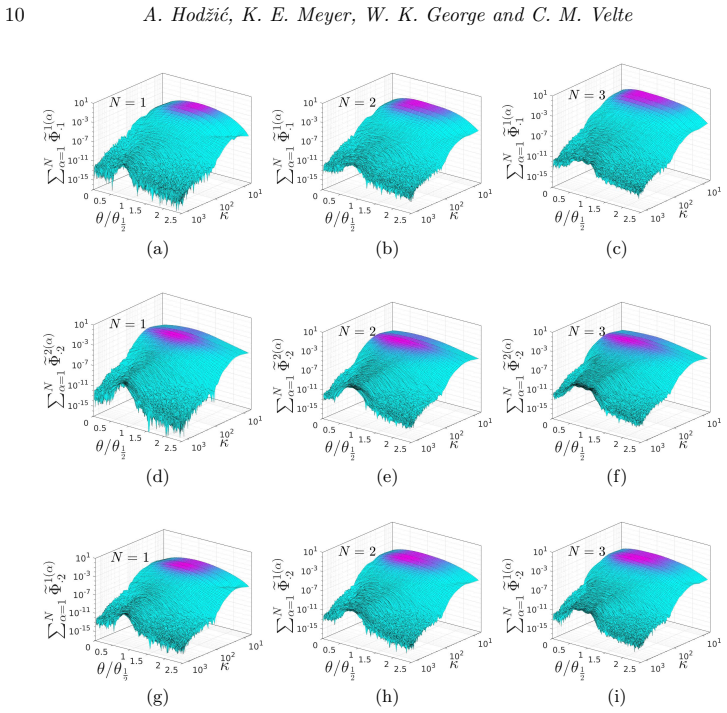
- [§3.1, Eq. (3.15)] The eigenfunction basis is asserted rather than validated, and the frequency ω is undefined. The production term (3.21b) and all ENP results in Figs. 8–10 are computed by projecting onto the SADFM basis Φ_α defined in (3.15). These are production rates of the actual dynamical LD modes only if the SADFM functions are eigenfunctions of the sampled two-point correlation tensor. The paper does not report any residual or reconstruction error of the two-point correlation tensor; Fig. 13 validates only single-point statistics. Moreover, Eq. (3.15) contains e^{i(ω+κξ+mφ−2ξ)}, but no time variable appears in the expression, and the PIV data are not described as time-resolved. The authors should state how ω is obtained from the data, or remove it from the ansatz, and should provide a direct check of the basis, e.g., the reconstruction error of R^i_{·j}, a comparison with a numerical eigen-decomposition of the sampled correlation tensor, or an explicit reference to the validation in the companion paper (Hodžić et al. 2019). Until this is supplied, the central claim in Section 4 that 'a wide range of modes obtain a substantial part of their energy directly from the mean flow' is conditional on an unverified ansatz.
- [§3.6, Figs. 8 and 10] The claim of near-constant ENP levels over the -5/3 range is made without uncertainty quantification. For example, the text reports a standard deviation of about 8.5% for α=1 over κ∈[26,300], but this is a scatter about the mean of a single realization, not an estimate of sampling uncertainty. Likewise, the fitted -5/3 and -7/3 slopes in Figs. 3–5 and 12 are presented without confidence bands or a stated fitting procedure. Since the central conclusion concerns the relative importance of direct production versus cascade transport in the -5/3 range, the authors should provide at least bootstrap confidence intervals on P_{ρλ,θ} and on the spectral slopes, or otherwise quantify the uncertainty from the finite PIV sample. Without this, the distinction between single-mode reconstruction of the -7/3 range and multi-mode reconstruction of the -5/3 range cannot be assessed quantitatively.
- [§3.6, Eq. (3.25)] The ENP metric normalizes production by the eigenvalue λ, but 'significant' is not tied to any comparison point. In the -5/3 range the eigenvalues of high-wavenumber modes are small, so even a modest absolute production rate can yield a large normalized value. The abstract and conclusions state that modes obtain 'significant amounts of energy directly from the mean flow,' yet no benchmark is given against which this significance is judged. The authors should compare the production term to the dissipation rate and/or to the spectral energy flux across the -5/3 range, and discuss whether the inferred direct production changes the leading-order budget. Without such a comparison, the claim of 'significant' direct production remains a statement about the normalization convention rather than about the dynamical balance.
minor comments (4)
- [§1, p. 2] There are typos throughout, e.g., 'the the experimental setup' (p. 2), 'commmonly' (p. 7), and 'cumulutive' (Fig. 13 caption).
- [§3.3, p. 7] The sentence 'If α = β = γ expression (3.21 b) defines the non-linear energy transfer within a given mode' should refer to Eq. (3.21c), since (3.21b) is the production term; the current text appears to mislabel the equation reference.
- [§3.4, p. 11] The text refers to 'figure 14' before Figure 13 has been introduced; the appendix figures should be renumbered or cross-referenced in the order of appearance.
- [§3.2, p. 5] The symbol θ_{1/2} is used to normalize the transverse coordinate in Figs. 3–5 and throughout the text, but it is not defined in this paper; please define it explicitly.
Circularity Check
No circularity: the modal production and spectral reconstructions are projections of the PIV data onto its own LD eigenfunctions, not independent predictions; the SADFM validation gap and undefined frequency ω are correctness concerns, not circular reductions.
full rationale
The paper's derivation chain is: (i) take the LD/SADFM eigenfunctions from Hodžić et al. (2019), obtained from the same PIV data; (ii) expand the velocity field in these eigenfunctions via (3.14); (iii) substitute into the TKE equation to obtain the modal production term (3.21b) and the modal spectra (3.18). Step (iii) is an exact modal decomposition, not an inverse derivation: the production term is evaluated from the eigenfunctions and the measured mean-velocity gradient, and the 'reconstruction' of the spectra is a partial sum of an expansion whose full sum equals the measured spectrum. The conclusion that a wide range of modes receive energy directly from the mean flow is a direct reading of the computed production values, not a prediction derived from the conclusion, so it is not circular. The main caveats are validation gaps rather than circularity: the SADFM basis in Eq. (3.15) is imported from a self-cited companion paper and is not tested here against a two-point correlation reconstruction residual, and the frequency ω appearing in (3.15) is not defined in terms of the PIV sampling. These affect the reliability and physical interpretation of the quantitative claims, but no equation in the paper is equivalent to its own input by construction and no fitted parameter is renamed as a prediction.
Assumptions & free parameters
free parameters (2)
- Jet velocity decay rate B =
B = 2 B_u / sqrt(pi) = 6.5 with B_u = 5.76
- Stretched coordinate scale C =
not stated
assumptions (4)
- domain assumption The fluctuating velocity can be represented exactly by SADFM eigenfunctions as psi_j^alpha e^{i(omega t + kappa xi + m phi - 2 xi)} over the domain (Eq. 3.15)
- domain assumption Jet far-field statistics are homogeneous in the stretched coordinate xi such that Fourier modes in xi are eigenfunctions
- standard math The Lumley decomposition operator is self-adjoint, ensuring non-negative eigenvalues and the orthogonality relations used in Eq. (3.2) and (3.21)
- domain assumption PIV measurements provide the two-point two-time correlation tensor including the temporal separation needed for omega in Eq. (3.15)
Cite this review
Pith. "Pith review of Lumley Decomposition of the Turbulent Round Jet Far-field. Part 2 -- Dynamics." pith.science (2026). https://pith.science/paper/NW65CVDH
@misc{pith2026190901307,
  author       = {Pith},
  title        = {Pith review of: Lumley Decomposition of the Turbulent Round Jet Far-field. Part 2 -- Dynamics},
  year         = {2026},
  howpublished = {\url{https://pith.science/paper/NW65CVDH}},
  note         = {Machine review of arXiv:1909.01307}
}
abstract
In the current work the reconstruction of the far-field region of the turbulent axi-symmetric jet is performed in order to investigate the modal turbulence kinetic energy production contributions. The reconstruction of the field statistics is based on a semi-analytical Lumley Decomposition (LD) of the PIV sampled field using stretched amplitude decaying Fourier modes (SADFM), derived in Hod\v{z}i\'c et al. 2019, along the streamwise coordinate. It is shown that, a wide range of modes obtain a significant amount of energy directly from the mean flow, and are therefore not exclusively dependent on a Richardson-like energy cascade even in the $\kappa$-range in which the energy spectra exhibit the $-5/3$-slope. It is observed that the $-7/3$-range in the cross-spectra is fully reconstructed using a single mode in regions of high mean shear, and that shear-stresses are nearly fully reconstructed using the first two modes. These results indicate that most of the energy production related to shear-stresses is related to the first LD mode.
Figures


Figures from the paper (13 more)


Forward citations
Cited by 1 Pith paper
-
Lumley Decomposition of the Turbulent Round Jet Far-field. Part 1 -- Kinematics
In the far field of a turbulent round jet, the Lumley decomposition in stretched spherical coordinates yields streamwise eigenfunctions that are Fourier modes with linearly growing wavelength and amplitude decaying as...
Reference graph
Works this paper leans on
-
[1]
, " * write output.state after.block = add.period write newline
ENTRY address author booktitle chapter edition editor howpublished institution journal key month note number organization pages publisher school series title type volume year label extra.label sort.label short.list INTEGERS output.state before.all mid.sentence after.sentence after.block FUNCTION init.state.consts #0 'before.all := #1 'mid.sentence := #2 '...
-
[2]
write newline
" write newline "" before.all 'output.state := FUNCTION n.dashify 't := "" t empty not t #1 #1 substring "-" = t #1 #2 substring "--" = not "--" * t #2 global.max substring 't := t #1 #1 substring "-" = "-" * t #2 global.max substring 't := while if t #1 #1 substring * t #2 global.max substring 't := if while FUNCTION word.in bbl.in capitalize " " * FUNCT...
-
[3]
Arndt, R. E.A., Long, D. F. & Glauser, M. N. 1997 The proper orthogonal decomposition of pressure fluctuations surrounding a turbulent jet . Journal of Fluid Mechanics\/ 340 , 1--33
work page 1997
-
[4]
Citriniti, J. H. & George, W. K. 2000 Reconstruction of the global velocity field in the axisymmetric mixing layer utilizing the proper orthogonal decomposition . Journal of Fluid Mechanics\/ 418 , 137--166
work page 2000
-
[5]
Corrsin, S. & Kistler, A. L. 1955 Free-Stream Boudaries of Turbulent Flows . Tech. Rep.\/
work page 1955
-
[6]
Ewing, D 1995 On Multi-Point Similarity Solutions in Turbulent Free-Shear Flows . Ph.d. dissertation, The State Univeristy of New York at Buffalo
work page 1995
-
[7]
Ewing, D., Frohnapfel, B., George, W. K., Pedersen, J. M. & Westerweel, J. 2007 Two-point similarity in the round jet . Journal of Fluid Mechanics\/ 577 , 309--330
work page 2007
-
[8]
Gamard, S., George, W. K., Jung, D. & Woodward, S. 2002 Application of a "slice" proper orthogonal decomposition to the far field of an axisymmetric turbulent jet . Physics of Fluids\/ 14 (7), 2515--2522
work page 2002
Show all 33 references
-
[9]
& George, W
Gamard, S., Jung, D. & George, W. K. 2004 Downstream evolution of the most energetic modes in a turbulent axisymmetric jet at high Reynolds number. Part 2. The far-field region . Journal of Fluid Mechanics\/ 514 , 205--230
2004
-
[10]
George, W. K. 2017 A 50-Year Retrospective and the Future . In Whither Turbulence and Big Data in the 21st Century?\/ , pp. 13--43. Springer
2017
-
[11]
N., Leib, S
Glauser, M. N., Leib, S. J. & George, W. K. 1987 Coherent Structures in the Axisymmetric Turbulent Jet Mixing Layer . In Fifth International Symposium on Turbulent Shear Flows\/ . Springer-Verlag Berlin Heidelberg
1987
-
[12]
2013 Introduction to Tensor Analysis and the Calculus of Moving Surfaces \/
Grinfeld, P. 2013 Introduction to Tensor Analysis and the Calculus of Moving Surfaces \/
2013
-
[13]
2019 A Tensor Calculus Formulation of the Lumley Decomposition applied to the Turbulent Axi-symmetric Jet Far-field
Hod z i \' c , A. 2019 A Tensor Calculus Formulation of the Lumley Decomposition applied to the Turbulent Axi-symmetric Jet Far-field . Ph.d. thesis, Technical University of Denmark
2019
-
[14]
E., Velte, C
Hod z i \' c , A., Meyer, K. E., Velte, C. M. & George, W. K. 2019 Lumley Decomposition of the Turbulent Round Jet Far-field. Part 1 -- Kinematics . ArXiv\/ (1908.05134)
2019 arXiv
-
[15]
J., Capp, S
Hussein, H. J., Capp, S. P. & George, W. K. 1994 Velocity measurements in a high-Reynolds-number, momentum-conserving, axisymmetric, turbulent jet . Journal of Fluid Mechanics\/ 258 (1), 31--75
1994
-
[16]
& George, W
Jung, D., Gamard, S. & George, W. K. 2004 Downstream evolution of the most energetic modes in a turbulent axisymmetric jet at high Reynolds number. Part 1. The near-field region . Journal of Fluid Mechanics\/ 514 , 173--204
2004
-
[17]
J., Glauser, M
Leib, S. J., Glauser, M. N. & George, W. K. 1984 An application of Lumley's orthogonal decomposition to the axisymmetric turbulent jet mixing layer . In Proc. 9th Rolla Symp. on Turbulence in Fluids\/ (ed. X. B. Reed, G. K. Patterson & J. L. Zakin). University of Missoury, Rolla
1984
-
[18]
Lumley, J. L. 1967 Similarity and the turbulent energy spectrum . Physics of Fluids\/ 10 (4), 855--858
1967
-
[19]
I., Sandberg, R
Mullyadzhanov, R. I., Sandberg, R. D., Abdurakipov, S. S., George, W. K. & Hanjali \' c , K. 2018 Propagating helical waves as a building block of round turbulent jets . Physical Review Fluids\/ 3 (6)
2018
-
[20]
D., Podvin, B., Mathelin, L
Muralidhar, S. D., Podvin, B., Mathelin, L. & Fraigneau, Y. 2018 Spatio-temporal Proper Orthogonal Decomposition of turbulent channel flow . ArXiv\/ (1805.01494)
2018 arXiv
-
[21]
Panchapakesan, N. R. & Lumley, J. L. 1993 Turbulence measurements in axisymmetric jets of air and helium. Part 1. Air jet . Journal of Fluid Mechanics\/ 246 , 197--223
1993
-
[22]
T., Towne, A., Rigas, G., Colonius, T
Schmidt, O. T., Towne, A., Rigas, G., Colonius, T. & Br \` e s, G. A. 2018 Spectral analysis of jet turbulence . Journal of Fluid Mechanics\/ 855 , 953--982
2018
-
[23]
& Lumley, J
Tennekes, H. & Lumley, J. L. 1972 A First Course in Turbulence \/ . Cambridge, Massachusetts: MIT Press
1972
-
[24]
Towne, A., Schmidt, O. T. & Colonius, T. 2018 Spectral proper orthogonal decomposition and its relationship to dynamic mode decomposition and resolvent analysis . Journal of Fluid Mechanics\/ 847 , 821--867
2018
-
[25]
Townsend, A. A. 1956 The structure of turbulent shear flows \/ . Cambridge: Cambridge University Press
1956
-
[26]
a nstr \
W \" a nstr \" o m, M. 2009 Spatial decompositions of a fully-developed turbulent round jet sampled with particle image velocimetry . Ph.d. thesis, Chalmers University of Technology
2009
-
[27]
a nstr \
W \" a nstr \" o m, M., George, W. K. & Meyer, K.E. 2012 Streamwise and Radial Decomposition of a Turbulent Axisymmetric Jet . In Progress in Turbulence and Wind Energy IV\/ (ed. Martin Oberlack, Joachim Peinke, Alessandro Talamelli, Luciano Castillo & Michael H \" o lling), p...
2012
-
[28]
a nstr \
W \" a nstr \" o m, M., George, W. K. & Meyer, K. E. 2006 Stereoscopic PIV and POD applied to the far turbulent axisymmetric jet . In 36th AIAA Fluid Dynamics Conference and Exhibit\/ , p. 3368
2006
-
[29]
a nstr \
W \" a nstr \" o m, M., George, W. K., Meyer, K. E. & Westergaard, C. 2007 Identifying Sources of Errors on Stereoscopic PIV Measurements . In 5th ASME/JSME 2007 Joint Fluids Engineering Conference\/ , pp. 987--996
2007
-
[30]
& Fiedler, H
Wygnanski, I. & Fiedler, H. 1969 Some measurements in the self-preserving jet . Journal of Fluid Mechanics\/ 38 (3), 577--612
1969
-
[31]
@esa (Ref
\@ifclassloaded aguplus natbib The aguplus class already includes natbib coding, so you should not add it explicitly Type <Return> for now, but then later remove the command natbib from the document \@ifclassloaded nlinproc natbib The nlinproc class already includes natbib cod...
-
[32]
@stdbsttrue NAT@ctr \@lbibitem[ NAT@ctr ] \@lbibitem[#1]#2 \@extra@b@citeb \@ifundefined br@#2\@extra@b@citeb \@namedef br@#2 \@nameuse br@#2\@extra@b@citeb \@ifundefined b@#2\@extra@b@citeb @num @parse #2 [ @natanchorstart #2\@extra@b@citeb \@biblabel @num @natanchorend] @ifc...
-
[33]
**jfm.tex ! Emergency stop
@open @close @open @close and [1] URL: #1 \@ifundefined chapter * \@mkboth \@ifundefined NAT@sectionbib * \@mkboth * \@mkboth\@gobbletwo \@ifclassloaded amsart * \@ifclassloaded amsbook * \@ifundefined bib@heading @heading NAT@ctr thebibliography [1] @ \@biblabel NAT@ctr \@bib...
2013
Reviewed August 14, 2026 · model on record in the stance chip above.
Discussion (0). Continue with ORCID to comment.