REVIEW 3 major objections 4 minor 21 references
Directional TSDF: Modeling Surface Orientation for Coherent Meshes
T0 review · 3 major / 4 minor · reviewed 2026-08-14 · deepseek-v4-flash
Pith's one-line read Splitting a TSDF into six directional volumes preserves thin geometry that standard TSDF fusion erases.
desk verdict Solid, well-ablated extension of TSDF fusion that plausibly fixes thin-structure reconstruction at coarse resolutions, but the evaluation is narrower than the 'state-of-the-art' claim suggests. read the letter →
The pith
A machine-rendered reading of the paper's core claim, the machinery that carries it, and where it could break.
The reading
What carries the argument
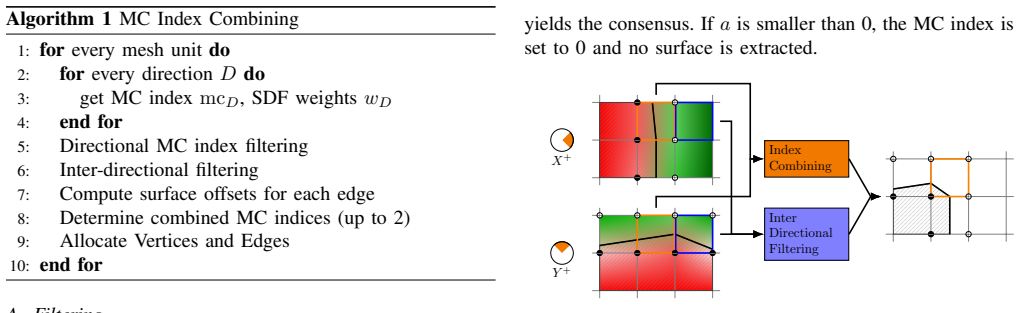
The load-bearing object is the directional TSDF, a voxel-hashed grid in which each block can hold up to six separate truncated signed-distance arrays, one per axis direction ($X^+, X^-, Y^+, Y^-, Z^+, Z^-$). Direction assignment is governed by the correspondence weight $w_D(n)=\langle n, v_D\rangle$, which routes each measurement into every sector whose axis is within $\sin(\pi/8)$ of the surface normal, so a sample usually enters at most three directions. The companion mechanism is gradient-directed ray casting: starting from the measured surface point, a ray is traversed along the estimated normal in both directions and every voxel within the truncation range is updated with the point-to-plane distance, replacing voxel projection and avoiding aliasing at steep angles. Mesh extraction uses a modified marching cubes that computes one MC index per direction, discards direction-inconsistent indices, votes across directions with the consensus formula of Eq. (6), and combines remaining indices by intersection so a mesh unit can contain two opposite surfaces. Together these mechanisms let thin structures be encoded as two well-separated zero crossings instead of one blurred one.
What would settle it
Render a synthetic thin plate whose surface normal lies exactly on the bisector between two direction sectors and reconstruct it with the proposed pipeline at a coarse voxel size; if the reconstructed mesh shows holes, double walls, or an inflated zero crossing at that boundary while the same plate a few degrees away reconstructs cleanly, the sector discretization is the limiting factor.
Extended reading notes
Core claim
The paper's central claim is that the TSDF's thin-structure failure is a property of the representation, not just of voxel resolution: a scalar signed distance field encodes a surface as a sign transition, and two opposing surfaces closer than the truncation distance merge into one inflated zero crossing. To remove that coupling, the directional TSDF replaces the scalar field with up to six fields per voxel indexed by the positive and negative coordinate axes, assigns each depth sample to every direction sector whose axis aligns with the measured normal (weight $w_D(n)=\langle n, v_D\rangle$, accepted above $\sin(\pi/8)$), and integrates with a weighted moving average. New measurements are fused by casting rays along the surface normal rather than the camera ray or voxel projection, using the point-to-plane distance to the measured point. Mesh extraction is a modified marching cubes: one MC index per direction, a lookup-table filtering of direction-invalid surfaces, an inter-directional vote $a=\sum_D w^{\mathrm{sdf}}_D\langle \nabla\Phi_D, v_D\rangle a_D$ that suppresses overhangs, and an index-intersection step that lets one mesh unit contain two opposing faces. On the two public benchmark suites used in the paper, the proposed pipeline achieves lower RMSE than the baseline at nearly every tested voxel size, with the largest gains on thin features such as the Dragon's ridge and tail.
Load-bearing premise
The method assumes that six fixed, axis-aligned direction sectors with a $\sin(\pi/8)$ correspondence threshold are enough to assign every real surface to a consistent direction, and that no surface curves sharply enough inside one voxel to make the direction assignment fail.
Editorial extensions
If this is right
- Thin structures thinner than the voxel size can be reconstructed without shrinking the voxel grid, so coarse-resolution mapping no longer loses details like ridges, ears, and tails.
- Steep observation angles stop being a source of aliasing: fusing along the surface normal uses every depth pixel instead of discarding or mis-projecting it.
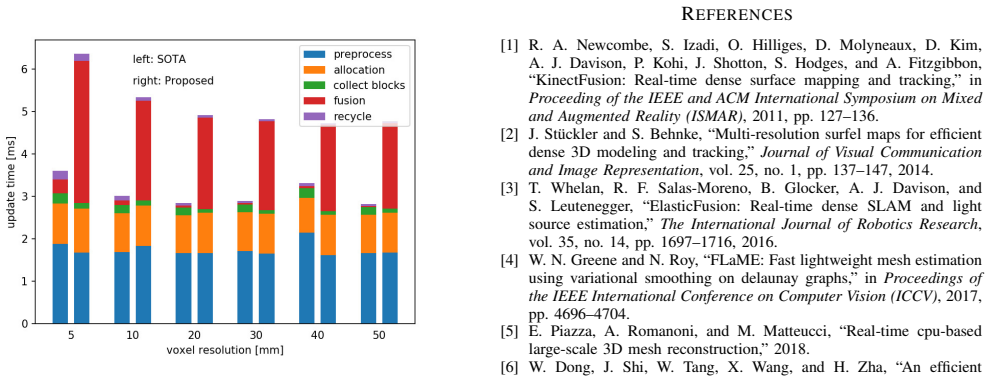
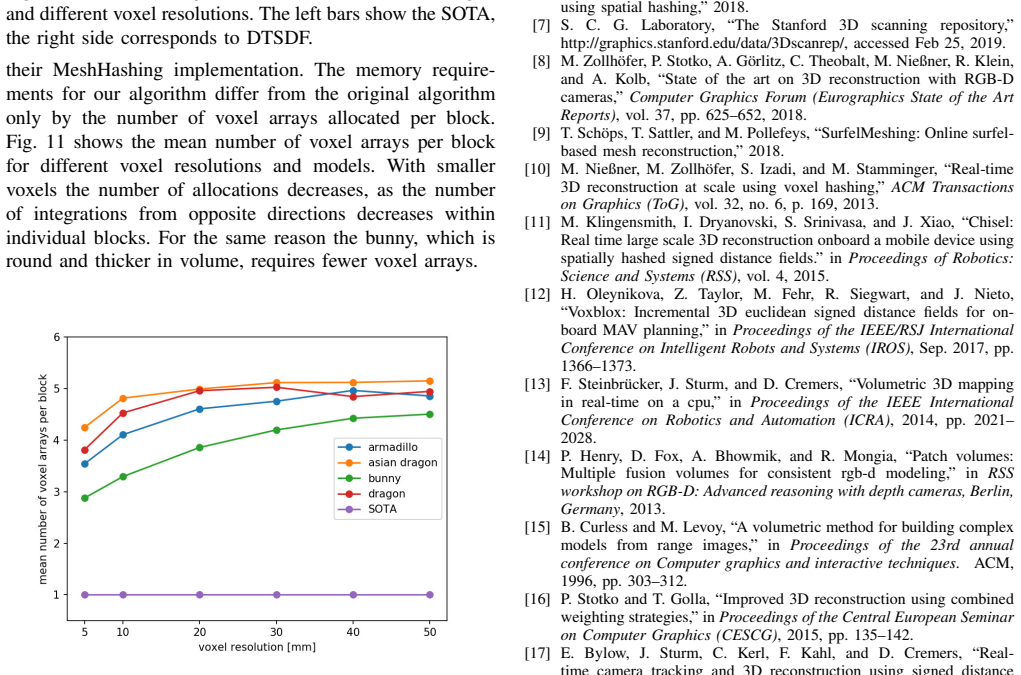
- Because the per-direction arrays are allocated on demand in a hashed block structure, the added cost scales with the number of directions actually observed in a block, not always six-fold memory.
- The same representation can support frame-to-model registration, since the per-direction fields keep consistent information from different viewing directions.
- At coarse voxel sizes the reported RMSE improvements are roughly a factor of two on the Dragon and Bunny benchmarks, suggesting the biggest benefit appears exactly where standard TSDF is weakest.
Reading between the lines
- The six-sector discretization is likely a convenience rather than an optimum; the same separation idea could be tested with more sectors, adaptive sector boundaries learned from the data, or normal clustering, and the $\sin(\pi/8)$ threshold is an obvious sensitivity knob.
- The paper's evaluation uses rendered depth images with known poses; applying the pipeline to real sensor noise, especially along edges and at grazing angles, could reveal whether the voting and MC-index filtering still suppress artifacts without losing true geometry.
- Because the truncation distance is still set by sensor noise, the directional representation trades memory for geometric faithfulness; a natural extension would make truncation direction-aware, shrinking it where thin structure is detected.
- The method's per-direction fields could serve as a building block for other volumetric tasks, such as collision checking on thin obstacles or semantic mapping, though the paper does not discuss those.
Signed reviews
Editorial analysis
A structured set of objections, weighed in public.
Referee Report
Summary. The paper proposes the Directional TSDF (DTSDF), an extension of the truncated signed distance function representation for real-time RGB-D reconstruction. Instead of storing a single signed distance per voxel, the volume is split into six directional arrays aligned with the positive and negative coordinate axes, and each depth measurement is fused into the directions whose axis has sufficient overlap with the measured surface normal (Section III). Fusion is performed by gradient-directed ray casting along the estimated surface normal, with a point-to-plane distance and combined weighting (Section V). Mesh extraction is done by a modified marching cubes algorithm that filters implausible per-direction MC indices, votes between directions, intersects compatible surface components, and applies a regularization step (Section IV). The method is evaluated on the Stanford and Zhou datasets at several voxel resolutions, comparing RMSE against the MeshHashing baseline, with an ablation over fusion modes and an analysis of runtime and memory (Section VI). The central claim is that DTSDF preserves thin and steep geometry better than standard TSDF fusion, with reported reductions in RMSE such as Dragon from 4.44 mm to 2.15 mm at 10 mm voxels.
Significance. If the results hold, DTSDF would be a useful, inexpensive extension of the standard TSDF pipeline, enabling coarse-resolution reconstruction of thin structures without changing the underlying voxel hashing framework. The paper has several strengths: it is clearly written, the experiments use public datasets with ground truth, the ablation in Table III explicitly separates the contribution of the directional representation from that of the fusion strategy, and the quantitative improvement over the chosen baseline is consistent across voxel sizes. The method is not parameter-free, but the main free parameters are identified. The significance is moderate: the improvements are empirical and would be strengthened by broader comparison and sensitivity analysis, but the core idea is plausible and potentially impactful for robotics and real-time mapping.
major comments (3)
- [Section III, Eq. (3)] The direction assignment depends on six fixed, axis-aligned sectors with a correspondence threshold of sin(pi/8). This discretization is not rotation-invariant: a surface normal halfway between two axes is assigned to both directions, and the behavior near sector boundaries is resolved only by the heuristic filtering and voting in Section IV. The evaluation scans all objects in a fixed orientation relative to the world frame, so the central claim that DTSDF handles arbitrary thin and steep geometry is tested only for one alignment. I request a sensitivity experiment in which the object (or equivalently the camera trajectory) is rotated in the world frame, e.g., in 15-degree increments over 0 to 90 degrees, and the RMSE is reported. Without such a test, the possibility that the reported improvements are partly due to alignment of the models with the sector axes cannot be ruled out.
- [Tables I-III] The empirical claim that DTSDF 'outperforms state-of-the-art TSDF reconstruction algorithms' is supported by comparison against only a single baseline, MeshHashing [6], and by single-run RMSE values without error bars or repeated trials. The ablation in Table III is informative, but the spread across models and fusion modes suggests that run-to-run or trajectory-dependent variation could be significant. At minimum, the comparison should include a second recent TSDF pipeline (e.g., Voxblox or Chisel) and should report repeated trials or an explicit statement of determinism for each experimental condition. As written, the abstract's plural 'algorithms' overstates the evidence.
- [Section IV-A, Eq. (6) and Section IV-C] The intra-directional and inter-directional filtering, the voting scheme of Eq. (6), and the MC index intersection and regularization are heuristic and are not quantitatively validated. Since the directional representation can produce multiple zero crossings per edge, these steps are the only mechanisms preventing holes, double walls, and overhangs. The reported RMSE to ground truth is not sensitive to such topological artifacts: a mesh with a missing thin wall can have the same RMSE as a complete one if the missing surface is small. I ask for complementary metrics, such as precision/recall against the ground truth surface, chamfer distance, number of connected components, or number of non-manifold edges, and for a sensitivity sweep over the direction threshold and voting weights. This is directly relevant to the paper's claim of producing a 'coherent mesh.'
minor comments (4)
- [Section IV-C, Algorithm 2] The 'compatible' function used in the MC index combining algorithm is not defined. Please specify the compatibility condition (e.g., whether two components share an edge or are coplanar) so that the algorithm is reproducible.
- [Table IV] The row labels for the second block of Table IV appear to be missing: the first row is labeled 'total time,' but the second row, which presumably gives the meshing proportion, is also labeled 'total time.' Please correct the labels or add a separate row for meshing percentage.
- [Section VI] The statement 'No other parameters were changed' should be accompanied by a short enumeration of the fixed parameters (truncation factor, direction threshold, weighting coefficients), since these are part of the method's specification.
- [Section V, Eq. (9)] The thread-safe accumulation uses atomic floating-point additions. The order of atomic operations can affect the final sum due to floating-point non-associativity; please state whether the results are deterministic across runs or whether this is a source of small run-to-run variation.
Circularity Check
No significant circularity: the central accuracy claim is an empirical comparison against independent ground-truth meshes, and the fixed threshold/heuristics are design choices, not fitted targets.
full rationale
The paper makes an empirical systems claim: the directional TSDF, normal-directed ray casting, and modified marching cubes reduce mesh RMSE relative to the MeshHashing baseline. The derivation chain does not reduce to its inputs. The direction weights in Eq. (3) and the voting filter in Eq. (6) are fixed, openly stated design heuristics; they are not fitted to the RMSE targets. The only threshold, sin(pi/8), is a fixed sector-boundary choice, and no parameter is estimated from the ground-truth models used in evaluation. Gradient-based ray casting is explicitly credited to Fossel et al. [18] as an extension rather than derived from a new theorem, and the directional representation is a novel data structure whose properties are tested, not established through a uniqueness argument. The evaluation uses external datasets (Stanford 3D scanning repository and Zhou et al.) with independent ground-truth meshes and fixed poses, so the reported accuracy numbers are external evidence rather than consequences of the method's assumptions. The only self-citation, in a passing related-work reference to multi-resolution surfel maps, is not load-bearing. No equation-level reduction of a predicted quantity to fitted parameters, no imported uniqueness theorem, no ansatz smuggled in via citation, and no renaming of a known result was found. The paper's main risks are generalizability and heuristic correctness, which are accuracy concerns rather than circularity.
Assumptions & free parameters
free parameters (3)
- Direction-correspondence threshold sin(pi/8) =
sin(pi/8) ≈ 0.3827
- Truncation distance factor (4 x voxel size) =
4 voxels
- Directional voting weights wsdf_D in Eq. (6) =
unspecified
assumptions (4)
- standard math A signed distance function's zero set defines the surface, and truncating at a threshold preserves the surface location.
- domain assumption Six axis-aligned direction sectors can represent arbitrary surface orientations when measurements are assigned by w_D(n) = <n, v_D> with threshold sin(pi/8).
- domain assumption Surface normals estimated from a depth neighborhood plus bilateral filter are accurate enough to guide direction assignment and ray-casting fusion.
- ad hoc to paper Inter-directional MC index filtering, voting, and regularization remove false surfaces without removing true ones.
invented entities (1)
-
Directional TSDF volume decomposition: six per-direction signed distance arrays per voxel block
Cite this review
Pith. "Pith review of Directional TSDF: Modeling Surface Orientation for Coherent Meshes." pith.science (2026). https://pith.science/paper/BDYKPLMU
@misc{pith2026190805146,
  author       = {Pith},
  title        = {Pith review of: Directional TSDF: Modeling Surface Orientation for Coherent Meshes},
  year         = {2026},
  howpublished = {\url{https://pith.science/paper/BDYKPLMU}},
  note         = {Machine review of arXiv:1908.05146}
}
read the original abstract
Real-time 3D reconstruction from RGB-D sensor data plays an important role in many robotic applications, such as object modeling and mapping. The popular method of fusing depth information into a truncated signed distance function (TSDF) and applying the marching cubes algorithm for mesh extraction has severe issues with thin structures: not only does it lead to loss of accuracy, but it can generate completely wrong surfaces. To address this, we propose the directional TSDF - a novel representation that stores opposite surfaces separate from each other. The marching cubes algorithm is modified accordingly to retrieve a coherent mesh representation. We further increase the accuracy by using surface gradient-based ray casting for fusing new measurements. We show that our method outperforms state-of-the-art TSDF reconstruction algorithms in mesh accuracy.
Figures


Figures from the paper (7 more)



Reference graph
Works this paper leans on
-
[6]
An efficient volumetric mesh representation for real-time scene reconstruction using spatial hashing,
W. Dong, J. Shi, W. Tang, X. Wang, and H. Zha, “An efficient volumetric mesh representation for real-time scene reconstruction using spatial hashing,” 2018
work page 2018
-
[1]
KinectFusion: Real-time dense surface mapping and tracking,
R. A. Newcombe, S. Izadi, O. Hilliges, D. Molyneaux, D. Kim, A. J. Davison, P. Kohi, J. Shotton, S. Hodges, and A. Fitzgibbon, “KinectFusion: Real-time dense surface mapping and tracking,” in Proceeding of the IEEE and ACM International Symposium on Mixed and Augmented Reality (ISMAR) , 2011, pp. 127–136
work page 2011
-
[2]
Multi-resolution surfel maps for efficient dense 3D modeling and tracking,
J. St ¨uckler and S. Behnke, “Multi-resolution surfel maps for efficient dense 3D modeling and tracking,” Journal of Visual Communication and Image Representation , vol. 25, no. 1, pp. 137–147, 2014
work page 2014
-
[3]
ElasticFusion: Real-time dense SLAM and light source estimation,
T. Whelan, R. F. Salas-Moreno, B. Glocker, A. J. Davison, and S. Leutenegger, “ElasticFusion: Real-time dense SLAM and light source estimation,” The International Journal of Robotics Research , vol. 35, no. 14, pp. 1697–1716, 2016
work page 2016
-
[4]
FLaME: Fast lightweight mesh estimation using variational smoothing on delaunay graphs,
W. N. Greene and N. Roy, “FLaME: Fast lightweight mesh estimation using variational smoothing on delaunay graphs,” in Proceedings of the IEEE International Conference on Computer Vision (ICCV) , 2017, pp. 4696–4704
work page 2017
-
[5]
Real-time cpu-based large-scale 3D mesh reconstruction,
E. Piazza, A. Romanoni, and M. Matteucci, “Real-time cpu-based large-scale 3D mesh reconstruction,” 2018
work page 2018
-
[7]
The Stanford 3D scanning repository,
S. C. G. Laboratory, “The Stanford 3D scanning repository,” http://graphics.stanford.edu/data/3Dscanrep/, accessed Feb 25, 2019
work page 2019
-
[8]
State of the art on 3D reconstruction with RGB-D cameras,
M. Zollh ¨ofer, P. Stotko, A. G¨orlitz, C. Theobalt, M. Nießner, R. Klein, and A. Kolb, “State of the art on 3D reconstruction with RGB-D cameras,” Computer Graphics F orum (Eurographics State of the Art Reports), vol. 37, pp. 625–652, 2018
work page 2018
Show all 21 references
-
[9]
SurfelMeshing: Online surfel- based mesh reconstruction,
T. Sch ¨ops, T. Sattler, and M. Pollefeys, “SurfelMeshing: Online surfel- based mesh reconstruction,” 2018
2018
-
[10]
Real-time 3D reconstruction at scale using voxel hashing,
M. Nießner, M. Zollh ¨ofer, S. Izadi, and M. Stamminger, “Real-time 3D reconstruction at scale using voxel hashing,” ACM Transactions on Graphics (ToG) , vol. 32, no. 6, p. 169, 2013
2013
-
[11]
Chisel: Real time large scale 3D reconstruction onboard a mobile device using spatially hashed signed distance fields
M. Klingensmith, I. Dryanovski, S. Srinivasa, and J. Xiao, “Chisel: Real time large scale 3D reconstruction onboard a mobile device using spatially hashed signed distance fields.” in Proceedings of Robotics: Science and Systems (RSS) , vol. 4, 2015
2015
-
[12]
V oxblox: Incremental 3D euclidean signed distance fields for on- board MA V planning,
H. Oleynikova, Z. Taylor, M. Fehr, R. Siegwart, and J. Nieto, “V oxblox: Incremental 3D euclidean signed distance fields for on- board MA V planning,” in Proceedings of the IEEE/RSJ International Conference on Intelligent Robots and Systems (IROS) , Sep. 2017, pp. 1366–1373
2017
-
[13]
V olumetric 3D mapping in real-time on a cpu,
F. Steinbr ¨ucker, J. Sturm, and D. Cremers, “V olumetric 3D mapping in real-time on a cpu,” in Proceedings of the IEEE International Conference on Robotics and Automation (ICRA) , 2014, pp. 2021– 2028
2014
-
[14]
Patch volumes: Multiple fusion volumes for consistent rgb-d modeling,
P. Henry, D. Fox, A. Bhowmik, and R. Mongia, “Patch volumes: Multiple fusion volumes for consistent rgb-d modeling,” in RSS workshop on RGB-D: Advanced reasoning with depth cameras, Berlin, Germany, 2013
2013
-
[15]
A volumetric method for building complex models from range images,
B. Curless and M. Levoy, “A volumetric method for building complex models from range images,” in Proceedings of the 23rd annual conference on Computer graphics and interactive techniques . ACM, 1996, pp. 303–312
1996
-
[16]
Improved 3D reconstruction using combined weighting strategies,
P. Stotko and T. Golla, “Improved 3D reconstruction using combined weighting strategies,” in Proceedings of the Central European Seminar on Computer Graphics (CESCG) , 2015, pp. 135–142
2015
-
[17]
Real- time camera tracking and 3D reconstruction using signed distance functions
E. Bylow, J. Sturm, C. Kerl, F. Kahl, and D. Cremers, “Real- time camera tracking and 3D reconstruction using signed distance functions.” in Proceedings of Robotics: Science and Systems (RSS) , vol. 2, 2013
2013
-
[18]
2D-SDF-SLAM: A signed distance function based SLAM frontend for laser scanners,
J.-D. Fossel, K. Tuyls, and J. Sturm, “2D-SDF-SLAM: A signed distance function based SLAM frontend for laser scanners,” in Pro- ceedings of the IEEE/RSJ International Conference on Intelligent Robots and Systems (IROS) , 2015, pp. 1949–1955
2015
-
[19]
A fast voxel traversal algorithm for ray tracing,
J. Amanatides, A. Woo et al., “A fast voxel traversal algorithm for ray tracing,” in Eurographics, vol. 87, no. 3, 1987, pp. 3–10
1987
-
[20]
Marching cubes: A high resolu- tion 3D surface construction algorithm,
W. E. Lorensen and H. E. Cline, “Marching cubes: A high resolu- tion 3D surface construction algorithm,” in ACM siggraph computer graphics, vol. 21, no. 4, 1987, pp. 163–169
1987
-
[21]
Dense scene reconstruction with points of interest,
Q.-Y . Zhou and V . Koltun, “Dense scene reconstruction with points of interest,” ACM Transactions on Graphics , vol. 32, no. 4, p. 112, 2013
2013
Reviewed August 14, 2026 · model on record in the stance chip above.
Discussion (0). Continue with ORCID to comment.