REVIEW 3 major objections 4 minor 1 cited by
Abundant refractory sulfur in protoplanetary disks
T0 review · 3 major / 4 minor · reviewed 2026-08-14 · deepseek-v4-flash
Pith's one-line read This paper measures, for the first time, that (89 ± 8)% of sulfur in planet-forming disks is locked in refractory solids such as FeS, not in gas or ice.
desk verdict First real measurement of refractory sulfur in planet-forming disks, with a plausible 89% central value; the caveat is that the result shifts to 45±22% with a solar reference, so the headline number needs a systematic-error qualifier. read the letter →
The pith
A machine-rendered reading of the paper's core claim, the machinery that carries it, and where it could break.
The reading
What carries the argument
The load-bearing mechanism is the Contaminated A-stars Method (CAM): in stars more massive than about 1.4 M_sun, the radiative envelope mixes slowly, so the photosphere (only ~1e-10 M_sun) can be almost entirely replaced on timescales of days by disk accretion, making the stellar surface a direct sample of inner-disk material. Dust trapping at a radial pressure bump (e.g., planet-induced) removes large grains before accretion, so the refractory component of each element is scaled by a per-star depletion factor δd, while the volatile component accretes freely. The abundance of element X in accreted material is $(X/\mathrm{H})_{\rm disk} = [(1-f_X) + f_X \delta_d] \times (X/\mathrm{H})_{\rm ref}$, with f_X the refractory fraction; combining this with the photospheric mixing fraction fph and fitting fS and fNa globally with Bayesian Multinest sampling extracts the refractory fractions from the iron–sulfur correlation.
What would settle it
A direct ALMA measurement of gas-phase sulfur carriers (H2S, CS, SO) in the inner disk of a dust-trapping system that finds sulfur in gas and ice well above the paper's predicted 11% of total would falsify the refractory-dominated picture; alternatively, expanding the open cluster reference sample to more coeval clusters and recomputing fS, if the cluster mean sulfur abundance shifts by more than ~0.1 dex, the 89% central value would not survive.
Extended reading notes
Core claim
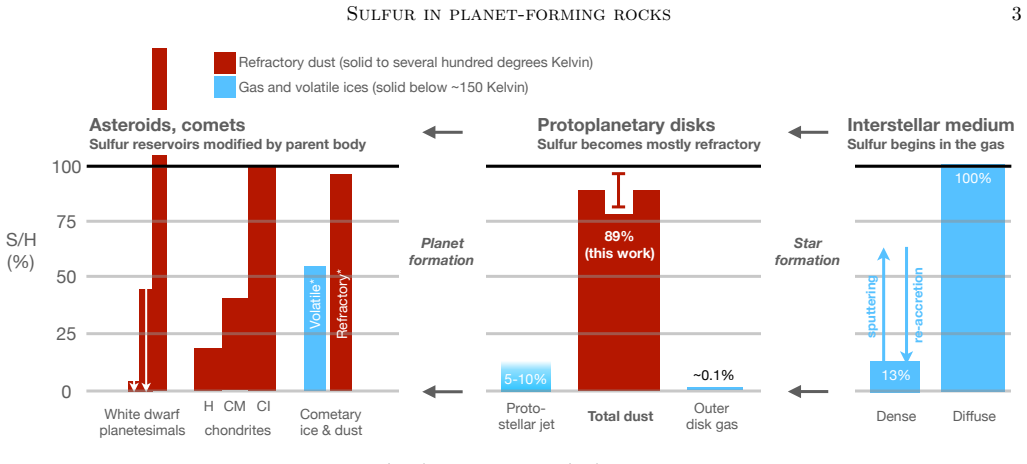
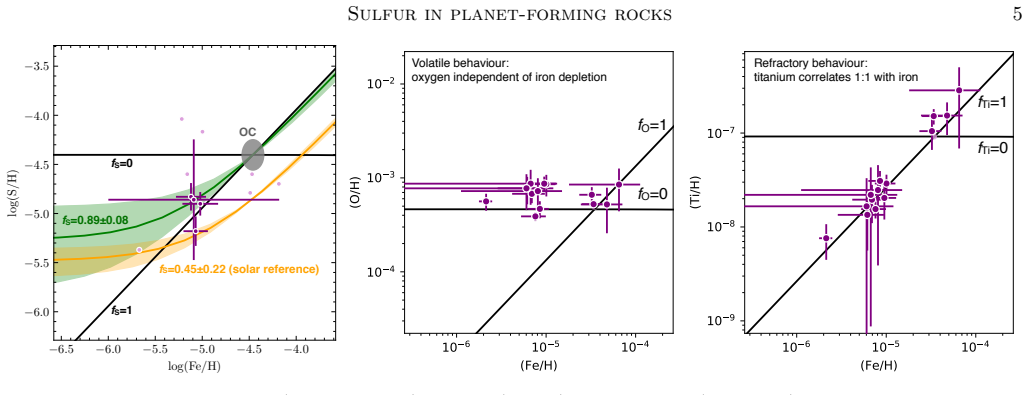
The central discovery is that sulfur in the terrestrial-planet-forming zone of protoplanetary disks is predominantly refractory: fS = (89 ± 8)%. The inference comes from the correlation between sulfur and iron abundances in accretion-contaminated photospheres of Herbig Ae/Be stars, using dust trapping at pressure bumps to fractionate the accreting material. Because the carrier must be far more refractory than water ice, the authors identify sulfide minerals, most plausibly FeS, as the main reservoir, with sulfur chains S_n playing at most a minor role. As a consistency check, imposing the condensation-model expectation fS < fNa leaves fS unchanged at 89% while shifting fNa to 97%, and an orthogonal distance regression fit using a solar reference gives fS = (75 ± 8)%. The result is stated as the first measurement of the refractory fraction of sulfur in protoplanetary disks.
Load-bearing premise
The result rests on the assumption that the disk-hosting stars and the young open cluster stars used as a reference have the same initial bulk composition; if the reference is replaced by solar abundances, the inferred refractory sulfur fraction drops from 89% to 45%.
Editorial extensions
If this is right
- In the inner few to ten astronomical units around ~2–3 M_sun stars, almost all sulfur is available to be incorporated directly into rocky planetesimals, rather than being delivered later as ice.
- Gas-phase and ice sulfur in the planet-forming zone is predicted to be at most (11 ± 8)% of the total, a concrete target for ALMA searches for H2S, CS, and SO.
- The refractory carrier must survive temperatures well above 150 K, ruling out H2S, OCS, SO, and SO2 ices as main reservoirs and favouring FeS and related sulfide minerals.
- In hot Jupiter atmospheres formed by core accretion of gas alone, little H2S is expected; significant H2S would point to late planetesimal accretion.
- The solar-system pattern—volatile sulfur in cometary ices, sulfur in rocky meteorites as sulfides and chains—is a natural outcome of a general disk process rather than a local anomaly.
Reading between the lines
- If the 89% figure holds, models of prebiotic chemistry and habitable-zone volatile delivery should treat sulfur as a rock-derived element in the inner disk, with volcanic and impact processing, not ice sublimation, as its main pathway into atmospheres.
- The same accretion-contamination technique could be extended to carbon, phosphorus, and chlorine, whose refractory fractions are poorly known; those elements' fX values would similarly be pinned down by correlations with iron in the same sample.
- The large shift between open-cluster and solar reference compositions (89% vs 45%) implies the absolute value is sensitive to Galactic chemical evolution corrections; applying an age- and position-matched chemical evolution model could tighten or move the central value.
Signed reviews
Editorial analysis
A structured set of objections, weighed in public.
Referee Report
Summary. The paper applies the contaminated A-star method (CAM) to photospheric abundance measurements of 16 young disk-hosting stars, using young open cluster stars as the reference initial composition, and performs Bayesian inference with the Multinest sampler to infer the refractory fractions fS, fNa, fO, and fZn in protoplanetary disks. The main result is that 89 ± 8 % of sulfur is refractory, with a minority in gas/ice; sodium is inferred at 35 ± 16 % refractory, oxygen at 2 ± 2 %, while a solar-reference fit gives fS = 45 ± 22 %. The paper interprets the refractory sulfur as sulfide minerals such as FeS and predicts a gas-plus-ice sulfur fraction of at most 11 ± 8 % in the inner disk. Synthetic-data tests in Appendix B support the inference machinery itself.
Significance. If the central value is robust, this is the first quantitative measurement of the refractory fraction of sulfur in protoplanetary disks, with direct implications for planetesimal composition, disk chemistry, and the sulfur budget of the terrestrial-planet-forming zone. The method is interesting and the Bayesian machinery is carefully tested on synthetic data, which is a genuine strength. However, the headline number depends strongly on the adopted stellar reference composition, and the paper does not yet quantify this systematic uncertainty; the gap between the open-cluster and solar-reference results is larger than the quoted statistical errors. The significance of the paper therefore stands or falls on whether the reference-composition choice can be made robust.
major comments (3)
- [Section 2.4 and Section 3, Table 1] The reference-composition choice is the main load-bearing assumption. The open-cluster sulfur reference is log(S/H) = -4.33 ± 0.28, which is 0.55 dex above the solar value of -4.88, and all six usable sulfur detections in the disk-host sample lie at or below -4.66. The model therefore interprets these stars as strongly sulfur-depleted, driving fS to 89 ± 8 %; replacing the reference with the solar composition changes the result to 45 ± 22 %, a shift of more than 2 sigma. The paper argues that the open-cluster reference is more appropriate, but it does not quantify the systematic uncertainty associated with this choice. The authors should provide a systematic error budget, repeat the fit with several independent reference populations, or otherwise demonstrate that the open-cluster reference is unbiased for these particular disk-hosting stars.
- [Section 3] The Bayesian evidence comparison used to prefer the open-cluster reference is not decisive as presented. The two fits are based on different numbers of elements and observations because the solar-reference fit additionally includes zinc, and the quantity reported as "log L" is not defined as either the log-evidence or the log-likelihood. The paper acknowledges that the evidence difference is affected by the differing observation count, but then dismisses this effect as negligible without a quantitative calculation. A fair comparison would require identical datasets with and without the extra element, or a predictive check such as cross-validation on held-out abundances.
- [Section 3 and Section 2.4] The text states that "self-consistent posteriors on the reference composition" make the Multinest fit superior, implying that the reference abundances are free parameters in the main fit. However, Section 2.4 only specifies priors for fS, fNa, δd, and fph; it does not state the prior on the reference composition or show the resulting posterior for S_ref. If the data pull S_ref away from the open-cluster mean, the central fS value may be biased in a way that the current uncertainty statement does not capture. The authors should report the posterior on the reference abundances and test how fS changes when the reference prior is widened or shifted.
minor comments (4)
- [Section 2.4] There is a typo in the sentence defining δd: "the level of change of the refactory dust mass" should read "refractory dust mass".
- [Figure 1 caption] The caption says "Each stage is normalised to its own standard" and the figure is ordered from right to left, which is confusing because the text is read left to right; explicitly labeling each bar group with its normalization and adding left-to-right ordering would improve clarity.
- [Section 2.4] The description of the fph prior says the Gaussian is cut off at three standard deviations or at fph ≤ 1, but it is not stated whether the cut is applied before or after the log-normal transformation and how the normalization is adjusted; please clarify.
- [Appendix B] The synthetic-data test validates the inference machinery using a solar-like reference, but it does not test the more dangerous scenario in which the assumed reference is offset from the true initial composition by a few tenths of dex; such a test would be directly relevant to the main result.
Circularity Check
No circularity: the refractory sulfur fraction is inferred from independent open-cluster reference abundances through a forward model, with self-citations that are not load-bearing for the central value.
full rationale
Walk-through of the derivation chain: Section 2.4 defines (X/H)_ref as the mean abundance of young open cluster stars (Fossati et al. 2011; Martin et al. 2017), which is external to the disk-host stars whose sulfur depletion is being measured. Table 1 lists this reference independently of the sample-star abundances. Equations (1)-(3) are forward models: for a fixed reference, observed stellar abundances, and photospheric contamination fraction fph, the free parameters fS, fZn, delta_d, and fph are fitted; fS is not an input and no equation defines the reference in terms of fS or vice versa. The reported fS = (89 +/- 8)% is therefore a fitted parameter, not a quantity derived from itself. The statement that <=(11 +/- 8)% of sulfur remains in gas and ice is simply the arithmetic complement 1 - fS, but the paper does not use that complement as evidence for fS, so it is a transparent derived consequence rather than a circular step. The method relies on self-citations (CAM; Kama et al. 2015; Jermyn & Kama 2018), and fph comes from the authors' prior work, but the paper explicitly checks that assuming fph = 1 gives similar results, so this self-citation is not load-bearing for the central value. The reference-composition sensitivity (fS = 89% with the open-cluster reference versus 45% with the solar reference) is disclosed by the authors and is a systematic/correctness concern, not a circularity: the solar fit is a different external input choice, not the fitted result fed back as an input. No uniqueness theorem or ansatz is imported from the authors' prior work to force the result, and Appendix B validates the inference on synthetic data generated from Equation (2), showing that the fitting procedure recovers known input fX values. Under the required quote-and-reduction standard, no circular step is exhibited.
Assumptions & free parameters
free parameters (6)
- f_S (refractory fraction of sulfur) =
0.89 ± 0.08 (open cluster reference); 0.45 ± 0.22 (solar reference)
- f_Na (refractory fraction of sodium) =
0.35 ± 0.16 (field star reference); 0.77 ± 0.18 (solar reference)
- f_O (refractory fraction of oxygen) =
0.02 ± 0.02
- f_Zn (refractory fraction of zinc) =
0.52 ± 0.34 (solar reference)
- delta_d (dust depletion factor per star)
- f_ph (photospheric contamination fraction per star)
assumptions (4)
- domain assumption Stars more massive than 1.4 Msun have radiative envelopes where mixing is dominated by slow diffusion, so the photosphere can be replaced by accreted material on short timescales.
- domain assumption The accretion stream composition directly samples the total elemental composition of the inner disk.
- domain assumption Dust depletion (delta_d) affects the refractory component of all elements equally.
- domain assumption The open cluster stars have the same bulk composition as the disk-hosting stars.
Cite this review
Pith. "Pith review of Abundant refractory sulfur in protoplanetary disks." pith.science (2026). https://pith.science/paper/NUIIRE23
@misc{pith2026190805169,
  author       = {Pith},
  title        = {Pith review of: Abundant refractory sulfur in protoplanetary disks},
  year         = {2026},
  howpublished = {\url{https://pith.science/paper/NUIIRE23}},
  note         = {Machine review of arXiv:1908.05169}
}
abstract
Sulfur is one of the most abundant elements in the Universe, with important roles in astro-, geo-, and biochemistry. Its main reservoirs in planet-forming disks have previously eluded detection: gaseous molecules only account for $<1\,$\% of total elemental sulfur, with the rest likely in either ices or refractory minerals. Mechanisms such as giant planets can filter out dust from gas accreting onto disk-hosting stars. For stars above 1.4 solar masses, this leaves a chemical signature on the stellar photosphere that can be used to determine the fraction of each element that is locked in dust. Here, we present an application of this method to sulfur, zinc, and sodium. We analyse the accretion-contaminated photospheres of a sample of young stars and find $(89\pm8)\,$\% of elemental sulfur is in refractory form in their disks. The main carrier is much more refractory than water ice, consistent with sulfide minerals such as FeS.
Figures

Forward citations
Cited by 1 Pith paper
-
Ammonium salt formation and abundance in protoplanetary disks
In a disk model, cosmic-ray-driven chemistry converts gas-phase N2 and CO into ammonium salts and CO2 ice in the inner midplane, making ammonium cyanate and ammonium hydrosulfide the dominant N and S carriers inside ~50 au.
Reference graph
Works this paper leans on
-
[1]
, " * write output.state after.block = add.period write newline
ENTRY address archivePrefix author booktitle chapter doi edition editor eprint howpublished institution journal key month note number organization pages publisher school series title misctitle type volume year version url label extra.label sort.label short.list INTEGERS output.state before.all mid.sentence after.sentence after.block FUNCTION init.state.co...
-
[2]
write newline
" write newline "" before.all 'output.state := FUNCTION format.doi doi empty "" "doi:" doi * if FUNCTION format.url url empty "" new.block "" url * "" * if FUNCTION format.eprint eprint empty "" archivePrefix empty "" archivePrefix ":" * if eprint field.or.null * if FUNCTION format.pid eprint empty format.doi format.eprint if FUNCTION n.dashify 't := "" t...
-
[3]
s0X+YRFE g mY >
thebibliography [1] 20pt to REFERENCES 6pt =0pt 10pt plus 3pt =0pt =0pt =1pt plus 1pt =0pt =0pt -12pt =13pt plus 1pt =20pt =13pt plus 1pt \@M =10000 =-1.0em =0pt =0pt 0pt =0pt =1.0em @enumiv\@empty 10000 10000 `\.\@m \@noitemerr \@latex@warning Empty `thebibliography' environment \@ifnextchar \@reference \@latexerr Missing key on reference command Each re...
2017
- [4]
-
[5]
E., Bergin , E
Anderson , D. E., Bergin , E. A., Maret , S., & Wakelam , V. 2013, , 779, 141
2013
-
[6]
Andrews , S. M., Wilner , D. J., Hughes , A. M., Qi , C., & Dullemond , C. P. 2009, , 700, 1502
work page 2009
-
[7]
M., Huang , J., P \'e rez , L
Andrews , S. M., Huang , J., P \'e rez , L. M., et al. 2018, , 869, L41
2018
-
[8]
J., & Scott , P
Asplund , M., Grevesse , N., Sauval , A. J., & Scott , P. 2009, , 47, 481
2009
Show all 75 references
-
[9]
2016, , 205, 41
Birnstiel , T., Fang , M., & Johansen , A. 2016, , 205, 41
2016
-
[10]
Boogert , A. C. A., Gerakines , P. A., & Whittet , D. C. B. 2015, , 53, 541
2015
-
[11]
Boogert , A. C. A., Schutte , W. A., Helmich , F. P., Tielens , A. G. G. M., & Wooden , D. H. 1997, , 317, 929
1997
-
[12]
S., Walsh , C., Kama , M., et al
Booth , A. S., Walsh , C., Kama , M., et al. 2018, , 611, A16
2018
-
[13]
2006, Science, 314, 1711
Brownlee , D., Tsou , P., Al \'e on , J., et al. 2006, Science, 314, 1711
2006
-
[14]
2016, , 462, S253
Calmonte , U., Altwegg , K., Balsiger , H., et al. 2016, , 462, S253
2016
-
[15]
Chambers , J. E. 2009, , 705, 1206
2009
-
[16]
Charnley , S. B. 1997, , 481, 396
1997
-
[17]
P., Anderson , M
Collings , M. P., Anderson , M. A., Chen , R., et al. 2004, , 354, 1133
2004
-
[18]
H., Olofsson , H., & Justtanont , K
Danilovich , T., De Beck , E., Black , J. H., Olofsson , H., & Justtanont , K. 2016, , 588, A119
2016
-
[19]
2018, ArXiv e-prints, arXiv:1807.05144
Danilovich , T., Ramstedt , S., Gobrecht , D., et al. 2018, ArXiv e-prints, arXiv:1807.05144
2018 arXiv
-
[20]
2017, , 606, A124
Danilovich , T., Van de Sande , M., De Beck , E., et al. 2017, , 606, A124
2017
-
[21]
2012, , 426, 354
Druard , C., & Wakelam , V. 2012, , 426, 354
2012
-
[22]
1997, , 317, L55
Dutrey , A., Guilloteau , S., & Guelin , M. 1997, , 317, L55
1997
-
[23]
2011, , 535, A104
Dutrey , A., Wakelam , V., Boehler , Y., et al. 2011, , 535, A104
2011
-
[24]
Feroz, F., & Hobson, M. P. 2008, Monthly Notices of the Royal Astronomical Society, 384, 449. http://dx.doi.org/10.1111/j.1365-2966.2007.12353.x
2008
-
[25]
P., & Bridges, M
Feroz, F., Hobson, M. P., & Bridges, M. 2009, Monthly Notices of the Royal Astronomical Society, 398, 1601. http://dx.doi.org/10.1111/j.1365-2966.2009.14548.x
2009
-
[26]
P., Cameron, E., & Pettitt, A
Feroz, F., Hobson, M. P., Cameron, E., & Pettitt, A. N. 2013, Importance Nested Sampling and the MultiNest Algorithm, , , arXiv:1306.2144
2013 arXiv
-
[27]
P., Bagnulo , S., Wade , G
Folsom , C. P., Bagnulo , S., Wade , G. A., et al. 2012, , 422, 2072
2012
-
[28]
P., Bagnulo , S., et al
Fossati , L., Folsom , C. P., Bagnulo , S., et al. 2011, , 413, 1132
2011
-
[29]
2010, , 524, A19
Fuente , A., Cernicharo , J., Ag \'u ndez , M., et al. 2010, , 524, A19
2010
-
[30]
T., Koester , D., Farihi , J., et al
G \"a nsicke , B. T., Koester , D., Farihi , J., et al. 2012, , 424, 333
2012
-
[31]
R., Baas , F., Greenberg , J
Geballe , T. R., Baas , F., Greenberg , J. M., & Schutte , W. 1985, , 146, L6
1985
-
[32]
O., & Corbally , C
Gray , R. O., & Corbally , C. J. 1998, , 116, 2530
1998
-
[33]
1975, Journal of the Atmospheric Sciences, 32, 1212
Hapke, B., & Nelson, R. 1975, Journal of the Atmospheric Sciences, 32, 1212
1975
-
[34]
1971, Oxidation of Metals, 3, 545
Haugen, S., & Sterten, A. 1971, Oxidation of Metals, 3, 545
1971
-
[35]
P., & Waters , L
Hony , S., Bouwman , J., Keller , L. P., & Waters , L. B. F. M. 2002, , 393, L103
2002
-
[36]
Jenkins , E. B. 2009, , 700, 1299
2009
-
[37]
S., & Kama, M
Jermyn, A. S., & Kama, M. 2018, Monthly Notices of the Royal Astronomical Society, 476, 4418. http://dx.doi.org/10.1093/mnras/sty429
2018 doi
-
[38]
K., Christoforidis , A., & Kissel , J
Jessberger , E. K., Christoforidis , A., & Kissel , J. 1988, , 332, 691
1988
-
[39]
Jim \'e nez-Escobar , A., & Mu \ n oz Caro , G. M. 2011, , 536, A91
2011
-
[40]
L., Snow , Jr., T
Joseph , C. L., Snow , Jr., T. P., Seab , C. G., & Crutcher , R. M. 1986, , 309, 771
1986
-
[41]
P., & Pinilla , P
Kama , M., Folsom , C. P., & Pinilla , P. 2015, , 582, L10
2015
-
[42]
F., et al
Kama , M., Bruderer , S., van Dishoeck , E. F., et al. 2016, , 592, A83
2016
-
[43]
F., Zahnle, K., Pinto, J., & Young, A
Kasting, J. F., Zahnle, K., Pinto, J., & Young, A. 1989, Origins of Life and Evolution of the Biosphere, 19, 95
1989
-
[44]
P., Rahman , Z., Hiroi , T., et al
Keller , L. P., Rahman , Z., Hiroi , T., et al. 2013, in Lunar and Planetary Science Conference, Vol. 44, Lunar and Planetary Science Conference, 2404
2013
-
[45]
P., Hony , S., Bradley , J
Keller , L. P., Hony , S., Bradley , J. P., et al. 2002, , 417, 148
2002
-
[46]
Kerridge , J. F. 1976, , 259, 189
1976
-
[47]
Larimer , J. W. 1967, , 31, 1215
1967
-
[48]
C., Frost , D
Laurenz , V., Rubie , D. C., Frost , D. J., & Vogel , A. K. 2016, , 194, 123
2016
-
[49]
S., Kremser , D
Lauretta , D. S., Kremser , D. T., & Fegley , Jr., B. 1996, , 122, 288
1996
-
[50]
M., Kraemer , K
Lisse , C. M., Kraemer , K. E., Nuth , J. A., Li , A., & Joswiak , D. 2007, , 187, 69
2007
-
[51]
2003, , 591, 1220
Lodders , K. 2003, , 591, 1220
2003
-
[52]
2014, Earth and Planetary Science Letters, 394, 186
Malavergne , V., Cordier , P., Righter , K., et al. 2014, Earth and Planetary Science Letters, 394, 186
2014
-
[53]
J., Stift , M
Martin , A. J., Stift , M. J., Fossati , L., et al. 2017, , 466, 613
2017
-
[54]
M., et al
Mart \' n-Dom \'e nech , R., Jim \'e nez-Serra , I., Mu \ n oz Caro , G. M., et al. 2016, , 585, A112
2016
-
[55]
2017, , 469, 3347
Matsuura , M., Indebetouw , R., Woosley , S., et al. 2017, , 469, 3347
2017
-
[56]
2010, Earth and Planetary Science Letters, 300, 321
Orthous-Daunay , F.-R., Quirico , E., Lemelle , L., et al. 2010, Earth and Planetary Science Letters, 300, 321
2010
-
[57]
E., Tielens , A
Palumbo , M. E., Tielens , A. G. G. M., & Tokunaga , A. T. 1995, , 449, 674
1995
-
[58]
2001, , 373, 633
Paunzen , E. 2001, , 373, 633
2001
-
[59]
2012, , 545, A81
Pinilla , P., Benisty , M., & Birnstiel , T. 2012, , 545, A81
2012
-
[60]
Ryde , N., & Lambert , D. L. 2005, in Astronomical Society of the Pacific Conference Series, Vol. 336, Cosmic Abundances as Records of Stellar Evolution and Nucleosynthesis, ed. T. G. Barnes , III & F. N. Bash , 355
2005
-
[61]
Z., Blamont , J
Sagdeev , R. Z., Blamont , J. E., Galeev , A. A., et al. 1986, Soviet Astronomy Letters, 12, 243
1986
-
[62]
2018, , 617, A28
Semenov , D., Favre , C., Fedele , D., et al. 2018, , 617, A28
2018
-
[63]
Smith , R. G. 1991, , 249, 172
1991
-
[64]
1973, Oxidation of Metals, 7, 45
Sterten, ., & Haugen, S. 1973, Oxidation of Metals, 7, 45
1973
-
[65]
1993, , 413, 376
Turcotte , S., & Charbonneau , P. 1993, , 413, 376
1993
-
[66]
W., van Terwisga , S., et al
van der Marel , N., Verhaar , B. W., van Terwisga , S., et al. 2016, , 592, A126
2016
-
[67]
2004, , 422, 159
Wakelam , V., Caselli , P., Ceccarelli , C., Herbst , E., & Castets , A. 2004, , 422, 159
2004
-
[68]
T., & Kallemeyn , G
Wasson , J. T., & Kallemeyn , G. W. 1988, Philosophical Transactions of the Royal Society of London Series A, 325, 535
1988
-
[69]
J., Fakra , S
Westphal , A. J., Fakra , S. C., Gainsforth , Z., et al. 2009, , 694, 18
2009
-
[70]
1980, Journal of Geophysical Research: Space Physics, 85, 7849
Winick, J., & Stewart, A. 1980, Journal of Geophysical Research: Space Physics, 85, 7849
1980
-
[71]
M., Occhiogrosso , A., Viti , S., et al
Woods , P. M., Occhiogrosso , A., Viti , S., et al. 2015, , 450, 1256
2015
-
[72]
E., & Weaver , T
Woosley , S. E., & Weaver , T. A. 1995, , 101, 181
1995
-
[73]
2013, , 766, 132
Xu , S., Jura , M., Klein , B., Koester , D., & Zuckerman , B. 2013, , 766, 132
2013
-
[74]
2017, , 836, L7
Xu , S., Zuckerman , B., Dufour , P., et al. 2017, , 836, L7
2017
-
[75]
2010, Nature Geoscience, 3, 834
Zhang, X., Liang, M.-C., Montmessin, F., et al. 2010, Nature Geoscience, 3, 834
2010
Reviewed August 14, 2026 · model on record in the stance chip above.
Discussion (0). Continue with ORCID to comment.