REVIEW 3 major objections 3 minor 37 references
Chaos in the inert Oort cloud
T0 review · 3 major / 3 minor · reviewed 2026-08-14 · deepseek-v4-flash
Pith's one-line read The paper argues that the 'inert Oort cloud'—the distant belt thought frozen for 4.5 billion years—is actually dominated by chaos, with galactic tides stirring orbits down to about 500 au.
desk verdict Convincing map of the chaotic 'inert Oort cloud' — the one real soft spot is that the inert-region boundaries are drawn without the radial galactic tide, and that omission needs a robustness test. read the letter →
The pith
A machine-rendered reading of the paper's core claim, the machinery that carries it, and where it could break.
The reading
What carries the argument
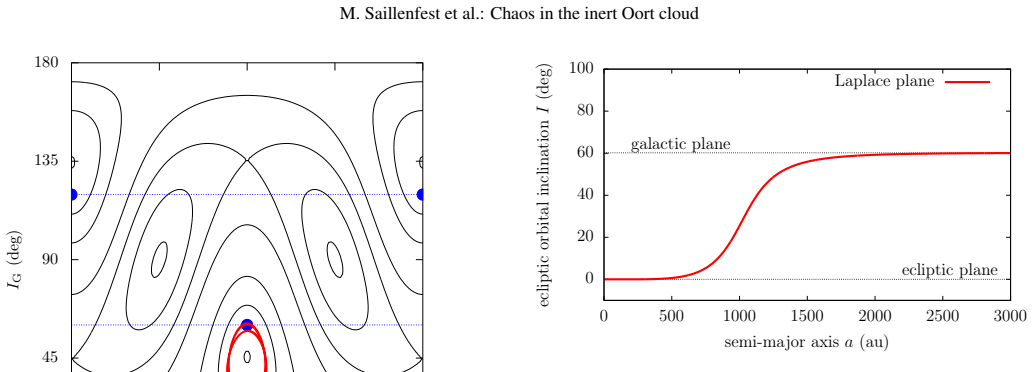
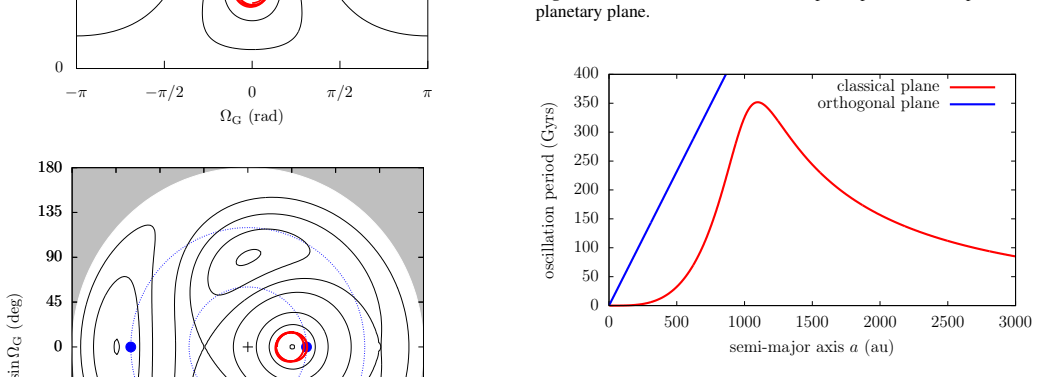
The paper's workhorse is the simplified two-degree-of-freedom secular Hamiltonian $F = \varepsilon_{P2}\bar H_{P2} + \varepsilon_{GV}\bar H_{GV}$, formed from the planetary quadrupole moment, the J2-like term from the giant planets, and the vertical component of the galactic tide, with both expressed in galactic coordinates. This Hamiltonian is formally identical to the satellite problem of a J2-flattened planet and a distant star, so the known 'Laplace plane' geometry applies: circular orbits precess about a tilted equilibrium plane whose inclination swings from the ecliptic pole to the galactic pole near a≈1000 au. On top of this, the paper uses Poincaré surfaces of section to localize regular and chaotic regions, a pendulum approximation to compute resonance widths analytically in the weakly perturbed planetary regime, and 4.5-Gyr integrations of uniform swarms with a Particle Swarm Optimisation search for maximum excursions, turning the infinite-time phase portrait into finite-time predictions.
What would settle it
A decisive check is to recompute the Poincaré sections and maximum-excursion maps with the full Hamiltonian of Eq. (9), adding the hexadecapole and radial tide: if the chaotic sea between 800 and 1100 au shrinks significantly, or the 500-au boundary shifts by more than the quoted uncertainty, the central claim would not survive.
Extended reading notes
Core claim
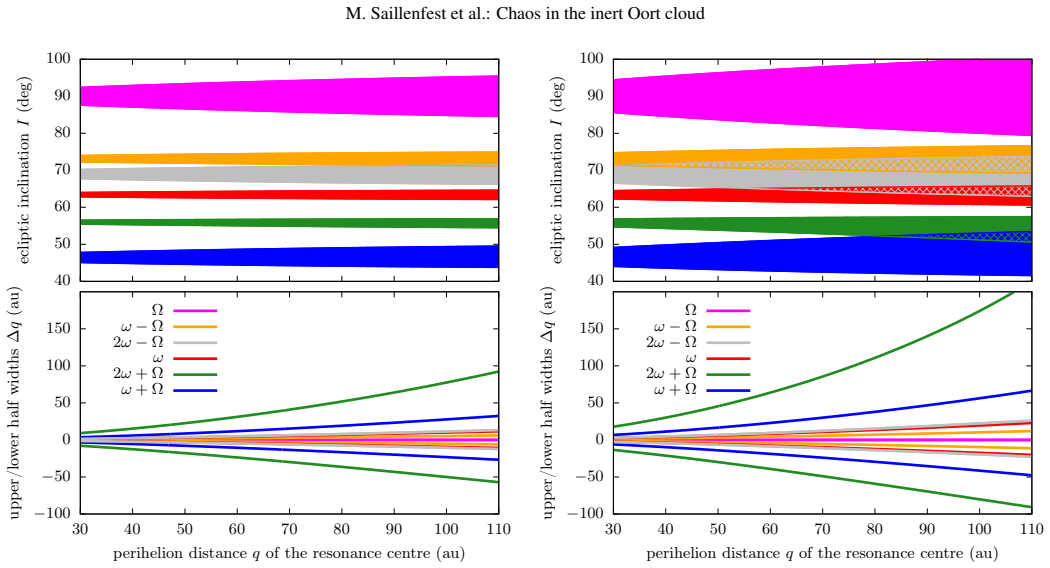
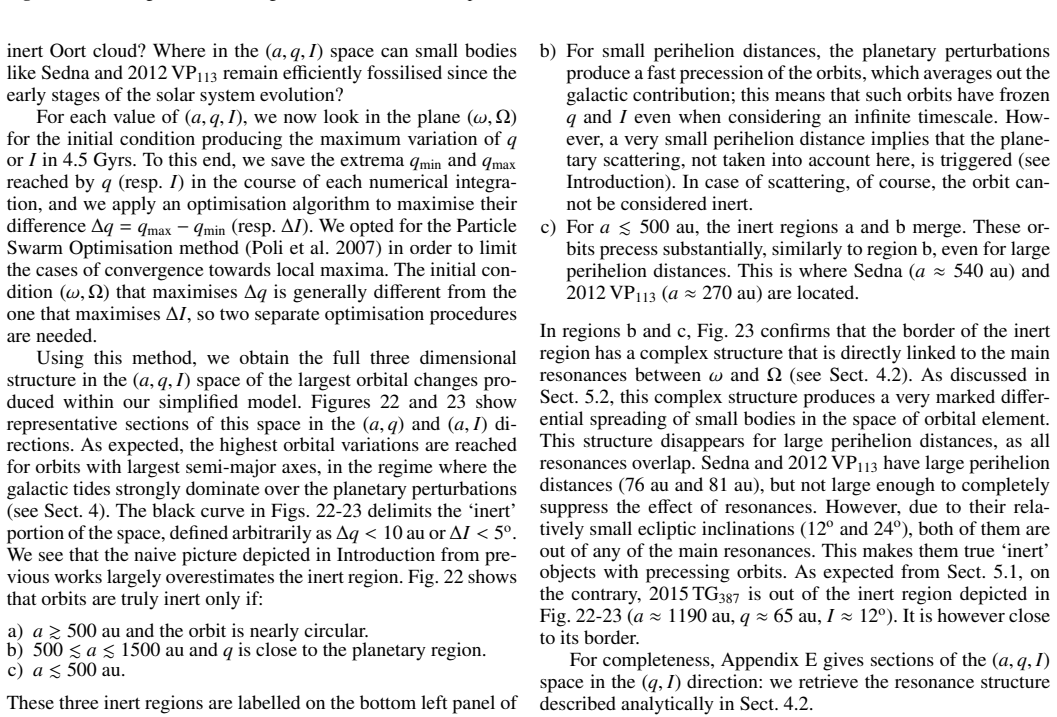
The central discovery is that the inert Oort cloud divides into three dynamical regimes separated by a Laplace-plane transition near 1000 au. At semi-major axes well below this crossover the planetary perturbations dominate and the secular motion is integrable; well above it the galactic tide dominates and the motion is again integrable. In between, roughly from 800 to 1100 au, the two degrees of freedom interact fully and the phase space is almost completely chaotic across nearly the whole eccentricity range. The paper shows that this chaos is not confined to absurd timescales: 4.5-Gyr integrations starting from uniform angle distributions produce clustered angles for a>500 au, a relic of very slow differential precession, and perihelion excursions of tens to hundreds of au, concentrated in the inclination windows that host the ω+Ω, 2ω+Ω, ω−Ω and 2ω−Ω resonances. In this picture, orbits can be considered truly inert over the solar system's age only in small, precisely mapped portions of the (a, q, I) space: Sedna and 2012 VP113 live in such portions, while 2015 TG387 sits near but outside the border.
Load-bearing premise
The quantitative maps of the inert region assume that the hexadecapolar planetary term and the radial component of the galactic tide are negligible; if either of them is not small where the inert boundaries are drawn, the phase-space structure and the boundary locations could shift.
Editorial extensions
If this is right
- Simulations of trans-Neptunian objects with semi-major axes above about 500 au should include the galactic tides, otherwise the long-term evolution of perihelion and inclination is misrepresented.
- Detached objects do not necessarily require close stellar passages during the solar system's youth: a few gigayears of tidal agitation can raise or lower perihelia by tens of au at these distances.
- A Planet 9 on a nominal orbit near a≈700–900 au would lie close to or inside chaotic zones; its perihelion could drift substantially, weakening the assumption that its shepherding geometry is fixed.
- Angular clustering seen in distant Kuiper-belt surveys after 4.5 Gyr is largely a temporary relic of initial conditions produced by differential precession, and should not be read directly as evidence of an undiscovered perturber.
- The truly fossilized reservoir is much smaller, a≲500 au plus a few special islands, than the 'inert cloud' cartoon suggested, so observational searches for primordial material should target those islands.
Reading between the lines
- If the neglected radial tide breaks the axisymmetry near the inert boundaries, the chaotic fraction could grow and the protected islands could shift, implying that the paper's 'less inert than it appears' conclusion would strengthen even if its specific boundary maps are revised.
- A testable prediction follows from the resonance map: a survey of detached objects at a≈500–1500 au should preferentially find large perihelion changes at ecliptic inclinations near 50° and 130°, while low-inclination orbits stay dull.
- The same Laplace-plane crossover should occur in other planetary systems tilted with respect to their galactic plane, so the inner-edge 'inert belts' seen in debris disks could be churned by the same mechanism.
- Because the diffusion acts over gigayears, the current perihelia of Sedna-class objects may encode the integrated tidal and planetary history rather than a primordial freeze; comparing the predicted angle- and inclination-dependent drift rates with future discoveries could disentangle the two.
Signed reviews
Editorial analysis
A structured set of objections, weighed in public.
Referee Report
Summary. The manuscript studies the long-term secular dynamics of small bodies in the intermediate 'inert Oort cloud' region, where planetary perturbations and galactic tides are of comparable magnitude. It derives an averaged Hamiltonian containing the planetary quadrupole and hexadecapole terms and the vertical and radial galactic tides, then restricts the analysis to the planetary quadrupole plus the vertical galactic tide (Eq. 13). On this basis it introduces a galactic Laplace plane, gives an analytic treatment of secular resonances in the planetary-dominated regime, explores the intermediate regime with Poincaré sections for semi-major axes from 500 to 2000 au, and integrates swarms of 10^5 particles for 4.5 Gyr to map maximum excursions in perihelion distance and inclination. The central conclusion is that the inert Oort cloud is far from fossilized: the phase space is mostly chaotic at a≈800–1100 au, and galactic tides produce measurable changes down to a≈500 au, so that only small portions of orbital-element space, including Sedna and 2012 VP113, remain truly inert over 4.5 Gyr.
Significance. If the main conclusion is robust, the paper is significant: it challenges the common assumption that the region between roughly 500 and 2000 au is dynamically frozen, and it has direct implications for interpreting detached trans-Neptunian objects, for the Planet 9 debate, and for numerical simulations of distant small bodies. The paper's strengths are the clean Hamiltonian formulation with externally fixed physical constants, the analytic resonance-width calculation in Appendix D, the systematic use of Poincaré sections, and the large 4.5-Gyr numerical campaign. The main caveat is that the quantitative maps of chaos and of the inert-region boundaries are produced with a truncated Hamiltonian and with arbitrary inertness thresholds; whether the boundaries would shift under a fuller model is not tested.
major comments (3)
- [§3, Eq. (13); Figs. 22–23] The quantitative inert-region boundaries and the 4.5-Gyr maximum-variation maps are computed with the simplified Hamiltonian F, which drops the radial galactic tide εGR HGR of Eq. (12). The order-of-magnitude comparison in Fig. 2 shows that εGR/εGV ≈ 0.125 throughout the studied range, so this is not a separation by two orders of magnitude. More importantly, the radial term contains cos(2ΩG − 2θ) and therefore introduces secular resonances at Ω̇G ≈ νG; in the transition region (a ≈ 800–1100 au) the planetary precession rate Ω̇G in Eq. (15) can approach νG for eccentric orbits because of the (1 − e²)⁻² factor. The paper offers no test of whether adding εGR changes the Poincaré sections of Figs. 10–16 or the maximum-variation maps of Figs. 22–23. I request either numerical comparisons with the radial tide included for a few representative (a, e, I) cells, or an analytic estimate of the widths and locations of the 2ΩG − 2θ resonances, before the inert-region limits can be considered quantitative. The hexadecapolar term εP4 is likely negligible at a ≥ 500 au, so my concern is specifically the radial tide.
- [§5.3, Figs. 22–23 and E.1] The inert region is defined by the thresholds Δq < 10 au and ΔI < 5° over 4.5 Gyr. These thresholds are arbitrary, and the manuscript gives no sensitivity test around them. Because the quantitative statements in the abstract and conclusions, such as the location of the inert boundaries and the claim that galactic tides are discernible down to about 500 au, depend on this choice, the reader cannot tell whether, for example, Δq < 30 au or ΔI < 10° would shift the borders by 100–200 au in semi-major axis. I ask for a short sensitivity analysis in which the thresholds are varied by at least a factor of two, or for an explicit statement of how the qualitative conclusions depend on the threshold values.
- [§5.3, Figs. 22–23] The maps in Figs. 22–23 are presented as the maximum possible variations of q and I for each (a, q, I), but the maxima are obtained by a Particle Swarm Optimisation routine whose parameters and stopping criteria are not specified. PSO is a heuristic; without a convergence check against a dense (ω, Ω) grid for a few representative cells, one cannot exclude under-sampled global maxima. Since the inert-region boundary is defined through these maxima, a missed maximum would bias the boundary, in the sense of making the inert region too large. Please add a validation of the optimisation, for example by comparing PSO results with a fine grid in a small number of (a, q, I) cells.
minor comments (3)
- [References] In the reference list, 'V okrouhlický' should be 'Vokrouhlický'.
- [Fig. 2] The comparison of perturbation amplitudes is shown on a linear scale; a logarithmic vertical scale would make the small parameters εP4 and εGR visible over the full range of a and would better support the order-of-magnitude justification for dropping these terms.
- [Appendix D, Table D.1] The resonance centres in Table D.1 are given as values of cos I, but the table does not state that these are pendulum-approximation values accurate only in the weakly perturbed planetary regime; adding a remark to that effect would prevent readers from applying them where the perturbation is no longer small.
Circularity Check
No significant circularity: the chaotic maps and inert-region boundaries are forward predictions of the model Hamiltonian, not fits to observed bodies.
full rationale
The paper's central claim — that the inert Oort cloud is mostly chaotic and that galactic tides matter down to about 500 au — is obtained by integrating and phase-space-analyzing the secular Hamiltonian F = εP2 HP2 + εGV HGV (Eq. 13). The constants entering εP2, εGV, and the frame conversion are taken from published sources (Bretagnon 1982; Fouchard 2004; Murray 1989), and no parameter is fitted to Sedna, 2012 VP113, or 2015 TG387: the observed bodies are compared afterwards with the model. The Laplace-plane equilibrium (Sect. 3) is the fixed point of this Hamiltonian; the resonance locations and widths (Sect. 4.2) are pendulum approximations of the same Hamiltonian; the Poincaré sections (Figs. 10–16) and the 4.5-Gyr maps (Figs. 19–23) are direct integrations. Thus the quantitative boundaries of the inert region are genuine model predictions rather than restatements of input data. The self-citations (Saillenfest et al. 2016 for multipole formulas; Fouchard 2004 for G2 and G3) are not load-bearing in the sense of forbidding alternatives: the formulas are standard and independently available, and the galactic constants are external inputs, not derived from the target objects. The main caveat is physical rather than circular: Eq. (13) drops the hexadecapolar planetary term and the radial galactic tide εGR, whose untested resonances could modify the detailed boundaries of Figs. 22–23. That is a model-truncation and robustness issue, not a reduction of the conclusions to their inputs.
Assumptions & free parameters
free parameters (1)
- inert thresholds =
Δq < 10 au, ΔI < 5 degrees over 4.5 Gyr
assumptions (7)
- domain assumption The small body never goes inside the orbits of the planets, so the planetary potential can be expanded in Legendre polynomials.
- domain assumption Mean-motion resonances with Neptune are inefficient in the inert Oort cloud, so the averaged planetary perturbation is valid.
- domain assumption The galactic tide is modeled at quadrupolar order with G2 = -G1 and a constant rotation rate νG (circular galactic orbit of the Sun); the radial tide term εGR is dropped in the main analysis.
- domain assumption The hexadecapolar planetary term εP4 and higher-order terms are negligible for the qualitative dynamics.
- domain assumption The ecliptic plane is inertial: no precession of the ecliptic pole around the galactic pole.
- domain assumption Passing stars and molecular clouds are neglected over 4.5 Gyr.
- standard math Averaging over the orbital period is valid to first order (secular approximation).
Cite this review
Pith. "Pith review of Chaos in the inert Oort cloud." pith.science (2026). https://pith.science/paper/34MLMFQI
@misc{pith2026190805175,
  author       = {Pith},
  title        = {Pith review of: Chaos in the inert Oort cloud},
  year         = {2026},
  howpublished = {\url{https://pith.science/paper/34MLMFQI}},
  note         = {Machine review of arXiv:1908.05175}
}
read the original abstract
Context: Distant trans-Neptunian objects are subject to planetary perturbations and galactic tides. The former decrease with the distance, while the latter increase. In the intermediate regime where they have the same order of magnitude (the 'inert Oort cloud'), both are weak, resulting in very long evolution timescales. To date, three observed objects can be considered to belong to this category. Aims: We aim to provide a clear understanding of where this transition occurs, and to characterise the long-term dynamics of small bodies in the intermediate regime: relevant resonances, chaotic zones (if any), and timescales at play. Results: There exists a tilted equilibrium plane (Laplace plane) about which orbits precess. The dynamics is integrable in the low and high semi-major axis regimes, but mostly chaotic in between. From 800 to 1100 au, the chaos covers almost all the eccentricity range. The diffusion timescales are large, but not to the point of being indiscernible in a 4.5 Gyrs duration: the perihelion distance can actually vary from tens to hundreds of au. Orbital variations are favoured in specific ranges of inclination corresponding to well-defined resonances. Starting from uniform distributions, the orbital angles cluster after 4.5 Gyrs for semi-major axes larger than 500 au, because of a very slow differential precession. Conclusions: Even if it is characterised by very long timescales, the inert Oort cloud is much less inert than it appears. Orbits can be considered inert over 4.5 Gyrs only in small portions of the space of orbital elements, which include (90377) Sedna and 2012VP113. Effects of the galactic tides are discernible down to semi-major axes of about 500 au. We advocate including the galactic tides in simulations of distant trans-Neptunian objects, especially when studying the formation of detached bodies or the clustering of orbital elements.
Figures


Figures from the paper (19 more)






Reference graph
Works this paper leans on
-
[1]
, " * write output.state after.block = add.period write newline
ENTRY address archiveprefix author booktitle chapter edition editor howpublished institution eprint journal key month note number organization pages publisher school series title type volume year label extra.label sort.label short.list INTEGERS output.state before.all mid.sentence after.sentence after.block FUNCTION init.state.consts #0 'before.all := #1 ...
-
[2]
write newline
" write newline "" before.all 'output.state := FUNCTION n.dashify 't := "" t empty not t #1 #1 substring "-" = t #1 #2 substring "--" = not "--" * t #2 global.max substring 't := t #1 #1 substring "-" = "-" * t #2 global.max substring 't := while if t #1 #1 substring * t #2 global.max substring 't := if while FUNCTION word.in bbl.in " " * FUNCTION format....
-
[3]
T., Shankman , C., Volk , K., et al
Bannister , M. T., Shankman , C., Volk , K., et al. 2017, , 153, 262
work page 2017
-
[4]
Batygin , K., Adams , F. C., Brown , M. E., & Becker , J. C. 2019, Physics Reports, 805, 1
work page 2019
- [5]
-
[6]
Becker , J. C., Adams , F. C., Khain , T., Hamilton , S. J., & Gerdes , D. 2017, , 154, 61
work page 2017
-
[7]
Brasser , R., Duncan , M. J., Levison , H. F., Schwamb , M. E., & Brown , M. E. 2012, , 217, 1
work page 2012
- [8]
Show all 37 references
-
[9]
1982, , 114, 278
Bretagnon , P. 1982, , 114, 278
1982
-
[10]
E., Trujillo , C., & Rabinowitz , D
Brown , M. E., Trujillo , C., & Rabinowitz , D. 2004, , 617, 645
2004
-
[11]
R., Levison , H
Dones , L., Weissman , P. R., Levison , H. F., & Duncan , M. J. 2004, in Astronomical Society of the Pacific Conference Series, Vol. 323, Star Formation in the Interstellar Medium: In Honor of David Hollenbach, ed. D. Johnstone , F. C. Adams , D. N. C. Lin , D. A. Neufeeld , &...
2004
-
[12]
2016, , 587, L8
Fienga , A., Laskar , J., Manche , H., & Gastineau , M. 2016, , 587, L8
2016
-
[13]
2004, MNRAS, 349, 347
Fouchard , M. 2004, MNRAS, 349, 347
2004
-
[14]
2018, , 620, A45
Fouchard , M., Higuchi , A., Ito , T., & Maquet , L. 2018, , 620, A45
2018
-
[15]
Fouchard , M., Rickman , H., Froeschl \'e , C., & Valsecchi , G. B. 2017, , 292, 218
2017
-
[16]
2012, , 220, 392
Gallardo , T., Hugo , G., & Pais , P. 2012, , 220, 392
2012
-
[17]
2002, , 157, 269
Gladman , B., Holman , M., Grav , T., et al. 2002, , 157, 269
2002
-
[18]
2005, Celest
Gomes , R., Gallardo , T., Fern\'andez , J., & Brunini , A. 2005, Celest. Mech. Dynam. Astron., 91, 109
2005
-
[19]
S., Soares , J
Gomes , R. S., Soares , J. S., & Brasser , R. 2015, , 258, 37
2015
-
[20]
& Kokubo , E
Higuchi , A. & Kokubo , E. 2015, , 150, 26
2015
-
[21]
2007, , 134, 1693
Higuchi , A., Kokubo , E., Kinoshita , H., & Mukai , T. 2007, , 134, 1693
2007
-
[22]
2015, , 453, 3157
J \' lkov \'a , L., Portegies Zwart , S., Pijloo , T., & Hammer , M. 2015, , 453, 3157
2015
-
[23]
A., Pike , R., Lawler , S., et al
Kaib , N. A., Pike , R., Lawler , S., et al. 2019, , 158, 43
2019
-
[24]
& Bou \'e , G
Laskar , J. & Bou \'e , G. 2010, , 522, A60
2010
-
[25]
2014, , 791, 86
Li , G., Naoz , S., Holman , M., & Loeb , A. 2014, , 791, 86
2014
-
[26]
& Nesvorny , D
Morbidelli , A. & Nesvorny , D. 2019, arXiv e-prints [ [arXiv] 1904.02980 ]
2019 arXiv
-
[27]
Murray , C. A. 1989, , 218, 325
1989
-
[28]
2007, Swarm Intelligence, 1, 33
Poli , R., Kennedy , J., & Blackwell , T. 2007, Swarm Intelligence, 1, 33
2007
-
[29]
2018, , 619, A133
Polycarpe , W., Saillenfest , M., Lainey , V., et al. 2018, , 619, A133
2018
-
[30]
Saillenfest , M., Fouchard , M., Tommei , G., & Valsecchi , G. B. 2016, Celestial Mechanics and Dynamical Astronomy, 126, 369
2016
-
[31]
Saillenfest , M., Fouchard , M., Tommei , G., & Valsecchi , G. B. 2017 a , Celestial Mechanics and Dynamical Astronomy, 129, 329
2017
-
[32]
Saillenfest , M., Fouchard , M., Tommei , G., & Valsecchi , G. B. 2017 b , Celestial Mechanics and Dynamical Astronomy, 127, 477
2017
-
[33]
S., Trujillo , C
Sheppard , S. S., Trujillo , C. A., Tholen , D. J., & Kaib , N. 2019, , 157, 139
2019
-
[34]
2009, , 137, 3706
Tremaine , S., Touma , J., & Namouni , F. 2009, , 137, 3706
2009
-
[35]
Trujillo , C. A. & Sheppard , S. S. 2014, , 507, 471
2014
-
[36]
Tsiganis , K., Gomes , R., Morbidelli , A., & Levison , H. F. 2005, , 435, 459
2005
-
[37]
2019, , 157, 181
Vokrouhlick \'y , D., Nesvorn \'y , D., & Dones , L. 2019, , 157, 181
2019
Reviewed August 14, 2026 · model on record in the stance chip above.
Discussion (0). Continue with ORCID to comment.