REVIEW 4 major objections 4 minor 4 references
Sky Brightness Measurements and Ways to Mitigate Light Pollution in Kirksville, Missouri
T0 review · 4 major / 4 minor · reviewed 2026-08-14 · deepseek-v4-flash
Pith's one-line read This paper reports that a dark-sky site near Flagstaff is about 1.3 magnitudes per square arcsecond darker than a semi-rural observatory and about 2.5 magnitudes per square arcsecond darker than a university campus roof, with…
desk verdict A modest, honestly reported local SQM baseline with a real calibration ambiguity that keeps the headline magnitude differences from being quantitatively trustworthy. read the letter →
The pith
A machine-rendered reading of the paper's core claim, the machinery that carries it, and where it could break.
The reading
What carries the argument
The load-bearing object is the sky quality meter (SQM), a small photometer that reports sky brightness in magnitudes per square arcsecond. The paper uses hand-held SQM and SQM-L meters on a tripod with a protractor and plumb bob to measure brightness as a function of altitude and azimuth, following the published procedure of Birriel and Adkins (2010), and datalogging SQM-LU-DL meters for continuous zenith monitoring. The critical calibration step is a constant 0.7 magnitude per square arcsecond offset added to readings from the two older sensors to make them agree with the three newer ones; the paper concedes the offset is not constant across all sky brightness and temperature conditions.
What would settle it
Simultaneously point one old-generation and one new-generation SQM at the same region of sky over nights covering at least 18 to 22 magnitudes per square arcsecond and a range of temperatures; if the old sensor's offset from the new sensor deviates from 0.7 magnitudes per square arcsecond by more than 0.2 in either direction, the reported 1.3 and 2.5 magnitude differences between sites are not a stable baseline.
Extended reading notes
Core claim
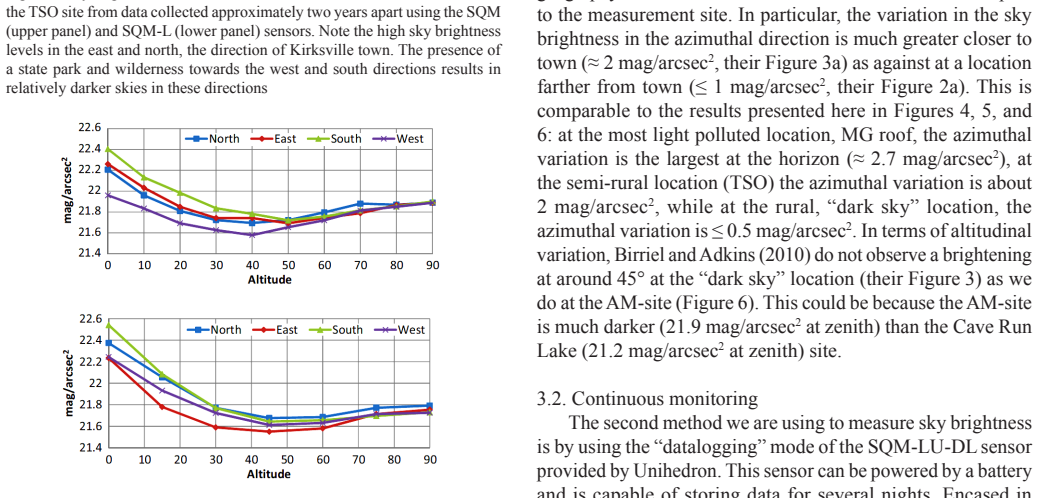
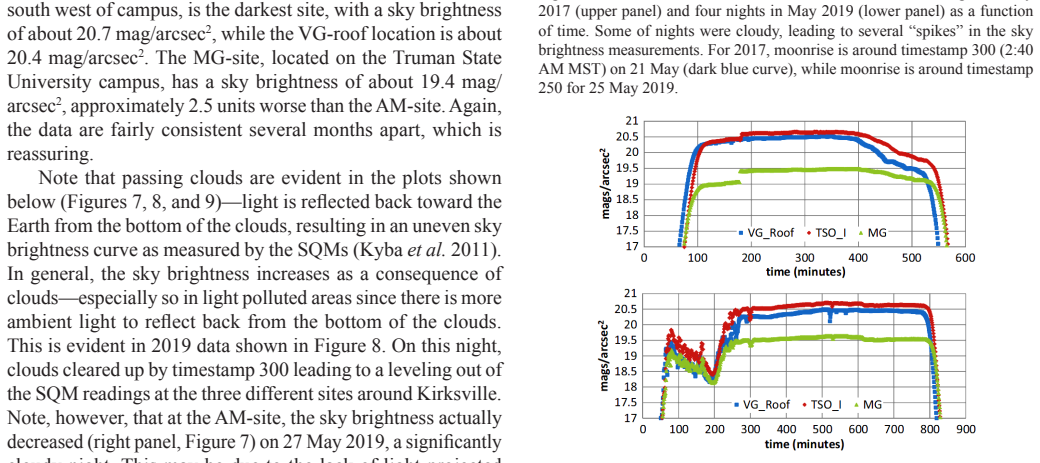
On the paper's own terms, the central discovery is a quantitative map of local sky brightness: the dark-sky site averages about 21.9 magnitudes per square arcsecond at the zenith, while the semi-rural observatory site averages about 20.7 and the campus science-building roof about 19.4. The differences are direction-dependent: at the observatory, north and east are about 1 magnitude per square arcsecond brighter than south and west because the town lies to the northeast, and at the campus rooftop the west direction is up to 3 magnitudes per square arcsecond brighter than south. The dark site is nearly uniform in azimuth. These numbers are offered as a baseline for the paper's mitigation program: installing fully shielded fixtures and replacing blue-white lamps with 3000 K lights, then re-measuring to see whether the sky actually darkens.
Load-bearing premise
The whole comparison rests on the assumption that adding a single 0.7 magnitude per square arcsecond correction to all readings from the two older meters makes them equal to the newer meters at every sky brightness and temperature; the paper itself notes the offset is not constant.
Editorial extensions
If this is right
- The measured baselines give a before-and-after yardstick: re-running the same SQM measurements after the shields and 3000 K lamps are installed should show whether the sky brightness at the campus roof and observatory actually improves.
- The direction-dependent pattern means the main sources of sky glow are identifiable local fixtures: town lights to the northeast for the observatory and unshielded globe lights to the west for the campus roof, so targeted shielding in those directions should give the largest gains.
- If the measurements are representative, other small towns can reproduce the same protocol to quantify their own light pollution without specialized equipment, making local advocacy data-driven.
- The comparison also sets a realistic expectation: even a semi-rural site a few miles from town is about 1.3 magnitudes per square arcsecond brighter than a designated dark-sky site, so substantial improvement requires regional lighting policy, not just single-fixture retrofits.
Reading between the lines
- The azimuthal asymmetry at the campus roof (west up to 3 magnitudes brighter than south) likely comes mostly from unshielded fixtures within a few hundred meters, so the fifty shields now being installed in one street should produce a measurable drop in that direction; the paper's planned re-measurement will test this.
- The paper does not model the vertical distribution of emitted light, but the altitude scans imply that most wasted light escapes at low angles; a natural next step would be to compare the SQM data with satellite radiance maps to see how much upward light the town emits.
- If the 0.7 magnitude offset drifts with temperature, the absolute site-to-site differences could shift by a few tenths, but the direction-dependent comparisons within a single sensor are more robust; a useful extension would be a lab calibration of the old sensors against a stable light source.
Signed reviews
Editorial analysis
A structured set of objections, weighed in public.
Referee Report
Summary. This paper reports sky brightness measurements at three sites in Kirksville, Missouri (the Truman State Observatory, the roof of Magruder Hall science building, and a residence roof) and at Anderson Mesa near Flagstaff, Arizona, using Unihedron Sky Quality Meters. The authors use two methods: manual altitude-azimuth scans following Birriel and Adkins (2010) and continuous zenith monitoring with datalogging SQM-LU-DL sensors. The headline claims are that Anderson Mesa is approximately 1.3 mag/arcsec2 darker than the Truman Observatory site and approximately 2.5 mag/arcsec2 darker than the Magruder Hall roof, and that the azimuthal brightness variation is much larger at the urban and semi-rural Kirksville sites than at Anderson Mesa. The paper also describes ongoing light pollution mitigation efforts, including installation of dark-sky shields and warmer-color lights on campus.
Significance. If the quantitative results are taken at face value, the paper provides a useful baseline for before-and-after evaluation of light pollution mitigation in a small midwestern town and demonstrates a simple, low-cost monitoring approach with off-the-shelf sensors. The qualitative conclusion that Anderson Mesa is darker than all Kirksville sites is credible, consistent with previous studies, and not circular in any way. The strengths include the use of multiple co-located sensors, comparison with an established dark-sky site, and a clearly described public outreach and advocacy component. However, the specific numerical claims (1.3 and 2.5 mag/arcsec2) rest on a sensor-offset correction whose direction and constancy are not established in the manuscript, and the sensor-to-site mapping is missing, so the central quantitative claims cannot yet be taken at face value.
major comments (4)
- [Section 2, Figure 1] The direction of the sensor offset is internally inconsistent. The text states that Darth and Yoda gave values 0.65–0.75 "higher" than the newer sensors, while the caption to Figure 1 states that the newer sensors give darker measurements; in mag/arcsec2, darker means a higher numerical value. If the older sensors read higher, adding 0.7 makes them even darker and increases any disagreement, whereas if the older sensors read lower (brighter), the word "higher" is wrong. Please state unambiguously which sensors read brighter or darker and whether the offset was added to or subtracted from the Darth and Yoda readings, and show a sample before/after correction.
- [Section 3.2, Figure 9] The manuscript does not identify which of the five sensors (Darth, Yoda, Rey, Finn, Kylo) were used for each continuous-monitoring run that enters the comparison in Figure 9. Since the 0.7 mag/arcsec2 offset is applied only to Darth and Yoda, the reported values of 1.3 mag/arcsec2 (AM vs TSO) and 2.5 mag/arcsec2 (AM vs MG) cannot be reproduced or assessed by the reader. Provide a table or statement mapping each dataset to a specific sensor and indicate whether the offset was applied.
- [Section 2] The paper concedes that the offset is not constant at different levels of darkness and may have a temperature-dependence, yet all Darth/Yoda data are corrected with a single 0.7 mag/arcsec2 value derived near 19 mag/arcsec2. The AM site measures approximately 21.9 mag/arcsec2, so the correction is extrapolated well beyond the calibrated range. Because the claimed 1.3 mag/arcsec2 difference is of the same order as the possible error introduced by this extrapolation, the quantitative claims need either a brightness-resolved calibration or a clear restriction to the newer sensors.
- [Section 3.2, Table 1, Figure 9] The comparison in Figure 9 combines data from different seasons (January vs March/May), elevations (2163 m vs 299 m), and typical humidity conditions, with no correction for airmass or extinction. The paper reports differences to 0.1 mag/arcsec2 precision; at minimum, the text should state that the comparison is uncorrected for these factors and estimate the associated systematic uncertainty on the 1.3 and 2.5 mag/arcsec2 values.
minor comments (4)
- [Section 4] There is a stray brace in "(Kyba et al. 2011}"; it should read "(Kyba et al. 2011)".
- [Abstract and Section 2] The units are written inconsistently as "mags/arcsec2" in the abstract and Section 2 and "mag/arcsec2" elsewhere; please use one convention throughout.
- [Figure 6 caption] The caption reads "two clear night two years apart"; this should be "two clear nights two years apart".
- [Section 3.1] The statement that the Moon was rising in the east during the 2019 Anderson Mesa measurements is made without quantifying the resulting bias; please indicate the affected altitudes/azimuths or state that the effect is small compared to the reported trends.
Circularity Check
No circularity: the paper reports empirical sky-brightness measurements with an explicit sensor-calibration step, not a derivation that reduces to its inputs.
full rationale
This paper is an observational report, not a derivation. The central claims—that Anderson Mesa is about 1.3 mag/arcsec2 darker than the Truman State Observatory site and about 2.5 mag/arcsec2 darker than the science-building roof—are direct comparisons of SQM readings from different locations. No quantity is defined in terms of the claimed result, and no parameter is fitted to a subset of data and then renamed a prediction. The 0.7 mag/arcsec2 offset applied to the older Darth and Yoda sensors is a calibration adjustment described in Section 2, and the paper openly states that the offset is not constant and may be temperature-dependent; this is a measurement-accuracy limitation, not a circular step, because the site-to-site differences are not constructed from that offset alone and the paper does not claim the offset forces the 1.3 or 2.5 mag figures. The Anderson Mesa and Kirksville comparisons are additionally supported by azimuthal and altitudinal sky-brightness plots and by repeated measurements on different nights. Citations to prior work (Birriel and Adkins 2010; Kyba et al. 2011) are used only for methodology context and qualitative comparison, not as load-bearing justification for the quantitative results. There is no self-citation chain, no uniqueness theorem, no ansatz imported via citation, and no renaming of a known result. The honest finding is therefore no significant circularity, with score 0.
Assumptions & free parameters
free parameters (1)
- sensor offset for Darth and Yoda =
0.7 mag/arcsec2
assumptions (3)
- domain assumption SQM readings are a valid measure of night sky brightness under the conditions measured
- ad hoc to paper Measurements at different epochs, seasons, and sites are directly comparable without correction for elevation, humidity, or airmass
- ad hoc to paper A constant offset can correct the two older sensors to match the newer sensors
Cite this review
Pith. "Pith review of Sky Brightness Measurements and Ways to Mitigate Light Pollution in Kirksville, Missouri." pith.science (2026). https://pith.science/paper/PXUQL2WT
@misc{pith2026190805234,
  author       = {Pith},
  title        = {Pith review of: Sky Brightness Measurements and Ways to Mitigate Light Pollution in Kirksville, Missouri},
  year         = {2026},
  howpublished = {\url{https://pith.science/paper/PXUQL2WT}},
  note         = {Machine review of arXiv:1908.05234}
}
abstract
We describe the level of light pollution in and around Kirksville, Missouri and at Anderson Mesa near Flagstaff, Arizona by measuring the sky brightness using Unihedron sky quality meters. We report that, on average, the Anderson Mesa site is approximately 1.3 mag/arcsec$^2$ darker than the Truman State Observatory site, and approximately 2.5 mag/arcsec$^2$ darker than the roof of the science building at Truman State University in Kirksville. We also show that at the Truman observatory site, the North and East skies have significantly high sky brightness (by about 1 mag/arcsec$^2$) as compared to the South and West skies. Similarly, the sky brightness varies significantly with azimuth on the top of the science building at Truman State -- the west direction being as much as 3 mag/arcsec$^2$ brighter than the south direction. The sky brightness at Anderson Mesa is much more uniform, varying by less than 0.4 mag/arcsec$^2$ at most along the azimuthal direction. Finally, we describe the steps we are taking in the Kirksville area to mitigate the nuisance of light pollution by installing fully shielded outdoor light fixtures and improved outdoor lights on Truman State University's campus.
Figures


Figures from the paper (7 more)





Reference graph
Works this paper leans on
-
[1]
Aube, M., Roby, J., and Kocifaj, M. 2013, PLoS ONE , 8, e67798. Birriel, J., and Adkins, J. K. 2010, J. Amer. Assoc. Var. Star Obs., 38,
work page 2013
-
[221]
Chepesiuk, R. 2009, Environ. Health Prospect., 117, A20. Gaston, K. J., et al.. 2012, J. Appl. Ecology, 49,
work page 2009
-
[1256]
Visibility, Environmental, and Astronomical Issues Associated with Blue-Rich White Outdoor Lighting
International Dark Sky Association. 2010, “Visibility, Environmental, and Astronomical Issues Associated with Blue-Rich White Outdoor Lighting” (https://www. darksky.org/our-work/grassroots-advocacy/resources/ida- publications/). Kyba C. C. M., Ruhtz, T., Fischer, J., and Holker, F. 2011, PLoS ONE, 6, e17307. Luginbuhl, C., Moore, C., and McGovern, T., ed...
work page 2010
-
[2966]
Schaefer, B. 2019, private communication. Tekatch, A. 2019, private communication. Walker, M. F., 1977, Publ. Astron. Soc. Pacific, 89, 405
work page 2019
Reviewed August 14, 2026 · model on record in the stance chip above.
Discussion (0). Continue with ORCID to comment.