REVIEW 3 major objections 3 minor 59 references
Computational Prediction of Structural, Electronic, Optical Properties and Phase Stability of Double Perovskites K2SnX6 (X = I, Br, Cl)
T0 review · 3 major / 3 minor · reviewed 2026-08-14 · deepseek-v4-flash
Pith's one-line read Two lead-free double perovskites can serve as solar-cell absorbers.
desk verdict The electronic screening is solid and useful, but the central claim recommending cubic K2SnBr6 contradicts the paper's own phase diagram—cubic is stable only above 433 K, so the room-temperature absorber recommendation doesn't hold. read the letter →
The pith
A machine-rendered reading of the paper's core claim, the machinery that carries it, and where it could break.
The reading
What carries the argument
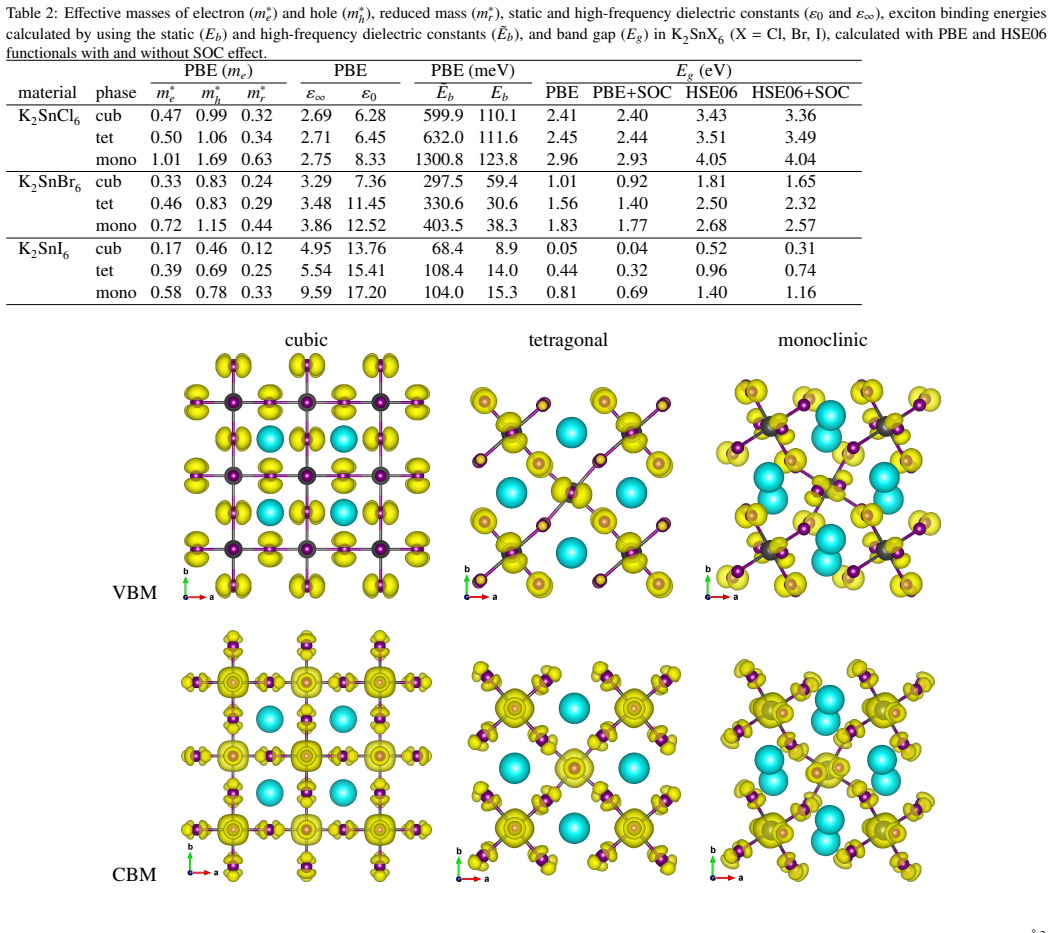
The argument is carried by a first-principles pipeline. A generalized-gradient density functional optimizes the cubic, tetragonal, and monoclinic structures and, via perturbation theory, produces phonon dispersions and dielectric constants; a screened hybrid functional with spin–orbit coupling provides band gaps and band curvatures. Effective masses and the static dielectric constant feed a hydrogenic exciton formula, $E_b = 13.6\,\mathrm{eV}\times \mu/\varepsilon_s^2$, yielding the quoted binding energies, while phonon densities of states are integrated into constant-volume harmonic Helmholtz free energies whose inter-phase differences fix the transition temperatures. The monoclinic phases are dynamically stable, but the cubic and tetragonal phases show imaginary-frequency phonon modes, which the paper labels 'anharmonic' and leaves out of the free energy.
What would settle it
Measure the optical absorption edge and temperature-dependent photoluminescence of cubic K2SnBr6 and monoclinic K2SnI6: if the gaps are not near 1.65 eV and 1.16 eV, or the exciton binding energies are not near 59 and 15 meV, the central suitability claim collapses. Differential scanning calorimetry on all three compounds would also check the predicted transition temperatures (449/345 K for the iodide, 433/301 K for the bromide, 281/210 K for the chloride).
Extended reading notes
Core claim
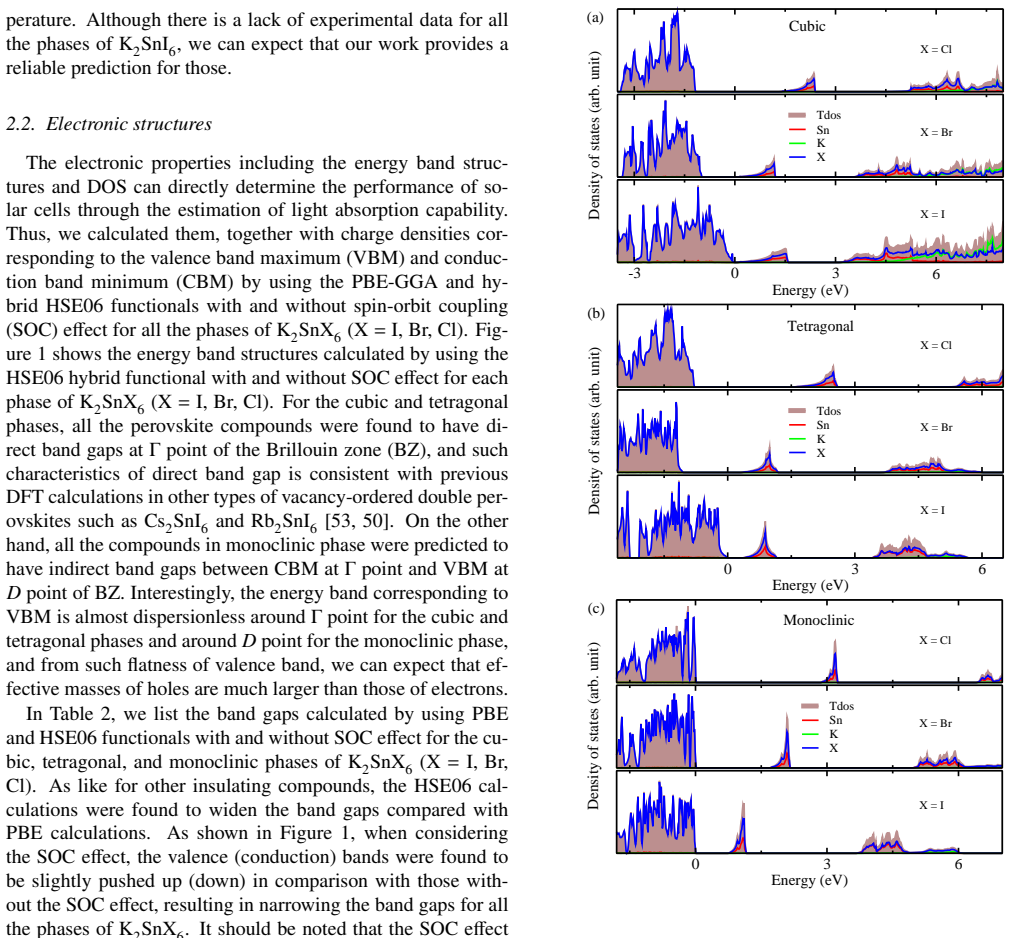
On its own terms, the paper establishes that K2SnBr6 in the cubic phase and K2SnI6 in the monoclinic phase combine the two properties a light absorber needs: a band gap inside the solar-friendly range (1.65 eV and 1.16 eV from hybrid-functional calculations with spin–orbit coupling) and a small exciton binding energy (59.4 meV and 15.3 meV from a hydrogenic model using the static dielectric constant), meaning photoexcited charges can be split into free carriers. The same calculations place K2SnCl6 outside this role, with band gaps of 3.36–4.04 eV, while the iodine compound in cubic and tetragonal forms has very small gaps (0.31 and 0.74 eV) suited instead to infrared applications. The paper further claims a monotonic trend—band gap and exciton binding energy rise as symmetry falls and as X goes from I to Br to Cl—and predicts, from harmonic phonon free energies, transition temperatures of 449/345 K for K2SnI6, 433/301 K for K2SnBr6, and 281/210 K for K2SnCl6, the chloride values sitting reasonably close to the measured 262 and 255 K.
Load-bearing premise
The predicted transition temperatures rest on the assumption that the vibrational free energy of the cubic and tetragonal phases can be trusted even though those phases show unstable vibrations (imaginary frequencies) that the paper labels 'anharmonic' and sets aside along with volume changes.
Editorial extensions
If this is right
- Cubic K2SnBr6 and monoclinic K2SnI6 should be tested in thin-film solar cells: their calculated gaps (1.65 and 1.16 eV) sit near the optimum for single-junction absorbers, and their low exciton binding energies indicate efficient free-carrier generation.
- Band-gap engineering across the series is systematic: replacing I with Br and then Cl widens the gap, and lowering symmetry from cubic to monoclinic also widens it, so composition and crystal phase can be used as tuning knobs.
- K2SnCl6 is predicted to be a wide-gap semiconductor (3.36–4.04 eV), useful as a charge-transport layer rather than an absorber, while cubic and tetragonal K2SnI6 (0.31 and 0.74 eV) are candidates for infrared optoelectronics.
- Each compound should switch from cubic to tetragonal to monoclinic on cooling, with the chloride transitions predicted at 281 K and 210 K, close to the measured 262 K and 255 K; the bromide and iodide should show the same sequence at higher temperatures.
Reading between the lines
- A device-oriented follow-up is to test whether the predicted monoclinic-to-tetragonal transition near 345 K in K2SnI6 (and 301 K in the bromide) affects operating solar cells, since the paper does not address properties above the transition.
- The same screening pipeline could be extended to other B-site cations (Ge, Zr, Ti) in K2BX6, looking for additional lead-free absorbers with gaps in the 1.0–1.7 eV range, provided the imaginary-phonon issue is handled by anharmonic renormalization or molecular dynamics.
- The literature comparison cited in the paper suggests that shrinking the A-site cation lowers carrier effective masses; that trend implies mixed K/Cs or K/Rb compositions might tune mobility and gap continuously, an alloying direction the paper leaves untested.
Signed reviews
Editorial analysis
A structured set of objections, weighed in public.
Referee Report
Summary. The paper reports a systematic DFT study of the vacancy-ordered double perovskites K2SnX6 (X = I, Br, Cl) in cubic, tetragonal, and monoclinic phases. Using PBE and HSE06 functionals with and without spin-orbit coupling, the authors compute lattice constants, band structures, effective masses, dielectric constants, exciton binding energies, and absorption coefficients. They also compute constant-volume Helmholtz free energies from phonon DOS to estimate phase transition temperatures. The central application claim is that cubic K2SnBr6 and monoclinic K2SnI6 are suitable light absorbers for solar cells because of their band gaps (1.65 and 1.16 eV) and low exciton binding energies (59.4 and 15.3 meV). The paper also predicts cubic-tetragonal and tetragonal-monoclinic transition temperatures for all three compounds.
Significance. If the results hold, the paper provides a useful comparative dataset for a less-studied family of lead-free halide perovskites, with lattice constants that match experiment and a consistent trend of increasing band gap with lower symmetry and heavier halide. The explicit exciton binding energies and carrier effective masses are valuable for photovoltaic assessment. However, the central solar-cell recommendation is currently undermined by the paper's own phase-stability results, which place the cubic phase of K2SnBr6 as stable only above 433 K, not at room temperature. The phase transition temperatures themselves rest on a harmonic free-energy treatment of dynamically unstable phases, a methodological gap that makes the quantitative predictions unreliable as stated.
major comments (3)
- [Abstract, Section 2.2, Section 2.4, Conclusions] The manuscript's main application claim is internally inconsistent with its own phase-stability diagram. Section 2.4 and Figure 5 predict that cubic K2SnBr6 transforms to the tetragonal phase at 433 K, so at room temperature (~300 K) the thermodynamically stable phase is tetragonal K2SnBr6. Nevertheless, the abstract, Section 2.2, and Conclusions recommend 'cubic K2SnBr6' as a light-absorber based on the cubic HSE06+SOC band gap of 1.65 eV. The tetragonal phase has a band gap of 2.32 eV (Table 2), a qualitatively different absorber profile. Either the phase-transition temperatures are correct, in which case the cubic phase is not the operative absorber at room temperature, or they are not reliable, in which case the paper has not established which phase is stable under operating conditions. The recommendation must be reconciled with the phase-stability analysis.
- [Section 2.4 and Computational Methods] The phase transition temperatures are derived from constant-volume harmonic Helmholtz free energies computed from phonon DOS, yet Figure 4 shows that the cubic and tetragonal phases have negative-energy (imaginary) phonon modes, which the text labels 'anharmonic'. The paper never specifies how these imaginary modes enter the harmonic free-energy expression, and it concedes in Section 2.4 that volume change and anharmonic-mode contributions are ignored. In a harmonic free energy, an imaginary frequency makes the vibrational partition function ill-defined (the energy is unbounded below). The method section only states that free energies are 'post-processed' from phonon DOS, without describing the handling of unstable modes. Consequently, the predicted transition temperatures (449, 433, 281, 345, 301, 210 K) are not reliable as stated. To support the phase-stability claims, the authors should either adopt a treatment that properly renormalizes or samples anharmonic modes (e.g., self-consistent phonon theory or molecular dynamics) or explicitly justify that the harmonic expression over the imaginary branches yields physically meaningful free-energy differences.
- [Section 2.1, Eq. for t_G] The Goldschmidt tolerance factor is written as tG = (rK + rSn)/√2(rSn + rX). For a perovskite ABX3 the standard expression is (rA + rX)/√2(rB + rX), and for vacancy-ordered A2BX6 the same anion-involving form is generally used. As written, the numerator omits rX and instead includes rSn, which is not the conventional definition. The reported values (0.88, 0.87, 0.85) do not follow obviously from standard Shannon radii for either form of the expression. The authors must state the ionic radii used and correct the formula or the numerical values, because the conclusion that all three compounds satisfy 0.8 < tG < 1.0 and can form the perovskite structure depends on this quantity.
minor comments (3)
- [Throughout] There are several typographical errors: 'indispensible' should be 'indispensable', 'comperciallization' should be 'commercialization', 'tripe' should be 'triple' (all in Section 1), 'goning' should be 'going' (Section 2.1), and the Conclusions refer to 'K2SnX3' which should be 'K2SnX6'.
- [Section 2.3] The exciton binding energies in Table 2 are computed from PBE effective masses and dielectric constants, while the band gaps reported in the same table are from HSE06 and HSE06+SOC. The manuscript should state whether mixing levels of theory introduces uncertainty into the conclusion that the exciton binding energies are 'low'.
- [Section 2.4] The agreement with experimental transition temperatures for K2SnCl6 (281 vs 262 K and 210 vs 255 K) is mentioned only qualitatively. Reporting the temperature step of 10 K and the sensitivity of the crossing points to the free-energy expression would help the reader assess the precision of the transition temperatures.
Circularity Check
No significant circularity: the band gaps, exciton binding energies, and phase-transition temperatures are first-principles outputs, not fits to the target compounds.
full rationale
The derivation chain is self-contained with respect to the target compounds. The central predictions—lattice constants, HSE06+SOC band gaps, effective masses, dielectric constants, exciton binding energies, and phonon-based transition temperatures—are direct outputs of standard DFT/DFPT calculations. The HSE exchange fraction (20%) is a method parameter justified by prior halide-perovskite calibrations, not fitted to K2SnX6 data. The exciton binding energies follow from the Wannier model using the calculated masses and dielectric constants, so they are derived outputs, not inputs. The transition temperatures are obtained from independent Helmholtz free-energy differences; the comparison with the experimental K2SnCl6 transitions is explicit, with deviations attributed to ignored volume change and anharmonic modes. The few self-citations ([20,23,54]) document computational methods and prior calibrations; none imports an unverified premise or forbids alternatives. The limitations flagged in Sec. 2.4—imaginary 'anharmonic' phonon modes entering the harmonic free energies and ignored volume change—are reliability concerns, not circularity. The internal tension between recommending room-temperature cubic K2SnBr6 and the predicted 433/301 K transitions is an inconsistency, not a circular derivation.
Assumptions & free parameters
free parameters (1)
- HSE exact-exchange fraction =
0.20
assumptions (4)
- domain assumption PBE and HSE06 density functional approximations give accurate total energies, band structures, and phonons for these compounds.
- domain assumption Harmonic phonon approximation and neglect of volume change and anharmonicity are adequate for Helmholtz free energy differences.
- domain assumption The Wannier-Mott hydrogenic model with static dielectric constant gives exciton binding energies.
- domain assumption Empirical Goldschmidt tolerance and octahedral factor criteria from prior literature indicate perovskite formability.
Cite this review
Pith. "Pith review of Computational Prediction of Structural, Electronic, Optical Properties and Phase Stability of Double Perovskites K2SnX6 (X = I, Br, Cl)." pith.science (2026). https://pith.science/paper/JIFAXVOE
@misc{pith2026190805236,
  author       = {Pith},
  title        = {Pith review of: Computational Prediction of Structural, Electronic, Optical Properties and Phase Stability of Double Perovskites K2SnX6 (X = I, Br, Cl)},
  year         = {2026},
  howpublished = {\url{https://pith.science/paper/JIFAXVOE}},
  note         = {Machine review of arXiv:1908.05236}
}
read the original abstract
Vacancy-ordered double perovskites K2SnX6 (X = I, Br, Cl) attract significant research interest due to their potential application as light-absorbing materials in perovskite solar cells. However, a deep insight into their material properties at the atomic scale is yet scarce. Here we present a systematic investigation on their structural, electronic, optical properties and phase stabilities in cubic, tetragonal, and monoclinic phases based on density functional theory calculations. Quantitatively reliable prediction of lattice constants, band gaps, effective masses of charge carriers, exciton binding energies is provided in comparison with the available experimental data, revealing the increasing tendency of band gap and exciton binding energy as lowering the crystallographic symmetry from cubic to monoclinic and going from I to Cl. We highlight that cubic K2SnBr6 and monoclinic K2SnI6 are suitable for the application as a light-absorber for solar cell devices due to their proper band gaps of 1.65 and 1.16 eV and low exciton binding energies of 59.4 and 15.3 meV, respectively. The constant-volume Helmholtz free energies are determined through phonon calculations, giving a prediction of their phase transition temperatures as 449, 433 and 281 K for cubic-tetragonal and 345, 301 and 210 K for tetragonal-monoclinic transitions for X = I, Br and Cl. Our calculations provide an understanding of material properties of vacancy-ordered double perovskite K2SnX6, helping to devise a low-cost and high performance perovskite solar cell.
Figures

Figures from the paper (2 more)


Reference graph
Works this paper leans on
- [1]
-
[2]
H. Zhou, Q. Chen, G. Li, S. Luo, T.-B. Song, H.-S. Duan, Z. Hong, J. You, Y . Liu, Y . Yang, Interface Engineering of Highly Efficient Perovskite So- lar Cells, Science 345 (2014) 542–546
work page 2014
-
[3]
N. J. Jeon, J. H. Noh, W. S. Yang, Y . C. Kim, S. Ryu, J. Seo, S. I. Seok, Compositional Engineering of Perovskite Materials for High- Performance Solar Cells, Nature 517 (2015) 476–480
work page 2015
-
[4]
W. S. Yang, B. W. Park, E. H. Jung, N. J. Jeon, Y . C. Kim, D. U. Lee, S. S. Shin, J. Seo, E. K. Kim, J. H. Noh, S. I. Seok, Iodide Management in Formamidinium-Lead-Halide-Based Perovskite Layers for Efficient Solar Cells, Science 356 (2017) 1376–1379
work page 2017
- [5]
-
[6]
G. Xing, N. Mathews, S. Sun, S. S. Lim, Y . M. Lam, M. Gr ¨atzel, S. Mhaisalkar, T. C. Sum, Long-Range Balanced Electron- and Hole- Transport Length in Organic-Inorganic CH3NH3PbI3, Science 342 (2013) 344–347
work page 2013
-
[7]
J. M. Frost, K. T. Butler, F. Brivio, C. H. Hendon, M. van Schilfgaarde, A. Walsh, Atomistic Origins of High-Performance in Hybrid Halide Per- ovskite Solar Cells, Nano Lett. 14 (2014) 2584–2590
work page 2014
-
[8]
B. Philippe, B. W. Park, R. Lindblad, J. Oscarsson, S. Ahmadi, E. M. J. Johansson, H. Rensmo, Chemical and Electronic Structure Characteriza- tion of Lead Halide Perovskites and Stability Behavior under Di fferent Exposures-a Photoelectron Spectroscopy Investigation, Chem. Mater. 27 (2015) 1720–1731
work page 2015
Show all 59 references
-
[9]
S. D. Wolf, J. Holovsky, S. J. Moon, P. Loper, B. Niesen, M. Ledin- sky, F. J. Haug, J. H. Yum, C. Ballif, Organometallic Halide Perovskites: Sharp Optical Absorption Edge and its relation to Photovoltaic Perfor- mance, J. Phys. Chem. Lett. 5 (2014) 1035–1039
2014
-
[10]
Burschka, N
J. Burschka, N. Pellet, S. J. Moon, R. Humphry-Baker, P. Gao, M. K. Nazeeruddin, M. Gr ¨atzel, Sequential Deposition as a Route to High- Performance Perovskite-Sensitized Solar Cells, Nature 499 (2013) 316– 319
2013
-
[11]
Baikie, Y
T. Baikie, Y . N. Fang, J. M. Kadro, M. Schreyer, F. X. Wei, S. G. Mhaisalkar, M. Gr ¨atzel, T. J. White, Synthesis and Crystal Chemistry of the Hybrid Perovskite (CH 3NH3)PbI3 for Solid-State Sensitised So- lar Cell Applications, J. Mater. Chem. A 1 (2013) 5628–5641
2013
-
[12]
J. Feng, X. Zhu, Z. Yang, X. Zhang, J. Niu, Z. Wang, S. Zao, S. Priya, S. Liu, D. Yang, Record E fficiency Stable Flexible Perovskite Solar Cell Using E ffective Additive Assistant Strategy, Adv. Mat. 30 (2018) 1801418
2018
-
[13]
J. H. Noh, S. H. Im, J. H. Heo, T. N. Mandal, S. I. Seok, Chemical Management for Colorful, E fficient, and Stable Inorganic-Organic Hy- brid Nanostructured Solar Cells, Nano Lett. 13 (2013) 1764–1769
2013
-
[14]
P. Luo, Z. Liu, W. Xia, C. Yuan, J. Cheng, Y . Lu, Uniform, Stable, and Efficient Planar-Heterojunction Perovskite Solar Cells by Facile Low- Pressure Chemical Vapor Deposition under Fully Open-Air Conditions, ACS Appl. Mater. Interfaces 7 (2015) 2708–2714
2015
-
[15]
Kye, C.-J
Y .-H. Kye, C.-J. Yu, U.-G. Jong, Y . Chen, A. Walsh, Critical Role of Water in Defect Aggregation and Chemical Degradation of Perovskite Solar Cells, J. Phys. Chem. Lett 9 (2018) 2196–2201
2018
-
[16]
J. Yang, B. D. Siempelkamp, D. Liu, T. L. Kelly, Investigation of CH3NH3PbI3 Degradation Rates and Mechanisms in Controlled Humid- ity Environments Using in Situ Techniques, ACS Nano 9 (2015) 1955– 1963
2015
-
[17]
T. A. Berhe, W.-N. Su, C.-H. Chen, C.-J. Pan, J.-H. Cheng, H.-M. Chen, M.-C. Tsai, L.-Y . Chen, A. A. Dubaleb, B.-J. Hwang, Organometal Halide Perovskite Solar Cells: Degradation and Stability, Energy Environ. Sci. 9 (2016) 323–356
2016
-
[18]
Aharon, B
S. Aharon, B. E. Cohen, L. Etgar, Hybrid Lead Halide Iodide and Lead Halide Bromide in E fficient Hole Conductor Free Perovskite Solar Cell, J. Phys. Chem. C 118 (2014) 17160–17165
2014
-
[19]
Sadhanala, F
A. Sadhanala, F. Deschler, T. H. Thomas, S. E. Dutton, K. C. Goedel, F. C. Hanusch, M. L. Lai, U. Steiner, T. Bein, P. Docampo, D. Cahen, R. H. Friend, Preparation of Single-Phase Films of CH 3NH3Pb(I1−xBrx)3 with Sharp Optical Band Edges, J. Phys. Chem. Lett. 5 (2014) 2501–2505
2014
-
[20]
Jong, C.-J
U.-G. Jong, C.-J. Yu, J.-S. Ri, N.-H. Kim, G.-C. Ri, Influence of Halide Composition on the Structural, Electronic, and Optical Properties of Mixed CH 3NH3Pb(I1−xBrx)3 Perovskites Calculated using the Virtual Crystal Approximation Method, Phys. Rev. B 94 (2016) 125139
2016
-
[21]
Tripathi, M
N. Tripathi, M. Yanagida, Y . Shirai, T. Masuda, L. Han, K. Miyano, Hysteresis-Free and Highly Stable Perovskite Solar Cells Produced via a Chlorine-Mediated Interdiffusion Method, J. Mater. Chem. A 3 (2015) 12081–12088
2015
-
[22]
Ng, C.-Y
T.-W. Ng, C.-Y . Chan, M.-F. Lo, Z. Q. Guan, C.-S. Lee, Formation Chem- istry of Perovskites with Mixed Iodide/Chloride Content and the Implica- tions on Charge Transport Properties, J. Mater. Chem. A 3 (2015) 9081– 9085
2015
-
[23]
Jong, C.-J
U.-G. Jong, C.-J. Yu, Y .-M. Jang, G.-C. Ri, S.-N. Hong, Y .-H. Pae, Re- vealing the Stability and E fficiency Enhancement in Mixed Halide Per- ovskites MAPb(I1-xClx)3 with Ab initio Calculations, J. Power Sources 350 (2017) 65–72
2017
-
[24]
G. Niu, W. Li, J. Li, X. Liang, L. Wang, Enhancement of Thermal Stabil- ity for Perovskite Solar Cells through Cesium Doping, RSC Adv. 7 (2017) 17473–17479
2017
-
[25]
Z. Li, M. Yang, J.-S. Park, S.-H. Wei, J. J. Berry, K. Zhu, Stabilizing Perovskite Structures by Tuning Tolerance Factor: Formation of For- mamidinium and Cesium Lead Iodide Solid-State Alloys, Chem. Mater. 28 (2016) 284–292
2016
-
[26]
Rehman, D
W. Rehman, D. P. McMeekin, J. B. Patel, R. L. Milot, M. B. Johnston, H. J. Snaith, L. M. Herz, Photovoltaic Mixed-Cation Lead Mixed-Halide Perovskites: Links Between Crystallinity, Photo-Stability and Electronic Properties, Energy Environ. Sci. 10 (2017) 361–369
2017
-
[27]
Lee, D.-H
J.-W. Lee, D.-H. Kim, H.-S. Kim, S.-W. Seo, S. M. Cho, N.-G. Park, For- mamidinium and Cesium Hybridization for Photo- and Moisture-Stable Perovskite Solar Cell, Adv. Energy Mater. 5 (2015) 1501310
2015
-
[28]
Saliba, T
M. Saliba, T. Matsui, J.-Y . Seo, K. Domanski, J.-P. Correa-Baena, M. K. Nazeeruddin, S. M. Zakeeruddin, W. Tress, A. Abate, A. Hagfeldtd, M. Gr¨atzel, Cesium-Containing Triple Cation Perovskite Solar Cells: Im- proved Stability, Reproducibility and High E fficiency, Energy Envi...
2016
-
[29]
Duong, Y
T. Duong, Y . L. Wu, H. Shen, J. Peng, X. Fu, D. Jacobs, E.-C. Wang, T. C. Kho, K. C. Fong, M. Stocks, E. Franklin, A. Blakers, et al. , Rubidium Multication Perovskite with Optimized Bandgap for Perovskite-Silicon Tandem with over 26% Efficiency, Adv. Energy Mater. (2017) 1700228
2017
-
[30]
Zhang, J
M. Zhang, J. S. Yun, Q. Ma, J. Zheng, C. F. J. Lau, X. Deng, J. Kim, D. Kim, J. Seidel, M. A. Green, S. Huang, A. W. Y . Ho-Baillie, High- Efficiency Rubidium-Incorporated Perovskite Solar Cells by Gas Quench- ing, ACS Energy Lett. 2 (2017) 438–444
2017
-
[31]
Boysen, A
H. Boysen, A. W. Hewat, A Neutron Powder Investigation of the Struc- tural Changes in K 2SnCl6, Acta Crystallographica B 34 (1978) 1412– 1418
1978
-
[32]
Higashi, S
T. Higashi, S. Syoyama, K. Osaki, Structure of Potassium Hexabro- mostannate(IV) at Room Temperature, Acta Crystallographica B 35 (1979) 144–146
1979
-
[33]
J. B. Ho ffman, A. L. Schleper, P. V . Kamat, Transformation of Sin- tered CsPbBr3 Nanocrystals to Cubic CsPbI 3 and Gradient CsPbBr xI3-x through Halide Exchange, J. Am. Chem. Soc. 138 (2016) 8603–8611
2016
-
[34]
Kulbak, D
M. Kulbak, D. Cahen, G. Hodes, How Important Is the Organic Part of Lead Halide Perovskite Photovoltaic Cells? E fficient CsPbBr3 Cells, J. Phys. Chem. Lett. 6 (2015) 2452–2456
2015
-
[35]
G. E. Eperon, G. M. Patern ´o, R. J. Sutton, A. Zampetti, A. A. Haghigh- irad, F. Cacialli, H. J. Snaith, Inorganic Caesium Lead Iodide Perovskite Solar Cells, J. Mater. Chem. A 3 (2015) 19688–19695
2015
-
[36]
Heidrich, W
K. Heidrich, W. Schafer, M. Schreiber, J. Sochtig, G. Trendel, J. Treusch, T. Grandke, H. J. Stolz, Electronic Structure, Photoemission Spectra, and Vacuum-Ultraviolet Optical Spectra of CsPbCl3 and CsPbBr3, Phys. Rev. B 24 (1981) 5642
1981
-
[37]
Bekenstein, B
Y . Bekenstein, B. A. Koscher, S. W. Eaton, P. Yang, A. P. Alivisatos, Highly Luminescent Colloidal Nanoplates of Perovskite Cesium Lead Halide and Their Oriented Assemblies, J. Am. Chem. Soc. 137 (2015) 16008–16011
2015
-
[38]
Swarnkar, A
A. Swarnkar, A. R. Marshall, E. M. Sanehira, B. D. Chernomordik, D. T. Moore, J. A. Christians, T. Chakrabarti, J. M. Luther, Quantum Dot In- duced Phase Stabilization of α-CsPbI3 Perovskite for High-E fficiency Photovoltaics, Science 354 (2016) 92–95
2016
-
[39]
Q. A. Akkerman, V . D’Innocenzo, S. Accornero, A. Scarpellini, A. Petrozza, M. Prato, L. Manna, Tuning the Optical Properties of Ce- sium Lead Halide Perovskite Nanocrystals by Anion Exchange Reactions, J. Am. Chem. Soc. 137 (2015) 10276–10281
2015
-
[40]
C. K. Moller, Crystal Structure and Photoconductivity of Caesium Plumbohalides, Nature 182 (1958) 1436
1958
-
[41]
Z. Chen, J. J. Wang, Y . Ren, C. Yu, K. Shum, Schottky Solar Cells Based on CsSnI3 Thin-Films, Appl. Phys. Lett. 101 (2012) 093901
2012
-
[42]
M. H. Kumar, S. Dharani, W. L. Leong, P. P. Boix, R. R. Prabhakar, T. Baikie, C. Shi, H. Ding, R. Ramesh, M. Asta, M. Gr ¨atzel, S. G. Mhaisalkar, N. Mathews, Lead-Free Halide Perovskite Solar Cells with High Photocurrents Realized Through Vacancy Modulation, Adv. Mater. 26 (2...
2014
-
[43]
Sabba, H
D. Sabba, H. K. Mulmudi, R. R. Prabhakar, T. Krishnamoorthy, T. Baikie, P. P. Boix, S. Mhaisalkar, N. Mathews, Impact of Anionic Br Substitu- tion on Open Circuit V oltage in Lead Free Perovskite (CsSnI3-xBrx) Solar Cells, J. Phys. Chem. C 119 (2015) 1763–1767
2015
-
[44]
X. Li, F. Cao, D. Yu, J. Chen, Z. Sun, Y . Shen, Y . Zhu, L. Wang, Y . Wei, Y . Wu, H. Zeng, All Inorganic Halide Perovskites Nanosystem: Synthe- sis, Structural Features, Optical Properties and Optoelectronic Applica- tions, Small 13 (2017) 1603996
2017
-
[45]
C. C. Stoumpos, C. D. Malliakas, M. G. Kanatzidis, Semiconducting Tin and Lead Iodide Perovskites with Organic Cations: Phase Transitions, High Mobilities, and Near-Infrared Photoluminescent Properties, Inorg. Chem. 52 (2013) 9019–9038
2013
-
[46]
Jung, J.-H
Y .-K. Jung, J.-H. Lee, A. Walsh, A. Soon, Influence of Rb /Cs Cation- Exchange on Inorganic Sn Halide Perovskites: From Chemical Structure to Physical Properties, Chem. Mater. 29 (2017) 3181–3188
2017
-
[47]
A. E. Maughan, A. M. Ganose, M. M. Bordelon, E. M. Miller, D. O. Scanlon, J. R. Neilson, Defect Tolerance to Intolerance in the Vacancy- Ordered Double Perovskite Semiconductors Cs2SnI6 and Cs2TeI6, J. Am. Chem. Soc. 138 (2016) 8453–8464
2016
-
[48]
A. E. Maughan, A. M. Ganose, M. A. Almaker, D. O. Scanlon, J. R. Neilson, Tolerance Factor and Cooperative Tilting E ffects in Vacancy- Ordered Double Perovskite Halides, Chem. Mater. 30 (2018) 3909–3919
2018
-
[49]
A. E. Maughan, A. M. Ganose, A. M. Candia, J. T. Granger, D. O. Scanlon, J. R. Neilson, Anharmonicity and Octahedral Tilting in Hybrid Vacancy-Ordered Double Perovskites, Chem. Mater. 30 (2018) 472–483
2018
-
[50]
B. Lee, C. C. Stoumpos, N. Zhou, F. Hao, C. Malliakas, C.-Y . Yeh, T. J. Marks, M. G. Kanatzidis, R. P. H. Chang, Air-Stable Molecular Semicon- ducting Iodosalts for Solar Cell Applications: Cs2SnI6 as a Hole Conduc- tor, J. Am. Chem. Soc. 36 (2014) 15379–15385
2014
-
[51]
Saparov, J.-P
B. Saparov, J.-P. Sun, W. Meng, Z. Xiao, H.-S. Duan, O. Gunawan, D. Shin, I. G. Hill, Y . Yan, D. B. Mitzi, Thin-Film Deposition and Charac- terization of a Sn-Deficient Perovskite Derivative Cs2SnI6, Chem. Mater. 28 (2016) 2315–2322
2016
-
[52]
See Webpage at https://periodictable.com/Properties/A/CrustAbundance.an.html
-
[53]
Y . Cai, W. Xie, H. D. Y . Chen, K. Thirumal, L. H. Wong, N. Math- ews, S. G. Mhaisalkar, M. Sherburne, M. Asta, Computational Study of Halide Perovskite-Derived A 2BX6 Inorganic Compounds: Chemical Trends in Electronic Structure and Structural Stability, Chem. Mater. 29 (2017...
2017
-
[54]
Jong, C.-J
U.-G. Jong, C.-J. Yu, Y .-H. Kye, Y .-G. Choe, W. Hao, S. Li, First- Principles Study on Structural, Electronic, and Optical Properties of Inor- ganic Ge-Based Halide Perovskites, Inorg. Chem. 58 (2019) 4134–4140
2019
-
[55]
Gonze, B
X. Gonze, B. Amadon, P. M. Anglade, J. M. Beuken, F. Bottin, et al. , ABINIT: First-principles Approach to Material and Nanosystem Proper- ties, Comput. Phys. Commun. 180 (2009) 2582–2615
2009
-
[56]
Fuchs, M
M. Fuchs, M. Sche ffler, Ab initio Pseudopotentials for Electronic Struc- ture Calculations of Poly-Atomic Systems Using Density-Functional Theory, Comput. Phys. Commun. 67 (1999) 119
1999
-
[57]
J. P. Perdew, A. Ruzsinszky, G. I. Csonka, O. A. Vydrov, G. E. Scuseria, L. A. Constantin, X. Zhou, K. Burke, Restoring the Density Gradient Ex- pansion for Exchange in Solids and Surfaces, Phys. Rev. Lett. 100 (2008) 136406
2008
-
[58]
J. Heyd, G. E. Scuseria, E fficient Hybrid Density Functional Calculations in Solids: Assessment of the Heyd Scuseria Ernzerhof Screened Coulomb Hybrid Functional, J. Chem. Phys. 121 (2004) 1187
2004
-
[59]
M. H. Du, E fficient Carrier Transport in Halide Perovskites: Theoretical Perspectives, J. Mater. Chem. A 2 (2014) 9091–9098. 9
2014
Reviewed August 14, 2026 · model on record in the stance chip above.
Discussion (0). Continue with ORCID to comment.