REVIEW 2 major objections 3 minor 22 references
Near L-edge photoionization of triply charged iron ions
T0 review · 2 major / 3 minor · reviewed 2026-08-14 · deepseek-v4-flash
Pith's one-line read The final charge states produced when Fe3+ absorbs an L-shell photon are explained by including slow three-electron Auger decays with shake-down transitions, which earlier cascade calculations omitted.
desk verdict A solid first measurement of Fe3+ L-edge partial cross sections with a genuinely improved, if partly unverified, shake-down Auger cascade model that deserves serious refereeing. read the letter →
The pith
A machine-rendered reading of the paper's core claim, the machinery that carries it, and where it could break.
The reading
What carries the argument
The central object is the Auger cascade decay tree built over thousands of fine-structure levels of the intermediate charge states, with transition rates computed in the single-configuration approximation using MCDHF wave functions. The key extension is the inclusion of three-electron Auger decays—processes in which the Auger electron is released together with an additional shake-down transition of a third bound electron—for levels that are energetically forbidden to decay by ordinary two-electron Auger processes. The cascade model assumes radiative losses are negligible so that every energetically allowed level autoionizes, and it is this assumption plus the shake-down channels that carries the argument from inner-shell vacancy to final charge-state distribution. A 30,000 K Boltzmann distribution over the 37 ground-configuration fine-structure levels accounts for the metastable content of the ion beam when comparing computed and measured photoabsorption spectra.
What would settle it
Measure whether the low-lying levels of the 2s22p63s23p43d6 configuration of Fe4+ autoionize or radiatively relax; if radiative decay competes even at the few-percent level, the predicted Fe5+ and Fe6+ yields would shift and the agreement with the measured charge-state fractions would weaken.
Extended reading notes
Core claim
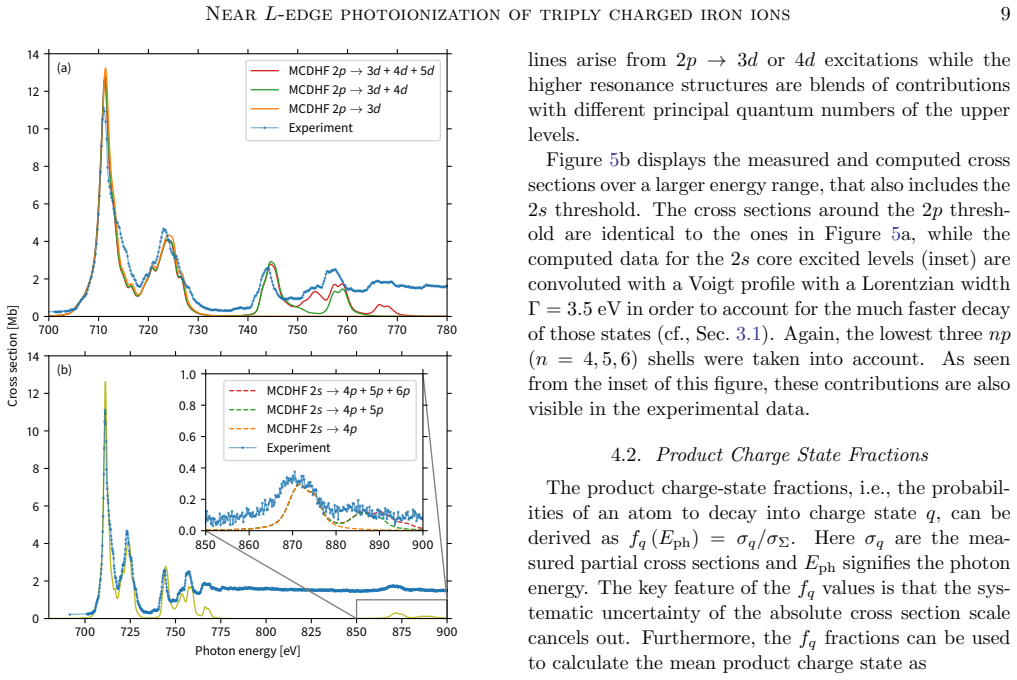
The paper establishes that the product charge-state fractions following L-shell photoexcitation or photoionization of Fe3+ are well described by MCDHF-based Auger cascade calculations, provided the cascade tree includes three-electron Auger processes with a shake-down transition of a (sub-)valence electron. The decisive example is the lower-lying levels of the 2s22p63s23p43d6 configuration in Fe4+, which cannot decay to Fe5+ by a two-electron Auger process because the required final state is energetically out of reach; instead they autoionize through a three-electron Auger decay in which a 3d electron shakes down to 3p, filling the 3p double vacancy and releasing the Auger electron. Including these channels raises the predicted yields of Fe6+ and Fe7+ and produces the pronounced step in the mean product charge state at the 2p ionization threshold, which the earlier calculations of Kaastra and Mewe (1993) missed. The paper also assigns the measured resonance structure to 2p→nd (n=3,4,5) and 2s→np (n≥4) transitions, using a 30,000 K Boltzmann population of the 37 fine-structure levels of the Fe3+ ground configuration to account for metastable ions in the beam. The remaining deficiencies—overestimated Fe4+ and underestimated Fe7+/Fe8+—are attributed to unmodeled shake-up and direct double Auger decays.
Load-bearing premise
The model assumes that any excited level with enough energy will release an electron rather than emit light, including slow three-electron Auger decays whose rates are never computed; if radiative decay competes for the lower-lying levels of configuration 7, the predicted Fe5+ and Fe6+ yields would shift.
Editorial extensions
If this is right
- Any future L-shell photoabsorption model for Fe3+ must include slow shake-down three-electron Auger channels to reproduce the measured final charge-state distribution.
- The mean product charge state now shows the correct step at the 2p ionization threshold, so charge-balance models for photoionized iron plasmas can rely on these fractions where earlier tables could not.
- The measured partial cross sections provide a benchmark dataset for 680–950 eV that can be used to test other theoretical treatments of inner-shell cascades.
- Because the model still underestimates Fe7+ and omits Fe8+, improving the description of the highest charge states will require adding shake-up transitions and direct double Auger decays to the cascade tree.
Reading between the lines
- If the shake-down mechanism is as general as it appears, earlier cascade tables for other M-shell iron ions and neighboring transition metals likely suffer the same omission, and their charge-state yields may need revision.
- Because no three-electron Auger rates were actually computed, the agreement implies—but does not prove—that these slow decays still outpace radiative relaxation; a direct calculation of those rates would turn the assumed mechanism into a tested one.
- A measurement using a pure ground-state Fe3+ beam (free of metastable levels) would decouple the cascade model from the adopted 30,000 K population assumption and give a sharper test of the remaining Fe4+ overestimate.
Signed reviews
Editorial analysis
A structured set of objections, weighed in public.
Referee Report
Summary. The manuscript reports merged-beams measurements of partial cross sections for single and multiple photoionization of Fe3+ by single-photon absorption at 680–950 eV, covering 2p and 2s photoexcitation resonances and direct ionization. The measured partial cross sections are normalized to the Verner et al. (1993) theoretical total cross section at one energy point, and the product charge-state fractions f_q and mean charge state q̄ are derived. The photoabsorption spectra are compared with MCDHF and HFR calculations, using a Boltzmann population at 30,000 K for the ground-configuration metastable levels and a −2.2 eV energy shift to reproduce the measured spectrum. The paper's central claim is that extensive MCDHF Auger-cascade calculations, including slow three-electron Auger decays accompanied by shake-down transitions, yield product charge-state fractions in good agreement with experiment and a substantial improvement over the earlier Kaastra and Mewe (1993) cascade tables. The authors attribute the improvement to the inclusion of these shake-down channels, which were missing in previous work.
Significance. The paper provides valuable benchmark data for Fe3+ L-shell photoabsorption, relevant to X-ray absorption and emission studies of astrophysical plasmas, and the measured partial cross sections are made available in machine-readable form with statistical uncertainties. If the cascade result holds, it identifies a concrete physical mechanism, slow three-electron Auger decay accompanied by shake-down of a subvalence electron, that was omitted from previous inner-shell cascade models and that materially changes the predicted final charge-state distribution. The authors are also explicit about the model's limitations, in particular the absence of Fe8+ and most Fe7+ production. The strength of the work is its combination of state-of-the-art atomic-structure calculations with a dedicated measurement; the main risk is that the central cascade claim rests on an unquantified assumption about radiative losses.
major comments (2)
- [Sec. 4.2, Table 4, Figure 6] The central improvement over Kaastra and Mewe is governed by the statement in Sec. 4.3 that 'radiative losses are still negligible, so that all levels that are energetically allowed to autoionize will do so.' This assumption converts the lower-lying levels of configuration 7 into Fe5+ rather than Fe4+ and produces the large changes in F_{k,q} in Table 3 for 2s and 2p holes. However, no three-electron Auger transition rates are computed or tabulated, and the paper itself notes that such processes are expected to be slow. If radiative decay competes for any of the low-lying configuration-7 levels, the branching fractions in Table 3, and hence the f_q values in Figure 6 and Table 4, would shift and the claimed improvement could be weakened. I ask the authors to compute or bound the relevant Auger and radiative widths for these levels, or to provide a sensitivity estimate showing how f_q and q̄ change if a specified fraction of the low-lying levels decays radiatively instead of autoionizing.
- [Sec. 4.2, Table 4, Figure 6] The shake-down model does not produce Fe7+ or Fe8+ at the resonance energies listed in Table 4, whereas the experiment detects both charge states; for example, at 960 eV the model gives 3.8% Fe7+ while the experiment gives 9.4% Fe7+ and 0.4% Fe8+. The authors acknowledge that shake-up and direct double-Auger channels are missing from the cascade tree. Because the claimed agreement with the measured charge-state fractions is the central result, the manuscript should quantify how these omitted channels affect the reported f_q values or explicitly state which portion of the comparison is being used to support the claim of agreement. Without such a quantitative statement, the improvement over Kaastra and Mewe could be viewed as partly due to compensating omissions in the highest charge states.
minor comments (3)
- [Sec. 4.1 and Fig. 4] The Boltzmann temperature of 30,000 K is described as having 'no other justification than the relatively good agreement' between calculation and measurement; this fitted parameter, together with the −2.2 eV shift and the assumed line widths, should be listed explicitly in the main text as model parameters and not only in the figure caption.
- [Table 1] In Table 1, the entry at 691.568 eV has no σ5 value but a dash; the caption or notes should state whether this is a true zero, an upper limit, or a value that was not measured.
- [Abstract and Sec. 5] The abstract states that the theoretical charge-state fractions are 'in good agreement' with experiment, but no quantitative goodness-of-fit measure is given; a simple metric, such as the mean deviation or a chi-square value for the points shown in Figure 6, would make the assessment more precise.
Circularity Check
Shake-down cascade 'prediction' rests on an assumed 100%-autoionization rule rather than on computed rates; a fitted metastable temperature adds a second fitted input.
-
self definitional
[Sec. 4.3, 'Cascade Models', page 11, around Table 3 and Eq. (3)]
"The precise computation of the Auger transition rates including a shake-down transition is rather challenging due to complex correlation patterns [...] Here we assume that the radiative losses are still negligible, so that all levels that are energetically allowed to autoionize will do so. In the following we will refer to this extended cascade decay tree as 'shake-down'."
The three-electron Auger rates that would decide between radiative stabilization (Fe4+) and shake-down autoionization (Fe5+/Fe6+) are explicitly not computed. The F_{k,q} are instead set to 100% autoionization for every level above threshold. These F_{k,q} enter Eq. (3) and Table 4 to produce the 'predicted' charge-state fractions. Consequently the improved Fe5+/Fe6+ yields relative to Kaastra & Mewe are the direct bookkeeping of the assumption, not an independent theoretical prediction. Comparing those f_q with the measured charge-state fractions is a consistency check of the ansatz, not a test of computed transition rates.
-
fitted input called prediction
[Sec. 4.1, 'Photoabsorption Cross Section', Figure 4e and following paragraph]
"we chose a Boltzmann distribution at a temperature of 30 000 K with no other justification than the relatively good agreement between the calculated and measured photoabsorption spectra, as seen in Figure 4e. [...] All the following results were computed with this distribution."
The effective temperature of the initial Fe3+ level population is adjusted to make the synthetic photoabsorption spectrum match the measured one; the same distribution is then used as an input for subsequent photoexcitation charge-state fractions in Table 4. The later 'good agreement' of the modeled spectra is therefore partly produced by the fitted T rather than by an independent prediction. This is an openly admitted fit, but it is fitted input feeding the predicted quantities.
full rationale
The paper is mostly a self-contained experimental and computational study. The absolute normalization to Verner et al. (1993) is an openly stated scale calibration, and the -2.2 eV energy shift is a standard line-position calibration; neither affects the charge-state fractions, since f_q are ratios from which the absolute scale cancels. The two-electron Auger cascade rates, MCDHF/HFR photoexcitation spectra, and photoionization branching ratios involve genuine computation, and the comparison with the measured partial cross sections provides independent information, especially for the resonance positions. The circularity burden is concentrated in Sec. 4.3. The 'shake-down' model does not compute three-electron Auger rates; it imposes the rule that every energetically allowed level autoionizes. The branching fractions F_{k,q} in Table 3 that enter Eq. (3) and Table 4 are therefore not derived predictions for the affected channels; they are the rule itself. The improved Fe5+/Fe6+ agreement relative to Kaastra & Mewe is, to a substantial degree, the bookkeeping of that rule. This makes the central improvement partially circular. A second fitted input is the initial-level temperature T = 30,000 K, chosen to reproduce the measured photoabsorption spectrum and then used for subsequent photoexcitation predictions; this is openly admitted but still fitted input feeding a claimed prediction. The self-citations (Andersson et al. 2015; Schippers et al. 2016b; Beerwerth & Fritzsche 2017) are used only to explain why the shake-down rates were not computed; they are not load-bearing uniqueness claims, so they do not by themselves raise the score. Overall, the paper retains substantial independent content in the MCDHF spectra and two-electron cascade, but the key advertised improvement over previous theory partially reduces by construction.
Assumptions & free parameters
free parameters (5)
- Metastable population temperature T =
30,000 K
- Energy shift of computed spectra =
-2.2 eV
- Natural line width for 2p-hole resonances =
0.4 eV (uniform)
- Natural line width for 2s-hole resonances =
3.5 eV
- Absolute cross-section normalization factor =
Set to Verner et al. (1993) at 692 eV
assumptions (5)
- domain assumption MCDHF and HFR methods provide sufficiently accurate wave functions and transition rates for the photoexcitation and Auger processes.
- ad hoc to paper The Fe3+ ion beam contains an unknown mixture of ground and metastable levels, and a Boltzmann distribution at 30,000 K represents this mixture.
- ad hoc to paper Radiative decay is negligible compared with Auger decay for all energetically allowed levels, including the slow three-electron Auger channels.
- domain assumption Shake-up and direct double Auger processes are negligible for the product charge-state fractions.
- domain assumption The fluorescence yield from L-shell holes in iron is negligible, so photon scattering does not measurably deplete the summed cross section.
Cite this review
Pith. "Pith review of Near L-edge photoionization of triply charged iron ions." pith.science (2026). https://pith.science/paper/EIKZGHEV
@misc{pith2026190805252,
  author       = {Pith},
  title        = {Pith review of: Near L-edge photoionization of triply charged iron ions},
  year         = {2026},
  howpublished = {\url{https://pith.science/paper/EIKZGHEV}},
  note         = {Machine review of arXiv:1908.05252}
}
abstract
Relative cross sections for $m$-fold photoionization ($m=1,\ldots,5$) of Fe$^{3+}$ by single photon absorption were measured employing the photon-ion merged-beams setup PIPE at the PETRA III synchrotron light source operated at DESY in Hamburg, Germany. The photon energies used spanned the range of $680-950\,\mathrm{eV}$, covering both the photoexcitation resonances from the $2p$ and $2s$ shells as well as the direct ionization from both shells. Multiconfiguration Dirac-Hartree-Fock (MCDHF) calculations were performed to simulate the total photoexcitation spectra. Good agreement was found with the experimental results. These computations helped to assign several strong resonance features to specific transitions. We also carried out Hartree-Fock calculations with relativistic extensions taking into account both photoexcitation and photoionization. Furthermore, we performed extensive MCDHF calculations of the Auger cascades that result when an electron is removed from the $2p$ and $2s$ shells of Fe$^{3+}$. Our theoretically predicted charge-state fractions are in good agreement with the experimental results, representing a substantial improvement over previous theoretical calculations. The main reason for the disagreement with the previous calculations is their lack of inclusion of slow Auger decays of several configurations that can only proceed when accompanied by de-excitation of two electrons. In such cases, this additional shake-down transition of a (sub-)valence electron is required to gain the necessary energy for the release of the Auger electron.
Figures


Figures from the paper (3 more)


Reference graph
Works this paper leans on
-
[1]
Andersson, J., Beerwerth, R., Linusson, P., et al. 2015, PhRvA, 92, 023414
work page 2015
- [2]
-
[3]
Behar, E., Sako, M., & Kahn, S. M. 2001, ApJ, 563, 497
2001
-
[4]
Buth, C., Beerwerth, R., Obaid, R., et al. 2018, JPhB, 51, 055602
work page 2018
-
[5]
Cowan, R. D. 1981, The Theory of Atomic Structure and Spectra (Berkeley: California University Press), atomic-structure code accessible via http://aphysics2.lanl.gov/tempweb/lanl/
work page 1981
-
[6]
Fritzsche, S. 2001, JESRP, 114-116, 1155 —. 2012, CPC, 183, 1525 Froese Fischer, C., Rubin, R. H., & Rodriguez, M. 2008, MNRAS, 391, 1828
work page 2001
-
[7]
Grant, I. P. 2007, Relativistic quantum theory of atoms and molecules: theory and computation, Vol. 40 (Springer Science & Business Media), doi:10.1007/978-0-387-35069-1
-
[8]
2005, ApJ, 632, 788 J¨ onsson, P., Gaigalas, G., Biero´ n, J., Froese Fischer, C., &
Holczer, T., Behar, E., & Kaspi, S. 2005, ApJ, 632, 788 J¨ onsson, P., Gaigalas, G., Biero´ n, J., Froese Fischer, C., &
work page 2005
Show all 22 references
-
[9]
Grant, I. P. 2013, CPC, 184, 2197 J¨ onsson, P., He, X., Fischer, C. F., & Grant, I. 2007, CPC, 177, 597
2013
-
[10]
S., & Mewe, R
Kaastra, J. S., & Mewe, R. 1993, A&AS, 97, 443
1993
-
[11]
2018, NIST Atomic Spectra Database (version 5.5.2), [Online]
Kramida, A., Ralchenko, Y., Reader, J., & NIST ASD Team. 2018, NIST Atomic Spectra Database (version 5.5.2), [Online]. Available: http://physics.nist.gov/asd, Tech. rep., National Institute of Standards and Technology
2018
-
[12]
C., Xiang, J., Ravel, B., Kortright, J., & Flanagan, K
Lee, J. C., Xiang, J., Ravel, B., Kortright, J., & Flanagan, K. 2009, ApJ, 702, 970
2009
-
[13]
McGuire, E. J. 1972, PhRvA, 5, 1043 14 Beerwerth et al
1972
-
[14]
S., & de Groot, F
Miedema, P. S., & de Groot, F. M. 2013, JESRP, 187, 32 M¨ uller, A., Bernhardt, D., Borovik, Jr., A., et al. 2017, ApJ, 836, 166
2013
-
[15]
Nahar, S. N. 2006, A&A, 448, 779
2006
-
[16]
F., & Manson, S
Reilman, R. F., & Manson, S. T. 1979, Astrophys. J. Suppl. Ser., 40, 815
1979
-
[17]
2014, JPhB, 47, 115602
Schippers, S., Ricz, S., Buhr, T., et al. 2014, JPhB, 47, 115602
2014
-
[18]
2017, ApJ, 849, 5
Schippers, S., Martins, M., Beerwerth, R., et al. 2017, ApJ, 849, 5
2017
-
[19]
2003, ECR Ion Sources, ed
Trassl, R. 2003, ECR Ion Sources, ed. F. J. Currell (Dordrecht: Springer Netherlands), 3–37
2003
-
[20]
A., & Yakovlev, D
Verner, D. A., & Yakovlev, D. G. 1995, A&AS, 109, 125
1995
-
[21]
A., Yakovlev, D
Verner, D. A., Yakovlev, D. G., Band, I. M., & Trzhaskovskaya., M. B. 1993, ADNDT, 55, 233
1993
-
[22]
2013, NIMA, 710, 151
Viefhaus, J., Scholz, F., Deinert, S., et al. 2013, NIMA, 710, 151
2013
Reviewed August 14, 2026 · model on record in the stance chip above.
Discussion (0). Continue with ORCID to comment.