REVIEW 4 major objections 4 minor 31 references
AutoCorrect: Deep Inductive Alignment of Noisy Geometric Annotations
T0 review · 4 major / 4 minor · reviewed 2026-08-14 · deepseek-v4-flash
Pith's one-line read A consistency loss lets a network learn to fix noisy geometric labels without any clean examples.
desk verdict A clever consistency-based annotation correction method with a solid ablation story, but the quantitative evaluation only tests synthetic perturbations of clean labels, so the central claim about cleaning real map noise is not actually measured. read the letter →
The pith
A machine-rendered reading of the paper's core claim, the machinery that carries it, and where it could break.
The reading
What carries the argument
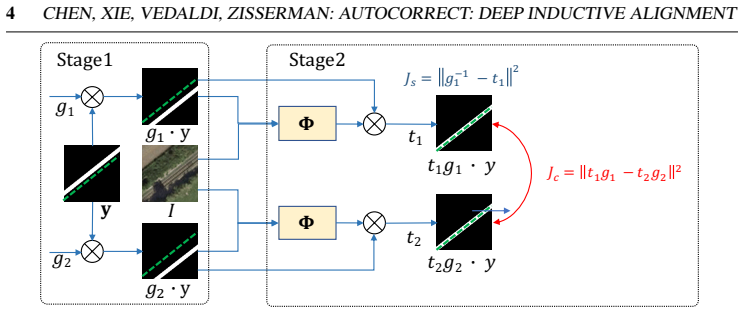
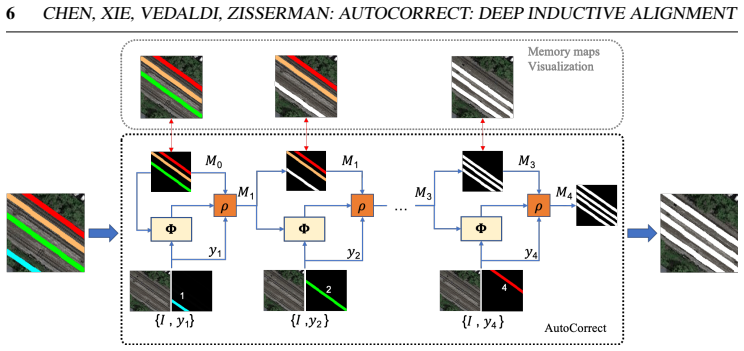
The central object is the transformation-consistency loss $J_c = \|t_1 g_1 - t_2 g_2\|^2$ (Eq. 3), which measures whether two randomly perturbed versions of the same annotation, after predicted corrections, return to a single common location; this is the unsupervised signal that replaces ground-truth alignment. Two auxiliary mechanisms carry the rest of the argument: the self-supervised loss $J_s = \|g^{-1} - \Phi(I, g \cdot y)\|^2$, which applies when annotations are known to be clean and acts as a stricter constraint; and the spatial memory map, a recurrent state that encodes all annotations and all corrections made so far, allowing the network to align an arbitrary number of instances one by one. The symmetry argument surrounding Lemma 2 is what makes the consistency signal meaningful for elongated objects: if an image is invariant along an object's axis, the corrected annotation must coincide with that axis.
What would settle it
Train AutoCorrect on clean railway-track annotations that are synthetically shifted only along the track direction; if the predicted corrections leave a systematic along-track offset even while the consistency loss stays near zero, then the consistency signal alone does not determine the true position along a symmetric axis.
Extended reading notes
Core claim
On its own terms, AutoCorrect claims that a CNN can perform per-instance correction of noisy geometric annotations without ever seeing a noise-free label. The mechanism is the transformation-consistency loss $J_c = \|t_1 g_1 - t_2 g_2\|^2$ of Eq. (3): random transformations $g_1, g_2$ are applied to an annotation, the network predicts corrections $t_1 = \Phi(I, g_1 \cdot y)$ and $t_2 = \Phi(I, g_2 \cdot y)$, and the constraint $t_1 g_1 = t_2 g_2$ is enforced. When some annotations are clean, the loss is shown to reduce to the stricter self-supervised loss $J_s = \|g^{-1} - \Phi(I, g \cdot y)\|^2$, and the symmetry argument of Lemma 2 is used to show that image symmetries implicitly constrain where corrected annotations can land. With a spatial memory map letting annotations be corrected sequentially while accounting for all other objects, the paper reports 0.445 IoU on its Railway tracks benchmark and the best reported PCK results on the public buildings benchmark.
Load-bearing premise
The load-bearing premise is that when the network is forced to make two perturbed copies of a noisy annotation agree, the image content contains enough evidence to identify their common point as the true object position rather than a wrong but self-consistent location; where the image is ambiguous, for example a straight track with no features along its length, that uniqueness can fail.
Editorial extensions
If this is right
- Map-derived labels for satellite imagery can be cleaned automatically without manual filtering: on the Railway tracks dataset, training on 35k noisy labels with the consistency loss gives 0.445 IoU, comparable to training on 3k manually cleaned labels.
- The consistency loss also helps when all training annotations are clean, acting as a regularizer and improving IoU from 0.425 to 0.436 in the paper's controlled comparison.
- Object symmetry is an implicit training signal: for elongated objects like tracks and roads, the corrected annotation must coincide with the visual axis of symmetry, which reduces correction ambiguity.
- Instance-level sequential correction, driven by the spatial memory map, handles images with an arbitrary number of objects and avoids duplicate associations of nearby similar objects.
- On the public buildings benchmark, per-instance transformation corrections outperform whole-image displacement-field methods at all evaluated pixel thresholds.
Reading between the lines
- An extension the paper does not pursue: the same consistency loss should apply to other annotation formats, such as keypoints or polylines, whenever a transformation group and a warping operation are available; the expected benefit is largest for categories with strong symmetry, where the self-consistency signal pinpoints the true location.
- The paper's uniqueness assumption suggests a practical failure mode: for objects with an axis of translational symmetry and no distinguishing features, corrections could converge to a shifted-but-consistent position; measuring along-axis versus cross-axis error would quantify when the method is reliable.
- If widely adopted, the approach could make noisy crowd-sourced or map-derived labels a viable training signal for other geospatial tasks, potentially reducing annotation cost for segmentation and detection at scale.
- A direct testable consequence: on datasets where per-instance noise is genuinely independent and large, AutoCorrect should outperform global alignment methods by an amount that grows with the number of independently shifted objects per image.
Signed reviews
Editorial analysis
A structured set of objections, weighed in public.
Referee Report
Summary. The paper proposes AutoCorrect, a CNN-based method to correct geometric annotation noise (registration errors) in geo-spatial imagery. The network takes an image and a set of annotated object masks and predicts a per-instance similarity transformation, processed sequentially through a spatial memory map. Training combines a self-supervised loss J_s = ||g^{-1} - Phi(I, g*y)||^2, a consistency loss J_c = ||t_1 g_1 - t_2 g_2||^2, and a gating rule in Eq. (5). The authors introduce a new Railway tracks dataset, report ablations showing that the spatial memory map and consistency loss improve IoU, and on INRIA Buildings report state-of-the-art PCK results under the protocol of [8, 27].
Significance. If the central claim were established, the ability to clean map-derived annotations at scale without manual labels would be valuable for remote sensing and learning with noisy annotations. The new Railway tracks dataset and the clearly organized ablations are useful contributions, and the spatial-memory-map idea for sequential instance-level correction is interesting. However, the current evidence is not sufficient: the training objective admits a trivial solution that simply cancels the synthetic perturbation, and every quantitative experiment is performed on synthetically perturbed clean labels, so the numbers do not demonstrate that natural geometric noise is corrected. The theoretical lemmas rely on a perfectly equivariant network that the loss does not enforce. These load-bearing gaps must be addressed before the claimed contribution can be accepted.
major comments (4)
- [Section 3.1, Eqs. (2)-(3) and Section 3.3, Eq. (5)] The training objective is compatible with the trivial solution Phi(I, g*y) = g^{-1}. For such a network, J_s = 0 by construction and J_c = ||g_1^{-1}g_1 - g_2^{-1}g_2|| = 0; the gating condition in Eq. (5) also selects alpha_s = 1 because IoU(t_i g_i y, y) = 1. Thus a network that ignores the image content and simply inverts the applied perturbation satisfies the loss exactly, and for a noisy base annotation y this leaves the uncorrected noisy label unchanged. The paper provides no mechanism or regularization that breaks this degeneracy, so the loss does not by itself reward moving a noisy annotation to the true object location.
- [Section 4.2 and 4.3] All quantitative results are obtained by taking manually clean annotations (the 1,000 Railway test images and the accurate INRIA annotations from [8, 27]) and applying synthetic perturbations from the same distribution used in training (translations up to 25 px, rotations up to 5 degrees). The models trained on natural annotation noise (models H/I/J) are also evaluated on these synthetically perturbed clean labels, not on naturally noisy labels with known ground-truth corrections. This protocol cannot measure whether AutoCorrect cleans real map-derived noise; a model that has learned to cancel the synthetic perturbation while leaving the natural noise untouched would score well. The central claim is therefore supported only by the qualitative examples in Figures 5 and 6.
- [Section 3.3 and 4.2] The paper claims that the method works "given only noisy annotations as input", but every trained model uses the self-supervised loss J_s, whose target g^{-1} is only valid when the base annotation is noise-free. No experiment trains with the consistency loss alone (e.g., alpha_s = 0 throughout), so the pure noisy-only scenario is never evaluated. The authors should either add such an ablation or temper the claim accordingly.
- [Section 3.1, Lemma 2] Lemma 2 assumes a perfectly equivariant Phi and an exact image symmetry m, neither of which holds for a CNN trained with Eqs. (2)-(3) or for natural images. The proof uses the step Phi(m*I, y) = m Phi(I, y), which is exactly the equivariance property that the training loss does not enforce. The informal extension to "statistical symmetry" of an object category is not derived, so the claim that symmetries reduce the ambiguity of correction is not rigorously established.
minor comments (4)
- [Section 3.3] The phrase "supplementary materiel" should read "supplementary material".
- [Section 4.1] It would help to clarify the relationship between the 4,000 manually identified accurate annotations and the roughly 35k images used for the natural-noise training of models H/I/J; in particular, whether the 4,000 are a subset of the 35k and how the remaining images are labeled.
- [Section 4.2, Table 1] The caption of Table 1 defines the abbreviations SMM and Consist., but the column labeled "Data" would benefit from explicit definitions of "20% Synth." and "~40% Natural" in the main text.
- [Figure 4] The axes of the PCK plot are not described in the text; please add axis labels and a legend explaining the plotted curves.
Circularity Check
No significant circularity: the training losses and evaluation are self-contained; ambiguity and synthetic-test issues are limitations, not circular steps.
full rationale
The derivation chain is not circular. Eq. (2) defines the self-supervised target as the inverse of a known synthetic perturbation, and Eq. (3) enforces consistency between two corrected versions; neither loss is defined in terms of the IoU/PCK metrics or of the reported test labels, and the network must still infer corrections from image content because the applied perturbation g is not provided as input. Lemmas 1 and 2 are equivariance statements about an ideal predictor and are not used to fit parameters or to define the evaluation. The Railway experiments use held-out clean labels with synthetic perturbations, and the INRIA experiments follow the protocol of [8,27]; the perturbation distribution matching training is a standard supervised-evaluation choice, not a construction that forces the reported numbers. Self-citations to VGG-M [5] and inductive visual localisation [10] are architectural/related-work references and are not load-bearing. The consistency loss does admit non-identifying solutions (e.g., both branches map to the same wrong location, or to the original noisy label), so identifiability ultimately rests on the image content and on object symmetry; this is an underdetermination/ambiguity limitation rather than a circular derivation. Likewise, models H/I/J are trained on natural noise but quantitatively tested on synthetic perturbations of clean labels, so the natural-noise claim is supported mainly qualitatively; this is a validation gap, not a circular step.
Assumptions & free parameters
free parameters (3)
- Perturbation range for random transformations g =
translation up to 25px, rotation up to 5 degrees
- IoU gating threshold in Eq. 5 =
0.2
- Loss weights alpha_s and alpha_c =
1 in early training, then 0 or 1 depending on IoU
assumptions (4)
- domain assumption The annotation transformation space is restricted to translations and rotations (2D similarities) and the noise is pure registration noise.
- standard math A perfect alignment network Phi is equivariant under image and annotation transformations (Lemma 1).
- domain assumption Each noisy annotation is associated with the correct object instance and the true object is visible in the image.
- domain assumption Object categories are statistically symmetric, so symmetries constrain the corrected annotation position (Lemma 2 discussion).
Cite this review
Pith. "Pith review of AutoCorrect: Deep Inductive Alignment of Noisy Geometric Annotations." pith.science (2026). https://pith.science/paper/R4DTIHBN
@misc{pith2026190805263,
  author       = {Pith},
  title        = {Pith review of: AutoCorrect: Deep Inductive Alignment of Noisy Geometric Annotations},
  year         = {2026},
  howpublished = {\url{https://pith.science/paper/R4DTIHBN}},
  note         = {Machine review of arXiv:1908.05263}
}
read the original abstract
We propose AutoCorrect, a method to automatically learn object-annotation alignments from a dataset with annotations affected by geometric noise. The method is based on a consistency loss that enables deep neural networks to be trained, given only noisy annotations as input, to correct the annotations. When some noise-free annotations are available, we show that the consistency loss reduces to a stricter self-supervised loss. We also show that the method can implicitly leverage object symmetries to reduce the ambiguity arising in correcting noisy annotations. When multiple object-annotation pairs are present in an image, we introduce a spatial memory map that allows the network to correct annotations sequentially, one at a time, while accounting for all other annotations in the image and corrections performed so far. Through ablation, we show the benefit of these contributions, demonstrating excellent results on geo-spatial imagery. Specifically, we show results using a new Railway tracks dataset as well as the public INRIA Buildings benchmarks, achieving new state-of-the-art results for the latter.
Figures

Figures from the paper (3 more)


Reference graph
Works this paper leans on
-
[1]
Alshehhi, P.R Marpu, W.L Woon, and M.D Mura
R. Alshehhi, P.R Marpu, W.L Woon, and M.D Mura. Simultaneous extraction of roads and buildings in remote sensing imagery with convolutional neural networks. ISPRS Journal of Photogrammetry and Remote Sensing, 2017
work page 2017
-
[2]
L. Berrada, A. Zisserman, and M. P. Kumar. Smooth loss functions for deep top-k classification. In International Conference on Learning Representations, 2018
work page 2018
-
[3]
J. Cai, R. Shin, and Song D. Making neural programming architectures generalize via recursion. In Proc. ICLR, 2017
work page 2017
-
[4]
J. Carreira, P Agrawal, K. Fragkiadaki, and J. Malik. Human pose estimation with iterative error feedback. Proc. CVPR, 2016
work page 2016
-
[5]
K. Chatfield, K. Simonyan, A. Vedaldi, and A. Zisserman. Return of the devil in the details: Delving deep into convolutional nets. In Proc. BMVC., 2014
work page 2014
-
[6]
X. Chen and A. Gupta. Spatial memory for context reasoning in object detection. In Proc. ICCV, 2017
work page 2017
- [7]
- [8]
Show all 31 references
-
[9]
Google Maps
Google. Google Maps. https://www.google.co.uk/maps, 2017
2017
-
[10]
Gupta, A
A. Gupta, A. Vedaldi, and A. Zisserman. Inductive visual localisation: Factorised training for superior generalisation. In Proc. BMVC., 2018
2018
-
[11]
Hoffman, E
J. Hoffman, E. Tzeng, T. Park, J. Zhu, P. Isola, K. Saenko, A. Efros, and T. Darrell. Cycada: Cycle consistent adversarial domain adaptation. In Proc. ICML, 2018
2018
-
[12]
J. Hu, A. Razdan, J. C. Femiani, M. Cui, and P. Wonka. Road network extraction and intersection detection from aerial images by tracking road footprints. IEEE Transac- tions on Geoscience and Remote Sensing, 2007
2007
-
[13]
Kowalski, J
M. Kowalski, J. Naruniec, and T. Trzcinski. Deep alignment network: A convolutional neural network for robust face alignment. IEEE Conference on Computer Vision and Pattern Recognition Workshops, 2017
2017
-
[14]
Laptev, H
I. Laptev, H. Mayer, T. Lindeberg, W. Eckstein, C. Steger, and A. Baumgartner. Auto- matic extraction of roads from aerial images based on scale space and snakes.Machine Vision and Applications, 2000
2000
-
[15]
Z. Li, Q. Chen, and V . Koltun. Interactive image segmentation with latent diversity. In Proc. CVPR, 2018
2018
-
[16]
Mnih and G
V . Mnih and G. E. Hinton. Learning to label aerial images from noisy data. In Proc. ICML, 2012. 12 CHEN, XIE, VEDALDI, ZISSERMAN: AUTOCORRECT: DEEP INDUCTIVE ALIGNMENT
2012
-
[17]
Oberweger, P
M. Oberweger, P. Wohlhart, and V . Lepetit. Training a feedback loop for hand pose estimation. In Proc. ICCV, 2015
2015
-
[18]
Planet dump retrieved from https://planet.osm.org
OpenStreetMap contributors. Planet dump retrieved from https://planet.osm.org . https://www.openstreetmap.org, 2017
2017
-
[19]
Patrini, A
G. Patrini, A. Rozza, A. K. Menon, R. Nock, and L. Qu. Making deep neural networks robust to label noise: A loss correction approach. In Proc. CVPR, 2017
2017
-
[20]
Reed and N
S. Reed and N. Freitas. Neural programmer-interpreters. In Proc. ICLR, 2016
2016
-
[21]
Romera-Paredes and P
B. Romera-Paredes and P. H. S. Torr. Recurrent instance segmentation. InProc. ECCV, 2015
2015
-
[22]
Multiple object extraction from aerial imagery with convolutional neural networks
S Saito, Y Yamashita, and Y Aoki. Multiple object extraction from aerial imagery with convolutional neural networks. Journal of Imaging Science and Technology, 2016
2016
-
[23]
Sundaram, T
N. Sundaram, T. Brox, and K. Keutzer. Dense point trajectories by GPU-accelerated large displacement optical flow. In Proc. ECCV, 2010
2010
-
[24]
A. Veit, N. Alldrin, G. Chechik, I. Krasin, A. Gupta, , and S. J. Belongie. Learning from noisy large-scale datasets with minimal supervision. In Proc. CVPR, 2017
2017
-
[25]
F. Wang, Q. Huang, M. Ovsjanikov, and L.J. Guibas. Unsupervised multi-class joint image segmentation. In Proc. CVPR, 2014
2014
-
[26]
T. Xiao, T. Xia, Y . Yang, C. Huang, and X. Wang. Learning from massive noisy labeled data for image classification. In Proc. CVPR, 2015
2015
-
[27]
Zampieri, G
A. Zampieri, G. Charpiat, N. Girard, and Y . Tarabalka. Multimodal image alignment through a multiscale chain of neural networks with application to remote sensing. In Proc. ECCV, 2018
2018
-
[28]
Zaremba, T
W. Zaremba, T. Mikolov, A. Joulin, and R. Fergus. Learning simple algorithms from examples. In Proc. ICML, 2016
2016
-
[29]
T. Zhou, K. Philipp, M. Aubry, Q. Huang, and A. Efros. Learning dense correspon- dence via 3d-guided cycle consistency. In Proc. CVPR, 2016
2016
-
[30]
X. Zhou, M. Zhu, and K. Daniilidis. Multi-image matching via fast alternating mini- mization. In Proc. ICCV, 2015
2015
-
[31]
J.Y . Zhu, T. Park, P. Isola, and A. Efros. Unpaired image-to-image translation using cycle-consistent adversarial networks. In Proc. ICCV, 2017
2017
Reviewed August 14, 2026 · model on record in the stance chip above.
Discussion (0). Continue with ORCID to comment.