REVIEW 4 major objections 5 minor 55 references
End-to-End Machine Learning for Experimental Physics: Using Simulated Data to Train a Neural Network for Object Detection in Video Microscopy
T0 review · 4 major / 5 minor · reviewed 2026-08-14 · deepseek-v4-flash
Pith's one-line read This paper establishes that a neural network trained entirely on simulated XY-model textures, augmented with injected camera noise, can detect and track topological defects in experimental liquid-crystal video microscopy with accuracy…
desk verdict The central sim-to-real feasibility claim holds up nicely, but the headline performance numbers are selected on the same hand-annotated validation set, so they are optimistic until a truly held-out test is evaluated. read the letter →
The pith
A machine-rendered reading of the paper's core claim, the machinery that carries it, and where it could break.
The reading
What carries the argument
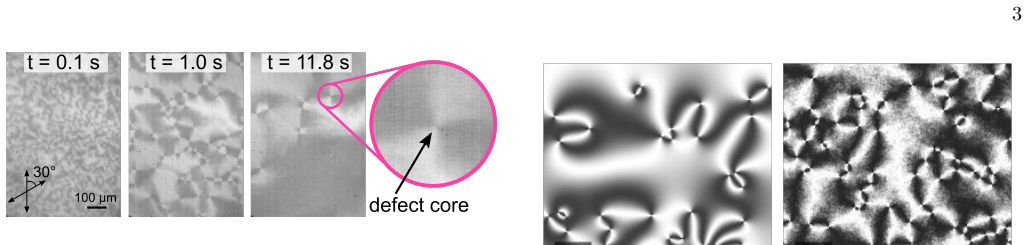
The machinery is a four-stage simulation-to-experiment pipeline. First, labeled textures are generated either by superposing random plus/minus vortices on an aligned XY director grid or by time-evolving the finite-temperature XY model, with defect coordinates assigned automatically by computing the winding number around every lattice plaquette. Second, each image is standardized with the formula $x'=(x-\langle x\rangle)/(6\sigma)+0.5$ to match mean brightness and dynamic range. Third, characteristic experimental artifacts are injected at controlled strengths: periodic camera read noise extracted from a frequency-domain analysis of real frames, Gaussian blur for defocus, randomized brightness and contrast, randomized lighting boundaries, and circular objects that imitate film islands. Fourth, these images train YOLOv2, a single-pass convolutional object detector that predicts bounding boxes and confidence scores directly from the image. The pipeline's job is to make synthetic and experimental images statistically similar at the pixel level, so that labels that cost nothing to produce transfer to real frames.
What would settle it
Record a new quench video with a different camera or optical configuration and run the top model with no retraining, comparing its detections to independent hand labels. If mean average precision falls well below the reported 0.818, the transfer depends on matching the specific sensor noise rather than on the physics of the simulated textures; if it stays near 0.8, the simulation-only recipe generalizes across hardware.
Extended reading notes
Core claim
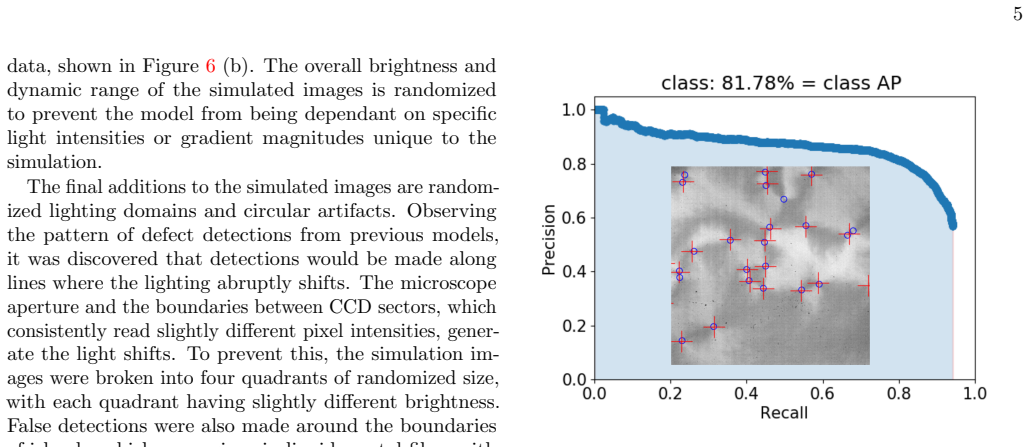
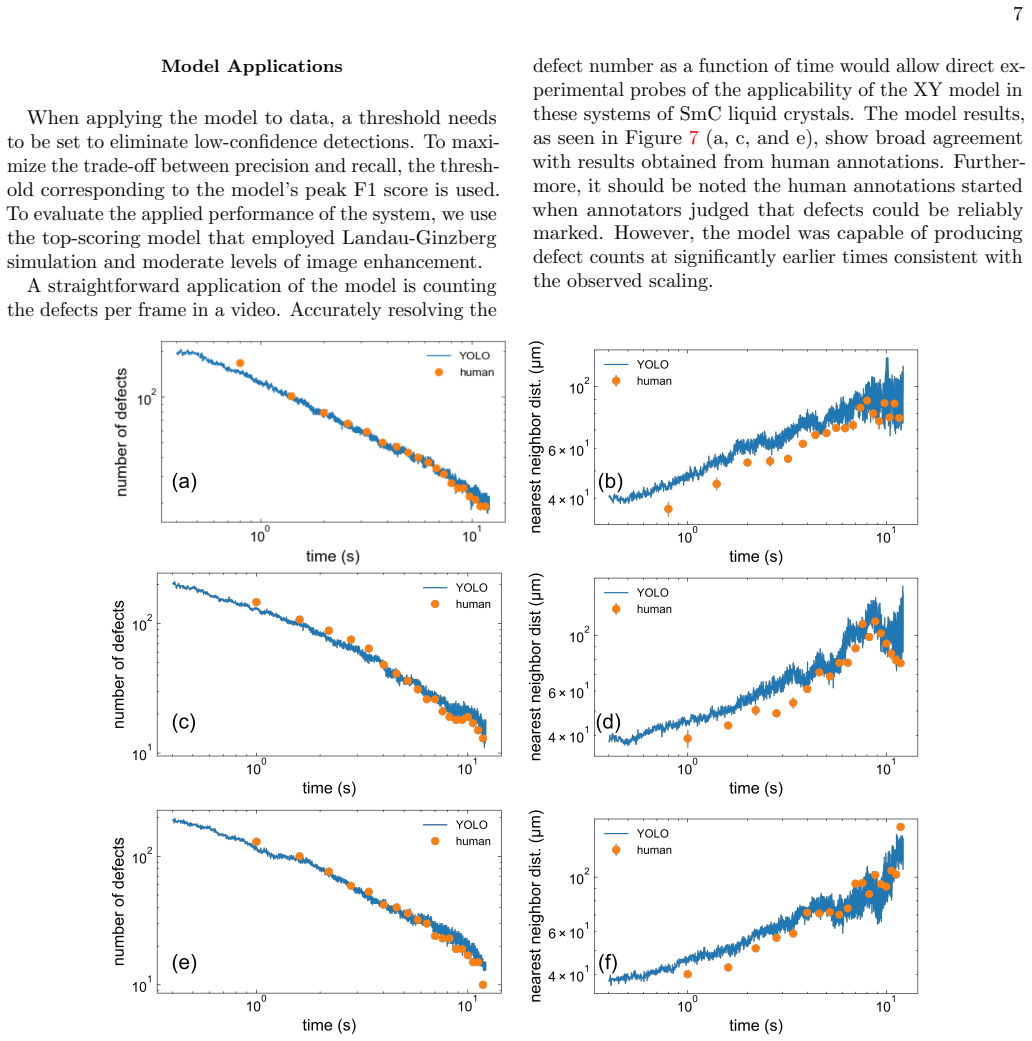
The central claim is that sim-to-real transfer for object detection can be achieved with a training-data pipeline rather than a new learning algorithm. The best model, trained exclusively on finite-temperature XY-model textures with moderate noise injection, reached a mean average precision of 0.818 and a peak F1 of 0.811 on hand-labeled experimental frames. Linked across time with a tracking routine, its defect paths matched human paths to an RMS error of 1.03 pixels. The paper further reports that the model produced reliable counts at early, high-density times where annotators could not mark defects, and that the scaling of defect number and nearest-neighbor distance with time followed the human-annotated trends. On this evidence the paper concludes that simulation-only training is viable for small-scale experimental video analysis.
Load-bearing premise
The result rests on the assumption that the simulated textures, after standardization and injected noise, span the same visual distribution as the real microscope images; if some systematic experimental feature is absent from the training pipeline, detection on real video degrades.
Editorial extensions
If this is right
- Because each 1104x800 frame takes about 0.07 seconds on a GPU, a 12-second, 6100-frame quench video becomes a minutes-scale analysis rather than a multi-hour manual annotation effort.
- New experimental targets require only a plausible forward model of the object plus a noise-injection recipe; the up-front cost of hand-labeling a training set disappears.
- With tracked paths agreeing with human labels to about one pixel, the pipeline can supply quantitative inputs for tests of XY-model scaling in defect number and nearest-neighbor spacing.
- The same simulation-plus-noise recipe should extend to other small-scale imaging tasks, such as active-matter defects, colloids, or biological objects, whenever their appearance can be simulated.
- Because the reported model trains in roughly 1 to 1.2 hours on a GPU, the approach is within reach of a single small laboratory.
Reading between the lines
- The largest share of the transfer may come from the noise-injection pipeline rather than the physics simulator; replacing the finite-temperature XY simulations with cheap random bowtie textures while keeping the same noise recipe would isolate how much physical realism the labels require.
- The reported upward bias in nearest-neighbor distances suggests the detector misses or merges defects in dense clusters; a calibration study on simulated frames with known defect separations could quantify this bias and yield a correction.
- Measuring inter-annotator agreement on the same validation frames would sharpen the 'human-level' claim: if humans disagree by more than 1.03 pixels, the model is effectively at the ground-truth limit, whereas much tighter agreement would leave room for improvement.
- The model's ability to count defects earlier than human annotators could push coarsening measurements into the high-density regime, subjecting the XY model's scaling predictions to a stricter test than manual data allowed.
Signed reviews
Editorial analysis
A structured set of objections, weighed in public.
Referee Report
Summary. The manuscript presents an end-to-end pipeline for training a YOLOv2 object detector exclusively on simulated images, with a noise-injection and standardization enhancement stage, and applies it to detect topological defects in video microscopy of freely suspended smectic-C liquid crystal films. Training data are generated either from superposed analytic defect solutions or from finite-temperature XY/Ginzburg-Landau simulations, so the training annotations are machine-exact. After evaluating about twenty-two enhancement configurations on hand-annotated experimental images, the authors report a best mAP of 0.818, a peak F1 of 0.811, defect-count and nearest-neighbor scaling comparisons on three videos, and a Trackpy tracking RMSE of 1.03 pixels relative to human labels. The claimed contribution is a full-stack simulated-to-real training method that avoids manual annotation for small-scale video microscopy applications.
Significance. If the transfer results survive evaluation on a properly held-out experimental set, this is a useful demonstration for small-scale physics video analysis: simulated training with tailored noise can yield detection performance close to manual annotation at roughly four orders of magnitude lower analysis time. Strengths include procedurally generated training data with exact annotations, a systematic ablation of enhancement components in Table 1, external validation against independent human labels, and concrete runtime measurements. The central feasibility claim is not circular, because evaluation is performed on experimentally acquired, hand-annotated images rather than on the simulator that generated the training data. However, the headline quantitative claims are weakened by model selection on the same validation set used to report final performance and by the absence of a human-human agreement baseline, so the current numbers are likely optimistic estimates of deployed performance.
major comments (4)
- [Effects of Simulated Image Enhancements / Table 1] The headline metrics mAP 0.818 and peak F1 0.811 are obtained by selecting the top-scoring model after evaluating roughly twenty-two configurations on the same hand-annotated experimental images used for all reported comparisons, and the three videos in Figure 7 are not shown to be disjoint from this selection process. The reported numbers are therefore maxima of a selection distribution rather than unbiased estimates of deployed performance. The authors should separate experimental frames or videos into a model-selection set and a final test set (or use nested validation) and report mAP, F1, and RMSE on the unused test set; this is load-bearing because these numbers are the paper's central quantitative claims.
- [Model Applications / Results and Discussion] The claim that the model is 'comparable in accuracy to human hand-annotation' cannot be assessed without a human-human baseline. A mAP of 0.818 against a single annotator's labels may be near ceiling or far below a second annotator's agreement with the first. Please measure inter-annotator agreement, for example precision/recall or localization error between two human annotations over the same frames, and compare model-vs-human performance with that human-vs-human reference.
- [Model Applications / Figure 7] The statement that the model outperformed human analysis in early high-defect-density frames is unsupported by the present evaluation, because there is no independent ground truth for frames that human annotators judged too unreliable to mark. The model's early-time counts could be biased even if they follow the expected scaling. If this claim is retained, it needs an object-level verification protocol, such as synthetic benchmarks at high defect density or adjudicated annotation of early frames.
- [Model Applications, tracking paragraph] The tracking RMSE of 1.03 pixels is reported for a single test case using nearest-neighbor path matching, with no statement of the number of trajectories or frames used, no uncertainty estimate, and no demonstration that the test frames were not involved in model selection. Please report the matching criterion, the count of trajectories and frames, results across multiple videos, and an uncertainty estimate, computed on a held-out set.
minor comments (5)
- [Introduction] 'preform' should be 'perform'.
- [Experimental System / Simulation Data] The terms 'Landau-Ginzberg' and 'Ginzburg-Landau' are both used, and 'refered' should be 'referred'; please standardize the terminology and fix the typo.
- [Standardization and Simulated Image Enhancement] Equation (4) fixes the standardization dynamic range at six standard deviations without justification or sensitivity analysis; a brief explanation or a reference for this choice would help readers apply the pipeline to other imaging systems.
- [Effects of Simulated Image Enhancements] 'Rigoursly' should be 'Rigorously', and the sentence beginning 'Using the max function...' should be checked for clarity.
- [Figure 6] The text refers to 'Figure 6(c)' for both Fourier noise and added circles; please verify that the panel labels and the corresponding descriptions match the figure as printed.
Circularity Check
Model-selection on the same hand-annotated validation set makes the headline mAP a fitted maximum; the sim-to-real training claim itself remains largely independent.
-
fitted input called prediction
[Section 'Effects of Simulated Image Enhancements' (Table 1) and Section 'Model Applications']
"To evaluate the effectiveness of each component in the pipeline, several models were trained on simulated images enhanced by various combinations of pipeline components. The models were validated using a hand-annotated set of experimental images to determine how well they performed on real data relative to human performance. ... To evaluate the applied performance of the system, we use the top-scoring model that employed Landau-Ginzberg simulation and moderate levels of image enhancement."
The same hand-annotated experimental set is used both to choose among the 22 configurations in Table 1 (noise type, intensity, simulation method, training length) and to compute the paper's headline metrics. The reported mAP 0.818, peak F1 0.811, and 1.03-pixel tracking error are thus the maximum of a validation sweep rather than an out-of-sample measurement; no experimental train/validation/test split is described. Selecting the top row of Table 1 by the very scores that are then reported as 'results' makes the quantitative claim a fitted selection statistic: the number is forced upward by construction and is not an independent estimate of real-world performance.
full rationale
The central training chain is not circular: the CNN is trained exclusively on XY-model simulations (Eqs. 1-2) with procedural artifacts, and the training labels come from the simulation's known defect locations or winding numbers, never from the human-annotated experimental set. The self-citation to Chattham et al. (ref 32, which includes author N. A. Clark) only supplies the empirical I ∝ cos(2θ) intensity relation and is not load-bearing circularity. The circularity burden lies in evaluation. Section 'Effects of Simulated Image Enhancements' and Table 1 score 22 configurations against the same hand-annotated experimental images, and 'Model Applications' then adopts 'the top-scoring model' for the headline mAP 0.818, peak F1 0.811, and tracking RMSE 1.03 px. Because no held-out experimental test split is described, these numbers are maxima over a model-selection sweep computed on the evaluation set, not unbiased out-of-sample predictions. This makes the quantitative headline a fitted selection ('fitted input called prediction'), while the underlying claim that simulated data can train a usable detector retains independent content.
Assumptions & free parameters
free parameters (4)
- Detection confidence threshold (peak F1) =
not reported numerically
- Noise enhancement intensities (L-/H- levels for FN, RV, RB, GB, DC, etc.) =
Low/high labels only, no numeric scales
- Feature standardization dynamic range (6 sigma) =
6
- Training image size =
200x200
assumptions (5)
- domain assumption XY model accurately represents smectic-C film textures and coarsening dynamics.
- domain assumption Reflected intensity follows I proportional to cos(2θ) under decrossed polarizers.
- standard math Winding number extraction identifies true defect locations in simulations.
- domain assumption Human annotations are ground truth.
- ad hoc to paper Standardization with a 6-sigma range preserves the defect signal.
Cite this review
Pith. "Pith review of End-to-End Machine Learning for Experimental Physics: Using Simulated Data to Train a Neural Network for Object Detection in Video Microscopy." pith.science (2026). https://pith.science/paper/3ZAC7MKW
@misc{pith2026190805271,
  author       = {Pith},
  title        = {Pith review of: End-to-End Machine Learning for Experimental Physics: Using Simulated Data to Train a Neural Network for Object Detection in Video Microscopy},
  year         = {2026},
  howpublished = {\url{https://pith.science/paper/3ZAC7MKW}},
  note         = {Machine review of arXiv:1908.05271}
}
read the original abstract
We demonstrate a method for training a convolutional neural network with simulated images for usage on real-world experimental data. Modern machine learning methods require large, robust training data sets to generate accurate predictions. Generating these large training sets requires a significant up-front time investment that is often impractical for small-scale applications. Here we demonstrate a `full-stack' computational solution, where the training data set is generated on-the-fly using a noise injection process to produce simulated data characteristic of the experimental system.
Figures


Figures from the paper (4 more)


Reference graph
Works this paper leans on
-
[1]
C. Adam-Bourdarios, G. Cowan, C. Germain-Renaud, I. Guyon, B. K´ egl, and D. Rousseau, Journal of Physics: Conference Series 664, 072015 (2015)
work page 2015
-
[2]
A. Radovic, M. Williams, D. Rousseau, M. Kagan, D. Bonacorsi, A. Himmel, A. Aurisano, K. Terao, and T. Wongjirad, Nature 560, 41 (2018)
work page 2018
-
[3]
Dey, International Journal of Computer Science and Information Technologies 7, 6 (2016)
A. Dey, International Journal of Computer Science and Information Technologies 7, 6 (2016). 9
work page 2016
-
[4]
C. Bishop, Pattern Recognition and Machine Learning , Information Science and Statistics (Springer-Verlag, New York, 2006)
work page 2006
-
[5]
K.-H. Tan and B. P. Lim, APSIPA Transactions on Signal and Information Processing 7 (2018/ed), 10.1017/AT- SIP.2018.6
work page doi:10.1017/at- 2018
- [6]
-
[7]
K. Albertsson, P. Altoe, D. Anderson, J. Anderson, M. An- drews, J. P. A. Espinosa, A. Aurisano, L. Basara, A. Be- van, W. Bhimji, D. Bonacorsi, B. Burkle, P. Calafiura, M. Campanelli, L. Capps, F. Carminati, S. Carrazza, Y.-f. Chen, T. Childers, Y. Coadou, E. Coniavitis, K. Cran- mer, C. David, D. Davis, A. De Simone, J. Duarte, M. Erdmann, J. Eschle, A. ...
arXiv 2018
-
[8]
D.-L. Deng, X. Li, and S. Das Sarma, Physical Review B 96 (2017), 10.1103/PhysRevB.96.195145
Show all 55 references
-
[9]
Carrasquilla and R
J. Carrasquilla and R. G. Melko, Nature Physics 13, 431 (2017)
2017
-
[10]
M. J. S. Beach, A. Golubeva, and R. G. Melko, Physical Review B 97 (2018), 10.1103/PhysRevB.97.045207
2018 doi
- [11]
-
[12]
Walters, Q
M. Walters, Q. Wei, and J. Z. Y. Chen, Physical Review E 99 (2019), 10.1103/PhysRevE.99.062701
2019 doi
-
[13]
A. L. Tarca, V. J. Carey, X.-w. Chen, R. Romero, and S. Drghici, PLoS Computational Biology 3, e116 (2007)
2007
-
[14]
O. Y. Al-Jarrah, P. D. Yoo, S. Muhaidat, G. K. Kara- giannidis, and K. Taha, Big Data Research 2, 87 (2015)
2015
-
[15]
P. Kner, B. B. Chhun, E. R. Griffis, L. Winoto, and M. G. L. Gustafsson, Nature Methods 6, 339 (2009)
2009
-
[16]
B. M. H. Lange, T. Sherwin, I. M. Hagan, and K. Gull, Trends in Cell Biology 5, 328 (1995)
1995
-
[17]
J. C. Crocker and D. G. Grier, Journal of Colloid and Interface Science 179, 298 (1996)
1996
-
[18]
Kellay, Physics of Fluids 29 (2017), bib- tex[publisher=AIP Publishing]
H. Kellay, Physics of Fluids 29 (2017), bib- tex[publisher=AIP Publishing]
2017
-
[19]
Baumgartl and C
J. Baumgartl and C. Bechinger, Europhysics Letters (EPL) 71, 487 (2005)
2005
-
[20]
Conte, P
D. Conte, P. Foggia, C. Sansone, and M. Vento, Inter- national Journal of Pattern Recognition and Artificial Intelligence 18, 265 (2004)
2004
-
[21]
Erhan, C
D. Erhan, C. Szegedy, A. Toshev, and D. Anguelov, in Proceedings of the IEEE Conference on Computer Vision and Pattern Recognition (2014) pp. 2147–2154
2014
-
[22]
M. B. Blaschko and C. H. Lampert, in Computer Vision – ECCV 2008 , Lecture Notes in Computer Science, edited by D. Forsyth, P. Torr, and A. Zieserman (Springer Berlin Heidelberg, 2008) pp. 2–15
2008
-
[23]
Yurke, A
B. Yurke, A. N. Pargellis, T. Kovacs, and D. A. Huse, Physical Review E 47, 1525 (1993)
1993
-
[24]
Svenek and S
D. Svenek and S. umer, Physical Review E 66, 021712 (2002)
2002
-
[25]
Svenek and S
D. Svenek and S. umer, Physical Review Letters 90, 155501 (2003)
2003
-
[26]
Radzihovsky, Physical Review Letters 115 (2015), 10.1103/PhysRevLett.115.247801
L. Radzihovsky, Physical Review Letters 115 (2015), 10.1103/PhysRevLett.115.247801
2015 doi
-
[27]
Pleiner, Physical Review A 37, 3986 (1988)
H. Pleiner, Physical Review A 37, 3986 (1988)
1988
-
[28]
A. N. Pargellis, P. Finn, J. W. Goodby, P. Panizza, B. Yurke, and P. E. Cladis, Physical Review A 46, 7765 (1992)
1992
-
[29]
A. N. Pargellis, S. Green, and B. Yurke, Physical Review E 49, 4250 (1994)
1994
-
[30]
Oswald, P
P. Oswald, P. Pieranski, and P. Pieranski, Nematic and Cholesteric Liquid Crystals : Concepts and Physical Prop- erties Illustrated by Experiments (CRC Press, 2005)
2005
-
[31]
Stannarius and K
R. Stannarius and K. Harth, Physical Review Letters 117 (2016), 10.1103/PhysRevLett.117.157801
2016 doi
-
[32]
Chattham, E
N. Chattham, E. Korblova, R. Shao, D. M. Walba, J. E. Maclennan, and N. A. Clark, Physical Review Letters 104 (2010), 10.1103/PhysRevLett.104.067801
2010 doi
-
[33]
Harth, Episodes of the Life and Death of Thin Fluid Membranes, Ph.D
K. Harth, Episodes of the Life and Death of Thin Fluid Membranes, Ph.D. thesis, Otto-von-Guericke-Universitt Magdeburg, Magdeburg, Germany (2016)
2016
-
[34]
Loft and T
R. Loft and T. A. DeGrand, Physical Review B 35, 8528 (1987)
1987
-
[35]
Jeli and L
A. Jeli and L. F. Cugliandolo, Journal of Statistical Me- chanics: Theory and Experiment 2011, P02032 (2011)
2011
-
[36]
Tobochnik and G
J. Tobochnik and G. V. Chester, Physical Review B 20, 3761 (1979)
1979
-
[37]
H. T. Trinh, Darkflow (GitHub, 2018)
2018
- [38]
-
[39]
Redmon, S
J. Redmon, S. Divvala, R. Girshick, and A. Farhadi, arXiv:1506.02640 [cs] (2015), arXiv: 1506.02640
2015 arXiv
-
[40]
Girshick, J
R. Girshick, J. Donahue, T. Darrell, and J. Malik, arXiv:1311.2524 [cs] (2013), arXiv: 1311.2524
2013 arXiv
-
[41]
Girshick, arXiv:1504.08083 [cs] (2015), arXiv: 1504.08083
R. Girshick, arXiv:1504.08083 [cs] (2015), arXiv: 1504.08083
2015 arXiv
-
[42]
S. Ren, K. He, R. Girshick, and J. Sun, IEEE Transac- tions on Pattern Analysis and Machine Intelligence 39, 1137 (2017)
2017
-
[43]
Lawrence, C
S. Lawrence, C. L. Giles, and A. C. Tsoi, in AAAI/IAAI (Citeseer, 1997) pp. 540–545
1997
-
[44]
Our solution for training a model on simulated data to analyze real data is to intro- duce various artifacts that mimic real-world inaccuracies into the simulated images
on the very specific shapes, textures, and gradients produced by the simulation. Our solution for training a model on simulated data to analyze real data is to intro- duce various artifacts that mimic real-world inaccuracies into the simulated images. Standardization and Simula...
2017
-
[45]
Lever, M
J. Lever, M. Krzywinski, and N. Altman, Nature Methods 13, 703 (2016)
2016
-
[46]
Aksoy and R
S. Aksoy and R. M. Haralick, Pattern Recognition Letters 22, 563 (2001)
2001
-
[47]
I. J. Goodfellow, J. Shlens, and C. Szegedy, arXiv:1412.6572 [cs, stat] (2014), arXiv: 1412.6572
2014 arXiv
-
[48]
C. M. Bishop, Neural Computation 7, 108 (1995)
1995
-
[49]
M. Kaur, D. Kumar, E. Walia, and M. Sandhu, Interna- tional Journal of Computer & Communication Technology 10 3, 5 (2014)
2014
-
[50]
Koppel and J
M. Koppel and J. Schler, Computational Intelligence 22, 100 (2006)
2006
-
[51]
Everingham, L
M. Everingham, L. Van Gool, C. K. I. Williams, J. Winn, and A. Zisserman, International Journal of Computer Vision 88, 303 (2010)
2010
-
[52]
Chinchor, in Proceedings of the 4th Conference on Message Understanding , MUC4 ’92 (Association for Com- putational Linguistics, Stroudsburg, PA, USA, 1992) pp
N. Chinchor, in Proceedings of the 4th Conference on Message Understanding , MUC4 ’92 (Association for Com- putational Linguistics, Stroudsburg, PA, USA, 1992) pp. 22–29, event-place: McLean, Virginia
1992
-
[53]
Giomi, M
L. Giomi, M. J. Bowick, P. Mishra, R. Sknepnek, and M. Cristina Marchetti, 372, 20130365
-
[54]
S. J. DeCamp, G. S. Redner, A. Baskaran, M. F. Hagan, and Z. Dogic, 14, 1110
-
[55]
Meijering, O
E. Meijering, O. Dzyubachyk, I. Smal, and p. u. fam- ily=Cappellen, given=Wiggert A., Imaging in Cell and Developmental Biology, 20, 894
Reviewed August 14, 2026 · model on record in the stance chip above.
Discussion (0). Continue with ORCID to comment.