REVIEW 3 major objections 4 minor 54 references
Many-Body Localization Landscape
T0 review · 3 major / 4 minor · reviewed 2026-08-14 · deepseek-v4-flash
Pith's one-line read This paper proves a weak version of many-body localization for a class of disordered lattice models: under weak hopping and interactions, a subset of exact eigenstates remain exponentially localized in Fock space.
desk verdict Genuinely new resonance-free locator expansion for the Fock-space landscape, but the claim of rigorously establishing weak MBL rests on an unproven Agmon-distance premise. read the letter →
The pith
A machine-rendered reading of the paper's core claim, the machinery that carries it, and where it could break.
The reading
What carries the argument
The machinery runs on three pieces. The MBLL itself, u_alpha = sum_beta (H+K)^{-1}_{$\alpha$ $\beta$}, is the effective-potential carrier: its inverse 1/u_alpha acts as a confining potential in Fock space, and the weighted Laplacian with weights u_alpha u_beta rewrites the eigenvalue equation as a discrete effective Schroedinger equation. The generalized Agmon metric S_alpha, defined as the infimum of path actions in the Fock graph, controls exponential decay, with the graph momentum p_alpha ~ $\sqrt$((1/u_alpha - E')/deg($\alpha$)) setting the decay rate. The locator expansion for u_alpha, in powers of (T+V)$U^{{-1}}$, is the convergence engine; because denominators are E_alpha rather than E - E_alpha, it is resonance-free and bounded by a geometric series for short-range hopping.
What would settle it
Take a disordered one-dimensional chain with fixed disorder strength, small hopping, and weak interactions, compute the MBLL by inverting (H+K) on the Fock-state graph for increasing N, and measure the minimal Agmon action separating inverse-landscape wells for eigenstates near the band edge. If the fraction of states with well separation growing with N tends to zero, or if that separation typically saturates, the locality bounds become order-one and the proof of persistent localized states would not be supported.
Extended reading notes
Core claim
The paper's central claim is that a weak form of many-body localization is rigorously established for a class of models: on a disordered lattice or graph with short-range hopping, weak interactions do not destroy exponential localization of a subset of many-body eigenstates. The subset is characterized through the many-body localization landscape, u_alpha, the solution to (H+K)|u>=|1> in Fock space; Theorem III.4 bounds every eigenstate by |psi_alpha| <= (E+K)u_alpha max|psi|. Agmon inequalities on the Fock-state graph show exponential decay of eigenstates in the classically forbidden regions of the inverse landscape. The decisive step is the locator expansion for u_alpha: its denominators are bare energies rather than energy differences, so no resonances occur and the series converges for small hopping and interactions. When the wells of the inverse landscape remain separated, the locality theorems imply that localization survives, giving a weak MBL statement for at least part of the Hilbert space in any dimension.
Load-bearing premise
The load-bearing premise is geometric: the exponential bounds are useful only if the distance between distinct wells grows with system size for a positive fraction of states; the paper argues this heuristically from typical paths but does not prove or quantify that fraction.
Editorial extensions
If this is right
- If the central claim is correct, a rigorous weak-MBL statement holds for arbitrary physical dimension, not only one-dimensional chains.
- For disorder realizations whose inverse-landscape wells do not percolate below an energy threshold, small hopping and interactions cannot destroy exponential localization of the associated states.
- The method yields a landscape that is cheaper to compute than exact diagonalization, enabling localization-structure tests on larger systems.
- The result does not establish full-spectrum MBL; the paper explicitly leaves open the possibility of ergodic behavior in the middle of the band.
- Higher connectivity of the Fock graph in higher dimensions suggests a percolation-driven mobility edge at intermediate energies.
Reading between the lines
- Beyond the paper, one can test its geometric premise numerically: compute the MBLL for small disordered chains and measure the Agmon distance between wells; if that distance does not grow with system size for a positive fraction of states, the exponential bounds become order-one and the proof would not extend.
- The resonance-free property of the landscape locator series suggests that other inverse-matrix observables, not just Green's functions, may admit convergent perturbative expansions, potentially offering numerical MBL diagnostics that avoid self-energy resummation.
- If the inverse-landscape/spectrum conjecture discussed in the paper transfers to Fock space, the convergent locator expansion would likely control energy shifts and level statistics, upgrading this weak MBL result to a spectral statement; that transfer is not part of the paper's proof.
- A natural next step, mentioned but not developed in the paper, is to start from the non-interacting localized basis and expand the MBLL in the interaction alone; this would make the landscape informative at larger hopping strengths.
Signed reviews
Editorial analysis
A structured set of objections, weighed in public.
Referee Report
Summary. The paper generalizes the single-particle localization landscape of Filoche and Mayboroda to interacting many-body lattice models, defining a many-body localization landscape (MBLL) u on the Fock-space graph via (H+K)u=1. The authors prove a landscape bound on eigenstates (Theorem III.4), derive Agmon-type decay estimates in Fock space (Lemma IV.1 and Theorem IV.3), prove two locality theorems (Theorems IV.5 and IV.6) relating well-restricted eigenstates to global eigenstates, and prove convergence of a resonance-free locator expansion for the landscape (Theorem V.1). They argue that these results, taken together, establish that a weak form of many-body localization survives weak hopping and weak interactions for a subset of the Hilbert space in any physical dimension.
Significance. If the central persistence claim were rigorously established, this would be a notable contribution to the many-body localization literature, one of few analytic results in arbitrary dimension. The paper’s mathematical core—Theorem III.4, the Agmon inequality in Lemma IV.1, and the convergent locator expansion for the landscape—appears correct and is presented clearly. The paper is also commendably explicit about several limitations, including the undetermined energy shift and the unquantified fraction of localized states. However, the conclusion overstates what the proofs actually deliver: the exponential decay bounds are conditional on geometric assumptions about the Agmon distance that are only discussed heuristically, and the paper’s own text flags that the fraction of localized states is unknown.
major comments (3)
- [Theorem IV.5 and Theorem IV.6] The definition of the projection Pψ(µ−δ,µ+δ) in Theorem IV.5 (and identically Pφ(µ−δ,µ+δ) in Theorem IV.6) is internally inconsistent. The text states that P projects onto eigenstates with eigenvalues between µ−δ and µ+δ, but the set A in Eq. (48) is defined by |λa−µ| ≥ δ, i.e., the complement of that interval. In the proof, A is correctly used as the set of eigenvalues outside the interval, and the bound is derived for the component of |φ⟩ on A, which is then written as ‖(I−Pψ(...))|φ⟩‖². This means the intended P is the projection onto the interval, and the definition of A should read |λa−µ| ≤ δ. As written, the theorem statement is self-contradictory and the meaning of the bound is ambiguous. Both theorems need to be corrected.
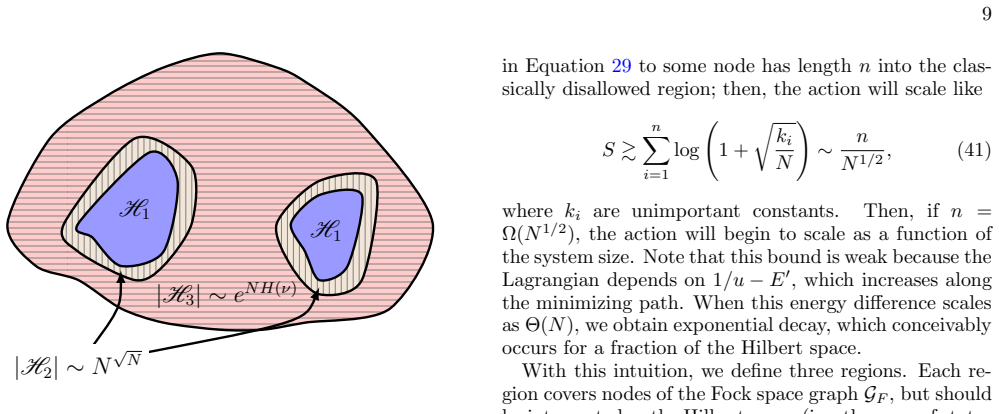
- [Section IV.B and Section VI] The paper’s headline claim that the results “prove” that localization persists for a part of the Hilbert space is not supported by the mathematics presented. The error bounds in Theorems IV.5 and IV.6 are O(N^{3/2}δ^{-1})e^{-S/2}, so they are useful only if the Agmon distance S between distinct wells grows faster than logarithmically in N. Section IV.B does not prove this: Eq. (41) gives a heuristic estimate S ∼ n/N^{1/2} along a typical path, the three-region H1/H2/H3 decomposition (Fig. 2) is explicitly heuristic, and the text states that exponential decay “conceivably occurs for a fraction of the Hilbert space” without quantifying that fraction. The conclusion in Section VI that the convergent locator expansion combined with the locality theorem “allows us to prove” persistence of MBL therefore overreaches. The conclusion should be weakened to “provides analytical evidence,” consistent with the abstract and with the paper’s own caveats.
- [Section V.A] The persistence argument relies on an additional uncontrolled assumption: that the many-body energy shift E′ is O(λN) and small enough that the classically allowed regions do not expand significantly. The paper explicitly concedes that “determining how the many-body energies shift under even a small perturbation is not immediately obvious” and that “we cannot fully determine the energy shifts due to interaction.” Consequently, the proof of persistence is conditional on an uncontrolled quantity. This limitation is acknowledged in the body, but it is not reflected in the conclusion’s “prove” language, and it should be.
minor comments (4)
- [Theorem IV.3, Eq. (35)] The exponential factor is typeset as e^{-Sα/√ε}; the derivation in the proof gives e^{-Sα}/√ε. Please clarify which expression is intended and correct the display accordingly.
- [Introduction] The text refers to a “Caylee graph”; this should read “Cayley graph.”
- [Section IV.B] The definitions of the regions H1, H2, and H3 are informal and are used in a heuristic argument. Consider labeling them explicitly as heuristic and providing more precise definitions or bounding the fraction of states in each region.
- [Theorem V.1 proof] The proof concludes by “choosing λ small enough” to make cλ/δ < 1, but λ is a bound on matrix elements of T+V; the smallness condition is on the physical parameters t and V. Please rephrase to avoid ambiguity.
Circularity Check
No significant circularity: the MBLL derivation is self-contained, with external prior work (Mayboroda et al.) and explicitly conditional assumptions rather than fitted inputs or self-citation chains.
full rationale
The paper's central derivation is not circular. The many-body localization landscape is defined by the linear equation (H+K)|u> = |1> (Eq. 13), independently of the eigenstates whose localization it is used to bound, and the bound |ψ_α| ≤ E' u_α in Theorem III.4 follows from positivity and the maximum principle rather than from assuming the desired conclusion. The Agmon estimates (Lemma IV.1, Lemma IV.2, Theorem IV.3) are algebraic consequences of the landscape equation and the weighted Laplacian identity; they do not presuppose exponential decay. The locality theorems IV.5 and IV.6 are proved from these bounds, with only the spectral counting corollary citing the external Ref. [24] of Arnold, David, Filoche, and Jerison, which is not authored by the present authors. The locator expansion in Section V is a genuine perturbative expansion of the landscape, not of the Green's function, and its convergence in Theorem V.1 rests only on the positive disorder support (E_α ≥ δN) and path-counting on the Fock graph; no target quantity is used as an input. The paper's main physical conclusion is explicitly conditional on unproven geometric and spectral premises — e.g., that the Agmon distance S between wells grows suitably with system size, that the wells do not percolate up to an energy threshold, and that the many-body energy shift is not too large — and these are stated as assumptions or heuristics (Sections IV.B, IV.C, V.A, VI) rather than being disguised as derived results. Such gaps are correctness risks, not circularity. The only author-overlapping citation, Ref. [53] (Gangopadhyay, Galitski, Muller), is a peripheral pointer to negative-U Hubbard physics and is not load-bearing. No fitted parameter is renamed as a prediction, no uniqueness theorem is imported from the authors' own prior work, and no known result is repackaged under new coordinates. Accordingly, the circularity score is 0.
Assumptions & free parameters
assumptions (5)
- domain assumption The Hamiltonian is particle-conserving with nearest-neighbor hopping and density-density interactions (Eq. 2), and disorder has positive support.
- ad hoc to paper Dirichlet boundary conditions are imposed by augmenting the Fock graph with boundary nodes where the wavefunction vanishes.
- standard math Eigenfunctions can be chosen real.
- domain assumption The many-body energy shift induced by the perturbation is O(lambda N) and small enough that classically allowed wells do not substantially expand.
- domain assumption For a positive fraction of states, the Agmon distance between distinct wells grows with system size (S roughly N^{1/2} log N).
Cite this review
Pith. "Pith review of Many-Body Localization Landscape." pith.science (2026). https://pith.science/paper/QFFQKFPX
@misc{pith2026190805283,
  author       = {Pith},
  title        = {Pith review of: Many-Body Localization Landscape},
  year         = {2026},
  howpublished = {\url{https://pith.science/paper/QFFQKFPX}},
  note         = {Machine review of arXiv:1908.05283}
}
read the original abstract
We generalize the notion of "localization landscape," introduced by M. Filoche and S. Mayboroda [Proc. Natl. Acad. Sci. USA 109, 14761 (2012)] for the single-particle Schrodinger operator, to a wide class of interacting many-body Hamiltonians. The many-body localization landscape (MBLL) is defined on a graph in the Fock space, whose nodes represent the basis vectors in the Fock space and edges correspond to transitions between the nodes connected by the hopping term in the Hamiltonian. It is shown that in analogy to the single-particle case, the inverse MBLL plays the role of an effective potential in the Fock space. We construct a generalized discrete Agmon metric and prove Agmon inequalities and locality theorems on the Fock-state graph to obtain bounds on the exponential decay of the many-body wave-functions in the Fock space. Using the MBLL and the locator expansion, we provide considerable analytical evidence for the existence of many-body localization for a wide-class of lattice models in any physical dimension for at least a part of their Hilbert space. The key to this argument is the observation that in sharp contrast to the conventional locator expansion for the Green's function, the locator expansion for the landscape function contains no resonances. For short-range hopping, which limits the connectivity of the Fock-state graph, the locator series is proven to be convergent and bounded by a simple geometric series. This, in combination with the Agmon inequalities and locality theorems, indicates that localization should survive weak interactions and weak hopping for a subset of states in the Hilbert space, but cannot prove or rule out localization of the other states. We also qualitatively discuss potential breakdown of the locator expansion in the MBLL for long-range hopping and the appearance of a mobility edge in higher-dimensional theories.
Figures

Reference graph
Works this paper leans on
-
[1]
P. W. Anderson, Phys. Rev. 109, 1492 (1958)
1958
-
[2]
D. M. Basko, I. L. Aleiner, and B. L. Altshuler, Annals of Physics 321, 1126 (2006)
2006
-
[3]
D. M. Basko, I. L. Aleiner, and B. L. Altshuler, Phys. Rev. B 76, 052203 (2007)
work page 2007
-
[4]
D. M. Basko, I. L. Aleiner, and B. L. Altshuler, Problems of Condensed Matter Physics , 50 (2006)
work page 2006
-
[5]
Oganesyan and D
V. Oganesyan and D. A. Huse, Phys. Rev. B 75, 155111 (2007)
2007
-
[6]
Pal and D
A. Pal and D. A. Huse, Phys. Rev. B 82, 174411 (2010)
2010
-
[7]
J. Z. Imbrie, Journal of Statistical Physics 163, 998 (2016)
work page 2016
-
[8]
ˇZnidariˇ c, T
M. ˇZnidariˇ c, T. Prosen, and P. Prelovˇ sek, Physical Re- view B 77, 064426 (2008)
2008
Show all 54 references
-
[9]
R. Vosk, D. A. Huse, and E. Altman, Phys. Rev. X 5, 031032 (2015)
2015
-
[10]
A. C. Potter, R. Vasseur, and S. A. Parameswaran, Phys. Rev. X 5, 031033 (2015). 18
2015
-
[11]
Serbyn and J
M. Serbyn and J. E. Moore, Phys. Rev. B 93, 041424 (2016)
2016
-
[12]
Serbyn, Z
M. Serbyn, Z. Papi´ c, and D. A. Abanin, Phys. Rev. Lett. 111, 127201 (2013)
2013
-
[13]
V. Ros, M. M¨ uller, and A. Scardicchio, Nuclear Physics B 891, 420 (2015)
2015
-
[14]
Schreiber, S
M. Schreiber, S. S. Hodgman, P. Bordia, H. P. L¨ uschen, M. H. Fischer, R. Vosk, E. Altman, U. Schneider, and I. Bloch, Science 349, 842 (2015)
2015
-
[15]
J.-y. Choi, S. Hild, J. Zeiher, P. Schauß, A. Rubio- Abadal, T. Yefsah, V. Khemani, D. A. Huse, I. Bloch, and C. Gross, Science 352, 1547 (2016)
2016
-
[16]
Kondov, W
S. Kondov, W. McGehee, W. Xu, and B. DeMarco, Phys. Rev. Lett. 114, 083002 (2015)
2015
-
[17]
Smith, A
J. Smith, A. Lee, P. Richerme, B. Neyenhuis, P. W. Hess, P. Hauke, M. Heyl, D. A. Huse, and C. Monroe, Nature Physics 12, 907 (2016)
2016
-
[18]
Nandkishore and D
R. Nandkishore and D. A. Huse, Annual Review of Con- densed Matter Physics 6, 15 (2015)
2015
-
[19]
D. A. Abanin, E. Altman, I. Bloch, and M. Serbyn, Rev. Mod. Phys. 91, 021001 (2019)
2019
-
[20]
I. V. Gornyi, A. D. Mirlin, and D. G. Polyakov, Phys. Rev. Lett. 95, 206603 (2005)
2005
-
[21]
Filoche and S
M. Filoche and S. Mayboroda, Proc. Natl. Acad. Sci. USA 109, 14761 (2012)
2012
-
[22]
M. Lyra, S. Mayboroda, and M. Filoche, EPL (Euro- physics Letters) 109, 47001 (2015)
2015
-
[23]
D. N. Arnold, G. David, D. Jerison, S. Mayboroda, and M. Filoche, Phys. Rev. Lett. 116, 056602 (2016)
2016
-
[24]
D. N. Arnold, G. David, M. Filoche, D. Jerison, and S. Mayboroda, Communications in Partial Differential Equations, 1 – 31 (2019)
2019
-
[25]
J. Buhl, I. Cinzori, I. Ginnett, M. Landry, Y. Li, and X. Liu, arXiv preprint arXiv:1907.00808 (2019)
2019 arXiv
-
[26]
Filoche, M
M. Filoche, M. Piccardo, Y.-R. Wu, C.-K. Li, C. Weis- buch, and S. Mayboroda, Phys. Rev. B 95, 144204 (2017)
2017
-
[27]
Piccardo, C.-K
M. Piccardo, C.-K. Li, Y.-R. Wu, J. S. Speck, B. Bonef, R. M. Farrell, M. Filoche, L. Martinelli, J. Peretti, and C. Weisbuch, Phys. Rev. B 95, 144205 (2017)
2017
-
[28]
C.-K. Li, M. Piccardo, L.-S. Lu, S. Mayboroda, L. Mar- tinelli, J. Peretti, J. S. Speck, C. Weisbuch, M. Filoche, and Y.-R. Wu, Phys. Rev. B 95, 144206 (2017)
2017
-
[29]
Mayboroda and B
S. Mayboroda and B. Poggi, Transactions of the Ameri- can Mathematical Society (2019)
2019
-
[30]
S. Iyer, V. Oganesyan, G. Refael, and D. A. Huse, Phys. Rev. B 87, 134202 (2013)
2013
-
[31]
V. P. Michal, B. L. Altshuler, and G. V. Shlyapnikov, Phys. Rev. Lett. 113, 045304 (2014)
2014
-
[32]
ˇZnidariˇ c and M
M. ˇZnidariˇ c and M. Ljubotina, Proceedings of the Na- tional Academy of Sciences 115, 4595 (2018)
2018
-
[33]
X. Li, X. Li, and S. D. Sarma, Physical Review B 96, 085119 (2017)
2017
-
[34]
ˇSuntajs, J
J. ˇSuntajs, J. Bonˇ ca, T. Prosen, and L. Vidmar, arXiv preprint arXiv:1905.06345 (2019)
2019 arXiv
-
[35]
De Roeck and F
W. De Roeck and F. Huveneers, Physical Review B 95, 155129 (2017)
2017
-
[36]
Polkovnikov, private communication, Amsterdam (July, 2019)
A. Polkovnikov, private communication, Amsterdam (July, 2019)
2019
-
[37]
N. R. Bernier, L. D. T´ oth, A. K. Feofanov, and T. J. Kippenberg, Phys. Rev. A 98, 023841 (2018)
2018
-
[38]
Harder, Y
M. Harder, Y. Yang, B. M. Yao, C. H. Yu, J. W. Rao, Y. S. Gui, R. L. Stamps, and C. M. Hu, Phys. Rev. Lett. 121, 137203 (2018)
2018
-
[39]
Abou-Chacra, D
R. Abou-Chacra, D. Thouless, and P. Anderson, Journal of Physics C: Solid State Physics 6, 1734 (1973)
1973
-
[40]
S. Agmon, Lectures on exponential decay of solutions of second-order elliptic equations: Bounds on eigenfunc- tions of n-body Schr¨ odinger operations.(Mathematical Notes 29) (Princeton University Press, 2014)
2014
-
[41]
Agmon, in Schr¨ odinger operators(Springer, 1985) pp
S. Agmon, in Schr¨ odinger operators(Springer, 1985) pp. 1–38
1985
-
[42]
Simon, in Annales de l’IHP Physique th´ eorique, Vol
B. Simon, in Annales de l’IHP Physique th´ eorique, Vol. 38 (1983) pp. 295–308
1983
-
[43]
Helffer and J
B. Helffer and J. Sjostrand, Communications in Partial Differential Equations 9, 337 (1984)
1984
-
[44]
Simon, Bull
B. Simon, Bull. Amer. Math. Soc. 8, 323 (1983)
1983
-
[45]
Helffer, in Spectral and scattering theory and applica- tions (Mathematical Society of Japan, 1994) pp
B. Helffer, in Spectral and scattering theory and applica- tions (Mathematical Society of Japan, 1994) pp. 113–141
1994
-
[46]
Helffer and B
B. Helffer and B. Parisse, in Annales de l´ ıˆUIHP, Section Physique th´ eorique, Vol. 60 (1994) pp. 147–187
1994
-
[47]
X. P. Wang, in Annales de l’IHP Physique th´ eorique , Vol. 43 (1985) pp. 269–319
1985
-
[48]
Mayboroda, Invited talk at the Institute for Advanced Study, Princeton, NJ (March 8, 2016); available online: https://www.youtube.com/watch?v=4OxJqrf8S-k ()
S. Mayboroda, Invited talk at the Institute for Advanced Study, Princeton, NJ (March 8, 2016); available online: https://www.youtube.com/watch?v=4OxJqrf8S-k ()
2016
-
[49]
Arnold, D
D. Arnold, D. Guy, M. Filoche, D. Jerison, and S. Mayboroda, SIAM Journal on Scientific Computing 41 (2019)
2019
-
[50]
S. Mayboroda, Invited talk at the International Congress of Mathematicians (ICM 2018), Rio de Janeiro, Brazil (August 8, 2018); available online: https://www.youtube.com/watch?v=FhPsWJL9eNQ ()
2018
-
[51]
Goldsheid, S
I. Goldsheid, S. Molchanov, and L. Pastur, Funct. Anal. Appl 11, 8 (1977)
1977
-
[52]
Kunz and B
H. Kunz and B. Souillard, Communications in Mathe- matical Physics 78, 201 (1980)
1980
-
[53]
Gangopadhyay, V
A. Gangopadhyay, V. Galitski, and M. M¨ uller, Phys. Rev. Lett. 111, 026801 (2013)
2013
-
[54]
Sachdev and J
S. Sachdev and J. Ye, Phys. Rev. Lett. 70, 3339 (1993)
1993
Reviewed August 14, 2026 · model on record in the stance chip above.
Discussion (0). Continue with ORCID to comment.