REVIEW 3 major objections 6 minor 23 references
A Catalog of Astrophysical Neutrino Candidates for IceCube
T0 review · 3 major / 6 minor · reviewed 2026-08-14 · deepseek-v4-flash
Pith's one-line read This paper builds an online catalog that records every published version of each IceCube astrophysical neutrino candidate and flags the best values for public use.
desk verdict A modest but useful infrastructure paper: a curated catalog of public IceCube alert data, honest about its limits, with real open questions about curation rules and reproducibility. read the letter →
The pith
A machine-rendered reading of the paper's core claim, the machinery that carries it, and where it could break.
The reading
What carries the argument
The catalog's data model is the one-to-many event document: each event is a database document, and every measured attribute is an array in which the same index across all arrays points to the same source publication; a per-attribute default index marks the value IceCube recommends for public use. This schema lets a single event carry multiple reconstructions from GCN notices, circulars, and offline analyses, while the front end displays only the recommended values and the detail pages expose the full history.
What would settle it
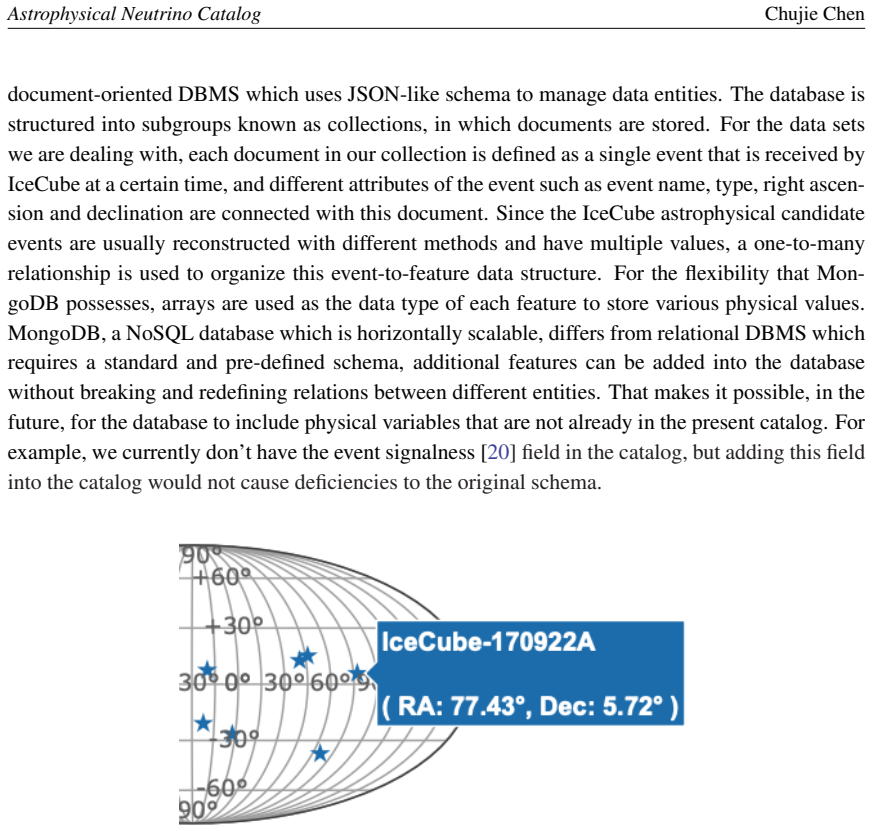
Look up a catalogued event such as IceCube-170922A and compare the catalog's displayed right ascension and declination with the values in its GCN circular and in the latest published HESE event list; if the displayed recommended position differs from the best final reconstruction, the catalog is not actually highlighting the best information.
Extended reading notes
Core claim
The central claim is that a single web-accessible catalog can serve as the registry for IceCube astrophysical neutrino candidates, preserving every publicly released reconstruction of each event and designating one recommended set of values. The catalog organizes each event as one database document whose attributes (time, type, direction, energy, angular uncertainty) are stored as parallel arrays, so that all values from a given source share the same array index, and a marked default index per attribute selects which source's value IceCube suggests the public use. The paper demonstrates this with the 27 April 2016 alert, which appeared in a GCN notice, a refined GCN circular, and subsequent HESE conference presentations: the catalog keeps all versions while displaying the recommended one. At the time of writing, the database held 25 realtime-alert candidates, and the design is intended to absorb future samples from HESE, up-going muon, and EHE analyses as they are published.
Load-bearing premise
The catalog is only as reliable as the unstated choice of which published version of each event is recommended, since the paper gives no rule for making that choice.
Editorial extensions
If this is right
- Community users can download a CSV of recommended event properties without manually reconciling GCN notices, circulars, and proceedings, lowering the barrier to multi-messenger follow-up studies.
- Because the detail pages preserve every published reconstruction, comparisons among analyses become straightforward and inconsistencies in event positions or energies can be spotted by inspection.
- The array-based schema allows the same catalog to absorb new event samples and new physical fields, such as signalness, without a database redesign.
- Sky-map queries by event type and declination make it practical to assemble custom samples for stacking analyses and target searches.
- If the catalog is kept current, it can become the shared reference table that observatories use to trigger follow-up on new alerts and to audit past ones.
Reading between the lines
- Because the recommended-value flag is chosen by catalog maintainers with no stated selection rule, an external user cannot distinguish an expert curation choice from an arbitrary one; publishing the rule or score behind each default index would make the recommendation independently checkable.
- If the same schema were applied to public alert streams from other neutrino detectors, the catalog pattern could become a general multi-messenger registry, not just an IceCube tool.
- The current 25-event sample is too small to test selection effects, but once HESE, up-going muon, and EHE samples are added, the catalog would allow the first systematic check of how likely a realtime alert is to survive offline reanalysis with a changed position or energy.
- One can infer that the maintainers are making an implicit claim that the latest offline reconstruction is generally the best; a useful test would be to compare early alert coordinates with final published coordinates across all catalogued events to quantify how much offline refinement matters.
Signed reviews
Editorial analysis
A structured set of objections, weighed in public.
Referee Report
Summary. The paper presents an online catalog of astrophysical neutrino candidate events from IceCube, built on a MongoDB database behind a Firebase-hosted web application. The catalog is designed to store multiple published reconstructions of the same event (currently from GCN Notices and GCN Circulars), to designate a default 'recommended' value for each attribute, and to let users query, visualize, and download the data. The manuscript reports that the database currently contains 25 events with a total size of 53.73 KB and that additional IceCube publications will be added in the future. No physics analysis or new measurements are presented; the deliverable is a community tool.
Significance. If maintained and validated, the catalog would fill a practical niche by relieving external users of the need to collect and reconcile multiple GCN/ICRC versions of the same neutrino event. The paper is transparent about the current partial deployment and makes no overreaching physics claims. Its main value proposition is curation: the 'recommended' values and the record of multiple published versions. Because that curation is not yet validated and because the live service is explicitly on a test server with no versioned snapshot, the utility claim rests on unverified infrastructure and undocumented judgment. The paper would be strengthened by a clear selection rule for recommended values, a data-validation description, and a machine-readable release of the catalog at the time of publication.
major comments (3)
- [Section 2.2] The default index is the load-bearing element of the paper's central claim that the catalog 'highlights the best information' (abstract), but the manuscript gives no criterion for choosing it. The text only says that the default index identifies which source's value 'we suggest is used by the public.' Because the home table and CSV download expose these recommended values, the authors should specify the selection rule (for example, the most recent offline reconstruction, the smallest reported angular uncertainty, or an explicit IceCube preference hierarchy) and validate the recommended values against the original GCN Notices/Circulars for a sample of events. Without this, users cannot assess whether the catalog propagates the best available coordinates and energies.
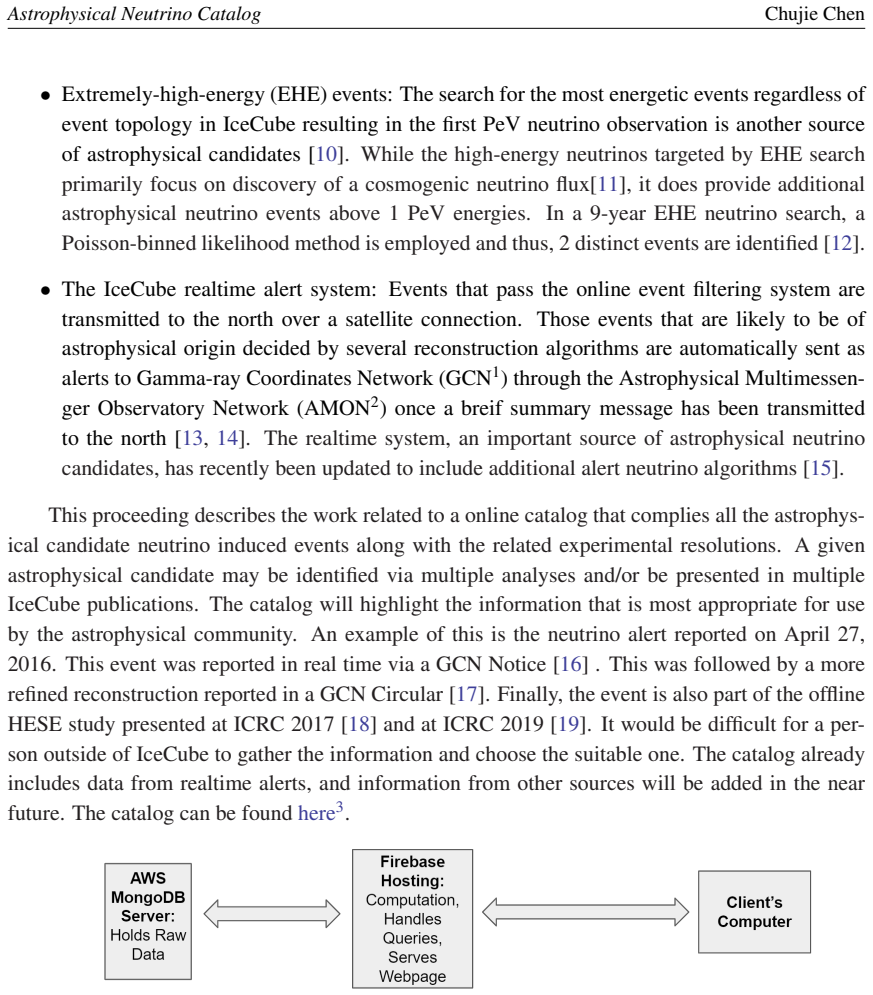
- [Sections 2.2, 2.3, and 4] The paper states that the database is hosted on AWS 'for testing purposes,' that the free tier supports no more than 100 concurrent connections, and that other IceCube publications 'will be added' in the future. This contradicts the abstract's present-tense framing that 'All studies by IceCube that produce astrophysical candidates will be included in our catalog' and prevents a reader from independently verifying the claimed contents (25 events, 53.73 KB). The authors should clearly state the production status of the service, provide a versioned data snapshot (for instance, a CSV or JSON file in the proceedings or a persistent DOI), and describe the planned long-term hosting and maintenance for the URL.
- [Sections 2.1 and 3] There is no description of data-integrity checks for the GCN-extracted values or for the 'recommended result source' assignment illustrated in Figure 4. Since the catalog's value depends on not propagating typos, stale positions, or inconsistent reconstruction choices, the authors should document their ingestion and parsing workflow, any automated or manual validation steps, and how errors discovered after ingestion are corrected and versioned. At a minimum, a comparison of a few catalog entries with the corresponding GCN Notices and Circulars would establish that the extraction and indexing procedures are reliable.
minor comments (6)
- [Abstract and Section 2.2] The abstract promises that 'signalness' will be contained in the catalog, but Section 2.2 explicitly states that the signalness field is not yet present; please clarify whether signalness is currently available to users.
- [Figure 1 caption] The caption contains a typo: 'communicates bewteen' should be 'communicates between,' and 'possess' should presumably be 'process.'
- [Page 2 and Section 2.2] There are several typographical errors, including 'mouns' for 'muons,' 'breif' for 'brief,' and 'the the value' for 'the value.' A careful proofread is needed.
- [Section 2.1] The text says that '10 features' are collected from GCN notices but never lists them; please add a table or list of the field names, units, and data types, including how missing values are represented.
- [Section 4] The current catalog contains only realtime alert events, while the introduction also describes HESE, up-going muon, and EHE samples; please state which of these categories are already represented among the 25 events and which are planned.
- [Figures 2 and 4] The screenshots would be more useful if the captions included the date the page was accessed and the URL; the live URL is given only as a footnote, and a stable link in the text would help readers.
Circularity Check
No circularity: the catalog compiles externally published GCN data and makes no derived predictions or fitted parameters.
full rationale
The paper is a descriptive software/catalog paper, not a derivation. Its claims concern the collection, storage, and display of astrophysical neutrino candidate information extracted from GCN Notices and GCN Circulars (Section 2.1). There is no fitted model, no predicted quantity, and no theoretical derivation whose output is fed back into its own input. The 'default index' described in Section 2.2 is an editorial choice about which published source to display as the preferred value; it is not a prediction generated from the catalog, and the paper is explicit that the GCN circular 'is set to be recommended result source' for the example shown (Figure 4). The values themselves originate from external IceCube publications and GCN alerts, so the catalog does not construct its own evidence or rename a known result as a new one. Concerns about maintenance burden, the free-tier AWS limitations, or the lack of a formal validation criterion for the 'default index' are usability and robustness issues, not circular reasoning. Under the stated review rules, absence of a derivation chain means the circularity burden is nil, so the appropriate score is 0.
Assumptions & free parameters
assumptions (3)
- domain assumption GCN notices and circulars are complete and accurate records of IceCube's astrophysical neutrino alerts.
- domain assumption The 'IceCube preferred' values selected via the default index are the best values for public use.
- domain assumption The catalog's web hosting (Firebase plus free AWS) will remain sufficiently available for community use.
Cite this review
Pith. "Pith review of A Catalog of Astrophysical Neutrino Candidates for IceCube." pith.science (2026). https://pith.science/paper/DBH7ILB6
@misc{pith2026190805290,
  author       = {Pith},
  title        = {Pith review of: A Catalog of Astrophysical Neutrino Candidates for IceCube},
  year         = {2026},
  howpublished = {\url{https://pith.science/paper/DBH7ILB6}},
  note         = {Machine review of arXiv:1908.05290}
}
read the original abstract
Multi-messenger astrophysics will enable the discovery of new astrophysical neutrino sources and provide information about the mechanisms that drive these objects. We present a curated online catalog of astrophysical neutrino candidates. Whenever single high energy neutrino events, that are publicly available, get published multiple times from various analyses, the catalog records all these changes and highlights the best information. All studies by IceCube that produce astrophysical candidates will be included in our catalog. All information produced by these searches such as time, type, direction, neutrino energy and signalness will be contained in the catalog. The multi-messenger astrophysical community will be able to select neutrinos with certain characteristics, e.g. within a declination range, visualize data for the selected neutrinos, and finally download data in their preferred form to conduct further studies.
Figures

Figures from the paper (1 more)

Reference graph
Works this paper leans on
-
[1]
Aartsen et al., Journal of Instrumentation 12 (2017) P03012
IceCube Collaboration, M. Aartsen et al., Journal of Instrumentation 12 (2017) P03012
work page 2017
-
[2]
Achterberg et al., Astroparticle Physics 26 (2006) 155–173
IceCube Collaboration, A. Achterberg et al., Astroparticle Physics 26 (2006) 155–173
work page 2006
- [3]
-
[4]
Aartsen et al., Physical review letters 113 (2014) 101101
IceCube Collaboration, M. Aartsen et al., Physical review letters 113 (2014) 101101
work page 2014
-
[5]
IceCube Collaboration, PoS(ICRC2019)842 (2019)
work page 2019
-
[6]
N. Wandkowsky, Latest results on astrophysical neutrinos using high-energy events with contained vertices, June, 2018
work page 2018
-
[7]
Aartsen et al., The Astrophysical Journal 833 (2016) 3
IceCube Collaboration, M. Aartsen et al., The Astrophysical Journal 833 (2016) 3
work page 2016
-
[8]
IceCube Collaboration, M. G. Aartsen et al., Phys. Rev. D 89 (Mar, 2014) 062007
work page 2014
Show all 23 references
-
[9]
IceCube Collaboration, PoS(ICRC2017)1005 (2017)
2017
-
[10]
IceCube Collaboration, M. G. Aartsen et al., Phys. Rev. Lett. 111 (Jul, 2013) 021103
2013
-
[11]
Aartsen et al., Physical review letters 117 (2016) 241101
IceCube Collaboration, M. Aartsen et al., Physical review letters 117 (2016) 241101
2016
-
[12]
IceCube Collaboration, PoS(ICRC2017)975 (2017)
2017
-
[13]
Aartsen et al., Astroparticle Physics (2017) 30–41
IceCube Collaboration, M. Aartsen et al., Astroparticle Physics (2017) 30–41
2017
-
[14]
IceCube Collaboration, PoS(ICRC2017)982 (2017)
2017
-
[15]
IceCube Collaboration, PoS(ICRC2019)1021 (2019)
2019
-
[16]
GCN Notice 67093193_127853
IceCube Collaboration, “GCN Notice 67093193_127853.”
-
[17]
GCN Circular 19363
IceCube Collaboration, “GCN Circular 19363.”
-
[18]
IceCube Collaboration, PoS(ICRC2017)981 (2017)
2017
-
[19]
IceCube Collaboration, PoS(ICRC2019)1004 (2019)
2019
-
[20]
IceCube Collaboration, PoS(ICRC2017)961 (2017)
2017
-
[21]
IceCube Collaboration, Science 361 (2018) eaat1378
2018
-
[22]
Kadler, F
M. Kadler, F. Krauß, K. Mannheim, R. Ojha, C. Müller, R. Schulz, G. Anton, W. Baumgartner, T. Beuchert, S. Buson, et al., Nature Physics 12 (2016) 807
2016
-
[23]
Padovani, P
P. Padovani, P. Giommi, E. Resconi, T. Glauch, B. Arsioli, N. Sahakyan, and M. Huber, Monthly Notices of the Royal Astronomical Society 480 (2018) 192–203. 8
2018
Reviewed August 14, 2026 · model on record in the stance chip above.
Discussion (0). Continue with ORCID to comment.