REVIEW 3 major objections 6 minor 53 references
Multiview-Consistent Semi-Supervised Learning for 3D Human Pose Estimation
T0 review · 3 major / 6 minor · reviewed 2026-08-14 · deepseek-v4-flash
Pith's one-line read MCSS learns a multi-view-consistent pose embedding from unlabeled synchronized video and regresses a canonical, yaw-invariant 3D pose from it with limited 3D labels, improving normalized pose error from 149.28 mm to 111.94 mm with S1-only…
desk verdict Solid weak-supervision method for 3D pose with a nice multi-view embedding idea, but the headline comparison to Rhodin et al. rests on an unspecified evaluation frame and a canonicalization equation that is ambiguous as written. read the letter →
The pith
A machine-rendered reading of the paper's core claim, the machinery that carries it, and where it could break.
The reading
What carries the argument
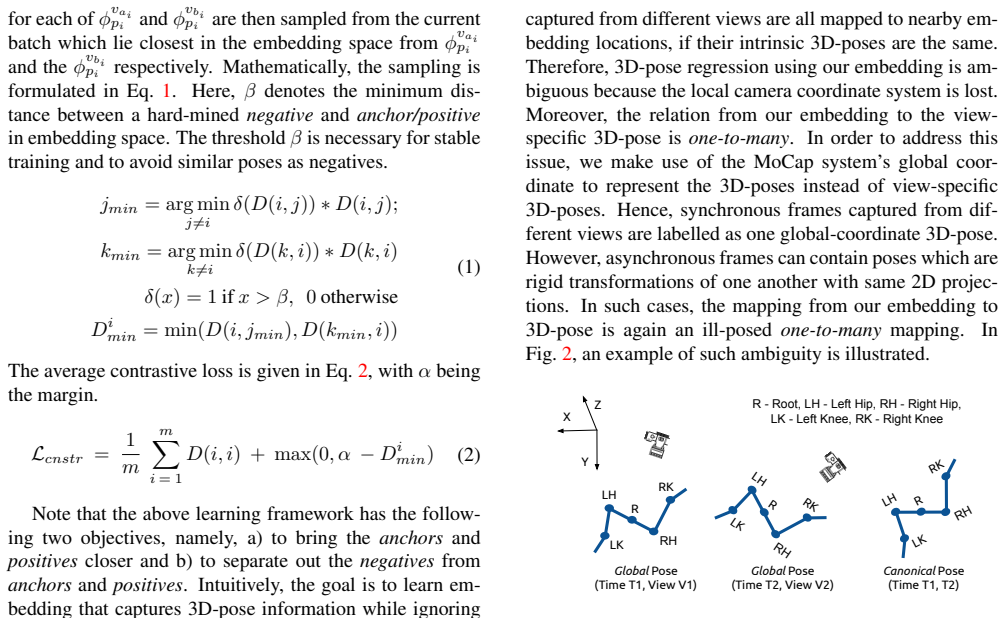
The central object is a 128-dimensional pose embedding $\varphi$ shared by the contrastive loss and the pose-regression head. The contrastive loss (Eqs. 1-2) pulls same-pose, different-view pairs together and pushes the closest in-batch negatives apart via a margin $\alpha$ and threshold $\beta$; mini-batches drawn from one subject with overlapping backgrounds stop the embedding from using appearance or background to separate negatives. The canonical pose transformation (Eq. 3) rotates each MoCap skeleton about the vertical (+Z) axis by angle $\theta = \cos^{-1}(\hat{u}_{xy}\cdot \hat{\imath})$ so the pelvis-to-left-hip bone is parallel to the XZ plane, giving a view- and rigid-rotation-invariant regression target. Because the embedding already enforces consistency, a shallow FC(128,48) head suffices and the backbone is only ResNet-18, unlike the ResNet-50 used by the comparison method [36].
What would settle it
Take a MoCap skeleton whose pelvis-to-left-hip direction has a negative y-component and apply Eq. 3 as written; if the resulting canonical skeleton is a mirrored version of the one produced by its x-axis reflection, the transformation is not the bijection the argument needs. A public implementation check, whether the rotation uses a signed angle and whether an inverse transform to camera coordinates is defined, would settle both the representation and the reported MPJPE comparisons.
Extended reading notes
Core claim
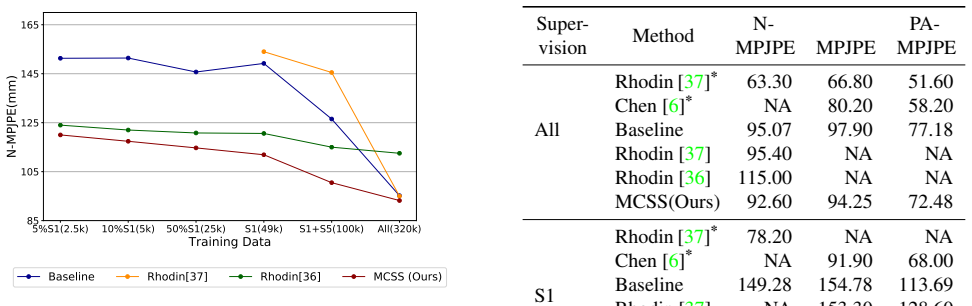
The paper claims that a multi-view-consistent pose embedding, learned from synchronized multi-view video by contrastive metric learning, is enough weak supervision to train a monocular 3D pose regressor, provided the regression target is a canonical pose that removes viewpoint and rigid-rotation ambiguity. The embedding is shared between the contrastive loss and a shallow regression head, so limited 3D pose labels refine the embedding while the embedding constrains pose predictions. With labels from a single subject, MCSS reaches 111.94 mm N-MPJPE against 149.28 mm for the supervised baseline and 122.60 mm for the leading geometry-aware method [36]; the improvement persists when that method is restricted to the same ResNet-18 backbone. The same embedding also supports cross-view, cross-subject pose retrieval with errors close to an oracle that has ground-truth 3D poses.
Load-bearing premise
The load-bearing premise is that Eq. 3 defines a consistent bijection from every global MoCap pose to a canonical pose: as written, $\theta = \arccos(\hat{u}_{xy}\cdot \hat{\imath})$ ignores the sign of the y-component, so symmetric poses may not reach a unique canonical target, and the paper never states how canonical predictions are mapped back to camera coordinates for MPJPE.
Editorial extensions
If this is right
- With one subject's 3D labels on the main benchmark, MCSS reports 111.94 mm N-MPJPE, versus 149.28 mm for the supervised-only baseline and 122.60 mm for the prior geometry-aware method [36].
- The method degrades gracefully as 3D supervision shrinks from all five subjects to 5% of one subject, showing the contrastive signal carries pose structure.
- Regressing canonical pose instead of global-coordinate pose is worth about 45 N-MPJPE points in their ablation (MCSS-global 157.30 vs MCSS 111.94).
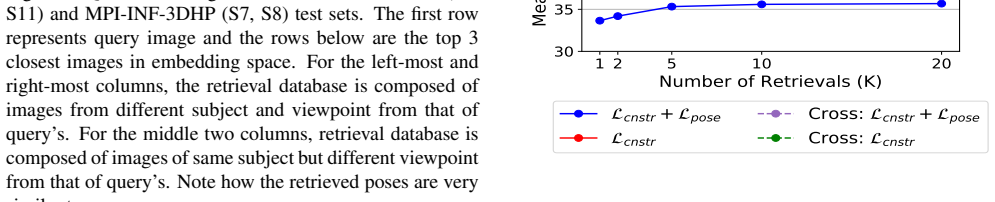
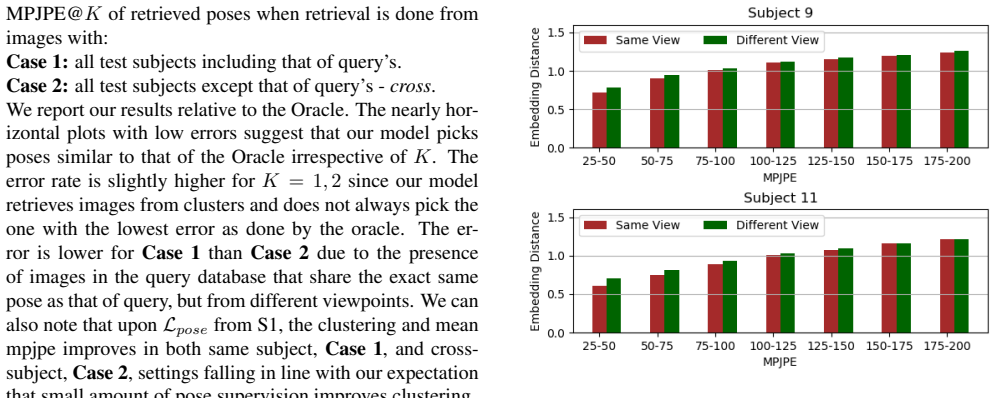
- The learned embedding retrieves cross-view, cross-subject poses with Mean-PA-MPJPE@K close to the ground-truth oracle on both multi-view datasets, supporting pose retrieval as a usable downstream task.
- No 2D pose labels, pre-trained 2D pose estimators, camera extrinsics, or background extraction are required, and inference is 24.8 ms per image versus 75.3 ms for the comparison model [36].
Reading between the lines
- A direct test of the mechanism would be to train MCSS on multi-view footage with near-identical camera angles; if the contrastive signal still helps, view consistency is not what drives the gain.
- The cross-dataset drop the paper reports (retrieval MPJPE 119.6 mm without fine-tuning) suggests the embedding retains domain-specific appearance cues; a domain-adversarial variant might separate pose content from appearance more cleanly.
- Eq. 3 as written uses arccos of a dot product that ignores the sign of the y-component, so mirrored poses could map inconsistently unless the implementation uses a signed angle; making the rotation bijective and specifying the inverse transform would let MPJPE comparisons to camera-coordinate methods be reproduced.
- The same embedding could serve as a differentiable pose prior for single-image 3D reconstruction in settings where only multi-view video, not 3D labels, is available; the paper's retrieval experiments are evidence the descriptor is pose-specific.
Signed reviews
Editorial analysis
A structured set of objections, weighed in public.
Referee Report
Summary. The paper proposes MCSS, a semi-supervised framework for monocular 3D human pose estimation. It trains a ResNet-18 feature extractor and an embedding network with a contrastive metric-learning loss on synchronized, unlabeled multi-view video frames, using hard-negative mining, while simultaneously regressing a 'canonical' 3D pose from the embedding with limited 3D labels. The canonical representation is defined in Eq. (3) by rotating the global MoCap pose about the vertical axis so that the pelvis-to-left-hip bone lies parallel to the XZ plane. Experiments on Human3.6M and MPI-INF-3DHP report that under S1-only supervision MCSS reaches N-MPJPE 111.94 mm versus 149.28 mm for the baseline and 122.60 mm for Rhodin et al. [36], and the paper also proposes cross-view pose-retrieval benchmarks.
Significance. If the reported numbers are measured on a common footing, the paper makes a useful contribution: it shows that synchronized, uncalibrated multi-view video can supply a metric-learning signal that reduces dependence on 3D pose labels, and it does so with a smaller backbone (ResNet-18) than [36] (ResNet-50). The canonical-pose target is a sensible response to the one-to-many ambiguity between the learned embedding and view-specific coordinates, and the global-versus-canonical ablation in Table 2 is informative. The proposed cross-view and cross-subject pose-retrieval protocol, with Oracle comparisons, is a useful benchmark for future work. However, the central quantitative claim hinges on coordinate-frame details that are not specified; until those are resolved, the improvement over [36] cannot be taken at face value.
major comments (3)
- [Section 3.2.1, Eq. (3)] The canonicalization is not a well-defined function of the pose as written. Because theta = cos^{-1}(u_xy dot i) returns the absolute angle rather than a signed angle, a left-hip horizontal projection with a positive y component is rotated the wrong way, and the resulting bone is not parallel to the XZ plane. The same intrinsic pose can therefore receive different canonical targets depending on which side of the XZ plane it lies, making the L1 pose-regression supervision inconsistent. The paper should define theta with a signed angle, e.g., theta = -atan2(u_y, u_x), and state explicitly that the implementation uses the signed version; no code is provided to disambiguate. In addition, the inverse of Eq. (3) is never defined, although it is needed if any evaluation is done after mapping predictions back to global coordinates.
- [Section 5, Table 1 and Fig. 3] The evaluation frame for MPJPE, N-MPJPE, and PA-MPJPE is never stated. MCSS outputs canonical poses, whereas Rhodin et al. [36,37] output camera-coordinate poses. If the metrics are computed in the canonical frame, the comparison is not on a common footing, because canonicalization applies a pose-dependent rotation R(theta(p)): the quantity ||R(theta(p_hat)) p_hat - R(theta(p_gt)) p_gt|| is not equal to ||p_hat - p_gt|| in general, and part of the reported gap could be a coordinate artifact. If the metrics are computed after transforming canonical predictions back to global or camera coordinates, the inverse of Eq. (3) must be specified. Please state, for each metric, which coordinate frame is used, how [36] and the baseline are placed in that same frame, and whether the canonical rotation is computed from the prediction, the ground truth, or a shared value. Without this information, the headline improvement of 25% over baseline and 8.7% over state-of-the-art cannot be verified.
- [Section 5, Table 2] The ablation against MCSS-global is difficult to interpret without the evaluation protocol. MCSS-global is trained to regress poses in the MoCap global coordinate system; if it is then evaluated under a canonical-frame metric, its substantially larger error could be partly an artifact of comparing a non-canonical output against a canonical target, rather than evidence about the learned representation. Please specify how MCSS-global's predictions are evaluated, for example whether they are canonicalized at test time or measured directly in global coordinates, and report the metric in a frame that treats both variants fairly.
minor comments (6)
- [Section 5, paragraph after Fig. 3] The text uses 'MVSS' where the method is elsewhere called 'MCSS'; please correct this typo.
- [Section 4, Pose Regression paragraph] The text refers to 'The pose regression network G', but Fig. 1a and Sec. 3.2 denote the regression head as H; please align the notation.
- [Section 3.1, Eq. (1)] If all candidate distances in the batch are below beta, the product delta(D(i,j)) D(i,j) is zero for every j, so jmin and kmin are not uniquely defined; please state how this degenerate case is handled.
- [References] References [6] and [7] are the same paper; one duplicate should be removed.
- [Section 6.3, Generalization] The sentence reporting 119.6 mm for K=10 and 101.9 mm for K=20 appears to contradict the intuition and the trend in Table 3; please clarify whether K is the number of retrieved neighbors and why a larger K gives lower error in this cross-dataset setting.
- [Section 3.1.1 and Section 4] The paper states that specific hyper-parameter choices are detailed in the supplementary material; if the supplementary material is part of the submission, it should be included with the review version.
Circularity Check
No significant circularity: the semi-supervised signal and pose regression are measured against external benchmarks and independent baselines.
full rationale
I walked the derivation chain and found no step where a claimed prediction reduces by construction to an input or to a self-citation. The semi-supervised signal Lcnstr (Eq. 2) is built from synchronized multiview image pairs and hard-negative mining, which is independent of the 3D pose labels used in Lpose (Sec. 3.2). Pose estimation is evaluated on held-out subjects S9/S11 against an internal baseline and external methods (Rhodin et al. [36] and [37]), with results reported on public datasets Human3.6M and MPI-INF-3DHP. References [8] and [40] are self-citations from the same group, but they appear only in general context and related-work statements; no load-bearing claim, uniqueness theorem, or ansatz is imported from them. The canonical pose representation (Eq. 3) is defined directly from MoCap global coordinates, and the paper explicitly ablates it against global-coordinate regression (MCSS vs. MCSS-global, Table 2), so the representation choice is tested rather than assumed. The ambiguity about how canonical predictions are mapped back for MPJPE comparison is an evaluation-protocol concern and a correctness risk, not a circularity. The derivation is self-contained relative to external benchmarks.
Assumptions & free parameters
free parameters (4)
- Contrastive margin alpha =
0.6
- Hard-negative threshold beta =
0.3
- Embedding dimension dim_phi =
128
- Metric/pose batch ratio =
3:1
assumptions (4)
- domain assumption Frames captured synchronously from different views of the same subject contain the same intrinsic 3D pose.
- domain assumption Within a same-subject mini-batch, the closest non-positive samples are valid hard negatives of different poses, and the threshold beta prevents pushing apart temporally close same-pose frames.
- ad hoc to paper Eq. 3 defines a well-defined yaw-invariant canonicalization for all global poses, so the same intrinsic pose always maps to the same canonical target.
- domain assumption ImageNet-pretrained ResNet features transfer to multi-view pose similarity and 3D pose regression.
Cite this review
Pith. "Pith review of Multiview-Consistent Semi-Supervised Learning for 3D Human Pose Estimation." pith.science (2026). https://pith.science/paper/RVU32RYQ
@misc{pith2026190805293,
  author       = {Pith},
  title        = {Pith review of: Multiview-Consistent Semi-Supervised Learning for 3D Human Pose Estimation},
  year         = {2026},
  howpublished = {\url{https://pith.science/paper/RVU32RYQ}},
  note         = {Machine review of arXiv:1908.05293}
}
read the original abstract
The best performing methods for 3D human pose estimation from monocular images require large amounts of in-the-wild 2D and controlled 3D pose annotated datasets which are costly and require sophisticated systems to acquire. To reduce this annotation dependency, we propose Multiview-Consistent Semi Supervised Learning (MCSS) framework that utilizes similarity in pose information from unannotated, uncalibrated but synchronized multi-view videos of human motions as additional weak supervision signal to guide 3D human pose regression. Our framework applies hard-negative mining based on temporal relations in multi-view videos to arrive at a multi-view consistent pose embedding. When jointly trained with limited 3D pose annotations, our approach improves the baseline by 25% and state-of-the-art by 8.7%, whilst using substantially smaller networks. Lastly, but importantly, we demonstrate the advantages of the learned embedding and establish view-invariant pose retrieval benchmarks on two popular, publicly available multi-view human pose datasets, Human 3.6M and MPI-INF-3DHP, to facilitate future research.
Figures

Figures from the paper (4 more)


Reference graph
Works this paper leans on
-
[36]
Unsu- pervised geometry-aware representation for 3d human pose estimation
Helge Rhodin, Mathieu Salzmann, and Pascal Fua. Unsu- pervised geometry-aware representation for 3d human pose estimation. In ECCV, 2018. 2, 3, 5, 6
work page 2018
-
[1]
Densepose: Dense human pose estimation in the wild
Rıza Alp G ¨uler, Natalia Neverova, and Iasonas Kokkinos. Densepose: Dense human pose estimation in the wild. In CVPR, 2018. 3
2018
-
[2]
2d human pose estimation: New benchmark and state of the art analysis
Mykhaylo Andriluka, Leonid Pishchulin, Peter Gehler, and Bernt Schiele. 2d human pose estimation: New benchmark and state of the art analysis. In CVPR, 2014. 5, 6
work page 2014
-
[3]
Ex- ploiting temporal context for 3d human pose estimation in the wild
Anurag Arnab, Carl Doersch, and Andrew Zisserman. Ex- ploiting temporal context for 3d human pose estimation in the wild. In CVPR, 2019. 3
work page 2019
-
[4]
Position referencing and consistent world modeling for mobile robots
Raja Chatila and Jean-Paul Laumond. Position referencing and consistent world modeling for mobile robots. In ICRA,
-
[5]
Unsupervised 3d pose estimation with geometric self- supervision
Ching-Hang Chen, Ambrish Tyagi, Amit Agrawal, Dy- lan Drover, Rohith MV , Stefan Stojanov, and James M Rehg. Unsupervised 3d pose estimation with geometric self- supervision. In CVPR, 2019. 3, 5
work page 2019
-
[7]
Weakly-supervised discovery of geometry-aware representation for 3d human pose estimation
Xipeng Chen, Kwan-Yee Lin, Wentao Liu, Chen Qian, and Liang Lin. Weakly-supervised discovery of geometry-aware representation for 3d human pose estimation. In CVPR,
-
[8]
Learning 3d hu- man pose from structure and motion
Rishabh Dabral, Anurag Mundhada, Uday Kusupati, Safeer Afaque, Abhishek Sharma, and Arjun Jain. Learning 3d hu- man pose from structure and motion. In ECCV, 2018. 1, 3
work page 2018
Show all 53 references
-
[9]
Inferring 3d body pose from silhouettes using activity manifold learning
Ahmed Elgammal and Chan-Su Lee. Inferring 3d body pose from silhouettes using activity manifold learning. In CVPR,
-
[10]
Semi- supervised learning in gigantic image collections
Rob Fergus, Yair Weiss, and Antonio Torralba. Semi- supervised learning in gigantic image collections. In NIPS,
-
[11]
Holopose: Holistic 3d human reconstruction in-the-wild
Riza Alp Guler and Iasonas Kokkinos. Holopose: Holistic 3d human reconstruction in-the-wild. In CVPR, 2019. 3
2019
-
[12]
In the wild human pose estimation using explicit 2d features and intermediate 3d rep- resentations
Ikhsanul Habibie, Weipeng Xu, Dushyant Mehta, Gerard Pons-Moll, and Christian Theobalt. In the wild human pose estimation using explicit 2d features and intermediate 3d rep- resentations. In CVPR, 2019. 3
2019
-
[13]
Deep residual learning for image recognition
Kaiming He, Xiangyu Zhang, Shaoqing Ren, and Jian Sun. Deep residual learning for image recognition. In CVPR,
-
[14]
Catalin Ionescu, Dragos Papava, Vlad Olaru, and Cristian Sminchisescu. Human3. 6m: Large scale datasets and pre- dictive methods for 3d human sensing in natural environ- ments. In TPAMI, 2013. 1, 5
2013
-
[15]
End-to-end recovery of human shape and pose
Angjoo Kanazawa, Michael J Black, David W Jacobs, and Jitendra Malik. End-to-end recovery of human shape and pose. In CVPR, 2018. 3
2018
-
[16]
Learning 3d human dynamics from video
Angjoo Kanazawa, Jason Y Zhang, Panna Felsen, and Jiten- dra Malik. Learning 3d human dynamics from video. In CVPR, 2019. 3
2019
-
[17]
Adam: A method for stochastic optimization
Diederik P Kingma and Jimmy Ba. Adam: A method for stochastic optimization. In arXiv, 2014. 5
2014
-
[18]
Self- supervised learning of 3d human pose using multi-view ge- ometry
Muhammed Kocabas, Salih Karagoz, and Emre Akbas. Self- supervised learning of 3d human pose using multi-view ge- ometry. In CVPR, 2019. 2, 3, 5
2019
-
[19]
Affine structure from motion
Jan J Koenderink and Andrea J Van Doorn. Affine structure from motion. In JOSA A, 1991. 1
1991
-
[20]
Learning to reconstruct 3d human pose and shape via model-fitting in the loop
Nikos Kolotouros, Georgios Pavlakos, Michael J Black, and Kostas Daniilidis. Learning to reconstruct 3d human pose and shape via model-fitting in the loop. In CVPR, 2019. 3
2019
-
[21]
Semi- supervised deep learning for monocular depth map predic- tion
Yevhen Kuznietsov, Jorg Stuckler, and Bastian Leibe. Semi- supervised deep learning for monocular depth map predic- tion. In CVPR, 2017. 1
2017
-
[22]
Thin-slicing for pose: Learning to understand pose without explicit pose es- timation
Suha Kwak, Minsu Cho, and Ivan Laptev. Thin-slicing for pose: Learning to understand pose without explicit pose es- timation. In CVPR, 2016. 2, 7
2016
-
[23]
Modeling view and posture manifolds for tracking
Chan-Su Lee and Ahmed Elgammal. Modeling view and posture manifolds for tracking. In CVPR, 2007. 2
2007
-
[24]
Semi-supervised boosting using visual similarity learning
Christian Leistner, Helmut Grabner, and Horst Bischof. Semi-supervised boosting using visual similarity learning. In CVPR, 2008. 1
2008
-
[25]
Generating multiple hypotheses for 3d human pose estimation with mixture density network
Chen Li and Gim Hee Lee. Generating multiple hypotheses for 3d human pose estimation with mixture density network. In CVPR, 2019. 3
2019
-
[26]
Visualizing data using t-sne
Laurens van der Maaten and Geoffrey Hinton. Visualizing data using t-sne. In JMLR, 2008. 6
2008
-
[27]
A simple yet effective baseline for 3d human pose estimation
Julieta Martinez, Rayat Hossain, Javier Romero, and James J Little. A simple yet effective baseline for 3d human pose estimation. In CVPR, 2017. 3, 4
2017
-
[28]
Monocular 3d human pose estimation in the wild using improved cnn supervision
Dushyant Mehta, Helge Rhodin, Dan Casas, Pascal Fua, Oleksandr Sotnychenko, Weipeng Xu, and Christian Theobalt. Monocular 3d human pose estimation in the wild using improved cnn supervision. In 3DV, 2017. 1, 5
2017
-
[29]
Vnect: Real-time 3d human pose estimation with a single rgb cam- era
Dushyant Mehta, Srinath Sridhar, Oleksandr Sotnychenko, Helge Rhodin, Mohammad Shafiei, Hans-Peter Seidel, Weipeng Xu, Dan Casas, and Christian Theobalt. Vnect: Real-time 3d human pose estimation with a single rgb cam- era. In TOG, 2017. 1, 3
2017
-
[30]
Working hard to know your neighbor’s mar- gins: Local descriptor learning loss
Anastasiia Mishchuk, Dmytro Mishkin, Filip Radenovic, and Jiri Matas. Working hard to know your neighbor’s mar- gins: Local descriptor learning loss. In NIPS, 2017. 3, 5
2017
-
[31]
A survey of com- puter vision-based human motion capture
Thomas B Moeslund and Erik Granum. A survey of com- puter vision-based human motion capture. In CVIU, 2001. 1
2001
-
[32]
Pose embeddings: A deep architecture for learning to match human poses
Greg Mori, Caroline Pantofaru, Nisarg Kothari, Thomas Le- ung, George Toderici, Alexander Toshev, and Weilong Yang. Pose embeddings: A deep architecture for learning to match human poses. In arXiv, 2015. 2
2015
-
[33]
Coarse-to-fine volumetric predic- tion for single-image 3d human pose
Georgios Pavlakos, Xiaowei Zhou, Konstantinos G Derpa- nis, and Kostas Daniilidis. Coarse-to-fine volumetric predic- tion for single-image 3d human pose. In CVPR, 2017. 1, 4
2017
-
[34]
3d human pose estimation in video with tem- poral convolutions and semi-supervised training
Dario Pavllo, Christoph Feichtenhofer, David Grangier, and Michael Auli. 3d human pose estimation in video with tem- poral convolutions and semi-supervised training. In CVPR,
-
[35]
Deep multitask architecture for integrated 2d and 3d human sensing
Alin-Ionut Popa, Mihai Zanfir, and Cristian Sminchisescu. Deep multitask architecture for integrated 2d and 3d human sensing. In CVPR, 2017. 3 9
2017
-
[37]
Learning monocular 3d human pose esti- mation from multi-view images
Helge Rhodin, J ¨org Sp ¨orri, Isinsu Katircioglu, Victor Con- stantin, Fr ´ed´eric Meyer, Erich M ¨uller, Mathieu Salzmann, and Pascal Fua. Learning monocular 3d human pose esti- mation from multi-view images. In CVPR, 2018. 3, 4, 5, 6
2018
-
[38]
Imagenet large scale visual recognition challenge
Olga Russakovsky, Jia Deng, Hao Su, Jonathan Krause, San- jeev Satheesh, Sean Ma, Zhiheng Huang, Andrej Karpathy, Aditya Khosla, Michael Bernstein, et al. Imagenet large scale visual recognition challenge. In IJCV, 2015. 5
2015
-
[39]
A comparison and eval- uation of multi-view stereo reconstruction algorithms
Steven M Seitz, Brian Curless, James Diebel, Daniel Scharstein, and Richard Szeliski. A comparison and eval- uation of multi-view stereo reconstruction algorithms. In CVPR, 2006. 1
2006
-
[40]
Monocular 3d human pose estimation by generation and ordinal ranking
Saurabh Sharma, Pavan Teja Varigonda, Prashast Bindal, Abhishek Sharma, and Arjun Jain. Monocular 3d human pose estimation by generation and ordinal ranking. In ICCV,
-
[41]
Semi-supervised learning for anomalous trajectory detection
Rowland R Sillito and Robert B Fisher. Semi-supervised learning for anomalous trajectory detection. InBMVC, 2008. 1
2008
-
[42]
Self- supervised learning of pose embeddings from spatiotemporal relations in videos
Omer Sumer, Tobias Dencker, and Bjorn Ommer. Self- supervised learning of pose embeddings from spatiotemporal relations in videos. In ICCV, 2017. 2, 7
2017
-
[43]
Compositional human pose regression
Xiao Sun, Jiaxiang Shang, Shuang Liang, and Yichen Wei. Compositional human pose regression. In ICCV, 2017. 1, 3
2017
-
[44]
Integral human pose regression
Xiao Sun, Bin Xiao, Fangyin Wei, Shuang Liang, and Yichen Wei. Integral human pose regression. In ECCV, 2018. 1, 3, 4, 5
2018
-
[45]
Structured prediction of 3d human pose with deep neural networks
Bugra Tekin, Isinsu Katircioglu, Mathieu Salzmann, Vincent Lepetit, and Pascal Fua. Structured prediction of 3d human pose with deep neural networks. In BMVC, 2016. 3
2016
-
[46]
L2-net: Deep learn- ing of discriminative patch descriptor in euclidean space
Yurun Tian, Bin Fan, and Fuchao Wu. L2-net: Deep learn- ing of discriminative patch descriptor in euclidean space. In CVPR, 2017. 5
2017
-
[47]
Lifting from the deep: Convolutional 3d pose estimation from a sin- gle image
Denis Tome, Chris Russell, and Lourdes Agapito. Lifting from the deep: Convolutional 3d pose estimation from a sin- gle image. In CVPR, 2017. 1, 3, 4, 5
2017
-
[48]
3d people tracking with gaussian process dynamical models
Raquel Urtasun, David J Fleet, and Pascal Fua. 3d people tracking with gaussian process dynamical models. In CVPR,
-
[49]
3d hu- man pose estimation with siamese equivariant embedding
M ´arton V ´eges, Viktor Varga, and Andr ´as L ˝orincz. 3d hu- man pose estimation with siamese equivariant embedding. In Neurocomputing, 2019. 3
2019
-
[50]
Repnet: Weakly su- pervised training of an adversarial reprojection network for 3d human pose estimation
Bastian Wandt and Bodo Rosenhahn. Repnet: Weakly su- pervised training of an adversarial reprojection network for 3d human pose estimation. In CVPR, 2019. 3, 4
2019
-
[51]
3d human pose machines with self-supervised learning
Keze Wang, Liang Lin, Chenhan Jiang, Chen Qian, and Pengxu Wei. 3d human pose machines with self-supervised learning. In TPAMI, 2019. 3
2019
-
[52]
Drpose3d: Depth ranking in 3d hu- man pose estimation
Min Wang, Xipeng Chen, Wentao Liu, Chen Qian, Liang Lin, and Lizhuang Ma. Drpose3d: Depth ranking in 3d hu- man pose estimation. In IJCAI, 2018. 1
2018
-
[53]
Semantic graph convolutional networks for 3d human pose regression
Long Zhao, Xi Peng, Yu Tian, Mubbasir Kapadia, and Dim- itris N Metaxas. Semantic graph convolutional networks for 3d human pose regression. In CVPR, 2019. 3
2019
-
[54]
Weakly-supervised transfer for 3d human pose estimation in the wild
Xingyi Zhou, Qixing Huang, Xiao Sun, Xiangyang Xue, and Yichen Wei. Weakly-supervised transfer for 3d human pose estimation in the wild. In ICCV, 2017. 1, 3, 4 10
2017
Reviewed August 14, 2026 · model on record in the stance chip above.
Discussion (0). Continue with ORCID to comment.