REVIEW 3 major objections 5 minor 56 references
$b \bar b$ Kinematic Correlations in Cold Nuclear Matter
T0 review · 3 major / 5 minor · reviewed 2026-08-14 · deepseek-v4-flash
Pith's one-line read One Gaussian transverse-momentum smearing reproduces all LHCb bottom-pair correlation measurements.
desk verdict A solid, honest NLO+kt comparison to LHCb bbar pair data; the useful result is that J/psi decay washes out kT sensitivity, but the pair-level kT kick remains an acknowledged approximation that deserves a quantitative check. read the letter →
The pith
A machine-rendered reading of the paper's core claim, the machinery that carries it, and where it could break.
The reading
What carries the argument
The load-bearing object is the exclusive HVQMNR Monte Carlo for heavy-quark pair production at next-to-leading order, combined with a Gaussian transverse-momentum smearing, $g_p(k_T) = \frac{1}{\pi\langle k_T^2\rangle} e^{-k_T^2/\langle k_T^2\rangle}$, applied to the pair in the final state, and Peterson fragmentation with $\epsilon_P = 0.0004$. The average kick grows logarithmically with energy, $\langle k_T^2\rangle = 1 + \frac{\Delta}{3}\ln(\sqrt{s}/20~\mathrm{GeV})~\mathrm{GeV}^2$, with $\Delta=1$ as the default for proton-proton collisions, giving about $3\mathrm{GeV}^2$ at 7 TeV. This single smearing stands in for the resummation that the fixed-order code does not include, softening the back-to-back peak in azimuth and filling the low pair-$p_T$ region; the paper notes that the initial-state and final-state implementations of the kick are exactly equivalent only at leading order.
What would settle it
A direct measurement of $B$-hadron pair correlations with the same transverse-momentum cuts, without the $J/\psi$ decay in between, would test the decay-decorrelation claim: if the parent $B$ pairs show no stronger dependence on broadening than the $J/\psi$ pairs do, the central mechanism is wrong. Alternatively, a resummed or parton-shower-matched next-to-leading-order calculation with explicit all-order treatment of low pair transverse momentum should reproduce the same LHCb distributions; if it cannot match the data with the same single-kick prescription, the broadening model is inadequate.
Extended reading notes
Core claim
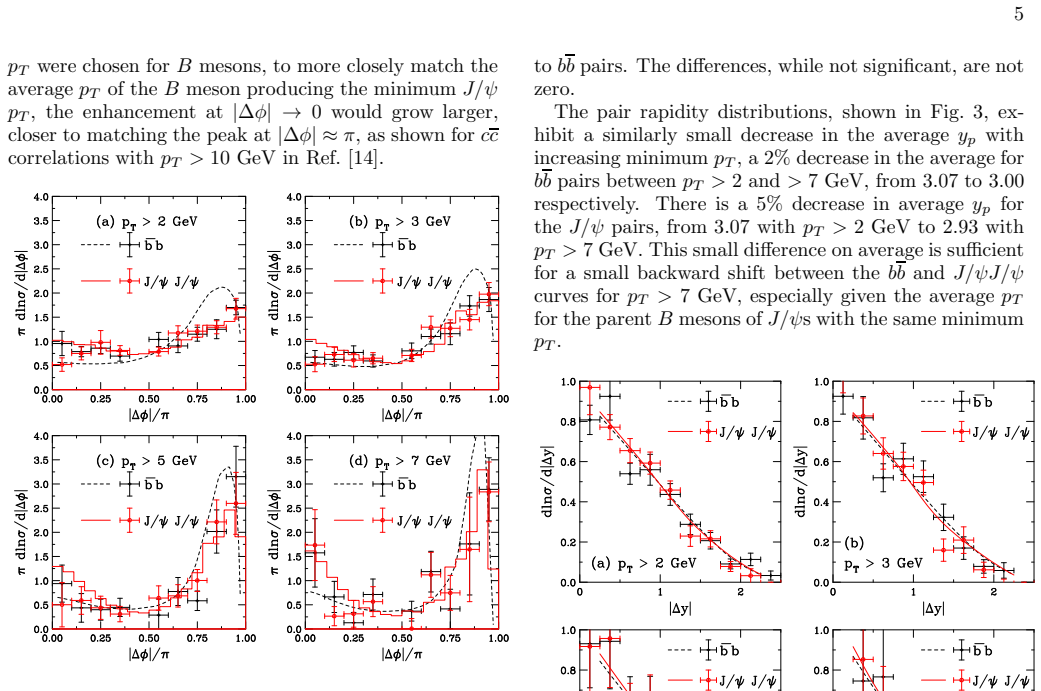
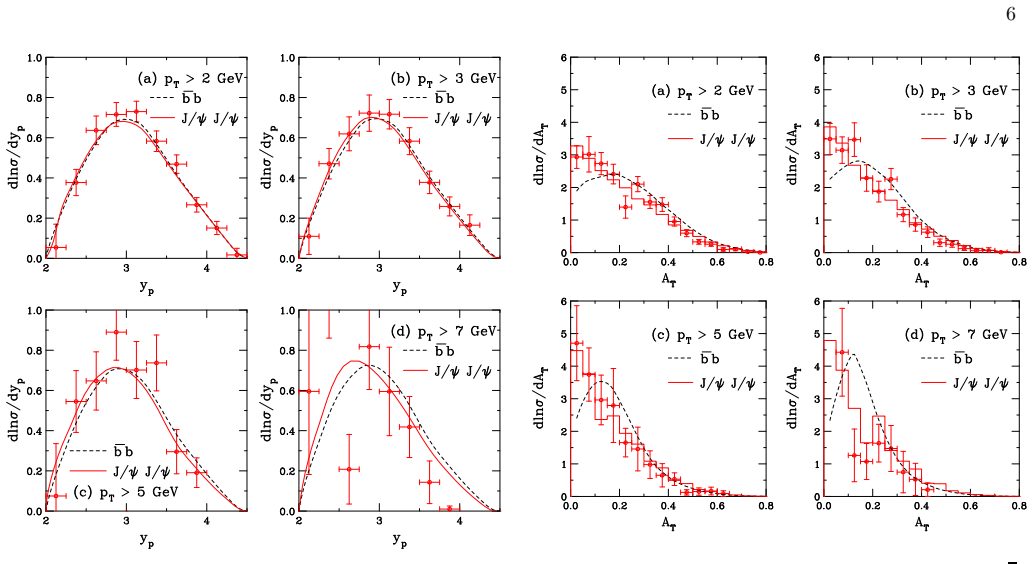
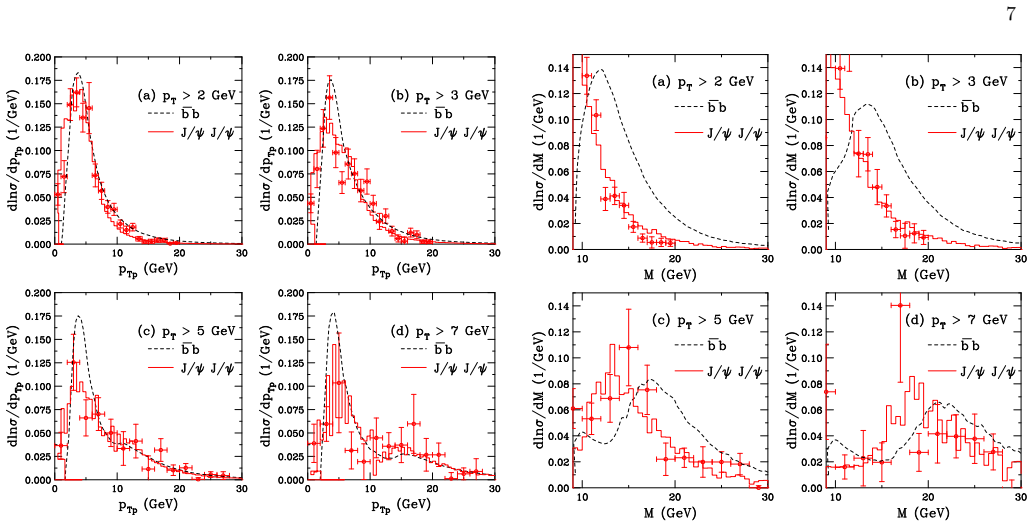
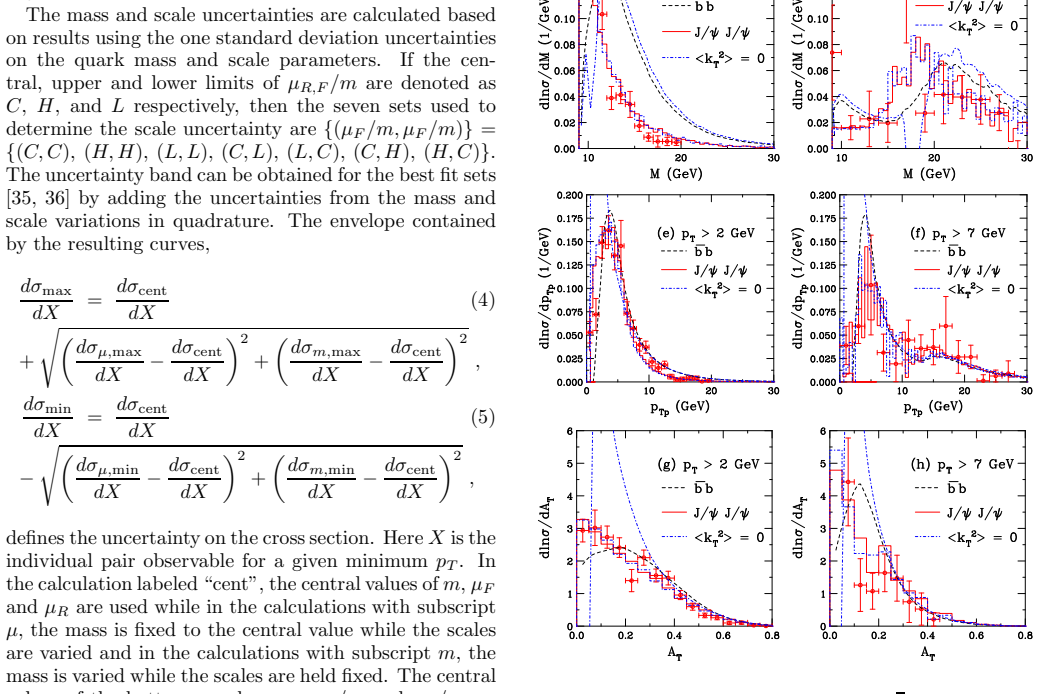
The central claim is that an exclusive next-to-leading-order treatment of $b\bar b$ production with a single Gaussian intrinsic $k_T$ broadening and Peterson fragmentation describes every LHCb measurement of $b\bar b \to J/\psi J/\psi$ correlations at 7 and 8 TeV, for minimum $J/\psi$ transverse momenta of 2, 3, 5 and 7 GeV in the forward rapidity range $2<y<4.5$. The same calculation reproduces the shapes of $|\Delta\phi|$, $|\Delta y|$, the pair rapidity, the transverse momentum asymmetry $A_T$, the pair transverse momentum, and the pair mass. The paper's key interpretive result is that the parent $b\bar b$ distributions retain a clear imprint of the $k_T$ broadening, while the $J/\psi$ pair distributions are almost unaffected, because the decay randomizes the $J/\psi$ momentum direction relative to the parent $B$ meson. Therefore measurements of $J/\psi$ decay products alone are not a good probe of initial-state broadening; direct $B$-meson pair observables would be. The paper also shows that mass and scale variations change normalization more than shape, and that its nuclear-modification scenarios separate effects: pair rapidity tracks fragmentation, while azimuthal separation tracks broadening.
Load-bearing premise
The claim rests on the assumption that one Gaussian transverse-momentum kick, applied with a single energy-dependent width to the produced pair, is an adequate stand-in for all non-perturbative and resummation effects on the pair's transverse momentum; if that equivalence fails at next-to-leading order, the calculated shapes can change.
Editorial extensions
If this is right
- The $p+p$ shapes of all six LHCb pair observables are stable between 7 and 8 TeV, so calculations at a single energy can be compared with the combined data.
- Because the $J/\psi$ decays decorrelate the final state from the parent pair, future measurements of reconstructed $B$-meson pairs would expose more of the intrinsic broadening signal that the decay channel hides.
- Measured pair-rapidity and azimuthal-separation ratios in proton-nucleus and nucleus-nucleus collisions can be used together: the first is sensitive mainly to fragmentation and energy loss, the second mainly to $k_T$ broadening.
- Mass and scale variations chiefly change the normalization of the pair distributions rather than their shapes, so comparisons of distribution shapes to data are robust against these theoretical uncertainties.
Reading between the lines
- If the decay-decorrelation argument is correct, the same Gaussian-smearing model applied to charm pairs should produce much stronger azimuthal modifications at accessible LHCb transverse momenta, since for charm the kick width is comparable to the quark mass; this gives a sharper test of the mechanism than bottom pairs do.
- The illustrative nuclear scenarios imply a quantitative strategy for heavy-ion data: a simultaneous fit of nuclear modification factors as functions of pair rapidity and azimuthal separation could separate energy loss from transverse-momentum broadening without relying on a full energy-loss calculation.
- A dedicated resummed or parton-shower-matched calculation with explicit all-order treatment of low pair transverse momentum would show whether the single Gaussian kick is absorbing a real physical effect or merely providing a tuned stand-in.
Signed reviews
Editorial analysis
A structured set of objections, weighed in public.
Referee Report
Summary. The manuscript presents next-to-leading-order calculations of b-bbar pair production in the exclusive HVQMNR framework, with Peterson fragmentation and Gaussian intrinsic-kT broadening, and compares the resulting b-meson-pair and J/psi-pair observables with LHCb measurements from p+p collisions at 7 and 8 TeV for four minimum pT thresholds. The paper reports good agreement for all six pair observables, studies the sensitivity of the results to kT broadening, evaluates mass and scale uncertainties, examines the rapidity dependence, and extends the model to p+Pb and Pb+Pb collisions by increasing the broadening and modifying the fragmentation parameter in order to illustrate possible cold-nuclear-matter effects. The main physical conclusions are that the NLO-plus-kT model can describe the LHCb correlated observables and that parent b-bbar pairs are more sensitive to kT broadening than the J/psi pairs produced in their decays.
Significance. If the central claim holds, the paper provides a useful baseline: a fixed-parameter NLO calculation tuned to single-particle data reproduces correlated b-bbar observables, and the comparison is a genuine prediction test rather than a fit, since the parameters mb, muF/m, muR/m, epsilon_P, and <kT^2> were set in Ref. [14] from total bbar cross sections, FONLL B-meson pT, and Upsilon pT data. The paper covers six observables and four pT cuts, which is a broad and valuable test, and the explanation that the isotropic B decay decorrelates the J/psi directions is a clean, nontrivial insight. The nuclear-matter section is explicitly illustrative rather than a quantitative prediction. The main weaknesses are the unquantified NLO kT-kick scheme, the mismatched selection used for the 'bb' comparisons, and the absence of any statistical measure of the claimed agreement; these need to be addressed before the central claim can be considered established.
major comments (3)
- [Sec. IV, Figs. 1-6] The calculated 'bb' distributions are obtained by applying the minimum pT cut to the parent B mesons, while the LHCb 'bb' data are selected by the daughter J/psi pT thresholds and the parent B pT is not measured. Because the B to J/psi decay is not collinear, a B meson with pT below the nominal threshold can produce a J/psi above it (the J/psi momentum in the B rest frame is about 1.7 GeV), and conversely a B meson above the threshold can produce a J/psi below it. The two phase-space regions are therefore different, and the comparison of |Delta phi*|, pTp, and AT in Figs. 1-6 may be biased. Please quantify this effect by repeating the 'bb' calculation with the actual acceptance, i.e. generating B pairs, decaying them, applying only the J/psi pT cuts, and constructing the vertex-derived direction variables, or otherwise justify that the B pT cut is a faithful proxy for the LHCb selection.
- [Sec. III, Eq. (3)] The kT kick is applied to the QQ pair in its rest frame, and the text explicitly states that this procedure is equivalent to an initial-state kick only at leading order, while at NLO a final-state light parton makes the correspondence inexact. This is the central approximation behind all the paper's results, including the comparison with <kT^2>=0 in Sec. V. Since the 2-to-3 configurations with a hard light parton are precisely what populate the small-|Delta phi| region and the shoulder in pTp, the claimed description of these shapes depends on an unquantified scheme choice. I request an estimate of the effect obtained by applying the kick to the full NLO final state instead of only to the pair, or a phase-space argument establishing that the difference is negligible for the observables under study.
- [Sec. IV, Figs. 1-6; Sec. IX] The paper's central claim that the calculations 'reproduce the data very well' and are in 'good agreement' is supported only by visual inspection. No chi-square, pull, or other goodness-of-fit metric is reported for any observable at any pT threshold. Given that the LHCb data and uncertainties are public, a quantitative comparison (e.g., chi2 per degree of freedom computed with the correlated systematic uncertainties, or a table of pulls) is feasible and would turn the qualitative claim into a testable statement. If such a metric cannot be provided, the wording should be softened to state that the calculations are consistent with the data within the model uncertainties.
minor comments (5)
- [Sec. VI, Eqs. (4)-(5)] The displayed uncertainty bands are constructed from mass and scale variations only; they do not include the uncertainty in <kT^2> or the scheme ambiguity discussed in Sec. III. This should be stated explicitly in the captions of Figs. 8 and 9, since a reader may otherwise interpret the bands as the total theoretical uncertainty.
- [Sec. VIII] The nuclear-matter discussion uses only the central EPS09 set and models energy loss by changing epsilon_P to the e+e- value. The text is appropriately cautious, but the final paragraph of Sec. IX should state more explicitly that the discriminating power between broadening and energy loss is demonstrated only within this toy model, not as a quantitative prediction for data.
- [Throughout] There are several typographical and grammatical errors that should be corrected: 'The bb pair distribution include' in Sec. IV; 'decrase' in Sec. VI; 'colliosions' in Ref. [4]; 'senstive' in Sec. IX; 'These contributions and summed together' in Sec. III; and 'The changes in the shadowing ratios is then small' in Sec. VIII.
- [Fig. 7] The caption uses 'J/psi' instead of the journal-style 'J/psi' used elsewhere; please make the notation consistent.
- [Sec. IV] For reproducibility, a table summarizing the central parameter values (mb, muF/m, muR/m, epsilon_P, Delta, and <kT^2> at the relevant energies) and their sources would be helpful; these values are currently scattered through the text and Ref. [14].
Circularity Check
No significant circularity: model parameters fixed to external single-particle data; LHCb pair observables are out-of-sample predictions.
full rationale
This paper is a model application rather than a first-principles derivation, and its validation against LHCb data is not equivalent to its inputs. The parameters mb, muF/m, muR/m, epsilon_p, and <kT^2> are imported from Ref. [14], where they were fixed using external data: total bbbar cross sections, FONLL B-meson pT distributions, and Upsilon pT distributions (Sec. III). None of the LHCb pair observables compared here — normalized (1/sigma)d sigma/dX shapes for |Delta phi|, |Delta y|, y_p, A_T, p_Tp, and M for both parent bbbar and J/psi J/psi pairs — were used in those fits. Moreover, because the comparisons are normalized to the total cross section, the absolute normalization information that fixed mb and the scales largely cancels, so the shape predictions are genuinely out-of-sample. The self-citation to Ref. [14] provides the model and parameter values, but Ref. [14] itself is benchmarked against independent data; no fitted parameter is renamed as a prediction. The Sec. III caveat that initial- versus final-state kT implementations are only equivalent at LO is a modeling limitation, not a circular reduction: it identifies an assumption whose failure could change the shapes, but the assumption is not derived from the target LHCb observables. No equation in the paper reduces by construction to its own input, so the appropriate finding is no significant circularity.
Assumptions & free parameters
free parameters (8)
- mb =
4.65 +/- 0.09 GeV
- muF/m =
1.40 (+0.77, -0.49)
- muR/m =
1.10 (+0.22, -0.20)
- epsilon_p (p+p) =
0.0004
- Delta (p+p) =
1
- Delta (p+Pb) =
2
- Delta (Pb+Pb) =
4
- epsilon_p (Pb+Pb) =
0.006
assumptions (5)
- domain assumption NLO perturbative QCD factorization is valid for bottom quark pair production at LHC energies.
- domain assumption The Gaussian kT smearing of Eq. (3) can represent the combined effect of intrinsic parton kT and resummation of soft gluons.
- domain assumption The same kT broadening and fragmentation parameters determined in Ref. [14] apply to b quark pair production in p+p collisions at 7 and 8 TeV.
- domain assumption The inclusive decay B to J/psi X with the PDG branching ratio of 1.094% captures the J/psi kinematics relevant to the LHCb acceptance.
- domain assumption Nuclear shadowing is described by central EPS09 NLO nPDFs, and the chosen enhanced kT and modified fragmentation parameters qualitatively represent cold nuclear matter effects.
Cite this review
Pith. "Pith review of $b \bar b$ Kinematic Correlations in Cold Nuclear Matter." pith.science (2026). https://pith.science/paper/GUTR6QX5
@misc{pith2026190805320,
  author       = {Pith},
  title        = {Pith review of: $b \bar b$ Kinematic Correlations in Cold Nuclear Matter},
  year         = {2026},
  howpublished = {\url{https://pith.science/paper/GUTR6QX5}},
  note         = {Machine review of arXiv:1908.05320}
}
abstract
Background: The LHCb Collaboration has studied a number of kinematic correlations between $B$-hadron pairs through their subsequent decays to $J/\psi$ pairs at 7 and 8 TeV for four minimum values of the $J/\psi$ $p_T$. Purpose: In this work, these measurements are compared to calculations of $b \bar b$ pairs and their hadronization and inclusive decays to $J/\psi J/\psi$ are compared to the same observables. Potential cold matter effects on the $b \bar b$ pair observables are discussed to determine which are most likely to provide insights about the system and why. Methods: The calculations, employing the exclusive HVQMNR code, assume the same intrinsic $k_T$-broadening and fragmentation as in [R. Vogt, Phys. Rev. C {\bf 98} (2018) 034907]. The pair distributions presented by LHCb are calculated in this approach, both for the parent $b \bar b$ and the $J/\psi J/\psi$ pairs produced in their decay. The sensitivity of the results to the intrinsic $k_T$ broadening is shown. The theoretical uncertainties due to the $b$ quark mass and scale variations on both the initial $b \bar b$ pairs and the resulting $J/\psi$ pairs are also shown. Possible effects due to the presence of the nucleus are studied by increasing the size of the $k_T$ broadening and modification of the fragmentation parameter. Results: Good agreement with the LHCb data is found for all observables. The parent $b \bar b$ distributions are more sensitive to the $k_T$ broadening than are the final-state $J/\psi$ pairs. Conclusions: Next-to-leading order calculations with $k_T$ broadening, as in [R. Vogt, Phys. Rev. C {\bf 98} (2018) 034907], can describe all correlated observables. Multiple measurements of correlated observables are sensitive to different nuclear effects which can help distinguish between them.
Figures

Figures from the paper (13 more)




Reference graph
Works this paper leans on
-
[14]
Vogt, Heavy Flavor Azimuthal Correlations in Cold Nuclear Matter, Phys
R. Vogt, Heavy Flavor Azimuthal Correlations in Cold Nuclear Matter, Phys. Rev. C 98 (2018) 034907
work page 2018
-
[1]
C. Albajar et al. (UA1 Collaboration), Measurement of bb correlations at the CERN pp collider, Z. Phys. C 61 (1994) 41
work page 1994
-
[2]
B. Abbot et al. (D0 Collaboration), The bb production cross section and angular correlations in pp collisions at√s = 1. 8 TeV, Phys. Lett. B 487 (2000) 264
work page 2000
-
[3]
D. Acosta et al. (CDF Collaboration), Measurements of bb azimuthal production correlations in pp collisions at 17 √s = 1. 8 TeV, Phys. Rev. D 71 (2005) 092001
work page 2005
-
[4]
T. Aaltonen et al. (CDF Collaboration), Measurement of correlated bb production in pp colliosions at √s = 1960 TeV, Phys. Rev. D 77 (2008) 072004
work page 2008
-
[5]
M. Aaboud et al. (ATLAS Collaboration), Measurement of b-hadron pair production with the ATLAS detector in proton-proton collisions at √s = 8 TeV, JHEP 1711 (2017) 062
work page 2017
-
[6]
C. Aidala et al. (PHENIX Collaboration), Correlations of µµ ,eµ , and ee pairs in p +p collisions at √s = 200 GeV and implications for cc and bb production mechanisms, arXiv:1805.04075
-
[7]
S. Acharya et al. [ALICE Collaboration], Dielectron pro- duction in proton-proton collisions at √s = 7 TeV, JHEP 1809, 064 (2018)
work page 2018
Show all 56 references
-
[8]
Acharya et al
S. Acharya et al. [ALICE Collaboration], Dielectron and heavy-quark production in inelastic and high-multiplicit y protonproton collisions at √sN N = 13 TeV, Phys. Lett. B 788, 505 (2019)
2019
-
[9]
F. E. Paige and S. D. Protopopescu, Isajet 5.20: A Monte Carlo Event Generator for pp and ¯pp Interactions, Conf. Proc. C 860115, 213 (1986)
1986
-
[10]
[2] as: M
Cited in Ref. [2] as: M. Baarmand and F. Paige. HVQ- JET Monte Carlo Event Generator, private communica- tion
-
[11]
Corcella et al
G. Corcella et al. , HER WIG 6: An event generator for hadron emission reactions with interfering gluons (includ - ing supersymmetric processes), JHEP 0101, 010 (2001)
2001
-
[12]
Sjostrand et al
T. Sjostrand et al. , High-energy physics event generation with PYTHIA 6.1, Comput. Phys. Commun. 135, 238 (2001); arXiv:hep-ph/0308153
2001 arXiv
-
[13]
M. L. Mangano, P. Nason, and G. Ridolfi, Heavy quark correlations in hadron collisions at next-to-leading orde r, Nucl. Phys. B 373, 295 (1992)
1992
-
[15]
Aaij et al
R. Aaij et al. (LHCb Collaboration), Study of b b corre- lations in high energy proton-proton collisions, JEHP 11 (2017) 030
2017
-
[16]
In this work, the model of Q Q production developed in Ref
and by LHCb at √s = 7 TeV [17] and B hadron-b jet pairs measured by CMS at √s = 7 TeV [18], it allows a more straightforward comparison to calculations than the dilepton decay channel. In this work, the model of Q Q production developed in Ref. [14], with modified fragmentation...
-
[17]
Aaij et al
R. Aaij et al. [LHCb Collaboration], Observation of dou- ble charm production involving open charm in pp colli- sions at √ s = 7 TeV, JHEP 1206, 141 (2012), [JHEP 1403, 108 (2014)]
2012
-
[18]
Reisert et al
B. Reisert et al. [CDF Collaboration], Charm Produc- tion Studies at CDF, Nucl. Phys. Porc. Suppl. 170, 243 (2007)
2007
-
[19]
Sjostrand, S
T. Sjostrand, S. Mrenna and P. Z. Skands, PYTHIA 6.4 physics and manual, JHEP 05 (2006) 026
2006
-
[20]
Khachatryan et al
V. Khachatryan et al. [CMS Collaboration], Measure- ment of BB Angular Correlations based on Seconary Verte Reconstruction at √s = 7 TeV, JHEP 1105, 136 (2011)
2011
-
[21]
Frixione, P
S. Frixione, P. Nason, and G. Ridolfi, A positive- weight next-to-leading-order Monte Carlo for heavy flavour hadroproduction, JHEP 0709, 126 (2007); arXiv:0707.3081 [hep-ph]
2007 arXiv
-
[22]
Sjostrand, S
T. Sjostrand, S. Mrenna and P. Z. Skands, A brief intro- duction to PYTHIA 8.1, Comp. Phys. Comm. 178 (2008) 852
2008
-
[23]
Aaij et al
R. Aaij et al. [LHCb Collaboration], Production of J/ψ and Υ mesons in pp collisions at √s = 8 TeV, JHEP 1306, 064 (2013)
2013
-
[24]
Aaij et al
R. Aaij et al. [LHCb Collaboration], Measurement of J/ψ production in pp collisions at √ s = 7 TeV, Eur. Phys. J. C 71, 1645 (2011)
2011
-
[25]
Bedjidian et al., Hard probes in heavy ion collisions at the LHC: Heavy flavor physics, arXiv:hep-ph/0311048
M. Bedjidian et al., Hard probes in heavy ion collisions at the LHC: Heavy flavor physics, arXiv:hep-ph/0311048
-
[26]
Norrbin and T
E. Norrbin and T. Sj¨ ostrand, Production and Hadroniza - tion of Heavy Quarks, Eur. Phys. J C 17, 137 (2000)
2000
-
[27]
Cacciari, M
M. Cacciari, M. Greco and P. Nason, The pT spectrum in heavy flavor hadroproduction, JHEP 05, 007 (1998)
1998
-
[28]
Peterson, D
C. Peterson, D. Schlatter, I. Schmitt, and P. Zerwas, Scaling Violations in Inclusive e+e− Annihilation Spec- tra, Phys. Rev. D 27 (1983) 105
1983
-
[29]
Helenius and H
I. Helenius and H. Paukkunen, Revisiting the D meson hadroproduction in general-mass variable flavour number scheme, JHEP 1805, 196 (2018)
2018
-
[30]
B. A. Kniehl, G. Kramer, I. Schienbein and H. Spies- berger, Inclusive D∗ + production in pp collisions with massive charm quarks, Phys. Rev. D 71, 014018 (2005)
2005
-
[31]
Frixione, M
S. Frixione, M. L. Mangano, P. Nason and G. Ridolfi, Charm and bottom production: theoretical results versus experimental data, Nucl. Phys. B 431, 453 (1994)
1994
-
[32]
C. Y. Lo and J. D. Sullivan, Transverse Momentum Dis- tributions in Drell-Yan Processes, Phys. Lett. B 86, 327 (1979)
1979
-
[33]
Chiappeta and M
P. Chiappeta and M. Greco, Transverse Momentum Dis- tributions for Drell-Yan Pairs in QCD, Phys. Lett. B 106, 219 (1981)
1981
-
[34]
Altarelli, G
G. Altarelli, G. Parisi and R. Petronzio, Transverse Mo - mentum in Drell-Yan Processes, Phys. Lett. B 76, 351 (1978)
1978
-
[35]
R. E. Nelson, R. Vogt and A. D. Frawley, Narrowing the uncertainty on the total charm cross section and its effect on theJ/ψ cross section, Phys. Rev. C 87, 014908 (2013)
2013
-
[36]
Tanabashi et al
M. Tanabashi et al. [Particle Data Group], Review of Particle Physics, Phys. Rev. D 98, 030001 (2018)
2018
-
[37]
Vogt, Shadowing effects on J/ψ and Υ production at energies available at the CERN Large Hadron Collider, Phys
R. Vogt, Shadowing effects on J/ψ and Υ production at energies available at the CERN Large Hadron Collider, Phys. Rev. C 92, 034909 (2015)
2015
-
[38]
R. E. Nelson, R. Vogt and A. D. Frawley, in preparation
-
[39]
Younus, U
M. Younus, U. Jamil and D. K. Srivastava, Correlations of Heavy Quarks Produced at Large Hadron Collider, J. Phys. G 39, 025001 (2012)
2012
-
[40]
Nahrgang, J
M. Nahrgang, J. Aichelin, P. B. Gossiaux and K. Werner, Azimuthal correlations of heavy quarks in Pb + Pb col- lisions at √ s = 2. 76 TeV at the CERN Large Hadron Collider, Phys. Rev. C 90, 024907 (2014)
2014
-
[41]
Younus, S
M. Younus, S. K. Tripathy, P. K. Sahu and Z. Niak, Az- imuthal correlations of D-mesons in p +p andp+Pb col- lisions at LHC energies, Eur. Phys. J. A 53, 112 (2017)
2017
-
[42]
As noted in Ref
for each of the LHCb pT cuts. As noted in Ref. [14] and in Figs. 8 and 9, if ⟨k2 T ⟩ is kept fixed, the mass and scale uncertainties do not substantially change the shapes of the distributions. The central gluon modification of the latest nPDF set, EPPS16 [43], is not significant...
-
[43]
Younus and D
M. Younus and D. K. Srivastava, Effect of Energy Loss on Azimuthal Correlations of charm and correlated charm decay in collision of lead nuclei at √ s = 2. 76 ATeV, J. Phys. G 40, 065004 (2013)
2013
-
[44]
K. J. Eskola, H. Paukkunen and C. A. Salgado, EPS09: A New Generation of NLO and LO Nuclear Parton Dis- tribution Functions, JHEP 0904, 065 (2009)
2009
-
[45]
K. J. Eskola, P. Paakkinen, H. Paukkunen and C. A. Sal- gado, EPPS16: Nuclear parton distributions with LHC data, Eur. Phys. J. C 77, 163 (2017)
2017
-
[46]
J. L. Albacete et al. , Predictions for Cold Nuclear Matter Effects in p+Pb Collisions at √ sNN = 8. 16 TeV, Nucl. Phys. A 972, 18 (2018)
2018
-
[47]
Vogt, Relation of hard and total cross-sections to ce n- trality, Acta Phys
R. Vogt, Relation of hard and total cross-sections to ce n- trality, Acta Phys. Hung. A 9, 339 (1999)
1999
-
[48]
R. Vogt, B. V. Jacak, P. L. McGaughey and P. V. Ru- uskanen, Rapidity distribution of dileptons from a 18 hadronizing quark-gluon plasma, Phys. Rev. D 49, 3345 (1994)
1994
-
[49]
Mischke, A new correlation method to identify and separate charm and bottom production processes at RHIC, Phys
A. Mischke, A new correlation method to identify and separate charm and bottom production processes at RHIC, Phys. Lett. B 671, 361 (2009)
2009
-
[50]
Helenius and H
I. Helenius and H. Paukkunen, Double D-meson produc- tion in proton-proton and proton-lead collisions at the LHC, arXiv:1906.06971
1906 arXiv
-
[51]
Aaij et al
R. Aaij et al. [LHCb Collaboration], Prompt and non- prompt J/ψ production and nuclear modification in pPb collisions at √ sNN = 8. 16 TeV, Phys. Lett. B 774, 159 (2017)
2017
-
[52]
Aaij et al
R. Aaij et al. [LHCb Collaboration], Measurement of B+, B0 and Λ 0 b production in pPb collisions at √ sNN =
-
[53]
16 TeV, Phys. Rev. D 99, 052011 (2019)
2019
-
[54]
J. P. Lansberg and H. S. Shao, Towards an automated tool to evaluate the impact of the nuclear modification of the gluon density on quarkonium, D and B meson pro- duction in protonnucleus collisions, Eur. Phys. J. C 77, 1 (2017)
2017
-
[55]
Vitev, T
I. Vitev, T. Goldman, M. B. Johnson and J. W. Qiu, Phys. Rev. D 74, 054010 (2006)
2006
-
[56]
Andronic et al
A. Andronic et al. , Heavy-flavour and quarkonium pro- duction in the LHC era: from protonproton to heavy-ion collisions, Eur. Phys. J. C 76, 107 (2016)
2016
Reviewed August 14, 2026 · model on record in the stance chip above.
Discussion (0). Continue with ORCID to comment.