REVIEW 3 major objections 5 minor 42 references
On Separating Points for Ensemble Controllability
T0 review · 3 major / 5 minor · reviewed 2026-08-14 · deepseek-v4-flash
Pith's one-line read The paper proves that uniform ensemble controllability of time-invariant linear ensembles with real eigenvalues is equivalent to finite-dimensional controllability tests on reparameterized individual systems, captured by the rank of an…
desk verdict The scalar Gramian rank test is a genuinely useful result and likely correct, but the multidimensional part leans on an unproven continuous-triangularization assumption, and the proof of the scalar theorem is too sloppy as written. read the letter →
The pith
A machine-rendered reading of the paper's core claim, the machinery that carries it, and where it could break.
The reading
What carries the argument
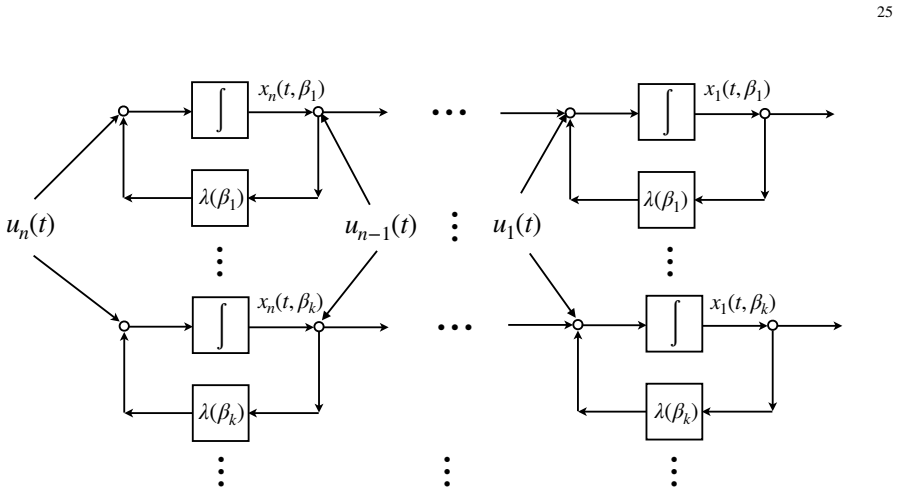
The load-bearing object is the Ensemble Controllability Gramian $D(\eta)$, a matrix whose rows are the control row vectors $b(\beta)$ evaluated at the $\kappa(\eta)$ parameter values with $a(\beta)=\eta$ (or, in the multidimensional case, at the preimages of each eigenvalue). It carries the argument by turning the density question for the Lie algebra generated by the drift and control fields into a linear-algebra statement: full row rank means the control fields separate every pair of parameter values lying on different injective branches of the drift. The second mechanism is the reparameterization map that rewrites an $n$-dimensional ensemble, coordinate by coordinate, as a one-dimensional ensemble whose drift is built from the eigenvalue functions; this reduces multidimensional controllability to the scalar separating-points criterion. The Stone–Weierstrass theorem supplies the final step: a closed subalgebra of $C(K,\mathbb{R})$ that separates points and contains constants is dense, so controllability is equivalent to separation.
What would settle it
Exhibit a continuous family $A(\beta)$ on a compact interval with real eigenvalues for which no continuous global triangularization exists, and choose $B(\beta)$ so that the induced reparameterized diagonal system is controllable for every eigenvalue tuple. If the original ensemble is not uniformly ensemble controllable on $C(K,\mathbb{R}^n)$—for instance, if the closure of the Lie algebra generated by the drift and control fields is not all of $C(K,\mathbb{R}^n)$—then the paper's Theorem 4 equivalence is false; a direct check on such a two-dimensional crossing example would settle the point.
Extended reading notes
Core claim
At the center is a dictionary between ensemble controllability and separation of points. The paper proves (Theorem 1) that the scalar multi-input ensemble $\frac{d}{dt}x(t,\beta)=a(\beta)x(t,\beta)+\sum_{i=1}^m b_i(\beta)u_i(t)$ is uniformly ensemble controllable on $C(K,\mathbb{R})$ if and only if $\operatorname{span}\{b_1|_{a^{-1}(\eta)},\dots,b_m|_{a^{-1}(\eta)}\}=C(a^{-1}(\eta),\mathbb{R})$ for every $\eta$ in the range of $a$; because each preimage is finite, this is equivalent to $\operatorname{rank}(D(\eta))=\kappa(\eta)$, where $D(\eta)$ is the Ensemble Controllability Gramian. The multidimensional analogue (Theorems 2–4) states that when $A(\beta)$ is diagonalizable or upper-triangularizable with real eigenvalues, the $n$-dimensional ensemble is uniformly ensemble controllable if and only if the reparameterized system, with each coordinate indexed by its own eigenvalue $\eta_i=\lambda_i(\beta)$, is controllable on $\mathbb{R}^N$ for every eigenvalue tuple; $N$ is the total number of preimage points. In particular, coincident eigenvalues and non-injective eigenvalue functions do not destroy controllability as long as enough independent controls separate the branches. The paper also shows that a Jordan-block drift requires as many controls as the system dimension, in contrast to the single chain of integrators familiar from finite-dimensional linear control.
Load-bearing premise
The multidimensional claims rest on the premise that $A(\beta)$ can be continuously transformed to diagonal or upper-triangular form with the same real eigenvalue functions on the whole parameter set; if such a continuous transformation does not exist, the reparameterization step and hence the equivalence can fail.
Editorial extensions
If this is right
- If the main theorems are correct, a scalar linear ensemble with drift $a$ is uniformly ensemble controllable exactly when the number of controls is at least the maximum number of parameter values sharing a drift value and the Gramian $D(\eta)$ has full rank at every $\eta$.
- For $n$-dimensional ensembles with real eigenvalues, checking ensemble controllability reduces to checking finite-dimensional controllability of the reparameterized system for each eigenvalue tuple; no infinite-dimensional approximation is needed.
- State coupling does not reduce the control budget: an ensemble whose drift is a single Jordan block requires $n$ independent controls, the same number as an ensemble with $n$ coincident real eigenvalues.
- The separating-points argument carries over to $L^p_n(K,\mu)$ and to $C_0(\Omega,\mathbb{R}^n)$ because $C(K,\mathbb{R}^n)$ is dense in those spaces, so the rank conditions extend beyond compact parameter intervals and continuous state spaces.
- For the linear-parameter-variation family $\frac{d}{dt}X=\beta A X+B U$, the criterion recovers the previously known necessary and sufficient conditions, including the requirement $\operatorname{rank}(B)=n$ when $0$ lies in the parameter interval.
Reading between the lines
- The rank test suggests a design rule the paper does not spell out: choose $m$ control channels and tune the functions $b_i(\beta)$ so that their evaluations on each preimage set are linearly independent, turning a verification criterion into a constructive control-design recipe.
- A testable extension is to non-diagonalizable or non-real-spectrum ensembles: because the proofs lean on continuous triangularization, systems whose eigenvalue curves cross or whose eigenvectors cannot be chosen continuously may need a condition stated in terms of invariant subspaces rather than individual eigencurves.
- The dictionary between separating points and controllability may carry over to nonlinear ensembles whose vector fields generate a separating Lie algebra; if so, the finite-dimensional Gramian test would become a general algebraic condition for population controllability.
- Because the reparameterized individual systems are finite-dimensional, the result suggests that for linear ensembles the only genuinely infinite-dimensional obstruction is the geometry of the parameter-to-spectrum map, not functional analytic complexity.
Signed reviews
Editorial analysis
A structured set of objections, weighed in public.
Referee Report
Summary. The paper studies uniform ensemble controllability of time-invariant linear ensemble systems on C(K,R^n), where K is a compact subset of R. The authors introduce the idea of separating points and define an Ensemble Controllability Gramian. The main scalar result, Theorem 1, characterizes controllability of the multi-input scalar system by the condition that the control fields b_i restricted to each level set of the drift a span all continuous functions on that level set; Corollary 1 turns this into a finite-dimensional rank condition. The paper then extends the framework to multi-dimensional systems with diagonalizable drift and real eigenvalues (Theorems 2 and 3), to Jordan-block drift (Proposition 2 and Corollary 2), and finally to general real-eigenvalue matrices via triangularization (Theorem 4). The overarching claim is that ensemble controllability on an infinite-dimensional function space can be checked by finite-dimensional controllability tests on the reparameterized systems.
Significance. If the results are correct, the paper offers a clean and potentially useful algebraic criterion for a broad class of linear ensemble systems: the scalar condition 'separating points on every fiber' and the associated rank test for the Ensemble Controllability Gramian are natural and go beyond earlier necessary or sufficient conditions. The reparameterization viewpoint and the connection to the previous linear-parameter-variation results in [23] are valuable. The paper is also clearly written and the examples are illuminating. However, the multidimensional claims currently rest on several proof gaps, and the proof of the scalar Theorem 1 itself contains an unjustified inference, so the significance is conditional on a rigorous repair of these arguments.
major comments (3)
- [Section II-B, proof of Theorem 1] The sufficiency proof contains an unjustified inference. After showing that L0|Ki = C(Ki,R) and that A|Ki is contained in L0|Ki, the text concludes 'A⊆L0' (page 9). This does not follow: a function whose restriction to each set of a partition lies in the restriction of a linear space need not itself belong to that global linear space. At best one could hope for A being contained in the closure of L0 in the uniform topology, but that containment is not shown. Additionally, the proof invokes Proposition 1 for the multi-input system restricted to Ki, although Proposition 1 is a single-input statement. Since Theorem 1 and its Corollary 1 underpin the multidimensional results, this gap is load-bearing and must be repaired, for example by proving directly that the closure of L0 is a subalgebra using the fiberwise rank condition.
- [Section III-A, Lemma 1 and Theorems 2–3] The multidimensional proofs are sketched to a degree that is not sufficient for the claims made. Lemma 1 is proved by asserting the existence of a bijective parameterization ψ and then checking the scalar Gramian, but the appendix construction only treats the two-dimensional case and the equivalence between controllability of the original two-dimensional system on C(K,R^2) and controllability of the scalar system on C(K′,R) is not fully justified. Theorem 2's induction step (page 18) is a single paragraph: for n=k+1, the proof forms a vector with the scalarized first k states and the (k+1)-st state, but it does not verify that the resulting two-dimensional system satisfies the hypotheses of Lemma 1, nor that the induction hypothesis transfers to the coupled system with shared control U. Theorem 3's proof ends with 'the rest of the proof directly follows the same case discussed in Theorem 2' (page 19), which does not address the coupling among the n scalar sub-ensembles. These are central gaps for the main multidimensional characterization.
- [Section III-B, Theorem 4] Theorem 4 assumes that A(β) can be transformed to an upper triangular matrix T(β), but the paper does not prove that the transformation P(β) can be chosen continuously in β. A pointwise triangularization with a discontinuous P would not preserve uniform ensemble controllability on C(K,R^n), since the induced map on the function space would not be a bounded isomorphism. Note that the example A(β)=[[0,1],[β,0]] from the stress-test is not an actual counterexample: T(β)=[[√β,1],[0,−√β]] is continuous on [0,1] and similar to A(β) for every β. Still, the general existence of a continuous real Schur form is not automatic when eigenvalue multiplicities change, and the manuscript supplies no proof. The proof also relies on Corollary 2, whose statement is itself not rigorous: it refers to both J and Λ and never states that the similarity P(β) is continuous. Theorem 4 therefore needs an explicit lemma on continuous triangularization (or an explicit assumption) before the equivalence (i)⇔(ii) is established.
minor comments (5)
- [Abstract] The phrase 'This means enables the characterization' is ungrammatical and should be rewritten.
- [Remark 4] The word 'reparameteriezed' in Remark 4 is a typo; it should be 'reparameterized'.
- [Corollary 2] The notation in Corollary 2 is inconsistent: it introduces P^{-1}AP=Λ, but then writes the transformed equation as dY/dt = JY + B̃U, and later refers to Z without defining it. The intended system should be stated clearly.
- [Theorem 4] The statement of Theorem 4 says 'This system is uniformly ensemble controllable' in part (i) without clearly identifying whether 'this system' is the original X-system or the transformed Y-system; since the theorem is formulated after a triangularizing transformation, the relation back to the original system should be explicit.
- [Remark 6] The claim that the results extend to Lp_n(K,μ) because C(K,R^n) is dense in Lp_n(K,μ) needs more justification: density of a subset of states does not by itself transfer an approximation property of a particular control-linear reachable set from the uniform norm to the Lp norm.
Circularity Check
No circular derivation: the central rank criteria are proved in-paper from Stone-Weierstrass and explicit reparameterizations; the only self-citation is a consistency check, not a premise.
full rationale
The paper's main claims are derived self-contained. Proposition 1 proves the scalar single-input criterion directly from the Lie algebra of reachable states and Weierstrass approximation. Theorem 1 proves the multi-input fiberwise rank condition by separating points in each fiber a^{-1}(eta) and applying Stone-Weierstrass, with the necessity direction obtained by restricting an assumed ensemble-controllable system to each fiber. Corollary 1 is a literal translation of Theorem 1 through the isomorphism C(a^{-1}(eta), R) = R^{kappa(eta)}, not a new input. The multidimensional results in Theorems 2-4 and Proposition 2 are reductions to the scalar criteria via explicit coordinate transformations and reparameterization maps constructed in the paper and its appendix; they do not assume the desired controllability conclusion. The only self-citation is [23] in Example 4, where the authors note that their independently derived rank conditions coincide with earlier linear-parameter-variation conditions; this is a cross-check, not a load-bearing premise. The correctness concern raised about Theorem 4, namely that a continuous family A(beta) with real eigenvalues need not admit a continuous global triangularization P(beta) (e.g., A(beta)=[[0,1],[beta,0]] on [0,1]), is a proof-gap or correctness issue, not circularity, because the theorem is not derived by assuming its own equivalence or by fitting a parameter to the target result. Accordingly, no circular step is identified; the modest score reflects only the presence of a non-load-bearing self-reference.
Assumptions & free parameters
assumptions (5)
- standard math Stone-Weierstrass theorem
- standard math Weierstrass approximation theorem
- domain assumption Lie algebra characterization of ensemble controllability
- domain assumption Continuous diagonalization or triangularization of A(beta)
- domain assumption Piecewise constant controls and compact parameter set
Cite this review
Pith. "Pith review of On Separating Points for Ensemble Controllability." pith.science (2026). https://pith.science/paper/I3G27E5V
@misc{pith2026190805323,
  author       = {Pith},
  title        = {Pith review of: On Separating Points for Ensemble Controllability},
  year         = {2026},
  howpublished = {\url{https://pith.science/paper/I3G27E5V}},
  note         = {Machine review of arXiv:1908.05323}
}
read the original abstract
Recent years have witnessed a wave of research activities in systems science toward the study of population systems. The driving force behind this shift was geared by numerous emerging and ever-changing technologies in life and physical sciences and engineering, from neuroscience, biology, and quantum physics to robotics, where many control-enabled applications involve manipulating a large ensemble of structurally identical dynamic units, or agents. Analyzing fundamental properties of ensemble control systems in turn plays a foundational and critical role in enabling and, further, advancing these applications, and the analysis is largely beyond the capability of classical control techniques. In this paper, we consider an ensemble of time-invariant linear systems evolving on an infinite-dimensional space of continuous functions. We exploit the notion of separating points and techniques of polynomial approximation to develop necessary and sufficient ensemble controllability conditions. In particular, we introduce an extended notion of controllability matrix, called Ensemble Controllability Gramian. This means enables the characterization of ensemble controllability through evaluating controllability of each individual system in the ensemble. As a result, the work provides a unified framework with a systematic procedure for analyzing control systems defined on an infinite-dimensional space by a finite-dimensional approach.
Figures

Reference graph
Works this paper leans on
- [23]
-
[1]
T. M. A POSTOL , Mathematical Analysis, Addison-Wesley series in mathematics, Addison- Wesley, 2 ed., 1974
work page 1974
-
[2]
N. A UGIER , U. B OSCAIN , AND M. S IGALOTTI , Adiabatic ensemble control of a continuum of quantum systems, SIAM Journal on Control and Optimization, 56 (2018), pp. 4045–4068
work page 2018
-
[3]
A. B ECKER AND T. B RETL , Approximate steering of a unicycle under bounded model perturbation using ensemble control , IEEE Transactions on Robotics, 28 (2012), pp. 580– 591
work page 2012
-
[4]
M. B ELHADJ , J. S ALOMON , AND G. T URINICI , Ensemble controllability and discrimi- nation of perturbed bilinear control systems on connected, simple, compact lie groups , European Journal of Control, 22 (2015), pp. 23–29
work page 2015
- [5]
-
[6]
X. C HEN, Structure theory for ensemble controllability, observability, and duality , Mathe- matics of Control, Signals, and Systems, 31 (2019), pp. 1–40. August 16, 2019 DRAFT 32
work page 2019
-
[7]
Y. C HEN, Modeling and control of collective dynamics: From schroedinger bridges to optimal mass transport , May 2016
work page 2016
Show all 42 references
-
[8]
C HEN , T
Y. C HEN , T. G EORGIOU , AND M. P AVON, Optimal steering of ensembles , the 22nd International Symposium on Mathematical Theory of Networks and Systems, Minneapolis, MN, USA, (2016)
2016
-
[9]
C HING AND J
S. C HING AND J. T. R ITT, Control strategies for underactuated neural ensembles driven by optogenetic stimulation. , Front Neural Circuits, 7 (2013), p. 54
2013
-
[10]
D IRR , U
G. D IRR , U. H ELMKE , AND M. S CH ¨ONLEIN , Controlling mean and variance in ensembles of linear systems , IFAC-PapersOnLine, 49 (2016), pp. 1018–1023. 10th IFAC Symposium on Nonlinear Control Systems NOLCOS 2016
2016
-
[11]
G. B. F OLLAND , Real Analysis, John Wiley and Sons, Inc., 1999
1999
-
[12]
S. J. G LASER , T. S CHULTE -HERBR ¨UGGEN , M. S IEVEKING , N. C. N. O. S CHEDLETZKY , O. W. S ØRENSEN , AND C. G RIESINGER , Unitary control in quantum ensembles, maximiz- ing signal intensity in coherent spectroscopy , Science, 280 (1998), pp. 421–424
1998
-
[13]
H ELMKE AND M
U. H ELMKE AND M. S CH ¨ONLEIN , Uniform ensemble controllability for one-parameter families of time-invariant linear systems , Systems and Control Letters, 71 (2014), pp. 69– 77
2014
-
[14]
J IANG , D
M. J IANG , D. D ONG , AND R. W U, Multiple independent quantum states sharing under collaboration of agents in quantum networks , Quantum Information Processing, 11 (2012), pp. 1829–1844
2012
-
[15]
K AFASHAN AND S
M. K AFASHAN AND S. CHING , Optimal stimulus scheduling for active estimation of evoked brain networks, Journal of Neural Engineering, 12 (2015), p. 066011
2015
-
[16]
I. Z. K ISS , C. G. R USIN , H. K ORI , AND J. L. H UDSON , Engineering complex dynamical structures: Sequential patterns and desynchronization, Science, 316 (2007), pp. 1886–1889
2007
-
[17]
I. Z. K ISS , I. Z HAI , AND J. H UDSON , Emerging coherence in a population of chemical oscillators, Science, 296 (2002), pp. 1676–1678
2002
-
[18]
K URITZ , S
K. K URITZ , S. Z ENG , AND F. ALLG ¨OWER , Ensemble controllability of cellular oscillators, IEEE Control Systems Letters, 3 (2019), pp. 296–301
2019
-
[19]
L I, Ensemble control of bloch equations , IEEE Transactions on Automatic Control, 54 (2009), pp
J.-S. L I, Ensemble control of bloch equations , IEEE Transactions on Automatic Control, 54 (2009), pp. 528–536
2009
-
[20]
, Ensemble control of finite-dimensional time-varying linear system, IEEE Transactions on Automatic Control, 56 (2011), pp. 345–357. August 16, 2019 DRAFT 33
2011
-
[21]
J.-S. L I, I. D ASANAYAKE , AND J. R UTHS , Control and synchronization of neuron ensembles, IEEE Transactions on Automatic Control, 58 (2013), pp. 1919–1930
2013
-
[22]
L I AND N
J.-S. L I AND N. K HANEJA , Control of inhomogeneous quantum ensembles , Physical Review A, 73 (2006), p. 030302
2006
-
[24]
J.-S. L I, J. R UTHS , AND S. G LASER , Exact broadband excitation of two-level systems by mapping spins to springs , Nature Communications, 1 (2017), p. 446
2017
-
[25]
J.-S. L I, J. RUTHS , T.-Y. YU, H. A RTHANARI , AND G. WAGNER , Optimal pulse design in quantum control: A unified computational method , Proceedings of the National Academy of Sciences, 108 (2011), pp. 1879–1884
2011
-
[26]
P HELPS , Q
C. P HELPS , Q. G ONG , J. O. M. R OYSET , C. W ALTON , AND I. K AMINER , Consistent ap- proximation of a nonlinear optimal control problem with uncertain parameters, Automatica, 50 (2014), pp. 2987–2997
2014
-
[27]
P HELPS , J
C. P HELPS , J. O. R OYSET , AND Q. G ONG, Optimal control of uncertain systems using sample average approximations , SIAM Journal on Control and Optimization, 54 (2016), pp. 1–29
2016
-
[28]
P OLITI , Collective Dynamics in Neural Networks , Springer International Publishing, Cham, 2015, pp
A. P OLITI , Collective Dynamics in Neural Networks , Springer International Publishing, Cham, 2015, pp. 21–25
2015
-
[29]
M. G. R OSENBLUM AND A. S. P IKOVSKY , Controlling synchronization in an ensemble of globally coupled oscillators , Phys. Rev. Lett., 92 (2004), p. 114102
2004
-
[30]
R UTHS AND J.-S
J. R UTHS AND J.-S. L I, A multidimensional pseudospectral method for optimal control of quantum ensembles, Journal of Chemical Physics, 134 (2011), p. 044128
2011
-
[31]
2021– 2032
, Optimal control of inhomogeneous ensembles , IEEE Transactions on Automatic Control: Special Issue on Control of Quantum Mechanical Systems, 57 (2012), pp. 2021– 2032
2012
-
[32]
S CH ¨ONLEIN AND U
M. S CH ¨ONLEIN AND U. H ELMKE , Control of ensembles of single-input continuous-time linear systems, in 4th IFAC Workshop on Distributed Estimation and Control in Networked Systems, 2013
2013
-
[33]
M. M. S IDOR AND C. A. M CCLUNG , Timing matters: using optogenetics to chronically manipulate neural circuitry and rhythms , Frontiers in behavioral neuroscience, 8 (2014), pp. 41–41. August 16, 2019 DRAFT 34
2014
-
[34]
W ANG , E
S. W ANG , E. D. H ERZOG , I. Z. K ISS , W. J. S CHWARTZ , G. B LOCH , M. S EBEK , D. G RANADOS -FUENTES , L. W ANG , AND J.-S. L I, Inferring dynamic topology for decoding spatiotemporal structures in complex heterogeneous networks , Proceedings of the National Academy of Sci...
2018
-
[35]
W ANG AND J.-S
S. W ANG AND J.-S. L I, Fixed-endpoint optimal control of bilinear ensemble systems, SIAM Journal on Control and Optimization, 55 (2017), pp. 3039–3065
2017
-
[36]
, Free-endpoint optimal control of inhomogeneous bilinear ensemble systems , Auto- matica, 95 (2018), pp. 306–315
2018
-
[37]
Z ENG AND F
S. Z ENG AND F. ALLG ¨OWER , On the ensemble observability problem for nonlinear systems, in Proc. 54th IEEE Conference on Decision and Control, 2015, pp. 6318 – 6323
2015
-
[38]
Z ENG AND F
S. Z ENG AND F. A LLG ¨OWER , A moment-based approach to ensemble controllability of linear systems, Systems & Control Letters, 98 (2016), pp. 49–56
2016
-
[39]
Z ENG , S
S. Z ENG , S. W ALDHERR , C. E BENBAUER , AND F. A LLG ¨OWER , Ensemble observability of linear systems , IEEE Transactions on Automatic Control, 61 (2016), pp. 1452–1465
2016
-
[40]
Z ENG , W
S. Z ENG , W. Z HANG , AND J.-S. L I, On the computation of control inputs for linear ensembles, in American Control Conference, 2018
2018
-
[41]
Z HANG AND J.-S
W. Z HANG AND J.-S. L I, On controllability of time-varying linear population systems with parameters in unbounded sets , Systems & Control Letters, 118 (2018), pp. 94–100
2018
-
[42]
Z LOTNIK , R
A. Z LOTNIK , R. N AGAO, I. Z. K ISS , AND J.-S. L I, Phase-selective entrainment of nonlinear oscillator ensembles , Nature Communications, 7 (2016), p. 10788. August 16, 2019 DRAFT
2016
Reviewed August 14, 2026 · model on record in the stance chip above.
Discussion (0). Continue with ORCID to comment.