REVIEW 2 major objections 4 minor 47 references
Density Effects on the Post-shock Turbulence Structure and Dynamics
T0 review · 2 major / 4 minor · reviewed 2026-08-14 · deepseek-v4-flash
Pith's one-line read Density determines whether post-shock turbulence becomes symmetric or keeps its tear-drop shape.
desk verdict First Lagrangian VGT analysis of variable-density shock-turbulence interaction with a plausible pressure-Hessian mechanism, but the headline density-conditioned topology claim rests on a P≈0 filter whose density bias is never checked. read the letter →
The pith
A machine-rendered reading of the paper's core claim, the machinery that carries it, and where it could break.
The reading
What carries the argument
The central object is the velocity gradient tensor $A_{ij}=\partial u_i/\partial x_j$, examined through the second and third invariants $Q^*$ and $R^*$ of its anisotropic, deviatoric part; the joint PDF of those invariants classifies local flow topology into four quadrant types. The Lagrangian part of the argument uses conditional mean vectors $(\langle DQ/Dt\rangle,\langle DR/Dt\rangle)$ in the $(Q,R)$ plane, together with the transport equations for the invariants, to separate the dynamics into mutual-interaction, pressure Hessian, baroclinic, and viscous terms. The pressure Hessian is the load-bearing term: it is the only contribution whose conditional-mean field qualitatively changes from isotropic turbulence after the shock, and it is the term whose action differs most strongly between heavy and light fluid particles.
What would settle it
Repeat the finest-grid simulation with a larger scale-separation ratio, for example by moving to a higher Reynolds number or using a shock-resolving method with $\eta/\delta_n \gtrsim 5$, and check whether the heavy-fluid $(Q^*,R^*)$ joint PDF remains nearly symmetric and whether the pressure Hessian remains the dominant term. If the symmetrization weakens or the heavy-fluid counterclockwise conditional-mean trajectories disappear, the central claim depends on the finite numerical shock thickness.
Extended reading notes
Core claim
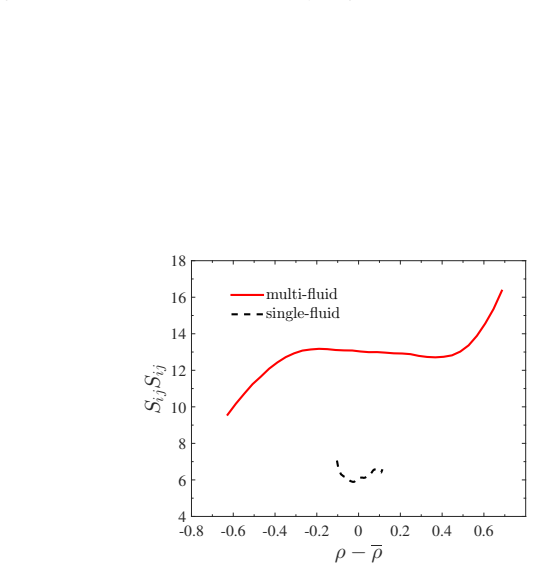
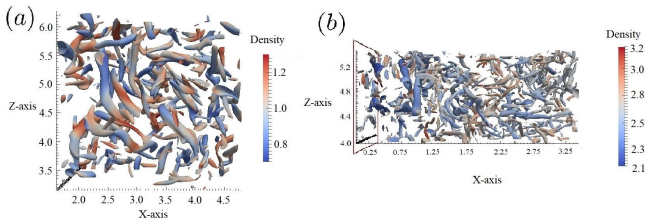
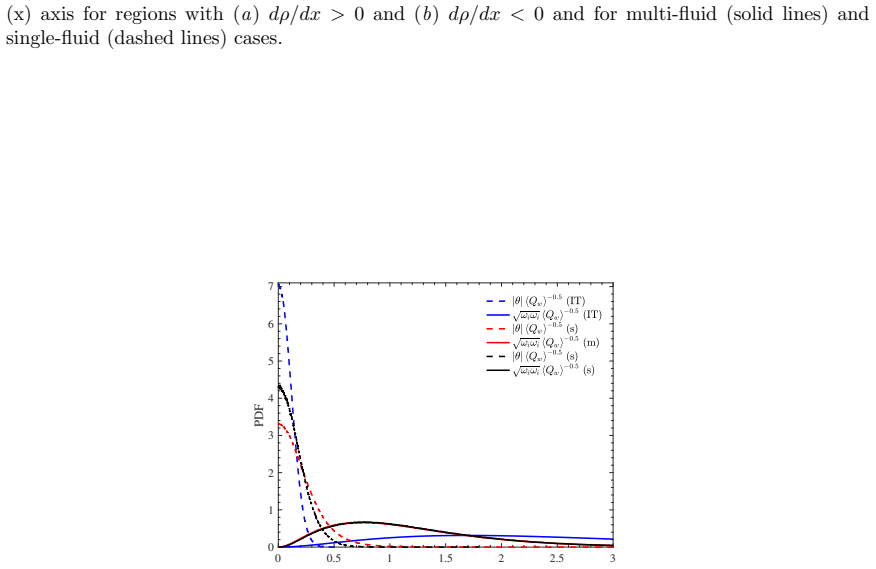
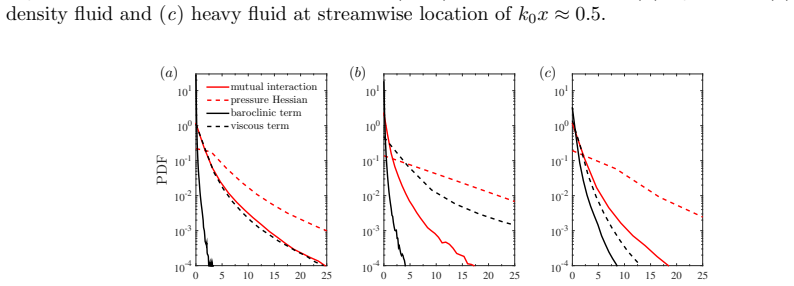
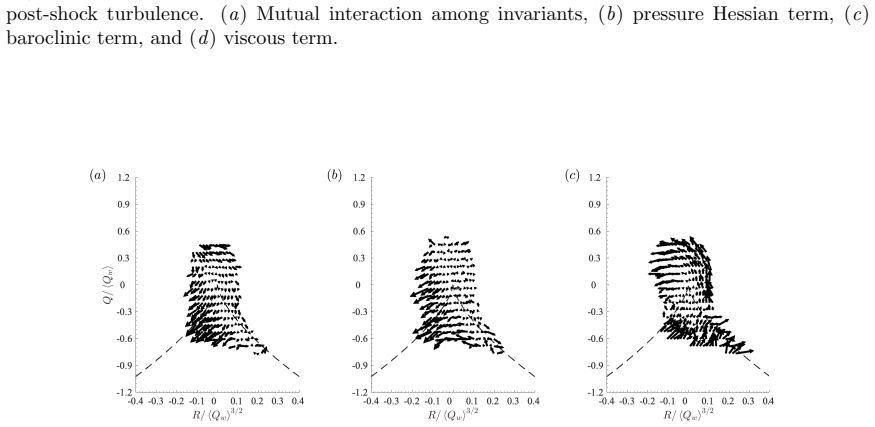
At Atwood number 0.28, after a binary mixture of heavy and light fluids passes through a Mach 2 normal shock, the velocity-gradient invariant statistics separate according to local density. The joint PDF $(Q^*, R^*)$ of the second and third invariants of the anisotropic velocity gradient tensor becomes nearly symmetric in heavy-fluid regions, with an enlarged share of stable-node/saddle/saddle topology, while light-fluid regions retain the characteristic tear-drop distribution of isotropic turbulence. The same density split appears in the vortex stretching contribution to enstrophy, whose joint PDF with $-Q_s^*$ becomes almost fully symmetric in the multi-fluid case. Lagrangian tracking of 4.5 million particles shows that the circulating conditional-mean dynamics of $(Q,R)$ in isotropic turbulence is weakened after the shock, and in heavy-fluid regions the conditional mean trajectories reverse to counterclockwise motion. The transport-equation decomposition attributes these differences mainly to the pressure Hessian: it is amplified across the shock, from about 61 percent to about 74 percent of the total contribution, and it acts differently on heavy, medium, and light fluid particles.
Load-bearing premise
The numerical shock thickness is small enough relative to the Kolmogorov scale, about $\eta/\delta_n = 1.9$ on the finest grid, that shock-capturing artifacts do not corrupt the post-shock velocity-gradient statistics or the Lagrangian particle trajectories.
Editorial extensions
If this is right
- Immediately downstream of the shock, multi-fluid turbulence is not uniformly two-dimensionalized: heavy-fluid regions become more axisymmetric and strain-dominated than light-fluid regions at the same location.
- The mean vortex stretching rate is reduced in the multi-fluid case mainly by a change in topology, through enhanced Q1 and Q3 regions, rather than by a decrease in the variance of the stretching term.
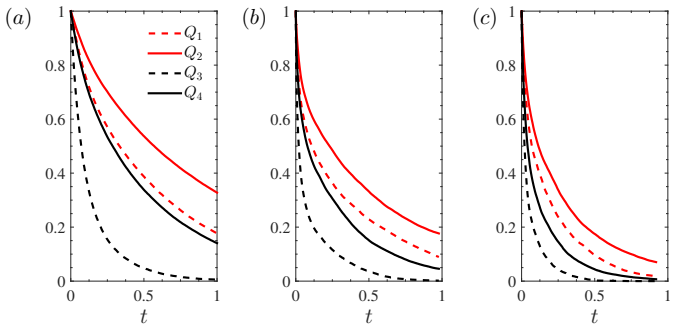
- The return to the classic tear-drop shape is driven by particles starting in Q1 and Q3, whose contributions to vortex stretching recover faster than those from Q2 and Q4 particles.
- Any subgrid-scale model for variable-density shock-turbulence interaction should include a density-dependent pressure Hessian to capture the differing evolution of heavy and light fluid regions.
- The baroclinic term, despite strong density and pressure gradients, remains the smallest of the four invariant-transport contributions for the parameters studied and does not directly control the topological evolution.
Reading between the lines
- The paper's conditional statistics suggest a testable prediction: in the broken-shock regime at higher Atwood number, the density split in topology should sharpen further, with heavy-fluid regions becoming even more symmetric and light-fluid regions approaching the isotropic tear-drop more quickly; the same analysis could be repeated there.
- A natural extension is to form a mixing measure from the conditional PDF asymmetry, for example the difference in quadrant population fractions between heavy and light regions, and use it as a one-parameter marker of density effects on post-shock structure.
- The finding that the pressure Hessian, not the baroclinic term, carries the density effect implies that reduced models respecting the pressure Hessian structure may outperform models that emphasize baroclinic vorticity generation, a point the paper does not explicitly pursue.
- Because Lagrangian residence times are shorter in the multi-fluid case, particle-based subgrid models may need a density-dependent eddy-turnover time in this regime.
Signed reviews
Editorial analysis
A structured set of objections, weighed in public.
Referee Report
Summary. This manuscript studies the interaction of a Mach 2 shock with multi-fluid, variable-density isotropic turbulence at Atwood number 0.28, using turbulence-resolving shock-capturing simulations and tracking 4.5 million Lagrangian particles. It analyzes the post-shock turbulence structure through velocity-gradient-tensor (VGT) invariants, compares the multi-fluid results with single-fluid STI and isotropic turbulence, and reports that the joint PDF of the anisotropic invariants, PDF(Q*,R*), becomes nearly symmetric in heavy-fluid regions while light-fluid regions retain the tear-drop shape. Lagrangian conditional-mean dynamics are used to show that the pressure Hessian is the dominant and density-dependent contribution to the evolution of the VGT invariants. The paper includes grid-convergence tests and Lagrangian sample-size convergence tests as supporting evidence.
Significance. The strengths of the paper are substantial: the simulation data are grid-converged for the dissipation rates shown in Fig. 2, the Lagrangian conditional statistics are checked for sample-size convergence in Figs. 3-4, the VGT invariant equations in Eqs. (5)-(7) are exact transforms of the Navier-Stokes equations, and the study contains no fitted parameters, with single-fluid STI and isotropic turbulence serving as external anchors. If the density-conditioned PDF claim survives scrutiny, the work would provide new, physically detailed understanding of variable-density shock-turbulence interaction and useful constraints for subgrid models. However, the central headline claim currently rests on a P≈0-filtered subset without demonstration that the filter is density-neutral; this must be resolved before the result is fully established.
major comments (2)
- [Section 3.2, Figure 16] The central claim that PDF(Q*,R*) is nearly symmetric in heavy-fluid regions while light-fluid regions retain the tear-drop shape is computed on the P≈0 subset introduced in Section 3.2, yet the paper does not report whether the filter probability is uniform across density bins. This matters because the authors themselves argue in Section 3.2 that local shock strength is positively correlated with pre-shock density, so heavy-fluid regions should plausibly have larger mean dilatation P. If the P≈0 criterion preferentially excludes heavy-fluid points, the comparison in Figure 16 is confounded: the apparent symmetrization could be a property of the incompressible subset rather than of heavy-fluid regions in the actual flow. The abstract and conclusions state the claim without this caveat. Please report the probability of satisfying the filter, e.g., P/⟨Qw⟩^0.5 < 0.1, as a function of density; recompute the density-conditioned PDFs either without the filter or with an appropriate reweighting; and provide a quantitative symmetry metric, such as quadrant probability ratios or a comparison to the reflected PDF, instead of visual inspection alone.
- [Section 2.4] The paper relies on η/δn ≈ 1.9, together with earlier LIA convergence tests in Tian et al. (2017a), to justify using the finest-grid data for all subsequent statistical claims. However, the grid-convergence test shown in Fig. 2 covers dissipation rates and scalar dissipation, not the VGT invariant PDFs or the density-conditioned topology that underpin the main claims. Immediately post-shock, invariant statistics are sensitive to the numerical shock structure, and the scale separation is only about a factor of two. Please provide a resolution sensitivity check for Figures 15-16, or at least for the proposed symmetry metric, on coarser grids, or state explicitly which quantitative criterion from Tian et al. (2017a) establishes that η/δn ≈ 1.9 is sufficient for derivative-level statistics of this type.
minor comments (4)
- [Figure 19] The caption labels the panels as (a) Q2, (b) Q1, (c) Q3 and (d) Q4, while the text in Section 3.2 describes (a,b) as Q1 and Q2; the labels should be reconciled.
- [Figure 30] The caption uses the label (a) twice; the medium-density panel should be labeled (b).
- [Equation (6a)] The notation ∂p2/∂xi∂xj is ambiguous; it should be written as ∂²p/(∂xi∂xj) or equivalent.
- [Section 3.3] The sentence beginning 'The percentage of contributions, using the means indicate...' is incomplete or garbled; please restate how the percentages 61.3%, 74.9% and 73.9% are defined and computed.
Circularity Check
No significant circularity; the statistical claims are measured from direct simulation and exact Lagrangian post-processing, not reduced to fitted inputs or self-citation chains.
full rationale
The paper's central claims—the density-conditioned joint PDF(Q*,R*) shape, the vortex-stretching PDF, and the pressure-Hessian contributions—are quantities measured from the simulated velocity fields and from the exact Lagrangian evolution equations (Eqs. 5–7), which are rearrangements of the Navier-Stokes equations rather than fitted models. The database and LIA convergence results are taken from earlier work by the same group, but those citations are independent simulation benchmarks and parameter-free convergence checks; they do not define the post-shock statistics. The only conditioning choice that deserves scrutiny is Section 3.2's restriction to "data points where P≈ 0," which the paper states "encompass about 60% of the flow." Because the paper does not report whether the P≈0 selection probability is uniform across density bins, and because it cites its own prior result that local shock strength increases with pre-shock density, the heavy-fluid conditional PDF in Figure 16 could in principle reflect a density-biased incompressible subset. That is a sampling/confounding concern, not circularity: the reported PDFs are direct measurements of the selected subset, not quantities that are equivalent to the selection criterion by definition. No fitted parameter is renamed as a prediction, no definition builds the conclusion into an input, and no load-bearing uniqueness claim rests on self-citation. Accordingly, the circularity score is 0.
Assumptions & free parameters
free parameters (5)
- Atwood number At =
0.28
- Inflow turbulent Mach number Mt =
0.1 (about 0.09 before the shock)
- Taylor Reynolds number Re_lambda =
45 (about 42 before the shock)
- Inflow peak wavenumber k0 =
4
- Prandtl and Schmidt numbers =
0.75
assumptions (5)
- standard math The compressible Navier-Stokes equations for a miscible binary mixture, with the perfect gas law and Fickian diffusion, govern the flow (Section 2.1).
- standard math The Lagrangian evolution equations for the VGT invariants (Eqs. 5-7) are exact consequences of the Navier-Stokes equations as given by Chu & Lu (2013).
- domain assumption Taylor's hypothesis is valid for converting temporal turbulence into spatial inflow at Mt around 0.1 (Section 2.2).
- domain assumption The numerical shock is sufficiently resolved with eta/delta_n around 1.9 such that shock-capturing artifacts do not contaminate the post-shock statistics (Section 2.4).
- domain assumption Compressibility (dilatational) effects are weak for the present parameters, so the anisotropic VGT analysis restricted to small |P| data (about 60% of the flow) is representative (Sections 3.2 and 3.3).
Cite this review
Pith. "Pith review of Density Effects on the Post-shock Turbulence Structure and Dynamics." pith.science (2026). https://pith.science/paper/HYUMAI44
@misc{pith2026190805327,
  author       = {Pith},
  title        = {Pith review of: Density Effects on the Post-shock Turbulence Structure and Dynamics},
  year         = {2026},
  howpublished = {\url{https://pith.science/paper/HYUMAI44}},
  note         = {Machine review of arXiv:1908.05327}
}
abstract
Turbulence structure resulting from multi-fluid or multi-species, variable-density isotropic turbulence interaction with a Mach 2 shock is studied using turbulence-resolving shock-capturing simulations and Eulerian (grid) and Lagrangian (particle) methods. The complex roles density play in the modification of turbulence by the shock wave are identified. Statistical analyses of the velocity gradient tensor (VGT) show that the density variations significantly change the turbulence structure and flow topology. Specifically, a stronger symmetrization of the joint probability density function (PDF) of second and third invariants of the anisotropic velocity gradient tensor, PDF$(Q^\ast, R^\ast)$, as well as the PDF of the vortex stretching contribution to the enstrophy equation, are observed in the multi-species case. Furthermore, subsequent to the interaction with the shock, turbulent statistics also acquire a differential distribution in regions having different densities. This results in a nearly symmetrical PDF$(Q^\ast, R^\ast)$ in heavy fluid regions, while the light fluid regions retain the characteristic tear-drop shape. To understand this behavior and the return to "standard" turbulence structure as the flow evolves away from the shock, Lagrangian dynamics of the VGT and its invariants are studied by considering particle residence times and conditional particle variables in different flow regions. The pressure Hessian contributions to the VGT invariants transport equations are shown to be not only affected by the shock wave, but also by the density in the multi-fluid case, making them critically important to the flow dynamics and turbulence structure.
Figures


Figures from the paper (27 more)











Reference graph
Works this paper leans on
-
[1]
Bechlars, P. & Sandberg, R. D. 2017 Evolution of the velocity gradient tensor invariant dynamics in a turbulent boundary layer . J. Fluid Mech. 815 , 223--242
work page 2017
-
[2]
Boukharfane, R. , Bouali, Z. & Mura, A. 2018 Evolution of scalar and velocity dynamics in planar shock-turbulence interaction . Shock Waves 28 (6), 1117--1141
work page 2018
-
[3]
Buttay, R. , Lehnasch, G. & Mura, A. 2016 Analysis of small-scale scalar mixing processes in highly under-expanded jets . Shock Waves 26 (2), 193--212
work page 2016
-
[4]
Chong, M. S. , Perry, A. E. & Cantwell, B. J. 1990 A general classification of three-dimensional flow fields . Phys. Fluids A: Fluid Dynam. 2 (5), 765--777
work page 1990
-
[5]
Chong, M. S. , Soria, J. , Perry, A. E. , Chacin, J. , Cantwell, B. J. & Na, Y. 1998 Turbulence structures of wall-bounded shear flows found using dns data . J. Fluid Mech. 357 , 225--247
work page 1998
-
[6]
Chu, Y. B. & Lu, X. Y. 2013 Topological evolution in compressible turbulent boundary layers . J. Fluid Mech. 733 , 414--438
work page 2013
-
[7]
Hannappel, R. & Friedrich, R. 1995 Direct numerical simulation of a Mach 2 shock interacting with isotropic turbulence . Appl. Sci. Res. 54 (3), 205--221
work page 1995
- [8]
Show all 47 references
-
[9]
Jaberi, F. A. , Livescu, D. & Madnia, C. K. 2000 Characteristics of chemically reacting compressible homogeneous turbulence . Phys. Fluids 12 (5), 1189--1209
2000
-
[10]
, Cazalbou, J.-B
Jamme, S. , Cazalbou, J.-B. , Torres, F. & Chassaing, P. 2002 Direct numerical simulation of the interaction between a shock wave and various types of isotropic turbulence . Flow Turbul. Combust. 68 (3), 227--268
2002
-
[11]
, Luo, K
Jin, T. , Luo, K. , Dai, Q. & Fan, J. 2015 Simulations of cellular detonation interaction with turbulent flows . AIAA Journal 54 (2), 419--433
2015
-
[12]
Kovasznay, L. S. G. 1953 Turbulence in supersonic flow . J. Aeronaut. Sci. 20 (10), 657--674
1953
-
[13]
, Bermejo-Moreno, I
Larsson, J. , Bermejo-Moreno, I. & Lele, S. K. 2013 Reynolds- and Mach -number effects in canonical shock - turbulence interaction . J. Fluid Mech. 717 , 293--321
2013
-
[14]
& Lele, S
Larsson, J. & Lele, S. K. 2009 Direct numerical simulation of canonical shock/turbulence interaction . Phys. Fluids 21 (12), 126101
2009
-
[15]
, Lele, S
Lee, S. , Lele, S. K. & Moin, P. 1992 Simulation of spatially evolving turbulence and the applicability of taylor’s hypothesis in compressible flow . Phys. Fluids A: Fluid Dynam. 4 (7), 1521--1530
1992
-
[16]
, Lele, S
Lee, S. , Lele, S. K. & Moin, P. 1993 Direct numerical simulation of isotropic turbulence interacting with a weak shock wave . J. Fluid Mech. 251 , 533--562
1993
-
[17]
, Lele, S
Lee, S. , Lele, S. K. & Moin, P. 1997 Interaction of isotropic turbulence with shock waves: effect of shock strength . J. Fluid Mech. 340 , 225--247
1997
-
[18]
Lele, S. K. 1992 Compact finite difference schemes with spectral-like resolution . J. Comput. Phys. 103 (1), 16--42
1992
-
[19]
& Jaberi, F
Li, Z. & Jaberi, F. A. 2012 A high-order finite difference method for numerical simulations of supersonic turbulent flows . Int. J. Numer. Meth. Fl. 68 (6), 740--766
2012
-
[20]
, Ristorcelli, J
Livescu, D. , Ristorcelli, J. R. , Petersen, M. R. & Gore, R. A. 2010 New phenomena in variable-density Rayleigh -- Taylor turbulence . Phys. Scr. T142 , 014015
2010
-
[21]
& Ryu, J
Livescu, D. & Ryu, J. 2016 Vorticity dynamics after the shock--turbulence interaction . Shock Waves 26 (3), 241--251
2016
-
[22]
, Lee, S
Mahesh, K. , Lee, S. , Lele, S. K. & Moin, P. 1995 The interaction of an isotropic field of acoustic waves with a shock wave . J. Fluid Mech. 300 , 383--407
1995
-
[23]
, Lele, S
Mahesh, K. , Lele, S. K. & Moin, P. 1997 The influence of entropy fluctuations on the interaction of turbulence with a shock wave . J. Fluid Mech. 334 , 353--379
1997
-
[24]
2011 Lagrangian dynamics and models of the velocity gradient tensor in turbulent flows
Meneveau, C. 2011 Lagrangian dynamics and models of the velocity gradient tensor in turbulent flows . Annu. Rev. Fluid Mech. 43 , 219--245
2011
-
[25]
, Martin, J
Ooi, A. , Martin, J. , Soria, J. & Chong, M. S. 1999 A study of the evolution and characteristics of the invariants of the velocity-gradient tensor in isotropic turbulence . J. Fluid Mech. 381 , 141--174
1999
-
[26]
Perry, A. E. & Chong, M. S. 1987 A description of eddying motions and flow patterns using critical-point concepts . Annu. Rev. Fluid Mech. 19 (1), 125--155
1987
-
[27]
& Grasso, F
Pirozzoli, S. & Grasso, F. 2004 Direct numerical simulations of isotropic compressible turbulence: Influence of compressibility on dynamics and structures . Phys. Fluids 16 (12), 4386--4407
2004
-
[28]
, Sinha, K
Quadros, R. , Sinha, K. & Larsson, J. 2016 Turbulent energy flux generated by shock/homogeneous-turbulence interaction . J. Fluid Mech. 796 , 113--157
2016
-
[29]
Ribner, H. S. 1954 Convection of a pattern of vorticity through a shock wave. NACA TR-1164
1954
-
[30]
& Livescu, D
Ryu, J. & Livescu, D. 2014 Turbulence structure behind the shock in canonical shock - vortical turbulence interaction . J. Fluid Mech. 756 , R1
2014
-
[31]
Sethuraman, Y. P. M. , Sinha, K. & Larsson, J. 2018 Thermodynamic fluctuations in canonical shock--turbulence interaction: effect of shock strength . Theor. Comp. Fluid Dyn. 32 (5), 629--654
2018
-
[32]
& Girimaji, S
Suman, S. & Girimaji, S. S. 2010 Velocity gradient invariants and local flow-field topology in compressible turbulence . J. Turbul. (11), N2
2010
-
[33]
, Jaberi, F
Tian, Y. , Jaberi, F. , Li, Z. & Livescu, D. 2017 a\/ Numerical study of variable density turbulence interaction with a normal shock wave . J. Fluid Mech. 829 , 551--588
2017
-
[34]
, Jaberi, F
Tian, Y. , Jaberi, F. & Livescu, D. 2018 Density effects on the flow structure in multi-fluid shock-turbulence interaction. In 2018 AIAA Aerospace Sciences Meeting\/ , p. 0374
2018
-
[35]
, Jaberi, F
Tian, Y. , Jaberi, F. , Livescu, D. & Li, Z. 2017 b\/ Numerical study of shock--turbulence interactions in variable density flows. In Proceedings of TSFP-10 (2017) Chicago\/ , International Symposium on Turbulence and Shear Flow Phenomena , vol. 3 , pp. 8C--3
2017
-
[36]
, Jaberi, F
Tian, Y. , Jaberi, F. A. & Livescu, D. 2019 Shock propagation in media with non-uniform density . In 31st International Symposium on Shock Waves 1. ISSW 2017\/ (ed. A. Sasoh, T. Aoki & M. Tatayama ) . Springer, Cham
2019
-
[37]
, Jaberi, F
Tian, Y. , Jaberi, F. A. , Livescu, D. & Li, Z. 2017 c\/ Numerical simulation of multi-fluid shock-turbulence interaction. In AIP Conference Proceedings\/ , Shock Compression of Condensed Matter , vol. 1793 , p. 150010 . AIP Publishing
2017
-
[38]
Vaghefi, N. S. & Madnia, C. K. 2015 Local flow topology and velocity gradient invariants in compressible turbulent mixing layer . J. Fluid Mech. 774 , 67--94
2015
-
[39]
, Shi, Y
Wang, J. , Shi, Y. , Wang, L. P. , Xiao, Z. , He, X. T. & Chen, S. 2012 Effect of compressibility on the small-scale structures in isotropic turbulence . J. Fluid Mech. 713 , 588--631
2012
-
[40]
Wang, L. & Lu, X. Y. 2012 Flow topology in compressible turbulent boundary layer . J. Fluid Mech. 703 , 255--278
2012
-
[41]
Yeung, P. K. 2002 Lagrangian investigations of turbulence . Annu. Rev. Fluid Mech. 34 (1), 115--142
2002
-
[42]
Yeung, P. K. & Pope, S. B. 1988 An algorithm for tracking fluid particles in numerical simulations of homogeneous turbulence . J. Comput. Phys. 79 (2), 373--416
1988
-
[43]
, " * write output.state after.block = add.period write newline
ENTRY address author booktitle chapter edition editor howpublished institution journal key month note number organization pages publisher school series title type volume year eprint label extra.label sort.label short.list INTEGERS output.state before.all mid.sentence after.sen...
-
[44]
write newline
" write newline "" before.all 'output.state := FUNCTION n.dashify 't := "" t empty not t #1 #1 substring "-" = t #1 #2 substring "--" = not "--" * t #2 global.max substring 't := t #1 #1 substring "-" = "-" * t #2 global.max substring 't := while if t #1 #1 substring * t #2 gl...
-
[45]
@esa (Ref
\@ifclassloaded aguplus natbib The aguplus class already includes natbib coding, so you should not add it explicitly Type <Return> for now, but then later remove the command natbib from the document \@ifclassloaded nlinproc natbib The nlinproc class already includes natbib cod...
-
[46]
@stdbsttrue NAT@ctr \@lbibitem[ NAT@ctr ] \@lbibitem[#1]#2 \@extra@b@citeb \@ifundefined br@#2\@extra@b@citeb \@namedef br@#2 \@nameuse br@#2\@extra@b@citeb \@ifundefined b@#2\@extra@b@citeb @num @parse #2 [ @natanchorstart #2\@extra@b@citeb \@biblabel @num @natanchorend] @ifc...
-
[47]
@open @close @open @close and [1] URL: #1 \@ifundefined chapter * \@mkboth \@ifundefined NAT@sectionbib * \@mkboth * \@mkboth\@gobbletwo \@ifclassloaded amsart * \@ifclassloaded amsbook * \@ifundefined bib@heading @heading NAT@ctr thebibliography [1] @ \@biblabel NAT@ctr \@bib...
1996
Reviewed August 14, 2026 · model on record in the stance chip above.
Discussion (0). Continue with ORCID to comment.