REVIEW 3 major objections 5 minor 46 references
Robust parametric modeling of Alzheimer's disease progression
T0 review · 3 major / 5 minor · reviewed 2026-08-14 · deepseek-v4-flash
Pith's one-line read The paper claims that a single latent disease progression score, linearly mapped from age and shared across biomarkers, suffices to model Alzheimer's progression when biomarker curves are fit jointly with a robust M-estimator and a…
desk verdict Solid engineering contribution undermined by a false novelty claim (modified Stannard is just reparameterized Richards) and a test protocol that turns the state-of-the-art comparison into a self-fit exercise. read the letter →
The pith
A machine-rendered reading of the paper's core claim, the machinery that carries it, and where it could break.
The reading
What carries the argument
The load-bearing machinery is the modified Stannard logistic function, $$g(s;\$\theta$)=\left[1+\tfrac{1}{\gamma}$e^{{-\frac{b}}${\gamma}(s-c)}\right]^{-\gamma},$$ a flexible S-shaped curve whose asymmetry parameter $\gamma$ lets the model describe slow-then-fast or fast-then-slow biomarker change while keeping the inflection point at $c$; and the robust fitting scheme, which alternates between estimating biomarker parameters $\theta_k$ and subject parameters $(\alpha_i,\beta_i)$ under the logistic-loss M-estimator $\rho(r)=\ln\cosh(r)$, down-weighting large residuals so outliers do not distort the curves. Bootstrap resampling quantifies the estimates, inflection points provide a temporal ordering of biomarkers, and kernel density estimates of the DPS distributions feed a Bayesian classifier.
What would settle it
Fit the model twice using disjoint biomarker sets, say CSF and PET versus MRI and cognitive tests, and compare the DPS assigned to each patient-visit; if the two estimates disagree by more than measurement noise, or if adding a quadratic term in age such as $s=\alpha t+\beta t^2$ yields a materially lower validation loss, then the single-axis linear DPS assumption fails and the inflection-point ordering is not trustworthy.
Extended reading notes
Core claim
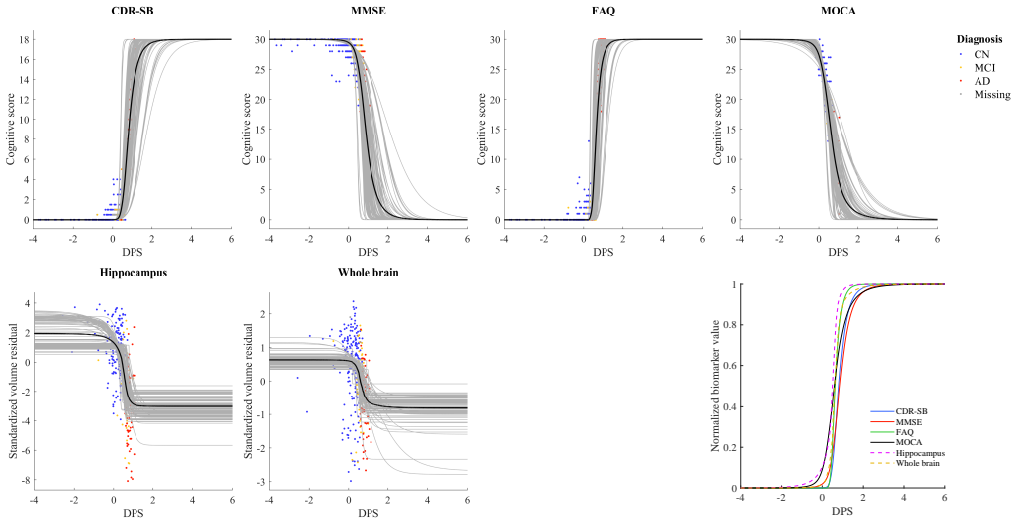
The paper's claim is that a parametric, robust extension of the earlier Jedynak model captures AD progression accurately. Concretely, each subject's age $t_{i,j}$ is mapped to a progression score $s_{i,j}=\alpha_i t_{i,j}+\beta_i$, each biomarker $k$ is modeled as a modified Stannard function $f(s;\theta_k)$ with an asymmetry parameter $\gamma$, and all parameters are fit jointly by minimizing $\sum_{i,j,k} w_i \rho\!\left((y_{i,j,k}-f(s_{i,j};\theta_k))/\sigma_k\right)$ with the logistic loss $\rho(r)=\ln\cosh(r)$. On the ADNI test set the model attains an average normalized MAE of 0.991 across 16 biomarkers and a multiclass AUC of 0.934 for CN/MCI/AD classification (0.931 before ensemble bagging), compared with NMAE 1.552 for the analogous Jedynak model. The same model, trained on ADNI, transfers to the NACC cohort with NMAE 1.182 and AUC 0.929, and the inflection points order CSF, PET, and an early memory test before MRI and later cognitive tests.
Load-bearing premise
The model assumes a patient's whole disease state is one number—the disease progression score—that grows linearly with age and that every biomarker is a monotone S-shaped function of that same number; if real Alzheimer's trajectories are multidimensional, or if progression speed varies with disease stage rather than age, the fitted curves and the ordering derived from their inflection points are not valid.
Editorial extensions
If this is right
- With age as the only input, the fitted model predicts all 16 modeled ADNI biomarker values—volumetric MRI, PET, CSF, and cognitive scores—on a common progression axis.
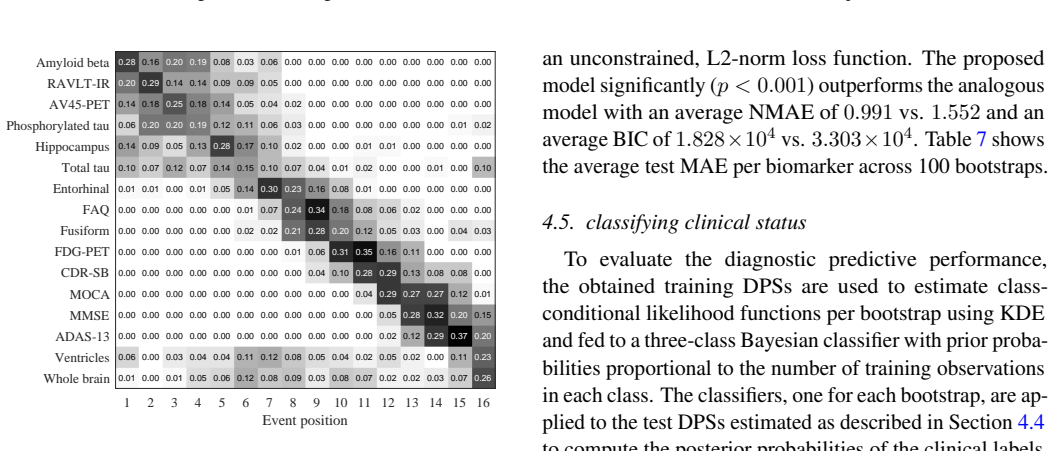
- The inflection-point ordering implies a fixed sequence of biomarker abnormality: amyloid beta, amyloid PET, and the RAVLT memory test turn early, MRI atrophy follows, and cognitive scales turn last; the paper uses this ordering for staging.
- The Bayesian classifier built on DPS densities separates cognitively normal, MCI, and AD with multiclass AUC around 0.93, so the same progression score used for curve fitting also carries diagnostic information.
- Since an ADNI-trained model predicts NACC values with only moderately higher error, the fitted disease timeline generalizes across cohorts and across different sets of available biomarkers.
- The model needs only two distinct visits per subject and tolerates missing biomarker measurements, so it can be applied to sparse clinical datasets.
Reading between the lines
- A testable consequence of the single-axis assumption: if progression is truly one-dimensional, the DPS estimated from one biomarker subset should agree with the DPS estimated from another; disagreements would reveal that Alzheimer's has more than one temporal dimension.
- The fact that an asymmetric curve (modified Stannard) beats symmetric Verhulst and Richards variants suggests biomarker dynamics are not symmetric around the inflection point; a follow-up could model the asymmetry parameter $\gamma$ per biomarker as a marker of early versus late acceleration.
- Robust M-estimation could be repurposed as an outlier detector: large residuals under logistic loss would flag individual visits as suspect, for instance measurement errors or atypically fast progressors—an application the paper does not develop.
- The cross-cohort result implies a strategy for smaller cohorts: train the parametric template on a large, richly measured cohort and then calibrate only per-subject progression rates on a smaller cohort, rather than refitting all curves.
Signed reviews
Editorial analysis
A structured set of objections, weighed in public.
Referee Report
Summary. This paper proposes a robust parametric disease progression model for Alzheimer's disease, extending the approach of Jedynak et al. (2012, 2015). The model maps each subject's age to a disease progression score (DPS) via a subject-specific linear transformation and jointly fits constrained generalized logistic curves to longitudinal biomarker data using M-estimation. The authors evaluate several logistic functions and loss functions, introduce what they call the modified Stannard function, use bootstrapping to quantify uncertainty, order biomarkers by estimated inflection points, and classify clinical status using kernel density estimates of DPS distributions with a Bayesian classifier. On ADNI test data, the best configuration (modified Stannard with logistic loss) is reported to achieve an average normalized MAE of 0.991 and a multiclass AUC of 0.934; on NACC data the corresponding values are 1.182 and 0.929. The paper also claims to outperform most state-of-the-art results in predicting biomarker values and classifying clinical status.
Significance. If the results are validated under an appropriate protocol, the work would make a useful contribution: robust M-estimation for disease progression modeling, joint fitting of multiple biomarkers, bootstrap-based uncertainty quantification, and cross-cohort evaluation are all valuable components, and the comparison with the analogous Jedynak model under the same protocol is a legitimate like-for-like assessment. The temporal ordering of biomarkers is consistent with prior literature, which lends credibility to the fitted curves. However, two load-bearing issues compromise the current claims: the modified Stannard function is mathematically a reparameterization of Richards' function, so the claimed novelty is inaccurate; and the comparison with TADPOLE and other state-of-the-art methods is not apples-to-apples because the test DPSs are estimated from each test subject's full longitudinal record, including the visits whose values are later 'predicted.' The paper's central contribution is therefore better described as a robust, jointly fitted extension of an existing parametric model rather than a new functional form with state-of-the-art forecasting performance.
major comments (3)
- [Section 4.6 and Section 2.3] The claimed state-of-the-art comparison in Section 4.6 is not supported by the evaluation protocol. In Section 2.3, for each test subject the subject-specific DPS parameters (alpha_i, beta_i) are estimated by minimizing Eq. (2) over all available biomarker values and visits for that subject, including the same visits whose biomarker values are subsequently predicted. The TADPOLE official evaluation, by contrast, requires predictions to be made from a fixed forecast date using only data available up to that date. The reported ADAS-13 MAE of 3.93 and AUC of 0.937 are therefore not comparable to the cited TADPOLE results (MAE 4.70, AUC 0.931). The authors should either rerun the evaluation under the official TADPOLE forecast protocol or remove the state-of-the-art comparison and revise the abstract and conclusion accordingly.
- [Table 1 and Section 1] The 'modified Stannard' function is not a new family of growth functions. Its formula, g(s) = [1 + (1/gamma) exp(-(b/gamma)(s-c))]^{-gamma}, becomes the Richards function after the reparameterization r = 1/gamma and b_r = b/gamma: [1 + r exp(-b_r(s-c))]^{-1/r}. Consequently, the claimed four-fold contribution of introducing a novel logistic function is incorrect, and the small BIC differences between Richards and modified Stannard in Table 5 are numerical artifacts of the optimization rather than evidence of a genuinely more flexible model. The novelty claim should be removed or the contribution reframed around the robust estimation and joint fitting components.
- [Sections 4.4 and 4.5] The test-set NMAE and AUC are not forecasting metrics in the usual sense. Because the test DPSs are estimated from the complete longitudinal record of each test subject, the reported errors measure the quality of a per-subject trajectory fit, not the accuracy of predictions made from an earlier time point. The comparison with the Jedynak model in Table 6 is fair as a like-for-like trajectory-shape comparison, and this is a legitimate evaluation target, but the manuscript should consistently describe the results as trajectory-modeling and trajectory-based classification performance, not as state-of-the-art biomarker prediction. This distinction is essential for readers comparing the results with TADPOLE and other longitudinal forecasting benchmarks.
minor comments (5)
- [Section 3.2] The definition of BIC uses E(Lopt)_train, while Sections 3.3 and 3.4 describe selecting Lopt using the validation loss; please clarify whether the reported BIC is computed from the training loss at the validation-selected iteration and how this avoids optimistic model selection.
- [Figure 5] The 16 by 16 probability matrix in Figure 5 is very dense and difficult to read at print size; enlarging the figure or presenting the ordering probabilities in a supplementary table would improve accessibility.
- [Table 7] The columns 'Inflection point (median)' and 'Test MAE (mean)' in Table 7 should state their units and clarify that the MAE values are averaged over the 100 bootstrap runs.
- [Section 3.1.3] The 3-month matching rule for MRI and clinical visits is reasonable, but the manuscript should report how many MRI visits in NACC were assigned missing clinical status as a consequence, since this affects the effective sample size for the classification experiments.
- [Section 5] The statement that the method could be applied to biomarkers with non-monotonic behavior 'as long as suitable functions are used' is vague; a concrete example or a reference to a suitable function family would make the claim more informative.
Circularity Check
The paper's test-set biomarker 'prediction' is a per-subject self-fit residual, because Eq. (2) estimates each test subject's DPS from the same values that are then scored.
-
fitted input called prediction
[Section 2.3, Eq. (2); applied in Section 4.4 / Table 6; compared in Section 4.6]
"Age mapping part of the proposed algorithm is applied to estimate the subject-specific parameters using Equation (2) based on the values of those biomarkers of the test subject that have available estimated biomarker-specific parameters in the fitted model. Next, biomarker values are predicted as f (si,j;θk) using the estimated test DPSs."
Equation (2) estimates the test subject's α_i, β_i by minimizing the robust loss over all of that subject's visits and biomarker values. Those same y_i,j,k values are then plugged into MAE = |y_i,j,k − f(s_i,j;θ_k)| to obtain the reported test NMAEs (0.991 for ADNI; 1.182 for ADNI-to-NACC) and the ADAS-13 MAE of 3.93. Thus the 'predicted' biomarker values are fitted values of a per-subject alignment, not forecasts of unseen measurements. Section 4.6 compares these with TADPOLE forecasting results (MAE 4.70, AUC 0.931), but TADPOLE uses data only up to a fixed forecast date, whereas the proposed evaluation uses the full longitudinal record of each test subject, including the target values.
full rationale
The core model-fitting derivation is not circular: biomarker parameters θ are optimized on training subjects via Eq. (1), the bootstrap/BIC model selection is self-contained, and the modified Stannard function is an independent modeling contribution rather than a renaming of an input. No load-bearing self-citation chain or imported uniqueness theorem was found. The circularity is confined to the evaluation protocol behind the paper's headline prediction claims. In Section 2.3, each test subject's DPS parameters (α_i, β_i) are estimated from that subject's own observed biomarker values via Eq. (2), and the same values are then used to compute MAE/NMAE against f(s_i,j;θ_k). This makes the 'test NMAE' an in-sample residual of a two-parameter subject alignment, not an out-of-sample prediction of biomarker values. The subsequent comparison with TADPOLE forecasting results in Section 4.6 is therefore not apples-to-apples: TADPOLE scores are true forecasts from a cutoff date, while the proposed numbers have access to the entire test trajectory. The classification AUC is also computed on test DPSs estimated from the full test record, so the 'diagnostic predictive performance' wording overstates out-of-sample prediction, though this is more a temporal-leakage issue than a definitional circularity. Overall, the central modeling contribution retains independent content, but the prediction claim partially reduces to a self-fit, giving a partial circularity score of 6.
Assumptions & free parameters
free parameters (3)
- KDE bandwidth w =
not reported
- Time gap threshold =
3 months
- Early stopping iteration range (Lmin, Lmax) =
10, 50
assumptions (5)
- domain assumption Each biomarker follows a monotone S-shaped (logistic) function of the DPS with fixed parameters.
- domain assumption The DPS of a subject is a linear function of age with subject-specific slope and intercept.
- domain assumption Additive white Gaussian noise with per-biomarker standard deviation sigma_k.
- domain assumption Complete monotonicity of biomarker trajectories over the modeled disease range.
- domain assumption The residual linear regression on controls corrects for cohort/software and head size differences.
Cite this review
Pith. "Pith review of Robust parametric modeling of Alzheimer's disease progression." pith.science (2026). https://pith.science/paper/TKS62RFQ
@misc{pith2026190805338,
  author       = {Pith},
  title        = {Pith review of: Robust parametric modeling of Alzheimer's disease progression},
  year         = {2026},
  howpublished = {\url{https://pith.science/paper/TKS62RFQ}},
  note         = {Machine review of arXiv:1908.05338}
}
read the original abstract
Quantitative characterization of disease progression using longitudinal data can provide long-term predictions for the pathological stages of individuals. This work studies the robust modeling of Alzheimer's disease progression using parametric methods. The proposed method linearly maps the individual's age to a disease progression score (DPS) and jointly fits constrained generalized logistic functions to the longitudinal dynamics of biomarkers as functions of the DPS using M-estimation. Robustness of the estimates is quantified using bootstrapping via Monte Carlo resampling, and the estimated inflection points of the fitted functions are used to temporally order the modeled biomarkers in the disease course. Kernel density estimation is applied to the obtained DPSs for clinical status classification using a Bayesian classifier. Different M-estimators and logistic functions, including a novel type proposed in this study, called modified Stannard, are evaluated on the data from the Alzheimer's Disease Neuroimaging Initiative (ADNI) for robust modeling of volumetric MRI and PET biomarkers, CSF measurements, as well as cognitive tests. The results show that the modified Stannard function fitted using the logistic loss achieves the best modeling performance with an average normalized MAE of 0.991 across all biomarkers and bootstraps. Applied to the ADNI test set, this model achieves a multiclass AUC of 0.934 in clinical status classification. The obtained results for the proposed model outperform almost all state-of-the-art results in predicting biomarker values and classifying clinical status. Finally, the experiments show that the proposed model, trained using abundant ADNI data, generalizes well to data from the National Alzheimer's Coordinating Center (NACC) with an average normalized MAE of 1.182 and a multiclass AUC of 0.929.
Figures


Figures from the paper (4 more)


Reference graph
Works this paper leans on
-
[1]
write newline
" write newline "" before.all 'output.state := FUNCTION n.dashify 't := "" t empty not t #1 #1 substring "-" = t #1 #2 substring "--" = not "--" * t #2 global.max substring 't := t #1 #1 substring "-" = "-" * t #2 global.max substring 't := while if t #1 #1 substring * t #2 global.max substring 't := if while FUNCTION word.in bbl.in ":" * " " * FUNCTION f...
-
[2]
author Beekly, D.L. , author Ramos, E.M. , author Lee, W.W. , author Deitrich, W.D. , author Jacka, M.E. , author Wu, J. , author Hubbard, J.L. , author Koepsell, T.D. , author Morris, J.C. , author Kukull, W.A. , et al., year 2007 . title The National Alzheimer's Coordinating Center (NACC) database : the uniform data set . journal Alzheimer Dis. Assoc. D...
work page 2007
-
[3]
author Biagioni, M.C. , author Galvin, J.E. , year 2011 . title Using biomarkers to improve detection of A lzheimer's disease . journal Neurodegener. Dis. Manag. volume 1 , pages 127--139
work page 2011
-
[4]
author Bilgel, M. , author Jedynak, B.M. , year 2019 . title Predicting time to dementia using a quantitative template of disease progression . journal Alzheimer's & Dementia: Diagnosis, Assessment & Disease Monitoring volume 11 , pages 205--215
work page 2019
-
[5]
author Bilgel, M. , author Prince, J.L. , author Wong, D.F. , author Resnick, S.M. , author Jedynak, B.M. , year 2016 . title A multivariate nonlinear mixed effects model for longitudinal image analysis: application to amyloid imaging . journal NeuroImage volume 134 , pages 658--670
work page 2016
-
[6]
author Chai, T. , author Draxler, R.R. , year 2014 . title Root mean square error ( RMSE ) or mean absolute error ( MAE )? -- A rguments against avoiding RMSE in the literature . journal Geosci. Model Dev. volume 7 , pages 1247--1250
work page 2014
-
[7]
author Coleman, T.F. , author Li, Y. , year 1996 . title An interior trust region approach for nonlinear minimization subject to bounds . journal SIAM J. Optim. volume 6 , pages 418--445
work page 1996
-
[8]
author Ewers, M. , author Sperling, R.A. , author Klunk, W.E. , author Weiner, M.W. , author Hampel, H. , year 2011 . title Neuroimaging markers for the prediction and early diagnosis of A lzheimer's disease dementia . journal Trends Neurosci. volume 34 , pages 430--442
work page 2011
Show all 46 references
-
[9]
, author Salat, D.H
author Fischl, B. , author Salat, D.H. , author Busa, E. , author Albert, M. , author Dieterich, M. , author Haselgrove, C. , author Van Der Kouwe, A. , author Killiany, R. , author Kennedy, D. , author Klaveness, S. , author Montillo, A. , author Makris, N. , author Rosen, B....
2002
-
[10]
, author Modat, M
author Fonteijn, H.M. , author Modat, M. , author Clarkson, M.J. , author Barnes, J. , author Lehmann, M. , author Hobbs, N.Z. , author Scahill, R.I. , author Tabrizi, S.J. , author Ourselin, S. , author Fox, N.C. , et al., year 2012 . title An event-based model for disease pr...
2012
-
[11]
, author Nielsen, M
author Ghazi, M.M. , author Nielsen, M. , author Pai, A. , author Cardoso, M.J. , author Modat, M. , author Ourselin, S. , author S rensen, L. , year 2019 . title Training recurrent neural networks robust to incomplete data: application to A lzheimer's disease progression mode...
2019
-
[12]
, year 1825
author Gompertz, B. , year 1825 . title On the nature of the function expressive of the law of human mortality, and on a new mode of determining the value of life contingencies . journal Philos. Trans. R. Soc. London , pages 513--583
-
[13]
, author Habets, P
author Gronenschild, E.H. , author Habets, P. , author Jacobs, H.I. , author Mengelers, R. , author Rozendaal, N. , author Van Os, J. , author Marcelis, M. , year 2012 . title The effects of FreeSurfer version, workstation type, and M acintosh operating system version on anato...
2012
-
[14]
, author Schmidt-Richberg, A
author Guerrero, R. , author Schmidt-Richberg, A. , author Ledig, C. , author Tong, T. , author Wolz, R. , author Rueckert, D. , year 2016 . title Instantiated mixed effects modeling of A lzheimer's disease markers . journal NeuroImage volume 142 , pages 113--125
2016
-
[15]
, author Till, R.J
author Hand, D.J. , author Till, R.J. , year 2001 . title A simple generalisation of the area under the ROC curve for multiple class classification problems . journal Mach. Learn. volume 45 , pages 171--186
2001
-
[16]
, author Welsch, R.E
author Holland, P.W. , author Welsch, R.E. , year 1977 . title Robust regression using iteratively reweighted least-squares . journal Commun. Stat. Theory Methods volume 6 , pages 813--827
1977
-
[17]
, year 2004
author Huber, P.J. , year 2004 . title Robust Statistics . volume volume 523 . publisher John Wiley & Sons
2004
-
[18]
, author Knopman, D.S
author Jack Jr, C.R. , author Knopman, D.S. , author Jagust, W.J. , author Petersen, R.C. , author Weiner, M.W. , author Aisen, P.S. , author Shaw, L.M. , author Vemuri, P. , author Wiste, H.J. , author Weigand, S.D. , et al., year 2013 . title Tracking pathophysiological proc...
2013
-
[19]
, author Knopman, D.S
author Jack Jr, C.R. , author Knopman, D.S. , author Jagust, W.J. , author Shaw, L.M. , author Aisen, P.S. , author Weiner, M.W. , author Petersen, R.C. , author Trojanowski, J.Q. , year 2010 . title Hypothetical model of dynamic biomarkers of the A lzheimer's pathological cas...
2010
-
[20]
, author Lang, A
author Jedynak, B.M. , author Lang, A. , author Liu, B. , author Katz, E. , author Zhang, Y. , author Wyman, B.T. , author Raunig, D. , author Jedynak, C.P. , author Caffo, B. , author Prince, J.L. , year 2012 . title A computational neurodegenerative disease progression score...
2012
-
[21]
, author Liu, B
author Jedynak, B.M. , author Liu, B. , author Lang, A. , author Gel, Y. , author Prince, J.L. , year 2015 . title A computational method for computing an A lzheimer's disease progression score; experiments and validation with the ADNI data set . journal Neurobiol. Aging volum...
2015
-
[22]
, year 2014
author Kuncheva, L.I. , year 2014 . title Combining pattern classifiers: methods and algorithms . publisher John Wiley & Sons
2014
-
[23]
, author Harvey, D
author Landau, S. , author Harvey, D. , author Madison, C. , author Reiman, E. , author Foster, N. , author Aisen, P. , author Petersen, R.C. , author Shaw, L. , author Trojanowski, J. , author Jack, C. , et al., year 2010 . title Comparing predictors of conversion and decline...
2010
-
[24]
, author Iddi, S
author Li, D. , author Iddi, S. , author Thompson, W.K. , author Donohue, M.C. , year 2019 . title Bayesian latent time joint mixed effect models for multicohort longitudinal data . journal Stat. Methods Med. Res. volume 28 , pages 835--845
2019
-
[25]
, author Filippone, M
author Lorenzi, M. , author Filippone, M. , author Frisoni, G.B. , author Alexander, D.C. , author Ourselin, S. , year 2017 . title Probabilistic disease progression modeling to characterize diagnostic uncertainty: application to staging and prediction in A lzheimer's disease ...
2017
-
[26]
, year 1993
author Machado, J.A. , year 1993 . title Robust model selection and M -estimation . journal Econometric Theory volume 9 , pages 478--493
1993
-
[27]
, author Oxtoby, N.P
author Marinescu, R.V. , author Oxtoby, N.P. , author Young, A.L. , author Bron, E.E. , author Toga, A.W. , author Weiner, M.W. , author Barkhof, F. , author Fox, N.C. , author Eshaghi, A. , author Toni, T. , et al., year 2020 . title The A lzheimer's disease prediction of lon...
2020 arXiv
-
[28]
, author Oxtoby, N.P
author Marinescu, R.V. , author Oxtoby, N.P. , author Young, A.L. , author Bron, E.E. , author Toga, A.W. , author Weiner, M.W. , author Barkhof, F. , author Fox, N.C. , author Klein, S. , author Alexander, D.C. , year 2018 . title TADPOLE challenge: prediction of longitudinal...
2018 arXiv
-
[29]
, author Ziegler, D.A
author O'Brien, L.M. , author Ziegler, D.A. , author Deutsch, C.K. , author Frazier, J.A. , author Herbert, M.R. , author Locascio, J.J. , year 2011 . title Statistical adjustments for brain size in volumetric neuroimaging studies: some practical implications in methods . jour...
2011
-
[30]
, author Alexander, D.C
author Oxtoby, N.P. , author Alexander, D.C. , year 2017 . title Imaging plus X : multimodal models of neurodegenerative disease . journal Curr. Opin. Neurol. volume 30 , pages 371
2017
-
[31]
, author Young, A.L
author Oxtoby, N.P. , author Young, A.L. , author Fox, N.C. , author Daga, P. , author Cash, D.M. , author Ourselin, S. , author Schott, J.M. , author Alexander, D.C. , year 2014 . title Learning imaging biomarker trajectories from noisy A lzheimer's disease data using a B aye...
2014
-
[32]
, year 1962
author Parzen, E. , year 1962 . title On estimation of a probability density function and mode . journal Ann. Math. Stat. volume 33 , pages 1065--1076
1962
-
[33]
, year 2008
author Pennacchi, P. , year 2008 . title Robust estimate of excitations in mechanical systems using M -estimators--theoretical background and numerical applications . journal J. Sound Vib. volume 310 , pages 923--946
2008
-
[34]
, author Aisen, P
author Petersen, R.C. , author Aisen, P. , author Beckett, L. , author Donohue, M. , author Gamst, A. , author Harvey, D. , author Jack, C. , author Jagust, W. , author Shaw, L. , author Toga, A. , author Trojanowski, J. , author Weiner, M. , year 2010 . title Alzheimer's Dise...
2010
-
[35]
, year 1998
author Prechelt, L. , year 1998 . title Early stopping--but when? , in: booktitle Neural Networks: Tricks of the Trade , pp. pages 55--69
1998
-
[36]
, year 1959
author Richards, F. , year 1959 . title A flexible growth function for empirical use . journal J. Exp. Bot. volume 10 , pages 290--301
1959
-
[37]
, author Leroy, A.M
author Rousseeuw, P.J. , author Leroy, A.M. , year 1987 . title Robust regression and outlier detection . volume volume 1 . publisher Wiley Online Library
1987
-
[38]
, author Williams, A
author Stannard, C. , author Williams, A. , author Gibbs, P. , year 1985 . title Temperature/growth relationships for psychrotrophic food-spoilage bacteria . journal Food Microbiol. volume 2 , pages 115--122
1985
-
[39]
, author Yao, C
author Tierney, M.C. , author Yao, C. , author Kiss, A. , author McDowell, I. , year 2005 . title Neuropsychological tests accurately predict incident A lzheimer disease after 5 and 10 years . journal Neurol. volume 64 , pages 1853--1859
2005
-
[40]
, author Bron, E.E
author Venkatraghavan, V. , author Bron, E.E. , author Niessen, W.J. , author Klein, S. , year 2019 . title Disease progression timeline estimation for A lzheimer's disease using discriminative event based modeling . journal NeuroImage volume 186 , pages 518--532
2019
-
[41]
, year 1845
author Verhulst, P. , year 1845 . title La loi d'accroissement de la population . journal Nouv. M \'e m. de l'Academie Royale des Sci. et Belles-Lettres de Bruxelles volume 18 , pages 1--41
-
[42]
, year 1945
author Wilcoxon, F. , year 1945 . title Individual comparisons by ranking methods . journal Biom. Bull. volume 1 , pages 80--83
1945
-
[43]
, author Tudorascu, D.L
author Yau, W.Y.W. , author Tudorascu, D.L. , author McDade, E.M. , author Ikonomovic, S. , author James, J.A. , author Minhas, D. , author Mowrey, W. , author Sheu, L.K. , author Snitz, B.E. , author Weissfeld, L. , et al., year 2015 . title Longitudinal assessment of neuroim...
2015
-
[44]
, author Oxtoby, N.P
author Young, A.L. , author Oxtoby, N.P. , author Huang, J. , author Marinescu, R.V. , author Daga, P. , author Cash, D.M. , author Fox, N.C. , author Ourselin, S. , author Schott, J.M. , author Alexander, D.C. , year 2015 . title Multiple orderings of events in disease progre...
2015
-
[45]
, author Fonov, V
author Zandifar, A. , author Fonov, V. , author Ducharme, S. , author Belleville, S. , author Collins, D.L. , year 2019 . title MRI and cognitive scores complement each other to accurately predict A lzheimer's dementia 2 to 7 years before clinical onset . journal bioRxiv , pag...
2019
-
[46]
, author Jongenburger, I
author Zwietering, M. , author Jongenburger, I. , author Rombouts, F. , author Van't Riet, K. , year 1990 . title Modeling of the bacterial growth curve . journal Appl. Environ. Microbiol. volume 56 , pages 1875--1881
1990
Reviewed August 14, 2026 · model on record in the stance chip above.
Discussion (0). Continue with ORCID to comment.