REVIEW 3 major objections 6 minor 4 references
Uncharacteristic second order martensitic transformation in metals via epitaxial stress fields
T0 review · 3 major / 6 minor · reviewed 2026-08-14 · deepseek-v4-flash
Pith's one-line read Epitaxial stress turns a first-order metal transition continuous.
desk verdict A solid MD demonstration that internal epitaxial stress can make martensitic transformations continuous, but the criticality evidence doesn't yet rule out disorder-broadened first-order behavior. read the letter →
The pith
A machine-rendered reading of the paper's core claim, the machinery that carries it, and where it could break.
The reading
What carries the argument
The load-bearing object is the coherent nanolaminate: a periodic stack in which a thin layer of ordered NiAl shares a defect-free interface with the transforming Ni63Al37 alloy, forcing both phases to adopt the same in-plane lattice parameter. Because the total free energy is then nearly the weighted sum of the two components as functions of lattice parameter, one component's preference for austenite cancels the other's preference for martensite, flattening the double-well landscape into a single shallow well. This 'free energy landscape engineering' is what converts the abrupt, hysteretic first-order jump into a continuous second-order transition; the scaling laws for strain order parameter, cluster sizes, and susceptibility then follow from that flat landscape.
What would settle it
Cool an actual 65 at. % NiAl NiAl/Ni63Al37 laminate, or run a molecular dynamics cell with interfaces free to decohere or with pre-existing dislocations, and measure the strain-temperature curve: a discontinuous jump in transformation strain, a nonzero cooling-heating hysteresis loop, or a barrier in the computed free energy landscape at 65 at. % NiAl would all show the order has not been changed by the epitaxial stress.
Extended reading notes
Core claim
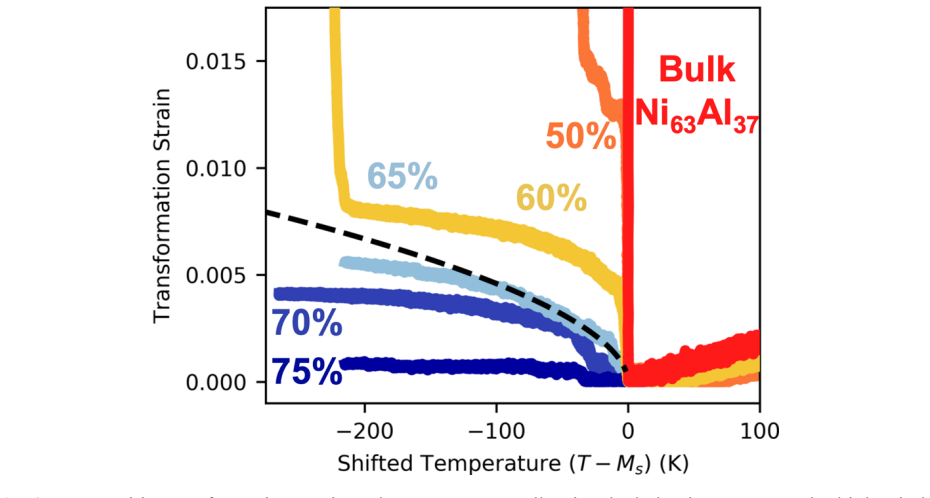
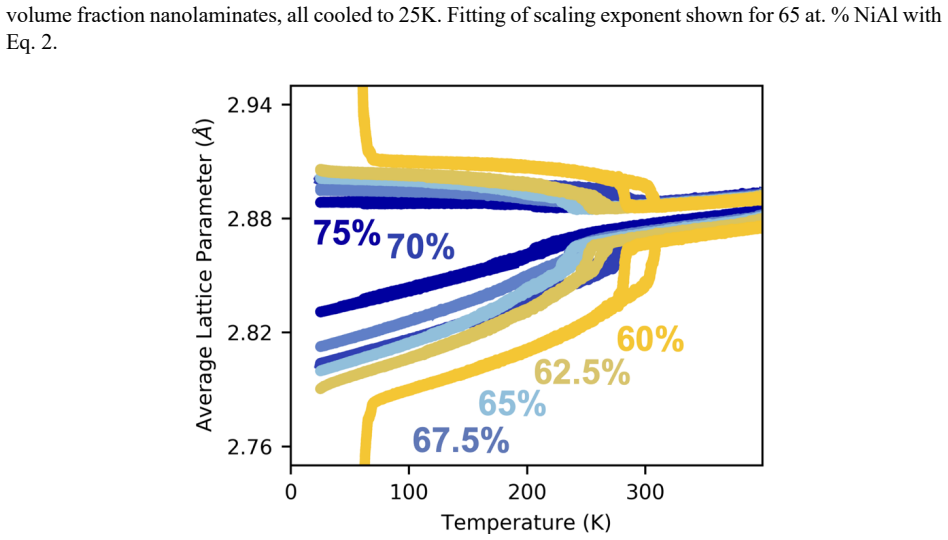
The central discovery is that a martensitic transformation, normally universally first order, can be made continuous by internal epitaxial stress. Coherent integration of B2 NiAl (which never wants to be martensitic) with Ni63Al37 (which does) forces the two phases to share in-plane lattice parameters, so the composite free energy becomes a weighted combination of two opposing landscapes; at 65 at. % NiAl this combination is flat and barrierless. The order parameter—transformation strain—then rises continuously with cooling, with near-zero hysteresis for NiAl fractions above 62.5 at. %, martensite domains that interpenetrate with rough fractal interfaces, and cluster-size distributions following a power law. The extracted critical exponents ($\beta$ between 0.45 and 0.7, $\tau$ between 1.3 and 1.6, $\gamma \approx 0.85$) fall in the range of other critical ferroic transitions and are consistent with mean-field universality.
Load-bearing premise
The mechanism assumes the two phases stay atomically coherent, sharing the same in-plane lattice parameter across a defect-free interface, for the whole transformation; if dislocations, interface sliding, or decohesion relax that constraint, the free energy reverts to a weighted average with a barrier, and the transformation becomes first order again.
Editorial extensions
If this is right
- In Ni-Al, any NiAl fraction above about 62.5 at. % should yield a continuous transformation with negligible thermal hysteresis, while lower fractions remain first order.
- The transformation strain can be varied continuously with temperature, so actuation could in principle be proportional rather than switch-like, reducing functional fatigue from abrupt shape changes.
- The observed exponents place the transition near the mean-field universality class, meaning predictions from Landau-type descriptions may transfer to this composite.
- The effect should be manufacturable by layered deposition (coherent metallic superlattices) or by coherent precipitates in conventional metallurgy, not only by external stress.
- Stiffness should show a sharp V-shaped dip near the critical temperature at high NiAl fractions, matching the simulated biaxial modulus and the reported gum-metal behavior.
Reading between the lines
- The same landscape-flattening argument should apply to any martensitic pair where one phase is stable and the other is unstable at all temperatures; the natural next test is to scan the lattice-parameter mismatch between layers and map where the barrier vanishes.
- A direct experimental test would be thermal cycling of sputter-deposited NiAl/Ni63Al37 superlattices: if hysteresis persists above 62.5 at. % NiAl, coherency was not maintained and the engineering premise of the mechanism failed.
- The continuous, barrierless transformation implies the transition temperature itself may become tunable by layer thickness and composition, since the flat landscape is a balance that shifts with volume fraction.
- If the mean-field assignment holds, finite-size rounding in small samples should follow Ginzburg-like criteria, with order-parameter fluctuations growing near the critical temperature; this is checkable in the existing simulation trajectories.
Signed reviews
Editorial analysis
A structured set of objections, weighed in public.
Referee Report
Summary. This manuscript uses molecular dynamics simulations of nanolaminates composed of B2 NiAl and off-stoichiometric Ni63Al37 to argue that epitaxial stress from a coherent second phase can change the martensitic transformation in Ni63Al37 from first-order to second-order-like. The authors compute free energy landscapes along strain paths, cool and heat the laminates at high NiAl volume fractions, and report a continuous transformation strain, near-zero thermal hysteresis, power-law martensite cluster-size distributions, and critical exponents beta around 0.45 to 0.7, tau around 1.3 to 1.6, and gamma near 0.85. They interpret these signatures as evidence for a critical point and attribute the behavior to free energy landscape engineering via coherency constraints. The paper also reports stiffness softening near the transformation temperature as a practical consequence.
Significance. If correct, the central claim is significant: it would be one of the few demonstrations that martensitic transformation order can be tuned by internal material design rather than by an external field, with implications for low-hysteresis shape-memory alloys and actuators. The paper has several strengths: direct MD evidence of continuous strain evolution, explicit contrast with bulk Ni63Al37, a physically motivated free-energy-landscape explanation, and a set of supplemental analyses including cluster scaling, system-size comparisons, and stiffness response. The authors are also appropriately cautious in noting that the universality class remains to be established. However, the evidence for true thermodynamic criticality is not yet conclusive; the distinction from disorder-broadened first-order behavior is the central correctness risk of the paper.
major comments (3)
- [§IV A/C, Figs. 2 and 3, Eq. (2)] The continuously varying order parameter and near-zero hysteresis shown in Figs. 2 and 3 do not uniquely establish a thermodynamic second-order transition: in a random alloy with strain gradients, local first-order regions can transform sequentially at slightly different temperatures, producing a continuous average order parameter and suppressed hysteresis while each local event remains first-order. The manuscript's checks do not separate these scenarios. In particular, beta is quoted as 0.45 to 0.7, a range spanning several universality classes; gamma is fit from only a few volume fractions (Supplemental Fig. 6); and the 5M/20M-atom comparison is described only as nearly identical without a finite-size-scaling analysis of a susceptibility or specific-heat peak. A disorder-broadened transition would show essentially size-independent continuous response, whereas a true critical point would show a specific-heat or strain-susceptibility peak that grows and shifts with system size. I recommend adding a quantitative finite-size-scaling analysis of the strain susceptibility or excess enthalpy, and if possible a latent-heat estimate, and tempering the second-order claim accordingly.
- [§IV C, Supplemental Fig. 6] The exponent analysis is too fragile to carry the universality-class conclusion. The reported beta range of 0.45 to 0.7 includes mean-field, 3D Heisenberg, and tricritical values, so it cannot distinguish mechanisms. For gamma, the fit in Supplemental Fig. 6 uses volume fractions from 60 to 75 at. % NiAl, yet the transformation character is discontinuous at 60% and continuous only at higher fractions; including non-critical compositions in a scaling fit can bias gamma. No confidence intervals or fit residuals are reported. The paper's own sentence in §IV C that additional work will be required to definitively assess the universality class is appropriate, but the abstract and conclusion go on to claim scaling-law behavior consistent with the mean-field universality class without the same caveat. Please either provide a more robust exponent analysis, including joint Ms and beta fits and sensitivity to the composition range, or weaken the universality-class statements to clearly indicate that the exponents are illustrative.
- [§III, Fig. 1D, and Methods] The proposed mechanism rests on the assumption that the NiAl/Ni63Al37 interfaces remain coherent and defect-free throughout the transformation, so that the two phases share the same in-plane lattice parameters. The simulations enforce this condition via periodic boundary conditions and do not test its stability against dislocation nucleation, interface sliding, or decohesion under the transformation-induced stresses. If coherency is lost, the composite free energy becomes a weighted average of two first-order landscapes and the barrier reappears. The paper should explicitly state this idealization as a limitation, and ideally test coherency stability through larger or free-standing cells or seeded defects, or restrict the conclusions to coherent nanolaminates under ideal interface conditions. Without such a test, the engineering-level claim that epitaxial stress can change the order of the transformation is not fully established.
minor comments (6)
- [§III and §IV] The strain rate and cooling/heating rate values appear corrupted in the text as 1∙10! ps-1 and 1∙10%% K/s; please replace them with the correct numeric values and state whether the cooling rate is the same for all systems.
- [Eq. (1)] The differential form includes all six stress and strain components, but the free energy landscapes in Fig. 1 appear to be computed under a uniaxial or biaxial strain path; please specify which components are integrated and how shear components are constrained, and note that integrating stress-strain at a finite rate gives a quasi-static path on a constrained free-energy surface rather than necessarily the equilibrium Helmholtz free energy.
- [Eq. (3) and cluster analysis] The text N ∝ V(, has a corrupted exponent and should read N ∝ V^{-tau}; also define how the cluster volume V is measured and whether the cluster-size histogram is logarithmically binned.
- [§II, PTM analysis] The polyhedral template matching RMS cutoff of 0.12 is a free parameter with no sensitivity test; because the cluster size distribution and fractal dimension depend on structural classification, please report at least one alternative cutoff and confirm that the reported exponents are stable.
- [Fig. 3 and §IV A] The statement near zero hysteresis should be quantified; define the hysteresis measure, for example the difference between forward and reverse transformation temperatures, and report it for each composition with error bars.
- [§V, Conclusion] The conclusion that the transformation can be described via scaling laws should be qualified by the caveat in §IV C that the universality class is not definitively established; the abstract's claim of power-law exponents comparable to other ferroic transitions should either be supported by confidence intervals or described as a qualitative comparison.
Circularity Check
No significant circularity: the central claims are direct MD observations with post hoc exponent fits; self-citations are background, not load-bearing.
full rationale
The paper's central claim—that a coherent second phase can change the martensitic transformation from first to second order—is supported by direct molecular dynamics simulations of the nanolaminates (Figs. 1C, 2, 3, and 4) rather than derived from the fitted parameters. The free-energy landscapes in Fig. 1 are computed from stress–strain integration, not from the order-parameter fits. The critical exponents (β, τ, γ) are extracted from simulated order parameters, cluster statistics, and volume-fraction variation after the fact; they are descriptive fits, not predictions that reduce by construction to the inputs. The FELE concept is attributed to the authors' prior work (Refs. 25–27), but the present article independently computes landscapes and performs thermal cycling simulations, so the self-citations are contextual and not load-bearing. The authors themselves flag the difficulty of extracting β ('notoriously difficult to extract from atomistic simulations') and state that 'Additional work will be required to definitively assess the universality class,' which shows the exponents are tentative interpretations rather than forced results. Concerns that the continuous order parameter might reflect disorder-broadened first-order behavior or that coherency is idealized are scientific validity issues, not circularity: they attack interpretation and realism, not a derivation that reduces to its own inputs. No equation in the paper is equivalent to another by construction, and no fitted parameter is renamed as a prediction. Therefore, no significant circularity is present.
Assumptions & free parameters
free parameters (2)
- Critical temperature Ms in the scaling fits =
fitted independently for each NiAl fraction (e.g., 65 at.% NiAl; values not tabulated)
- PTM RMS error cutoff =
0.12
assumptions (4)
- domain assumption Coherent interfaces force the NiAl and Ni63Al37 lamellae to share identical in-plane lattice parameters throughout the transformation.
- domain assumption The free energy landscape of the composite can be approximated as the weighted sum of the component landscapes as a function of lattice parameter.
- domain assumption The Farkas et al. interatomic potential captures the relevant physics of the martensitic transformation and interfacial stresses in Ni-Al.
- domain assumption The differential relation dF = V sigma_ij d epsilon_ij (Eq. 1) integrated along a strain-controlled path gives the Helmholtz free energy landscape even across a transformation.
Cite this review
Pith. "Pith review of Uncharacteristic second order martensitic transformation in metals via epitaxial stress fields." pith.science (2026). https://pith.science/paper/YPHYFVQU
@misc{pith2026190805342,
  author       = {Pith},
  title        = {Pith review of: Uncharacteristic second order martensitic transformation in metals via epitaxial stress fields},
  year         = {2026},
  howpublished = {\url{https://pith.science/paper/YPHYFVQU}},
  note         = {Machine review of arXiv:1908.05342}
}
read the original abstract
While most phase transformations, e.g. ferroelectric or ferromagnetic, can be first or second order depending on external applied fields, martensitic transformations in metallic alloys are nearly universally first order. We demonstrate that epitaxial stress originating from the incorporation of a tailored second phase can modify the free energy landscape that governs the phase transition and change its order from first to second. High-fidelity molecular dynamics simulations show a remarkable change in the character of the martensitic transformation in Ni-Al alloys near the critical point. We observe the continuous evolution of the transformation order parameter and scaling with power-law exponents comparable to those in other ferroic transitions exhibiting critical behavior. Our theoretical work provides a foundation to recent experimental and computational results on martensites near critical points.
Figures
Reference graph
Works this paper leans on
-
[9]
Fisher, M. E. The theory of equilibrium critical phenomena. Rep. Prog. Phys. 30, 615 (1967). 10. Kutnjak, Z., Blinc, R. & Ishibashi, Y. Electric field induced critical points and polarization rotations in relaxor ferroelectrics. Phys. Rev. B 76, 104102 (2007). 11. Li, F. et al. Ultrahigh piezoelectricity in ferroelectric ceramics by design. Nat. Mater. 17...
work page 1967
-
[21]
Zeng, X. et al. Complex Multicolor Tilings and Critical Phenomena in Tetraphilic Liquid Crystals. Science 331, 1302–1306 (2011). 22. Ostojic, S., Somfai, E. & Nienhuis, B. Scale invariance and universality of force networks in static granular matter. Nature 439, 828–830 (2006). 23. Wang, H. L. et al. Elastically confined martensitic transformation at the ...
work page 2011
-
[31]
Morrison, K. R., Cherukara, M., Kim, H. & Strachan, A. Role of grain size on the martensitic transformation and ultra-fast superelasticity in shape memory alloys. Acta Mater. 95, 37–43 (2015). 32. Plimpton, S. Fast Parallel Algorithms for Short-Range Molecular Dynamics. J. Comput. Phys. 117, 1–19 (1995). 33. Stukowski, A. Visualization and analysis of ato...
work page 2015
-
[43]
Lemanov, V. V., Smirnova, E. P., Syrnikov, P. P. & Tarakanov, E. A. Phase transitions and glasslike behavior in Sr(1-x)Ba(x)TiO3. Phys. Rev. B 54, 3151–3157 (1996). 44. Roytburd, A. L., Kim, T. S., Su, Q., Slutsker, J. & Wuttig, M. Martensitic transformation in constrained films. Acta Mater 46, 5095–5107 (1998). 45. Zhu, J., Gao, Y., Wang, D., Zhang, T.-Y...
work page 1996
Reviewed August 14, 2026 · model on record in the stance chip above.
Discussion (0). Continue with ORCID to comment.