REVIEW 2 major objections 5 minor 47 references
Random sequential adsorption of spheres on a cylinder
T0 review · 2 major / 5 minor · reviewed 2026-08-14 · deepseek-v4-flash
Pith's one-line read The paper pinpoints how a cylinder's radius ratio governs the jamming coverage of spheres, which stays below the flat-plane value and makes the 2D density peak at intermediate curvature.
desk verdict Solid RSA-on-cylinder paper with believable experiments and a clean mapping, but the high-curvature predictions rest on an unchecked kinetic exponent and should be treated as predictions, not settled results. read the letter →
The pith
A machine-rendered reading of the paper's core claim, the machinery that carries it, and where it could break.
The reading
What carries the argument
The load-bearing object is the exact mapping of the 3D adsorption problem onto a 2D random sequential adsorption process in the φ–z plane. A sphere centered at (z0, φ0) becomes a lens-shaped exclusion zone with boundary φ(z) = φ0 ± arcsin[√(R² − (z − z0)²)/(R + r)], and the cylinder becomes a periodic strip of width 2π. Simulations deposit these shapes randomly on the strip, and the asymptotic particle number is extracted from the universal kinetics ρ∞ − ρ(τ) ~ $τ^{{−1/2}}$ for two-degree-of-freedom parking. The conversion between the 2D and 3D coverages is carried by the one-parameter formulas ρ(2D)(r̃) = λ(r̃)Ã(r̃)/(2π) and ρ(3D)(r̃) = λ(r̃)/(3(1 + r̃)).
What would settle it
A direct simulation or experiment at very high curvature (r̃ ≲ 0.05) that measures the approach to jamming over many decades of time: if the exponent in ρ∞ − ρ(τ) ~ $τ^{{−1/d_f}}$ drifts away from d_f = 2 toward d_f = 1 as the wire thins, the extrapolated N∞ and hence the reported coverage curves are not the true asymptotic values.
Extended reading notes
Core claim
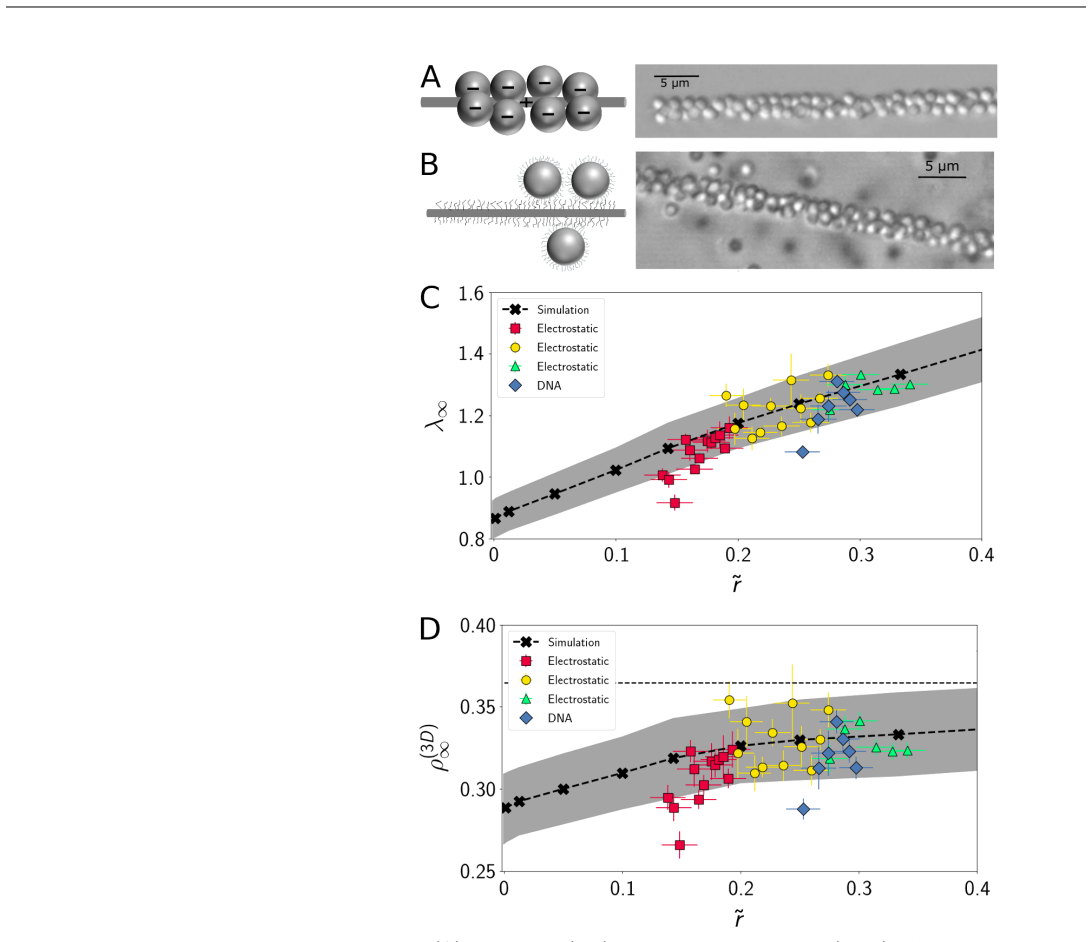
The central discovery is that random sequential adsorption of spheres on a cylinder is not a small perturbation of flat-surface parking: the asymptotic coverage depends on the ratio of sphere radius to cylinder radius, with ρ(3D)_∞ decreasing monotonically as the wire gets thinner and approaching ≈0.3647 on a plane, while the unwrapped 2D coverage ρ(2D)_∞ rises from the thin-wire limit, overshoots the planar value, and then falls back to ≈0.5471. The non-monotonicity follows from the product of two competing factors: the per-sphere angular area shrinks with r̃, while the saturated linear density grows because the maximum angular extent of a sphere decreases. Simulations show ρ(3D)_∞ increasing monotonically with r̃, and experiments with electrostatically and DNA-bound colloidal spheres match the predicted linear density over the accessible range r̃ ≳ 0.2. At short scales the adsorbed structures show weak chiral ordering with the preferred alignment angle obeying tan θ_max ≈ 3r̃.
Load-bearing premise
The asymptotic particle number is obtained by extrapolating finite-time simulations using the law ρ∞ − ρ(τ) ~ $τ^{{−1/2}}$, which assumes the effective number of degrees of freedom stays at two for every wire curvature; if the kinetics slow to one-dimensional behavior for very thin wires, the extrapolated coverages would be biased.
Editorial extensions
If this is right
- The 3D jamming coverage ρ(3D)_∞ increases monotonically with r̃ and never reaches the flat-plane limit of ≈0.3647, so any cylindrical curvature loosens the adsorbed monolayer in 3D.
- The 2D coverage ρ(2D)_∞ is non-monotonic: it overshoots the planar disk value ≈0.5471 at intermediate r̃, a distinctive signature of the competition between per-sphere area and angular packing.
- For very thin wires the random-parking density sits at about 61% of the densest possible packing, a ratio that stays near 0.62 across r̃ values.
- Short-range order in the jammed state is chiral, with the preferred pitch angle obeying tan θ_max ≈ 3r̃, so wire curvature biases the local alignment of neighboring spheres.
- The mapping to 2D RSA with shape (1) provides a parameter-free recipe to compute the coverage for any wire–sphere radius ratio without simulating the full 3D deposition.
Reading between the lines
- The τ^{−1/2} extrapolation assumes two degrees of freedom down to arbitrarily thin wires; if quasi-1D kinetics emerge for r̃ → 0, the extrapolated N∞ and the reported non-monotonic peak of ρ(2D)_∞ could shift, so the high-curvature predictions remain the least secure part of the paper.
- The experimental undersaturation at small r̃ hints that binding-energy decrease with curvature sets a practical irreversibility limit; using stronger bonds (covalent or longer DNA) could push experiments into the high-curvature regime and test the simulated coverage directly.
- The method transfers to other convex particles (ellipsoids, rods) on a cylinder: one only needs the angular envelope shape, so the same equation (1) input could predict coverage families for different particle shapes.
- The linear pitch-angle law tan θ_max ≈ 3r̃ offers a cheap experimental route to verifying the chiral ordering: count neighbor-center angles in 2D projection images of adsorbed spheres, no 3D reconstruction needed.
Signed reviews
Editorial analysis
A structured set of objections, weighed in public.
Referee Report
Summary. The paper studies random sequential adsorption (RSA) of hard spheres on a long cylinder of radius r, with sphere radius R, parameterized by r̃ = r/R. It maps the process to RSA of two-dimensional shapes on a strip in the φ–z plane, derives coverage formulas ρ(2D) and ρ(3D), and obtains asymptotic coverage from simulations extrapolated using the τ^{-1/2} law. Experiments with electrostatic and DNA-mediated binding of colloidal spheres to silica wires validate the predicted linear density and 3D coverage for r̃ ≳ 0.2. For high curvature (r̃ ≲ 0.2), simulations predict non-monotonic ρ(2D)∞ and monotonic ρ(3D)∞. The paper also reports weak chiral ordering, with tan θmax ≈ 3 r̃.
Significance. If the results hold, the paper provides a parameter-free prediction of curvature-dependent RSA coverage, validated by two independent experimental chemistries, and identifies a surprising non-monotonic 2D coverage. The geometric mapping is elegant, the simulation methodology is standard, and the experimental protocols are detailed, including error bars that account for particle-counting uncertainty. However, the high-curvature predictions rest on an unverified kinetic extrapolation, and the chiral ordering law is reported without statistical uncertainty. The experimental validation covers only the weak-to-moderate curvature regime, so the high-curvature claims remain purely predictive.
major comments (2)
- [Results, kinetics paragraph and Eq. (4)] The asymptotic values ρ(2D)∞ and ρ(3D)∞ at r̃ ≲ 0.2 are obtained by extrapolating finite-time simulation data with the law ρ∞−ρ(τ) ∼ τ^{-1/2}, which assumes df = 2 for all r̃. The paper's only defense is the sentence 'we do not observe a crossover to 1D asymptotic kinetics in our simulations as r̃ → 0,' but no exponent measurement, no local-slope analysis, and no supporting figure is provided. If the effective dimension crosses to df = 1 at small r̃, the τ^{-1/2} fit systematically biases the intercept below the true asymptote, and the claimed non-monotonicity of ρ(2D)∞ could be an artifact. Please provide a quantitative test, for example a plot of the logarithmic local slope d ln(ρ∞−ρ)/d ln τ versus 1/τ for the smallest r̃ values, or a comparison of extrapolations using df = 1 and df = 2.
- [Discussion and Fig. 5C] The relation tan θmax ≈ 3 r̃ is presented as a quantitative result, but the paper does not report the number of simulation runs, the standard error of θmax, the range of r̃ over which the fit is performed, or the goodness of fit. Without these, the claimed linear law is not falsifiable. Please provide fit details and uncertainty, and state how θmax depends on the correlation cutoff (the paper notes peaks disappear when the range is increased).
minor comments (5)
- [Results, packing density paragraph] The citation to packing spheres inside cylinders contains an unresolved '[?]' placeholder (the text reads '[?,35,41]'). Please complete the reference.
- [Results, Eq. (1)] The variables z and φ are introduced, but it would help to define the domain of φ and the periodicity explicitly (0 ≤ φ < 2π) before the strip of width 2π is used.
- [Methods, 'data anaysis' heading] There is a typo in the subsection heading: 'data anaysis' should be 'data analysis'.
- [Results, Fig. 5B] The caption says '⟨n(r)n(r',θ)⟩ as a function of angle θ' but the text defines it as counting pairs aligned at angle θ within tolerance Δy; the precise normalization of the correlation function (e.g., whether it is divided by the strip area) is not given.
- [Results, Fig. 3C and 3D] Several experimental points at small r̃ fall outside the two-sigma band, and the authors attribute this to weak binding on highly curved wires. This is plausible, but the statement 'these results validate our understanding' is too strong for the r̃ ≲ 0.2 region; the subsequent paragraph already restricts the validation to r̃ ≳ 0.2, so consider moving the validation phrase to that regime or adding a quantitative model of the undersaturation effect.
Circularity Check
No significant circularity: the asymptotic coverage predictions come from an exact geometric mapping, independent simulations, and parameter-free experimental comparisons.
full rationale
The paper's central derivation reduces the 3D geometry of spheres on a cylinder to an effective 2D RSA problem through the exact angular-envelope relation in Eq. (1); this is a geometric transformation, not a fitted input. The asymptotic quantities ρ(2D)∞ and ρ(3D)∞ are then obtained from simulations that directly implement the RSA rule and from experiments that count adsorbed particles with no model parameters fitted to the data. The low-curvature limits are checked against externally established plane RSA values (ρ(2D)∞ ≈ 0.5471, ρ(3D)∞ ≈ 0.3647), which provides an independent benchmark rather than a self-referential one. The only notable assumption is the use of the asymptotic law ρ∞ − ρ(τ) ∼ τ^{−1/2} to extrapolate N∞ from finite-time simulations; this is a kinetic assumption that could bias the high-curvature results if the effective dimension were to cross over, but it is not circular because the extrapolation is applied to simulated deposition data rather than to quantities defined by the claimed conclusion. The empirical relation tan θmax ≈ 3r̃ in Fig. 5C is presented as an observed correlation, not used to derive the coverage claims. No load-bearing self-citation chain, uniqueness import, or ansatz-smuggling via citation appears in the text. The derivation is therefore self-contained, with the identified caveat being an extrapolation risk rather than a circularity.
Assumptions & free parameters
free parameters (1)
- slope of tanθmax versus r̃ =
3
assumptions (6)
- domain assumption Adsorbed spheres have centers on the cylinder of radius R+r and make point contact with the wire.
- domain assumption Adsorption is irreversible and sequential, with no desorption, diffusion, or interactions beyond hard-core exclusion.
- domain assumption The 2D shape overlap condition in the φ-z plane is equivalent to 3D sphere overlap.
- domain assumption Asymptotic kinetics follow ρ∞-ρ(τ)~τ^{-1/2} for all r̃, so N∞ can be extrapolated from finite-time simulations.
- domain assumption Very long cylinders with periodic boundary conditions eliminate end effects.
- domain assumption Packing densities of spheres inside cylinders map to packing on the cylinder surface for single-layer configurations.
Cite this review
Pith. "Pith review of Random sequential adsorption of spheres on a cylinder." pith.science (2026). https://pith.science/paper/HNT6IEVG
@misc{pith2026190805350,
  author       = {Pith},
  title        = {Pith review of: Random sequential adsorption of spheres on a cylinder},
  year         = {2026},
  howpublished = {\url{https://pith.science/paper/HNT6IEVG}},
  note         = {Machine review of arXiv:1908.05350}
}
read the original abstract
Inspired by observations of beads packed on a thin string in such systems as sea-grapes and dental plaque, we study the random sequential adsorption of spheres on a cylinder. We determine the asymptotic fractional coverage of the cylinder as a function of the sole parameter in the problem, the ratio of the sphere radius to the cylinder radius (for a very long cylinder) using a combination of analysis and numerical simulations. Examining the asymptotic structures, we find weak chiral ordering on sufficiently small spatial scales. Experiments involving colloidal microspheres that can attach irreversibly to a silica wire via electrostatic forces or DNA hybridization allow us to verify our predictions for the asymptotic coverage.
Figures


Figures from the paper (2 more)


Reference graph
Works this paper leans on
-
[1]
Evans, J. W. . Rev. Mod. Phys. 1993, 65, 1281-1329
work page 1993
-
[2]
Wang, J.-S.; Pandey, R. B. Phys. Rev. Lett. 1996, 77, 1773-1776
work page 1996
-
[3]
Osberg, B.; Nuebler, J.; Gerland, U. Phys. Rev. Lett. 2015, 115, 088301
work page 2015
-
[4]
Shelke, P. B.; Ogale, S. B.; Khandkar, M. D.; Limaye, A. V. Phys. Rev. E 2008, 77, 066111
work page 2008
-
[5]
Adamczyk, Z.; Belouschek, P. J. Colloid Interface Sci. 1991, 146, 123-136
work page 1991
-
[6]
Tanemura, M.; Hasegawa, M. J. Theor. Biol. 1980, 82, 470-496
work page 1980
-
[7]
Thompson, A. P.; Glandt, E. D. J. Colloid Interface Sci. 1991, 146, 63-68
work page 1991
-
[8]
Talbot, J.; Tarjus, G.; Tassel, P. V.; Viot, P. Colloids and Surfaces A, 2000, 165, 287-324
work page 2000
Show all 47 references
-
[9]
Rosen,L.; Seaton,N.; Glandt,E. J. Chem. Phys. 1986, 85, 7359
1986
-
[10]
Swendsen, R. H. Phys. Rev. A 1981, 24, 504?508
1981
-
[11]
C.; Privman, V
Bartelt, M. C.; Privman, V. J. Chem. Phys. 1990, 93, 6820? 6823
1990
-
[12]
Renyi, A. Sel. Trans. Math. Stat. Prob 1963, 4, 203?218
1963
-
[13]
Privman, V.; Wang, J.-S.; Nielaba, P. Phys. Rev. B 1991, 43, 3366-3372
1991
-
[14]
Cie´ sla, M.; Barbasz, J. Phys. Rev. E 2014, 89, 022401
2014
-
[15]
Tarjus, G.; Viot, P. Phys. Rev. Lett. 1991, 67, 1875
1991
-
[16]
Viot, P.; Tarjus, G.; Ricci, S.; Talbot, J. J. Chem. Phys. 1992, 97, 5212-5218
1992
-
[17]
L.; Pandey, R
Becklehimer, J. L.; Pandey, R. B. J. Stat. Phys. 1994, 75, 765-771
1994
-
[18]
Fan, Y.; Percus, J. J. Stat. Phys. 1992, 66, 263-271
1992
-
[19]
Evans, J.; Nord, R. J. Stat. Phys. 1992, 69, 151-162
1992
-
[20]
J.; Ziff, R
Brosilow, B. J.; Ziff, R. M.; Vigil, R. D. Phys. Rev. A 1991, 43, 631-638
1991
-
[21]
Cie´ sla, M.; Barbasz, J. . Phys. Rev. E 2014, 90, 022402
2014
-
[22]
Suh, S.; Jung, B.; Park, Y.; Chihaia, V.; Parvulescu, V.; Gartner, M. Bull. Kor. Chem. Soc. 2008, 29, 873
2008
-
[23]
Cie´ sla,M.;Barbasz,J. J. Chem. Phys. 2012, 137, 044706
2012
-
[24]
Physica A 2007, 377, 102-114
Danwanichakul, P.; Charinpanitkul, T. Physica A 2007, 377, 102-114. 12/13
2007
-
[25]
J.; Hayes-Cameron, L
Manton, D. J.; Hayes-Cameron, L. In Handbook of Pediatric Dentistry (Fourth Edition), fourth edition ed.; Cameron, A. C., Widmer, R. P., Eds.; Mosby, 2013; pp 47–62
2013
-
[26]
Essential microbiology for dentistry, 2006, 255-265
Lakshman, S. Essential microbiology for dentistry, 2006, 255-265
2006
-
[27]
Mughal, A., and Weaire, D., 2017, Phys. Rev. E, 95(2), 022401
2017
-
[28]
L.; Rakesh, L.; Tomalia, D
Mansfield, M. L.; Rakesh, L.; Tomalia, D. A. J. Chem. Phys. 1996, 105, 3245-3249
1996
-
[29]
R.; Holmes-Cerfon, M
Chen, E. R.; Holmes-Cerfon, M. J. Nonlin. Sci. 2017, 27, 1743-1787
2017
-
[30]
B.; Holmes-Cerfon, M
Schade, N. B.; Holmes-Cerfon, M. C.; Chen, E. R.; Aronzon, D.;Collins, J. W.; Fan, J. A.; Capasso, F.; Manoharan, V. N. Phys. Rev. Lett. 2013, 110, 148303
2013
-
[31]
Feder, J.; Giaever, I. J. Colloid and Interface Sci. 1980, 78, 144-154
1980
-
[32]
Colloids and Surfaces A, 2016, 499, 1-9
Sadowska, M.; Adamczyk, Z.; Ocwieja, M.; Nattich-Rak, M. Colloids and Surfaces A, 2016, 499, 1-9
2016
-
[33]
Langmuir 2014, 30, 692-699
Sadowska, M.; Adamczyk, Z.; Nattich-Rak, M. Langmuir 2014, 30, 692-699
2014
-
[34]
T., Gross, M., and Okuyama, H
Pickett, G. T., Gross, M., and Okuyama, H. Phys. Rev. Lett., 2000, 85(17), 3652
2000
-
[35]
K., Weaire, D., and Hutzler, S
Mughal, A., Chan, H. K., Weaire, D., and Hutzler, S. T., 2012, Phys. Rev. E, 85(5), 051305
2012
-
[36]
K., 2011
Chan, H. K., 2011. Phys. Rev. E, 84(5), 050302
2011
-
[37]
and Ziff, R.M., 2018
Cie´ sla, M. and Ziff, R.M., 2018. J. Stat. Mech.: Theory and Experiment, 2018(4), p.043302
2018
-
[38]
and Jazssang, T., 1986
Hinrichsen, E.L., Feder, J. and Jazssang, T., 1986. J. Stat Phys., 44(5-6), pp.793-827
1986
-
[39]
and Jullien, R., 1992
Meakin, P. and Jullien, R., 1992. Physica A: Stat. Mech. Appl., 187(3-4), pp.475-488
1992
-
[40]
Baule, A. Phys. Rev. Lett., 2017, 119(2), p.028003
2017
-
[41]
E., and Charbonneau, P., 2016, Soft matter, 12(9), 2505-2514
Fu, L., Steinhardt, W., Zhao, H., Socolar, J. E., and Charbonneau, P., 2016, Soft matter, 12(9), 2505-2514
2016
-
[42]
Vigil,R.D.; Ziff,R.M. J. Chem. Phys. 1990, 93, 8270? 8272
1990
-
[43]
O˘ guz, E.C., Messina, R., and L¨ owen, H., 2011, EPL 94(2)
2011
-
[44]
Fu, L., Bian, C., Shields, C.W., Cruz, D.F., L´ opez, G.P., and Charbonneau, P., 2017, Soft matter, 13(18)
2017
-
[45]
Tong, L.; Mazur, E. J. Non-Crystalline Solids 2008, 354, 1240–1244
2008
-
[46]
Chandradoss, S.D.; Haagsma, A.C.; Lee, Y.K.; Hwang, J.H.; Nam, J.M.; Joo, C. J. Vis. Exp. 2014, 86, e50549
2014
-
[47]
S.; Wang, Y.; Pine, D
Oh, J. S.; Wang, Y.; Pine, D. J.; Yi, G.-R. Chem. Mater. 2015, 27, 8337-8344. 13/13
2015
Reviewed August 14, 2026 · model on record in the stance chip above.
Discussion (0). Continue with ORCID to comment.