REVIEW 3 major objections 5 minor 8 references
A 3-Dimensional Likelihood analysis method for detecting extended sources in VERITAS
T0 review · 3 major / 5 minor · reviewed 2026-08-14 · deepseek-v4-flash
Pith's one-line read This paper proposes a 3D maximum-likelihood method that lets VERITAS measure the morphology and spectra of extended gamma-ray sources too large for standard background subtraction.
desk verdict A candid status report, not a result: the paper's own residual maps contradict its core spatial-MSW factorization assumption, so the extended-source claim is unsupported as written. read the letter →
The pith
A machine-rendered reading of the paper's core claim, the machinery that carries it, and where it could break.
The reading
What carries the argument
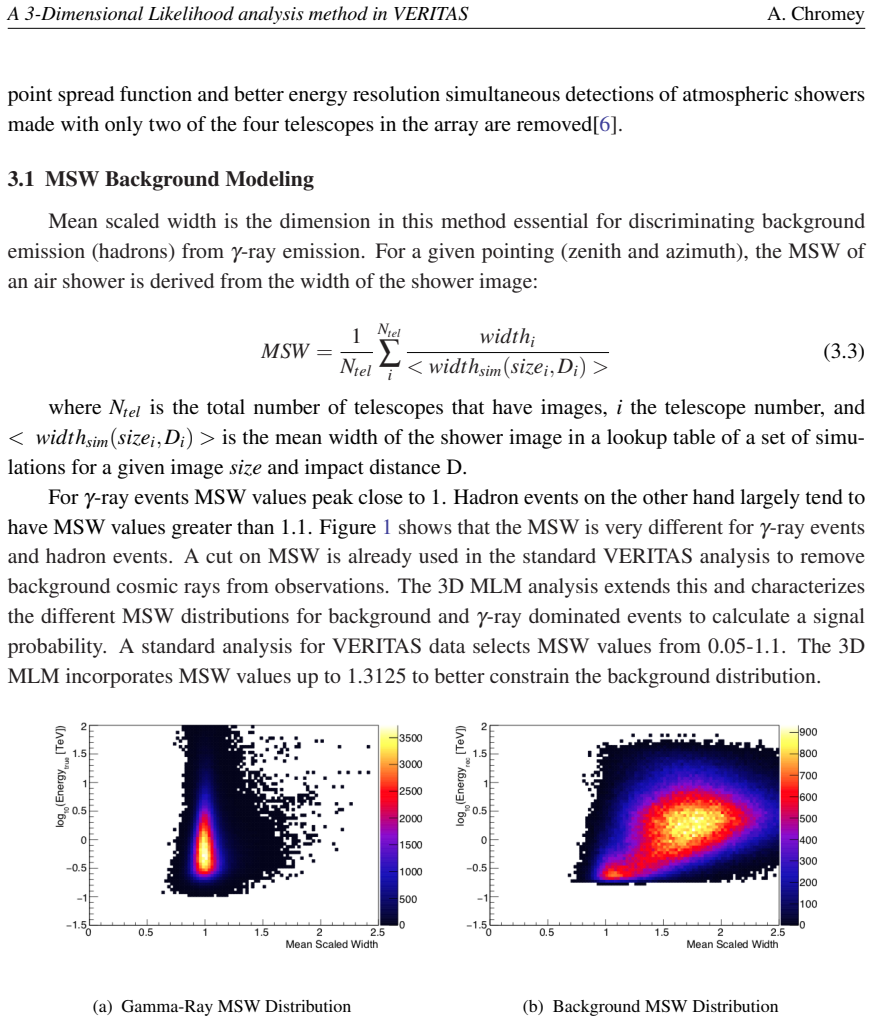
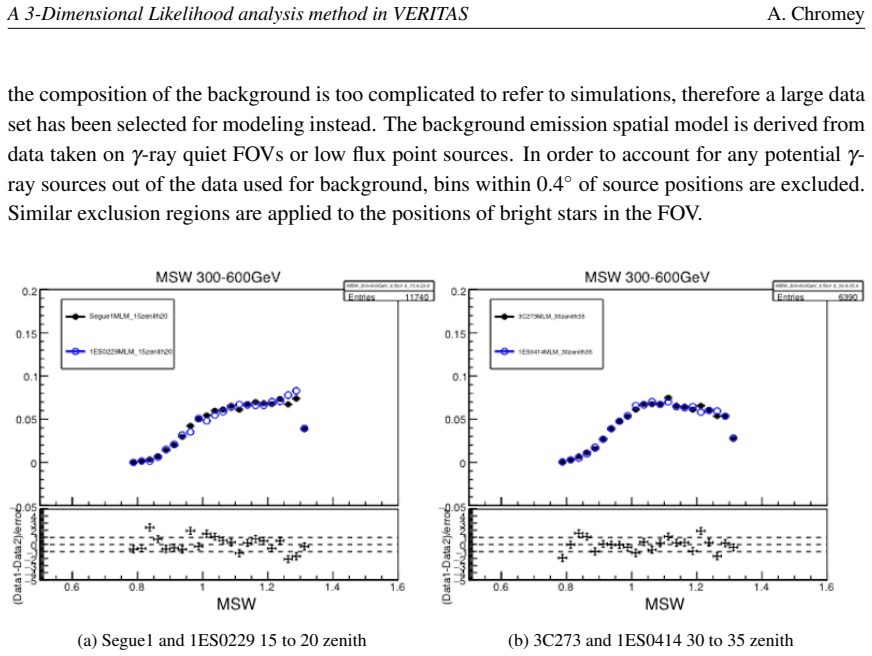
The load-bearing object is the three-dimensional likelihood itself, where the third dimension is the mean scaled width (MSW) of each air-shower image, computed by summing shower widths across telescopes and normalizing by simulated widths for that image size and impact distance. Gamma-ray events peak near MSW close to 1 while hadronic background events spread to larger values, so MSW replaces the need for a spatial OFF region. The source spatial model follows the standard likelihood formulation of equation (3.2), a convolution of intrinsic source morphology with the telescope point-spread function, energy response, and effective area, summed over reconstructed energy bins. The background MSW distribution is taken from VERITAS observations of gamma-ray-quiet fields, and the Poisson likelihood is augmented with the Barlow-Beeston method to account for the finite statistics of those model samples. The point-spread function is a symmetric King function with fitted $\sigma$ and fixed $\lambda$.
What would settle it
Analyze Crab data with the current 3D likelihood split by mean scaled width: if the paper's residual pattern—core over-subtracted for MSW 1.1-1.3 and under-subtracted below 1.1—persists after refitting the King function's $\sigma$, then the spatial model is biased and extended-source morphologies recovered from it cannot be trusted.
Extended reading notes
Core claim
The paper's central claim is that a maximum-likelihood analysis in three dimensions—two spatial coordinates plus mean scaled width—can estimate the morphology and spectrum of gamma-ray sources whose extent approaches the VERITAS field of view, which standard ring-background and reflected-region methods cannot do because they need a source-free patch of the camera for background estimation. The source model is built from simulations using a convolution of intrinsic source morphology with the point-spread function, energy response, and effective area, summed over energy bins, while the background model is built from deep observations of gamma-ray-quiet fields with source regions excluded. A binned-likelihood fit, with data unbinned in spatial and mean-scaled-width dimensions and binned in reconstructed energy, optimizes the model parameters. The method is presented as a work in progress: agreement with standard analysis has been shown on point sources, but full tests on known extended sources and implementation of the Barlow-Beeston correction for finite background statistics are ongoing.
Load-bearing premise
The load-bearing premise is that the width of an air-shower image is statistically independent of the gamma ray's arrival direction in the camera; the paper's own Crab residual maps show the point-spread function changing with image width, and if that coupling is real the fitted source shape is biased.
Editorial extensions
If this is right
- Standard VERITAS analyses could be extended to sources almost as large as the telescope's 3.5-degree field of view, including supernova remnants and pulsar wind nebulae whose emission fills the camera.
- Morphology and spectrum are fitted in one optimization, so the spatial shape and the spectral index no longer need separate treatments with different background regions.
- The same likelihood structure can treat several overlapping sources in one field, as already demonstrated on the two point sources 1ES 1218+304 and 1ES 1215+303.
- Using MSW values up to 1.3125 rather than the standard 1.1 cut gives more information on the hadronic background distribution and improves signal extraction.
- Successful validation on sources such as IC 443 would connect IACT measurements to extended sources already catalogued by Fermi-LAT and HAWC, bridging the GeV and TeV bands.
Reading between the lines
- The direct next step implied by the paper's own residual maps is to make the King-function point-spread parameters functions of MSW; the displayed Crab residuals suggest separate $\sigma$ and $\lambda$ values per MSW band would remove the over- and under-subtraction pattern.
- If the MSW-dependent point-spread function is corrected, the same likelihood structure could be extended to a joint fit of VERITAS, Fermi-LAT, and HAWC data, since all three are Poisson likelihoods over spatial and energy dimensions; this would let one extended-source model be constrained from 100 MeV to tens of TeV.
- A decisive end-to-end test not yet reported in the paper would be to inject simulated extended sources with known spectra into real VERITAS background fields and check that the fitted morphology and flux are unbiased in every MSW band.
Signed reviews
Editorial analysis
A structured set of objections, weighed in public.
Referee Report
Summary. The paper describes a three-dimensional maximum-likelihood method for VERITAS that models gamma-ray source and hadronic background events using two spatial coordinates plus the mean-scaled-width (MSW) shower parameter. The motivation is to enable analysis of extended sources, for which the standard ring-background and reflected-region methods fail because they require source-free field-of-view regions. The likelihood construction follows Mattox et al. with a King-function point-spread function (PSF), an MSW-based background model built from gamma-ray-free observations, and a binned energy treatment. The paper reports preliminary point-source consistency checks from prior work, identifies a PSF dependence on MSW that is not yet modeled, describes an ongoing Barlow-Beeston implementation to handle finite Monte Carlo statistics, and lists planned validation tests including Monte Carlo injections, the Crab, 1ES 1218+304/1ES 1215+303, dark-matter fields, and IC 443. The text is framed as a status report from ICRC2019.
Significance. If the method were completed and validated, it would address a genuine gap in IACT analysis: a likelihood framework capable of fitting extended sources up to the field-of-view scale and of combining multiple sources, with an alternative data-driven background model. The paper is clearly written and honestly discloses the main known limitation (MSW-dependent PSF) and the fact that validation is ongoing. However, as a journal contribution, the central claim that the method currently determines the morphology and spectra of extended sources is not supported by the evidence presented; the only quantitative-looking validation shown, the Crab residual maps, actually demonstrates a bias that is internally acknowledged. The paper is therefore more a progress report than a demonstration of a working method, and it needs either substantial model revision or a careful reframing of its claims.
major comments (3)
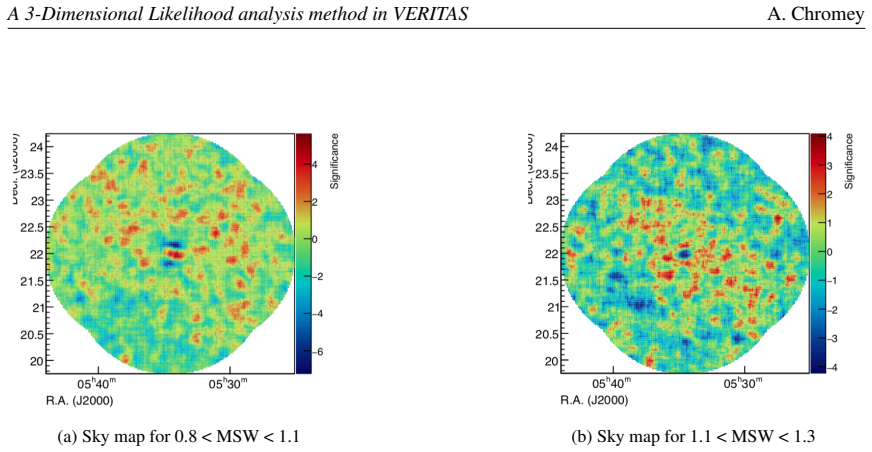
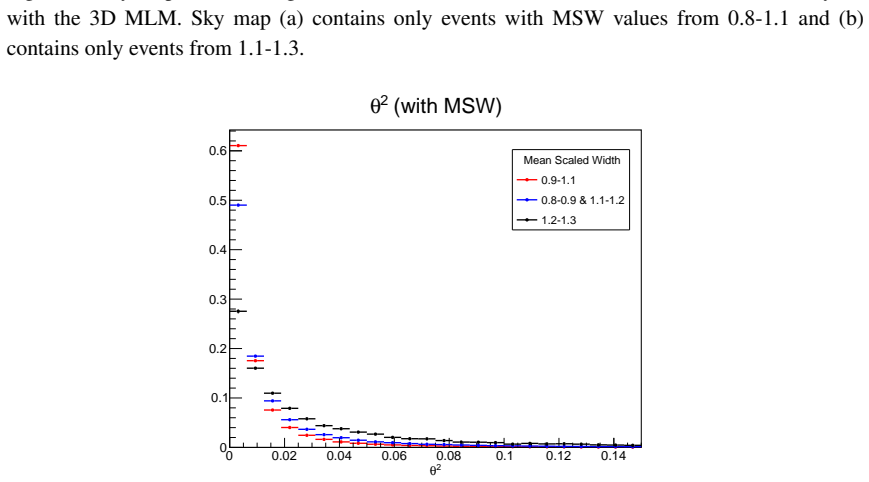
- [Section 3 and Section 3.2, Eq. (3.2), Eq. (3.4)] The source model is explicitly built on the assumption that the spatial parameters and MSW are uncorrelated, but Section 3.2 presents direct evidence against this assumption: for Crab data the residual sky maps show over-subtraction of the core and under-subtraction of the tail for MSW 1.1-1.3, with the opposite pattern for MSW < 1.1, and Figure 4 shows that the gamma-ray PSF radial distribution depends on MSW. Since the likelihood factorizes into a spatial term and an MSW term, the current point-source PSF is misspecified, and any extended-source morphology or spectrum fitted with this model will inherit that bias. The manuscript itself concludes that the PSF dependence is "not yet taken into account," so the opening claim of Section 3 that the method "optimizes model parameters to determine the morphology and spectra of extended sources" is not currently supported. Please either implement and validate an MSW-dependent PSF or restrict the claims to a status report with this limitation clearly stated as blocking the extended-source capability.
- [Sections 4 and 5] No quantitative validation of the method is presented. Section 4 states that the Barlow-Beeston likelihood calculation is "currently being rewritten" and that first tests will be done on bright point sources and empty fields; Section 5 describes the Monte Carlo extended-source tests, the Crab validation, and the IC 443 test only as planned. The only quantitative consistency check cited is the Cardenzana (2017) thesis comparison with standard analysis, which predates the MSW-dependent PSF issue and is not repeated or extended here. An abstract that advertises "current status and performance" should be accompanied by at least one closed validation result, such as the recovered morphology and spectrum of an injected extended source, or a comparison of the current implementation with standard analysis on a source such as the Crab.
- [Section 4, Eq. (4.3)] The finite-statistics issue in the background model is identified as a concern, but the remedy is not yet part of the code. Since the background model is derived from observations and the paper states that the 10:1 model-to-data sample ratio will not be satisfied in many bins, the method as described currently ignores an acknowledged source of systematic uncertainty in the likelihood. Please make the status of the Barlow-Beeston implementation explicit in the abstract and conclusions, and either quantify the expected impact of the approximation or present a test of the current likelihood before claiming enhanced sensitivity to extended sources.
minor comments (5)
- [Section 3] The acronym MSW is used in the opening of Section 3 before it is defined in Section 3.1; please define it at first use.
- [Figure 4] The final legend entry "(with MSW)" appears to be a placeholder; please replace it with the actual MSW range labels corresponding to the plotted curves.
- [Section 3.2] The terms "over-subtraction" and "under-subtraction" are qualitative; specifying the residual significance or event counts per MSW bin would make the reported bias measurable and reproducible.
- [Section 4, Eqs. (4.1)-(4.3)] Please check and clarify the index conventions in Eqs. (4.1)-(4.3); in particular, the relationship between p_j, A_ji, and the sums over j and i should be stated explicitly so that the likelihood expression is unambiguous.
- [References] Reference [6] is an unpublished Ph.D. thesis; if it contains essential derivations or validation details, please provide a persistent link or make the relevant equations self-contained in this manuscript.
Circularity Check
No circularity: the likelihood construction uses simulation and data inputs stated in the paper, and the admitted PSF/MSW dependence is a model misspecification rather than a claim that reduces to its own inputs.
full rationale
The derivation chain is the standard likelihood construction: the likelihood is L = product p(theta_i|s) (Eq. 3.1), the source spatial model follows Mattox et al. (Eq. 3.2), and the MSW background and gamma-ray terms come from simulations or selected gamma-ray-quiet observational fields. No equation in the paper is defined in terms of the quantity it is later claimed to predict. The King-function PSF (Eq. 3.4) is an explicit ansatz with sigma fit in the likelihood; this is an internal model fit, not a fitted input renamed as a prediction. The repeated citation to Cardenzana (2017)[6] supplies the instrument-response setup, energy cuts, and previous point-source validation, but the assumptions are restated in the paper and independently checked, notably by the Crab residual study. That study is an external benchmark against real VERITAS data, and it produces a frank negative result: 'Results of past validation studies of the 3D MLM on the brightest gamma-ray point sources show a dependence of PSF on MSW not yet taken into account.' This is an acknowledged model misspecification, not circularity. The validation sections 5-6 describe planned Monte Carlo tests against known inputs and future dark-matter and extended-source targets; because these tests are future work, the paper's extended-source claim is not yet demonstrated, but no part of the argument is equivalent to its inputs by construction. The Barlow-Beeston implementation being 'currently being rewritten' is likewise a completeness issue, not a circularity issue.
Assumptions & free parameters
free parameters (4)
- King-function PSF width sigma =
not reported (fit in likelihood)
- King-function PSF index lambda =
fixed (value not reported)
- Source flux normalization =
not reported
- Source spectral index =
not reported
assumptions (3)
- domain assumption Spatial distribution and MSW distribution are uncorrelated for both source and background models.
- domain assumption Gamma-ray MSW distributions are accurately described by simulations, and background MSW distributions are accurately described by data from gamma-ray quiet fields.
- domain assumption The point-spread function has a symmetric King-function form with a fixed exponent lambda.
Cite this review
Pith. "Pith review of A 3-Dimensional Likelihood analysis method for detecting extended sources in VERITAS." pith.science (2026). https://pith.science/paper/LIO66B6N
@misc{pith2026190805352,
  author       = {Pith},
  title        = {Pith review of: A 3-Dimensional Likelihood analysis method for detecting extended sources in VERITAS},
  year         = {2026},
  howpublished = {\url{https://pith.science/paper/LIO66B6N}},
  note         = {Machine review of arXiv:1908.05352}
}
abstract
Gamma ray observations from a few hundred MeV up to tens of TeV are a valuable tool for studying particle acceleration and diffusion within our galaxy. Constructing a coherent physical picture of particle accelerators such as supernova remnants, pulsar wind nebulae, and star-forming regions requires the ability to detect extended regions of gamma ray emission, to analyze small-scale spatial variation within these regions, and to synthesize data from multiple observatories across multiple wavebands. Imaging atmospheric Cherenkov telescopes (IACTs) provide fine angular resolution (<0.1$^\circ$) for gamma rays above 100 GeV. However, their limited fields of view typically make detection of extended sources challenging. Maximum likelihood methods are well-suited to simultaneous analysis of multiple fields with overlapping sources and to combining data from multiple gamma ray observatories. Such methods also offer an alternative approach to estimating the IACT cosmic ray background and consequently an enhanced sensitivity to sources that may be as large as the telescope field of view. We report here on the current status and performance of a maximum likelihood technique for the IACT VERITAS.
Figures
Figures from the paper (1 more)
Reference graph
Works this paper leans on
-
[6]
J. Cardenzana, A 3D Maximum Likelihood Analysis for Studying Highly Extended Sources in VERITAS Data, PhD diss., Iowa State University
-
[1]
U., et al., The 2HWC HAWC Observatory Gamma Ray Catalog, ApJ 843 40 [arXiv:1702.02992]
Abeysekara, A. U., et al., The 2HWC HAWC Observatory Gamma Ray Catalog, ApJ 843 40 [arXiv:1702.02992]
-
[2]
M. Ackermann et al., Search for Extended Sources in the Galactic Plane Using 6 Years of Fermi-Large Area Telescope PASS 8 Data above 10 GeV, ApJ 843 139 [arXiv:1702.00476]
-
[3]
Park, Performance of the VERITAS experiment, in proceedings of 34th ICRC, PoS (ICRC2015) 771
N. Park, Performance of the VERITAS experiment, in proceedings of 34th ICRC, PoS (ICRC2015) 771
- [4]
-
[5]
Mattox et al., The Likelihood Analysis of EGRET Data, ApJ 461, 396
J.R. Mattox et al., The Likelihood Analysis of EGRET Data, ApJ 461, 396
-
[7]
Measurement of Cosmic-ray Electrons at TeV Energies by VERITAS
A. Archer et al. [The VERITAS Collaboration], Measurement of Cosmic-ray Electrons at TeV Energies by VERITAS, Phys. Rev. D 98 no. 6 062004 [arXiv:1808.10028]
-
[8]
R. Barlow and C. Beeston., Fitting using finite Monte Carlo samples, Computer Physics-Communications 77 219-228 7
Reviewed August 14, 2026 · model on record in the stance chip above.
Discussion (0). Continue with ORCID to comment.