REVIEW 3 major objections 5 minor 15 references
Properties of the Interstellar Medium along Sight Lines to Nearby Planet Hosting Stars
T0 review · 3 major / 5 minor · reviewed 2026-08-14 · deepseek-v4-flash
Pith's one-line read This paper claims that three nearby planet-hosting stars show no astrospheric hydrogen-wall absorption, so their stellar wind mass-loss rates cannot be measured with the astrosphere technique.
desk verdict Solid new LISM data and a useful catalog, but the abstract oversells both the cloud assignments and the ionized-gas inference. read the letter →
The pith
A machine-rendered reading of the paper's core claim, the machinery that carries it, and where it could break.
The reading
What carries the argument
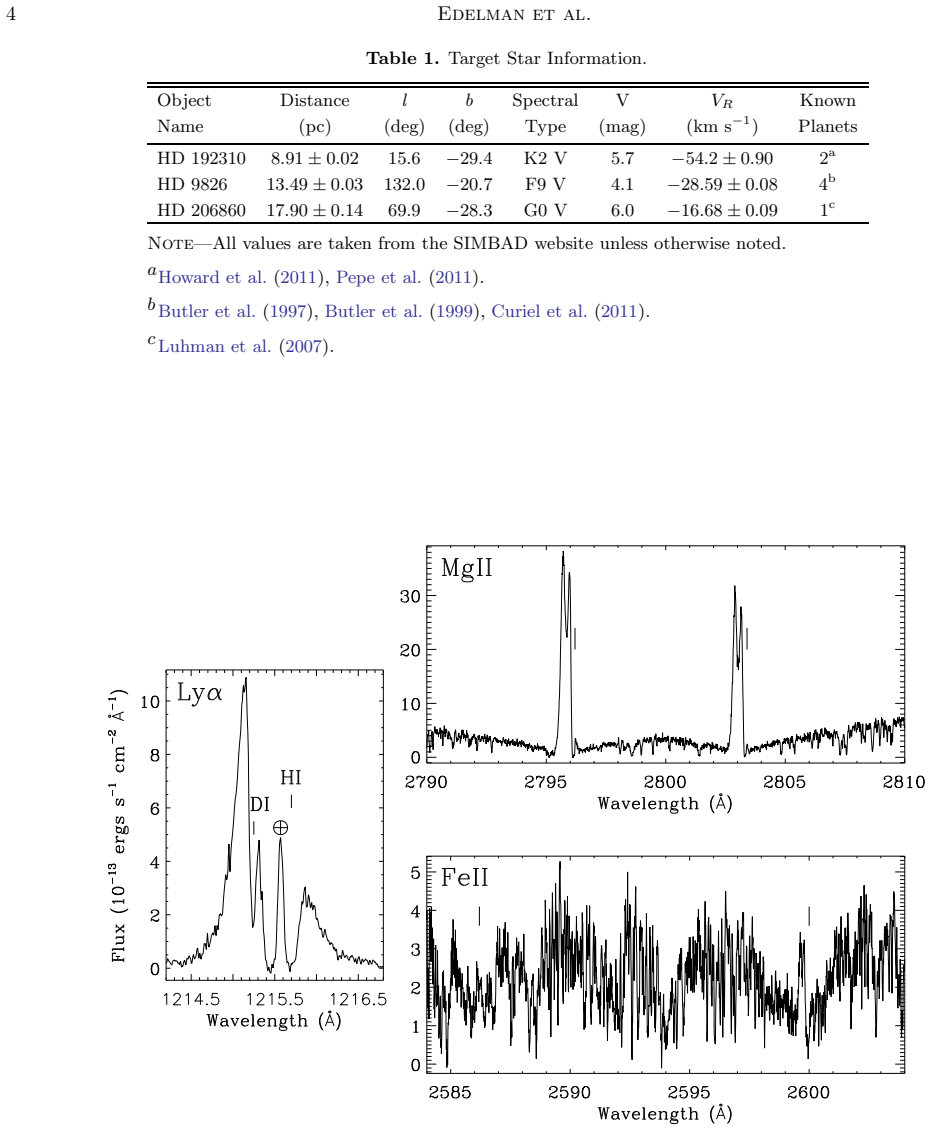
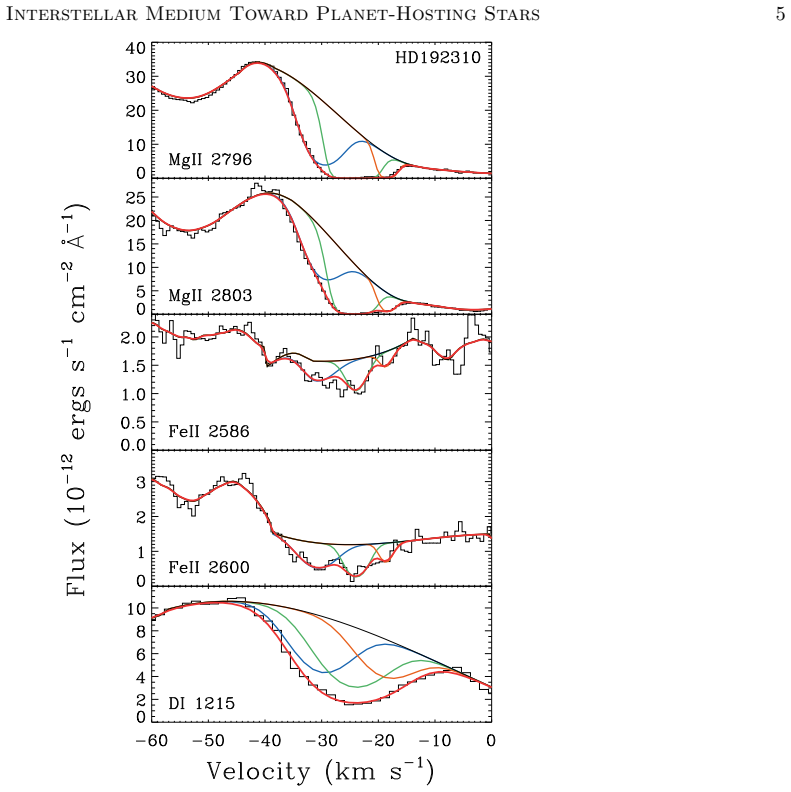
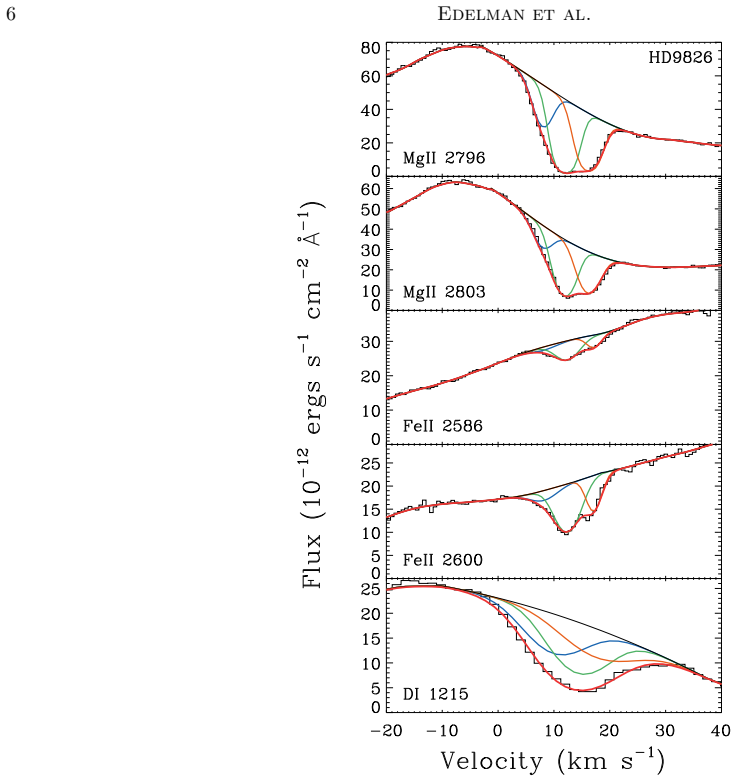
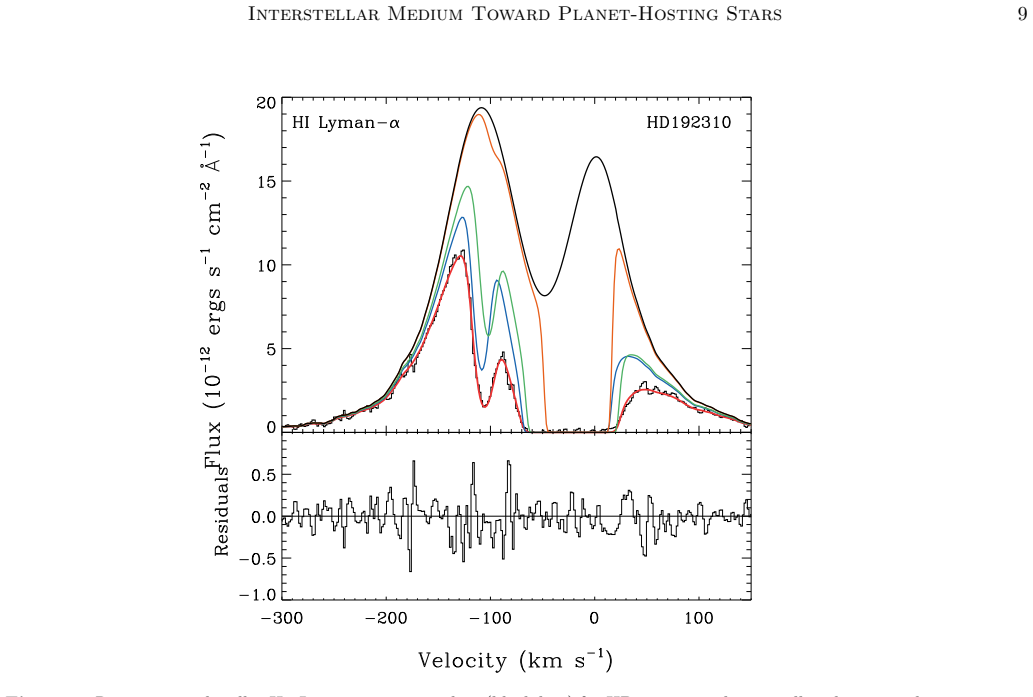
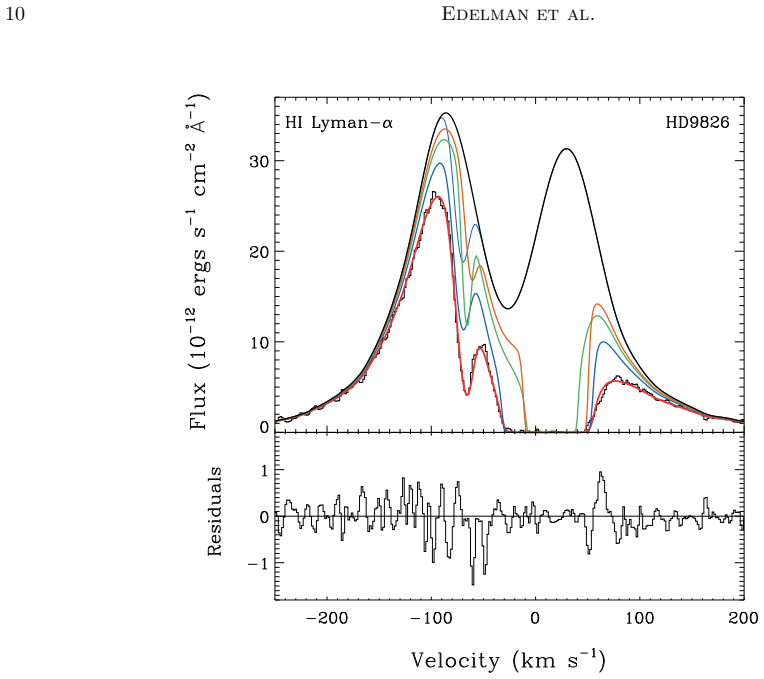
The central mechanism is the hydrogen wall, a region of decelerated and heated neutral hydrogen created by charge exchange between the stellar wind and interstellar neutrals; it imprints broad Lyman-alpha absorption blueshifted relative to the surrounding gas as seen from outside the star. The analysis machinery is multi-component Voigt-profile fitting of Mg II, Fe II, D I, and H I absorption, with D I providing a hydrogen column estimate through the fixed local D/H ratio, and the intrinsic stellar Lyman-alpha core reconstructed by assuming it resembles the self-reversed Mg II line shape. The no-astrosphere conclusion follows from examining residuals after subtracting the interstellar-only model, supplemented by H I versus D I velocity comparisons and by hydrodynamic model predictions for where hydrogen-wall absorption would appear.
What would settle it
A higher signal-to-noise Lyman-alpha spectrum of any one of these stars, analyzed with an independently reconstructed stellar line shape, that shows a residual blueshifted absorption feature at the hydrogen-wall velocity (around -90 km/s for HD 192310 and -50 km/s for HD 9826) would overturn the no-astrosphere conclusion.
Extended reading notes
Core claim
The central claim is that the Lyman-alpha line profiles of HD 192310, HD 9826, and HD 206860 are fully explained by the reconstructed stellar emission line plus interstellar H I and D I absorption in three velocity components; no additional blueshifted absorption from a stellar hydrogen wall is present. Consequently, none of these planet hosts has a detectable astrosphere, and their stellar wind mass-loss rates cannot be measured by the astrosphere technique. The authors infer that the stars are likely surrounded by fully ionized interstellar gas rather than embedded in the partially neutral clouds detected along their sight lines.
Load-bearing premise
The whole search for astrospheres relies on the assumption that the unseen core of each star's Lyman-alpha emission line has the same self-reversed shape as its Mg II lines; if the true core differs, the interstellar-only fit could hide a real blue-shifted hydrogen-wall feature.
Editorial extensions
If this is right
- If the paper's conclusion is right, these three host stars' winds are invisible to the only observationally based technique that currently measures mass-loss rates for solar-like stars.
- The likely ionized surroundings imply that the astrospheres of these stars, if present at all, are structured differently from the Sun's, so wind ram pressure cannot be inferred from hydrogen-wall absorption.
- The measured LISM component velocities for these three systems anchor the removal of interstellar contamination in any future Lyman-alpha transit observations of their planets.
- The catalogue of all known exoplanet hosts within 20 parsecs gives predicted cloud velocities and H I columns, allowing observers to identify sight lines where interstellar absorption is well separated from planet-induced features.
- For stars with no measured interstellar properties, the predicted dominant clouds and their velocities indicate how blended the interstellar absorption is likely to be in low-resolution spectra.
Reading between the lines
- The non-detections should not be read as weak winds; a stellar wind can exist without producing detectable hydrogen-wall absorption when the surrounding medium is ionized.
- HD 192310's measured H I minus D I velocity offset of about +3 km/s leans toward heliospheric absorption, so a dedicated observation of that sight line could test whether the Sun's own hydrogen wall contaminates the profile.
- The catalogue's predicted velocities could guide a targeted survey: choose transit-hosting stars within 20 parsecs whose predicted LISM velocities are cleanly separated from planet-induced absorption, maximizing the chance of detecting exoplanet atmospheric features.
- If future higher signal-to-noise spectra reveal a weak residual blueshifted feature in any of these stars, the conclusion would shift from no astrosphere to a weak astrosphere, immediately providing a mass-loss estimate for a planet host.
Signed reviews
Editorial analysis
A structured set of objections, weighed in public.
Referee Report
Summary. The paper presents HST/STIS ultraviolet spectra of three nearby exoplanet host stars (HD 192310, HD 9826, HD 206860) and analyzes interstellar absorption in Lyman-alpha, Mg II, Fe II, and D I. The authors identify three interstellar velocity components per sight line, match most of them to clouds in the Redfield & Linsky (2008) 15-cloud model, measure temperatures, turbulence, and depletions, and search for astrospheric Lyman-alpha absorption. They report no blue-shifted absorption indicative of an astrosphere and conclude that the stars are probably embedded in fully ionized interstellar gas. They also compile a table of measured and predicted LISM properties for all known exoplanet host stars within 20 pc.
Significance. If the non-detection holds, the paper rules out detectable hydrogen walls for these three planet hosts, implying that the astrosphere technique cannot be used to measure their mass-loss rates and supporting the picture that many nearby stars lie in ionized Local Bubble gas. The fitting methodology is standard, the component selection uses F-tests, and the non-detection is directly supported by the displayed residuals. The compiled table of 96 exoplanet host systems within 20 pc is a useful community resource, and the predicted velocities are explicitly labeled as model-dependent. The main weakness is that the strongest physical conclusion rests on the reconstructed stellar Lyman-alpha profile rather than on an unambiguous spectral feature.
major comments (3)
- [Abstract; Section 3; Section 6] The abstract and conclusions claim that 'eight of the nine components' are reliably assigned to Redfield & Linsky (2008) clouds, but Section 3 states that component 1 toward HD 206860 has two plausible identifications (Vel or Mic, both outside their known boundaries) and that component 1 toward HD 9826 has no known cloud match. These two statements together leave only seven unambiguous matches, or eight only if the ambiguous HD 206860 component is counted as a match. The text is internally inconsistent and should be corrected in the abstract, Section 3, and Section 6.
- [Section 2.3; Section 5] The claim that 'None of the stars show blue-shifted absorption indicative of an astrosphere' rests on the assumption that the intrinsic stellar Lyman-alpha core is similar to the Mg II lines including a self-reversal. The blue wing, where astrospheric absorption would appear, is reconstructed by subtracting interstellar absorption from this assumed intrinsic profile; a broader or more asymmetric true core could absorb a broad, shallow astrospheric feature into the reconstruction rather than leave a residual. The paper's own delta-v(HI-DI) test shows HD 192310 at +2.93 km/s, which the authors interpret as possible heliospheric absorption, demonstrating that an additional absorption component can shift the HI centroid at the ~3 km/s level. The result should therefore be phrased as a non-detection at the model-dependent sensitivity of the reconstruction, not as proof that no hydrogen wall exists; the abstract's wording 'implying that the stars are in regions of ionized interstellar gas' is too strong.
- [Section 5; Figures 10 and 11; Table 5] The statement that 'If hydrogen walls are present, they should have been detected' depends on the assumed stellar mass-loss rates of 5.9 and 5.1 Mdot_sun, taken from an X-ray luminosity correlation. Figures 10 and 11 therefore demonstrate only that walls at those assumed mass-loss rates would be detectable, not that all plausible hydrogen walls are excluded. The paper should specify a detection threshold in terms of astrospheric column density or mass-loss rate, or otherwise state the sensitivity of the search in units that do not rely on the assumed wind strengths.
minor comments (5)
- [Figure 1 caption] The caption mentions 'the ⊕ symbol' but does not define it; please spell out the symbol and its meaning explicitly.
- [Table 6] Several entries in Table 6 contain apparent formatting errors or missing separators (e.g., '0.1 3', '(35 .42)', '(16.73)'), and the distinction between measured and predicted values is sometimes unclear despite the parenthetical convention; please clean the table and mark measured and predicted entries consistently.
- [Section 2.2] The F-test used to justify the number of absorption components is mentioned but no significance threshold or procedural detail is given; please provide the threshold or a reference describing the test.
- [References] The reference entry for Wood et al. 2001 contains a duplicated year ('2001. 2001, ApJL, 547, L49') and should be corrected.
- [Section 4] The sentence 'The first component is likely the strongest absorber' is ambiguous; please clarify whether 'first' refers to the first-listed cloud, the component with the highest column density, or the LIC.
Circularity Check
No significant circularity: the astrosphere non-detection and LISM measurements rest on new STIS data; the only self-citations are minor and non-load-bearing.
full rationale
The central results do not reduce to their inputs by construction. The three interstellar velocity components per sight line are obtained from independent Voigt-profile fits to newly obtained STIS Mg II and Fe II spectra (Table 2), and the Lyman-alpha H I and D I fits (Table 3) are compared against the observed profiles rather than being forced by the Redfield & Linsky cloud model. The astrospheric search in Section 5 is a residual analysis with an explicit sensitivity test: the authors inject astrosphere models with assumed mass-loss rates and show that these would produce large residuals (Figures 10 and 11), so the non-detection is falsifiable rather than an identity. The assumption that the Lyman-alpha core is similar to Mg II including self-reversal is stated openly in Section 2.3 as an assumption; it limits the sensitivity of the search but does not constitute a hidden circular derivation. The self-citations to Redfield & Linsky (2000, 2008) are used for cloud identifications (Table 4) and for the predicted values in Table 6. Those table entries are explicitly labeled as predicted, and the cloud identification step is not used to prove the astrospheric non-detection. The paper also acknowledges that the HD 192310 velocity difference near 3 km/s may indicate heliospheric absorption, which is a stated caveat rather than a circular step. Overall, this is a minor self-citation case rather than a derivational circularity.
Assumptions & free parameters
free parameters (2)
- Intrinsic Lyman-alpha emission line shape adjustments =
not tabulated, varied to optimize fit
- Assumed stellar mass-loss rates for astrosphere models =
5.9 Mdot (HD 192310), 5.1 Mdot (HD 9826)
assumptions (5)
- domain assumption The Redfield & Linsky (2008) 15-cloud model correctly describes the local cloud velocity field and boundaries.
- ad hoc to paper The intrinsic Lyman-alpha line core has a shape similar to the Mg II lines, including self-reversal.
- domain assumption The D/H ratio in the LISM is 1.56e-5 (Linsky et al. 2006).
- domain assumption The astrosphere/hydrogen-wall model correctly predicts detectable Lyman-alpha absorption for the assumed wind parameters.
- domain assumption Metals in the LISM are fully in their first ionization state when computing depletions.
Cite this review
Pith. "Pith review of Properties of the Interstellar Medium along Sight Lines to Nearby Planet Hosting Stars." pith.science (2026). https://pith.science/paper/5B4TAFXF
@misc{pith2026190805375,
  author       = {Pith},
  title        = {Pith review of: Properties of the Interstellar Medium along Sight Lines to Nearby Planet Hosting Stars},
  year         = {2026},
  howpublished = {\url{https://pith.science/paper/5B4TAFXF}},
  note         = {Machine review of arXiv:1908.05375}
}
read the original abstract
We analyze high-resolution ultraviolet spectra of three nearby exoplanet host stars (HD 192310, HD 9826, and HD 206860) to study interstellar properties along their lines of sight and to search for the presence of astrospheric absorption. Using HST/STIS spectra of the Lyman-alpha, Mg II, and Fe II lines, we identify three interstellar velocity components in the lines of sight to each star. We can reliably assign eight of the nine components to partially ionized clouds found by Redfield & Linsky (2008) on the basis of the star's location in Galactic coordinates and agreement of measured radial velocities with velocities predicted from the cloud velocity vectors. None of the stars show blue-shifted absorption indicative of an astrosphere, implying that the stars are in regions of ionized interstellar gas. Coupling astrospheric and local interstellar medium measurements is necessary to evaluate the host star electromagnetic and particle flux, which have profound impacts on the atmospheres of their orbiting planets. We present a table of all known exoplanets located within 20 pc of the Sun listing their interstellar properties and velocities predicted from the local cloud velocity vectors.
Figures
Figures from the paper (8 more)



Reference graph
Works this paper leans on
-
[1]
Asplund, M., Grevesse, N., & Sauval, A. J. 2005, Cosmic Abundances as Records of Stellar Evolution and Nucleosynthesis, 336, 25 Ayres, T. R. 2010, ApJS, 187, 149 Butler, R. P., Marcy, G. W., Williams, E., Hauser, H., & Shirts, P. 1997, ApJL, 474, L115 Butler, R. P., Marcy, G. W., Fischer, D. A., et al. 1999, ApJ, 526, 916 Curiel, S., Cant´ o, J., Georgiev...
work page 2005
-
[8]
(12.66) 8 a Data in parentheses are predicted from models. The velociti es from Redfield & Linsky (2008): http://lism.wesleyan.edu/LISMdynamics.html and column densities from Redfield & Linsky (2000): http://lism.wesleyan.edu/ColoradoLIC.html. b Distances are from GAIA DR2 ( Gaia Collaboration et al. 2016 ,
work page 2008
-
[9]
Redfield, S., & Linsky, J. L. 2000, ApJ, 534, 825 Redfield, S., & Linsky, J. L. 2001, ApJ, 551, 413 Redfield, S., & Linsky, J. L. 2002, ApJS, 139, 439 Redfield, S., & Linsky, J. L. 2004a, ApJ, 602, 776 Redfield, S., & Linsky, J. L. 2004b, ApJ, 613, 1004 Redfield, S., & Linsky, J. L. 2008, ApJ, 673, 283-314 Redfield, S., & Linsky, J. L. 2015, ApJ, 812, 125 Rodrig...
work page 2000
-
[17]
78 12.14 17.55 16.45 17.34 1 γ Cep GJ 903 13.54 118.99 +15.32 3.22 LIC (8.33) (18.04) 8 Ross 1020 GJ 3779 13.75 14.12 +82.43 13.01 NGP (-8.29) 8 47 UMa GJ 407 13.80 175.78 +63.37 5.04 LIC,NGP (5.31) (17.23) (12.91) 8 GJ 1214 h 14.65 26.16 +23.61 14.67 Mic,G,Oph –26.4 g 18.06g (–27.76) (–28.78) 6,8 HIP 79431 14.54 355.20 +22.97 11.37 G,Gem (–29.24) (–28.63...
-
[25]
Slavin, J. D., & Frisch, P. C. 2008, A&A, 491, 53 Stassun, K. G., Collins, K. A., & Gaudi, B. S. 2017, AJ, 153, 136 Stone, E. C., Cummings, A. C., McDonald, F. B., et al. 2005, Science, 309, 2017 Stone, E. C., Cummings, A. C., McDonald, F. B., et al. 2008, Nature, 454, 71 van Belle, G. T., & von Braun, K. 2009, ApJ, 694,
work page 2008
-
[43]
(20.21) 8 55 Cnc h GJ 324A 12.59 196.79 +37.70 5.95 LIC,Gem (14.75) (17.78) (27 .78) 8 GJ 1132 h 12.62 277.26 +7.76 13.52 G,Cet (-2.73) (8.82) 8 VHS J1256-1257 12.7 j 304.67 +49.90 17.76 Leo (-8.71) 8 HD 147513 GJ 9559 12.91 341.62 +7.21 5.38 G,Gem (–26.63) (–25 .30) 8 HD 40307 GJ 2046 12.94 268.81 –30.34 7.15 Blue,G,Vel 9.4 18.6 0 (7.63) (18.38) 6,8 HD 9...
-
[96]
Gayley, K. G., Zank, G. P., Pauls, H. L., Frisch, P. C., & Welty, D. E. 1997, ApJ, 487, 259 Gr¨ unwaldt, H., Neugebauer, M., Hilchenbach, M., et al. 1997, Geophysical Research Letters, 24,
work page 1997
-
[146]
Izmodenov, V., Malama, Y. G., Gloeckler, G., et al. 2003, ApJ, 594, L59. Lammer, H., Chassefi` ere, E., Karatekin, ¨O., et al. 2013, SSRv, 174, 113 Lindler, D. 1999, CALSTIS Reference Guide (Greenbelt: NASA/LASP) Linsky, J. L., Draine, B. T., Moos, H. W., et al. 2006, ApJ, 647, 1106 Linsky, J. L., Bushinsky, R., Ayres, T., & France, K. 2012, ApJ, 757, 69 L...
work page 2003
Show all 15 references
-
[501]
V., Heerikhuisen, J., Roytershteyn, V., et al
Pogorelov, N. V., Heerikhuisen, J., Roytershteyn, V., et al . 2017, ApJ, 845,
2017
-
[679]
STIS Instrument Handbook
Hernandez, S., et al. 2011, “STIS Instrument Handbook” Version 13.0, (Baltimore: STScI) Howard, A. W., Johnson, J. A., Marcy, G. W., et al. 2011, ApJ, 730, 10 Jakosky, B. M., Brain, D., Chaffin, M., et al. 2018, Icarus, 315,
2011
-
[1085]
Vidal-Madjar, A., Lecavelier des Etangs, A., D´ esert, J.-M ., et al
18 Edelman et al. Vidal-Madjar, A., Lecavelier des Etangs, A., D´ esert, J.-M ., et al. 2003, Nature, 422, 143 Wood, B. E., Alexander, W. R., & Linsky, J. L. 1996, ApJ, 470, 1157 Wood, B. E., M¨ uller, H.-R., Zank, G. P., & Linsky, J. L. 2002, ApJ, 574, 412 Wood, B. E. 2004, L...
2003
-
[1163]
Gry, C., & Jenkins, E. B. 2014, A&A, 567, A58 Gurnett, D. A., Kurth, W. S., Burlaga, L. F., & Ness, N. F. 2013, Science, 341, 1489 Heerikhuisen, J., Pogorelov, N. V., Florinski, V., et al. 2008, ApJ, 682,
2014
-
[1492]
Echim, M. M. and Lemaire, J. and Lie-Svendsen, Ø. 2011, Surveys in Geophysics, 32, 1 Ehrenreich, D., Bourrier, V., Wheatley, P. J., et al. 2015, Nature, 522, 459 Fossati, L., Haswell, C. A., Froning, C. S., et al. 2010, ApJL, 714, L222 France, K., Linsky, J. L., Tian, F., Fron...
2011
-
[2001]
E., Linsky, J
2001, ApJL, 547, L49 Wood, B. E., Linsky, J. L., H´ ebrard, G., Williger, G. M., Moos, H. W., & Blair, W. P. 2004, ApJ, 609, 838 Wood, B. E., Redfield, S., Linsky, J. L., M¨ uller, H.-R., & Zank, G. P. 2005, 13th Cambridge Workshop on Cool Stars, Stellar Systems and the Sun, 56...
2001
-
[2018]
c Interstellar partially ionized clouds in the line of sight t o the star
unless otherwise noted. c Interstellar partially ionized clouds in the line of sight t o the star. For lines of sight with predicted interstellar ve locities, the first listed cloud is predicted to be the dominant absorber. d (1) This paper, (2) Redfield & Linsky (2008), (3) W...
2008
Reviewed August 14, 2026 · model on record in the stance chip above.
Discussion (0). Continue with ORCID to comment.