REVIEW 2 major objections 4 minor 39 references
Investigation of Ionic and Anomalous Magnetic Behavior in CrSe$_2$ Using $^8$Li $\beta$-NMR
T0 review · 2 major / 4 minor · reviewed 2026-08-14 · deepseek-v4-flash
Pith's one-line read Implanted $^{8}$Li$^{+}$ in CrSe$_2$ occupies two magnetically distinct van der Waals-gap sites, and its relaxation rate is blind to the 157 K magnetic transition.
desk verdict Careful first 8Li beta-NMR study of CrSe2 with new, credible raw data; the diffusion activation energy is the soft spot because the BPP peak is never observed. read the letter →
The pith
A machine-rendered reading of the paper's core claim, the machinery that carries it, and where it could break.
The reading
What carries the argument
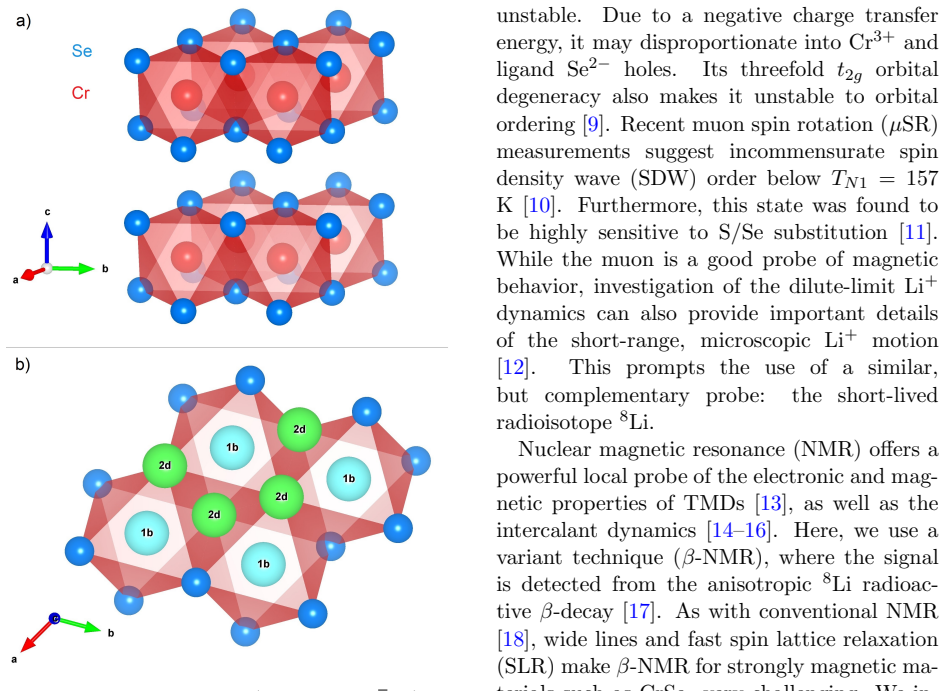
The central probe is $^{8}$Li$^{+}$ β-detected NMR: a beam of spin-polarized radioactive lithium ions is implanted into the sample, and the time-dependent β-decay asymmetry monitors the nuclear spin polarization, giving both resonance spectra and spin-lattice relaxation rates. The analysis rests on two working objects: the stretched-exponential relaxation model, which captures a distribution of local relaxation rates through the parameter $\beta$, and an activated relaxation model of the form $1/T_1 = C + A e^{-E_a/kT}$ for the high-temperature diffusive contribution, shared between two applied fields and yielding $E_a = 0.12(1)$ eV. The lack of resolved quadrupolar splitting and the small hyperfine coupling inferred from the resonance shift are what place the $^{8}$Li$^{+}$ in the high-symmetry (1b) and possibly (2d) interstitial sites of the van der Waals gap.
What would settle it
Extend the same $1/T_1$ measurements above 300 K, or to higher applied fields where a motional peak would shift, and look for the relaxation maximum. If no maximum appears and the field dependence does not follow the expected motional-narrowing behavior, the diffusion assignment and $E_a$ would be unsupported. Separately, a depth-dependent study with lower implantation energy would directly test whether the unshifted resonance is a near-surface site, which would change the two-environment interpretation.
Extended reading notes
Core claim
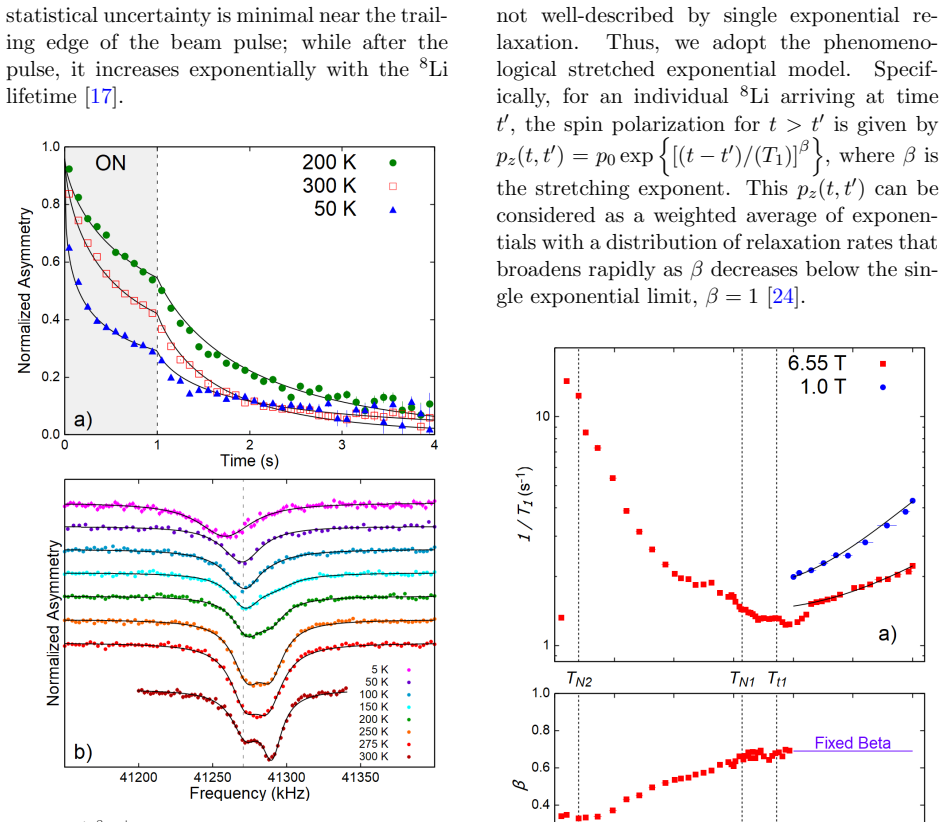
In the paper's own terms, implanted $^{8}$Li$^{+}$ in CrSe$_2$ stops at sites with a small electric-field gradient, most naturally in the van der Waals gap, and reports two magnetically inequivalent environments: a nearly unshifted line that persists to low temperature and a strongly positively shifted line that appears above about 150 K and broadens or diminishes on cooling. The relaxation is stretched-exponential, and its rate $1/T_1$ peaks at $T_{N2}\approx 20$ K, grows monotonically above 200 K with a field dependence consistent with diffusive hopping, and anomalously shows no feature at the upper magnetic transition $T_{N1}=157$ K or at the nearby structural transition. The paper argues these observations point to $^{8}$Li$^{+}$ occupation in the van der Waals gap, with the anomalous absence attributed either to a small ordered moment and weak hyperfine coupling or to a site-specific cancellation of internal fields.
Load-bearing premise
The diffusion interpretation above 200 K rests on the assumption that the field-dependent increase in $1/T_1$ is the low-temperature side of a relaxation peak whose maximum lies above room temperature; the paper itself notes that no maximum is observed up to 300 K, so if the rise has a different cause, the reported activation energy and onset claim do not follow.
Editorial extensions
If this is right
- If the assignment is right, implanted lithium in CrSe$_2$ occupies interstitial sites in the van der Waals gap, making the material a viable microscopic model for alkali intercalation in this layered host.
- The peak in $1/T_1$ at 20 K identifies a local probe of the low-temperature magnetic transition, while the absence of a feature at 157 K implies that the ordered moment and the hyperfine coupling at the lithium site are too weak to affect nuclear relaxation there.
- The monotonic, field-dependent rise above 200 K supports the onset of ionic diffusion, and the shared activation energy $E_a = 0.12(1)$ eV sets the temperature scale where hopping becomes important, although the absence of a relaxation maximum prevents a quantitative hop-rate determination.
- The coexistence of two resonances without an amplitude trade-off indicates that the two environments are not a simple site change; one candidate, a near-surface magnetically distinct layer, can be tested by changing the implantation energy.
Reading between the lines
- Editorial inference: if the near-surface layer explanation is correct, reducing the implantation energy from 19 keV should increase the relative amplitude of the unshifted line, a direct test the authors propose implicitly.
- Editorial inference: an activation energy near 0.12 eV would make room-temperature lithium hopping in CrSe$_2$ exceptionally fast, so comparing with $^7$Li NMR or ionic conductivity measurements could turn the diffusion onset into a quantitative intercalation-mobility prediction.
- Editorial inference: the apparent blindness of $1/T_1$ to the 157 K order may mean the $^{8}$Li sites couple selectively to a different magnetic component than the muon sites, hinting at spatially inhomogeneous or two-component magnetism in CrSe$_2$ rather than a simple incommensurate spin-density wave.
- Editorial inference: if the two resonances instead reflect two inequivalent bulk sites, their persistence to 300 K contradicts the expectation of a small 2d-to-1b migration barrier, suggesting the barrier is higher in CrSe$_2$ than in related compounds.
Signed reviews
Editorial analysis
A structured set of objections, weighed in public.
Referee Report
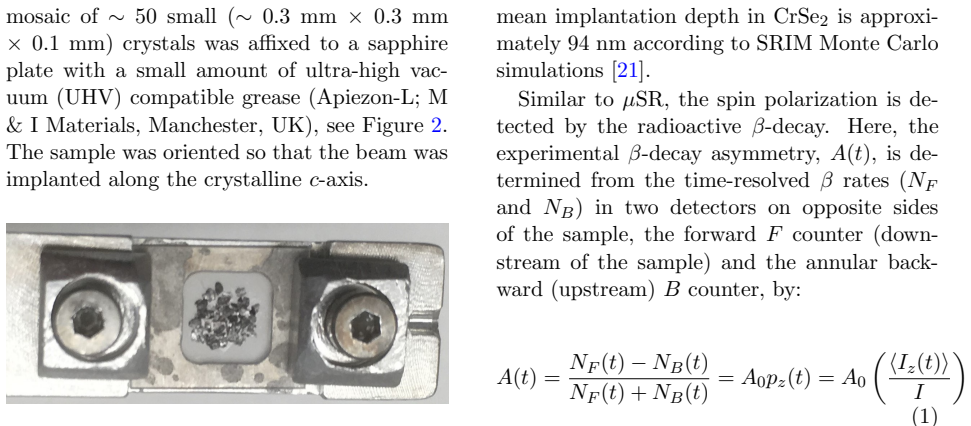
Summary. This manuscript presents a β-detected NMR study of 8Li implanted into a mosaic of 1T-CrSe2 single crystals over 4–300 K. The authors observe two broad resonances without resolved quadrupole splitting, which they associate with two magnetically distinct sites in the van der Waals gap. Spin-lattice relaxation is stretched exponential; 1/T1 exhibits a maximum near the ~20 K magnetic transition, a broad minimum with essentially no feature at the 157 K magnetic transition or the structural transitions between 150 and 200 K, and a monotonic increase above 200 K. This high-temperature rise is interpreted as the onset of 8Li+ diffusion, and a fit to C + A exp(−Ea/kT) yields Ea = 0.12(1) eV. Possible origins of the two resonances are discussed, including a speculative magnetically distinct near-surface layer.
Significance. Should the phenomenological findings hold, this is a useful experimental contribution to a poorly studied TMD: the two-component resonance structure and the anomalous insensitivity of 1/T1 to the 157 K transition are novel and likely to stimulate further work on CrSe2 and related intercalation hosts. The manuscript is generally careful: the β-NMR fitting is described in detail, the demagnetization correction is explicitly treated, the authors openly acknowledge the absence of the BPP maximum and the speculative character of the surface-layer explanation, and a falsifiable test (reducing the implantation energy) is proposed. The principal weakness is the quantitative activation-energy claim, which rests on an unverified model choice. The raw spectral and relaxation data are valuable independent of that interpretation.
major comments (2)
- [Discussion, Eq. (4) and Fig. 4] The paper states that the 'absence of a clear 1/T1 maximum at high temperatures prevents extracting quantitative information from this BPP model,' yet it immediately fits the same BPP-motivated functional form to extract Ea = 0.12(1) eV. This is an internal inconsistency: without a measured maximum (or a verified BPP line shape), the separation of the high-T rise from a constant magnetic term C is model-dependent, and the activation energy is not uniquely supported. Please either remove the quantitative Ea and reframe the high-T behavior as qualitatively consistent with diffusion, or provide additional evidence for the BPP flank (for example, data to higher temperature or at more fields).
- [Discussion, Eqs. (3)–(4) and Fig. 4a] The decomposition of 1/T1 into independent magnetic, Korringa, and diffusive terms assumes that the magnetic relaxation term C is temperature- and field-independent above 200 K and that the Korringa contribution is negligible. These assumptions are not directly tested. The observed field dependence of 1/T1 could, in principle, arise from field-dependent Cr spin fluctuations or from the stretched-exponential recovery shape (with β fixed to 0.69) rather than from Li hopping. The claim of diffusion onset above 200 K should therefore be softened, and the extracted Ea presented only under the explicit BPP-flank assumption, not as a standalone result.
minor comments (4)
- [Results, Fig. 4 caption and text] The text states that β is fixed for both applied fields above 200 K, but the caption is ambiguous. Please clarify in the text which temperature regions have β fixed and whether the fixed value 0.69 was obtained from the 6.55 T data, the 1 T data, or both.
- [Results, Fig. 5b and Discussion] The demagnetization correction uses an estimated ellipsoidal demagnetizing factor N ≈ 0.745, but the uncertainty in N is not propagated into the hyperfine coupling estimate A ≈ 2.1 kG/μB or into the low-temperature shift analysis. Please state the resulting uncertainty or note explicitly that the correction is approximate.
- [Results, relaxation fitting] The choice of a stretched exponential over a single exponential is stated but not quantitatively justified. Reporting the reduced χ2 for both fits at a representative temperature would strengthen the model selection.
- [Discussion and Conclusions] Minor grammatical issues: in the Discussion, 'The temperature independent amplitude of the SLR data show that this is not a signal wipe-out' should read 'shows'; in the Conclusions, 'It also passes through a peak' should more precisely read '1/T1 also passes through a peak.'
Circularity Check
No significant circularity: the central claims rest on measured spectra and relaxation data, with the fitted diffusion parameters explicitly labeled as fits rather than predictions.
full rationale
The paper's derivation chain is self-contained for its main claims. The two-environment and van der Waals gap conclusions follow from observed quantities: two broad resonances without quadrupole splitting, measured shifts corrected with a separately measured susceptibility, and comparisons to known Li intercalates and related TMDs; none of these conclusions presupposes itself. The high-temperature increase in 1/T1 is interpreted as the low-temperature flank of a BPP diffusion peak, but Eq. (4) is used only to fit Ea = 0.12(1) eV, and the paper explicitly states that the absence of a clear 1/T1 maximum prevents quantitative extraction from the BPP model. The fitted parameter is not presented as an independent prediction, nor is any target result defined in terms of its own input. Self-citations to prior work by the same group are comparative (e.g., prior beta-NMR studies in other materials) or methodological, not load-bearing in the sense of importing a uniqueness theorem or smuggling in the central ansatz. The testable suggestion that lower implantation energy would increase the unshifted-line amplitude is a genuine, falsifiable prediction from the proposed surface-layer hypothesis. The main weakness is a modeling limitation rather than circularity.
Assumptions & free parameters
free parameters (5)
- Activation energy Ea =
0.12(1) eV
- Pre-exponential factor A in Eq. (4) =
not quoted in text
- Constant magnetic relaxation rate C in Eq. (4) =
not quoted; estimated from the observed 1/T1 minimum
- Stretching exponent beta =
0.69 (fixed above 200 K); otherwise temperature dependent
- Demagnetizing factor N =
approximately 0.745
assumptions (5)
- standard math Stretched exponential relaxation p_z(t,t') = p0 exp{-(t/T1)^beta} adequately models the spin-lattice relaxation as a weighted average of exponentials.
- standard math The Bloembergen-Purcell-Pound (BPP) model relates the SLR rate to site-to-site hop rate, with a maximum when the hop rate matches the NMR frequency.
- domain assumption Demagnetization correction delta_demag = 4*pi*(N-1/3)*chi0(T) applies in the linear response regime with ellipsoidal crystallites (N approximately 0.745).
- domain assumption Korringa relaxation is negligible for 8Li in the vdW gap because conduction band states have little density in the gap, as inferred from NbSe2.
- domain assumption The 1b site in the vdW gap is the equilibrium Li site, and the EFG is small at vdW-gap sites, so absence of quadrupolar splitting indicates such sites.
invented entities (1)
-
Magnetically distinct near-surface layer for 8Li
independent evidence
Cite this review
Pith. "Pith review of Investigation of Ionic and Anomalous Magnetic Behavior in CrSe$_2$ Using $^8$Li $\beta$-NMR." pith.science (2026). https://pith.science/paper/RCG3ZS5T
@misc{pith2026190805421,
  author       = {Pith},
  title        = {Pith review of: Investigation of Ionic and Anomalous Magnetic Behavior in CrSe$_2$ Using $^8$Li $\beta$-NMR},
  year         = {2026},
  howpublished = {\url{https://pith.science/paper/RCG3ZS5T}},
  note         = {Machine review of arXiv:1908.05421}
}
abstract
We have studied a mosaic of 1T-CrSe$_2$ single crystals using $\beta$-detected nuclear magnetic resonance of $^{8}$Li from 4 to 300 K. We identify two broad resonances that show no evidence of quadrupolar splitting, indicating two magnetically distinct environments for the implanted ion. We observe stretched exponential spin lattice relaxation and a corresponding rate ($1/T_1$) that increases monotonically above 200 K, consistent with the onset of ionic diffusion. A pronounced maximum in $1/T_1$ is observed at the low temperature magnetic transition near 20 K. Between these limits, $1/T_1$ instead exhibits a broad minimum with a remarkable absence of strong features in the vicinity of structural and magnetic transitions between 150 and 200 K. Together, the results suggest $^{8}$Li$^{+}$ site occupation within the van der Waals gap between CrSe$_2$ trilayers. Possible origins of the two environments are discussed.
Figures
Figures from the paper (2 more)


Reference graph
Works this paper leans on
-
[1]
F. L´ evy (Ed.), Crystallography and Crystal Chemistry of Materials with Layered Structures, Springer Netherlands, 1976
work page 1976
-
[2]
R. H. Friend, A. D. Yoffe, Adv. Phys. 36 (1987) 1–94
work page 1987
-
[3]
M. S. Whittingham, Prog. Solid State Chem. 12 (1978) 41–99
work page 1978
-
[4]
J. B. Cook, H. Kim, Y. Yan, J. S. Ko, S. Robben- nolt, B. Dunn, S. H. Tolbert, Adv. Energy Mater. 6 (2016) 1501937
work page 2016
- [5]
-
[6]
C. F. Van Bruggen, R. J. Haange, G. A. Wiegers, D. K. G. De Boer, Physica B+C 99 (1980) 166– 172
work page 1980
- [7]
-
[8]
J. Sugiyama, H. Nozaki, I. Umegaki, S. Kobayashi, C. Michioka, H. Ueda, K. Yoshimura, Y. Sassa, O. K. Forslund, M. M˚ ansson, J. H. Brewer, JPS Conf. Proc. 21 (2018) 011004
work page 2018
Show all 39 references
-
[9]
Kobayashi, H
S. Kobayashi, H. Ueda, D. Nishio-Hamane, C. Mi- chioka, K. Yoshimura, Phys. Rev. B. 89 (2014) 054413
2014
-
[10]
Sugiyama, H
J. Sugiyama, H. Nozaki, I. Umegaki, T. Uyama, K. Miwa, J. H. Brewer, S. Kobayashi, C. Michioka, H. Ueda, K. Yoshimura, Phys. Rev. B. 94 (2016) 014408
2016
-
[11]
Kobayashi, N
S. Kobayashi, N. Katayama, T. Manjo, H. Ueda, C. Michioka, J. Sugiyama, Y. Sassa, O. K. Forslund, M. M˚ ansson, K. Yoshimura, H. Sawa, Inorg. Chem. 58 (2019) 14304–14315
2019
-
[12]
R. M. L. McFadden, T. J. Buck, A. Chatzichristos, C. Chen, K. H. Chow, D. L. Cortie, M. H. Dehn, V. L. Karner, D. Koumoulis, C. D. P. Levy, C. Li, I. McKenzie, R. Merkle, G. D. Morris, M. R. Pear- son, Z. Salman, D. Samuelis, M. Stachura, J. Xiao, J. Maier, R. F. Kiefl, W. A. M...
2017
-
[13]
Naito, H
M. Naito, H. Nishihara, T. Butz, Layered Transi- tion Metal Dichalcogenides, Springer Netherlands, 1992
1992
-
[14]
Prigge, W
C. Prigge, W. M¨ uller-Warmuth, R. Sch¨ ollhorn, Z. Phys. Chem. 189 (1995) 153–168
1995
-
[15]
Wilkening, W
M. Wilkening, W. Kuchler, P. Heitjans, Phys. Rev. Lett. 97 (2006) 065901
2006
-
[16]
Bensch, T
W. Bensch, T. Bredow, H. Ebert, P. Heitjans, S. Indris, S. Mankovsky, M. Wilkening, Prog. Solid State Chem. 37 (2009) 206–225
2009
-
[17]
W. A. MacFarlane, Solid State Nucl. Mag. Reson. 68 (2015) 1–12
2015
-
[18]
C. P. Grey, N. Dupr´ e, Chem. Rev. 104 (2004) 4493–4512
2004
-
[19]
Dilling, R
J. Dilling, R. Kr¨ ucken, G. Ball, Hyperfine Interact. 225 (2014) 1–8
2014
-
[20]
C. D. P. Levy, M. R. Pearson, G. D. Morris, K. H. Chow, M. D. Hossain, R. F. Kiefl, R. Labb´ e, J. Lassen, W. A. MacFarlane, T. J. Parolin, H. Saadaoui, M. Smadella, Q. Song, D. Wang, Hy- perfine Interact. 196 (2010) 287–294
2010
-
[21]
J. F. Ziegler, M. D. Ziegler, J. P. Biersack, Nucl. Instrum. Methods Phys. Res. B 268 (2010) 1818– 1823
2010
-
[22]
G. D. Morris, Hyperfine Interact. 225 (2014) 173– 182
2014
-
[23]
Hossain, H
M. Hossain, H. Saadaoui, T. Parolin, Q. Song, D. Wang, M. Smadella, K. Chow, M. Egilmez, I. Fan, R. Kiefl, S. Kreitzman, C. Levy, G. Morris, M. Pearson, Z. Salman, W. MacFarlane, Physica B 404 (2009) 914–916
2009
-
[24]
C. P. Lindsey, G. D. Patterson, J. Chem. Phys. 73 (1980) 3348–3357
1980
-
[25]
Salman, R
Z. Salman, R. F. Kiefl, K. H. Chow, M. D. Hossain, T. A. Keeler, S. R. Kreitzman, C. D. P. Levy, R. I. Miller, T. J. Parolin, M. R. Pearson, H. Saadaoui, J. D. Schultz, M. Smadella, D. Wang, W. A. Mac- Farlane, Phys. Rev. Lett. 96 (2006) 147601
2006
-
[26]
W. A. MacFarlane, Q. Song, N. J. C. Ingle, K. H. Chow, M. Egilmez, I. Fan, M. D. Hossain, R. F. Kiefl, C. D. P. Levy, G. D. Morris, T. J. Parolin, M. R. Pearson, H. Saadaoui, Z. Salman, D. Wang, Phys. Rev. B 92 (2015) 064409
2015
-
[27]
W. A. MacFarlane, T. J. Parolin, D. L. Cor- tie, K. H. Chow, M. D. Hossain, R. F. Kiefl, C. D. P. Levy, R. M. L. McFadden, G. D. Morris, M. R. Pearson, H. Saadaoui, Z. Salman, Q. Song, D. Wang, J. Phys. Conf. Ser. 551 (2014) 012033
2014
-
[28]
J. A. Osborn, Phys. Rev. 67 (1945) 351–357
1945
-
[29]
van Laar, D
B. van Laar, D. J. W. Ijdo, J. Solid State Chem. 3 (1971) 590–595
1971
-
[30]
D. Wang, M. Hossain, Z. Salman, D. Arseneau, K. H. Chow, S. Daviel, T. A. Keeler, R. F. Kiefl, S. R. Kreitzman, C. D. P. Levy, G. D. Morris, W. A. MacFarlane, T. J. Parolin, H. Saadaoui, Physica B 374 (2006) 239–242
2006
-
[31]
R. M. L. McFadden, A. Chatzichristos, K. H. Chow, D. L. Cortie, M. H. Dehn, D. Fujimoto, M. D. Hossain, H. Ji, V. L. Karner, R. F. Kiefl, C. D. P. Levy, R. Li, I. McKenzie, G. D. Morris, O. Ofer, M. R. Pearson, M. Stachura, R. J. Cava, W. A. MacFarlane, Phys. Rev. B 99 (2019) 125201
2019
-
[32]
B. G. Silbernagel, M. S. Whittingham, Mater. Res. Bull. 12 (1977) 853–858. 11
1977
-
[33]
G. D. Morris, W. A. MacFarlane, K. H. Chow, Z. Salman, D. J. Arseneau, S. Daviel, A. Hatakeyama, S. R. Kreitzman, C. D. P. Levy, R. Poutissou, R. H. Heffner, J. E. Elenewski, L. H. Greene, R. F. Kiefl, Phys. Rev. Lett. 93 (2004) 157601
2004
-
[34]
T. J. Parolin, Z. Salman, K. H. Chow, Q. Song, J. Valiani, H. Saadaoui, A. O’Halloran, M. D. Hos- sain, T. A. Keeler, R. F. Kiefl, S. R. Kreitzman, C. D. P. Levy, R. I. Miller, G. D. Morris, M. R. Pearson, M. Smadella, D. Wang, M. Xu, W. A. MacFarlane, Phys. Rev. B 77 (2008) 214107
2008
-
[35]
Van der Ven, G
A. Van der Ven, G. Ceder, Electrochem. Solid State 3 (2000) 301–304
2000
-
[36]
Bloembergen, E
N. Bloembergen, E. M. Purcell, R. V. Pound, Phys. Rev. 73 (1948) 679–712
1948
-
[37]
L. K. Alexander, N. B¨ uttgen, R. Nath, A. V. Ma- hajan, A. Loidl, Phys. Rev. B 76 (2007) 064429
2007
-
[38]
W. A. MacFarlane, T. J. Parolin, T. I. Larkin, G. Richter, K. H. Chow, M. D. Hossain, R. F. Kiefl, C. D. P. Levy, G. D. Morris, O. Ofer, M. R. Pear- son, H. Saadaoui, Q. Song, D. Wang, Phys. Rev. B 88 (2013) 144424
2013
-
[39]
H. E. Rhodes, P.-K. Wang, H. T. Stokes, C. P. Slichter, J. H. Sinfelt, Phys. Rev. B 26 (1982) 3559–3568. 12
1982
Reviewed August 14, 2026 · model on record in the stance chip above.
Discussion (0). Continue with ORCID to comment.