REVIEW 4 major objections 6 minor 28 references
Domain-adversarial Network Alignment
T0 review · 4 major / 6 minor · reviewed 2026-08-14 · deepseek-v4-flash
Pith's one-line read The paper claims that hiding which network a node belongs to, via an adversarial domain classifier, improves the matching of users across social networks.
desk verdict A clean, moderate-novelty combination of GCN embeddings, a DANN-style domain adversary, and a MAP anchor objective; the gains are plausible, but the experiments need error bars and a clear validation protocol before the numbers are fully reliable. read the letter →
The pith
A machine-rendered reading of the paper's core claim, the machinery that carries it, and where it could break.
The reading
What carries the argument
The load-bearing mechanism is a minimax game between a domain classifier and the two graph convolutional feature extractors (Eq. 7). A gradient reversal layer (GRL) sits between the extractors and the domain classifier: in the forward pass it passes features unchanged, and in the backward pass it reverses the gradient sign, so one end-to-end update simultaneously maximizes the domain-classifier loss (making the representation domain-invariant) and minimizes the alignment loss. The alignment loss itself is a bi-directional posterior (Eq. 3): for each anchor pair, the log-probability of observing the match in both directions, where the conditional probabilities are sampled softmaxes over node embeddings (Eq. 4-5). This probabilistic view treats alignment as multi-view matching rather than as a distance-minimization or a projection-mapping problem.
What would settle it
Construct two synthetic networks with strongly differing degree distributions where the ground-truth anchor pairs are exactly those with matching degree rank (i.e., hubs link to hubs). If running DANA with a large domain-adversarial weight gamma produces lower Hits@1 than running DNA with the adversary removed, then the paper's central claim—that suppressing domain-dependent features always aids alignment—would be falsified for that regime. The same test could be run on the real datasets by artificially rewiring one network's degree distribution and tracking the DANA-vs-DNA gap.
Extended reading notes
Core claim
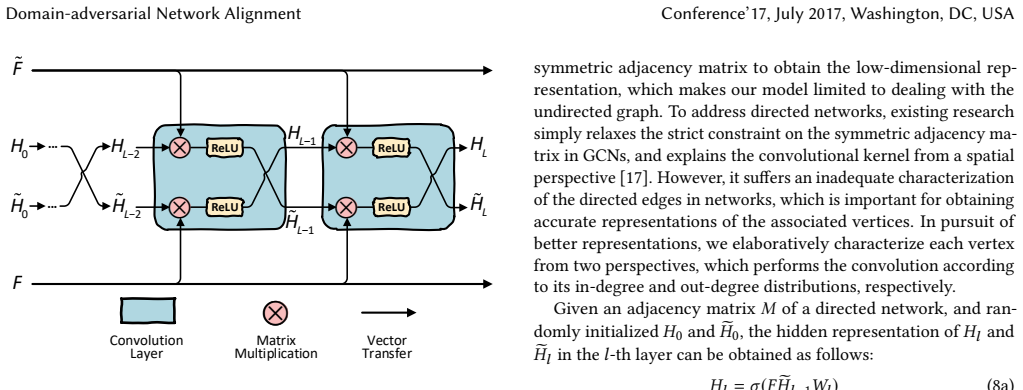
The central discovery the paper argues for is that injecting an adversarial domain classifier into the network-embedding process removes domain-dependent signals that are irrelevant—and sometimes harmful—to the alignment task, and that this removal measurably improves anchor prediction. Concretely, the paper trains two GCNs on the two networks, supervises them with a softmax-based posterior over observed anchors (Eq. 3), and simultaneously trains a domain classifier to tell which network a node came from while the GCNs are trained to fool it (Eq. 6-7, via gradient reversal). The ablation DNA, identical except for the adversarial module, consistently scores lower than DANA on all three datasets, which the paper takes as direct evidence that the adversary is what carries the gain. The paper also shows in a toy twinning-networks case that the adversarial training makes the domain classifier fail while diversifying the hidden-neuron directions, and interprets this as the disappearance of the y-axis-symmetric domain-discriminative pattern.
Load-bearing premise
The paper assumes that a representation which hides which network a node comes from still contains enough information to identify the same user across the two networks, even though structural signals like degree distribution can differ sharply and may be the very signals that disambiguate users.
Editorial extensions
If this is right
- If the central claim is right, then any representation-learning approach to network alignment should explicitly suppress domain-dependent features rather than merely map one embedding space to another.
- The reported superiority of DANA-SD over DNA, the no-adversary ablation, implies that the domain classifier is not a regularizer of convenience but the source of a large part of the improvement, so alignment methods built without it are leaving accuracy on the table.
- Weight-sharing between the two GCNs helps alignment and speeds up training, suggesting that pushing the two networks into a common subspace is beneficial even before any matching layer is learned.
- Direction-aware convolution (in-degree and out-degree views) improves link prediction within each directed network, which transfers to better alignment on directed social graphs like Twitter and Weibo.
Reading between the lines
- A testable consequence the paper does not explore: the benefit of domain invariance should shrink or reverse when the domain-dependent signal is itself the best matching cue, for example when hubs in one network correspond to hubs in the other; one could vary the degree-distribution asymmetry between two synthetic networks and watch whether the DANA-vs-DNA gap flips sign.
- The toy case only demonstrates that the domain classifier is fooled; it does not by itself prove the invariant representation retains enough discriminative power for alignment, so a formal information-theoretic statement of what is preserved under invariance would turn the empirical claim into a theorem about the method's limits.
- The same adversarial-invariance recipe could transfer to other entity-resolution problems where domain bias is structural, such as cross-lingual knowledge-graph alignment or user linking across platforms with very different activity patterns, but the invariance target would need to be chosen per task since 'domain' is not always the network identity.
Signed reviews
Editorial analysis
A structured set of objections, weighed in public.
Referee Report
Summary. The paper proposes DANA, a deep architecture for network alignment that combines GCN-based node embeddings with an adversarial domain classifier. The stated goal is to learn domain-invariant node representations by suppressing domain-dependent features that are irrelevant, or detrimental, to the alignment task. The training objective is a sum of a maximum-a-posteriori anchor-pair likelihood (Eq. 3) and an adversarial domain-classification loss (Eq. 6), optimized jointly through a gradient reversal layer (Eq. 7). Variants add weight-sharing between the two GCNs (DANA-S) and a direction-aware convolution structure for directed networks (DANA-SD). Experiments on DBLP, Foursquare-Twitter, and Douban-Weibo report Hits@1 and MRR improvements over several baselines, including a DNA variant that removes the domain-adversarial component. The paper also includes sensitivity analyses for the number of GCN layers L and the adversarial weight gamma, a comparison of the proposed probabilistic objective with an MSE objective, a link-prediction check of the directed convolution, and a toy case study of domain-invariant embeddings.
Significance. If the central empirical claim is supported, the paper makes a useful contribution by transferring domain-adversarial training from classification to network alignment, and by isolating the effect of the adversarial component through the DNA ablation. The MAP-based objective is derived cleanly, and the ablation ordering (DANA-SD > DANA-S > DANA > DNA) is logically organized and consistent with the paper's motivation. The paper also provides a direction-aware GCN variant that appears to help on directed networks. However, the empirical evidence would be much stronger with repeated-run statistics, a clearly separated validation protocol, and code or data release; the current point estimates without variance do not fully protect the main comparison against selection effects or run-to-run variability.
major comments (4)
- [Section 4.2 / Figs. 7 and 8] The sensitivity analyses for the number of GCN layers L and the adversarial weight gamma are evaluated with the same test-set metrics (Hits@k and MRR) that form the headline results in Table 2, and the paper does not state that a held-out validation split was used for model selection. With only single-run numbers in Table 2, the reported advantage of DANA-SD over DNA could be inflated by selection bias rather than caused by the adversarial module. Please specify the selection protocol, and ideally add a validation split or nested evaluation so that the chosen hyperparameters are not selected on the test set.
- [Section 3.1.1 Eq. (4) and Section 4.1.1] Training uses a dot-product softmax to define the anchor likelihood in Eq. (4), while evaluation ranks candidates by cosine similarity. The paper does not state that the learned representations are normalized, so the training and scoring objectives are not matched. A dot-product objective can be dominated by vector magnitude, whereas cosine similarity is scale-invariant, so this mismatch could materially affect the reported ranking results. Please clarify whether the representations are normalized, or justify and explicitly test the effect of this train-scoring mismatch.
- [Section 4.3 / Fig. 10] The toy case study demonstrates that DANA-S can fool the domain classifier on a symmetric twin network, but it does not establish the paper's underlying assumption that a representation which hides domain identity still preserves enough anchor-discriminative information on real data. The case study shows only that invariance is achievable, not that invariance is sufficient for alignment. Please provide a quantitative analysis on real data, for example by measuring both domain-classification accuracy and alignment performance as gamma varies, or by testing whether fully or partially invariant representations retain the information needed to rank true anchors.
- [Table 2 and Section 4.2.1] No error bars, standard deviations, or repeated-run results are reported anywhere in Section 4, and each number in Table 2 appears to be a single point estimate. The central claim that the adversarial component improves alignment rests on comparisons such as DANA-SD versus DNA (e.g., MRR gains of 5.70%, 27.86%, and 63.20% on the three datasets), but without variance estimates these gains cannot be assessed for statistical significance. Please report results over multiple independent runs, with means and standard deviations or confidence intervals, at least for the key DANA/DNA comparisons.
minor comments (6)
- [Section 1, first paragraph of contributions] The text says 'vanila GANA' where 'vanilla DANA' is intended; please fix the typo.
- [Section 4.1.1, formula for Hits@k] The displayed formula 'Hits @k = Hits A@k + Hits B@k |St est|× 2' is ambiguous; parentheses should be added so that the division and multiplication are unambiguous.
- [Section 3.1.1, Eqs. (3) and (4)] The notation p(v_j^B | v_i^A) abbreviates a conditional distribution that also depends on the model parameters, but this dependence is stated only in the surrounding text and not in the equations themselves; please make the notation consistent.
- [Section 4.2.3, Eq. (9)] The symbol C is used both for the number of negative samples in Eq. (9) and for the candidate set size in Eq. (5); please use distinct symbols to avoid confusion.
- [Section 4.2.1, discussion of DBLP] The dataset name DBLP is misspelled as 'DLBP' in the sentence about the undirected network; please correct it.
- [Section 2.2, last paragraph] In the sentence 'Meanwhile, the presentation learning is also task-driven', 'presentation' should be 'representation'.
Circularity Check
No significant circularity: DANA's adversarial alignment objective is an empirical architecture trained on held-out anchors; the DANA-vs-DNA comparison is an ablation, not a fitted result renamed as a prediction.
full rationale
The central claim is that adding an adversarial domain classifier to a GCN-based anchor-posterior objective improves network alignment. This claim is supported by training on 80% of anchor labels and testing on the remaining 20%, so the reported Hits@1 and MRR values are not forced by construction. The comparison DANA versus DNA is an ablation: DNA is defined as DANA without the adversarial component, and the difference is an empirical outcome rather than an identity. The objective in Eq. (7) combines the anchor posterior Eq. (3) with the domain-classifier loss Eq. (6) through a learned weighting; no equation reduces the test metric to a fitted parameter. The paper's reliance on DANN as a motivating framework is an external citation of a published method, not a self-citation, and it does not import any uniqueness theorem that forces the architecture. The only notable self-citation is that author Xin Li is a coauthor of the IONE baseline [11], but IONE is used as an external comparison method with its own published code and benchmark data, not as a premise in the derivation of DANA. Consequently, the self-citation is not load-bearing. Hyperparameter sensitivity analyses in Figs. 7 and 8 are empirical explorations and, while the paper does not specify a validation split, this is an experimental-design concern rather than evidence that a prediction reduces to its input by definition. Overall, the derivation chain is self-contained and the empirical comparisons are not circular.
Assumptions & free parameters
free parameters (6)
- gamma (adversarial weighting factor) =
1.0 (hand-set; sensitivity in Fig.8 on test data)
- lambda (regularization factor) =
0.01
- L (number of GCN layers) =
2
- embedding dimension =
100 (DANA-SD uses 50 per direction, concatenated to 100)
- batch sizes U and Z =
U=512, Z=training set size
- learning rate =
0.001
assumptions (6)
- standard math GCN layer-wise propagation rule with normalized adjacency and ReLU activation
- domain assumption DANN principle: a representation that maximizes domain classifier loss is domain-invariant
- ad hoc to paper Domain-invariant representations are sufficient for network alignment
- domain assumption Topological consistency assumption: affiliated nodes have consistent connectivity structure across networks
- domain assumption Transductive use of test node structure and test nodes' domain labels during training
- standard math Sampled softmax approximates full softmax
Cite this review
Pith. "Pith review of Domain-adversarial Network Alignment." pith.science (2026). https://pith.science/paper/S5MW65ES
@misc{pith2026190805429,
  author       = {Pith},
  title        = {Pith review of: Domain-adversarial Network Alignment},
  year         = {2026},
  howpublished = {\url{https://pith.science/paper/S5MW65ES}},
  note         = {Machine review of arXiv:1908.05429}
}
read the original abstract
Network alignment is a critical task to a wide variety of fields. Many existing works leverage on representation learning to accomplish this task without eliminating domain representation bias induced by domain-dependent features, which yield inferior alignment performance. This paper proposes a unified deep architecture (DANA) to obtain a domain-invariant representation for network alignment via an adversarial domain classifier. Specifically, we employ the graph convolutional networks to perform network embedding under the domain adversarial principle, given a small set of observed anchors. Then, the semi-supervised learning framework is optimized by maximizing a posterior probability distribution of observed anchors and the loss of a domain classifier simultaneously. We also develop a few variants of our model, such as, direction-aware network alignment, weight-sharing for directed networks and simplification of parameter space. Experiments on three real-world social network datasets demonstrate that our proposed approaches achieve state-of-the-art alignment results.
Figures


Figures from the paper (5 more)


Reference graph
Works this paper leans on
-
[1]
Alex T Adai, Shailesh V Date, Shannon Wieland, and Edward M Marco/t_te. Lgl: creating a map of protein function with an algorithm for visualizing very large biological networks. Journal of molecular biology , 340(1):179–190, 2004
work page 2004
-
[2]
Asnets: A benchmark dataset of aligned social networks for cross-platform user modeling
Xuezhi Cao and Yong Yu. Asnets: A benchmark dataset of aligned social networks for cross-platform user modeling. In Proceedings of the 25th ACM International on Conference on Information and Knowledge Management , pages 1881–1884. ACM, 2016
work page 2016
-
[3]
/Q_uanyu Dai, Qiang Li, Jian Tang, and Dan Wang. Adversarial network embedding. In /T_hirty-Second AAAI Conference on Arti/f_icial Intelligence, 2018
work page 2018
-
[4]
Convolutional neural networks on graphs with fast localized spectral /f_iltering
Micha¨el Defferrard, Xavier Bresson, and Pierre Vandergheynst. Convolutional neural networks on graphs with fast localized spectral /f_iltering. InAdvances in neural information processing systems, pages 3844–3852, 2016
work page 2016
-
[5]
Domain- adversarial training of neural networks
Yaroslav Ganin, Evgeniya Ustinova, Hana Ajakan, Pascal Germain, Hugo Larochelle, Franc ¸ois Laviole/t_te, Mario Marchand, and Victor Lempitsky. Domain- adversarial training of neural networks. /T_he Journal of Machine Learning Research, 17(1):2096–2030, 2016
work page 2016
-
[6]
Generative adversarial nets
Ian Goodfellow, Jean Pouget-Abadie, Mehdi Mirza, Bing Xu, David Warde-Farley, Sherjil Ozair, Aaron Courville, and Yoshua Bengio. Generative adversarial nets. In Advances in neural information processing systems , pages 2672–2680, 2014
2014
-
[7]
On using very large target vocabulary for neural machine translation
S´ebastien Jean, Kyunghyun Cho, Roland Memisevic, and Yoshua Bengio. On using very large target vocabulary for neural machine translation. arXiv preprint arXiv:1412.2007, 2014
arXiv 2007
-
[8]
Semi-supervised classi/f_ication with graph convolutional networks
/T_homas N Kipf and Max Welling. Semi-supervised classi/f_ication with graph convolutional networks. arXiv preprint arXiv:1609.02907, 2016
arXiv 2016
Show all 28 references
-
[9]
Deeper insights into graph convo- lutional networks for semi-supervised learning
Qimai Li, Zhichao Han, and Xiao-Ming Wu. Deeper insights into graph convo- lutional networks for semi-supervised learning. In Proceedings of the /T_hirty-Second AAAI Conference on Arti/f_icial Intelligence, (AAAI-18), the 30th innovative Applications of Arti/f_icial Intelligen...
2018
-
[10]
Adversarial learning for weakly-supervised social network alignment
Chaozhuo Li, Yukun Wang, Senzhang Wang, Yun Liu, Philip Yu, Zhoujun Li, and Yanbo Liang. Adversarial learning for weakly-supervised social network alignment. In /T_hirty-/T_hird AAAI Conference on Arti/f_icial Intelligence, 2019
2019
-
[11]
Aligning users across social networks using network embedding
Li Liu, William K Cheung, Xin Li, and Lejian Liao. Aligning users across social networks using network embedding. In International Joint Conference on Arti/f_icial Intelligence, pages 1774–1780, 2016
2016
-
[12]
Predict anchor links across social networks via an embedding approach
Tong Man, Huawei Shen, Shenghua Liu, Xiaolong Jin, and Xueqi Cheng. Predict anchor links across social networks via an embedding approach. In International Joint Conference on Arti/f_icial Intelligence, volume 16, pages 1823–1829, 2016
2016
-
[13]
User identity linkage by latent user space modelling
Xin Mu, Feida Zhu, Ee-Peng Lim, Jing Xiao, Jianzong Wang, and Zhi-Hua Zhou. User identity linkage by latent user space modelling. In Proceedings of the 22nd ACM SIGKDD International Conference on Knowledge Discovery and Data Mining , pages 1775–1784. ACM, 2016
2016
-
[14]
Cross-domain sentiment classi/f_ication via spectral feature alignment
Sinno Jialin Pan, Xiaochuan Ni, Jian-Tao Sun, Qiang Yang, and Zheng Chen. Cross-domain sentiment classi/f_ication via spectral feature alignment. In/T_he 19th International World Wide Web Conference, pages 751–760. ACM, 2010
2010
-
[15]
Deepwalk: Online learning of social representations
Bryan Perozzi, Rami Al-Rfou, and Steven Skiena. Deepwalk: Online learning of social representations. In Acm Sigkdd International Conference on Knowledge Discovery & Data Mining , 2014
2014
-
[16]
Evaluating web-based question answering systems
Dragomir R Radev, Hong Qi, Harris Wu, and Weiguo Fan. Evaluating web-based question answering systems. In Proceedings of the /T_hird International Conference on Language Resources and Evaluation, LREC 2002, May 29-31, 2002, Las Palmas, Canary Islands, Spain, 2002
2002
-
[17]
Modeling relational data with graph convolutional networks
Michael Schlichtkrull, /T_homas N Kipf, Peter Bloem, Rianne Van Den Berg, Ivan Titov, and Max Welling. Modeling relational data with graph convolutional networks. In European Semantic Web Conference, pages 593–607. Springer, 2018
2018
-
[18]
Mapping users across networks by manifold alignment on hypergraph
Shulong Tan, Ziyu Guan, Deng Cai, Xuzhen Qin, Jiajun Bu, and Chun Chen. Mapping users across networks by manifold alignment on hypergraph. In Twenty- Eighth AAAI Conference on Arti/f_icial Intelligence, volume 14, pages 159–165, 2014
2014
-
[19]
Arnetminer: extraction and mining of academic social networks
Jie Tang, Jing Zhang, Limin Yao, Juanzi Li, Li Zhang, and Zhong Su. Arnetminer: extraction and mining of academic social networks. In Proceedings of the 14th ACM SIGKDD international conference on Knowledge discovery and data mining , pages 990–998. ACM, 2008
2008
-
[20]
Line: Large-scale information network embedding
Jian Tang, Meng /Q_u, Mingzhe Wang, Ming Zhang, Jun Yan, and Qiaozhu Mei. Line: Large-scale information network embedding. In Proceedings of the 24th inter- national conference on world wide web , pages 1067–1077, 2015. Domain-adversarial Network Alignment Conference’17, July ...
2015
-
[21]
Irgan: A minimax game for unifying generative and discriminative information retrieval models
Jun Wang, Lantao Yu, Weinan Zhang, Yu Gong, Yinghui Xu, Benyou Wang, Peng Zhang, and Dell Zhang. Irgan: A minimax game for unifying generative and discriminative information retrieval models. In Proceedings of the 40th International ACM SIGIR conference on Research and Develop...
2017
-
[22]
Graphgan: Graph representation learning with generative adversarial nets
Hongwei Wang, Jia Wang, Jialin Wang, Miao Zhao, Weinan Zhang, Fuzheng Zhang, Xing Xie, and Minyi Guo. Graphgan: Graph representation learning with generative adversarial nets. In/T_hirty-Second AAAI Conference on Arti/f_icial Intelligence, 2018
2018
-
[23]
A survey of transfer learning
Karl Weiss, Taghi M Khoshgo/f_taar, and DingDing Wang. A survey of transfer learning. Journal of Big Data , 3(1):9, 2016
2016
-
[24]
Evaluation measures (information retrieval) — Wikipedia, the free encyclopedia
Wikipedia contributors. Evaluation measures (information retrieval) — Wikipedia, the free encyclopedia. h/t_tps://en.wikipedia.org/w/index.php?title= Evaluation measures (information retrieval)&oldid=889157178, 2019. [Online; ac- cessed 21-May-2019]
2019
-
[25]
Controllable invariance through adversarial feature learning
Qizhe Xie, Zihang Dai, Yulun Du, Eduard Hovy, and Graham Neubig. Controllable invariance through adversarial feature learning. In Advances in Neural Information Processing Systems, pages 585–596, 2017
2017
-
[26]
An information /f_low model for con/f_lict and /f_ission in small groups
Wayne W Zachary. An information /f_low model for con/f_lict and /f_ission in small groups. Journal of anthropological research , 33(4):452–473, 1977
1977
-
[27]
Integrated anchor and social link predictions across social networks
Jiawei Zhang and S Yu Philip. Integrated anchor and social link predictions across social networks. In International Joint Conference on Arti/f_icial Intelligence, pages 2125–2132, 2015
2015
-
[28]
Adversarial feature matching for text generation
Yizhe Zhang, Zhe Gan, Kai Fan, Zhi Chen, Ricardo Henao, Dinghan Shen, and Lawrence Carin. Adversarial feature matching for text generation. arXiv preprint arXiv:1706.03850, 2017
2017 arXiv
Reviewed August 14, 2026 · model on record in the stance chip above.
Discussion (0). Continue with ORCID to comment.