REVIEW 3 major objections 4 minor 12 references
Ergodic Rate Analysis of Cooperative Ambient Backscatter Communication
T0 review · 3 major / 4 minor · reviewed 2026-08-14 · deepseek-v4-flash
Pith's one-line read Cooperative ambient backscatter yields closed-form rate bounds and simple power-scaling laws.
desk verdict Competent, narrowly scoped rate-bound paper with one formal gap that matters: an asymptotic singular-value limit is invoked as a finite-size upper bound. read the letter →
The pith
A machine-rendered reading of the paper's core claim, the machinery that carries it, and where it could break.
The reading
What carries the argument
The load-bearing object is the equivalent channel seen by the primary receiver, $H=H_1+\alpha c\,h_{BC}h_{RB}^H$, where $H_1$ is the direct RF-source-to-receiver channel, $\alpha c$ is the tag's reflection, and the second term is the backscattered path. The receiver uses successive interference cancellation: it decodes the primary symbol first, cancels it, and then applies maximal-ratio combining along the backscatter channel. The mathematical engine is Jensen's inequality applied after replacing the expected squared largest singular value of $H_1$ by its large-$M,N$ asymptotic value $(\sqrt M+\sqrt N)^2$, together with Meijer G-function identities, the standard special functions for hypergeometric-type integrals, that convert the resulting integral expressions into closed forms.
What would settle it
Run a Monte Carlo simulation of the ergodic rate $R_1$ at small antenna counts (for example $M=N=2$ or $M=N=4$) across a range of SNR, and check whether the simulated value ever exceeds the right-hand side of (18); if it does, the claimed upper bound is not a true bound at finite array sizes.
Extended reading notes
Core claim
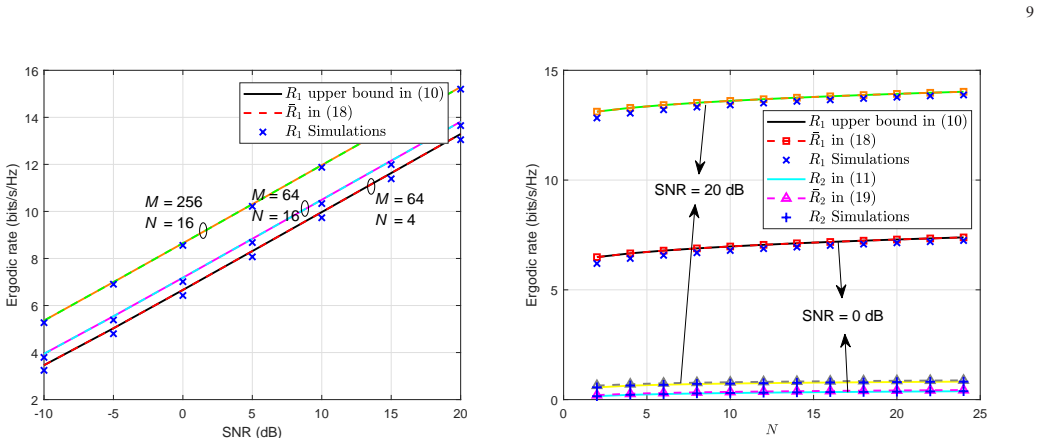
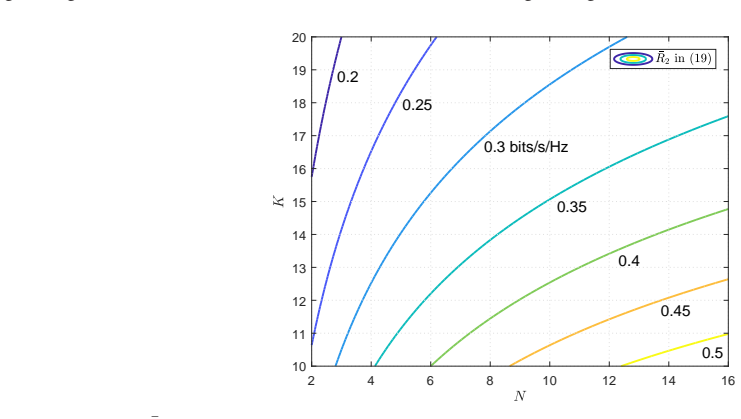
On the paper's own terms, the central claim is that the ergodic rate of the primary link satisfies $R_1 \le \log_2(1+\frac{P}{\sigma^2}((\sqrt M+\sqrt N)^2+\alpha^2\sigma_{BC}^2\sigma_{RB}^2))$ and that of the backscatter link satisfies $R_2 \le \frac{1}{K}\log_2(1+\frac{P\sigma_{BC}^2\sigma_{RB}^2}{\sigma^2}KN\alpha^2)$. From these bounds the paper concludes that the RF source's transmit power can be reduced by the factor $1/(\sqrt M+\sqrt N)^2$ for a nonvanishing rate as antenna counts grow, and that the backscatter rate asymptotically scales as $\frac{1}{K}\log_2(KN)$, so additional receive antennas compensate for a longer backscatter symbol period. It also notes that the backscatter link slightly improves the primary rate because the tag inadvertently acts as a relay.
Load-bearing premise
The load-bearing premise is that the expected squared largest singular value of the primary channel is already equal to its large-antenna limit $(\sqrt M+\sqrt N)^2$; at finite $M,N$ that equality is an approximation, and the uncomputed finite-size correction determines whether the primary-rate bound in (18) remains valid as stated.
Editorial extensions
If this is right
- Primary transmit power scales as $1/(\sqrt M+\sqrt N)^2$: if both antenna counts are quadrupled, the RF source can cut its power by roughly a factor of four at a fixed rate.
- Backscatter rate scales as $\frac{1}{K}\log_2(KN)$: doubling the number of receive antennas offsets a doubled backscatter symbol period, keeping the rate nearly constant.
- The tag's reflection adds a positive term to the primary rate bound, so the secondary link does not degrade the primary link under this decode-and-cancel scheme.
- The closed-form bounds let a designer choose antenna counts, symbol periods, and reflection coefficients without running link-level simulations.
Reading between the lines
- A direct next step would be computing the exact finite-$M,N$ expectation $\mathbb{E}[\sigma_{1m}^2]$ and testing whether the primary-rate bound in (18) survives at small antenna counts; the paper supplies only the asymptotic value.
- The same Jensen-plus-asymptotic-singular-value template should extend to Rician or correlated fading by replacing the asymptotic law in (15) with the corresponding non-Gaussian limit.
- Since $\bar R_2$ depends only logarithmically on $\alpha^2$, a low-power tag can cut its reflection coefficient substantially with little rate loss; optimizing $\alpha$ under an energy-harvesting constraint is an extension the paper does not take.
Signed reviews
Editorial analysis
A structured set of objections, weighed in public.
Referee Report
Summary. The manuscript analyzes a cooperative ambient backscatter system in which a multi-antenna RF source serves a multi-antenna cooperative receiver while a single-antenna backscatter transmitter modulates the ambient RF waveform. The receiver first decodes the primary signal and then, after SIC, decodes the backscattered signal. The authors derive upper bounds on the ergodic rates of both links: a closed-form bound for the primary link in (18) and one for the backscatter link in (19). They then state power-scaling laws, specifically that the primary transmit power can be reduced as 1/(sqrt(M)+sqrt(N))^2 and that the backscatter rate scales as (1/K) log2(KN). The derivations use Jensen's inequality, properties of Rayleigh product channels, and a known asymptotic result for the largest singular value of a random matrix. Simulation results are presented to support the tightness of the bounds and the scaling laws.
Significance. If the claimed bounds and scaling laws are rigorously established, the paper provides simple and useful design insights for cooperative ambient backscatter systems: the primary link benefits from massive-antenna power scaling, and the backscatter link can compensate for a longer symbol period by adding receive antennas. A clear strength of the manuscript is that the analysis is parameter-free: no fitted constants are used, and the backscatter-rate bound in (19) follows directly from Jensen's inequality and exact second moments. The R2 bound and the scaling law (1/K) log2(KN) are therefore on solid ground. The principal contribution, however, is the R1 bound and the associated power-scaling claim; those depend on an asymptotic random-matrix result being used as a finite-size equality, and this is the main point that needs attention before the results can be accepted as stated.
major comments (3)
- [Section III-B, Eq. (18) and proof of Theorem 1, Eq. (21)] The proof of (18) replaces E_h[sigma_1m^2] by the asymptotic value (sqrt(M)+sqrt(N))^2 using (15), but (15) is a limit result for large M and N with N/M constant, not a finite-size inequality. As stated, (18) is therefore not a proven upper bound for finite antenna counts. If the finite-size correction to E_h[sigma_1m^2] is positive, (18) can lie below the true ergodic rate of the primary link, and the power-reduction claim in Remark 1 would be optimistic. The same asymptotic substitution also enters Lemma 1's bound (10) through the definition of beta. Please either prove a finite-size inequality such as E_h[sigma_1m^2] <= (sqrt(M)+sqrt(N))^2 (with the correct variance scaling) or reformulate (18) and the corresponding claims as asymptotic/approximate results rather than exact upper bounds.
- [Section III-B, Theorem 1, Eq. (19)] The proof of the backscatter-rate bound (19) is omitted with the sentence "The proof of (19) is similar and it is omitted here." Since (19) is a formal statement, a complete proof should be included. The argument is short: apply Jensen's inequality over the channel expectations and use E[||h_BC||^2] = N sigma_BC^2 and E[|h_RB^H v_1m|^2] = sigma_RB^2. Adding these steps would make the theorem self-contained and remove a gap in the present exposition.
- [Section II and Section III-A, Eqs. (15), (18), (21)] The channel model states H1 ~ CN(0_N, sigma_1^2 I_N), but the singular-value asymptotic (15) and the R1 bounds (10) and (18) do not contain sigma_1^2. If H1 has row or column variance sigma_1^2, the first term in the parentheses of (18) should be sigma_1^2 (sqrt(M)+sqrt(N))^2, and the same scaling should appear in beta in (10). If the authors intend sigma_1 = 1 as a normalization, this must be stated explicitly. As written, the model definition and the displayed bounds are inconsistent for general sigma_1^2.
minor comments (4)
- [Section IV, Figs. 2 and 3] The simulation results are averaged over 1000 channel realizations, but no error bars or confidence intervals are shown. Since the quantities being approximated are ergodic rates, please report Monte Carlo standard errors or add error bars, especially to support the tightness claim for the R1 bound in Fig. 2.
- [Section III-A, proof of Lemma 1] The asymptotic result (15) is used inside the derivation of Lemma 1 without explicitly stating the required regime (large M and N with N/M fixed) in the lemma statement or in a remark. This assumption should be stated wherever the result is used.
- [Section II, system model] The notation H1 ~ CN(0_N, sigma_1^2 I_N) for a matrix is nonstandard and ambiguous. Please use a matrix-normal notation such as CN_{N,M}(0, sigma_1^2 I_N, I_M) or explicitly specify the distribution of each column.
- [Eq. (10)] The Meijer G-function expression in (10) appears to have formatting errors in the argument and parameter arrays; please correct the typography.
Circularity Check
No significant circularity: the rate bounds follow from Jensen's inequality, standard product-channel distributions, and an external singular-value asymptotic; no fitted input is renamed as a prediction.
full rationale
The derivation chain is self-contained against the stated Rayleigh-fading assumptions. The primary-link bound in (18) is obtained by applying Jensen's inequality to the exact conditional SNR in (12), then substituting the moments E_h[|u_1m^H h_BC|^2] = sigma_BC^2 and E_h[|h_RB^H v_1m|^2] = sigma_RB^2 from (22) and the singular-value asymptotic E_h[sigma_1m^2] -> (sqrt(M)+sqrt(N))^2 from (21). The asymptotic (21) is imported from the external reference [12] (Edelman), not from the present paper's fitted values or target result, so it is independent support for the large-antenna scaling claim. The backscatter-rate bound in (19) is stated without proof ('The proof of (19) is similar and it is omitted here'), but the structure is an analogous Jensen application to the exact expression for R2, so the omission is a presentation gap rather than a circular step. The power-scaling remark R1 ~ log(1 + P( sqrt(M)+sqrt(N))^2 / sigma^2 ) follows algebraically from (18), and the scaling R2 ~ (1/K) log2(KN) follows directly from (19); neither renames a fitted parameter as a prediction. The only self-citation is [10] for the independence of the direction and magnitude of a complex Gaussian vector; that is an elementary, verifiable fact and is not load-bearing. The main caveat is mathematical rather than circular: equation (21) is an asymptotic equality, so substituting it into the upper-bound chain (20) does not, by itself, prove a strict finite-M,N upper bound in (18). This is a correctness or tightness concern about finite-size behavior, not evidence that the result is equivalent to its inputs by construction.
Assumptions & free parameters
assumptions (5)
- domain assumption All channels are independent Rayleigh fading: H1, hRB, hBC with specified covariance matrices.
- domain assumption The RF source knows H1 and the CRx knows both H1 and hBC.
- standard math E[sigma_1m^2]/M converges to (1+sqrt(N/M))^2 as M and N grow with fixed ratio.
- domain assumption Noncoherent capacity equals coherent capacity for block-fading channels when the transmission length is large enough.
- domain assumption The beamforming vectors have unit norm.
Cite this review
Pith. "Pith review of Ergodic Rate Analysis of Cooperative Ambient Backscatter Communication." pith.science (2026). https://pith.science/paper/PMPT4RKV
@misc{pith2026190805455,
  author       = {Pith},
  title        = {Pith review of: Ergodic Rate Analysis of Cooperative Ambient Backscatter Communication},
  year         = {2026},
  howpublished = {\url{https://pith.science/paper/PMPT4RKV}},
  note         = {Machine review of arXiv:1908.05455}
}
read the original abstract
Ambient backscatter communication has shown great potential in the development of future wireless networks. It enables a backscatter transmitter (BTx) to send information directly to an adjacent receiver by modulating over ambient radio frequency (RF) carriers. In this paper, we consider a cooperative ambient backscatter communication system where a multi-antenna cooperative receiver separately decodes signals from an RF source and a BTx. Upper bounds of the ergodic rates of both links are derived. The power scaling laws are accordingly characterized for both the primary cellular transmission and the cooperative backscatter. The impact of additional backscatter link is also quantitatively analyzed. Simulation results are provided to verify the derived results.
Figures

Reference graph
Works this paper leans on
-
[1]
Backscatter communication and RFID : Coding, energy, and MIMO analysis,
C. Boyer and S. Roy, “Backscatter communication and RFID : Coding, energy, and MIMO analysis,” IEEE Trans. Wireless Commun., vol. 62, no. 3, pp. 770–785, Mar. 2014
work page 2014
-
[2]
Ambient backscatter: Wireless communicat ion out of thin air,
V . Liu, A. N. Parks, V . Talla, S. Gollakota, D. Wetherall, and J. R. Smith, “Ambient backscatter: Wireless communicat ion out of thin air,” in Proc. ACM SIGCOMM , Hong Kong, China, Aug. 2013, pp. 39–50
work page 2013
-
[3]
Enabling pra ctical backscatter communication for on-body sensors,
P . Zhang, M. Rostami, P . Hu, and D. Ganesan, “Enabling pra ctical backscatter communication for on-body sensors,” in Proc. ACM SIGCOMM , Florianopolis, Brazil, Aug. 2016, pp. 370–383
work page 2016
-
[4]
Cooperative ambient bac kscatter communications for green Internet-of-things,
G. Y ang, Q. Zhang, and Y . Liang, “Cooperative ambient bac kscatter communications for green Internet-of-things,” IEEE Internet of Things J. , vol. 5, no. 2, pp. 1116–1130, Apr. 2018
work page 2018
-
[5]
Riding on the primary: A ne w spectrum sharing paradigm for wireless-powered IoT devices,
X. Kang, Y . Liang, and J. Y ang, “Riding on the primary: A ne w spectrum sharing paradigm for wireless-powered IoT devices,” IEEE Trans. Wireless Commun. , vol. 17, no. 9, pp. 6335–6347, Sep. 2018
work page 2018
-
[6]
Transmit beamform ing for cooperative ambient backscatter communication systems,
R. Long, G. Y ang, Y . Pei, and R. Zhang, “Transmit beamform ing for cooperative ambient backscatter communication systems,” in Proc. IEEE GLOBECOM , Singapore, Dec. 2017, pp. 1–6
work page 2017
-
[7]
Capacity of noncoherent time-selective Rayleigh-fading channels,
Y . Liang and V . V . V eeravalli, “Capacity of noncoherent time-selective Rayleigh-fading channels,” IEEE Trans. Inf. Theory , vol. 50, no. 12, pp. 3095–3110, Dec. 2004
work page 2004
-
[8]
V . S. Adamchik and O. I. Marichev, “The algorithm for calc ulating integrals of hypergeometric type functions and its realization in REDUCE system,” in Proc. ISSAC , Tokyo, Japan, 1990, pp. 212–224
work page 1990
Show all 12 references
-
[9]
On the performance of rando m vector quantization limited feedback beamforming in a MISO system,
C. K. Au-Y eung and D. J. Love, “On the performance of rando m vector quantization limited feedback beamforming in a MISO system,” IEEE Trans. Wireless Commun. , vol. 6, no. 2, pp. 458–462, Feb. 2007
2007
-
[10]
MIMO relaying broadcast chann els with linear precoding and quantized channel state information feedback,
W . Xu, X. Dong, and W . Lu, “MIMO relaying broadcast chann els with linear precoding and quantized channel state information feedback,” IEEE Trans. Signal Process. , vol. 58, no. 10, pp. 5233–5245, Oct. 2010
2010
-
[11]
I. S. Gradshteyn and I. M. Ryzhik, T able of Integrals, Series, and Products , 7th Ed. San Diego, CA: Academic Press, 2007
2007
-
[12]
Eigenvalues and condition numbers of rand om matrices,
A. Edelman, “Eigenvalues and condition numbers of rand om matrices,” Ph.D. dissertation, MIT, Cambridge, MA, 1989
1989
Reviewed August 14, 2026 · model on record in the stance chip above.
Discussion (0). Continue with ORCID to comment.