REVIEW 3 major objections 5 minor 35 references
Engineered Nearest-Neighbour Interactions with Doubly Modulated Optical Lattices
T0 review · 3 major / 5 minor · reviewed 2026-08-14 · deepseek-v4-flash
Pith's one-line read By combining two-tone lattice shaking with a modulated on-site interaction, a Bose-Hubbard system can be driven into an extended Hubbard model with tunable nearest-neighbour interactions and density-assisted tunnelling, enabling…
desk verdict A clean bi-chromatic Floquet scheme for extending the Bose-Hubbard model, but the paper's headline figure uses modulation parameters that violate the paper's own perturbative assumption. read the letter →
The pith
A machine-rendered reading of the paper's core claim, the machinery that carries it, and where it could break.
The reading
What carries the argument
The argument rides on a unitary transformation $U_I(t)=\exp(i\sum_j \theta_j(t)\hat n_j + \frac{i\Gamma(t)}{2}\sum_j \hat n_j(\hat n_j-1))$ that moves both the shaking phase and the interaction modulation into the tunnelling amplitude, yielding $\hat A_{jk}(t)=J_{jk}e^{i\chi_{jk}(t)}e^{i\Gamma(t)(\hat n_j-\hat n_k)}$. All effective processes arise from the Fourier expansion of this operator, with coefficients $g^n_{jk}$ and $t^n_{jk}$ defined in Eq.~(8); the bi-chromatic shaking is encoded in two-dimensional Bessel functions $J_n(\tilde F_1,\tilde F_2)=\sum_s J_{n-2s}(\tilde F_1)J_s(\tilde F_2)$, and the interaction modulation enters through derivatives with respect to $\tilde F_2$. The central identity is Eq.~(19), which combines the $1/\omega$ and $1/\omega^2$ contributions into a single tunable nearest-neighbour interaction. The same machinery yields the density-dependent tunnelling rates (Eq.~(16)), the density-assist expansion (Eq.~(17)), and the co-tunnelling and split-tunnelling rates (Eq.~(22) and $T_s=-V_e/8$).
What would settle it
Perform an exact Floquet calculation, or a long-time simulation of the full time-dependent Hamiltonian (Eq.~(1)), at the Fig.~1 parameters $\omega=6j_0$, $U_d=-4j_0$, $U_0=0.3j_0$, $F_2=22j_0$, and compare the effective nearest-neighbour interaction extracted from the exact quasienergy spectrum with the value $V_e$ from Eq.~(19); a discrepancy beyond the assumed $1/\omega^2$ accuracy, or a non-negligible co-tunnelling rate, would refute the central claim. A second falsifier is the predicted vanishing of $h^R_{(1,1)}$ at $F_1\simeq 15.5j_0$: if a quantum-gas-microscope measurement of single-particle tunnelling from an $(n_j,n_{j+1})=(1,1)$-type initial state shows a finite rate there, the effective-Hamiltonian picture is wrong.
Extended reading notes
Core claim
Under the driving profiles $U_f(t)=2U_d\cos(2\omega t)$ and $F(t)=F_1\cos(\omega t)+2F_2\cos(2\omega t)$ on a one-dimensional lattice, the effective Floquet Hamiltonian reduces, up to order $\omega^{-2}$, to an extended Bose-Hubbard model with nearest-neighbour tunnelling, density-assisted tunnelling, on-site interaction, and nearest-neighbour interaction, with the latter given by $V_e=\frac{4j_0^2}{\omega^2}\sum_{n\neq0}\left[-\frac{U_d}{n}\frac{\partial}{\partial \tilde F_2}+\frac{U_0}{2n^2}\right]J_n^2(\tilde F_1,\tilde F_2)$ and $U_e=U_0-2V_e$. The key result is that $V_e$ can be made comparable to or larger than the on-site interaction by choosing a finite first-shaking amplitude $F_1$ and a static interaction $U_0$ much smaller than $U_d$, a regime inaccessible to ordinary single-frequency shaking. The paper further shows that the undesired split-tunnelling rate is $T_s=-V_e/8$, an order of magnitude smaller, and that co-tunnelling and next-nearest-neighbour processes are negligible in the parameter window of interest. From a Mott-insulator initial state, the density-assisted tunnelling produces an imbalance between doublon-holon pairs tunnelling left versus right, and exact diagonalisation shows that strong $V_e$ drives the system toward a density-wave ground state, while strong $U_e$ and strong tunnelling destroy it.
Load-bearing premise
The load-bearing assumption is that the Floquet-Magnus expansion truncated at order $1/\omega^2$, together with a first-order expansion in $U_d/\omega$, is quantitatively accurate for the parameters used in the examples ($\omega=6j_0$, $U_d=-4j_0$, where the peak interaction modulation $2|U_d|$ exceeds the driving frequency); if higher-order terms are significant, the predicted interaction constants, tunnelling suppressions, and phase boundaries no longer describe the actual driven system.
Editorial extensions
If this is right
- Tuning $F_1$ and $F_2$ alone lets an experiment suppress a selected density-dependent tunnelling channel to zero, such as $h^R_{(1,1)}$ near $F_1\simeq 15.5j_0$, while leaving other channels finite, giving selective control over particle transport.
- In the parameter window around $F_1\simeq 14j_0$, the effective nearest-neighbour interaction $V_e$ can be about twice the on-site interaction prefactor, bringing extended-Hubbard physics within reach of current lattice experiments.
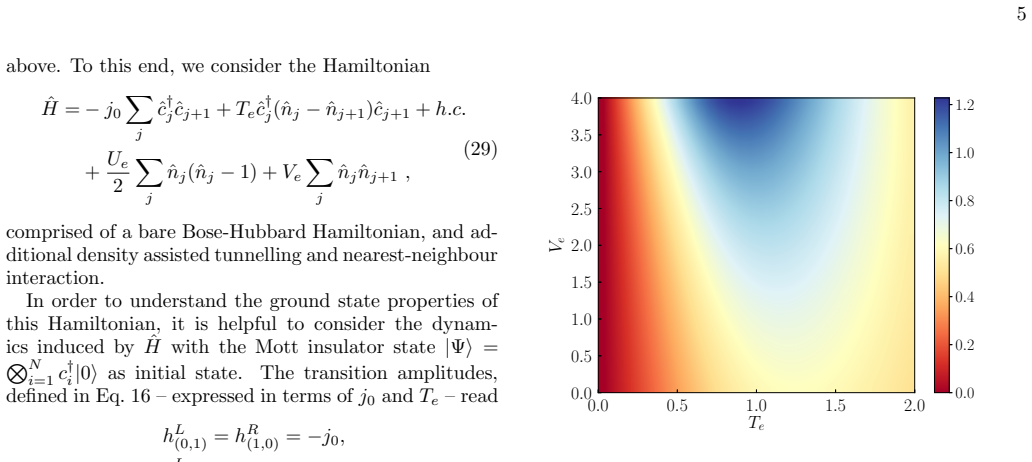
- Starting from a Mott insulator, the engineered density-assisted tunnelling with $T_e\simeq j_0$ creates an imbalance between right- and left-moving doublon-holon pairs, which is a measurable precursor of a density-wave ground state.
- The density-wave order parameter computed for 10 sites shows that strong $V_e$ stabilises the density wave, while large $U_e$ and large tunnelling suppress it, providing a clear experimental signature of the engineered interactions.
- Because split-tunnelling is automatically an order of magnitude weaker than $V_e$, the effective Hamiltonian (Eq.~(26)) is achievable without additional engineering.
Reading between the lines
- The same two-dimensional Bessel-function framework generalises naturally to multi-chromatic driving, so one could search systematically for parameter sets where several undesirable processes vanish simultaneously, something the paper does not do.
- If the perturbative expansion is validated at the proposed parameters, the technique would also work on two-dimensional lattices, where the interplay of density-assisted tunnelling and nearest-neighbour interactions could stabilise topological or chiral phases; the paper mentions this possibility without exploring it.
- A direct test of the central claim would be to measure the tunnelling suppression near $F_1=15.5j_0$ in a quantum-gas microscope; the paper's Fig.~1 prediction could be checked via single-site-resolved quench dynamics, which the paper does not propose.
- The authors note that longer-range interactions become accessible in shallow lattices where next-nearest-neighbour tunnelling is non-negligible; combining the present driving scheme with such lattices could yield Haldane-type insulating phases, an extension left for future work.
Signed reviews
Editorial analysis
A structured set of objections, weighed in public.
Referee Report
Summary. The manuscript studies a one-dimensional Bose-Hubbard model with time-periodic on-site energy (lattice shaking) and time-periodic on-site interaction. Using a Floquet-Magnus expansion up to order 1/ω^2 and a first-order expansion in the interaction-modulation amplitude, the authors derive an effective Hamiltonian containing nearest-neighbour tunnelling, density-assisted tunnelling, on-site and nearest-neighbour interactions, as well as co-/split-tunnelling and next-nearest-neighbour processes. They propose a bi-chromatic shaking F(t)=F1 cos ωt + 2F2 cos 2ωt together with an interaction modulation U_f(t)=2U_d cos 2ωt, and show that the effective couplings can be selectively enhanced or suppressed by tuning the driving parameters. As an application, they compute ground-state defect-pair imbalance and density-wave order parameters for the effective model, suggesting regimes with Mott-insulator defects and density-wave order.
Significance. If the effective-Hamiltonian derivation were quantitatively controlled at the parameters used, the paper would provide a useful toolbox for engineering extended Bose-Hubbard models in shaken optical lattices, with explicit closed-form expressions in terms of two-dimensional Bessel functions and a classification of the emergent processes. The central limitation, acknowledged in the text, is that the derivation is valid only for weak interaction modulation; this limitation is, however, not respected in the main demonstration (Fig. 1). Because the paper itself flags the missing support and the demonstration uses parameters outside the controlled regime, the results are not yet fully established; the analytic formulas and the algorithmic derivation are nevertheless valuable and the claimed tunability is plausible in a more conservative parameter window.
major comments (3)
- [Sec. III A 2 / Appendix A, Eqs. (A4)-(A6) and (19)] The derivation of the nearest-neighbour interaction constant V_e in Eq. (19) uses the approximation exp(iΓ(t)(n_j−n_k)) ≈ 1 + iΓ(t)(n_j−n_k) in Appendix A, i.e., a truncation at first order in Γ(t) whose expansion parameter is |U_d|/ω. Fig. 1 employs U_d = −4j0 and ω = 6j0, giving |U_d|/ω = 2/3 and a peak modulation 2|U_d| = 8j0 that exceeds ω. This directly contradicts the statement in Sec. II that the interaction modulation 'does not need to exceed the driving frequency' and the same section's restriction to 'sufficiently weak interactions.' The omitted O(Γ^2) terms contribute to the same commutators that produce V_e with relative size of order |U_d|/ω ≈ 2/3, so Eq. (19) and the amplitudes plotted in Fig. 1 are not under perturbative control at the parameters used to demonstrate the effect.
- [Sec. IV / Eq. (29), Figs. 2-3] The phase diagrams in Figs. 2 and 3 are obtained by exact diagonalization of the effective model Eq. (29), not of the full driven Hamiltonian Eq. (1) with the driving profiles Eqs. (9)-(10). Because the parameters Te and Ve used in these scans are taken from the uncontrolled expansion identified above, the predicted defect-pair imbalance and density-wave order cannot currently be attributed to the actual doubly modulated lattice at the parameters of Fig. 1. The authors should either restrict the demonstration to parameters satisfying |U_d|/ω ≪ 1 and U0/ω ≪ 1, or provide a numerical comparison between the effective model and the full time-dependent problem to validate the mapping.
- [Sec. III B / Eq. (26)] The neglect of split-tunnelling in Eq. (26) is justified only by the relation T_s = −V_e/8, i.e., relative to V_e itself. In the regimes of interest V_e is comparable to or larger than the single-particle tunnelling amplitudes, so the absolute rate |T_s| can be of order 0.1–1 j0; the error incurred by omitting this process from the model used in Figs. 2–3 is not quantified. A quantitative estimate of the effect of T_s on the ground-state properties would strengthen the claim that Eq. (26) faithfully captures the relevant physics.
minor comments (5)
- [Sec. II] The statement that the shaking must be strong, 'i.e. F(t) & ω', uses the symbol '&' in place of '≳' or 'approximately'; the intended meaning should be stated unambiguously.
- [Appendix A, Eq. (A7)] In Eq. (A7) the summation '∑_{\langle\langle jk\rangle\rangle, j=k}' is inconsistent: the condition j=k contradicts the indicated range over distinct sites, and presumably 'j≠k' or a different index was intended.
- [Sec. IV, Eqs. (16) and (30)] The connection between the density-assisted tunnelling amplitude Te in the model Hamiltonian (29) and the directional rates h^L/h^R defined in Eq. (16) should be stated explicitly; in particular, Eq. (30) sets h^L_(1,1) = −j0 + Te and h^R_(1,1) = −j0 − Te, but Eq. (16) expresses these rates through Bessel functions whose arguments differ by the sign of U_d, so the identification is not immediate.
- [Fig. 1] The caption says that 'induced repulsive interactions can be tuned to be notable from 10 to 17', but the vertical axis is not labelled with the plotted physical quantities; adding explicit labels and the values of the effective couplings would improve readability.
- [Sec. V] The outlook mentions the Haldane Bose insulator and topological order without concrete predictions or references to the required parameter regimes; a brief feasibility discussion would make the outlook more informative.
Circularity Check
No significant circularity: the effective couplings are derived from an explicit Floquet-Magnus expansion, and the one same-author cancellation theorem used is parameter-free and does not define the predicted terms.
full rationale
The derivation chain is self-contained in the relevant sense. Starting from the exact unitary transformation UI (Eq. 2), the paper expands the transformed tunnelling operator A_jk in Fourier components (Eqs. A4-A6) and constructs the effective Hamiltonian by Floquet-Magnus perturbation theory to order 1/omega^2 (Appendix A). The central coupling constants - Ve (Eq. 19), Tc (Eq. 22), the density-assisted tunnelling rates h_L/R (Eqs. 14-16), and Ue (Eq. 20) - are explicit functions of the driving parameters F1, F2, Ud, U0 and are not fitted to the phase diagrams. Figures 2 and 3 scan the effective parameters Te and Ve of the derived model (Eq. 29); this is a phase-diagram study of the effective Hamiltonian, not a fit that defines those parameters. The only same-author citation with structural weight is the statement, in Appendix A, that two-step tunnelling and the associated on-site-energy modification vanish in one dimension 'regardless of the drivings' (citing ref. [6]). That is a parameter-free one-dimensional cancellation theorem whose assumptions do not include the predicted nearest-neighbour interaction; under the review rule for cited results it counts as independent support, and the paper also re-derives the analogous second-order cancellation explicitly via Eq. A12. The paper's own caveat that the analysis is limited to 'sufficiently weak interactions' (Sec. II) is a convergence/validity limitation on the Gamma expansion, not a circularity. I find no step in which a 'prediction' reduces by construction to an input or to a fitted parameter.
Assumptions & free parameters
free parameters (2)
- U_d (amplitude of on-site interaction modulation) =
-4 j0 (Fig. 1)
- F2 (second-harmonic shaking amplitude) =
22 j0 (Fig. 1)
assumptions (4)
- domain assumption The Floquet-Magnus expansion up to order 1/ω^2 is valid and higher-order terms are negligible.
- domain assumption Two-step tunnelling and on-site energy renormalization vanish in one dimension for arbitrary driving.
- domain assumption The single-band Bose-Hubbard description with nearest-neighbour hopping is valid for the optical lattice system.
- domain assumption The ground state of the effective Hamiltonian Eq. (29) represents the phase of the periodically driven system.
Cite this review
Pith. "Pith review of Engineered Nearest-Neighbour Interactions with Doubly Modulated Optical Lattices." pith.science (2026). https://pith.science/paper/TYPSYZM5
@misc{pith2026190805494,
  author       = {Pith},
  title        = {Pith review of: Engineered Nearest-Neighbour Interactions with Doubly Modulated Optical Lattices},
  year         = {2026},
  howpublished = {\url{https://pith.science/paper/TYPSYZM5}},
  note         = {Machine review of arXiv:1908.05494}
}
read the original abstract
Optical lattice systems provide exceptional platforms for quantum simulation of many-body systems. We focus on the doubly modulated Bose-Hubbard model driven by both time-dependent on-site energy and interaction, and predict the emergence of the nearest neighbour interaction and density-assisted tunnelling. By specifically designing a bi-chromatic driving pattern for a one dimensional lattice, we demonstrate that the doubly modulated fields can be tuned to realize desired quantum phases, e.g. the Mott insulator phase with selective defects, and density wave phase.
Figures


Reference graph
Works this paper leans on
-
[14]
H. Lignier, C. Sias, D. Ciampini, Y. Singh, A. Zenesini, O. Morsch, and E. Arimondo. Dynamical control of matter-wave tunneling in periodic potentials. Phys. Rev. Lett., 99:220403, Nov 2007
work page 2007
-
[1]
Nearest-neighbour density assisted tunnelling The Hamiltonian ˆHt = ∑ jk c† j ˆA0 jkck, (11) given as the temporal average of the tunnelling term in Eq.4, depends on the driving parameters via the relation ˆA0 jk =−j0J0( ˜F1(j−k), ˜F2(j−k) + ˜Ud(ˆnj− ˆnk)). (12) 3 Because of the term ˆnj− ˆnk, the prefactors ˆA0 jk should not be taken literally as a rate ...
-
[2]
Nearest-neighbour interactions In the one dimensional chain the interaction terms of the effective Hamiltonian given in Eq. (6) reduces to ˆHint eff =Ve ∑ j ˆnj ˆnj+1 + Ue 2 ∑ j ˆnj(ˆnj− 1) , (18) with the nearest neighbour interaction constant Ve = 4j2 0 ω2 ∑ n⁄=0 [ −Ud n ∂ ∂ ˜F2 + U0 2n2 ] J2 n( ˜F1, ˜F2), (19) and the on-site interaction constant Ue =U0...
-
[3]
Co-tunnelling Co-tunnelling processes with two particles tunnelling from one site j to the same neighbour site k, can be de- scribed by ˆHc = ∑ j Tcc† kc† kcjcj (21) with k =j + 1 or k =j− 1. The tunnelling rate can be expressed in Bessel functions as Tc =−j2 0 ω2 ∑ n⁄=0 Jn( ˜F1, ˜F2) [Ud n ∂ ∂ ˜F2 + U0 4n2 ] J−n( ˜F1, ˜F2) . (22) In contrast to the densi...
-
[4]
site j− 1 and j + 1 in the one-dimensional case
Split-tunnelling Another emerging process appearing in second order can be interpreted as split-tunnelling, where particles on the same site j tunnel to two distinct adjacent sites, i.e. site j− 1 and j + 1 in the one-dimensional case. This is captured by the Hamiltonian ˆHs = ∑ j Tsc† j+1c† j−1cjcj (23) with the split tunnelling rate Ts that is determine...
-
[5]
Next-nearest-neighbour density assisted tunnelling In second order (1/ω2), there is nearest-neighbour den- sity assisted tunnelling described by the Hamiltonian ˆHa = ∑ j Tcc† j (ˆnj− 4ˆnj+1 + ˆnj+2)cj+2 . (24) The amplitude for this process coincides indeed with the amplitude for co-tunnelling given above in Eq. (22) Similarly to the discussion in Sec. I...
-
[6]
I. M. Georgescu, S. Ashhab, and Franco Nori. Quantum simulation. Rev. Mod. Phys., 86:153–185, Mar 2014
work page 2014
- [7]
Show all 35 references
-
[8]
Ultracold dipolar gases in optical lattices
C.Trefzger, C.Menotti, B.Capogrosso-Sansone, and M.Lewenstein. Ultracold dipolar gases in optical lattices. Journal of Physics B: Atomic, Molecular and Optical Physics, 44(19):193001, 2011
2011
-
[9]
Martinez, Christine A
Esteban A. Martinez, Christine A. Muschik, Philipp Schindler, Daniel Nigg, Alexander Erhard, Markus Heyl, Philipp Hauke, Marcello Dalmonte, Thomas Monz, Pe- ter Zoller, and Rainer Blatt. Real-time dynamics of lat- tice gauge theories with a few-qubit quantum computer. Nature, ...
2016
-
[10]
High-frequency approximation for periodically driven quantum systems from a floquet-space perspective
Andre Eckardt and Egidijus Anisimovas. High-frequency approximation for periodically driven quantum systems from a floquet-space perspective. New Journal of Physics, 17(9):093039, 2015
2015
-
[11]
Structure-dynamics relation in shaken optical lattices
Albert Verdeny and Florian Mintert. Structure-dynamics relation in shaken optical lattices. Phys. Rev. A, 92:033407, Sep 2015
2015
-
[12]
Non-standard hubbard models in optical lattices: a review
Omjyoti Dutta, Mariusz Gajda, Philipp Hauke, Maciej Lewenstein, Dirk-Soren Luhmann, Boris A Malomed, Tomasz Sowinski, and Jakub Zakrzewski. Non-standard hubbard models in optical lattices: a review. Reports on Progress in Physics, 78(6):066001, 2015
2015
-
[13]
Aidelsburger, M
M. Aidelsburger, M. Atala, S. Nascimb` ene, S. Trotzky, Y.-A. Chen, and I. Bloch. Experimental realization of strong effective magnetic fields in an optical lattice.Phys. Rev. Lett., 107:255301, Dec 2011
2011
-
[15]
Tunable chern in- sulator with optimally shaken lattices
Albert Verdeny and Florian Mintert. Tunable chern in- sulator with optimally shaken lattices. Phys. Rev. A, 92:063615, Dec 2015
2015
-
[16]
Courteille, R
Ph. Courteille, R. S. Freeland, D. J. Heinzen, F. A. van Abeelen, and B. J. Verhaar. Observation of a feshbach resonance in cold atom scattering. Phys. Rev. Lett., 81:69–72, Jul 1998
1998
-
[17]
Feshbach resonances in ultracold gases
Cheng Chin, Rudolf Grimm, Paul Julienne, and Eite Tiesinga. Feshbach resonances in ultracold gases. Rev. Mod. Phys., 82:1225–1286, Apr 2010
2010
-
[18]
Superfluid-insulator transition in a periodically driven optical lattice
Andr´ e Eckardt, Christoph Weiss, and Martin Holthaus. Superfluid-insulator transition in a periodically driven optical lattice. Phys. Rev. Lett., 95:260404, Dec 2005
2005
-
[19]
Exploring unconventional hubbard models with doubly modulated lattice gases
Sebastian Greschner, Luis Santos, and Dario Poletti. Exploring unconventional hubbard models with doubly modulated lattice gases. Phys. Rev. Lett., 113:183002, Oct 2014
2014
-
[20]
Di Liberto, C
M. Di Liberto, C. E. Creffield, G. I. Japaridze, and C. Morais Smith. Quantum simulation of correlated- hopping models with fermions in optical lattices. Phys. Rev. A, 89:013624, Jan 2014
2014
-
[21]
Phase diagram of the extended bose-hubbard model
Davide Rossini and Rosario Fazio. Phase diagram of the extended bose-hubbard model. New Journal of Physics, 14(6):065012, 2012
2012
-
[22]
Quantum phases from competing short- and long-range interactions in an optical lattice
Renate Landig, Lorenz Hruby, Nishant Dogra, Manuele Landini, Rafael Mottl, Tobias Donner, and Tilman Esslinger. Quantum phases from competing short- and long-range interactions in an optical lattice. Nature, 532:476 EP –, 04 2016
2016
-
[23]
Fisher, Shang-keng Ma, and B
Michael E. Fisher, Shang-keng Ma, and B. G. Nickel. Critical exponents for long-range interactions. Phys. Rev. Lett., 29:917–920, Oct 1972
1972
-
[24]
Young, Ali Hamed Moosavian, Michael Foss-Feig, and Alexey V
Zachary Eldredge, Zhe-Xuan Gong, Jeremy T. Young, Ali Hamed Moosavian, Michael Foss-Feig, and Alexey V. Gorshkov. Fast quantum state transfer and entanglement renormalization using long-range interactions. Phys. Rev. Lett., 119:170503, Oct 2017
2017
-
[25]
Gorshkov, and Christopher Monroe
Philip Richerme, Zhe-Xuan Gong, Aaron Lee, Crystal Senko, Jacob Smith, Michael Foss-Feig, Spyridon Micha- lakis, Alexey V. Gorshkov, and Christopher Monroe. Non-local propagation of correlations in quantum systems with long-range interactions. Nature, 511:198 EP –, 07 2014
2014
-
[26]
Nessi, A
N. Nessi, A. Iucci, and M. A. Cazalilla. Quantum quench and prethermalization dynamics in a two-dimensional fermi gas with long-range interactions. Phys. Rev. Lett., 113:210402, Nov 2014
2014
-
[27]
T. D. K¨ uhner and H. Monien. Phases of the one- dimensional bose-hubbard model. Phys. Rev. B, 58:R14741–R14744, Dec 1998
1998
-
[28]
Matthew P. A. Fisher, Peter B. Weichman, G. Grin- stein, and Daniel S. Fisher. Boson localization and the superfluid-insulator transition. Phys. Rev. B, 40:546–570, Jul 1989
1989
-
[29]
K¨ uhner, Steven R
Till D. K¨ uhner, Steven R. White, and H. Monien. One- dimensional bose-hubbard model with nearest-neighbor 9 interaction. Phys. Rev. B, 61:12474–12489, May 2000
2000
-
[30]
Dalla Torre, Erez Berg, and Ehud Altman
Emanuele G. Dalla Torre, Erez Berg, and Ehud Altman. Hidden order in 1d bose insulators. Phys. Rev. Lett., 97:260401, Dec 2006
2006
-
[31]
Goldman and J
N. Goldman and J. Dalibard. Periodically driven quan- tum systems: Effective hamiltonians and engineered gauge fields. Phys. Rev. X, 4:031027, Aug 2014
2014
-
[32]
Universal high-frequency behavior of periodically driven systems: from dynamical stabilization to floquet engi- neering
Marin Bukov, Luca D’Alessio, and Anatoli Polkovnikov. Universal high-frequency behavior of periodically driven systems: from dynamical stabilization to floquet engi- neering. Advances in Physics, 64(2):139–226, 2015
2015
-
[33]
Floquet engineering with quasienergy bands of periodically driven optical lattices
Martin Holthaus. Floquet engineering with quasienergy bands of periodically driven optical lattices. Journal of Physics B: Atomic, Molecular and Optical Physics, 49(1):013001, 2016
2016
-
[34]
Colloquium: Atomic quantum gases in periodically driven optical lattices
Andr´ e Eckardt. Colloquium: Atomic quantum gases in periodically driven optical lattices. Rev. Mod. Phys., 89:011004, Mar 2017
2017
-
[35]
On two- dimensional bessel functions
H J Korsch, A Klumpp, and D Witthaut. On two- dimensional bessel functions. Journal of Physics A: Mathematical and General, 39(48):14947, 2006
2006
Reviewed August 14, 2026 · model on record in the stance chip above.
Discussion (0). Continue with ORCID to comment.