REVIEW 3 major objections 5 minor 49 references
A Single-Shot Arbitrarily-Shaped Text Detector based on Context Attended Multi-Task Learning
T0 review · 3 major / 5 minor · reviewed 2026-08-14 · deepseek-v4-flash
Pith's one-line read SAST detects arbitrarily-shaped scene text in a single forward pass by predicting four geometric maps and clustering text-center pixels through point-to-quad assignment.
desk verdict SAST is a competent engineering integration for real-time arbitrary-shape text detection; its central speed-accuracy claim holds, but a few overstated comparisons and a genuine clustering edge case need attention. read the letter →
The pith
A machine-rendered reading of the paper's core claim, the machinery that carries it, and where it could break.
The reading
What carries the argument
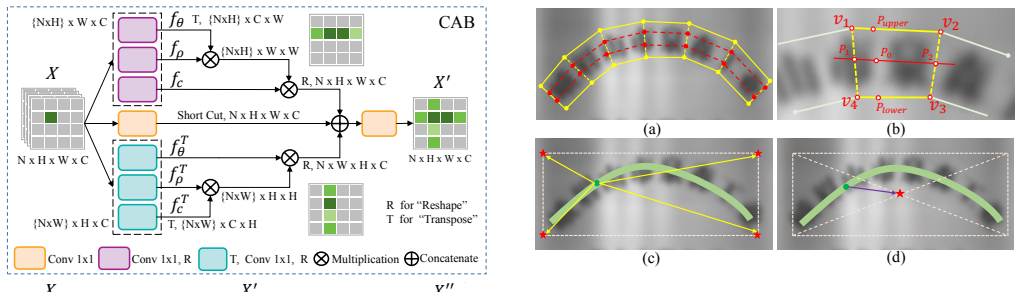
The load-bearing mechanism is point-to-quad assignment, a post-processing step that replaces connected-component analysis. It works in two stages: first, the TCL and TVO maps are thresholded to form candidate bounding quadrangles of text; second, each TCL pixel uses its TCO offset vector to point to a low-level center, and the pixel is assigned to the candidate quadrangle whose center is nearest. The geometric identity behind the TBO label is the proportional relation $(P_0-P_1)/(P_2-P_1)=(P_u-V_1)/(V_2-V_1)=(P_l-V_4)/(V_3-V_4)$, which locates the paired upper and lower border points for a center-line pixel. The Context Attention Block—a self-attention module that aggregates context along horizontal and vertical columns—supports the mechanism by giving each pixel long-range context; two stacked blocks let every pixel see the whole feature map.
What would settle it
Take a curved text image with a strong U- or S-shaped instance and compute, for every TCL pixel, the endpoint of its TCO vector; if those endpoints cluster into two or more distinct quadrangle centers within one annotated instance, the point-to-quad assignment will split it, and counting such splits across SCUT-CTW1500 or Total-Text would settle whether the assumption holds.
Extended reading notes
Core claim
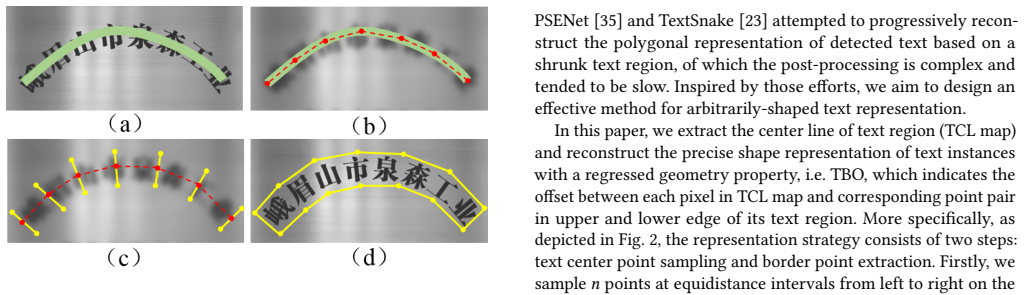
The central claim is that four jointly learned geometric properties—text center line (TCL), text border offset (TBO), text center offset (TCO), and text vertex offset (TVO)—are sufficient to detect arbitrarily-shaped text in one shot, provided the network sees long-range context and the post-processor uses high-level object knowledge. The paper argues that the Context Attention Block, which gathers horizontal and vertical context through a self-attention mechanism, gives more reliable segmentation of long or closely spaced text lines. The point-to-quad assignment then clusters TCL pixels by assigning each pixel to a quadrangle candidate: the TVO map produces candidate quadrangles, the TCO map points each pixel toward a center, and pixels are grouped by proximity to the corresponding quadrangle center. The final polygon is rebuilt from the TBO map by sampling center-line points and reading off paired border points. The reported results are Hmean 80.97% at 27.63 FPS on SCUT-CTW1500, 80.17% on Total-Text (81.45% and 80.21% with multi-scale testing), 86.91% on ICDAR2015, and 68.76% on ICDAR2017-MLT.
Load-bearing premise
The method leans on the assumption that all pixels of one text instance point, via the TCO map, to the same center of that instance's minimum enclosing quadrangle; if a curved text line bends far enough that pixels point to different centers, the clustering step can split one instance into pieces.
Editorial extensions
If this is right
- Text of arbitrary shapes can be detected in real time: 27.63 FPS on SCUT-CTW1500 at 81.0% Hmean on a single Titan Xp, which the paper reports as surpassing most segmentation-based detectors.
- Closely spaced text instances are separable without connected-component analysis, because pixel assignment uses object-level quadrangle centers rather than local connectivity.
- Long text lines resist fragmentation: context aggregation plus object-level assignment can hold a fragmented center-line response together.
- The same geometric-map scheme generalizes to multi-oriented and multilingual text, as shown by results on ICDAR2015 and ICDAR2017-MLT.
- Polygon vertices are chosen adaptively from center-line length, avoiding a fixed vertex count for curved text.
Reading between the lines
- Editor's inference: the same two-map assignment (pixels point to a learned center, then nearest-candidate matching) could apply to general instance segmentation of elongated objects such as roads, blood vessels, or wires, where connected-component analysis fails on nearby instances.
- Editor's inference: because TCL and the geometric maps are produced at 1/4 input resolution, the reported small-text failure implies a measurable height cutoff; below roughly that text height, recall should drop sharply, which would bound the detector's usefulness for far-away or dense small text.
- Editor's inference: the 27.63 FPS figure covers detection only; a full text-reading pipeline that adds recognition would run slower, so the real-time claim should not be read as end-to-end reading speed.
Signed reviews
Editorial analysis
A structured set of objections, weighed in public.
Referee Report
Summary. The paper proposes SAST, a segmentation-based single-shot detector for arbitrarily-shaped scene text. The network uses a ResNet-50/FPN stem with two serially stacked Context Attention Blocks and four parallel prediction heads for text center line (TCL), center offset (TCO), vertex offset (TVO), and border offset (TBO). Instance segmentation is obtained by a point-to-quad assignment that groups TCL pixels according to their TCO vectors relative to quadrangle candidates recovered from TVO, and final polygons are reconstructed from the TBO maps. The method is evaluated on ICDAR2015, ICDAR2017-MLT, SCUT-CTW1500, and Total-Text, with a reported runtime of 27.63 FPS at 80.97 Hmean on SCUT-CTW1500 using a single Titan Xp.
Significance. If the reported numbers are reproducible, the paper makes a useful engineering contribution: it demonstrates that a segmentation-based arbitrary-shape text detector can run at near-real-time speed while remaining competitive with TextSnake, TextField, and PSENet. The ablations in Tables 1-3 are well designed and individually test the three claimed components (TBO reconstruction, point-to-quad assignment, and CAB), and the evaluation covers the standard public benchmarks. The work is less strong on the conceptual side: the point-to-quad assignment rests on an assumption that is not discussed, and one explicit comparison claim in Section 4.5 is contradicted by the paper's own Table 6. Since no code or trained models are released and no error bars are reported, the empirical claims should be treated as preliminary until reproduced.
major comments (3)
- [§4.5 / Table 6] The text states that 'SAST achieves a better performance in a much faster speed' than previous arbitrarily-shaped text detectors, but Table 6 lists PSENet-1s (87.08) and PSENet-2s (87.21) above SAST (86.91) on ICDAR2015. Because PSENet is a segmentation-based arbitrary-shape detector appearing in the same table, the stated comparison is not supported by the reported numbers; please revise the claim to 'comparable' and specify the detectors for which SAST is actually faster.
- [§3.4 / §3.5] The TCO supervision defines the target center as the center of the minimum enclosing quadrangle of the annotation polygon, and point-to-quad assignment clusters all TCL pixels by nearest such object-level center. For two distinct curved instances whose minimum-enclosing-quadrangle centers coincide, for example two concentric curved text lines, all pixels from both instances produce the same low-level center, so no nearest-center rule can separate the instances even with perfect TCL/TCO/TVO predictions. This is a structural limitation of the clustering mechanism, not a tuning issue; the paper should either discuss it explicitly, add a fallback such as direction-aware or per-pixel embedding, or restrict the claim to configurations where centers are separated. The ablation in Table 1 shows only a 1.46 Hmean improvement over connected-component plus TBO, so the current evidence does not show that the assignment is robust to this failure mode.
- [§4.7 / Table 4] The real-time claim is central to the abstract, but the FPS column in Table 4 appears to mix numbers obtained on different hardware, and the footnote states that speed 'might be evaluated with different hardware environments.' For example, PSENet's 8.4 FPS in Table 4 is not measured on the same Titan Xp used for SAST. Since the title and abstract highlight speed, a controlled runtime comparison, or at least a clear per-method hardware table, is needed before 'surpassing most existing segmentation-based methods' can be properly evaluated.
minor comments (5)
- [§4.2 / §4.4] Section 4.2 states that the longer side is set to 1536 for single-scale testing unless otherwise stated, while Section 4.4 says the longer side is set to 512 for single-scale testing on SCUT-CTW1500 and Total-Text; the two statements should be reconciled or the difference explained.
- [§4.4 / Table 5] The text reports a Total-Text Hmean of 78.08%, but Table 5 lists SAST with Hmean 80.17%; these numbers should be made consistent.
- [Table 1] The first ablation row reports no runtime, although the text says point-to-quad assignment 'cost almost the same time' as connected component analysis; please add the missing timing or state explicitly that it was not measured.
- [Various] There are small typos: 'expending' should be 'expanding' in Section 4.3, and 'visualizatio n' should be 'visualization' in Section 4.6.
- [All experiments] All benchmark numbers are reported as point estimates from a single run; given the small test sets and typical run-to-run variance in text detection, Hmean differences of less than about one point should be interpreted cautiously.
Circularity Check
No significant circularity; SAST is an empirical systems paper evaluated on external public benchmarks, with no load-bearing derivation that reduces to its own inputs.
full rationale
The paper's central claim is that the proposed SAST architecture detects arbitrarily-shaped text accurately at real-time speed. This is supported by direct experiments on external public benchmarks (ICDAR2015, ICDAR2017-MLT, SCUT-CTW1500, Total-Text), with quantitative comparisons against prior methods. The proposed components—the Context Attention Block, the multi-task geometric maps, and the point-to-quad assignment—are described algorithmically and evaluated through ablations on SCUT-CTW1500. No result is derived from a fitted parameter renamed as a prediction: the loss weights are tuned during training and reported as implementation details, not as predicted outcomes. The point-to-quad assignment does rely on an explicit modeling assumption in Section 3.4 that pixels in the same TCL instance point to the same object-level center, but this is a stated architectural assumption about how the TCO supervision is defined, not a circular reduction of the claimed result to its inputs. The paper cites prior works by some of its own authors (WordSup and Look More Than Once), but these citations are contextual related-work references and are not load-bearing for the proposed method's derivation or for its benchmark evaluation. The method is self-contained against external benchmarks, and there is no equation or construction in the paper that makes the claimed accuracy or speed equivalent to its training data, label generation, or fitted parameters by definition. Therefore the circularity score is 0.
Assumptions & free parameters
free parameters (5)
- Loss weights λ1..λ4 =
1.0, 0.5, 0.5, 1.0
- TCL binarization threshold
- NMS threshold for quadrangle candidates
- Test input scale =
512 or 1536 (longer side)
- Multi-scale test set =
512, 768, 1536, 2048
assumptions (4)
- domain assumption Text regions can be represented by TCL, TBO, TCO, and TVO maps derived from polygon annotations.
- domain assumption Pixels belonging to the same text instance share a common object-level center, namely the center of the minimum enclosing quadrangle.
- domain assumption The TBO geometric construction using a line with average slope of upper and lower boundaries yields correct boundary point pairs.
- domain assumption Transfer learning from ImageNet-pretrained ResNet-50 and the SynthText pretraining step improve or at least do not hurt final accuracy.
Cite this review
Pith. "Pith review of A Single-Shot Arbitrarily-Shaped Text Detector based on Context Attended Multi-Task Learning." pith.science (2026). https://pith.science/paper/U7IHKF7V
@misc{pith2026190805498,
  author       = {Pith},
  title        = {Pith review of: A Single-Shot Arbitrarily-Shaped Text Detector based on Context Attended Multi-Task Learning},
  year         = {2026},
  howpublished = {\url{https://pith.science/paper/U7IHKF7V}},
  note         = {Machine review of arXiv:1908.05498}
}
read the original abstract
Detecting scene text of arbitrary shapes has been a challenging task over the past years. In this paper, we propose a novel segmentation-based text detector, namely SAST, which employs a context attended multi-task learning framework based on a Fully Convolutional Network (FCN) to learn various geometric properties for the reconstruction of polygonal representation of text regions. Taking sequential characteristics of text into consideration, a Context Attention Block is introduced to capture long-range dependencies of pixel information to obtain a more reliable segmentation. In post-processing, a Point-to-Quad assignment method is proposed to cluster pixels into text instances by integrating both high-level object knowledge and low-level pixel information in a single shot. Moreover, the polygonal representation of arbitrarily-shaped text can be extracted with the proposed geometric properties much more effectively. Experiments on several benchmarks, including ICDAR2015, ICDAR2017-MLT, SCUT-CTW1500, and Total-Text, demonstrate that SAST achieves better or comparable performance in terms of accuracy. Furthermore, the proposed algorithm runs at 27.63 FPS on SCUT-CTW1500 with a Hmean of 81.0% on a single NVIDIA Titan Xp graphics card, surpassing most of the existing segmentation-based methods.
Figures


Figures from the paper (2 more)

Reference graph
Works this paper leans on
-
[1]
Chee Kheng Ch’ng and Chee Seng Chan. 2017. Total-Text: A comprehensive dataset for scene text detection and recognition. In Int. Conf. Doc. Anal. Recognit. (ICDAR), Vol. 1. IEEE, 935–942
work page 2017
-
[2]
Dan Deng, Haifeng Liu, Xuelong Li, and Deng Cai. 2018. PixelLink: Detecting scene text via instance segmentation. In Proc. AAAI Conf. Artif. Intell. (AAAI)
work page 2018
-
[3]
Jia Deng, Wei Dong, Richard Socher, Li-Jia Li, Kai Li, and Li Fei-Fei. 2009. Ima- geNet: A large-scale hierarchical image database. In IEEE Conf. Comp. Vis. Patt. Recognit. (CVPR). IEEE, 248–255
work page 2009
-
[4]
Alireza Fathi, Zbigniew Wojna, Vivek Rathod, Peng Wang, Hyun Oh Song, Sergio Guadarrama, and Kevin P Murphy. 2017. Semantic instance segmentation via deep metric learning. arXiv:1703.10277
arXiv 2017
- [5]
-
[6]
Ankush Gupta, Andrea Vedaldi, and Andrew Zisserman. 2016. Synthetic data for text localisation in natural images. In IEEE Conf. Comp. Vis. Patt. Recognit. (CVPR). 2315–2324
work page 2016
-
[7]
Kaiming He, Georgia Gkioxari, Piotr Dollár, and Ross Girshick. 2017. Mask R-CNN. In IEEE Conf. Comp. Vis. Patt. Recognit. (CVPR) . 2961–2969
work page 2017
-
[8]
Kaiming He, Xiangyu Zhang, Shaoqing Ren, and Jian Sun. 2016. Deep residual learning for image recognition. In IEEE Conf. Comp. Vis. Patt. Recognit. (CVPR) . 770–778
work page 2016
Show all 49 references
-
[9]
Pan He, Weilin Huang, Tong He, Qile Zhu, Yu Qiao, and Xiaolin Li. 2017. Single shot text detector with regional attention. In IEEE Conf. Comp. Vis. Patt. Recognit. (CVPR). 3047–3055
2017
-
[10]
Wenhao He, Xu-Yao Zhang, Fei Yin, and Cheng-Lin Liu. 2017. Deep direct regression for multi-oriented scene text detection. In IEEE Conf. Comp. Vis. Patt. Recognit. (CVPR). 745–753
2017
-
[11]
Han Hu, Chengquan Zhang, Yuxuan Luo, Yuzhuo Wang, Junyu Han, and Errui Ding. 2017. WordSup: Exploiting Word Annotations for Character Based Text Detection. In IEEE Int. Conf. Comp. Vis. (ICCV) . 4950–4959
2017
-
[12]
Lichao Huang, Yi Yang, Yafeng Deng, and Yinan Yu. 2015. DenseBox: Unifying landmark localization with end to end object detection. arXiv:1509.04874
2015 arXiv
-
[13]
Zilong Huang, Xinggang Wang, Lichao Huang, Chang Huang, Yunchao Wei, and Wenyu Liu. 2018. CCNet: Criss-cross attention for semantic segmentation. arXiv:1811.11721
2018 arXiv
-
[14]
Zhida Huang, Zhuoyao Zhong, Lei Sun, and Qiang Huo. 2019. Mask R-CNN with pyramid attention network for scene text detection. In Winter Conf. Appl. Comp. Vis. (W ACV). IEEE, 764–772
2019
-
[15]
Dimosthenis Karatzas, Lluis Gomez-Bigorda, Anguelos Nicolaou, Suman Ghosh, Andrew Bagdanov, Masakazu Iwamura, Jiri Matas, Lukas Neumann, Vijay Ra- maseshan Chandrasekhar, Shijian Lu, et al. 2015. ICDAR 2015 competition on robust reading. In Int. Conf. Doc. Anal. Recognit. (ICD...
2015
-
[16]
Alexander Kirillov, Evgeny Levinkov, Bjoern Andres, Bogdan Savchynskyy, and Carsten Rother. 2017. InstanceCut: from edges to instances with multicut. In IEEE Conf. Comp. Vis. Patt. Recognit. (CVPR) . IEEE, 7322–7331
2017
-
[17]
Minghui Liao, Baoguang Shi, Xiang Bai, Xinggang Wang, and Wenyu Liu. 2017. TextBoxes: A fast text detector with a single deep neural network. In Proc. AAAI Conf. Artif. Intell. (AAAI). 4161–4167
2017
-
[18]
Minghui Liao, Zhen Zhu, Baoguang Shi, Gui-song Xia, and Xiang Bai. 2018. Rotation-sensitive regression for oriented scene text detection. In IEEE Conf. Comp. Vis. Patt. Recognit. (CVPR) . 5909–5918
2018
-
[19]
Tsung-Yi Lin, Piotr Dollár, Ross Girshick, Kaiming He, Bharath Hariharan, and Serge Belongie. 2017. Feature pyramid networks for object detection. In IEEE Conf. Comp. Vis. Patt. Recognit. (CVPR) . 2117–2125
2017
-
[20]
Wei Liu, Dragomir Anguelov, Dumitru Erhan, Christian Szegedy, Scott Reed, Cheng-Yang Fu, and Alexander C Berg. 2016. SSD: Single shot multibox detector. In Eur. Conf. Comp. Vis. (ECCV) . Springer, 21–37
2016
-
[21]
Yuliang Liu and Lianwen Jin. 2017. Deep matching prior network: Toward tighter multi-oriented text detection. In IEEE Conf. Comp. Vis. Patt. Recognit. (CVPR) . 1962–1969
2017
-
[22]
Yiding Liu, Siyu Yang, Bin Li, Wengang Zhou, Jizheng Xu, Houqiang Li, and Yan Lu. 2018. Affinity derivation and graph merge for instance segmentation. In Eur. Conf. Comp. Vis. (ECCV) . 686–703
2018
-
[23]
Shangbang Long, Jiaqiang Ruan, Wenjie Zhang, Xin He, Wenhao Wu, and Cong Yao. 2018. TextSnake: A flexible representation for detecting text of arbitrary shapes. In Eur. Conf. Comp. Vis. (ECCV) . 20–36
2018
-
[24]
Pengyuan Lyu, Minghui Liao, Cong Yao, Wenhao Wu, and Xiang Bai. 2018. Mask TextSpotter: An end-to-end trainable neural network for spotting text with arbitrary shapes. In Eur. Conf. Comp. Vis. (ECCV) . 67–83
2018
-
[25]
Pengyuan Lyu, Cong Yao, Wenhao Wu, Shuicheng Yan, and Xiang Bai. 2018. Multi- oriented scene text detection via corner localization and region segmentation. In IEEE Conf. Comp. Vis. Patt. Recognit. (CVPR) . 7553–7563
2018
-
[26]
Jianqi Ma, Weiyuan Shao, Hao Ye, Li Wang, Hong Wang, Yingbin Zheng, and Xi- angyang Xue. 2018. Arbitrary-oriented scene text detection via rotation proposals. IEEE Trans. Multimedia 20, 11 (2018), 3111–3122
2018
-
[27]
Fausto Milletari, Nassir Navab, and Seyed-Ahmad Ahmadi. 2016. V-Net: Fully convolutional neural networks for volumetric medical image segmentation. In 4th Int. Conf. 3D Vision (3DV) . IEEE, 565–571
2016
-
[28]
Nibal Nayef, Fei Yin, Imen Bizid, Hyunsoo Choi, Yuan Feng, Dimosthenis Karatzas, Zhenbo Luo, Umapada Pal, Christophe Rigaud, Joseph Chazalon, et al . 2017. ICDAR2017 robust reading challenge on multi-lingual scene text detection and script identification-rrc-mlt. In Int. Conf....
2017
-
[29]
Shaoqing Ren, Kaiming He, Ross Girshick, and Jian Sun. 2015. Faster R-CNN: Towards real-time object detection with region proposal networks. InAdv. Neural Inf. Process. Syst. (NIPS) . 91–99
2015
-
[30]
Baoguang Shi, Xiang Bai, and Serge Belongie. 2017. Detecting oriented text in natural images by linking segments. In IEEE Conf. Comp. Vis. Patt. Recognit. (CVPR). 2550–2558
2017
-
[31]
Bharat Singh and Larry S Davis. 2018. An analysis of scale invariance in object detection snip. In IEEE Conf. Comp. Vis. Patt. Recognit. (CVPR) . 3578–3587
2018
-
[32]
Zhi Tian, Weilin Huang, Tong He, Pan He, and Yu Qiao. 2016. Detecting text in natural image with connectionist text proposal network. In Eur. Conf. Comp. Vis. (ECCV). Springer, 56–72
2016
-
[33]
Jonas Uhrig, Eike Rehder, Björn Fröhlich, Uwe Franke, and Thomas Brox. 2018. Box2Pix: Single-shot instance segmentation by assigning pixels to object boxes. In IEEE Intell. Veh. Symp. (IV) . IEEE, 292–299
2018
-
[34]
Ashish Vaswani, Noam Shazeer, Niki Parmar, Jakob Uszkoreit, Llion Jones, Aidan N Gomez, Łukasz Kaiser, and Illia Polosukhin. 2017. Attention is all you need. In Adv. Neural Inf. Process. Syst. (NIPS) . 5998–6008
2017
-
[35]
Wenhai Wang, Enze Xie, Xiang Li, Wenbo Hou, Tong Lu, Gang Yu, and Shuai Shao. 2019. Shape Robust Text Detection With Progressive Scale Expansion Network. In IEEE Conf. Comp. Vis. Patt. Recognit. (CVPR) . 9336–9345
2019
-
[36]
Xiaolong Wang, Ross Girshick, Abhinav Gupta, and Kaiming He. 2018. Non-local neural networks. In IEEE Conf. Comp. Vis. Patt. Recognit. (CVPR) . 7794–7803
2018
-
[37]
Yue Wu and Prem Natarajan. 2017. Self-organized text detection with minimal post-processing via border learning. In IEEE Conf. Comp. Vis. Patt. Recognit. (CVPR). 5000–5009
2017
-
[38]
Yongchao Xu, Yukang Wang, Wei Zhou, Yongpan Wang, Zhibo Yang, and Xiang Bai. 2019. TextField: Learning A Deep Direction Field for Irregular Scene Text Detection. IEEE Trans. Image Process. (2019). arXiv:1812.01393
2019 arXiv
-
[39]
Qiangpeng Yang, Mengli Cheng, Wenmeng Zhou, Yan Chen, Minghui Qiu, and Wei Lin. 2018. IncepText: a new inception-text module with deformable PSROI pooling for multi-oriented scene text detection. In Int. Joint Conf. Artif. Intell. (IJCAI). IJCAI, 1071–1077
2018
-
[40]
Qixiang Ye and David Doermann. 2015. Text detection and recognition in imagery: A survey. IEEE Trans. Pattern Anal. Mach. Intell. 37, 7 (2015), 1480–1500
2015
-
[41]
Changqian Yu, Jingbo Wang, Chao Peng, Changxin Gao, Gang Yu, and Nong Sang. 2018. Learning a discriminative feature network for semantic segmentation. In IEEE Conf. Comp. Vis. Patt. Recognit. (CVPR) . IEEE, 1857–1866
2018
-
[42]
Liu Yuliang, Jin Lianwen, Zhang Shuaitao, and Zhang Sheng. 2017. Detecting curve text in the wild: New dataset and new solution. arXiv:1712.02170
2017 arXiv
-
[43]
Chengquan Zhang, Borong Liang, Zuming Huang, Mengyi En, Junyu Han, Errui Ding, and Xinghao Ding. 2019. Look More Than Once: An Accurate Detector for Text of Arbitrary Shapes. In IEEE Conf. Comp. Vis. Patt. Recognit. (CVPR)
2019
-
[44]
Zheng Zhang, Chengquan Zhang, Wei Shen, Cong Yao, Wenyu Liu, and Xiang Bai. 2016. Multi-oriented text detection with fully convolutional networks. In IEEE Conf. Comp. Vis. Patt. Recognit. (CVPR) . 4159–4167
2016
-
[45]
Shuai Zheng, Sadeep Jayasumana, Bernardino Romera-Paredes, Vibhav Vineet, Zhizhong Su, Dalong Du, Chang Huang, and Philip HS Torr. 2015. Conditional random fields as recurrent neural networks. InIEEE Conf. Comp. Vis. Patt. Recognit. (CVPR). 1529–1537
2015
-
[46]
Zhuoyao Zhong, Lei Sun, and Qiang Huo. 2018. An Anchor-Free Region Proposal Network for Faster R-CNN based Text Detection Approaches. arXiv:1804.09003
2018 arXiv
-
[47]
Xinyu Zhou, Cong Yao, He Wen, Yuzhi Wang, Shuchang Zhou, Weiran He, and Jiajun Liang. 2017. EAST: An efficient and accurate scene text detector. In IEEE Conf. Comp. Vis. Patt. Recognit. (CVPR) . 5551–5560
2017
-
[48]
Yixing Zhu and Jun Du. 2018. Sliding line point regression for shape robust scene text detection. In Int. Conf. Pattern Recognit. (ICPR) . 3735–3740
2018
-
[49]
Yingying Zhu, Cong Yao, and Xiang Bai. 2016. Scene text detection and recog- nition: Recent advances and future trends. Frontiers of Computer Science 10, 1 (2016), 19–36
2016
Reviewed August 14, 2026 · model on record in the stance chip above.
Discussion (0). Continue with ORCID to comment.