REVIEW 4 major objections 4 minor 40 references
Numerical determination of monopole scaling dimension in parity-invariant three-dimensional non-compact QED
T0 review · 4 major / 4 minor · reviewed 2026-08-14 · deepseek-v4-flash
Pith's one-line read This paper reports a direct lattice measurement of monopole scaling dimensions in three-dimensional non-compact QED, finding N=12 matches the large-N free-fermion value while N=2 and 4 deviate upward.
desk verdict Serious lattice method and a reassuring N=12 check, but the claimed positive finite-N deviations look like an artifact of the N-dependent renormalization factor. read the letter →
The pith
A machine-rendered reading of the paper's core claim, the machinery that carries it, and where it could break.
The reading
What carries the argument
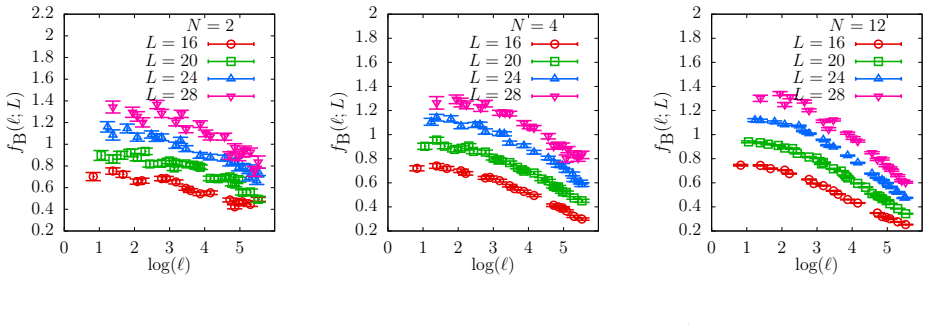
The load-bearing object is the background gauge field of a Q=1 monopole-antimonopole pair on a torus, coupled to the theory with an auxiliary flux parameter $\zeta$ that is integrated from 0 to 1. The free energy $F_B$ is obtained from the area under $W(\zeta)$, the response of the action to changes in $\zeta$, which is directly measurable in the Monte Carlo ensemble. The bare lattice free energy is converted to a physical one by a single renormalization factor $a^{2d(L)}$, where $d(L)$ is extracted from a fit at fixed lattice spacing $a=1/7$ over $L=16,\dots,28$; the residual $L$ dependence is then removed with a linear $1/L$ extrapolation in combined fits of the form $\delta(\ell;N,12) = (a_0 + a_1/L) + 2(b_0 + b_1/L)\log(\ell)$.
What would settle it
Repeat the free-energy measurement at smaller lattice spacings such as $a=1/9$ and $a=1/11$ over several $L$, and extrapolate $\Delta(N)/N$ to the continuum; if the N=12 slope moves outside $0.26(2)$, or the N=2 and 4 differences in Eq. (26) shrink toward zero or change sign, the renormalization ansatz of Eq. (22) with $d(L)$ from $a=1/7$ is the point of failure.
Extended reading notes
Core claim
The central claim is that the scaling dimension of the Q=1 monopole in parity-invariant three-dimensional non-compact QED can be measured directly on the lattice, and that the measurements give $\Delta(12)/12 = 0.26(2)$, hence $\Delta(12) = 3.24(24)$, in agreement with the leading large-N value $\Delta_\infty = 0.265$. The paper further finds $\Delta(2)/2 - \Delta(12)/12 = 0.153(9)$ and $\Delta(4)/4 - \Delta(12)/12 = 0.053(6)$, so the small-N deviations are positive and small, opposite in sign to the leading 1/N correction with $k = -0.0383$. The authors take this as evidence that the 1/N expansion around the free-fermion fixed point requires higher-order terms, or fails, for N of order one, while N=12 is consistent with the monopole being marginally relevant.
Load-bearing premise
The result rests on the assumption that the bare lattice free energy is renormalized by a single factor $a^{2d(L)}$, with $d(L)$ extracted from a fit at one lattice spacing $a=1/7$ over $L=16,\dots,28$, and that the remaining finite-size dependence is a linear $1/L$ lattice artifact.
Editorial extensions
If this is right
- If the central claim is right, N=12 sits at a monopole scaling dimension of 3.24(24), consistent with the marginal-relevance value 3, supporting the idea that around N=12 the monopole operator controls the onset of a mass gap in compact QED3.
- The positive deviations at N=2 and 4 contradict the sign of the leading 1/N correction, so the 1/N expansion around the free-fermion fixed point must receive important higher-order contributions at small N, or that expansion is not the right description there.
- The near-universal data collapse after the $a^{2d(L)}$ renormalization indicates the monopole correlator behaves like a local operator in the continuum, which would justify applying the same background-field method to other conformal field theories with topological defects.
- The fit ansatze in Eqs. (25) and (27) give concrete continuum-limit estimates that future simulations at smaller lattice spacing can directly test.
Reading between the lines
- Inference: if the positive small-N deviations persist at finer lattice spacings, a natural next test is to measure N=6 and N=8; a monotonic approach to the N=12 value would support a smooth crossover, while a non-monotonic trend would suggest a different fixed-point family at small N.
- Inference: the same background-field method could be applied directly to compact QED3 near the conjectured critical flavor count, where the monopole free energy is the quantity that decides whether the theory confines.
- Inference: the apparent locality of the renormalized monopole correlator on $T^3$ suggests the flavor-symmetry-breaking structure derived from zero modes on $S^2$ could be probed numerically via the transfer-matrix spectrum of the lattice Dirac operator in the monopole background.
Editorial analysis
A structured set of objections, weighed in public.
Referee Report
Summary. The paper computes, via hybrid Monte Carlo on three-dimensional non-compact QED with N=2, 4 and 12 two-component fermion flavors, the free energy cost of introducing a Q=1 monopole-antimonopole pair using a background-field coupling. It defines a lattice free energy per flavor, renormalizes it by a factor a^{2d(L)} with d(L) extracted from a fit at fixed lattice spacing, and studies the logarithmic dependence on the box size. The central claims are: Delta(12)/12 = 0.26(2), hence Delta(12) = 3.24(24), consistent with the large-N free-fermion value; and Delta(2)/2 - Delta(12)/12 = 0.153(9) and Delta(4)/4 - Delta(12)/12 = 0.053(6), i.e. positive small-N deviations opposite in sign to the leading 1/N correction.
Significance. If established, this would be a valuable first direct non-perturbative estimate of the monopole scaling dimension in non-compact QED3 and would constrain the size and sign of finite-N corrections to the large-N expansion. The method itself, based on smoothly varying the background flux and integrating W(zeta), is interesting and the data collapse in Fig. 4 is nontrivial. However, the paper's headline result for N=2,4 is not currently supported because the renormalization factor d(L)/N, extracted from the same lattice data, contributes a pure logarithmic term to the fitted slopes. The N=12 consistency check is suggestive but also inherits the same normalization uncertainty.
major comments (4)
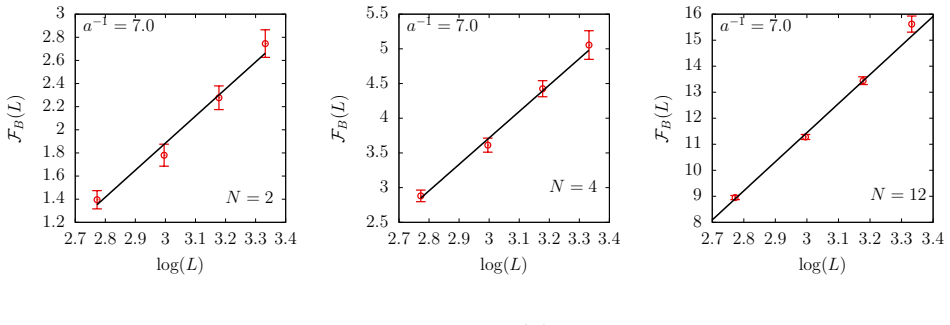
- [Section IV, Eq. (25) and Fig. 3] The extracted values of d(L)/N are used to construct fR via Eq. (22). In the difference delta(ell;N,12) = fR(N) - fR(12), the subtraction contributes the term 2[d(N)/N - d(12)/12] log(ell/L). The log(ell) part of this term has exactly the form absorbed into the coefficient 2 b0 of Eq. (25). Using the values quoted after Fig. 3, d(2)/2 - d(12)/12 = 0.120(59) and d(4)/4 - d(12)/12 = 0.011(57). Subtracting these from the fitted b0 values 0.1531(94) and 0.0529(61) leaves 0.033(60) and 0.042(57), both consistent with zero. Therefore the claimed positive deviations of Delta(N)/N from Delta(12)/12 are not separated from the normalization artifact and are not statistically established.
- [Section IV, Eq. (22) and Fig. 3] The factor d(L) is determined from a linear fit of FB(L) at fixed a=1/7 over L=16,20,24,28, not from a controlled a->0, L->infinity limit. The paper itself states that d(L)/N can depend on N at these intermediate L and that a=1/7 is used as an approximation to the strict a=0 result. This means the quantity D_d = d(N)/N - d(12)/12, which contaminates the slope in Eq. (25), is itself a finite-lattice artifact. To support the central claim, the authors would need to show that D_d extrapolates to zero (or otherwise estimate its systematic error) before attributing b0 to an infrared scaling-dimension difference.
- [Section IV, Eq. (25) and Fig. 5] The fit ansatz delta = a0 + a1/L + 2(b0 + b1/L) log(ell) assumes a pure logarithmic dependence over the entire range ell=1..250, with lattice-spacing effects entering only as linear 1/L corrections. This is an empirical assumption. Figure 4 shows visible curvature in fR(ell) at small ell for all N, so the apparent pure-log behavior of delta relies on a cancellation between N and 12. The authors do not test the stability of b0 against restricting the fit range to large ell, nor against adding a power-law term or a constant term times 1/L^2. Given that the central numbers come from b0, this robustness check is needed.
- [Section IV, Eq. (27) and Fig. 6] The N=12 value beta0 = 0.26(2) is also affected by the uncertainty in d(12)/12, because fR(ell) = fB(ell) + 2[d(12)/12] log(ell/L) and the added term contributes directly to the fitted slope. Since d(12)/12 = 0.465(20) has a 4-5% error, and the d(12) value is extracted at a single lattice spacing, the quoted systematic error on Delta(12)/12=0.26(2) appears underestimated. The agreement with the large-N value 0.262 is encouraging, but the consistency statement is weaker than claimed unless this normalization uncertainty is propagated.
minor comments (4)
- [Section IV, text after Eq. (22)] The sentence 'This was obtained by adding 2 d(L) log(l/L) to FB and then computing the resulting renormalized free energy per two component fermion' is ambiguous: 2 d(L) log(l/L) is added to the total free energy FB, not to the per-flavor free energy fB. Please clarify the factor of 1/N explicitly.
- [Figure 5 caption] The caption states 'The solid lines are the combined fits' but does not specify the fitted range of ell or the number of data points per fit. Please state the fit range and that 81 data points were used (as mentioned in the text).
- [Section IV, Eq. (25)] The text reports chi^2/dof < 2 for both fits, but the fits use data at fixed physical volume with differing lattice spacings and likely correlated errors from jackknife. Reporting the covariance or at least the effective number of independent configurations would make the chi^2 statement more informative.
- [Notation] The symbol l is used for both the lattice distance (e.g. in FB(L)) and the physical box size ell, and the notation ℓ/L is sometimes written as l/L in running text. Please standardize the notation to avoid confusion.
Circularity Check
No significant circularity: the d(L)/N subtraction is self-referential but not load-bearing, and the N=12 result is checked against external large-N inputs rather than fitted to them.
full rationale
The closest candidate for circularity is the renormalization in Eq. (22), where the fitted naive dimension d(L) is used to define the renormalized free energy, and then Eq. (25) fits the slope b0 that is identified with Delta(N)/N - Delta(12)/12. By construction, fR contains 2[d(N)/N] log(l/L), so the fitted slope b0 in Eq. (25) additively contains the fitted difference d(N)/N - d(12)/12. For N=2, d(2)/2 - d(12)/12 = 0.585(56) - 0.465(20) = 0.120(59), while the reported b0 is 0.1531(94); subtracting leaves only about 0.033(60), consistent with zero. For N=4 the same subtraction reduces 0.0529(61) to about 0.042(57). This is a genuine systematic separation problem, and the paper itself acknowledges that d(L)/N can depend on N at finite L and that fixed a=1/7 is used as an approximation to strict a=0. However, this is not circularity in the strict sense: the paper does not define the target scaling-dimension difference as the fitted d/N difference, and Eq. (25) fits a residual slope that could in principle have come out negative. The N=12 result is independently checked against externally computed large-N inputs, Delta_infinity=0.265 and k=-0.0383, rather than tuned to them, and beta0=0.26(2) is an independent fit result. Thus the central derivation is self-contained; the d(L) subtraction is a self-referential calibration step that raises a correctness/systematics risk, not a reduction of the prediction to an input.
Assumptions & free parameters
free parameters (2)
- d(L)/N, effective naive monopole dimension per flavor =
N=2: 0.585(56); N=4: 0.476(53); N=12: 0.465(20)
- Wilson mass mw (massless tuning) =
not quoted; tuned to the massless point per [10]
assumptions (5)
- domain assumption N-flavor non-compact QED3 with N=2,4,12 flows to an infrared conformal fixed point in the thermodynamic limit.
- domain assumption The monopole-antimonopole free energy obeys F_R(ell)=f0(rho)+2Delta log(ell) at fixed tau/ell=rho=1/4.
- ad hoc to paper The bare monopole correlator defined through the background-field coupling renormalizes by a single multiplicative factor a^{2d(L)} with d(L) fitted at the Gaussian fixed point, and residual L dependence is a linear 1/L lattice artifact.
- ad hoc to paper The difference delta(ell;N,12) is a pure logarithm over the entire simulated range ell=1..250 with finite-L corrections entering only through a0+a1/L and b0+b1/L.
- domain assumption The large-N values Delta_infinity=0.265 and k=-0.0383 from refs [1,4,28,31] are correct benchmarks.
Cite this review
Pith. "Pith review of Numerical determination of monopole scaling dimension in parity-invariant three-dimensional non-compact QED." pith.science (2026). https://pith.science/paper/VDGCO4LY
@misc{pith2026190805500,
  author       = {Pith},
  title        = {Pith review of: Numerical determination of monopole scaling dimension in parity-invariant three-dimensional non-compact QED},
  year         = {2026},
  howpublished = {\url{https://pith.science/paper/VDGCO4LY}},
  note         = {Machine review of arXiv:1908.05500}
}
abstract
We present a direct Monte-Carlo determination of the scaling dimension of a topological defect operator in the infrared fixed point of a three-dimensional interacting quantum field theory. For this, we compute the free energy to introduce the background gauge field of the $Q=1$ monopole-antimonopole pair in three-dimensional non-compact QED with $N=2,4$ and $12$ flavors of massless two-component fermions, and study its asymptotic logarithmic dependence on the monopole-antimonopole separation. We estimate the scaling dimension in the $N=12$ case to be consistent with the large-$N$ (free fermion) value. We find the deviations from this large-$N$ value for $N=2$ and $4$ are positive but small, implying that the higher order corrections in the large-$N$ expansion become mildly important for $N=2,4$.
Figures

Figures from the paper (3 more)


Reference graph
Works this paper leans on
-
[31]
S. M. Chester and S. S. Pufu, JHEP 08, 019 (2016), 1601.03476. 18
arXiv 2016
- [1]
-
[2]
It was possible to fit the data over the range of L from 16 to 28 using f0 + 2d log(L) and thereby obtain the value of d(L) over this range of L. The fits are shown as the black straight lines in the three panels. We obtained the slope 2 d(L) as 2.34(22), 3.81(21) and 11.17(48) for N = 2,4 and 12 respectively, which correspond to d(L)/N of 0.585(56), 0.476(...
-
[3]
A. M. Polyakov, Phys. Lett. B59, 82 (1975), [,334(1975)]
work page 1975
-
[4]
A. M. Polyakov, Nucl. Phys. B120, 429 (1977)
1977
-
[5]
S. S. Pufu, Phys. Rev. D89, 065016 (2014), 1303.6125
arXiv 2014
-
[6]
On the Interplay of Fermions and Monopoles in Compact QED_3
S. Hands, J. B. Kogut, and B. Lucini (2006), hep-lat/0601001. 17
work page Pith review arXiv 2006
-
[7]
C. Wang, A. Nahum, M. A. Metlitski, C. Xu, and T. Senthil, Phys. Rev. X7, 031051 (2017), 1703.02426
arXiv 2017
Show all 40 references
-
[8]
Hands, J
S. Hands, J. Kogut, and C. Strouthos, Nucl.Phys. B645, 321 (2002), hep-lat/0208030
2002 arXiv
-
[9]
Hands, J
S. Hands, J. Kogut, L. Scorzato, and C. Strouthos, Phys.Rev. B70, 104501 (2004), hep- lat/0404013
2004
- [10]
- [11]
- [12]
-
[13]
Di Pietro, Z
L. Di Pietro, Z. Komargodski, I. Shamir, and E. Stamou, Phys. Rev. Lett. 116, 131601 (2016), 1508.06278
2016 arXiv
-
[14]
Giombi, I
S. Giombi, I. R. Klebanov, and G. Tarnopolsky, J. Phys. A49, 135403 (2016), 1508.06354
2016 arXiv
-
[15]
A. V. Kotikov, V. I. Shilin, and S. Teber, Phys. Rev. D94, 056009 (2016), 1605.01911
2016 arXiv
-
[16]
V. P. Gusynin and P. K. Pyatkovskiy, Phys. Rev. D94, 125009 (2016), 1607.08582
2016 arXiv
- [17]
-
[18]
I. F. Herbut, Phys. Rev. D94, 025036 (2016), 1605.09482
2016 arXiv
-
[19]
Armour, S
W. Armour, S. Hands, J. B. Kogut, B. Lucini, C. Strouthos, and P. Vranas, Phys. Rev. D84, 014502 (2011), 1105.3120
2011 arXiv
-
[20]
E. Dyer, M. Mezei, and S. S. Pufu (2013), 1309.1160
2013 arXiv
-
[21]
S. M. Chester, M. Mezei, S. S. Pufu, and I. Yaakov, JHEP 12, 015 (2016), 1511.07108
2016 arXiv
-
[22]
S. M. Chester and S. S. Pufu, JHEP 08, 069 (2016), 1603.05582
2016 arXiv
-
[23]
X. Y. Xu, Y. Qi, L. Zhang, F. F. Assaad, C. Xu, and Z. Y. Meng, Phys. Rev. X9, 021022 (2019), 1807.07574
2019 arXiv
-
[24]
Wang, D.-C
W. Wang, D.-C. Lu, X. Y. Xu, Y.-Z. You, and Z. Y. Meng, Phys. Rev. B100, 085123 (2019), 1906.06929
2019 arXiv
-
[25]
Dupuis, M. B. Paranjape, and W. Witczak-Krempa (2019), 1905.02750
2019 arXiv
- [26]
-
[27]
Murthy and S
G. Murthy and S. Sachdev, Nucl. Phys. B344, 557 (1990)
1990
-
[28]
M. A. Metlitski, M. Hermele, T. Senthil, and M. P. A. Fisher, Phys. Rev. B78, 214418 (2008), 0809.2816
2008 arXiv
-
[29]
S. S. Pufu and S. Sachdev, JHEP 09, 127 (2013), 1303.3006
2013 arXiv
-
[30]
J. A. Gracey, Int. J. Mod. Phys. A33, 1830032 (2019), 1812.05368
2019 arXiv
- [32]
-
[33]
Sulejmanpasic and C
T. Sulejmanpasic and C. Gattringer, Nucl. Phys. B943, 114616 (2019), 1901.02637
2019 arXiv
-
[34]
T. A. DeGrand and D. Toussaint, Phys. Rev. D22, 2478 (1980), [,194(1980)]
1980
-
[35]
Villain, J
J. Villain, J. Phys.(France) 36, 581 (1975)
1975
-
[36]
Drouffe and J.-B
J.-M. Drouffe and J.-B. Zuber, Phys. Rept. 102, 1 (1983)
1983
-
[37]
M. E. Peskin, Annals Phys. 113, 122 (1978)
1978
- [38]
-
[39]
Kajantie, M
K. Kajantie, M. Laine, T. Neuhaus, J. Peisa, A. Rajantie, and K. Rummukainen, Nucl. Phys. B546, 351 (1999), hep-ph/9809334
1999 arXiv
- [40]
Reviewed August 14, 2026 · model on record in the stance chip above.
Discussion (0). Continue with ORCID to comment.